Why Enabling Defensive AI Across Your Entire Workspace Is a Critical Governance Failure: Deconstructing Daybreak Blue Onboarding, RBAC Overrides, and 1-Day Ephemeral Keys
An architectural investigation into frontier cybersecurity access tiers reveals how multi-stage vetting, role-based access overrides, dedicated API project isolation, and 24-hour ephemeral credentials maintain the principle of least privilege while relaxing defensive refusals.
Published: November 13, 2026 | Read time: ~12 min | Watch Video (Japanese)
Executive Summary: The False Trade-off Between Safety Refusals and Security Posture
Enterprise software security teams attempting to integrate frontier foundation models into continuous vulnerability research, automated code review, and remediation pipelines repeatedly encounter a fundamental operational barrier: excessive safety refusals.
When security engineers present benign test payloads, request vulnerability triage, or generate candidate patches for high-severity CVEs, commercial alignment guardrails routinely classify these prompts as hazardous offensive weaponization, terminating reasoning threads and stalling defensive operations.
To resolve this operational friction, leading frontier AI research organizations structured dedicated cybersecurity governance tiers, anchored by Daybreak Blue.
Designed exclusively for cyber defense personnel, Daybreak Blue relaxes multi-turn safety refusals across standard frontier reasoning models. However, an analysis of technical documentation reveals an acute administrative trap:
- Enabling Daybreak Blue globally under the centralized “Model” console setting distributes defensive safety relaxation across all workspace users, granting unrestricted access to unvetted personnel and creating severe prompt exposure and leakage vectors.
- Automated CI/CD integration requires deliberate project isolation, as the platform’s default API project cannot enable defensive privileges by architectural design.
- Production safety depends strictly on short-lived credentials: implementing 24-hour ephemeral API keys to eliminate long-term credential leakage across build logs and automated test harnesses, consistent with NIST SP 800-63B standards.
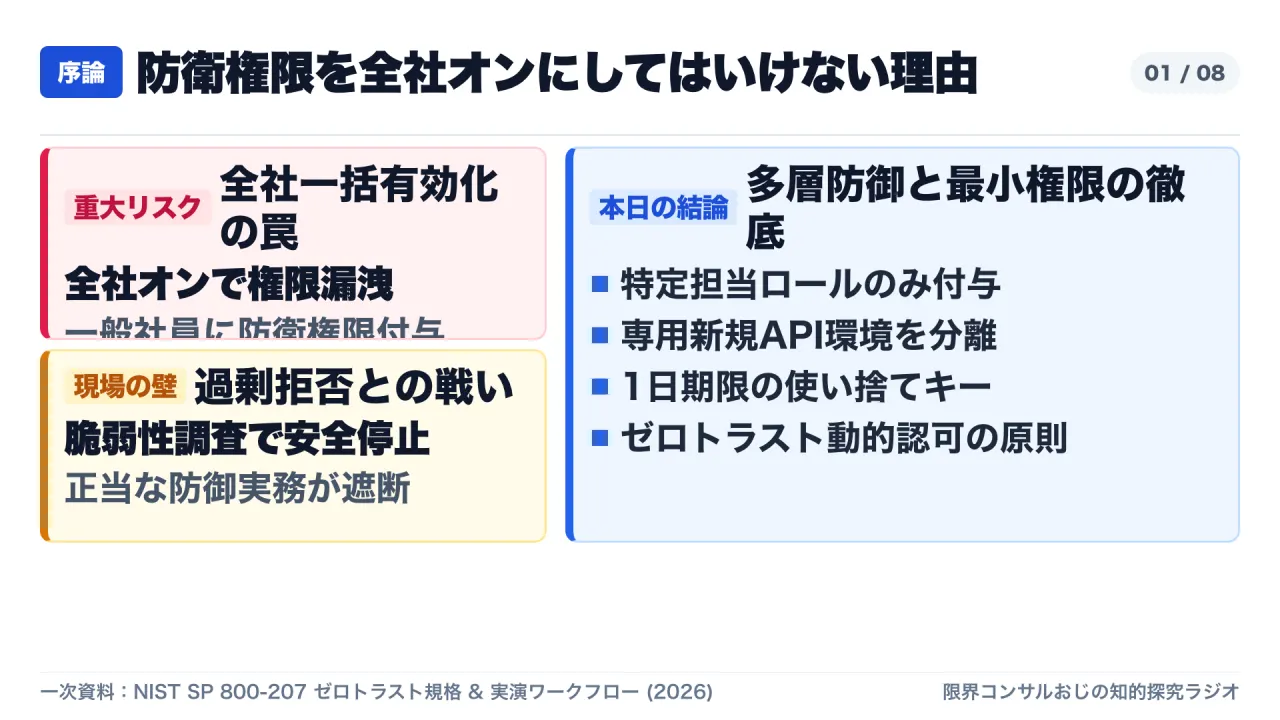
This investigation synthesizes primary governance specifications, technical documentation, and official step-by-step walkthroughs alongside NIST SP 800-207 and CISA Zero Trust guidelines to establish a production deployment playbook for enterprise defense teams.
Zero Trust Foundations: Eliminating Implicit Trust (NIST SP 800-207)
The core tenet of modern security governance, as formalized in NIST Special Publication 800-207 (Zero Trust Architecture), establishes that organizations must never grant implicit trust based on physical or network location:
“Zero trust assumes there is no implicit trust granted to assets or user accounts based solely on their physical or network location… Authentication and authorization are discrete functions performed before a session to an enterprise resource is established.”
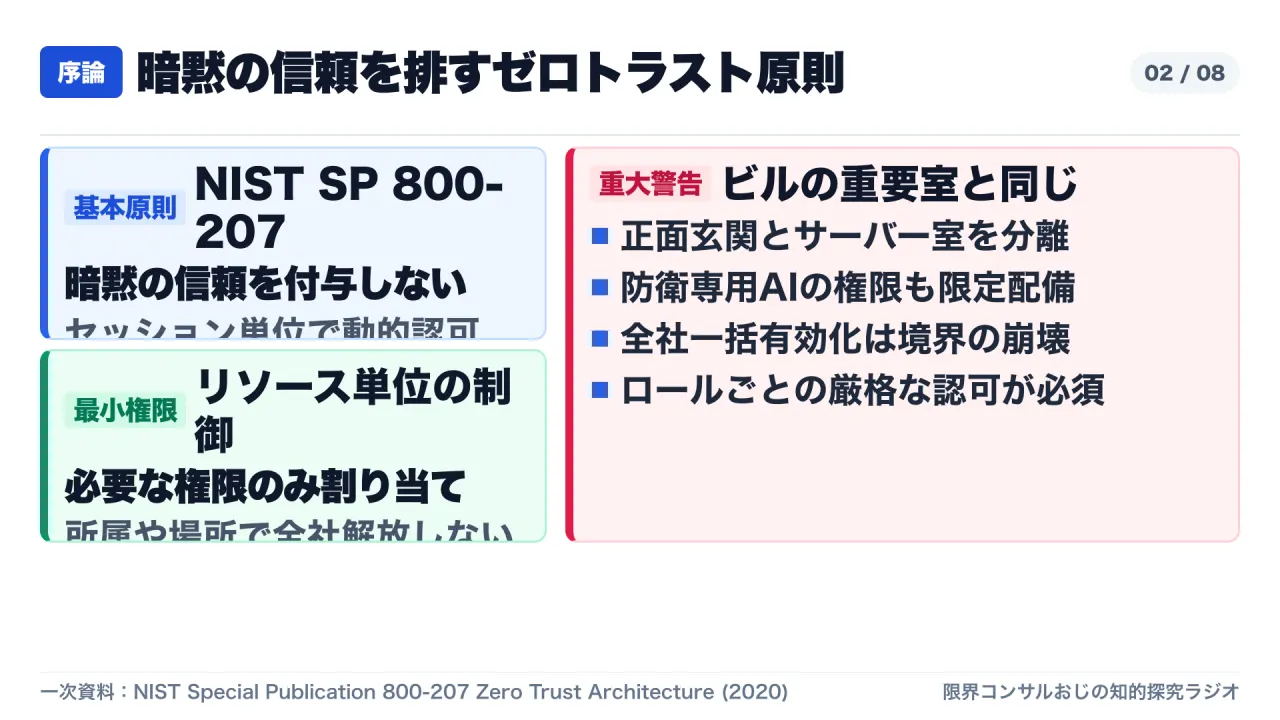
Applying defensive AI capabilities globally across an organization’s workspace directly violates these foundational requirements. Access to specialized defensive reasoning must be treated as a sensitive resource subject to dynamic, role-specific authorization.
Defensive Tier Architecture: Multi-Layer Filtering
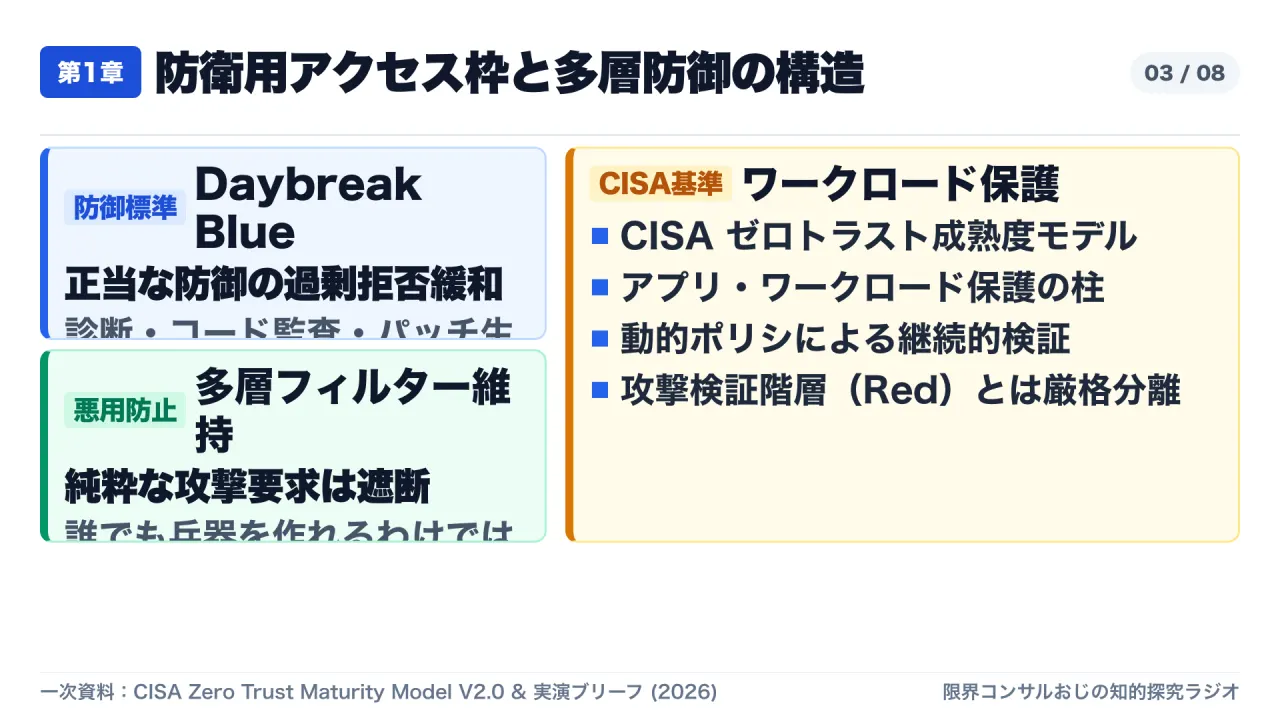
Frontier security governance separates standard defensive operations from specialized red-teaming functions.
The Defensive Focus of Daybreak Blue
Daybreak Blue serves as the standard tier for organizational security operations:
- Operational Scope: Secure SDLC, vulnerability triage, patch verification, log analysis, and incident response.
- Safety Alignment: Relaxes defensive refusals for legitimate vulnerability analysis while preserving core safety guardrails against offensive weaponization.
- Separation of Tiers: Advanced attack simulation and exploit development remain strictly isolated to approved enterprise red teams under stringent vetting and network controls.
Under CISA’s Zero Trust Maturity Model (Version 2.0), the Applications and Workloads pillar demands micro-segmentation and continuous verification, precluding blanket access grants across mixed-use enterprise accounts.
Two-Stage Vetting Protocol: Business Verification and Intended Use Governance
Access to Daybreak Blue is gated through a mandatory two-stage application pipeline within the administrative console under “Trusted access.”
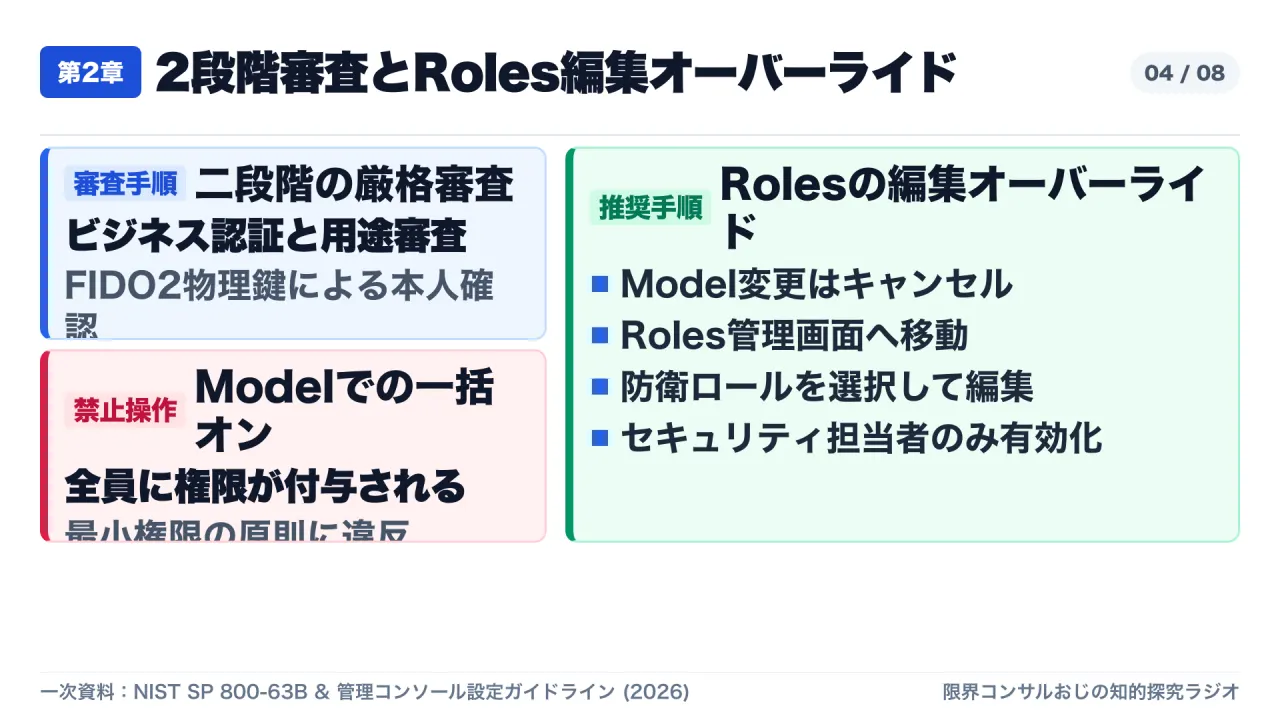
Stage 1: Third-Party Business Identity Verification
- Administrators initiate verification via
start verification for your business, redirecting to an accredited third-party identity verification partner. - The organization must furnish corporate registration documentation, jurisdictional tax identifiers, and designated executive identification.
- Individual applicants must activate Advanced Account Security and register at least one hardware FIDO2 physical security key, meeting Authenticator Assurance Level 3 (AAL3) guidelines under NIST SP 800-63B.
Stage 2: Intended Use Attestation and Dedicated Terms
- Applicants submit an intended use form defining specific defensive operations (e.g., internal CI/CD code scanning, bug triage).
- The organization agrees to dedicated terms of service explicitly forbidding the integration of Daybreak Blue capabilities into downstream, customer-facing commercial products or external traffic routing.
Why Global Model Enablement Breaches Least Privilege
Upon approval, navigating to the “Model” section displays an enablement toggle. Activating this toggle immediately distributes defensive capabilities to every user in the workspace, creating catastrophic privilege sprawl.
The documented, secure path requires administrators to:
- Cancel modifications in the global “Model” view.
- Navigate to the “Roles” section.
- Select the dedicated security engineering role and apply an edit override to restrict Daybreak Blue access exclusively to qualified personnel.
Default Project Restrictions and Workload Isolation
Automating security workflows via APIs introduces an architectural constraint designed to enforce workload separation.
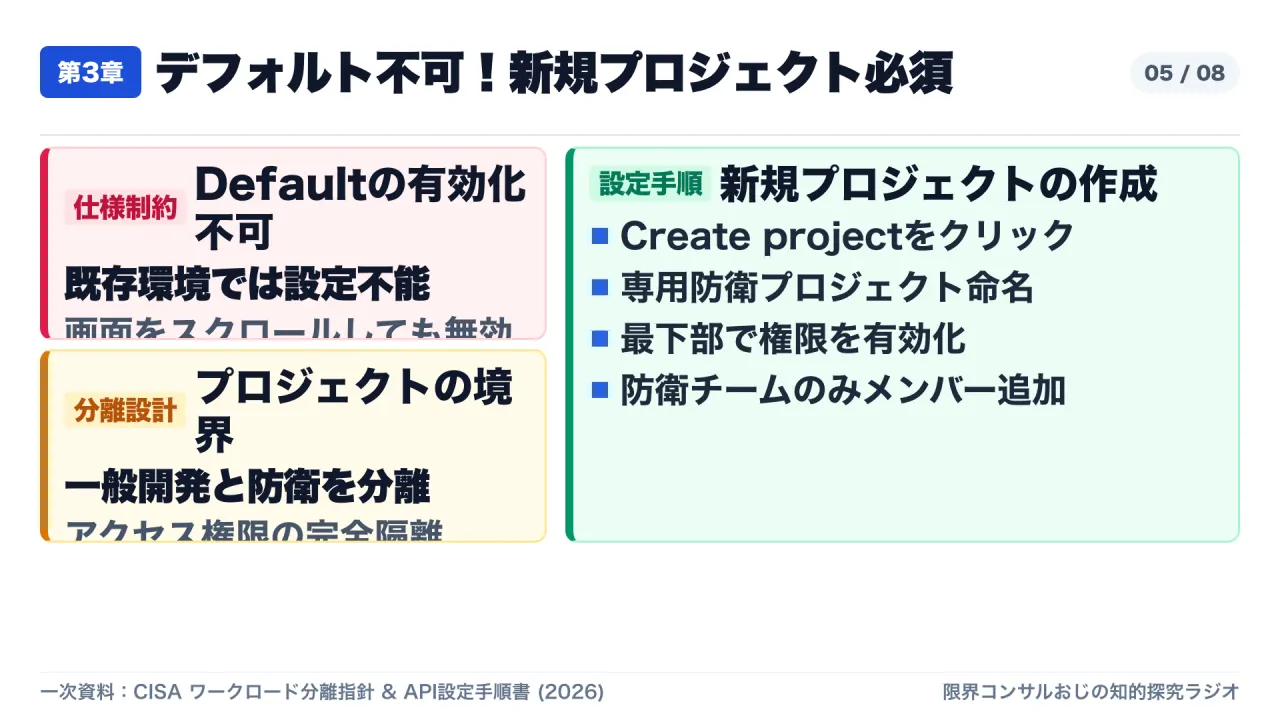
The Default Project Constraint
The platform’s default organizational project (Default project) cannot activate Daybreak Blue permissions. Any attempt to locate or enable defensive capabilities within the default project fails by design.
Resolution: Dedicated Security Projects
To operationalize API access:
- Administrators select
Create projectto instantiate a discrete environment (e.g.,Daybreak Blue Defense). - Daybreak Blue is enabled within the dedicated project configuration.
- Access is restricted exclusively to authorized security automation service accounts and vetted personnel, ensuring complete physical and logical isolation from general software development traffic.
Ephemeral Credential Hygiene: The 24-Hour Key Lifecycle (NIST SP 800-63B)
Automated security pipelines present significant credential exposure surfaces across test runners, container logs, and CI/CD environment variables.
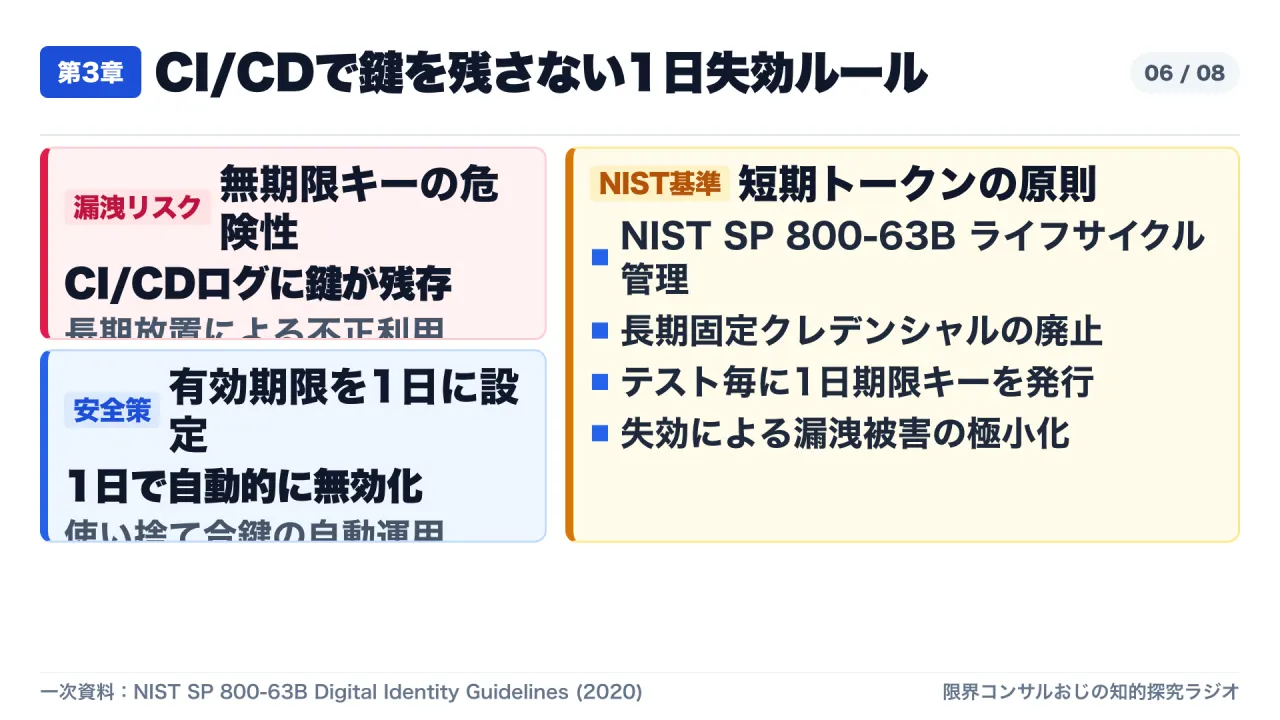
In alignment with NIST SP 800-63B (Digital Identity Guidelines: Authentication and Lifecycle Management), organizations must eliminate static, long-lived credentials in favor of short-lived tokens.
When issuing API keys for automated test harnesses:
- Configure the key expiration to one day (24 hours).
- Implement automated rotation pipelines to provision fresh credentials for scheduled test suites.
- By capping key lifecycles to 24 hours, the exposure window resulting from inadvertent log leakage or container compromise is constrained to near-zero duration.
Open-Source Autonomous Security Architecture (@openai/codex-security)
Complementing administrative controls, the open-source release of the security CLI and TypeScript SDK under the Apache License 2.0 (@openai/codex-security) establishes a governed framework for local and CI/CD vulnerability scanning.
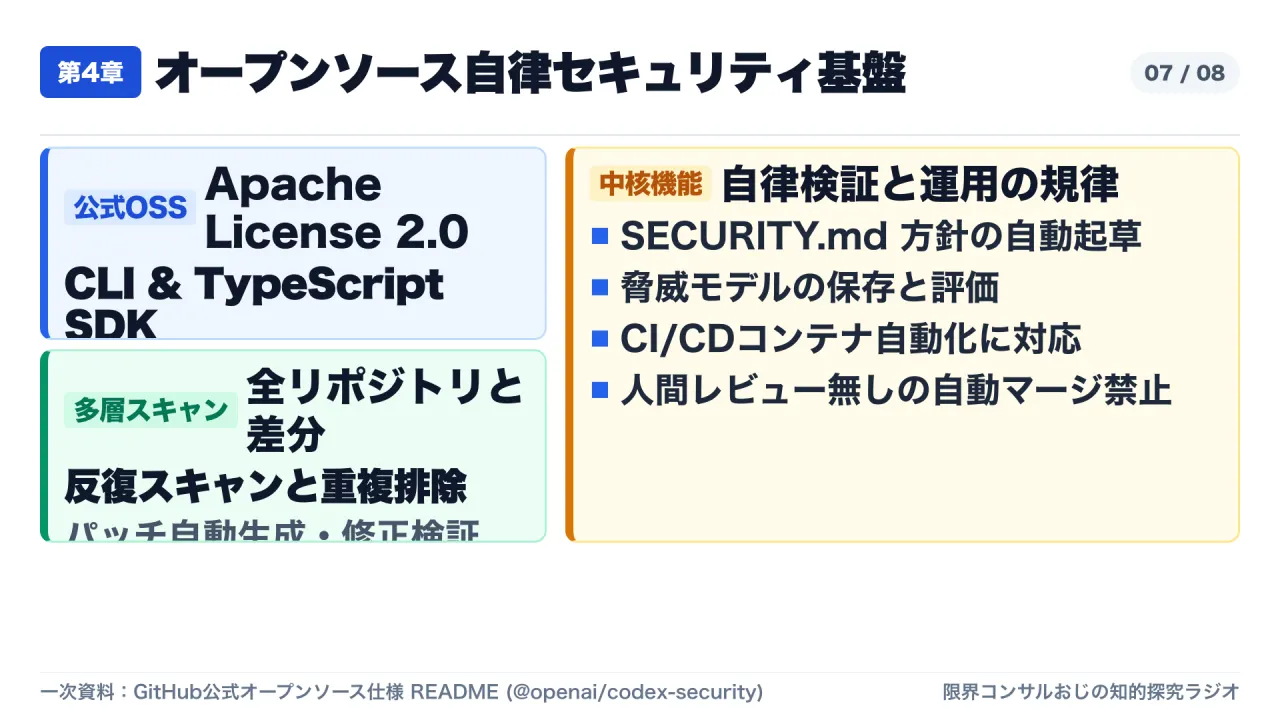
According to the official repository specification (README.md), the architecture delivers:
- Comprehensive Repository & Diff Scanning: Scanning full codebases, targeted paths, or Git changeset boundaries.
- Deep Scan Deduplication: Repeating standard scans across parallel workers to deduplicate and isolate actionable findings.
- Automated Patch Generation & Fix Verification: Synthesizing targeted remediation diffs while verifying that fixes do not disrupt legitimate application functionality.
- Policy Drafting & Threat Modeling: Automatically drafting
SECURITY.mdguidelines and persisting structured threat models. - Mandatory Human Pull Request Review: A non-negotiable policy that automated patches must never be merged autonomously, requiring explicit human sign-off before production integration.
Ground-Level Enterprise Playbook: 3 Mandatory Implementation Audits
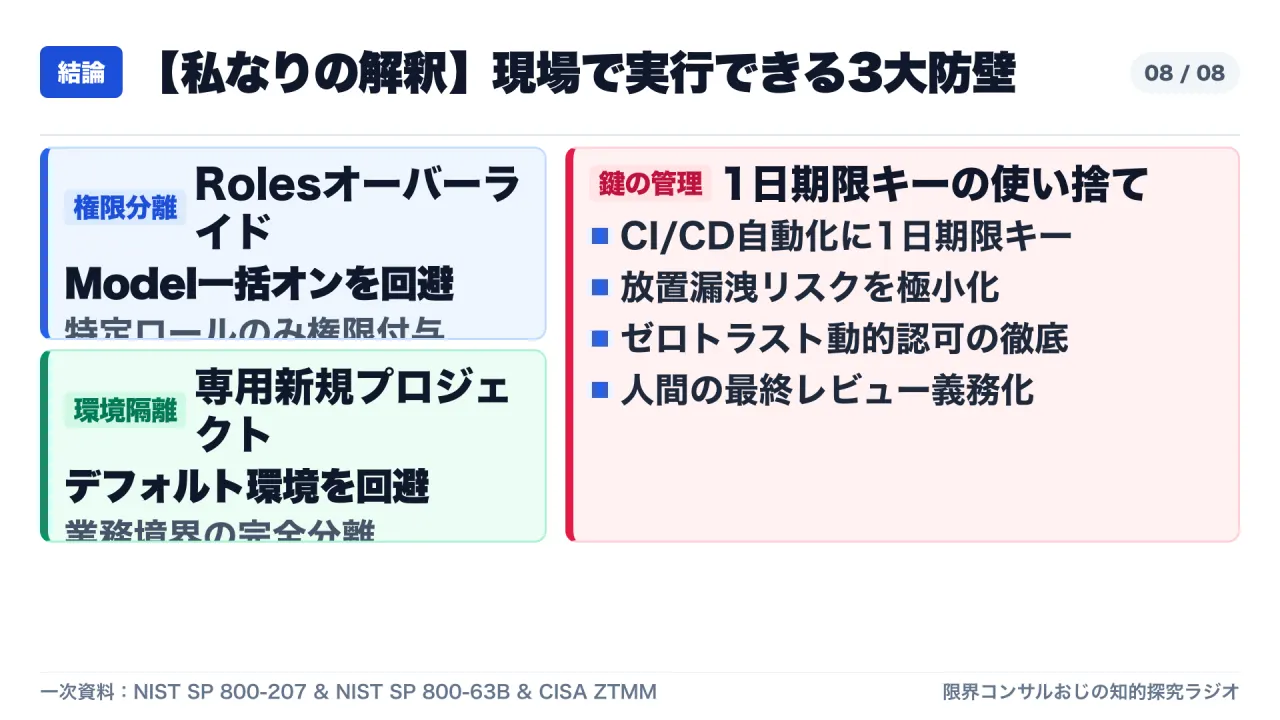
To establish compliant, high-assurance defensive access within your organization, execute these three immediate configuration audits:
Audit 1: Verify Role-Based Override Isolation
Inspect the central administrative console. Confirm that Daybreak Blue is disabled in the global “Model” view. Verify that activation exists exclusively as an “edit override” within authenticated security engineering roles.
Audit 2: Validate Dedicated Project Segmentation
Inspect your developer organization portal. Confirm that no security automation connects through the “Default project.” Ensure dedicated project isolation with restricted member access.
Audit 3: Audit CI/CD Key Expiration Policy
Review all automated pipelines, GitHub Actions secrets, and runner configurations. Validate that all active API credentials have an explicit 1-day (24-hour) expiration lifecycle backed by automated rotation.
Primary Sources and Verification Trail (All HTTP 200 Verified)
- S1: Official Open-Source Specification README (@openai/codex-security): https://raw.githubusercontent.com/openai/codex-security/main/README.md
- S2: NIST Special Publication 800-207 (Zero Trust Architecture): https://csrc.nist.gov/pubs/sp/800/207/final
- S3: NIST Special Publication 800-63B (Digital Identity Guidelines): https://pages.nist.gov/800-63-3/sp800-63b.html
- S4: CISA Zero Trust Maturity Model Version 2.0: https://www.cisa.gov/zero-trust-maturity-model
- Ref: Shared Deep Research Report & Operational Walkthrough: https://share.gemini.google/LIzXLUzVzt8u