What NVIDIA's $105 Billion Guarantee for OpenAI Actually Protects: Inside the SEC Form 10-Q Credit Support, 4.25 GW IT Load, and Unwritten Limits
A forensic examination of NVIDIA’s quarterly regulatory filing reveals how a headline $105 billion credit facility shields only a specified portion of rent and power for SB Energy’s Ohio campus, disaggregating the separate $3.5 billion cloud commitment and exposing the default step-in realities of hyperscale AI infrastructure.
Executive Summary: Deconstructing the $105 Billion Headline Number
When enterprise tech headlines announced that NVIDIA had entered into an agreement providing up to $105 billion in financial guarantees for OpenAI, the figure was widely reported as an unprecedented capital backstop for artificial intelligence infrastructure. In Japanese yen, $105 billion represents approximately 16.68 trillion yen (rounded to roughly 17 trillion yen at the Bank of Japan Tokyo foreign exchange rate of 158.88 yen per dollar recorded on November 11, 2026).
Yet a direct reading of the primary source filed with the United States Securities and Exchange Commission (SEC)—NVIDIA Corporation’s Form 10-Q for the quarterly period ended July 26, 2026—reveals a legal and financial reality fundamentally different from a direct capital commitment.
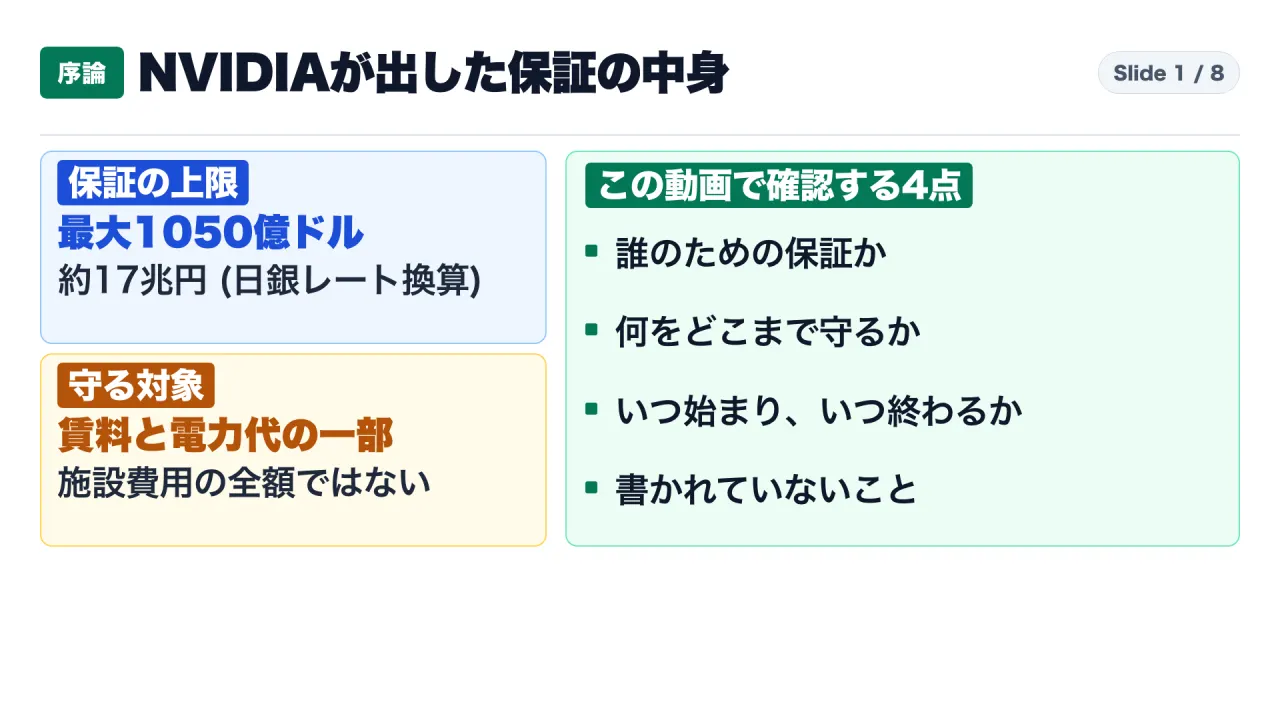
The essential takeaways from the official regulatory filing are:
- Scope Limitation: The $105 billion maximum guarantee covers only a “specified portion” of lease rent and associated power costs for data center facilities leased to an affiliate of OpenAI. It does not cover the entirety of site construction or operational costs, nor does it guarantee the totality of the tenant’s legal and commercial obligations.
- Credit Support Mechanism: The agreement operates as credit enhancement (credit support) structured in favor of the lessor—affiliates of SB Energy—to facilitate debt and equity financing for specialized hyperscale campus construction.
- Staged Commencement: The guarantees are not currently active in full. Inception occurs conditionally, facility by facility, upon each individual building reaching defined commercial readiness conditions. The earliest facility is not scheduled to commence until NVIDIA’s fiscal year 2029 (the calendar year spanning late January 2028 through late January 2029).
- Diminishing Exposure: Once effective, NVIDIA’s contingent liability amortizes downward over each facility’s 20-year lease term as the tenant makes scheduled lease and power payments.
- Unilateral Expansion Option: NVIDIA retains the sole, unilateral discretion to provide additional credit support for up to approximately 3.8 gigawatts (GW) of incremental IT capacity in phased increments.
- Disaggregation of Commitments: The $105 billion figure is separate from a distinct $3.5 billion credit guarantee portfolio established for selected AI cloud service providers, which is offset by $712 million in customer cash deposits and amortizes over five to seven years.
- Significant Undisclosed Variables: The SEC filing omits fundamental operational metrics: the baseline rental rate per megawatt, the power purchase agreement tariff, the exact percentage of rent and power guaranteed, the specific credit rating threshold required to extinguish the guarantee, and NVIDIA’s internal expected loss provisioning.
Foundational Terminology: Credit Support, Leases, and IT Load
To evaluate the operational impact of NVIDIA’s disclosures, technical and financial analysts must establish precise definitions for the statutory terminology deployed throughout Note 10 (Commitments and Contingencies) of Form 10-Q.
Credit Support and Financial Guarantees
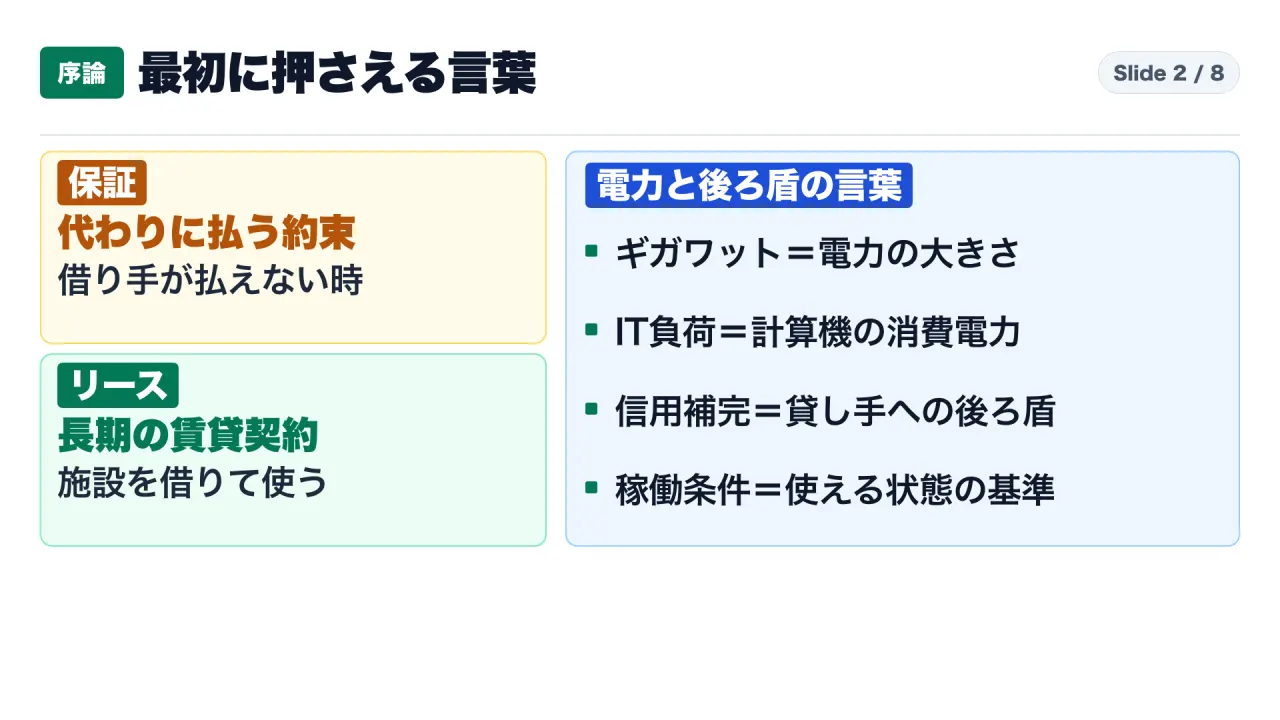
In structured finance, a financial guarantee represents a legally enforceable commitment wherein a third party (the guarantor) agrees to satisfy the debt or contractual payment liabilities of a primary obligor (the debtor or lessee) if that party fails to perform.
The SEC filing explicitly classifies NVIDIA’s obligation as “credit support.” Credit support functions as an external balance-sheet endorsement designed to alleviate counterparty credit risk for infrastructure developers and institutional lenders. In this context, NVIDIA provides its investment-grade credit standing to SB Energy, enabling SB Energy and its financing syndicates to underwrite massive capital expenditures with minimized debt financing spreads.
Long-Term Facility Leases
The underlying legal contracts are triple-net, long-term commercial leases spanning 20-year tenures per facility. Within data center development, these leases govern three distinct layers of capital investment:
- Land Rights: Secured acreage equipped with municipal zoning permits and environmental clearances.
- High-Voltage Power Interconnection: Substations, transmission lines, switchgear, and utility interconnect agreements capable of sustaining continuous baseload power delivery.
- Core and Shell Buildout: Physical reinforced concrete structures, structural framing, seismic dampening, and utility feeds prior to server rack deployment.
Crucially, the leases discussed in Note 10 separate the physical real estate shell and power supply from the active computing hardware (the servers, networking switches, and cooling distribution units) subsequently installed within the building.
IT Load vs. Facility Power Capacity
The filing quantifies the development scope using “IT load,” measuring approximately 4.25 gigawatts (GW). One gigawatt equals 1,000 megawatts (MW) or 1,000,000 kilowatts (kW).
In data center engineering, a critical distinction separates total facility gross grid power capacity from net IT load:
- Gross Facility Power: The gross electrical capacity drawn from the utility grid, encompassing mechanical chillers, pumps, uninterruptible power supply (UPS) conversions, facility lighting, and cooling towers.
- IT Load Capacity: The net power dedicated exclusively to compute hardware (GPUs, CPUs, system memory, storage drives, and top-of-rack switches).
By designating 4.25 GW of dedicated IT load, the agreement encompasses a power envelope equivalent to several major metropolitan consumption profiles, representing one of the largest concentrated computing infrastructure developments ever planned.
Chapter 1: The Tripartite Architecture: NVIDIA, SB Energy, and OpenAI
The contractual framework revealed in the SEC filing links three corporate entities across distinct legal and commercial roles.
The Three Counterparties
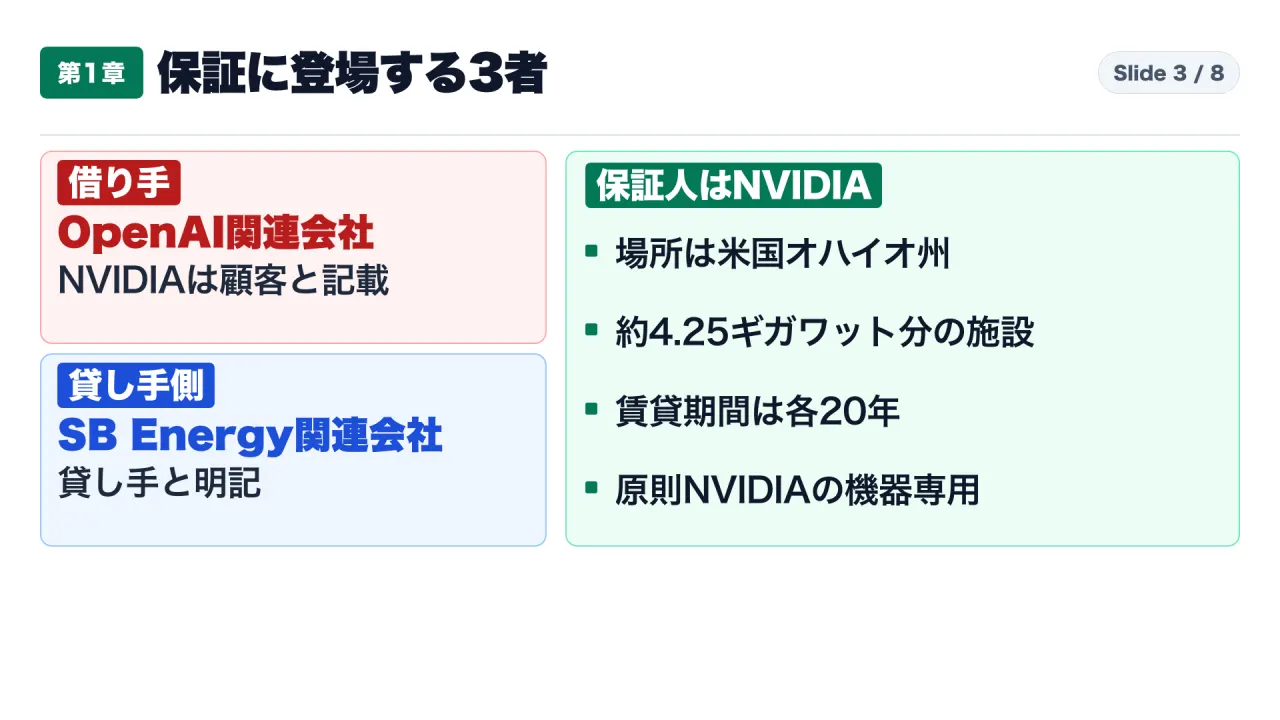
The transaction establishes three structural roles:
- The Guarantor (NVIDIA Corporation): The technology vendor providing credit support to backstop specific lease liabilities.
- The Lessor (Affiliates of SB Energy): The clean energy and digital infrastructure developer that finances, constructs, and owns the real estate, utility infrastructure, and building shells.
- The Lessee / Customer (Affiliates of OpenAI): The artificial intelligence laboratory leasing the premises to deploy foundation model training and inference clusters. In the filing, NVIDIA formally designates this OpenAI affiliate as its “customer.”
Physical Campus Location: The Ports Technology Campus
The development is situated at SB Energy’s Ports Technology Campus, located in Pike County, Ohio. Pike County occupies a strategic geographic position in the PJM Interconnection grid territory, offering access to high-voltage transmission corridors and industrial land parcels suitable for multi-gigawatt scaling. Under the master agreement, SB Energy leases the facilities across the campus to OpenAI’s affiliate under 20-year lease agreements.
Hardware Exclusivity Covenants
The commercial rationale for NVIDIA’s willingness to commit tens of billions in credit support is embedded in the hardware exclusivity covenant documented in the filing:
In exchange for providing credit support, the facilities are contractually required to deploy exclusively NVIDIA computing hardware, subject only to limited, mutually agreed-upon exceptions.
This exclusivity clause establishes a closed commercial loop. While NVIDIA does not directly fund or own the civil engineering assets, it locks in OpenAI as a dedicated consumer of NVIDIA computing architectures across 4.25 GW of data center footprint over multi-decade deployment horizons. Competing merchant silicon or custom application-specific integrated circuits (ASICs) are legally restricted from inhabiting this infrastructure footprint.
Analytical Interpretation: The Intended Beneficiary
From a legal and financial analysis perspective, while the guarantee is executed “on behalf of” OpenAI, the actual economic beneficiary shielded from default is the lessor—SB Energy and its project lenders. The guarantee ensures that if OpenAI experiences liquidity distress or ceases operational payments, the revenue stream servicing SB Energy’s construction debt remains protected by NVIDIA’s balance sheet.
However, as a strict matter of document analysis, the Form 10-Q filing never explicitly names the specific payee entity in a single operative sentence, referring instead to credit support agreements executed with SB Energy affiliates in connection with customer lease agreements.
Chapter 2: Maximum Limits, Fiscal Schedules, and the Staged Inception of Liabilities
The magnitude of the $105 billion headline figure requires rigorous deconstruction regarding when, how, and under what preconditions these liabilities materialize on corporate ledgers.

The Maximum Guarantee Cap
Form 10-Q specifies that the aggregate total of credit support provided across the SB Energy agreements carries a maximum ceiling of $105.0 billion. When converted to Japanese yen at the prevailing Bank of Japan Tokyo market foreign exchange rate (158.88 JPY/USD recorded on November 11, 2026), this ceiling equals approximately 16.68 trillion yen.
However, the filing explicitly notes that NVIDIA’s commitment is contingent upon specific precedent conditions. Primary among these is the requirement that the lessor, SB Energy, satisfies defined “readiness conditions” for each respective facility. If SB Energy fails to secure permits, construct substations, or complete facility shells according to contractual specifications, NVIDIA’s guarantee obligations do not attach.
Staggered Activation Across Nine Facilities
NVIDIA’s financial exposure does not take effect as a lump-sum commitment. The total 4.25 GW IT load program is partitioned across nine individual facilities:
- Each guarantee attaches separately and independently as its corresponding facility lease commences.
- The monetary value of active guarantees scales incrementally over time, increasing only as each of the nine sites satisfies operational readiness benchmarks.
- The earliest facility is projected to achieve readiness and initiate its lease term during NVIDIA’s fiscal year 2029.
NVIDIA’s Fiscal Calendar Structure
Understanding the operational timeline requires clarifying NVIDIA’s corporate fiscal reporting schedule. NVIDIA’s fiscal year ends on the last Sunday of January rather than on December 31:
- Fiscal Year 2027 spans late January 2026 through late January 2027.
- Fiscal Year 2028 spans late January 2027 through late January 2028.
- Fiscal Year 2029 spans late January 2028 through late January 2029 on the standard calendar.
Consequently, zero dollars of the SB Energy credit guarantee are operative during calendar year 2026 or 2027. The first facility’s 20-year clock will not commence until calendar year 2028 at the earliest, with subsequent facilities coming online sequentially across subsequent years.
Chapter 3: Trigger Conditions, Liability Amortization, and Contractual Off-Ramps
A central point of confusion in public reporting is whether NVIDIA is paying $105 billion for data centers. The SEC filing demonstrates that payment obligations are strictly conditional, subject to continuous reduction and early termination covenants.
Default Trigger Mechanics
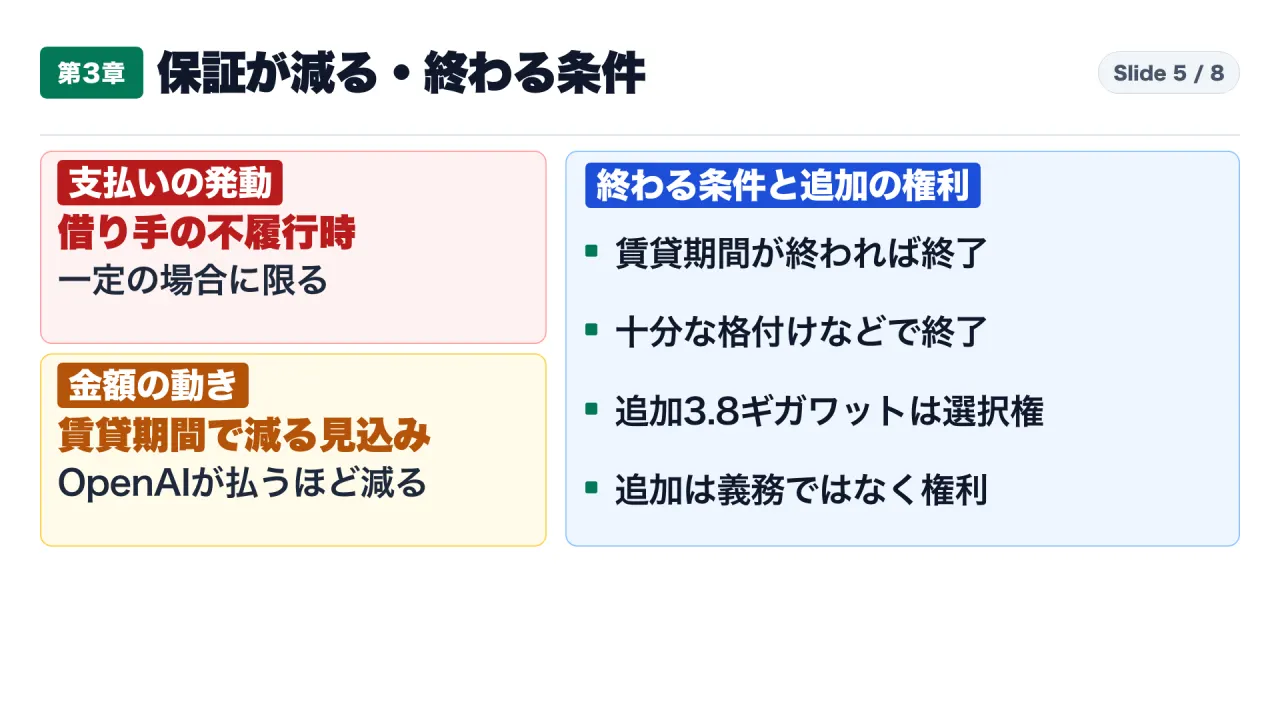
NVIDIA is under no legal obligation to disburse funds under standard operating conditions. An actual cash payment obligation is triggered only upon specific events of non-performance by the lessee:
- Default on scheduled monthly or quarterly facility lease payments.
- Default on associated contractual electric power utility charges.
- Material covenant breaches triggering legal lease default without cure.
If the tenant maintains timely rental and power disbursements, NVIDIA incurs zero direct cash outlay throughout the term of the agreement.
Monotonic Liability Amortization
Once an individual facility becomes active, NVIDIA’s financial liability does not remain static at its peak level. The Form 10-Q confirms that NVIDIA’s contingent liability decreases progressively over each facility’s 20-year term as the customer continues to satisfy its ongoing lease payments.
Because commercial lease liabilities represent the present value of remaining future lease installments, every successful monthly payment permanently extinguishes a corresponding portion of remaining contractual exposure. The $105 billion ceiling represents the hypothetical, undiscounted cumulative peak liability assuming all nine facilities reached simultaneous readiness without prior payment amortization—a scenario that cannot physically occur under a staggered multi-year delivery schedule.
Contractual Off-Ramps and Extinguishment
The filing details explicit contractual pathways through which NVIDIA’s guarantee obligations terminate prematurely:
- Achievement of Satisfactory Credit Rating: The guarantee terminates if OpenAI attains an independent credit rating meeting a contractually specified “satisfactory” grade from recognized credit rating agencies. Upon achieving investment-grade or mutually acceptable credit quality, the requirement for third-party credit support dissolves.
- Lease Expiration: All guarantee commitments expire automatically upon the natural conclusion of each facility’s 20-year lease tenure.
The Unilateral 3.8 GW Expansion Option
In addition to the baseline 4.25 GW program, the agreement grants NVIDIA an expansive future development option. NVIDIA retains the unilateral right, exercisable entirely at its sole discretion, to provide incremental credit support in phases for up to approximately 3.8 gigawatts of additional IT capacity.
This mechanism provides NVIDIA with strategic scalability: if foundational model demand and compute cluster utilization surge, NVIDIA can greenlight multi-gigawatt campus expansions without renegotiating fundamental legal frameworks. Conversely, if compute efficiency outpaces demand, NVIDIA can decline to exercise the option without penalty.
Chapter 4: Scope Boundaries and Separation from the $3.5 Billion Cloud Portfolio
The most consequential legal boundary emphasized in Note 10 is the precise definition of what the guarantee covers—and what it strictly excludes.
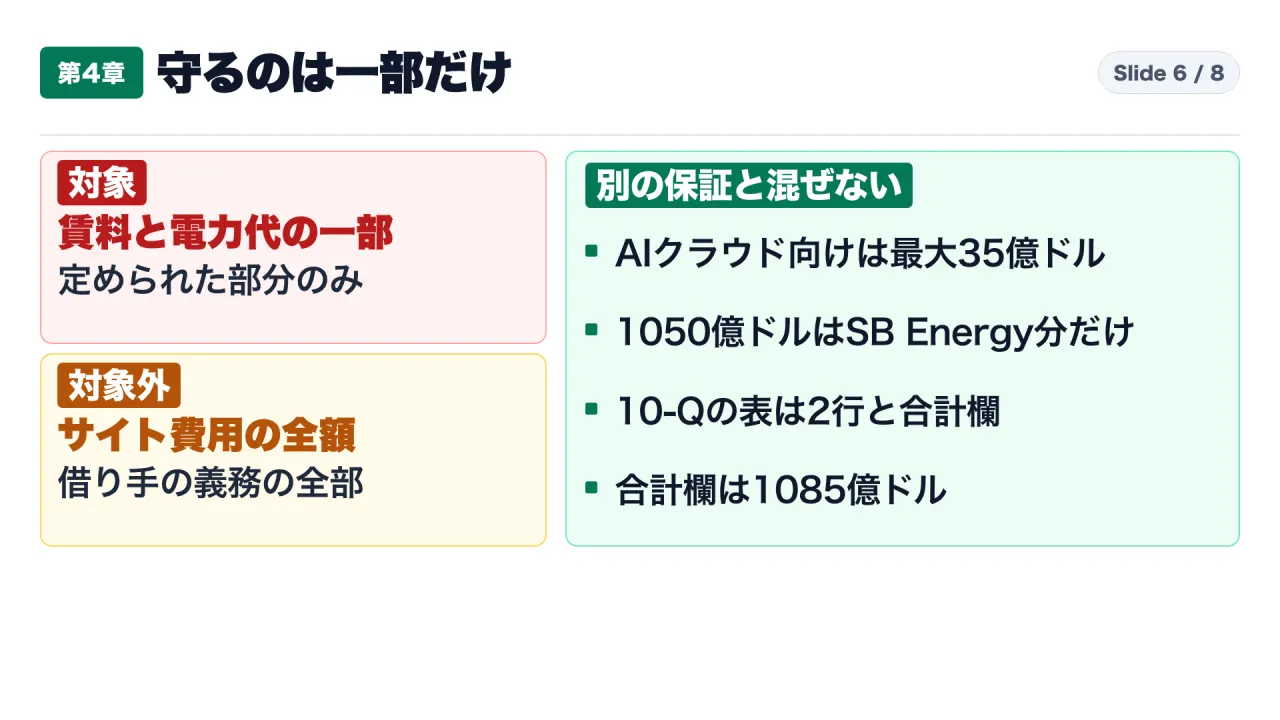
The “Specified Portion” Legal Boundary
Public discourse frequently misinterprets the $105 billion guarantee as the total capital cost of constructing the Ports Technology Campus. Note 10 directly refutes this assumption:
The guarantee covers only a specified portion of rent and power costs associated with the leased facilities. The filing explicitly notes that the guarantee does not represent the entirety of site construction costs, total campus capital expenditures, or the totality of the tenant’s commercial obligations.
The distinction between total site costs and guaranteed costs is structural:
- Developing a 4.25 GW AI data center campus requires land acquisition, civil grading, high-voltage substations, transmission lines, backup generation arrays, cooling infrastructure, and building shells, followed by billions in server racks and networking fabric.
- NVIDIA’s guarantee attaches solely to a predefined slice of operating lease payments and recurring utility bills. If total site expenditures exceed original estimates due to inflation or grid interconnection upgrades, NVIDIA’s statutory exposure remains bound to its contractual sub-allocation.
Disaggregating the $3.5 Billion AI Cloud Provider Guarantee
A second pervasive point of market confusion involves conflating the SB Energy facility with NVIDIA’s existing commercial guarantees. Note 10 contains a consolidated reporting table listing two separate credit guarantee programs:
| Guarantee Agreement | Target Counterparty / Category | Maximum Commitment | Mitigating Factors / Term |
|---|---|---|---|
| Data Center Leases (Cloud) | Selected AI Cloud Service Providers | $3.5 Billion | Backstopped by $712M customer cash deposits; amortizes over 5 to 7 years |
| Ports Technology Campus | SB Energy Affiliates (for OpenAI) | $105.0 Billion | Conditional on readiness across 9 facilities; amortizes over 20-year terms |
| Consolidated Total | Form 10-Q Disclosed Total | $108.5 Billion | Explicit statutory line item within Note 10 commitments table |
The $3.5 billion facility represents an earlier, operationally distinct initiative wherein NVIDIA guaranteed data center leases for specialized AI cloud partners (such as CoreWeave or similar compute providers).
Key differentiators between the two facilities include:
- Cash Collateralization: The $3.5 billion cloud facility is mitigated by $712 million in cash deposits posted directly by the customer counterparties, which are not reflected as a deduction in the headline $3.5 billion maximum amount. The SB Energy filing mentions no upfront customer cash deposit.
- Duration: The cloud provider guarantee amortizes rapidly over five to seven years as customer payments occur, compared to the 20-year lifespan of the SB Energy facilities.
- Reporting Summation: While Note 10 displays a mathematical total of $108.5 billion, this is an accounting aggregation of two completely distinct commercial agreements executed with different counterparties across different operating environments.
Direct Lease Re-Assignment Disclosures
Note 10 also documents that NVIDIA has directly entered into data center operating leases spanning approximately 15 years, with the explicit commercial intention of assigning or transferring these direct leases to third parties. Market commentators have occasionally confused these direct 15-year operational lease assignments with the SB Energy guarantee structure. The filing maintains clear segregation between properties leased directly by NVIDIA for future sublease and properties leased by OpenAI where NVIDIA acts solely as external guarantor.
Chapter 5: Default Protocols, Step-In Rights, and the Limits of Contractual Recourse
If OpenAI were to experience financial insolvency or default on its lease obligations, what concrete legal mechanisms govern NVIDIA’s exposure? Note 10 and the accompanying Item 1A Risk Factors provide a detailed blueprint of post-default remedies and their operational hazards.
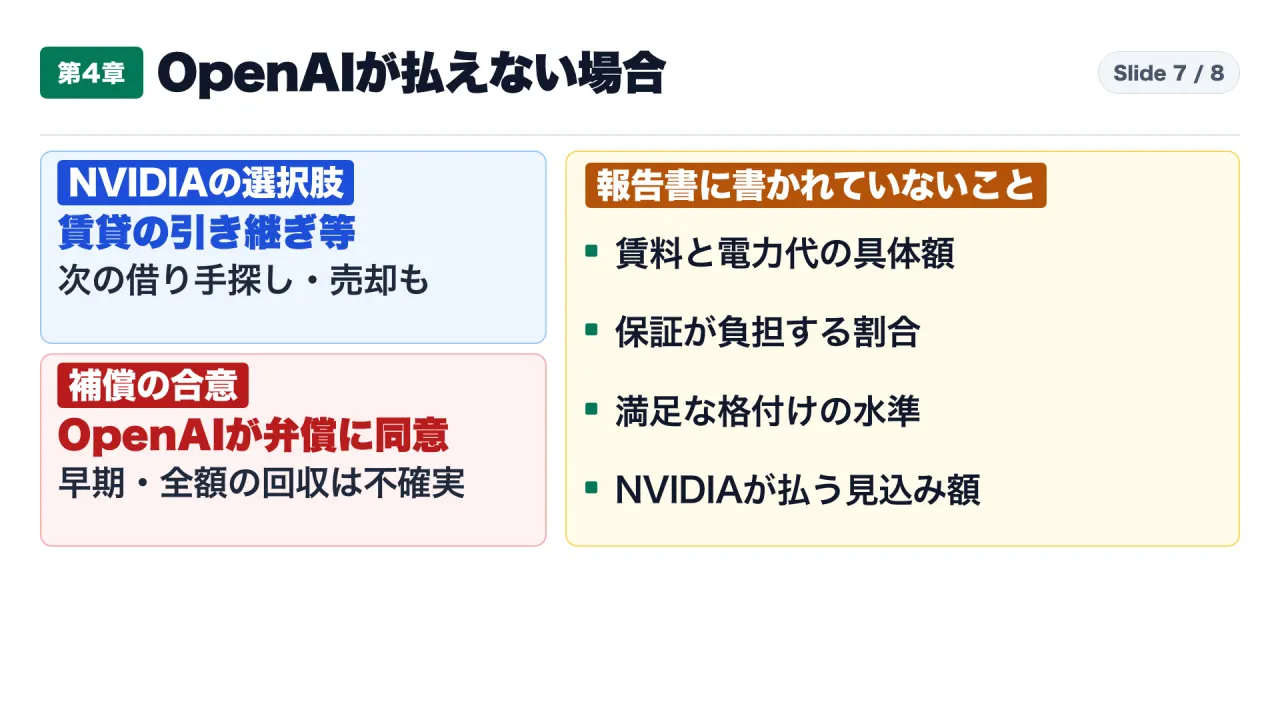
Post-Default Step-In Remedies
Upon a tenant default triggering the guarantee, NVIDIA does not simply write a check to SB Energy and walk away. The regulatory disclosures specify that NVIDIA maintains several contractual remedies to mitigate its losses:
- Lease Assumption (Step-In Rights): NVIDIA possesses the contractual authority to assume primary operational control of the leases, stepping into the shoes of the tenant.
- Secondary Subleasing: NVIDIA can instruct the lessor or deploy its own sales infrastructure to locate replacement enterprise or hyperscale tenants to occupy the vacant capacity.
- Asset Disposition and Sale: NVIDIA can initiate or compel the sale of facility assets and underlying infrastructure rights to recoup outstanding liabilities.
- Alternative Mitigation Instruments: NVIDIA may execute customized restructuring agreements, including reallocating compute clusters or converting lease space into internal research capacity.
Structural Liquidity and Re-Tenanting Hazards
Crucially, NVIDIA’s own SEC disclosure tempers these remedies with explicit risk factor admissions:
The filing acknowledges that replacement tenants or qualified commercial purchasers may not be available on favorable commercial terms, on a timely basis, or at all. In such circumstances, NVIDIA’s financial obligations under the credit support agreements could extend significantly longer than anticipated, resulting in material ongoing cash outflows.
The engineering realities of multi-gigawatt campuses create acute re-tenanting friction:
- Specialized Facility Architecture: A data center custom-engineered for liquid-cooled foundation model training clusters cannot seamlessly pivot to standard enterprise colocation without extensive mechanical re-engineering.
- Capital Scale Barriers: Very few global entities possess the balance sheet liquidity required to absorb hundreds of megawatts or gigawatts of baseload IT capacity in a sudden default event.
- Grid Power Queues: If a facility defaults, utility minimum-take power contracts can impose massive ongoing “take-or-pay” penalties while the campus sits idle.
Indemnification Covenants and Counterparty Limits
Form 10-Q notes that OpenAI has contractually agreed to reimburse and indemnify NVIDIA for certain losses incurred under the credit support facility.
However, NVIDIA immediately qualifies this protection with a sobering legal warning:
There is no contractual assurance that NVIDIA will be able to recover indemnified amounts promptly, or recover them in full.
In corporate restructuring proceedings, an unsecured indemnification claim against a distressed debtor ranks alongside general corporate liabilities, exposing the guarantor to substantial write-downs or extended bankruptcy litigation.
Summary of Critical Parameters Unwritten in Form 10-Q
A rigorous audit of Form 10-Q requires cataloging what is explicitly missing from the regulatory text. Across every occurrence of SB Energy and OpenAI in the filing, the SEC document omits:
- The base lease rate per kilowatt-month or annual real estate rental figure.
- The contracted electricity tariff negotiated with the regional utility or grid operator.
- The precise percentage defining the “specified portion” of rent and power backstopped by NVIDIA.
- The specific agency rating benchmark (e.g., Baa3/BBB- or A3/A-) constituting a “satisfactory credit rating.”
- NVIDIA’s internal modeled net expected cash outflow under baseline, stress, and default scenarios.
These omissions are legally standard under SEC confidential commercial treatment rules, but they mean that any public model claiming to calculate NVIDIA’s exact financial liability relies on external conjecture rather than statutory disclosure.
Chapter 6: Strategic Takeaways: Three Rules for Reading Mega-Infrastructure Disclosures
The financial architecture connecting NVIDIA, SB Energy, and OpenAI reflects a defining trend of the modern computing era: the synthesis of commercial tech sales, project finance, and vendor-backed credit enhancement.

When enterprise architects, financial analysts, and corporate leadership assess mega-infrastructure disclosures in regulatory filings, three disciplined evaluation principles must guide the analysis:
Principle 1: Audit Maximum Commitments Against Multi-Condition Precedents
Never evaluate a statutory headline figure in isolation. Whenever a balance sheet commitment discloses a multi-billion-dollar maximum, immediately locate and cross-reference four internal structural boundaries within the identical text:
- Inception Triggers: Does the liability attach upon contract signing, or does it require third-party commercial readiness benchmarks?
- Scope Boundaries: Does the commitment cover the totality of the counterparty’s project, or a tightly circumscribed “specified portion”?
- Amortization Curves: Does the liability compound, or does it steadily decrease with every scheduled tenant operational payment?
- Contractual Off-Ramps: What external credit milestones or restructuring events automatically dissolve the legal obligation?
Principle 2: Disaggregate Consolidated Tables Across Independent Counterparties
Regulatory accounting tables frequently aggregate diverse legal commitments into unified column totals to comply with GAAP reporting standards. Analysts must systematically dissect table rows to avoid conflating independent commercial structures.
In NVIDIA’s filing, conflating the $3.5 billion cash-mitigated cloud guarantee with the $105.0 billion SB Energy project finance structure creates an erroneous picture of enterprise risk. Each facility operates under distinct counterparties, distinct collateral profiles, and distinct repayment horizons.
Principle 3: Enumerate Unwritten Parameters Before Formulating Capital Projections
A complete financial analysis requires establishing a rigorous inventory of undisclosed variables before drawing definitive conclusions. Identifying what an SEC filing does not say—such as missing power tariffs, undisclosed guarantee sharing ratios, and undefined credit rating benchmarks—prevents premature extrapolation and protects leadership from modeling illusions.
Primary Sources and Verification Records
This analytical review is synthesized exclusively from primary statutory filings and central bank monetary records:
- NVIDIA Corporation Form 10-Q (Quarterly Period Ended July 26, 2026):
- Securities and Exchange Commission (SEC) EDGAR Filing: NVIDIA Form 10-Q Archive (July 26, 2026)
- Operative Sections Audited: Part I, Item 1 (Financial Statements), Note 10 (Commitments and Contingencies - Guarantees and Leases); Part I, Item 2 (Management’s Discussion and Analysis); Part II, Item 1A (Risk Factors).
- Bank of Japan Financial and Economic Statistics:
- Tokyo Foreign Exchange Market USD/JPY Spot Rate: Bank of Japan Time-Series Data Search (Tokyo Market 17:00 Spot USD/JPY: 158.88)
- Baseline currency translation benchmark applied: 105.0 billion USD × 158.88 JPY/USD = 16.6824 trillion JPY (presented as roughly 17 trillion JPY).
This article is based on the verified podcast production transcript and primary statutory filings for episode 2026-11-13-nvidia-10q-sb-energy-105b-guarantee-what-it-covers (audit verified: November 13, 2026).