Entrusting Your Wallet to Autonomous AI: How ChatGPT Wallet Uses Single-Use Scoped Payment Tokens and Biometrics to Eliminate Agent Card Exposure
An architectural investigation into OpenAI’s payment token infrastructure, card network partnerships with Visa, Mastercard, and American Express, the preservation of chargeback rights, and why merchants like Amazon and United Airlines are blocking autonomous agent checkouts.
Published: November 14, 2026 | Read time: ~12 min | Watch Video (Japanese)
Disclaimer: This publication provides objective technical, architectural, and security analysis. It does not constitute commercial endorsement or investment advice.
Executive Summary: The Architecture of Agentic Commerce
The transition of generative artificial intelligence from passive chatbots into autonomous software agents capable of executing multi-step tasks across the internet has reached its most critical friction point: financial execution.
Allowing an autonomous program to book travel, procure hardware, or manage subscriptions requires giving it the capacity to spend money. Yet handing primary credit card credentials—such as a 16-digit primary account number (PAN), expiration date, and CVV/CVC code—to an autonomous agent introduces unacceptable risks of model hallucination, runaway spend, prompt injection, and credential theft.
OpenAI’s launch of ChatGPT Wallet addresses this fundamental security challenge through an architectural paradigm shift: complete credential isolation via network tokenization.
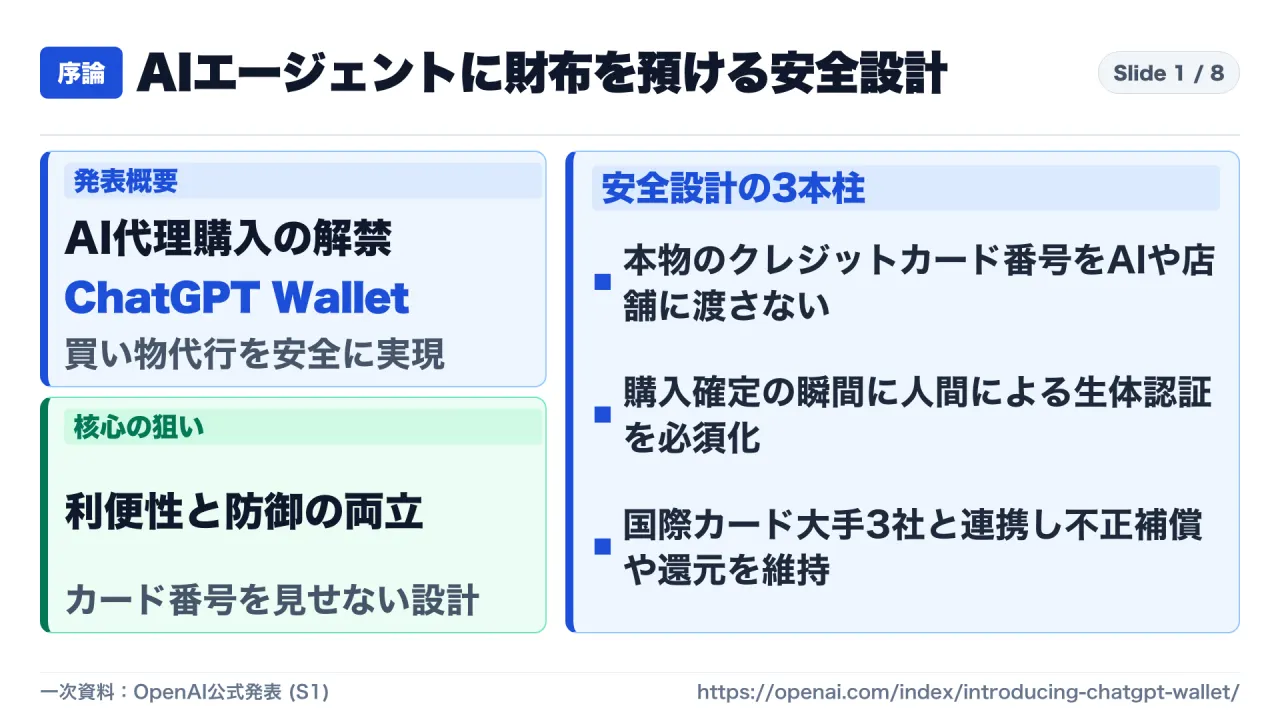
Built in direct partnership with American Express, Mastercard, and Visa, ChatGPT Wallet never exposes real card details to the AI agent or the online merchant. Instead, purchases rely on dynamic, single-use payment tokens restricted to a specific merchant and exact transaction amount, gated behind mandatory biometric authorization (Face ID or fingerprint scan).
Simultaneously, the rollout reveals emerging structural tensions across digital commerce: while payment networks embrace the platform, major vendors such as United Airlines and Amazon have deployed active blocks against autonomous agent access to defend proprietary customer touchpoints.
This report examines primary technical specifications, security disclosures, and regulatory implications of agent payment tokens.
1. Network Tokenization: Eliminating Primary Account Number Exposure
The Flaw of Direct Credential Provisioning
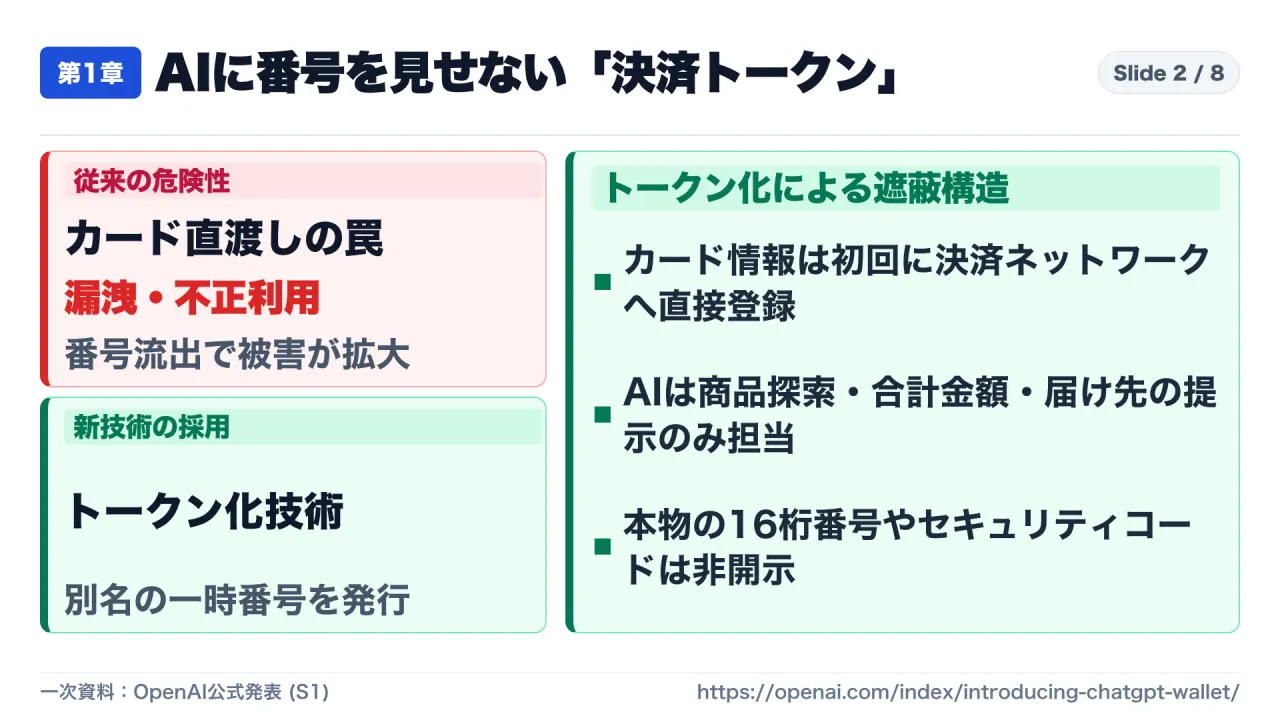
In legacy web automation, giving a bot purchasing power meant injecting raw card credentials into browser form fields. This created critical failure modes:
- Model & Context Leakage: Card numbers stored in model context windows or database tables are vulnerable to extraction via indirect prompt injection.
- Merchant Compromise: If an untrusted or breached merchant database is targeted, the stolen card details can be reused across unrelated platforms.
- Unbounded Financial Exposure: A leaked static credential allows repeated unauthorized charges up to the account’s total credit limit.
The Single-Use Scoped Token Model
ChatGPT Wallet decouples financial authorization from credential visibility using EMVCo-standard network tokenization protocols.
sequenceDiagram
    autonumber
    actor User as Consumer (Human)
    participant Agent as Autonomous Agent (dot)
    participant Net as Card Network (Visa/Mastercard/Amex)
    participant Merchant as Online Store (Merchant API)

    Note over User,Net: User vaults primary card once via secure network iframe
    User->>Agent: "Find and buy a lightweight travel backpack"
    Agent->>Merchant: Scrapes product data, inventory, and final checkout total
    Agent->>User: Displays item summary, total price, and shipping details
    User->>Net: Confirms checkout via Biometric Gate (Face ID / Fingerprint)
    Net->>Agent: Issues single-use token scoped to merchant & exact amount
    Agent->>Merchant: Dispatches scoped payment token to complete order
    Merchant->>Net: Settles transaction with card network
    Net-->>User: Primary account charged; rewards and protection applied
Under this architecture:
- Cardholder Onboarding: The user inputs primary card details once into a secure, sandboxed enrollment frame directly managed by the card network. OpenAI’s language models and agent orchestration layers never touch, store, or process raw PAN data.
- Agent Role: The agent (branded as “dot”) acts purely as an orchestrator. It identifies products, negotiates cart contents, extracts line-item totals, and presents a checkout summary to the user.
- Biometric Enforcement Gate: The agent cannot authorize financial settlement autonomously. Every purchase mandates an out-of-band biometric check on the user’s personal hardware device.
- Scoped Token Generation: Upon successful biometric validation, the payment network issues a cryptographic token. This token includes a synthetic card number, a dynamic security code, and a tightly constrained execution policy:
- Merchant Scoping: Valid exclusively at the designated merchant entity.
- Monetary Scoping: Valid strictly for the authorized transaction amount.
- Temporal Scoping: Expires rapidly if not consumed within minutes.
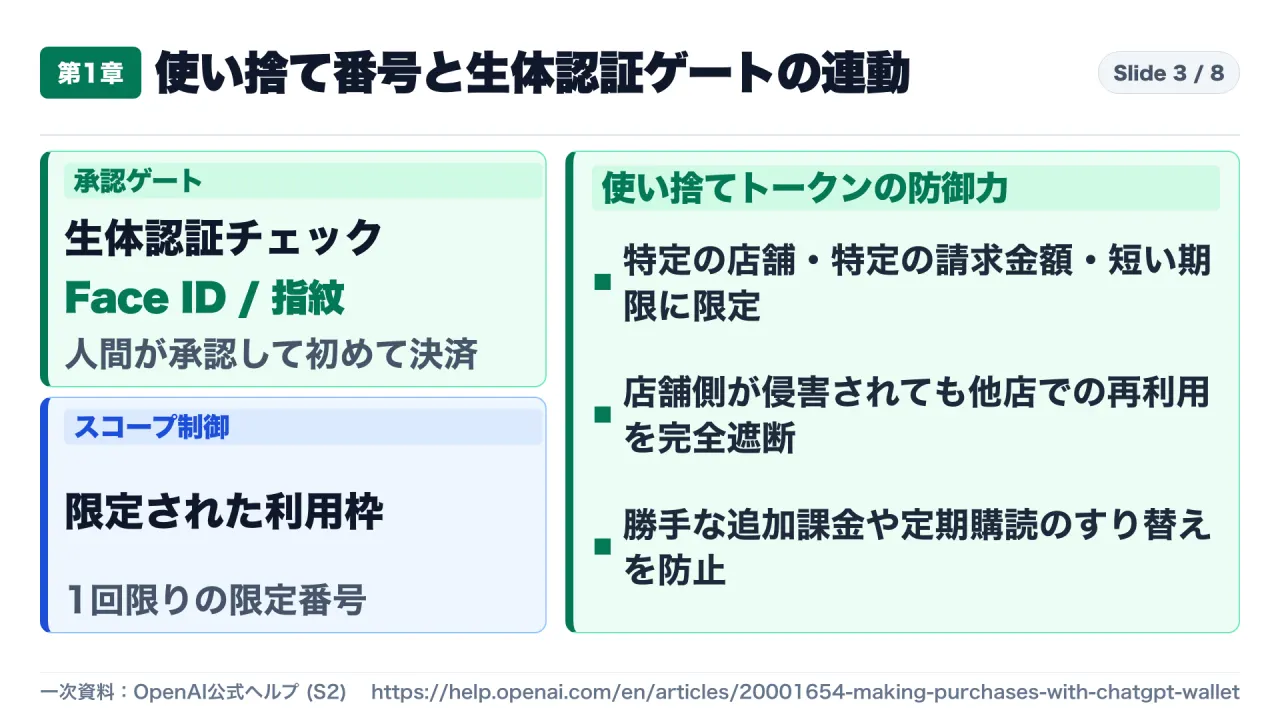
Even in the event of an adversary intercepting the token in transit or compromising the merchant’s backend database, the captured payload cannot be replayed or used at any other vendor.
2. Infrastructure Strategy: Leveraging Existing Global Card Networks
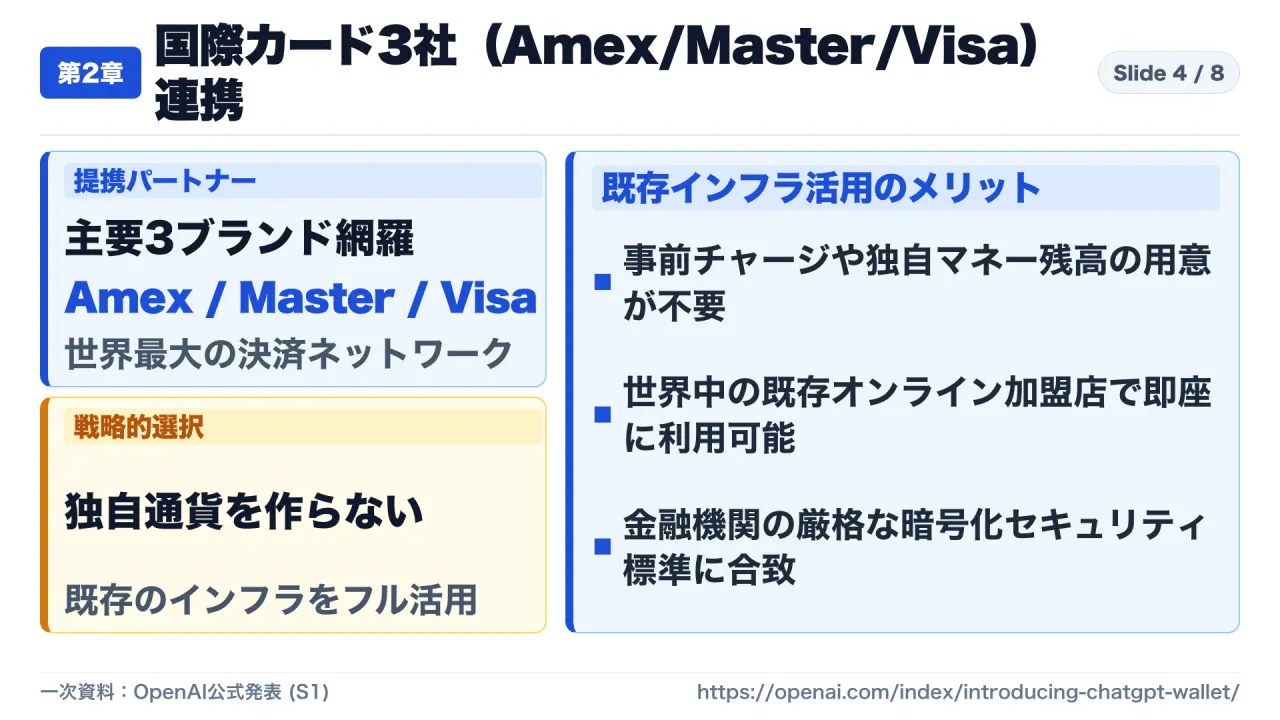
A critical architectural decision by OpenAI was eschewing proprietary closed-loop balances (such as a stored-value digital wallet or cryptocurrency rails) in favor of deep bilateral integration with legacy card schemes: American Express, Mastercard, and Visa.
Architectural and Commercial Drivers
| Strategic Vector | Closed-Loop Proprietary Wallet | Card Network Token Integration (ChatGPT Wallet) |
|---|---|---|
| Capital Friction | Requires pre-funding and balance management | Zero friction; settles directly against existing credit lines |
| Merchant Acceptance | Requires explicit onboarding of every merchant | Instantly compatible with tens of millions of existing online merchants |
| Regulatory Burden | Subject to money transmitter licensing and banking reserve rules | Leverages regulated tier-1 payment infrastructure and bank compliance |
| Consumer Incentives | Often forfeits cardholder perks and points | Preserves 100% of native reward points, airline miles, and cash back |
Preservation of Dispute and Chargeback Protections
A primary barrier to autonomous commerce has been legal and procedural ambiguity regarding transaction disputes. If an autonomous agent orders the wrong product, selects an incorrect size, or fails to deliver, who bears financial liability?
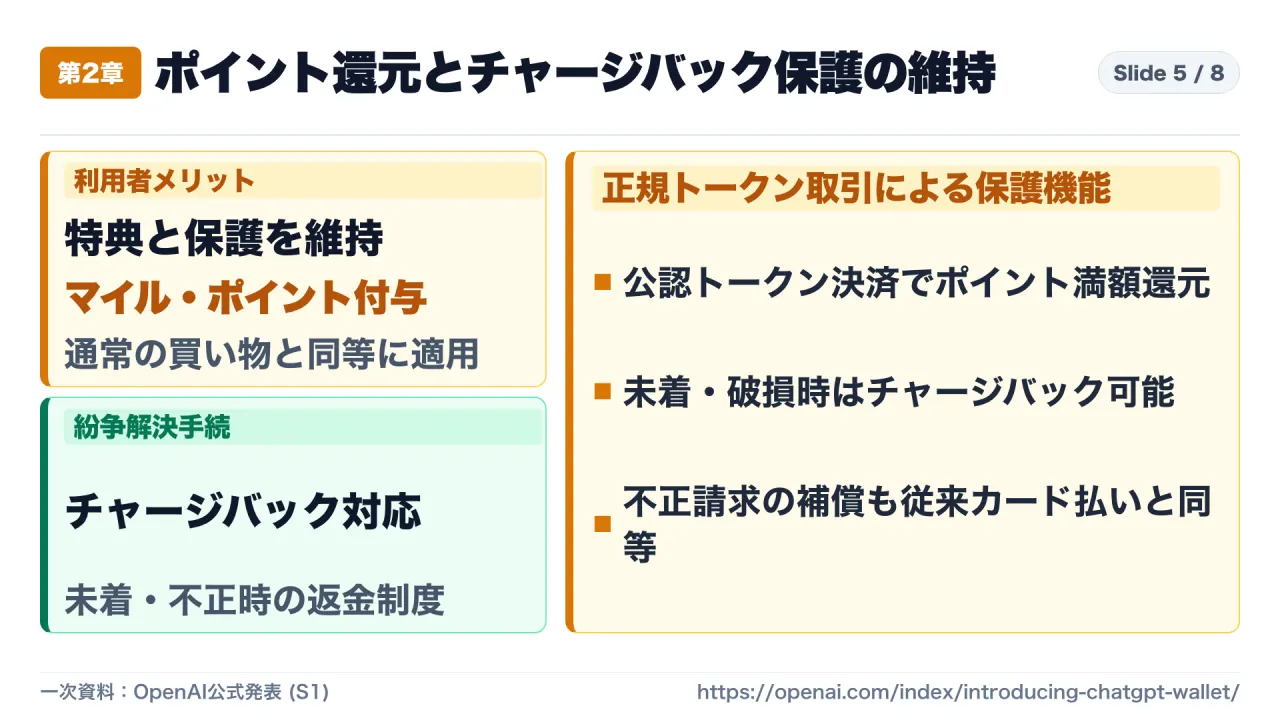
Because ChatGPT Wallet processes transactions as certified network token events, consumers maintain complete parity with traditional point-of-sale credit card protections:
- Zero-Liability Fraud Protection: Unauthorized transactions remain shielded under standard statutory cardholder protections.
- Chargeback Rights: In the event of non-delivery, vendor insolvency, or defective merchandise, consumers retain formal dispute arbitration mechanisms through their issuing banks.
- Credit Card Loyalty Programs: Points, travel insurances, and tiered membership multipliers are applied without third-party penalty.
3. Deployment Parameters: U.S. Pro Phasing and Zero-Fee Platform Strategy
Initial Rollout Constraints
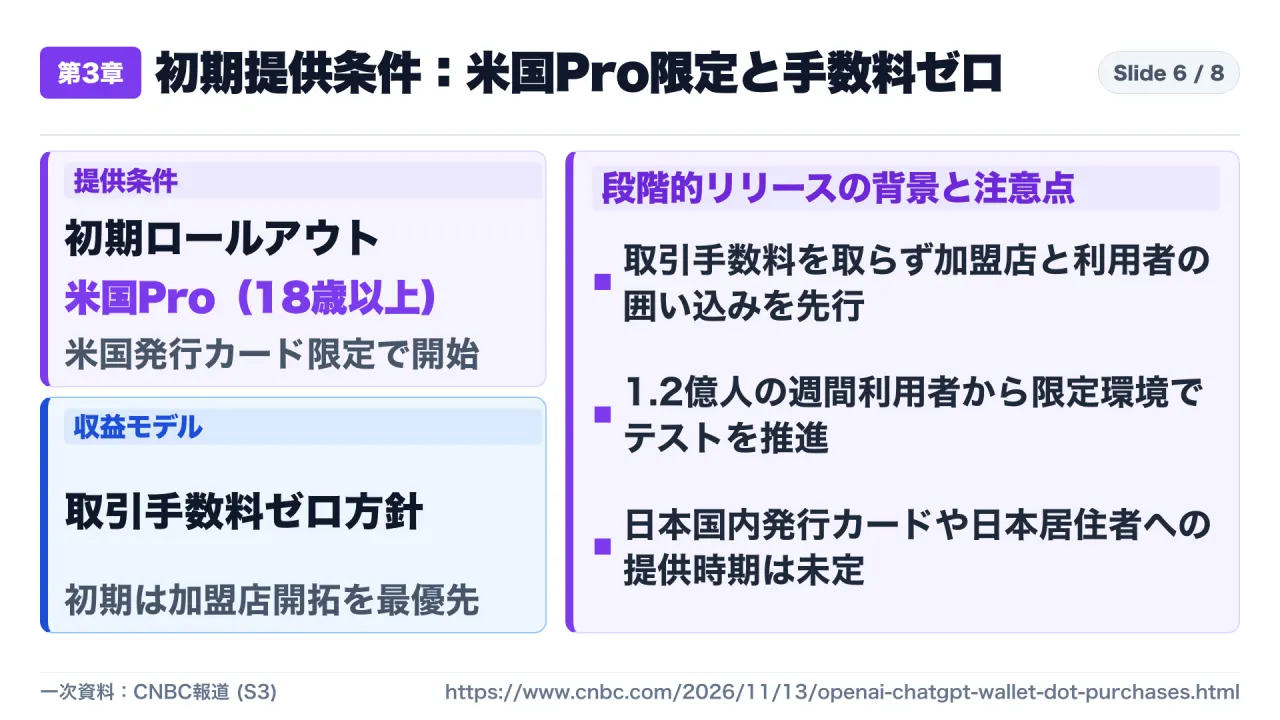
To manage operational risk and monitor edge-case transaction anomalies, OpenAI has established strict qualification boundaries for its initial launch:
- Subscriber Tier: Restricted exclusively to paying ChatGPT Pro subscribers.
- Jurisdictional Scope: Limited to United States residents aged 18 years and older.
- Issuance Compatibility: Supports U.S.-issued consumer credit cards across partner networks (including JPMorgan Chase and other major institutions). International rollout timelines and local card issuance outside the U.S. remain unconfirmed.
The Zero Take-Rate Strategy
Significantly, OpenAI confirmed that it is not charging transaction fees or taking a revenue cut from merchants during this initial phase.
This zero-take-rate strategy reflects deliberate platform dynamics:
- Friction Reduction for Vendors: Eliminating interchange surcharges removes financial resistance from merchants contemplating agent integration.
- Behavioral Telemetry: Establishing baseline data on consumer agent shopping patterns, error rates, and checkout drop-offs before monetizing the channel.
- Ecosystem Primacy: Cementing ChatGPT as the primary search, discovery, and conversion funnel before exploring revenue-sharing models or sponsored product placements.
4. Merchant Countermeasures: Why Amazon and United Airlines Block Autonomous Agents
The emergence of autonomous buyer agents has triggered immediate defensive maneuvers from major retail and transportation platforms.
Documented Blocking Actions
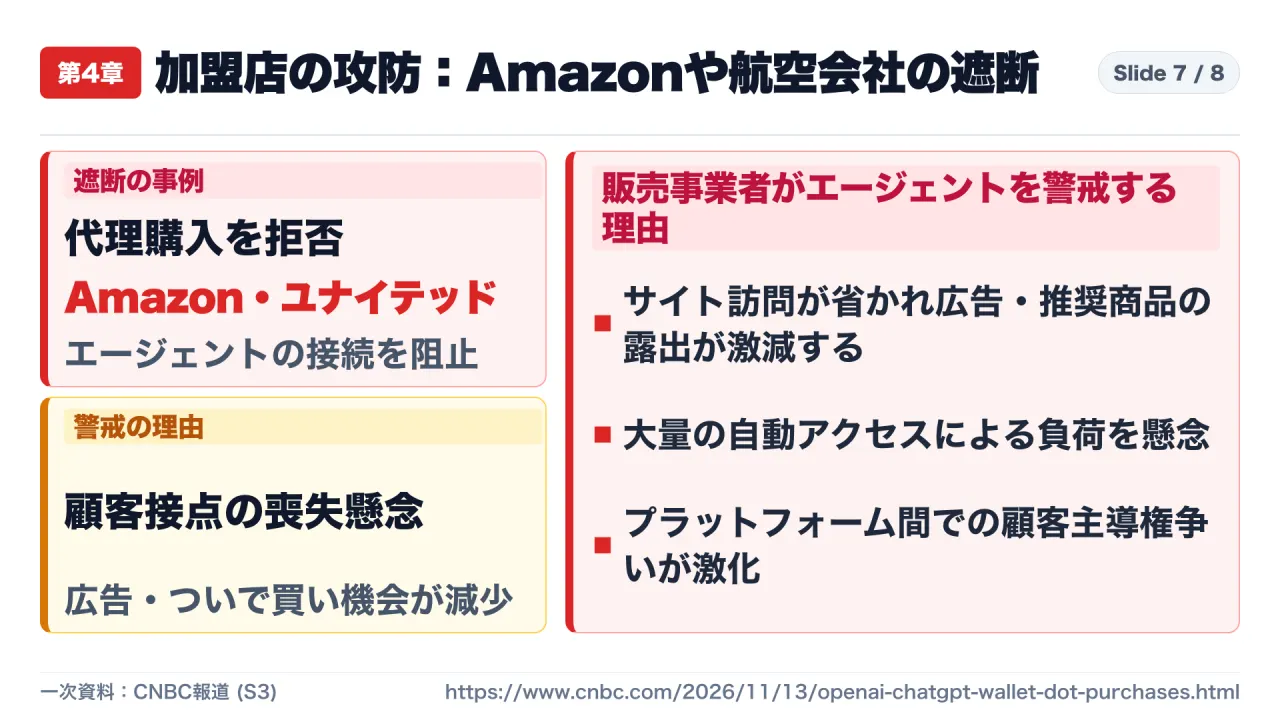
According to market disclosures, United Airlines confirmed that it actively blocks autonomous AI agents from accessing its reservation infrastructure to book tickets. Concurrently, Amazon deploys sophisticated bot detection and session-level enforcement to prevent external autonomous agents from executing programmatic purchases on its marketplace.
The Structural Threat to Vendor Unit Economics
Why would commercial platforms turn away programmatic paying customers? The resistance stems from three existential threats to merchant business models:
flowchart TD
    subgraph Traditional Consumer Flow
        A[User visits Website] --> B[Banner Ads & Sponsored Listings]
        B --> C[Personalized Recommendations & Cross-Sells]
        C --> D[Higher Cart Value & Brand Loyalty]
    end
    subgraph Autonomous Agent Flow
        E[Agent query: 'Buy cheapest flight'] --> F[Direct Headless Checkout]
        F --> G[Zero Ad Impressions, Zero Upsells]
        G --> H[Merchant Commoditization into Dumb Utility]
    end
- Destruction of the Retail Media Network: Modern e-commerce profitability relies heavily on high-margin advertising networks (e.g., sponsored search placements). When an AI agent bypasses search results to execute a direct headless checkout, advertising impressions drop to zero.
- Elimination of Impulse Purchases & Upsells: Human shoppers browse related accessories, warranties, and upgraded shipping tiers. AI agents execute surgical, least-cost checkouts, depressing average order values (AOV).
- Disintermediation and Brand Erasure: Vendors fear being relegated to backend fulfillment utilities, severing direct customer relationships and loyalty program enrollments.
5. Enterprise Hardening Playbook: Governance Principles for Autonomous Payments
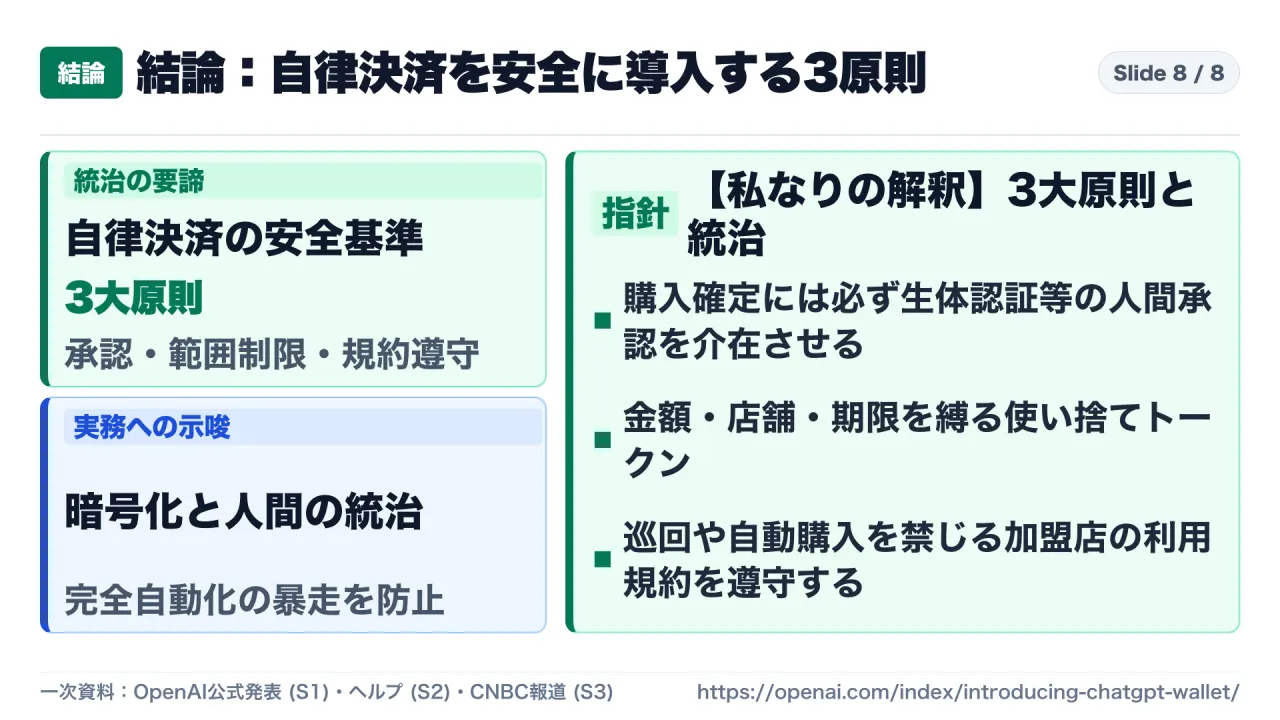
As autonomous agents expand from consumer shopping into corporate procurement, IT operations, and cloud resource management, enterprise architects must establish rigid governance guardrails.
3 Immutable Standards for Autonomous Financial Workflows
| Principle | Technical Implementation | Operational Rationale |
|---|---|---|
| 1. Strict Human-in-the-Loop (HITL) | Mandatory biometric validation or out-of-band cryptographic signature before settlement. | Prevents cascading recursive execution loops, prompt injection attacks, and hallucinated bulk orders. |
| 2. Scoped Ephemeral Tokens | Enforce network tokens bound to single merchant IDs, static maximum price thresholds, and sub-10-minute TTLs. | Eliminates blast radius in the event of agent compromise or merchant data leakage. |
| 3. Terms of Service (ToS) Compliance | Route purchases exclusively through documented partner APIs; respect vendor robots.txt and anti-agent declarations. |
Mitigates enterprise liability, anti-bot IP bans, account terminations, and legal disputes over unauthorized automation. |
Conclusion: Balancing Cryptographic Protection with Commercial Alignment
OpenAI’s ChatGPT Wallet demonstrates that the technical challenge of securing autonomous payments is largely solved. By anchoring agent execution to network tokenization and biometric validation, users can safely delegate procurement without exposing underlying financial assets.
However, the commercial challenge is only beginning. As demonstrated by Amazon and United Airlines, the battleground of agentic commerce will not be decided by token security alone, but by commercial negotiation between platform creators, payment networks, and merchants fighting to protect customer engagement and advertising margins.
Building sustainable autonomous systems requires both cryptographic rigor and respectful alignment with the economic realities of the digital marketplace.