DeepSeek Exposes Full App Architecture via API: Web Search, Document Parsing, Voice APIs at $0.75 per 1,000 Calls, and Server-Side Execution
A technical analysis of how DeepSeek-V4.1-Flash transforms AI application engineering by delivering full turnkey chatbot capabilities, server-side tool orchestration, Messages and Responses protocol compatibility, an MIT-licensed frontend, and mandatory safety moderation.
Japanese Edition (Original Article): Read on note Video Episode: Watch on YouTube
Disclaimer: This publication provides objective technical, architectural, and organizational analysis based strictly on publicly verifiable primary sources. It does not constitute commercial endorsement or investment advice.
Executive Summary: The Structural Shift from Raw Inference to Turnkey Application Stacks
Across the landscape of generative artificial intelligence engineering, a profound architectural shift is unfolding. For years, the dominant deployment paradigm treated foundation models as raw, stateless text generators. Developers attempting to build enterprise-grade conversational interfaces or domain-specific research assistants were forced to design, assemble, and maintain extensive client-side glue code and external infrastructure.
Historically, delivering a production-ready conversational application required maintaining at least five distinct operational layers:
- External Search Engine Integrations: Subscribing to commercial web search APIs and managing scraping pipelines to ground model responses in real-time information.
- Document Parsing and OCR Pipelines: Deploying specialized Optical Character Recognition (OCR) microservices and document converters to extract structured text from complex formats such as PDF, Microsoft Word (
.docx), PowerPoint (.pptx), and scanned images. - Client-Side Orchestration Loops (Function Calling): Writing multi-hop network orchestration logic that handles JSON tool-call requests, issues third-party HTTP requests, handles rate limits, parses responses, and resubmits context payloads back to the model.
- Independent Content Moderation Layers: Implementing strict safety filters and guardrails to screen inbound user prompts and outbound model generations for regulatory and policy compliance.
- Session and State Management: Coordinating context caching, multi-turn message history serialization, and token window budgets.
On November 13, 2026, DeepSeek decisively dismantled this architectural boundary with the release of its Full-Suite Application API for DeepSeek-V4.1-Flash (system identifier deepseek-flash). Instead of merely exposing raw model weights or token completion endpoints, DeepSeek exposed the entire underlying operational stack of its official consumer chat platform directly through simple API parameters.
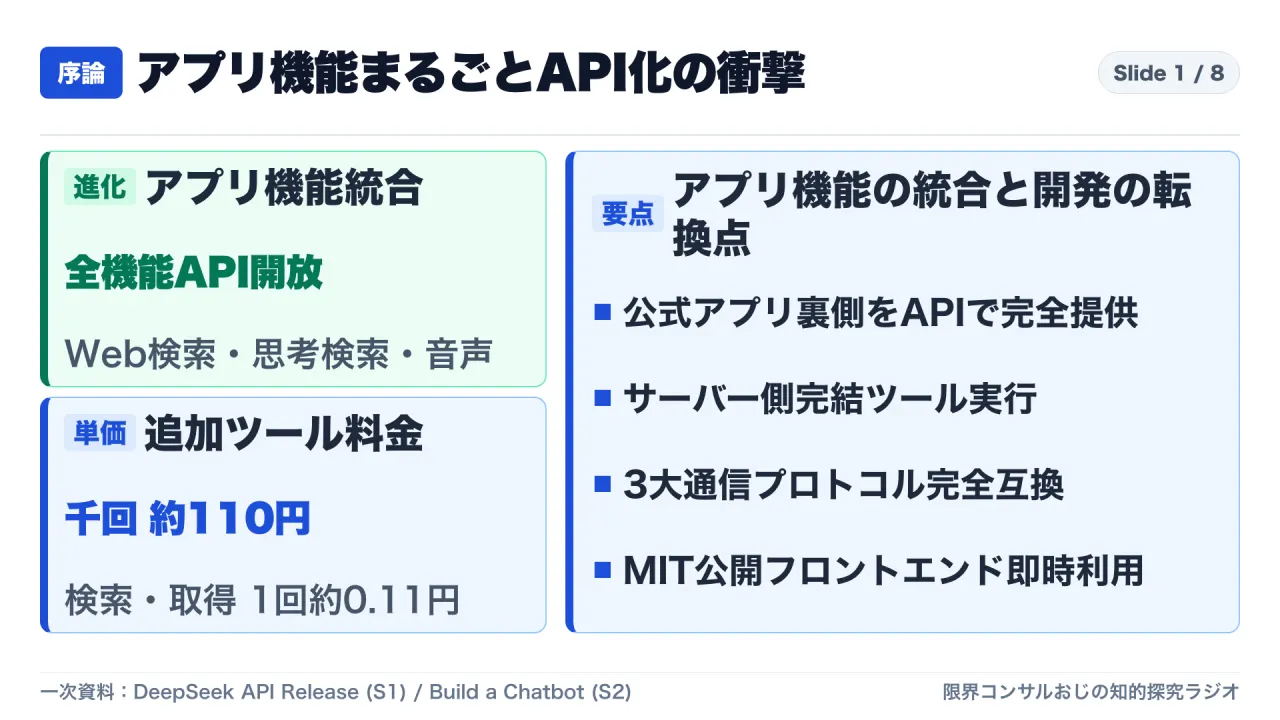
Under this new architectural framework, grounded web search with automated citation anchors, autonomous multi-turn deep thinking search, URL detection and web fetching, multi-format document extraction, and content safety moderation (safety_check) are executed entirely within DeepSeek’s internal server-side runtime. Developers no longer need to implement intermediate tool-calling roundtrips; a single API request returns an integrated response containing enriched citations, retrieved snippets, or explicit refusal markers.
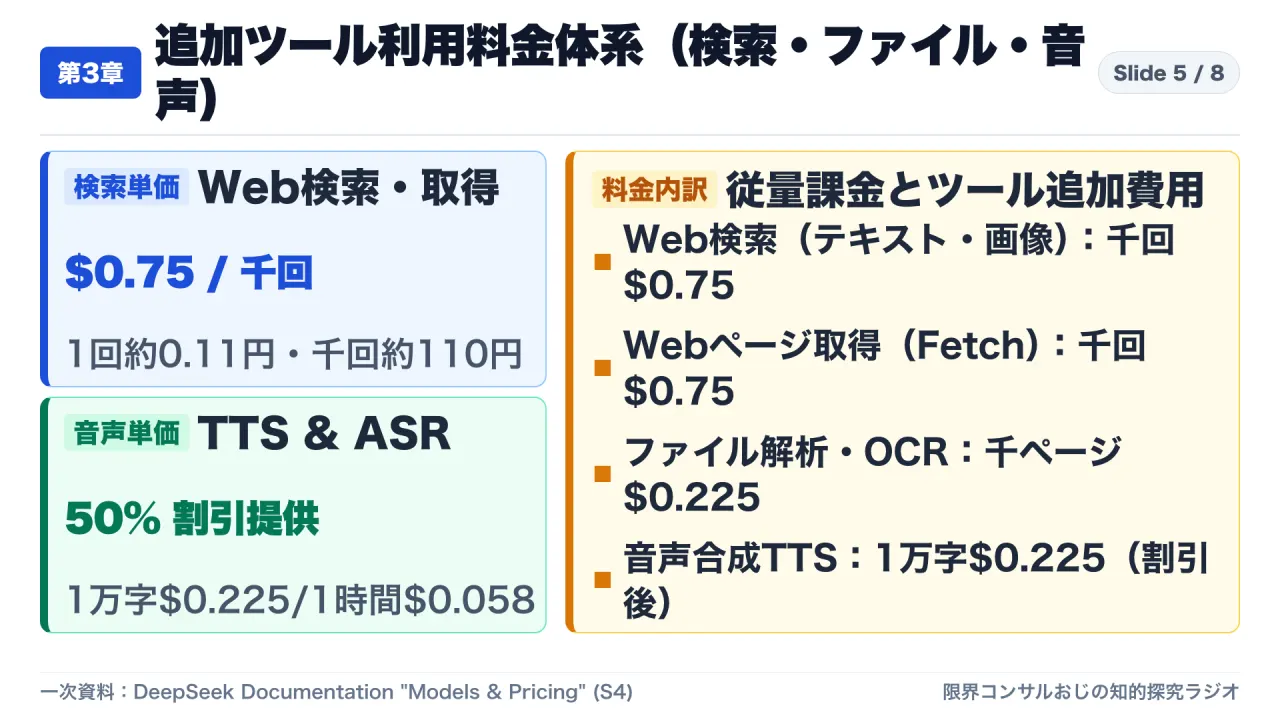
Furthermore, DeepSeek established an aggressive pricing structure: tool-level web searches and URL fetches cost $0.75 per 1,000 requests (approximately 110 Japanese yen), while document parsing and OCR run at $0.225 per 1,000 pages (approximately 33 Japanese yen). Accompanying this release, DeepSeek open-sourced its complete reference user interface (chat-demo) on GitHub under the permissive MIT license, enabling engineering teams to deploy a zero-backend, browser-direct conversational client in minutes.
1. Deep Feature Integration: Grounded Search, Deep Thinking, and URL Extraction
Two Distinct Modalities for Web Grounding
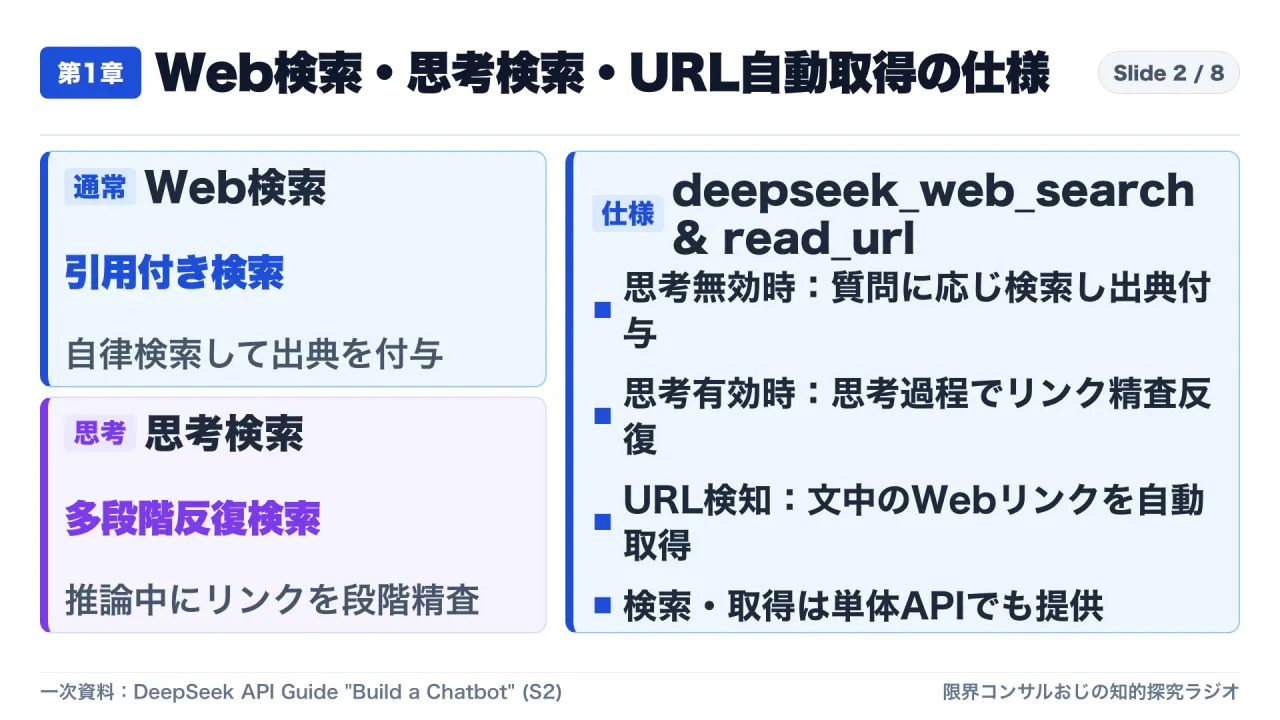
The DeepSeek Application API natively embeds two distinct web search mechanisms, selected automatically based on the model’s reasoning configuration:
- Standard Grounded Search (
deepseek_web_search): Operating when extended thinking is disabled, the model evaluates user queries, dynamically generates search keywords, queries web indices, and injects relevant snippets directly into its context window. The final output is automatically formatted with verified, clickable citation footnotes matching the retrieved source pages. - Deep Thinking Search (Iterative Multi-Hop Reasoning): When extended reasoning mode is active, the model executes recursive search loops. Rather than issuing a single static query, the model analyzes intermediate search results, identifies factual ambiguities, generates follow-up queries across multiple reasoning steps, and synthesizes complex multi-page conclusions before generating the final response.
Automated In-Band URL Parsing and Context Hydration
A persistent point of friction in building conversational agents has been handling raw links provided by users. In conventional architectures, client applications must implement regex matchers, initiate outbound HTTP requests, bypass bot protections, extract main DOM text, and inject the scraped content into the conversation thread.
Through the deepseek_read_url tool, DeepSeek moves this entire pipeline into its server backend. When a user message contains an external URL, the server detects the link, fetches the page content, filters boilerplate HTML, and integrates the plain text into the model’s active reasoning context. This capability operates seamlessly within both single-turn queries and multi-turn conversational histories.
2. Multi-Format Document Parsing and Standalone Utility APIs
Native File Ingestion and Layout Extraction
Enterprise AI deployments frequently stall on the challenge of unstructured document ingestion. Converting corporate slide decks, contracts, and financial statements into clean text suitable for LLM processing typically requires an expensive constellation of third-party OCR services, layout parsers, and custom chunking scripts.
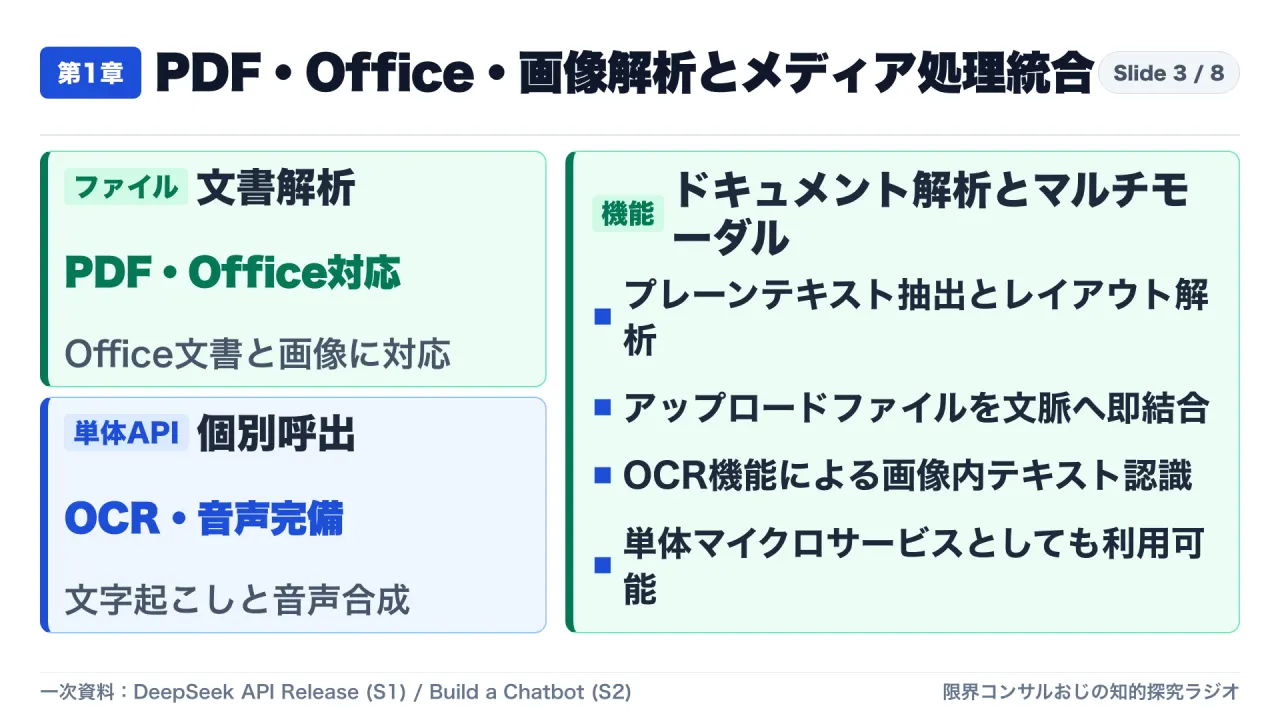
The DeepSeek Application API provides native ingestion for diverse binary document payloads:
- Portable Document Format (PDF): Extracts complex multi-column typography, embedded tables, and figures with positional accuracy.
- Office Document Formats: Natively digests Microsoft Word (
.docx) and PowerPoint (.pptx) archives without requiring client-side conversion servers. - Image Formats: Analyzes raster diagrams, screenshots, and scanned paper documents via integrated Optical Character Recognition (OCR).
Files are transmitted directly via multipart form payloads or base64 streams, processed within DeepSeek’s high-throughput parsing infrastructure, and appended directly to the conversational context.
Standalone Microservice Endpoints for Modular Architectures
Recognizing that many enterprise architectures require discrete processing services rather than monolithic chat sessions, DeepSeek decoupled its underlying tooling into standalone utility endpoints:
- Standalone Search API: Programmatic text and image search without invoking model text generation.
- Standalone Web Fetch API: High-speed, server-side URL fetching and DOM extraction.
- Standalone OCR API: Document and image text recognition priced independently of conversational context.
- Text-to-Speech (TTS) API: Neural voice synthesis priced at an promotional rate of $0.225 per 10,000 characters (50 percent discount off list price of $0.45).
- Automated Speech Recognition (ASR) API: Audio transcription priced at $0.058 per audio hour (50 percent discount off list price of $0.116).
3. Server-Side Execution: Eliminating Client-Side Orchestration Loops
Structural Comparison: Function Calling vs. Server-Side Orchestration
The transition from client-driven function calling to server-side tool execution represents a fundamental efficiency gain for distributed systems:
flowchart LR
    subgraph Traditional["Legacy Client-Side Tool Calling"]
        direction TB
        Client1["Client Application"] -->|1. Initial Prompt| Model1["Foundation Model"]
        Model1 -->|2. Tool Call JSON Request| Client1
        Client1 -->|3. Outbound HTTP Request| ExtAPI["External Search Engine"]
        ExtAPI -->|4. Raw Search Results| Client1
        Client1 -->|5. Submit Tool Outputs| Model1
        Model1 -->|6. Final Grounded Response| Client1
    end

    subgraph ServerSide["DeepSeek Server-Side Execution"]
        direction TB
        Client2["Client Application"] -->|1. Single Request (Tools Enabled)| Server2["DeepSeek Backend"]
        Server2 <--> Tool2["Internal Search / Scraper / OCR Engine"]
        Server2 -->|2. Streamed Response with Citations| Client2
    end
In the legacy Function Calling model, every tool invocation incurs significant network latency, serializes roundtrips across public networks, and exposes client code to network partition failures and parsing bugs.
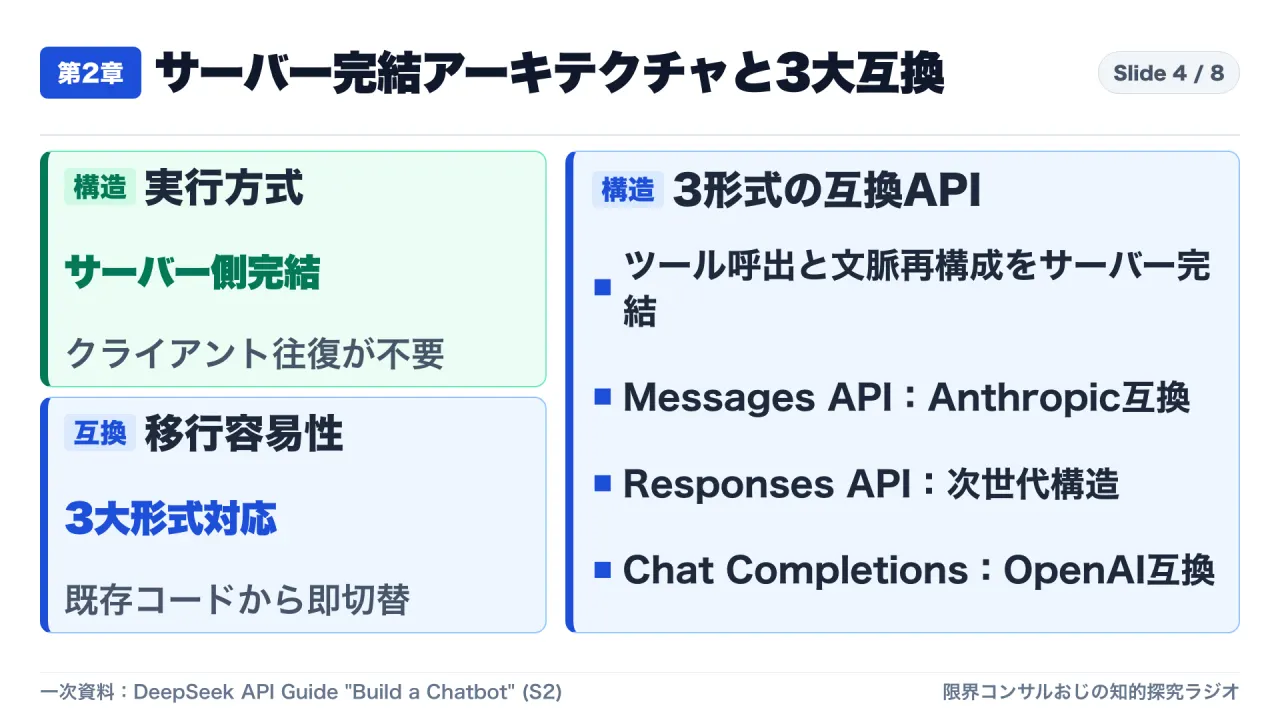
Under DeepSeek’s server-side execution model, tool resolution, data fetching, document parsing, and context recombination occur within DeepSeek’s internal cluster network. The client receives a single, cohesive stream of response chunks containing enriched citation metadata, eliminating intermediate roundtrip delays and dramatically simplifying client-side state machines.
Broad Interoperability Across Three Major Wire Protocols
To facilitate rapid enterprise migration, DeepSeek architected its gateway to support three widely adopted wire protocols:
- Anthropic Messages Protocol:
- Endpoint:
POST https://api.deepseek.com/anthropic/v1/messages - Compatibility: Accepts standard Anthropic payload structures, enabling drop-in configuration within existing SDK wrappers and agent orchestrators.
- Endpoint:
- OpenAI Responses Protocol:
- Endpoint:
POST https://api.deepseek.com/responses - Compatibility: Implements modern state-structured request patterns designed for next-generation multi-agent frameworks.
- Endpoint:
- OpenAI Chat Completions Protocol:
- Endpoint:
POST https://api.deepseek.com/chat/completions - Compatibility: Provides 100 percent backward compatibility with existing OpenAI SDK client libraries, LangChain, LlamaIndex, and community tooling by updating the base URL and API key.
- Endpoint:
4. The Economics of Extended Tool APIs and Model Inference
Detailed Tool Usage Cost Breakdown
DeepSeek prices extended application capabilities on a transparent, per-invocation basis:
| Tool / API Capability | Billing Unit | Price (USD) | Effective Rate (JPY equivalent) | Notes |
|---|---|---|---|---|
| Web Search (Text & Image) | Per 1,000 queries | $0.75 | ~110 JPY (~0.11 JPY / query) | Standalone or integrated via chat |
| Web Page Fetch (URL Fetch) | Per 1,000 pages | $0.75 | ~110 JPY (~0.11 JPY / fetch) | Executed via deepseek_read_url |
| Document Parsing & OCR | Per 1,000 pages | $0.225 | ~33 JPY (~0.033 JPY / page) | Covers PDF, Word, PPT, images |
| Text to Speech (TTS) | Per 10,000 characters | $0.225 | ~33 JPY | 50% discount from list $0.45 |
| Speech to Text (ASR) | Per 1 audio hour | $0.058 | ~8.5 JPY | 50% discount from list $0.116 |
Base Inference Economics of DeepSeek-V4.1-Flash
Underneath the tool orchestration layer, the primary reasoning engine provides exceptional throughput and competitive token pricing:
| Pricing Category | Off-Peak Rate (/1M tokens) | Peak Rate (/1M tokens) | Operational Specifications |
|---|---|---|---|
| Input (Context Cache Hit) | $0.003 (~0.45 JPY) | $0.006 (~0.90 JPY) | Context caching automatically applied |
| Input (Cold Cache Miss) | $0.15 (~22.5 JPY) | $0.30 (~45.0 JPY) | Ingestion of novel context payloads |
| Output Generation | $0.60 (~90.0 JPY) | $1.20 (~180.0 JPY) | Generation up to 384k tokens |
| Context Window Capacity | 1,000,000 tokens | 1,000,000 tokens | Large-scale multi-document reasoning |
| Concurrency Ceiling | 2,500 parallel streams | 2,500 parallel streams | High-density enterprise throughput |
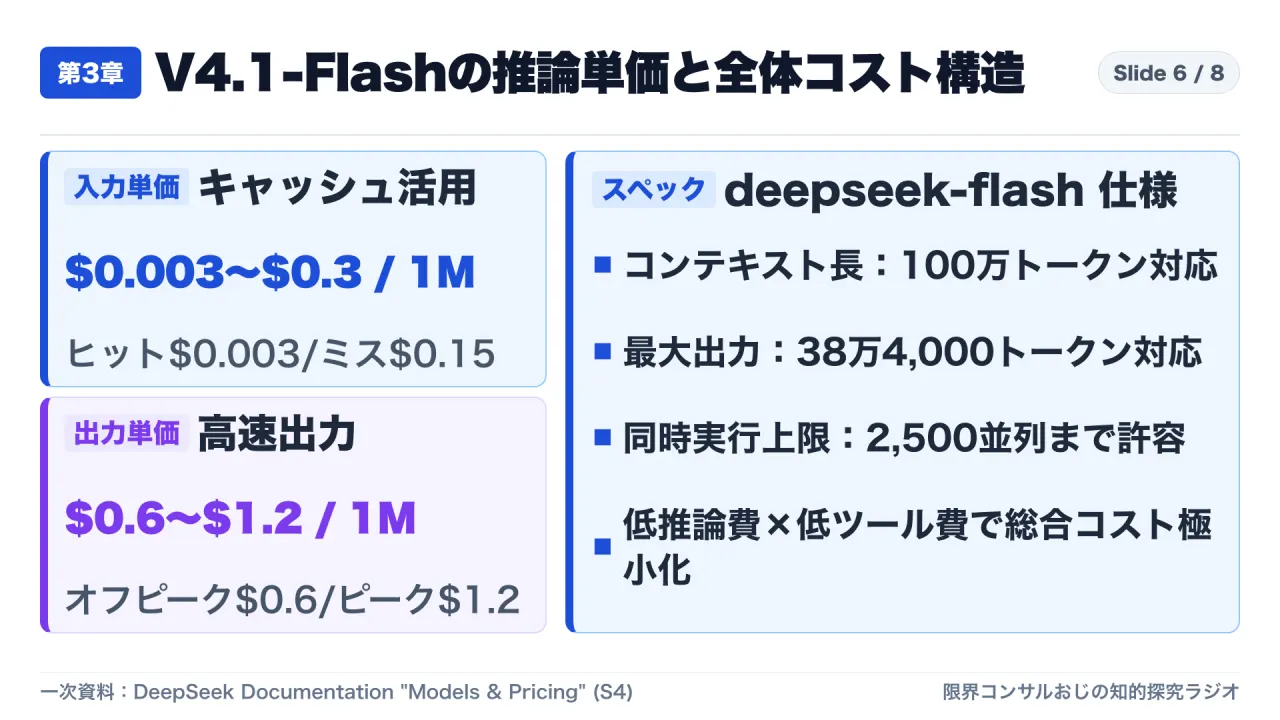
(Note: Off-peak rates apply during weekdays outside UTC 01:00-04:00 and 06:00-10:00, as well as all weekends and public holidays).
5. Client Reference Architecture and Mandatory Safety Governance
Zero-Backend Open Source Frontend (chat-demo)
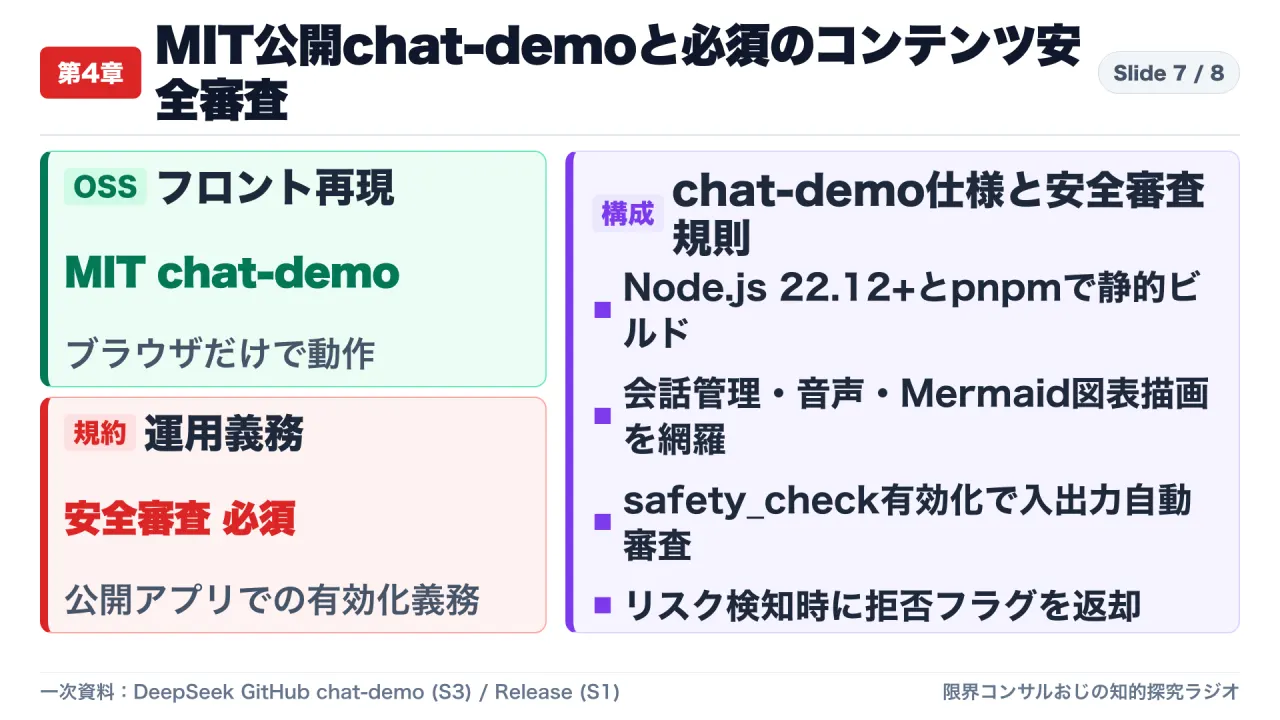
To accelerate developer adoption, DeepSeek released its full production frontend interface on GitHub (deepseek-ai/chat-demo) under the MIT open-source license:
- Technical Stack: Requires Node.js 22.12 or higher with
pnpmpackage manager. - Zero-Backend Architecture: The static client application runs entirely within the user’s browser, communicating directly with DeepSeek’s API endpoints via client-side HTTPS requests. No intermediate backend server is required.
- Client-Side State Storage: API keys, multi-session histories, user preferences, and uploaded files are stored strictly within local browser storage (
localStorageand IndexedDB). - Out-of-the-Box Feature Parity: Delivers real-time streaming, collapsible reasoning scratchpads, smart search triggers, citation badge popovers, multi-format file attachment drawers, live audio waveform visualizers during voice input, Mermaid diagram rendering, and complete JSON export/import of chat threads.
Mandatory Content Moderation Parameter (safety_check)
For organizations and developers deploying public-facing commercial applications, DeepSeek’s platform terms introduce stringent operational compliance requirements:
- Mandatory Parameter Configuration: Public services must explicitly enable the
safety_checkparameter (e.g.,{"level": "high"}) on all generation requests. - Dual-Direction Content Screening: DeepSeek’s moderation infrastructure evaluates both inbound user prompts and outbound model generations in real time. If harmful, unlawful, or policy-violating content is detected, the API stream terminates and returns a structured refusal marker (
refusal). - Developer Legal Accountability: The platform terms explicitly state that developers retain full legal responsibility for maintaining content safety within their customer applications, complying with regional AI regulatory registrations, and displaying conspicuous notices indicating that outputs are AI-generated.
6. Enterprise Migration Roadmap and Production Checklist
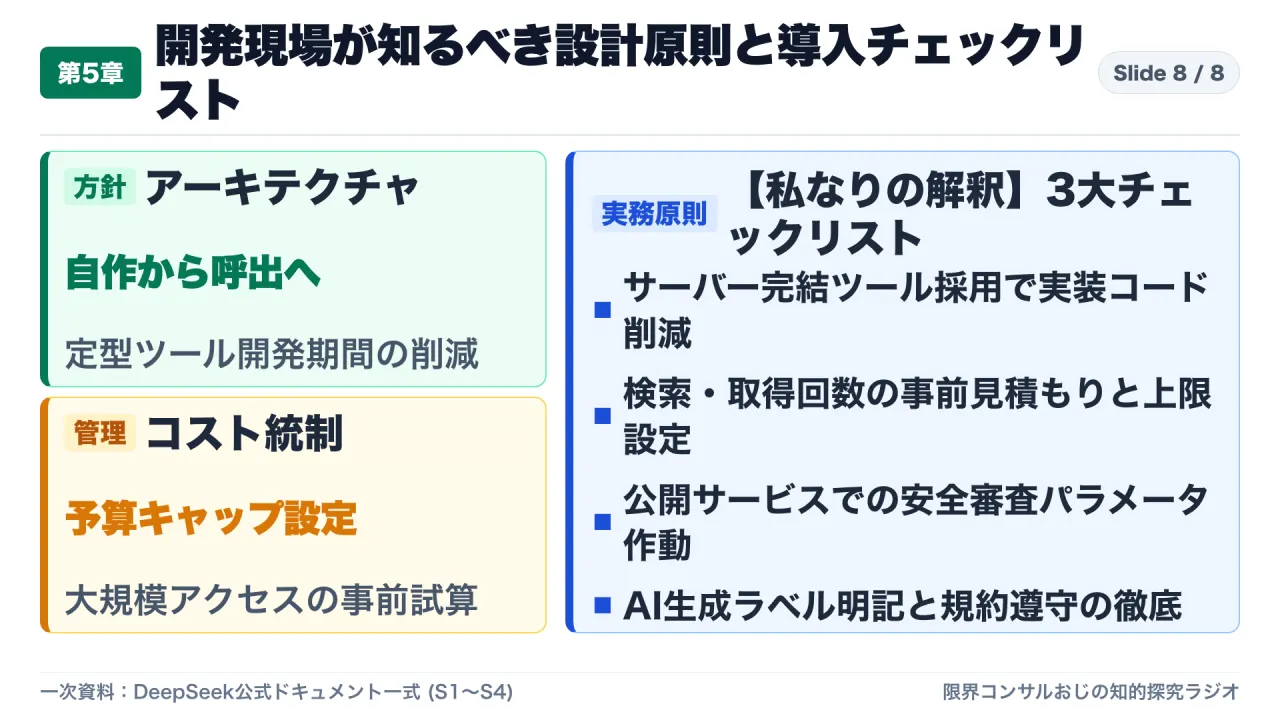
Transitioning enterprise systems from fragmented scraping scripts and disparate OCR pipelines to an integrated Application API requires methodical execution:
Enterprise Implementation Checklist
| Strategic Domain | Technical Verification Requirement | Recommended Architecture & Action |
|---|---|---|
| Scraping Infrastructure | Audit operational costs of headless browsers and custom proxies. | Decommission custom crawling services; route public URL reading to native deepseek_read_url. |
| Document OCR Pipelines | Evaluate licensing and latency of multi-format document parsers. | Replace standalone parsers with direct file ingestion via the Messages or Responses API; leverage native OCR. |
| Budget & Rate Limiting | Model recursive search frequency against token cost budgets. | Implement hard spend caps per user session to mitigate cascading costs from iterative deep thinking search loops. |
| Compliance & Guardrails | Inspect API payloads to verify moderation parameter enforcement. | Hardcode safety_check: { level: "high" } in production middleware; build robust UI handlers for refusal markers. |
| AI Disclosure & Transparency | Verify compliance with consumer transparency regulations. | Embed persistent UI labels informing end users that conversational responses are generated by artificial intelligence. |
7. Conclusion: The Emergence of the Turnkey Application API
DeepSeek’s release of the Full-Suite Application API signals a definitive transition in AI systems engineering. The primary locus of competition has expanded beyond model benchmark rankings and raw parameter counts toward the comprehensive, server-side vertical integration of utility tooling: web search, document parsing, voice synthesis, and safety moderation.
By slashing the incremental cost of grounded web search to $0.75 per 1,000 queries and providing drop-in compatibility across the Messages, Responses, and Chat Completions protocols, DeepSeek allows engineering teams to dismantle brittle client-side orchestration loops. Developers can now focus their capital and cognitive bandwidth on proprietary business workflows, secure domain integrations, and differentiated user experiences.