Anatomy of a Global SaaS Cascade: Inside the Microsoft 365 74-Nation Outage, Health-Check Self-Cannibalization, and the Cyber Insurance Recovery Fallacy
An architectural investigation into Incident EX1550543/MO1550821 reveals how automated server health checks triggered a TLS overload across 20+ services, why cyber insurance covered only 10–20% of direct losses in comparable hyperscale outages, and how enterprises must engineer out-of-band resilience.
Japanese Edition: Read the original Japanese article on Substack
Video Episode (Japanese Audio): Watch on YouTube
Disclaimer: This publication provides objective technical, architectural, and security analysis. It does not constitute commercial endorsement or investment advice.
1. Executive Summary: The Fragility of Unified Cloud Monocultures
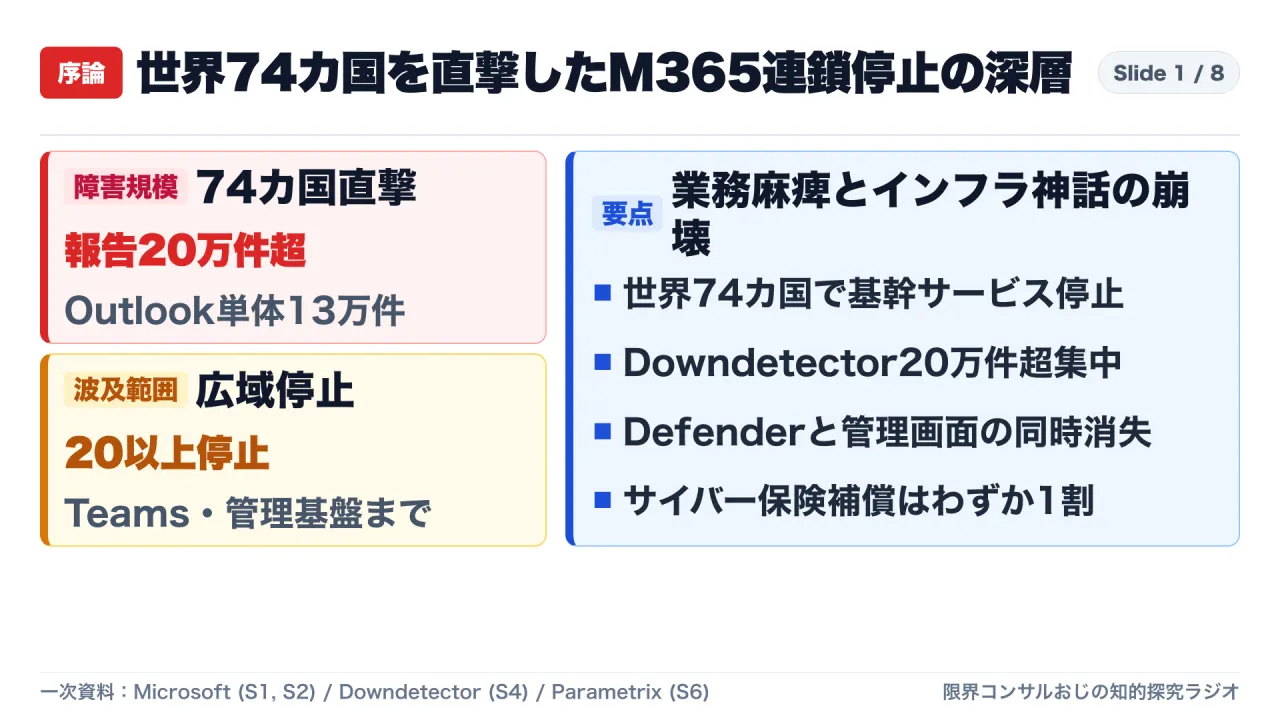
When critical communications across 74 countries collapsed simultaneously, paralyzing electronic mail, video conferencing, threat detection telemetry, and tenant administration, the global IT community witnessed the sharp reality of unified cloud monocultures.
The incident, logged under Microsoft incident identifiers EX1550543 (Exchange Online) and MO1550821 (M365 Suite), triggered over 130,000 incident reports for Outlook and more than 200,000 total reports across the suite on Downdetector. Healthcare facilities deferred outpatient triage, law enforcement dispatch centers lost access to active warrant directories, and financial institutions delayed trade settlements.
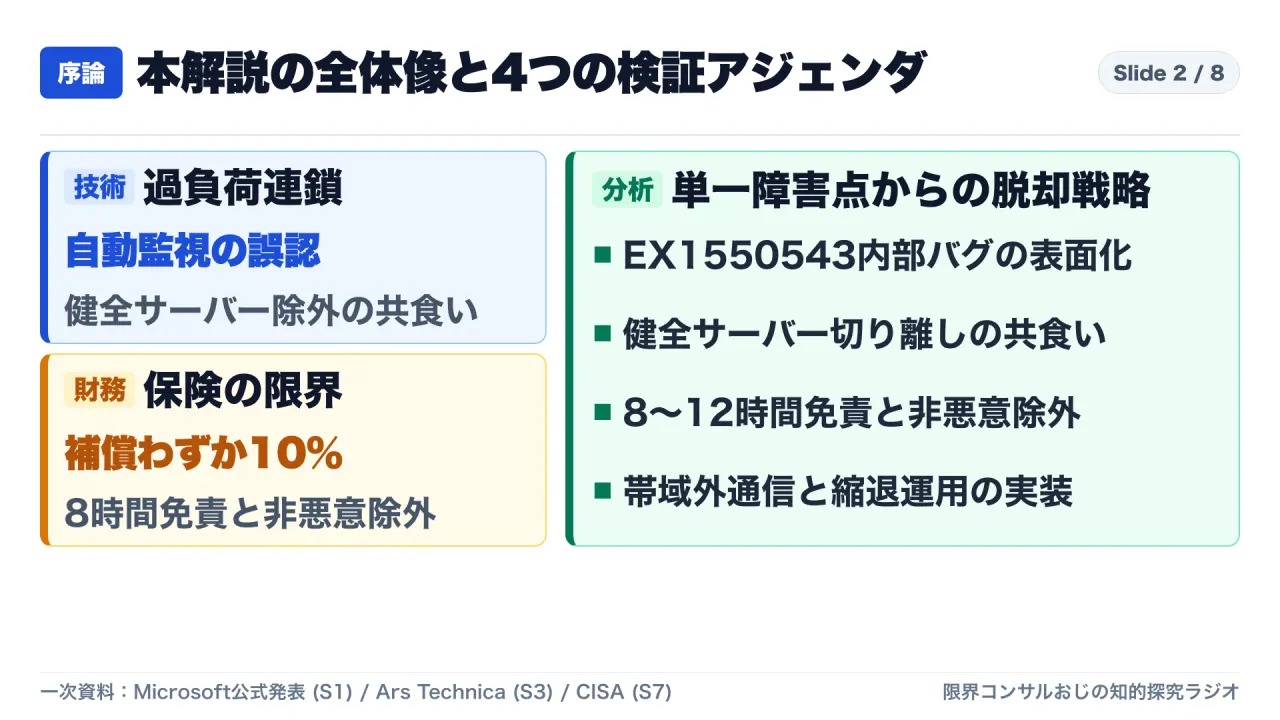
Initial speculation pointed toward state-sponsored cyberattacks or runaway autonomous AI agent swarms. However, Microsoft’s official post-incident communication confirmed that the outage stemmed from internal infrastructure dynamics: a latent configuration defect introduced during an earlier network capacity upgrade surfaced following a recent routine routing adjustment.
Crucially, the catastrophic cascade was catalyzed by the platform’s own automated defense systems. Automated server health-check algorithms misidentified transient packet latency as physical node failures, systematically ejecting healthy server pools from global traffic directors. The remaining active nodes were swamped by a tidal wave of cryptographic TLS handshakes, triggering CPU exhaustion and a cascading collapse across more than 20 interconnected services.
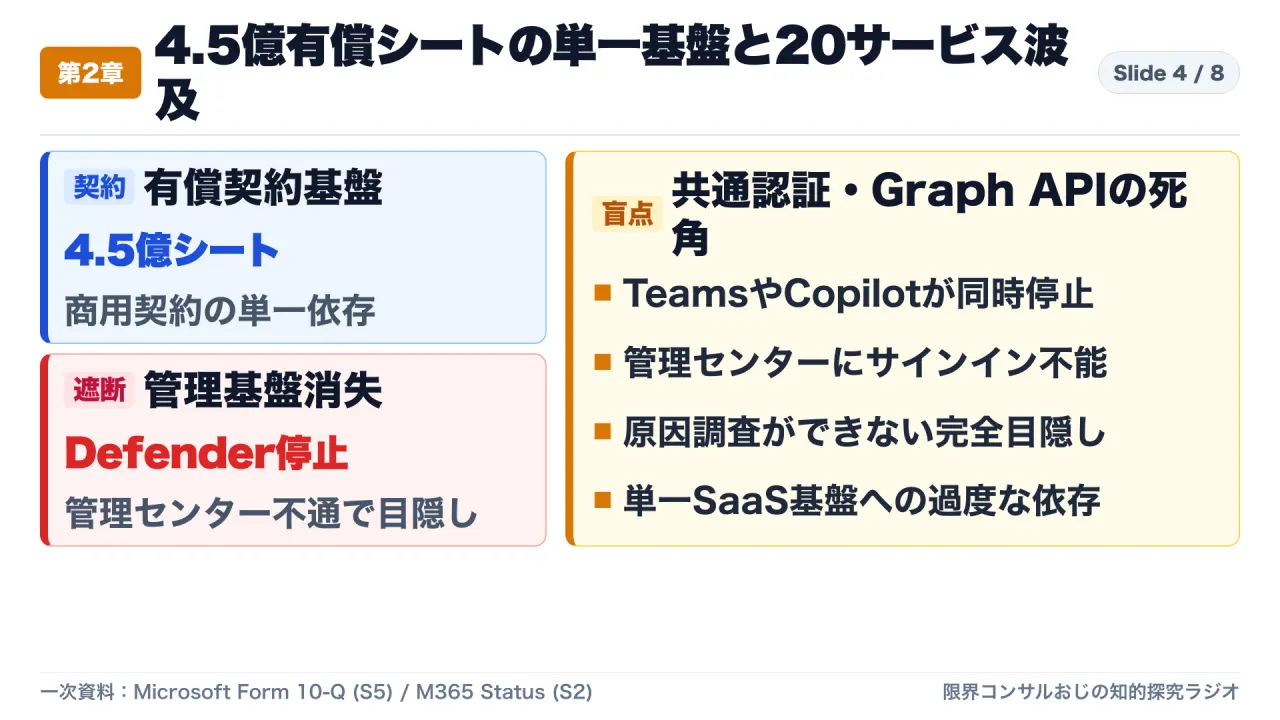
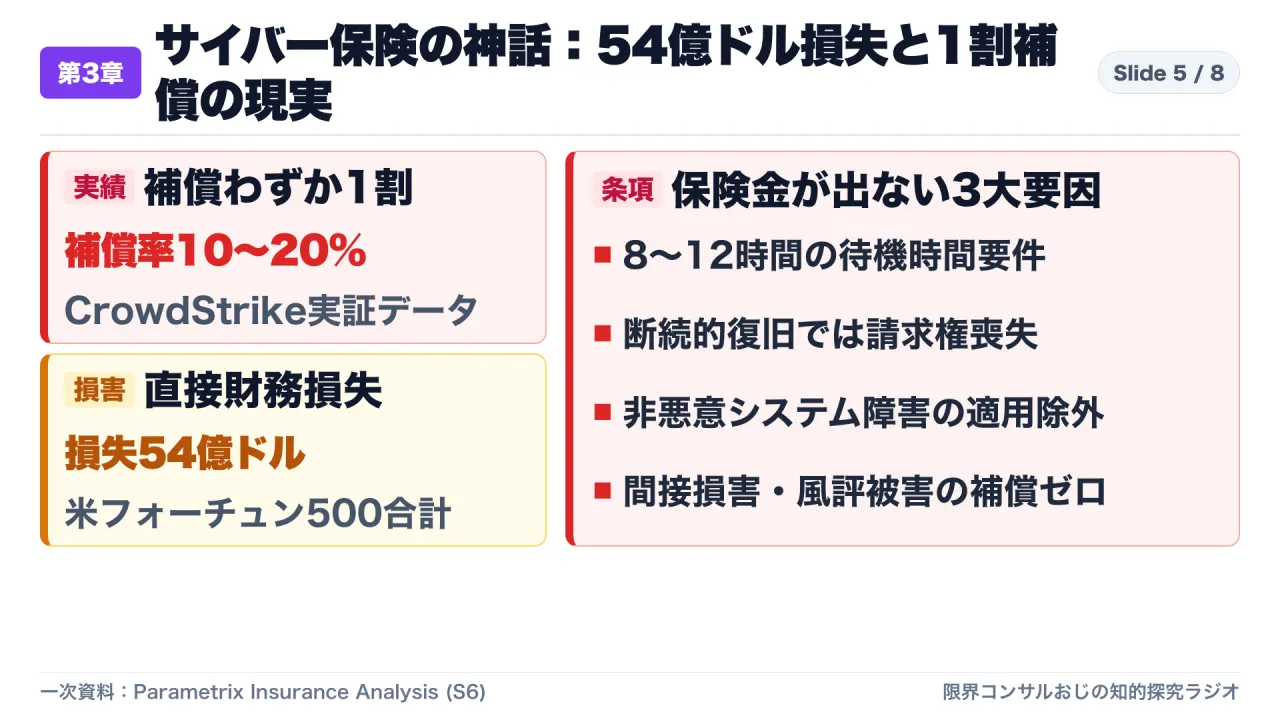
Simultaneously, the disruption shattered the corporate myth that “cyber insurance will cover cloud downtime losses.” Empirical forensic analysis from Parametrix demonstrates that during the 2024 CrowdStrike global outage—which inflicted $5.4 billion in direct financial losses on Fortune 500 companies—cyber insurance policies recovered merely 10% to 20% of the financial damage. Strict 8-to-12-hour waiting periods, non-malicious system outage exclusions, and indirect damage waivers left enterprise policyholders bearing the vast majority of the financial impact.
2. Technical Root Cause: The Mechanics of Health-Check Self-Cannibalization
The Incident Timeline and Trigger Point
The technical architecture of Microsoft 365 relies on distributed edge routing proxies (Front Door and Exchange Front End transport arrays) that continuously validate the responsiveness of backend mailbox servers and microservices.
| Incident Milestone | Technical Parameter | Primary Reference |
|---|---|---|
| Official Incident IDs | EX1550543 (Exchange Online) / MO1550821 (Suite-Wide) | Microsoft Service Health Portal |
| Global Blast Radius | 74 Countries and Territories | Downdetector Global Outage Telemetry |
| Telemetry Volume Peak | ~130k Outlook reports / ~200k Suite-wide reports | Downdetector Service Metrics |
| Underlying Root Mechanism | Automated health-check misjudgment + TLS handshake storm | Microsoft Official Communication / Ars Technica |
| Services Affected | Exchange, Teams, Copilot, Defender XDR, Admin Center (20+) | Microsoft Service Health Portal |
flowchart TD
    Config["Routine Network Configuration Change"] --> Latency["Latent Capacity Upgrade Defect Surfaced<br>(Transient Regional Latency)"]
    Latency --> Probes["Automated Health Checks<br>(High-frequency TCP/HTTP probes)"]
    Probes -->|Misinterprets latency as host death| Evict["Mass Eviction of Healthy Nodes / (Removed from Active Anycast Pools)"]
    Evict --> Concentration["Global Ingress Concentrated on Survivor Nodes"]
    Concentration --> TLSStorm["Cryptographic TLS Handshake Storm<br>(Client retry storms consume 100% CPU)"]
    TLSStorm --> Cascade["Cascading Failure Across 20+ Microservices"]
Cascading Failure in Distributed Systems
In large-scale distributed architectures, “protective” health checks frequently become the primary engine of failure propagation:
- Transient Latency vs. Node Death: High-frequency synthetic probes send heartbeat queries to worker pools. When a routine routing change introduced localized packet reordering, backend response times drifted past the health-check timeout threshold (typically 200–500ms).
- Aggressive Pool Eviction: Rather than throttling incoming ingress, the routing tier marked thousands of healthy backend instances as offline, immediately stripping them from active BGP anycast announcements.
- The TLS Handshake Avalanche: Unlike established persistent TCP streams, newly initiated TLS 1.3 connections require asymmetric cryptographic operations (Elliptic Curve Diffie-Hellman Key Exchange and RSA/ECDSA signature verification). The computational cost of negotiating a TLS session is roughly 25 to 50 times greater than routing active payload bytes.
- Retry Flooding: As desktop and mobile clients encountered dropped connections, exponential backoff implementations collapsed across hundreds of millions of endpoints. Instead of backing off gracefully, client software flooded the surviving proxies with simultaneous reconnection attempts, plunging the remaining infrastructure into total CPU exhaustion.
3. Scale and Interdependence: 450M+ Commercial Seats and Shared API Blindspots
Dissecting the User Base Metric
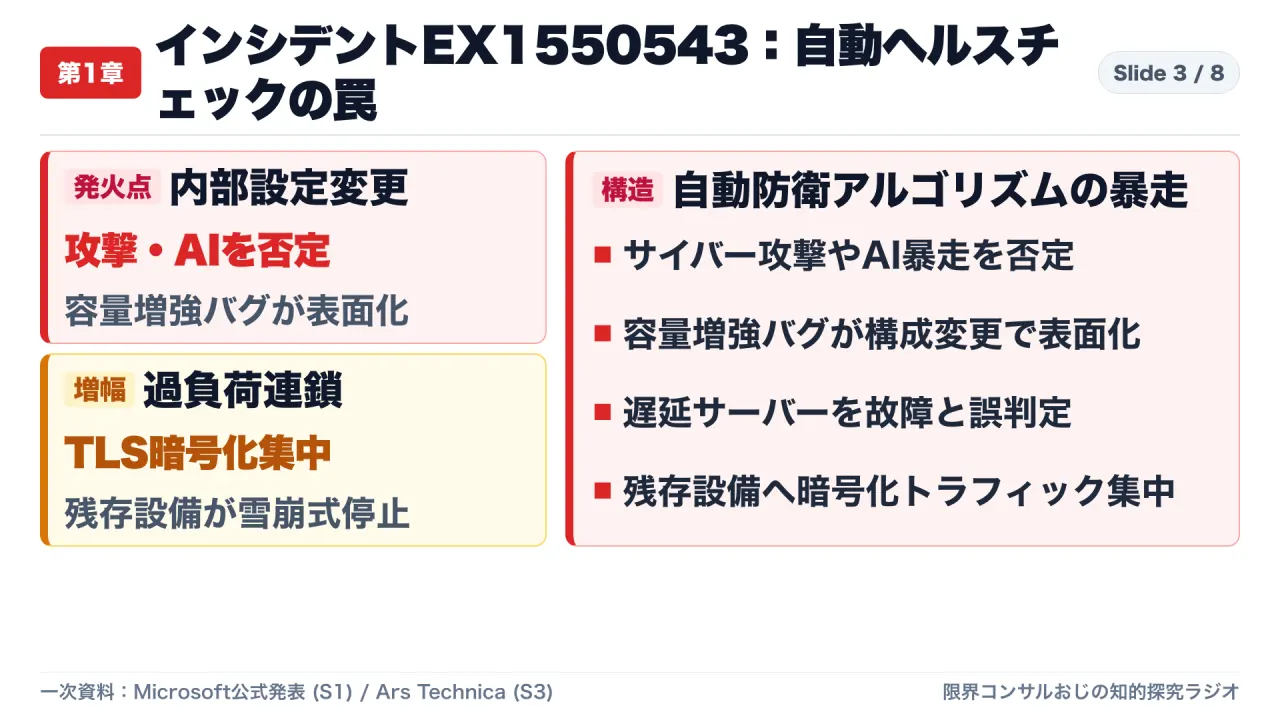
In general news reporting, the affected constituency is often mischaracterized as “450 million individual commercial users.” In SEC filings (Form 10-Q), Microsoft specifically defines this metric as 450M+ Commercial Paid Seats.
This distinction is operationally critical: a single commercial paid seat frequently represents an administrative service account, an automated ETL pipeline, a shared operational mailbox, or a medical workstation servicing multiple rotational shifts. A disruption impacting 450 million commercial seats paralyzes core organizational data pipelines far beyond individual desktop users.
The Dual-Blindspot Nightmare: Defender XDR and Admin Center Failure
Modern enterprise SaaS architecture promotes structural consolidation: organizations integrate identity, document collaboration, real-time messaging, endpoint telemetry, and access policies into a single vendor ecosystem.
During Incident EX1550543/MO1550821, this unified topology triggered an operational nightmare:
- Security Blindness (Defender XDR Loss): Microsoft Defender XDR relies on the same underlying Microsoft Graph API endpoints and identity fabric as the productivity applications. As the authentication proxies collapsed, endpoint security agents could not upload live event streams, effectively disabling enterprise security operations center (SOC) correlation engines.
- Administrative Paralysis (Admin Center Blackout): When IT incident commanders attempted to access the Microsoft 365 Admin Center to reroute MX records, inspect service health advisories, or configure tenant-wide forwarding rules, the administrative portal rejected all authentication requests.
When the tool responsible for remediating outages shares the exact failure domain as the service that failed, security teams are forced into total operational blindness.
4. Deconstructing the Cyber Insurance Myth: Why Cloud Outages Yield Pennies on the Dollar
A pervasive assumption among enterprise chief risk officers is that balance-sheet exposure from cloud infrastructure outages is mitigated by standalone corporate cyber insurance policies. Empirical evidence proves this assumption false.
Forensic Evidence from the CrowdStrike 2024 Benchmark
According to forensic risk modeling by Parametrix, the CrowdStrike Falcon update failure of July 2024 inflicted $5.4 billion in direct financial losses across US Fortune 500 enterprises (excluding Microsoft itself). However, cyber insurance policies indemnified only $540 million to $1.08 billion, representing an effective claim recovery rate of just 10% to 20%. Over 80% of direct losses were absorbed entirely by enterprise operating balance sheets.
flowchart LR
    A["Direct Fortune 500 Outage Losses<br>$5.4 Billion"] --> B{"Insurance Claim Gates"}
    B -->|Gate 1: Waiting Period / (8-12h Continuous Outage Required)| C["Claims Rejected / (Intermittent / Region-by-region recovery)"]
    B -->|Gate 2: Non-Malicious Exclusion / (Internal vendor defect, no hacker)| D["Coverage Dropped / Capped"]
    B -->|Gate 3: Indirect Damage Waivers / (Reputational & Opportunity loss)| E["Claims Excluded"]
    B -->|Approved Direct Recovery| F["Actual Insurance Payout / $540M - $1.08B (10-20%)"]
The Three Contractual Recovery Barriers
Why do enterprise policyholders recover so little following a catastrophic cloud disruption?
- The Waiting Period Gate (8–12 Hours Continuous Downtime):
- Business Interruption (BI) and Contingent Business Interruption (CBI) endorsements enforce strict time deductibles, typically requiring 8, 10, or 12 hours of uninterrupted, complete service unavailability.
- Hyperscale incidents rarely present as total, binary downtime across an entire 24-hour cycle. Traffic routes restore intermittently, web interfaces flicker, and localized data centers recover on rolling schedules. Insurance loss adjusters systematically disallow claims by arguing that the uninterrupted downtime threshold was never satisfied.
- The Non-Malicious System Failure Exclusion:
- Standard cyber policies were architected to defend against external hostile intrusion—specifically extortion, data theft, and ransomware.
- Non-malicious operational downtime (e.g., misconfigurations, vendor patch errors, capacity upgrade regressions) is frequently excluded entirely or restricted to narrow sub-limits that pay fractions of actual business interruption costs.
- Indirect Damage Waivers and Burden of Proof:
- Quantifying direct payroll losses or hardware triage costs is onerous; proving downstream lost revenue, customer churn, and SLA penalty liabilities requires audited forensic accounting that often exceeds the value of the potential settlement.
5. Frontline Operational Risks: Degraded Modes, Protocol Timeouts, and Phishing Exploits
While executive leadership monitors vendor communications, engineering and operational teams face four severe frontline failure modes:
1. New Outlook for Windows: The Loss of Cached Exchange Mode
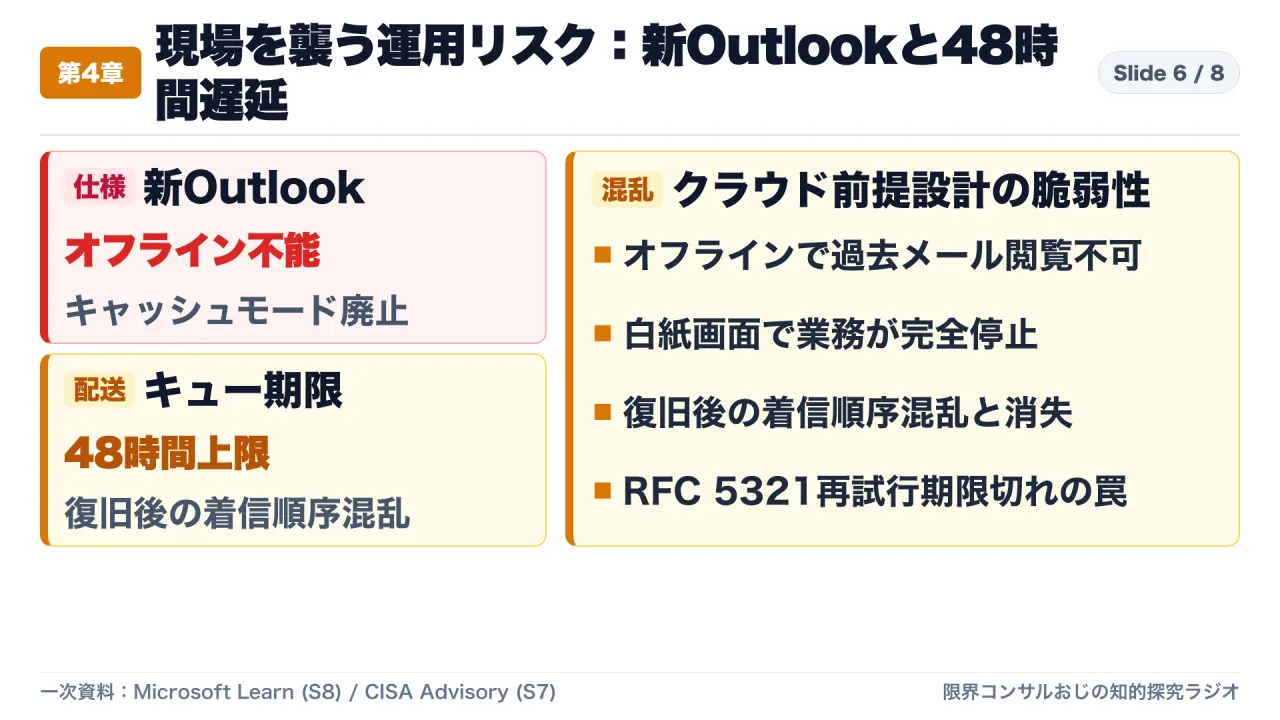
For over two decades, classic Outlook desktop (Win32) maintained local .ost cache databases via Cached Exchange Mode. If network connectivity was severed, employees retained offline access to indexed historical correspondence, contact registries, and calendar schedules, enabling continuous drafting of outgoing work.
The modern “New Outlook for Windows” (built upon WebView2 architecture) treats the client as a thin web container. Because local caching parity has not been engineered into the web application, an outage leaves users facing blank loading containers. Personnel cannot review contracts, verify billing histories, or reference emergency contact rosters stored in their inboxes.
2. RFC 5321 Delivery Retry Timeouts and Message Queuing
Under the Simple Mail Transfer Protocol (SMTP) standard defined in RFC 5321, external Mail Transfer Agents (MTAs) queue undelivered mail for a maximum retry interval—conventionally configured between 48 and 72 hours.
If tenant mail exchanges remain unreachable beyond this boundary, external relays emit terminal Non-Delivery Reports (NDRs) and purge the queued messages permanently. Furthermore, upon service recovery, queued messages from external senders flood tenant mailboxes simultaneously, inverting chronological delivery order and causing critical workflow deadlocks.
3. Panic-Driven Opportunistic Phishing
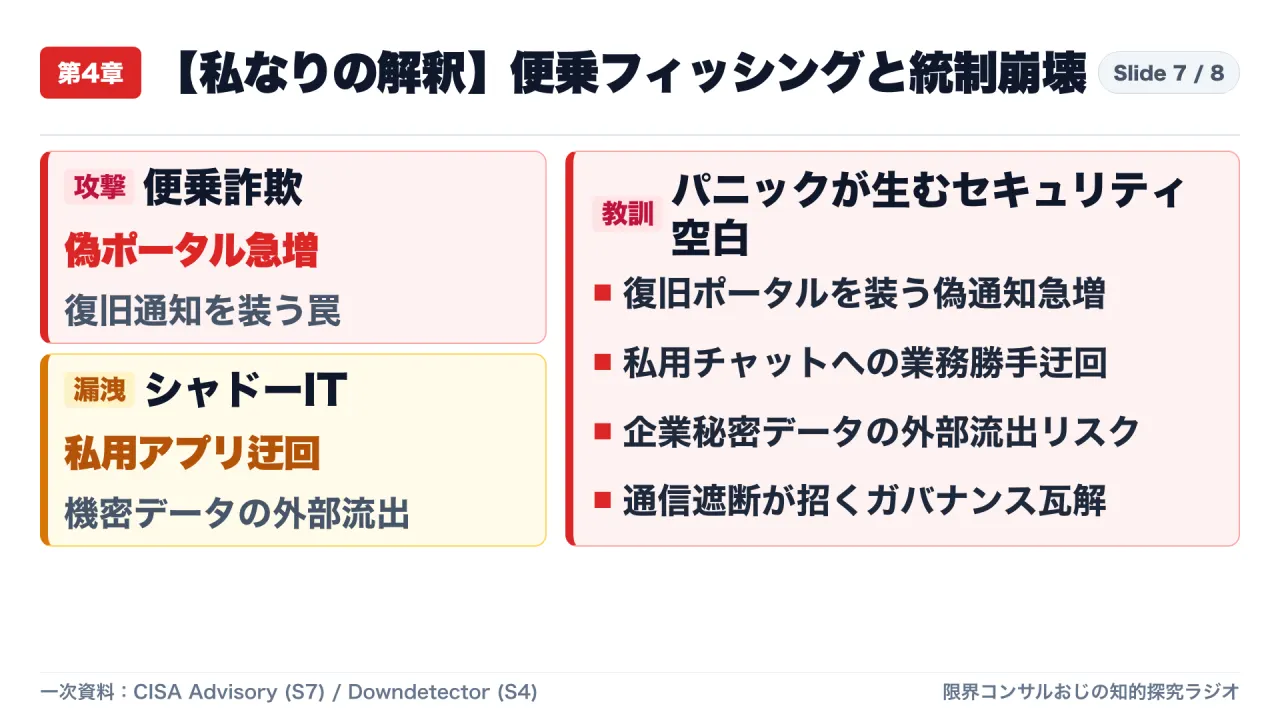
Adversaries exploit operational uncertainty. Within hours of the outage onset, threat actors launch targeted credential harvesting campaigns via external SMS and personal email channels, distributing lures masquerading as “Microsoft 365 Emergency Service Reconnect Portals” or “MTA Queue Verification Forms.” Panicked personnel routinely compromise organizational credentials in an effort to restore daily workflows.
4. Shadow IT Proliferation
When official communication systems fail, employees migrate operational data into unauthorized consumer messaging channels (e.g., personal WhatsApp groups, Telegram, unmanaged personal email). This mass exodus of corporate intellectual property bypasses Data Loss Prevention (DLP), enterprise archiving, and regulatory retention baselines, establishing long-term compliance liabilities.
6. Enterprise Hardening Blueprint: Out-of-Band Resilience and Degraded Operations
Hyperscale cloud providers operate state-of-the-art data centers, but zero downtime is mathematically unattainable in planetary-scale distributed software. Organizations must implement three deterministic architectural safeguards:
flowchart TD
    subgraph HardenedPosture["Three Pillars of Enterprise SaaS Resilience"]
        Pillar1["1. Out-of-Band Communication<br>Independent identity provider (non-Entra ID)<br>Isolated emergency messaging backbone"]
        Pillar2["2. Offline Degraded Mode Standards<br>Preserve classic Win32 client caches<br>Documented offline business continuity runbooks"]
        Pillar3["3. Contractual & SLA Audit<br>Review policy waiting periods (<4h desired)<br>Mandate non-malicious system outage coverage"]
    end
1. Provisioning True Out-of-Band (OOB) Incident Channels
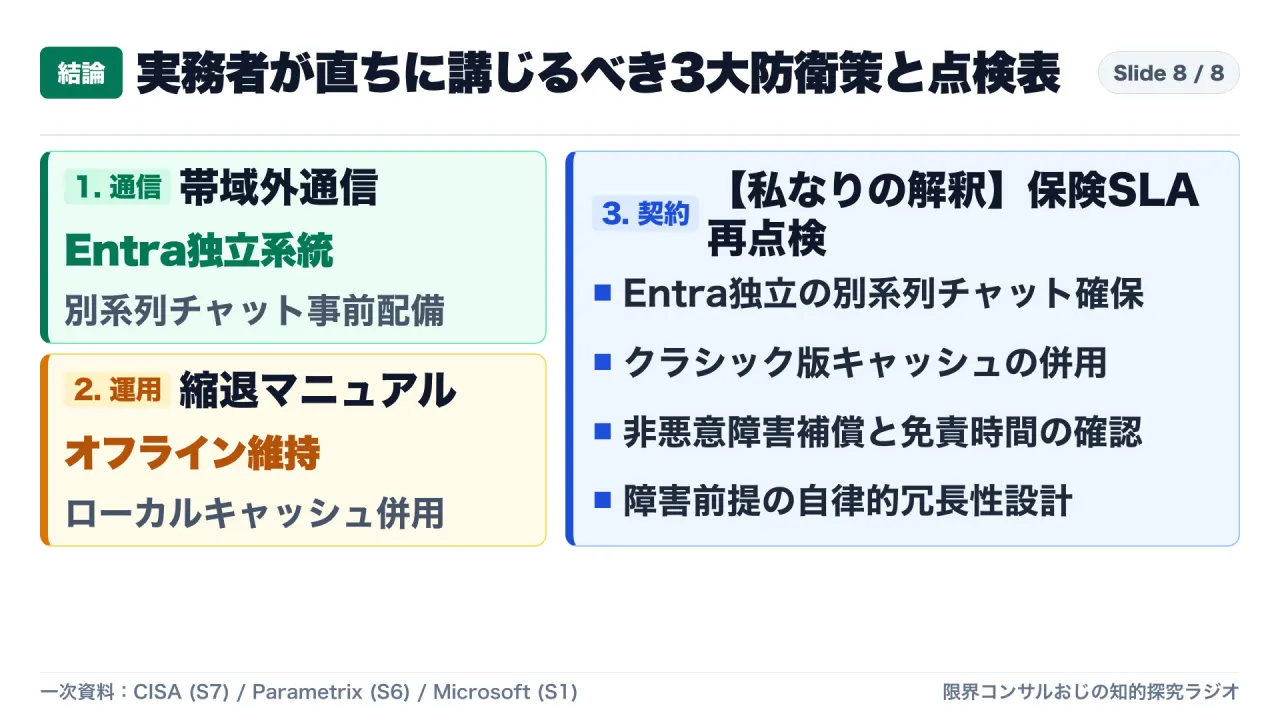
Incident response teams must never rely on the infrastructure they are tasked with restoring. Enterprise architecture must maintain an emergency communications backbone completely separated from Microsoft Entra ID (formerly Azure AD). This requires:
- Dedicated emergency communication platforms authenticated via an independent secondary Identity Provider (IdP).
- Out-of-band communication directories published securely on hardware security tokens or distributed encrypted local storage.
- Pre-authorized administrative escalation runbooks that execute without cloud-mediated multi-factor authentication loops.
2. Formalizing Degraded-Mode Operational Runbooks
Organizations must define and regularly rehearse “Degraded Mode” standard operating procedures:
- Client Policy Freeze: Retain Win32 Classic Outlook with Cached Exchange Mode on all mission-critical workstations rather than enforcing premature migrations to thin-client web wrappers.
- Local Operational Caches: Mandate that critical vendor contacts, dispatch procedures, and architectural diagrams are mirrored to local encrypted storage or dedicated on-premises appliances.
- Shadow IT Containment: Establish pre-cleared, corporate-managed secondary communication pathways so employees never resort to unvetted consumer messaging applications.
3. Auditing Cyber Insurance Endorsements and Vendor SLAs
Corporate risk managers must conduct immediate reviews of their policy portfolios:
- Audit the Waiting Period definitions in all Contingent Business Interruption endorsements; negotiate reductions from 12 hours down to 4 or 6 hours.
- Verify explicit coverage riders for Non-Malicious Administrative and Operational Failures, ensuring that provider misconfigurations are treated on par with external cyber intrusions.
- Re-evaluate SaaS Service Level Agreements (SLAs); vendor service credits (typically 10% to 25% of monthly subscription fees) represent negligible fractions of actual operational disruption costs.
7. Conclusion: Sovereign Resilience in an Era of Centralized Utilities
The Microsoft 365 74-nation cascade serves as a watershed moment for enterprise technology leadership. Centralized SaaS delivers unprecedented productivity and economies of scale, but it transforms diverse organizational computing environments into a synchronized single point of failure.
Neither vendor SLAs nor cyber insurance policies can restore lost operational integrity during a global cloud blackout. True operational resilience cannot be outsourced; it must be engineered through architectural isolation, out-of-band communication channels, and disciplined offline continuity protocols.