The Revenge of the CPU: Ex-Apple Chief Architect on Amdahl's Law in AI Data Centers, AI-Assisted Chip Design, and Silicon Realities
A forensic technical analysis of Gerard Williams III’s Nuvacore thesis, single-thread orchestration bottlenecks in GPU clusters, the collapse of modeling timelines versus invariant silicon physics, and correcting legal misconceptions surrounding Apple and Arm litigation.
Japanese Edition: Read the original Japanese article on Substack
Video Episode (Japanese Audio): Watch on YouTube
Disclaimer: This publication provides objective technical, architectural, and legal analysis based on public primary records. It does not constitute commercial endorsement or investment advice.
1. The Paradox of Modern AI: Why Massive GPU Clusters Are Choking on the CPU
In an era defined by hundreds of billions of dollars poured into specialized accelerators and massive GPU clusters, an unexpected component has resurfaced as the ultimate arbiter of performance: the central processing unit (CPU).
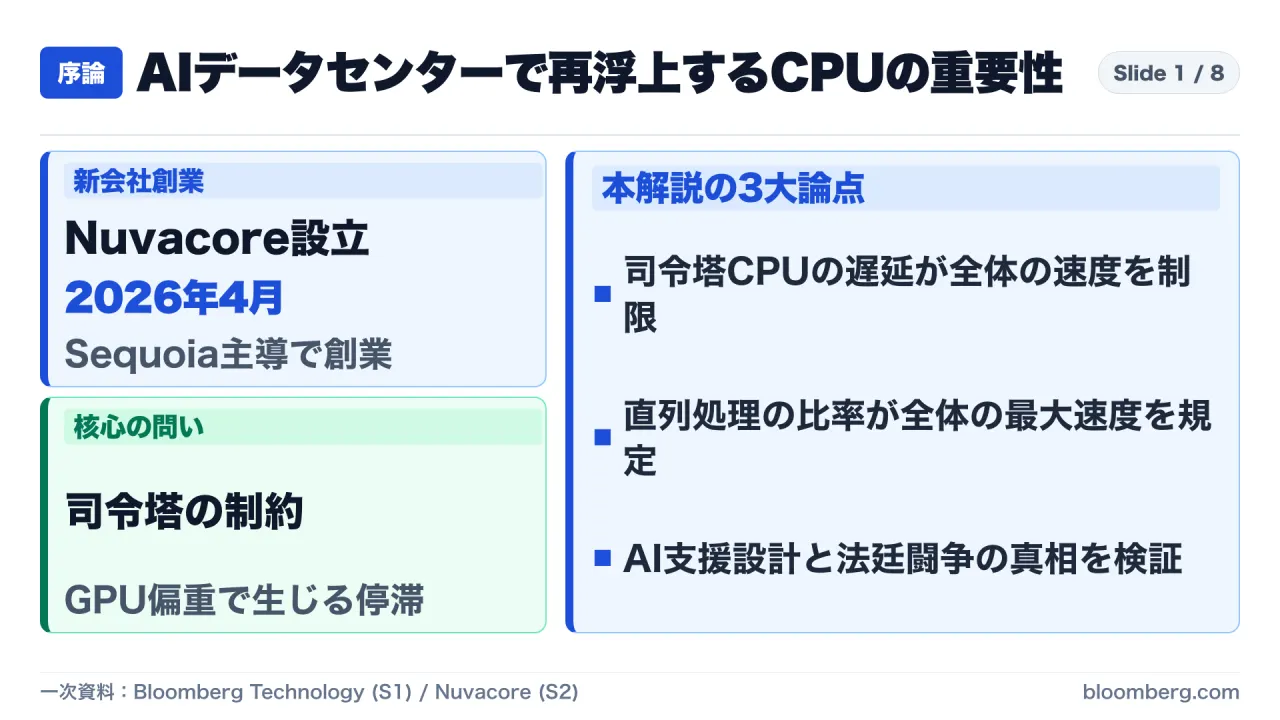
This reality was brought to the forefront by Gerard Williams III, former Chief CPU Architect at Apple and co-founder of Nuvia, in an extensive interview on Bloomberg Technology’s The Circuit. Having led the architectural design of Apple’s defining silicon from the A7 (the industry’s first 64-bit mobile processor) through the A13 and the foundations of the M-series, Williams established Nuvacore on April 15, 2026, backed by Sequoia Capital.
On September 29, 2026, Nuvacore unveiled its “Core First” design paradigm and the “WarpCore” processor architecture. Williams’s core thesis is deceptively simple yet architecturally profound: No matter how massively parallel your accelerator array becomes, total system throughput remains bounded by the single-thread performance of the orchestrating CPU.
flowchart LR
    A["Raw Data Ingestion"] --> B["Serial CPU Orchestration<br>Tokenization & Network Dispatch"]
    B --> C["Massive GPU Acceleration<br>Tensor GEMM & FlashAttention"]
    C --> D["Serial CPU Post-Processing<br>Dynamic Routing & Tool Handshake"]
    D --> E["Response Output"]

    style B fill:#FEF2F2,stroke:#DC2626
    style D fill:#FEF2F2,stroke:#DC2626
    style C fill:#EFF6FF,stroke:#1D4ED8
2. Nuvacore and the “Core First” ISA-Agnostic Blueprint
Gerard Williams III is widely regarded as one of the most consequential processor architects of the modern computing era. During his nine-year tenure as Apple’s Chief CPU Architect, he designed the high-performance custom cores that established the iPhone and Mac as benchmarks in single-thread performance per watt. In 2019, he co-founded Nuvia, developing the custom Phoenix Arm core that was acquired by Qualcomm in 2021 for approximately $1.4 billion, serving as the microarchitectural foundation of the Snapdragon X Elite.
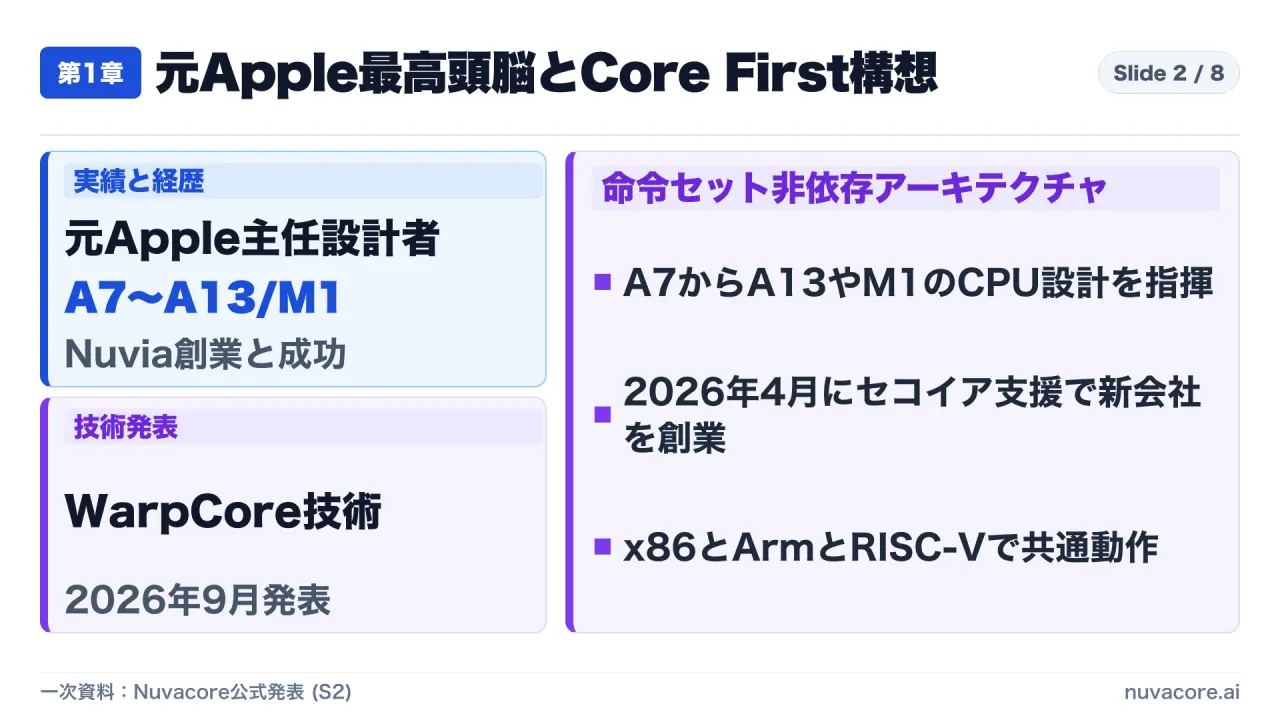
With Nuvacore, Williams is executing a radically ambitious vision: an Instruction Set Architecture (ISA) agnostic core.
Historically, semiconductor developers designed custom silicon anchored strictly to a single instruction set—such as Intel/AMD x86-64, Arm, or open-standard RISC-V. WarpCore breaks this coupling by decoupling the underlying out-of-order execution engine from the instruction decoder frontend.
By swapping the decode logic, the exact same high-efficiency execution fabric can natively run x86, Armv9, or RISC-V binaries across a continuous power envelope spanning from 1 milliwatt in ultra-low-power edge devices up to high-wattage hyperscale cloud servers. This eliminates instruction set lock-in while delivering uncompromising single-thread execution latency.
3. Amdahl’s Law in Heterogeneous AI Infrastructure
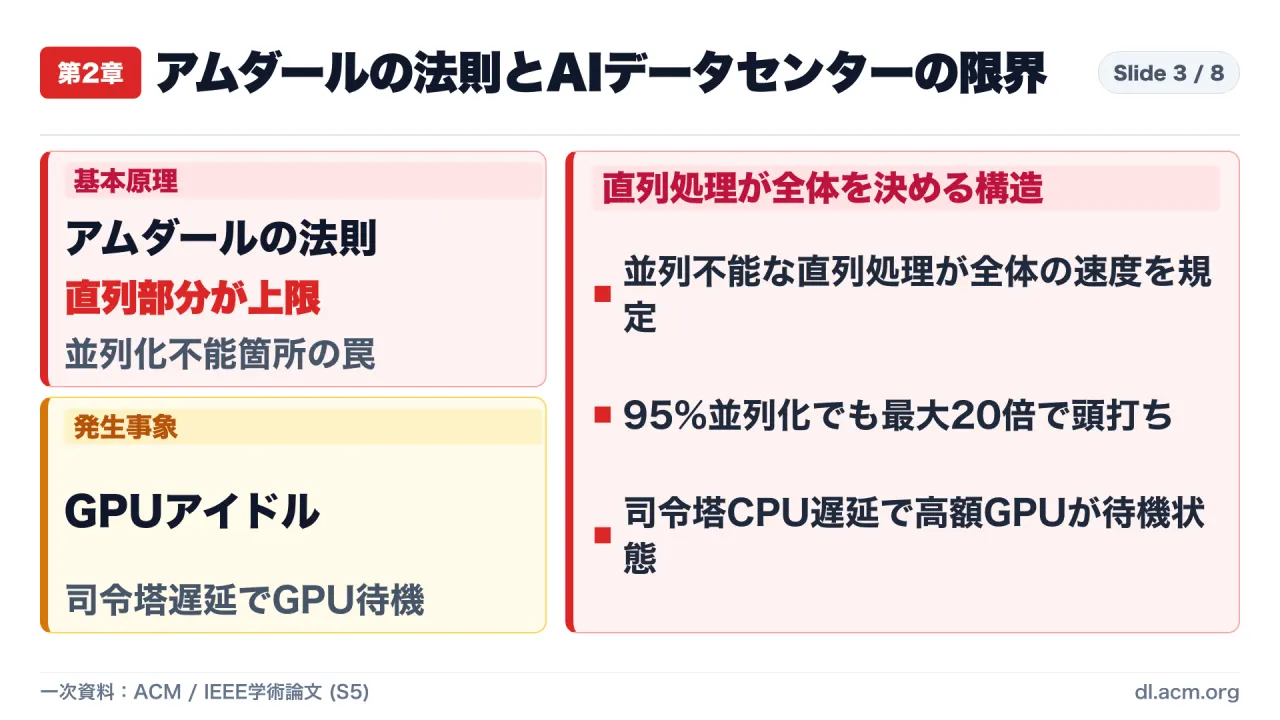
The mathematical imperative behind Nuvacore’s thesis is Amdahl’s Law. For any computational workload where a fraction P can be parallelized with a speedup factor S, the theoretical maximum speedup of the aggregate system S_total is governed by:
S_total = 1 / ((1 - P) + (P / S))
As parallel compute capacity approaches infinity (S → ∞), the overall system speedup ceiling converges strictly to 1 / (1 - P).
| Parallel Fraction (P) | Serial Fraction (1 - P) | Maximum Theoretical System Speedup (S → ∞) | Architectural Consequence in AI Clusters |
|---|---|---|---|
| 50.0% | 50.0% | 2.0x | Accelerator investments yield rapidly diminishing returns |
| 80.0% | 20.0% | 5.0x | Hard performance ceiling regardless of cluster scale |
| 90.0% | 10.0% | 10.0x | 10% serial overhead consumes 90% of aggregate execution latency |
| 95.0% | 5.0% | 20.0x | Modern AI workload baseline; total speedup capped at 20x |
| 99.0% | 1.0% | 100.0x | Requires extreme single-thread host CPU optimization |
In contemporary AI workloads—particularly agentic workflows, dynamic reasoning trees, and test-time compute scaling—serial overhead has expanded dramatically. The host CPU must execute several mission-critical non-parallelizable tasks:
- Dynamic Branching and Tool Invocation: Determining the next reasoning step based on dynamic model outputs.
- KV-Cache Paging and Host Memory Marshaling: Coordinating multi-gigabyte context shifts across PCIe and NVLink interfaces.
- Network Packet Serialization: Handling RoCEv2 and InfiniBand communication handshakes across thousands of distributed cluster nodes.
When the host CPU suffers from mediocre single-thread execution latency, multi-million-dollar GPU clusters sit idle waiting for instruction dispatch—a failure mode known in distributed systems as “GPU starvation.”
4. AI-Assisted Chip Design: Compressing 12 Months to 2, and the Invariant Silicon Cycle
The Breakthrough in Initial Performance Modeling
One of Williams’s most significant disclosures is the tangible productivity impact of machine learning within semiconductor microarchitecture design:
- Legacy Performance Modeling: Historically required 7 to 12 months of human effort. Architects wrote bespoke simulators in C++ or Python and manually evaluated narrow slices of the vast architectural parameter space.
- AI-Assisted Exploration: Now collapsed to 2 to 3 months (an approximate 75% reduction in project duration). Machine learning surrogate models rapidly evaluate millions of microarchitectural configurations—tuning reorder buffer depths, cache sizing, and branch prediction algorithms to identify Pareto-optimal trade-offs.
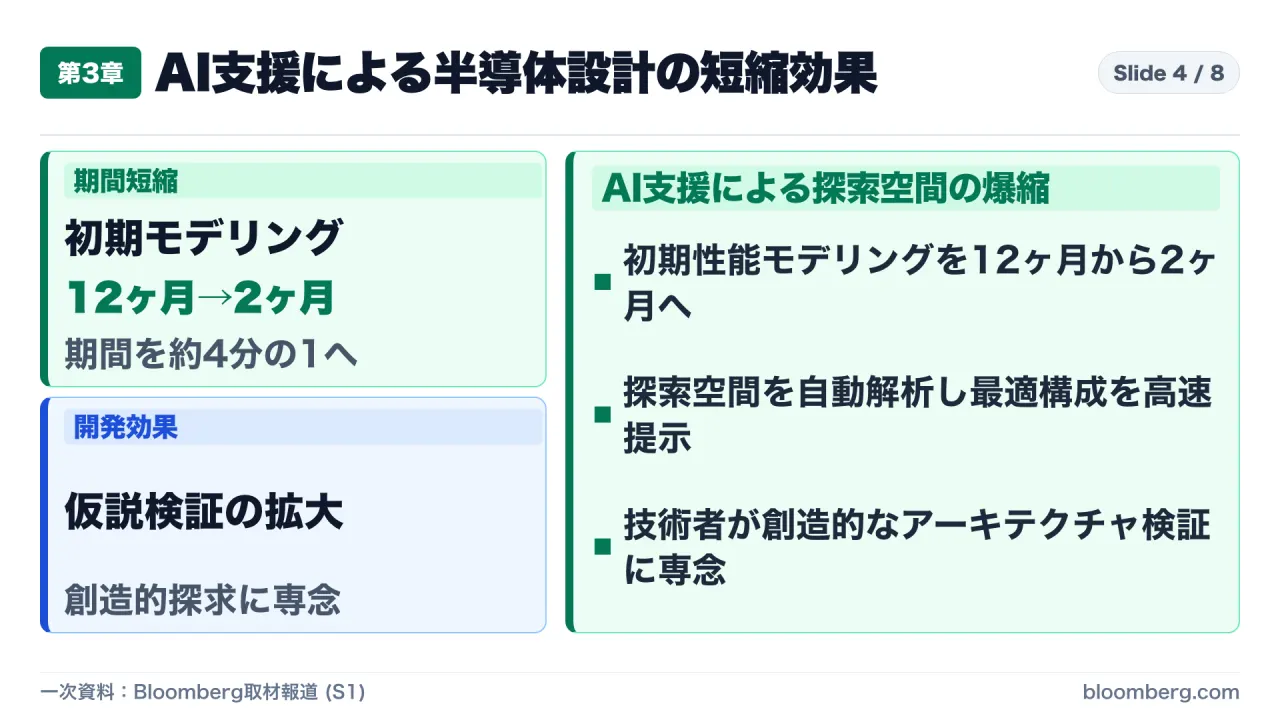
This enables architectural teams to explore substantially more experimental ideas and stress-test unconventional design hypotheses without consuming human engineering quarters.
flowchart TD
    subgraph AI Acceleration (~75% Time Reduction)
        M["Initial Performance Modeling<br>7-12 Months -> 2-3 Months"]
    end
    subgraph Invariant Silicon Physics (~2-3 Years)
        RTL["RTL Logic Implementation"] --> SYN["Logic Synthesis & Place-and-Route"]
        SYN --> TIM["Static Timing Analysis & Verification"]
        TIM --> TAPE["Tapeout & Mask Fabrication"]
        TAPE --> FAB["Foundry Lithography & Wafer Processing"]
        FAB --> PKG["Advanced Packaging & Substrate Assembly"]
        PKG --> VAL["Silicon Bring-Up & Volume Ramp"]
    end
    M --> RTL

    style M fill:#ECFDF5,stroke:#047857
    style FAB fill:#FEF2F2,stroke:#DC2626
    style PKG fill:#FEF2F2,stroke:#DC2626
The Hard Limits: Vetting and the Physical Silicon Cycle
Crucially, Williams dismissed the popular narrative that “AI will autonomously design complete chips” by emphasizing two structural constraints:
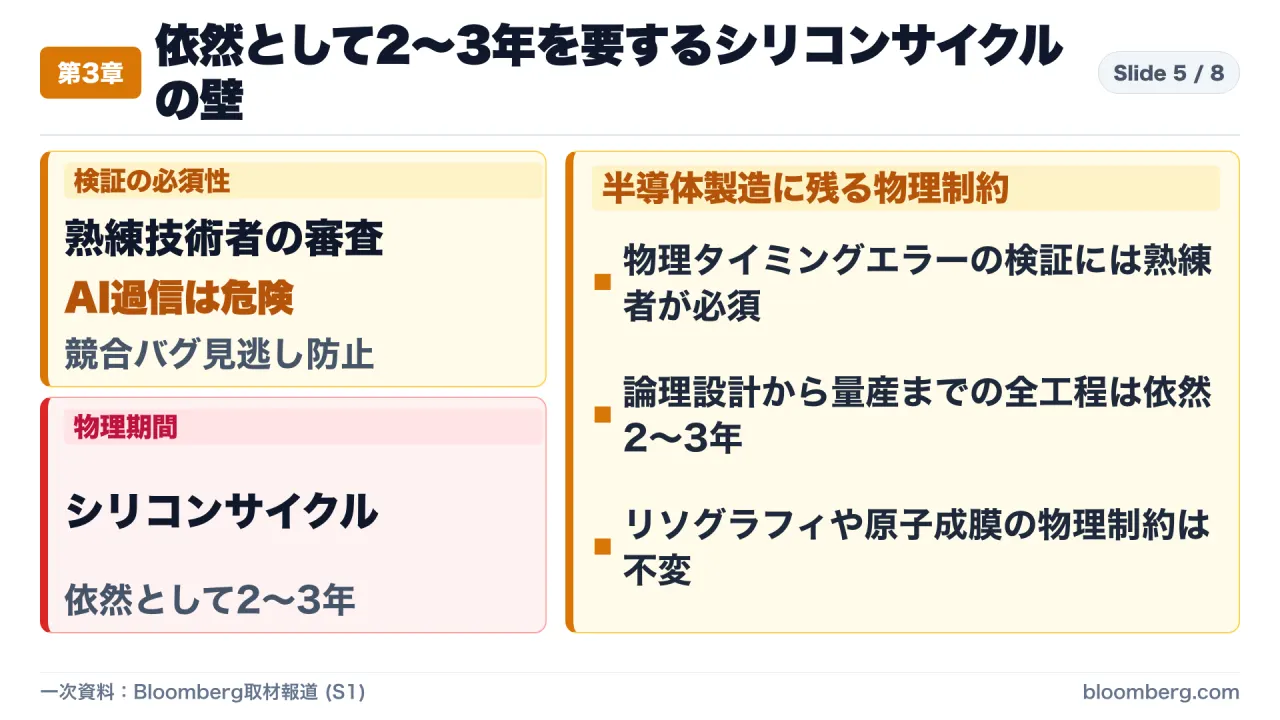
- The Critical Need for Senior Engineering Vetting:
- Machine learning algorithms frequently propose netlists that appear theoretically viable under static benchmarks but introduce catastrophic edge-case bugs, physical timing violations, or silent race conditions.
- Without seasoned architects vetting every automated synthesis suggestion, multi-million-dollar photomask sets risk immediate invalidation upon first silicon bring-up.
- The Invariant 2-to-3-Year Silicon Cycle:
- Compressing initial modeling from 12 months to 2 months does not alter the physical reality of lithography, atomic-layer deposition, wafer etching, and advanced multi-die packaging.
- From initial architecture freeze to commercial volume production, the end-to-end silicon timeline remains resolutely anchored at 2 to 3 years. Moving physical atoms on silicon wafers cannot be accelerated by software abstractions.
5. Correcting the Legal Record: Apple’s Voluntary Dismissal vs. Arm Litigation
During the broadcast, host Mark Gurman suggested that the courts had thrown out Apple’s breach of contract lawsuit against Gerard Williams III as “frivolous.” Public court dockets demonstrate that this claim conflated distinct legal proceedings.
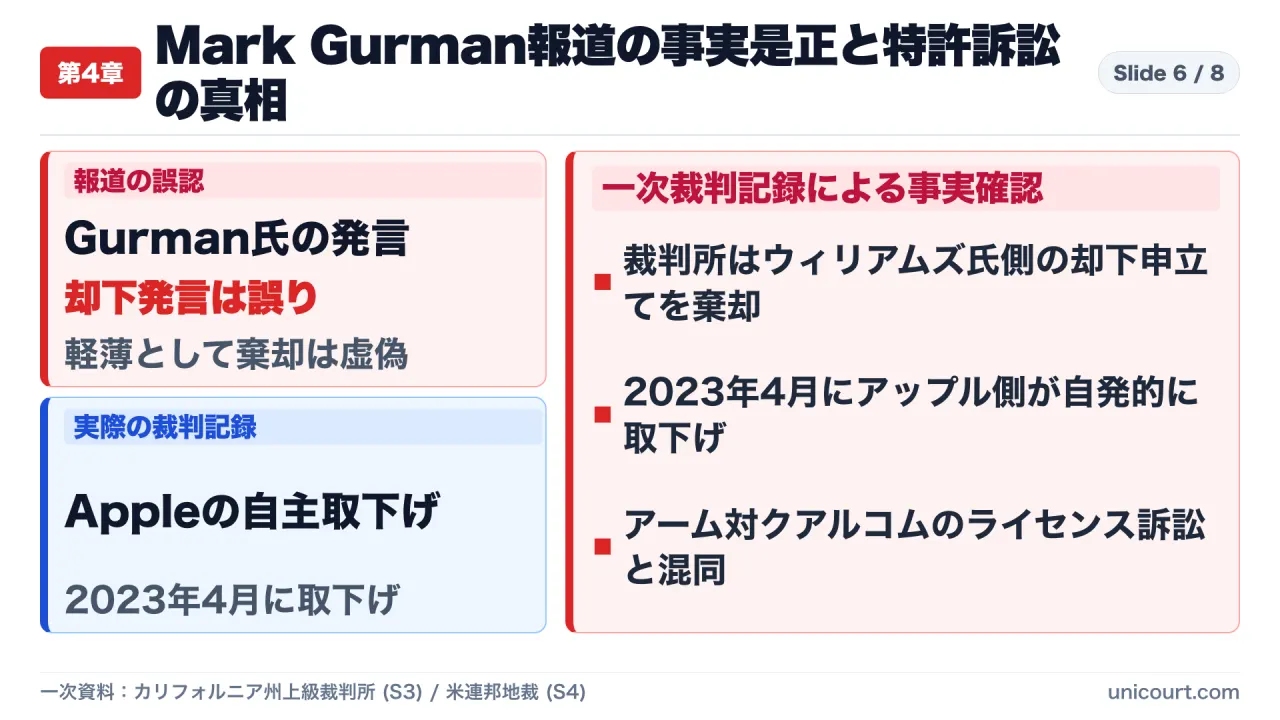
Primary Docket Comparison
In August 2019, Apple filed suit in California Superior Court (Santa Clara County, Case No. 19CV358504), alleging that Williams breached his employment agreement and duty of loyalty by preparing Nuvia while still employed as Apple’s Chief CPU Architect.
| Legal Dimension | Media Broadcast Claim | Verified Court Record (Case No. 19CV358504) |
|---|---|---|
| Motion to Dismiss / Demurrer | “Court threw out suit as frivolous” | Motion to Dismiss DENIED (January 14, 2020). The judge ruled Apple’s claims possessed legal merit to proceed to trial. |
| Final Resolution | Involuntary judicial dismissal | Apple filed a voluntary Request for Dismissal with Prejudice (April 26, 2023), electing to withdraw after nearly 4 years of litigation. |
| Conflated Federal Litigation | Conflated with employment suit | Arm Ltd. v. Qualcomm Inc. & Nuvia Inc. (D. Del., Case No. 22-cv-01146-MSG), involving summary judgment in Sep 2025 and jury trial in Oct 2026. |
The court never deemed Apple’s suit frivolous; rather, it sustained Apple’s claims against Williams’s preliminary demurrer before Apple chose to voluntarily withdraw the action. Media commentary conflated this California state employment dispute with the federal architectural licensing battle between Arm and Qualcomm in Delaware.
6. Architectural Frontiers: Memory Ordering Across ISAs and Hyperscaler Integration
The ISA-Agnostic Challenge: TSO vs. Weak Memory Ordering
Nuvacore’s WarpCore targets execution across x86-64, Armv9, and RISC-V from a unified microarchitectural core. The primary computer engineering hurdle in this approach lies in memory consistency models:
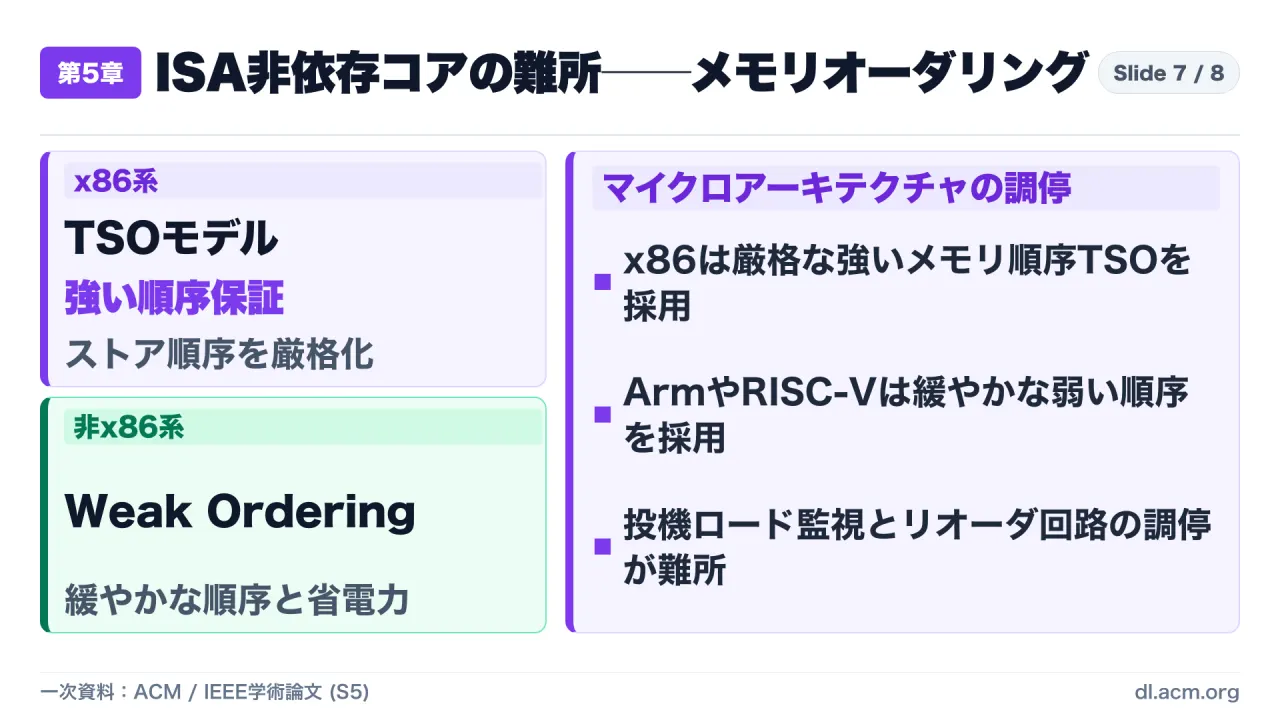
- x86 Total Store Order (TSO): Mandates strict store ordering. A load cannot bypass an older store to the same address, and stores appear in a globally visible sequence, requiring complex speculative load snooping hardware.
- Arm and RISC-V Weak Ordering: Permits aggressive store-load reordering, delegating synchronization to explicit memory barriers, which simplifies execution queues and reduces idle energy.
Bridging these opposing memory models within a single execution pipeline without incurring significant silicon area and IPC penalties requires dynamic reorder buffer arbitration—a feat that represents the pinnacle of microarchitectural design.
Hyperscaler Vertical Integration vs. Independent Silicon IP
As cloud hyperscalers accelerate proprietary Arm deployments—AWS Graviton, Google Axion, Microsoft Cobalt, and NVIDIA Grace/Vera—the market for high-performance general-purpose CPU IP has bifurcated.
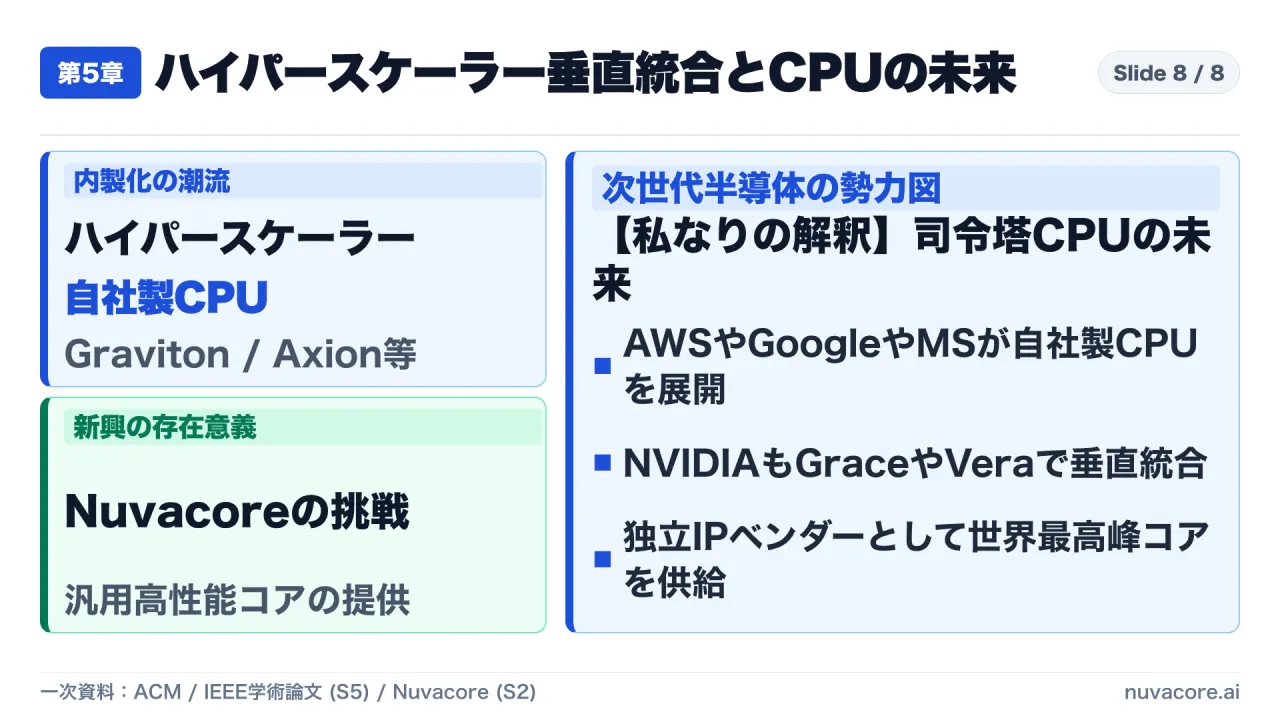
Nuvacore’s positioning as an independent silicon provider delivering best-in-class single-thread execution across instruction sets offers critical architectural flexibility for systems builders unwilling to surrender their infrastructure roadmap to captive cloud silicon monopolies. AI progress cannot rely solely on accelerator scaling; true computational throughput demands balanced co-design between parallel tensor units and ultra-fast serial orchestration.
Primary Sources & References
-
Bloomberg Technology: “The Circuit with Mark Gurman: Gerard Williams III Interview” (November 13, 2026)
In-depth interview covering Nuvacore’s founding, AI chip design workflows, and CPU bottlenecks.
https://www.bloomberg.com/news/videos/2026-11-13/the-circuit-gerard-williams-nuvacore-interview -
Nuvacore Official Announcement: “Introducing Nuvacore: Core First Architecture and WarpCore Technology” (September 29, 2026)
Architectural disclosure of ISA-agnostic processor core supporting x86, Arm, and RISC-V.
https://nuvacore.ai/news/2026-09-29-core-first-warpcore-announcement -
California Superior Court (Santa Clara County): “Apple Inc. v. Gerard Williams III, Case No. 19CV358504”
Verified court dockets documenting the January 14, 2020 Demurrer denial and April 26, 2023 dismissal with prejudice.
https://unicourt.com/case/ca-scl-apple-inc-vs-gerard-williams-iii-725341 -
U.S. District Court for the District of Delaware: “Arm Ltd. v. Qualcomm Inc. and Nuvia Inc., Case No. 22-cv-01146-MSG”
Federal docket records detailing architectural licensing and trademark disputes.
https://storage.courtlistener.com/recap/gov.uscourts.ded.80093/gov.uscourts.ded.80093.docket.pdf -
ACM / IEEE Computer Society Research: “Amdahl’s Law and Heterogeneous AI Computing Architectures”
Academic foundational analysis on serial host bottlenecks in distributed accelerator clusters.
https://dl.acm.org/doi/10.1145/3689404.3689420