The Collapse of Single-Vendor AI Infrastructure: Inside NVIDIA's Interim CEO Transition and the 70-Country Cloud Outage
An architectural, financial, and regulatory analysis of NVIDIA’s Form 8-K executive transition, the cascading Microsoft 365 network failure, Anthropic’s IPO liquidity covenants, and Cerebras’s 59-wafer ultra-fast inference shifting systems from token maxing to token budgeting.
Japanese Edition: Read the original Japanese article on Substack
Video Episode (Japanese Audio): Watch on YouTube
Disclaimer: This publication provides objective technical, architectural, and governance analysis based on primary sources. It does not constitute commercial endorsement or investment advice.
Executive Summary: The Crisis of Single-Vendor Dependencies
As artificial intelligence models evolve into mission-critical infrastructure, systemic exposures arising from concentrated reliance on single hardware providers and centralized hyperscalers have surfaced simultaneously.
In November 2026, two pivotal events disrupted corporate computing. NVIDIA Corporation—controlling over 80% of global AI acceleration hardware—announced the resignation of founder and CEO Jensen Huang, appointing CFO Colette Kress as interim CEO and establishing its first independent Board Chair. Simultaneously, Microsoft 365 suffered a service outage spanning 70 nations, disrupting enterprise communication, identity verification, and Copilot AI workloads when automated health checks triggered an unconstrained cascading disconnect loop.
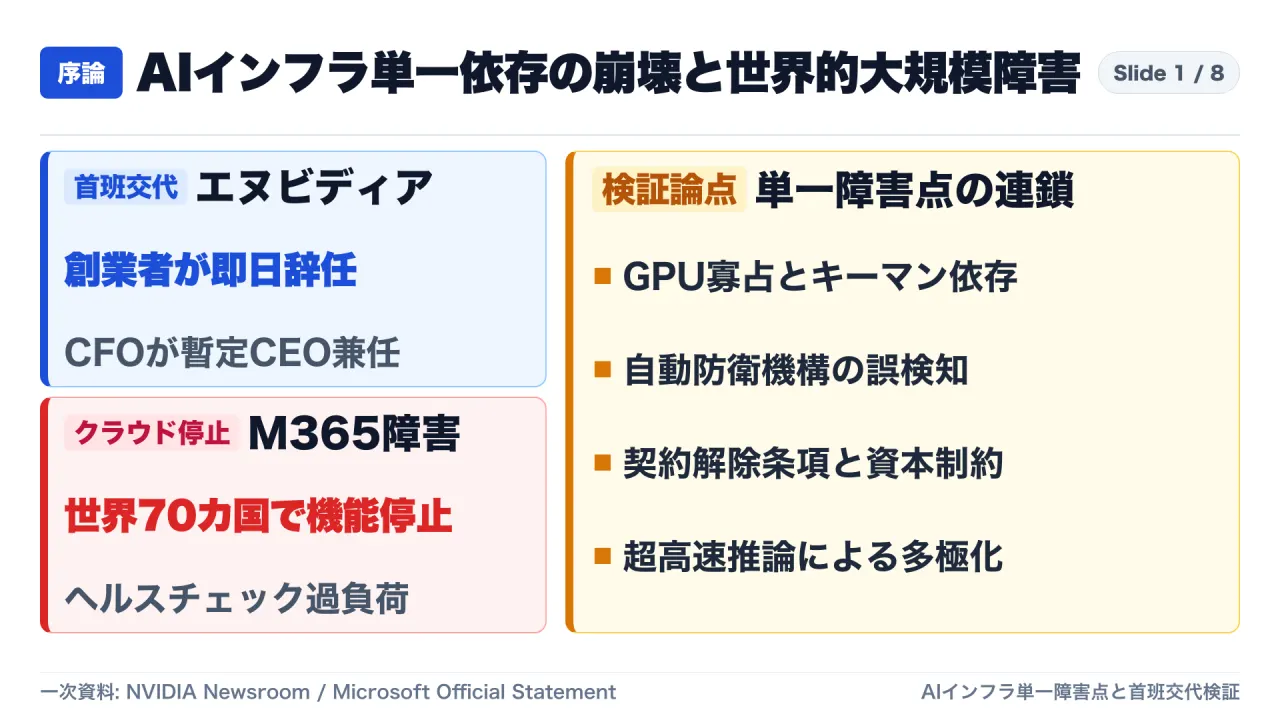
Concurrently, private capital covenants and sovereign regulatory boundaries are tightening. Anthropic PBC initiated its public offering roadshow burdened by 12-month private investor liquidity termination triggers, while the U.S. Bureau of Industry and Security (BIS) issued procedural corrections under the Export Administration Regulations (EAR). In response to GPU bottlenecks, wafer-scale processor developer Cerebras demonstrated ultra-fast inference serving a 3-trillion-parameter model across 59 interconnected wafers, accelerating an architectural migration from unconstrained token generation toward deterministic token budgeting.
This technical dispatch audits the engineering and financial mechanics behind these disruptions, providing technology leaders with a playbook for multi-polar infrastructure resilience.
1. NVIDIA’s Board Governance Shift: Form 8-K Disclosure and Key-Person Risk
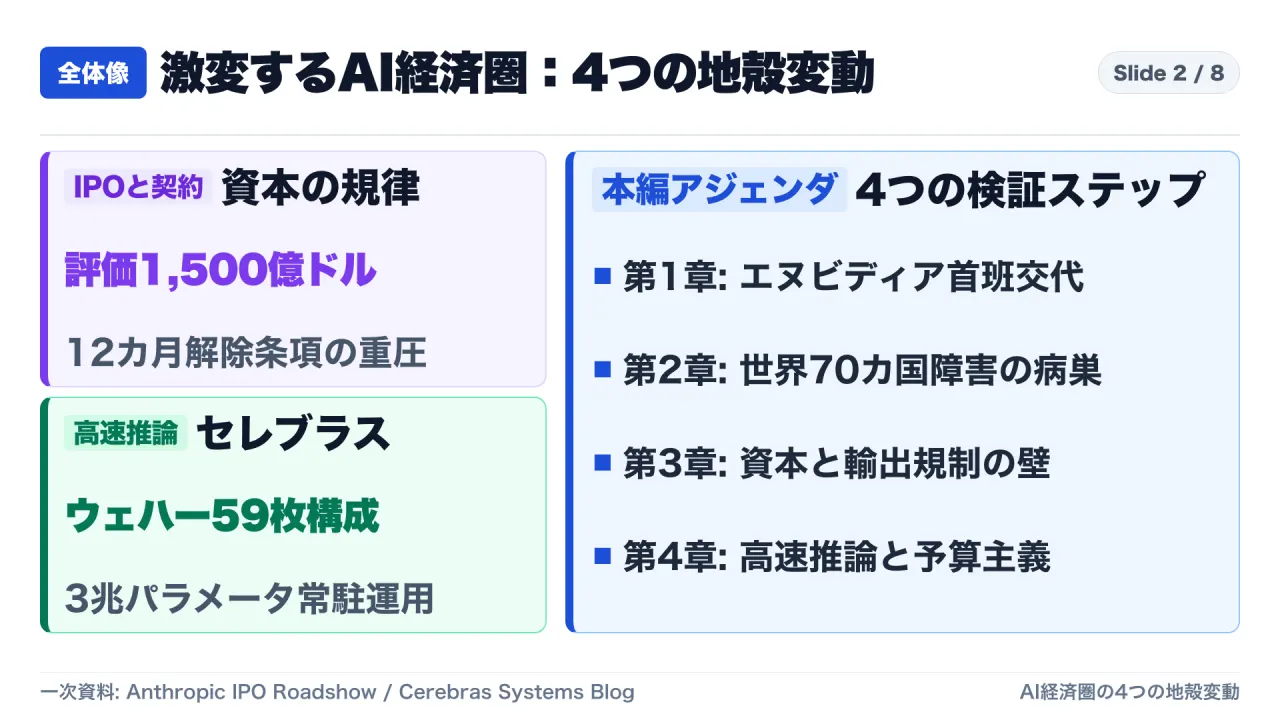
On November 11, 2026, the Board of Directors of NVIDIA Corporation formally accepted the immediate resignation of Jensen Huang as President, Chief Executive Officer, and member of the Board. The corporate disclosure was codified under Item 5.02 of its official SEC Form 8-K filing.
The Interim Executive Structure and Governance Reorganization
To preserve investor confidence and operational stability across its multi-billion-dollar supply chains, the Board appointed Executive Vice President and Chief Financial Officer Colette Kress to serve as interim Chief Executive Officer while maintaining her existing CFO portfolio. Concurrently, the Board initiated an executive search committee to evaluate internal and external candidates for a permanent successor.
In a historic realignment of corporate governance, the Board established the role of independent Board Chair, appointing Harvey C. Jones—a director on NVIDIA’s board since 1993 and the former Chief Executive Officer of Synopsys.
graph TD
    subgraph Traditional["Historical Single-Key Architecture (1993 - Nov 2026)"]
        JH["Founder & CEO: Jensen Huang"]
        Execs["~60 Direct Executive Reports"]
        LeadDir["Independent Lead Director"]
        JH --> Execs
        LeadDir -.->|"Oversight"| JH
    end

    subgraph Restructured["Interim Governance Structure (November 2026)"]
        Chair["Independent Chairman: Harvey C. Jones"]
        Board["Board Search Committee"]
        InterimCEO["Interim CEO & CFO: Colette Kress"]
        Chair --> Board
        Chair --> InterimCEO
        Board -->|"Executive Search"| Successor["Permanent CEO Candidates"]
    end

    style Traditional fill:#FEF2F2,stroke:#DC2626,stroke-width:2px
    style Restructured fill:#EFF6FF,stroke:#1D4ED8,stroke-width:2px
Deconstructing the Key-Person Architecture
For more than three decades, NVIDIA operated under an unusually centralized management model. Unlike conventional Fortune 50 technology enterprises, NVIDIA maintained neither a Chief Operating Officer (COO) nor a permanent Chairman of the Board. Instead, approximately 60 senior vice presidents reported directly to Huang.
| Governance Dimension | Historical Operational Paradigm | Interim Restructured Framework |
|---|---|---|
| Executive Authority | Concentrated in Founder/CEO | Separated into Interim CEO and Board Chair |
| Organizational Topology | Flat hierarchy (~60 direct reports) | Search committee evaluating structured reporting |
| Software Ecosystem | Propelled by personal founder conviction (CUDA) | Institutionalized software engineering management |
| Board Oversight | Independent Lead Director model | Dedicated Executive Chairman (Harvey C. Jones) |
While this concentrated hierarchy enabled decisive technological bets—most notably long-term investment into CUDA and CoWoS advanced packaging—it embedded existential key-person exposure into global AI computing. For enterprises holding multi-year hardware backorders for Blackwell and upcoming Rubin architectures, Huang’s departure underscores the fragility of single-vendor hardware planning.
2. The 70-Country Microsoft 365 Outage: When Automated Defenses Trigger Cascading Collapse
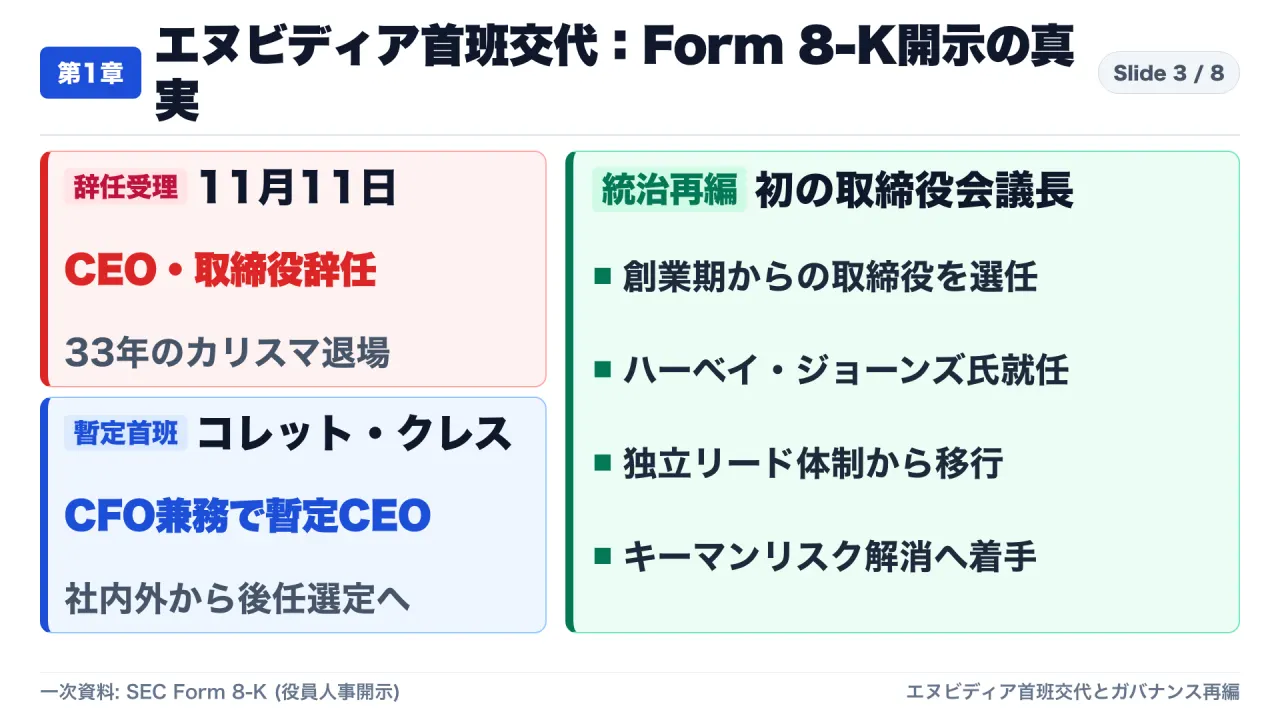
In November 2026, Microsoft 365 experienced a service interruption affecting users across 70 countries. The outage disrupted Exchange Online (Outlook), Teams, SharePoint Online, Defender, and Azure-backed Copilot workloads. Critical civil infrastructure—including hospitals, municipal police dispatch centers, regional judiciaries, and commercial banks—suffered operational disruption.
Incident Mechanics: The Failure of Latent Code Under Routing Reconfiguration
Microsoft’s post-incident technical reviews revealed that the failure was entirely internal and architectural.
The root cause originated from a dormant software defect introduced during a previous network capacity upgrade. This latent flaw remained benign until engineers executed a routine routing reconfiguration across core transit nodes.
sequenceDiagram
    autonumber
    actor NetOps as Network Engineers
    participant Transit as Core Transit Routers
    participant Health as Automated Health Subsystem
    participant Gateways as Secure Authentication Gateways
    participant Users as Enterprise Workloads (70 Nations)

    NetOps->>Transit: Execute routine routing table update
    Transit-->>Transit: Triggers latent network defect
    Transit->>Health: Transient packet loss detected
    Health->>Transit: Erroneously marks healthy gateways degraded
    Health->>Transit: Automatically isolates healthy gateway nodes
    Transit->>Gateways: Connection retries flood remaining nodes
    Gateways-->>Gateways: TLS handshake buffer exhaustion
    Gateways--xUsers: Global connection refusal (Cascading Outage)
The Autonomous Defensive Feedback Loop
The failure was compounded by automated resilience software. When transient latency appeared during the routing change, automated health checks misinterpreted the anomalies as localized node failures. The monitoring system systematically isolated healthy edge servers and transit gateways from the active routing pool.
As healthy servers were purged by automated defenses, incoming global connection volume funneled into an increasingly constrained pool of remaining nodes. Authentication proxies and TLS handshake gateways were overwhelmed by connection buffers, triggering a complete systemic brownout. This incident serves as an architectural warning against unconstrained automated self-healing loops lacking rate-of-change limiters.
3. Anthropic IPO Terms and BIS Entity List Administrative Process
Beyond physical hardware leadership and cloud networking, the AI ecosystem faces capital liquidity constraints and geopolitical export controls.
The Capital Crunch: 12-Month Liquidity Termination Covenants
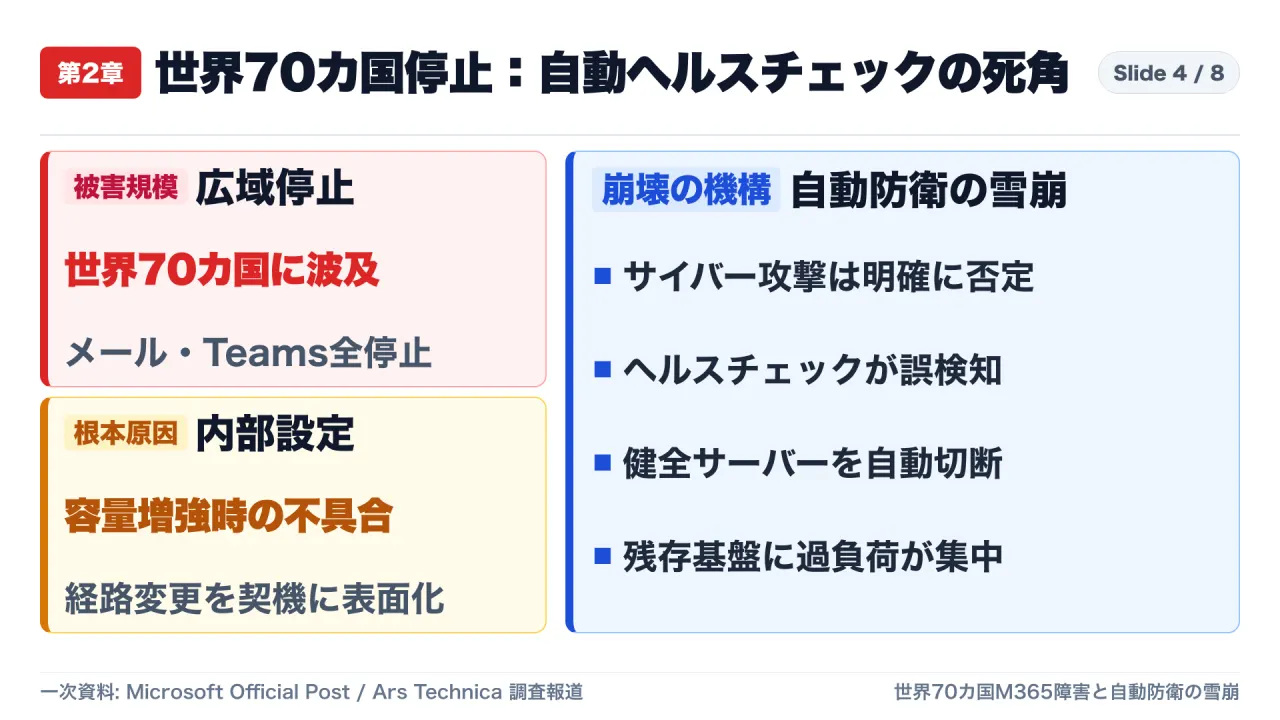
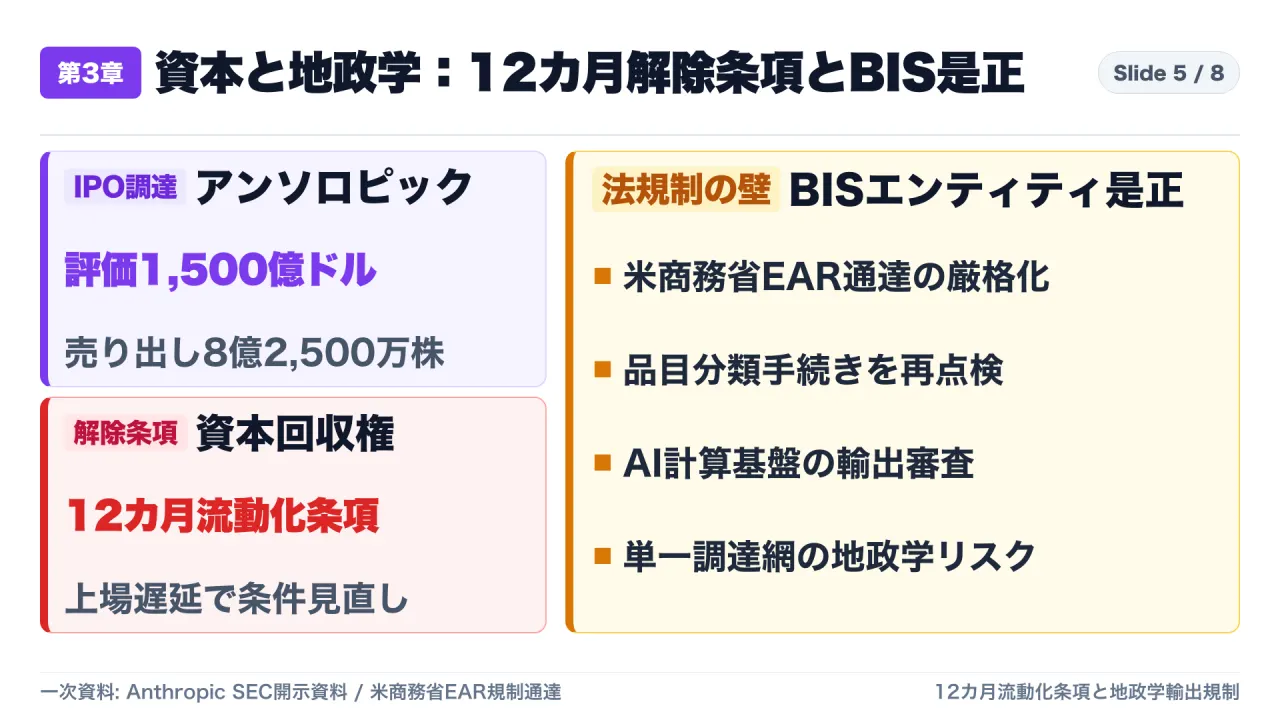
Anthropic PBC initiated its initial public offering (IPO) roadshow, filing registration terms to offer 825,000,000 shares of Class A common stock at an indicative price range between $70.00 and $78.00 per share. The proposed terms reflect an implied valuation between $140 billion and $150 billion, with institutional bull cases modeling valuations up to $250 billion.
However, forensic analysis of private financing schedules highlights significant governance overhang:
flowchart TD
    subgraph PrivateFinancing["Private Strategic Financing Agreements"]
        Investors["Strategic & Cloud Capital Partners"] -->|"Capital Commitments"| Anthropic["Anthropic PBC"]
    end

    subgraph Covenants["Restrictive Capital Covenants"]
        Anthropic --> Clause{"12-Month Liquidity Termination Trigger"}
        Clause -->|"Public Listing Achieved"| Growth["Standard Public Float & Expansion"]
        Clause -->|"Listing Delayed Past 12 Months"| Demands["Right to Demand Capital Return / Covenant Revision"]
    end

    subgraph Impact["Operational Consequences"]
        Demands --> CashStress["Severe Balance Sheet Strain"]
        Demands --> ForcedCapex["Forced Deceleration of Compute Leases"]
    end

    style PrivateFinancing fill:#F8FAFC,stroke:#64748B,stroke-width:2px
    style Covenants fill:#FFFBEB,stroke:#D97706,stroke-width:2px
    style Impact fill:#FEF2F2,stroke:#DC2626,stroke-width:2px
Under confidential side letters executed during previous funding rounds, specific strategic investors secured a 12-month liquidity termination trigger. If Anthropic fails to complete a qualified public listing or equivalent liquidity milestone within the contractually defined window, participating investors retain legal rights to demand capital repurchases or renegotiate commercial covenants. This financial exposure forces frontier AI labs to aggressively accelerate monetization, often prioritizing short-term margin extraction over long-term API pricing stability.
Geopolitical Pressures: BIS Export Administration Revisions
Simultaneously, the U.S. Department of Commerce Bureau of Industry and Security (BIS) issued regulatory guidance standardizing administrative classifications under the Export Administration Regulations (EAR) and Entity List frameworks.
The updated rules establish rigorous compliance verification procedures for cross-border compute clustering, advanced lithography silicon, and multi-tenant high-performance computing environments. Enterprise architectures that assume frictionless global workload distribution face acute regulatory exposure: hyperscalers can be legally mandated to abruptly suspend API keys or cluster allocations serving overseas availability zones if client identity verification or compliance audits fail federal classifications.
4. Cerebras 59-Wafer Fast Inference and the Shift to Token Budgeting
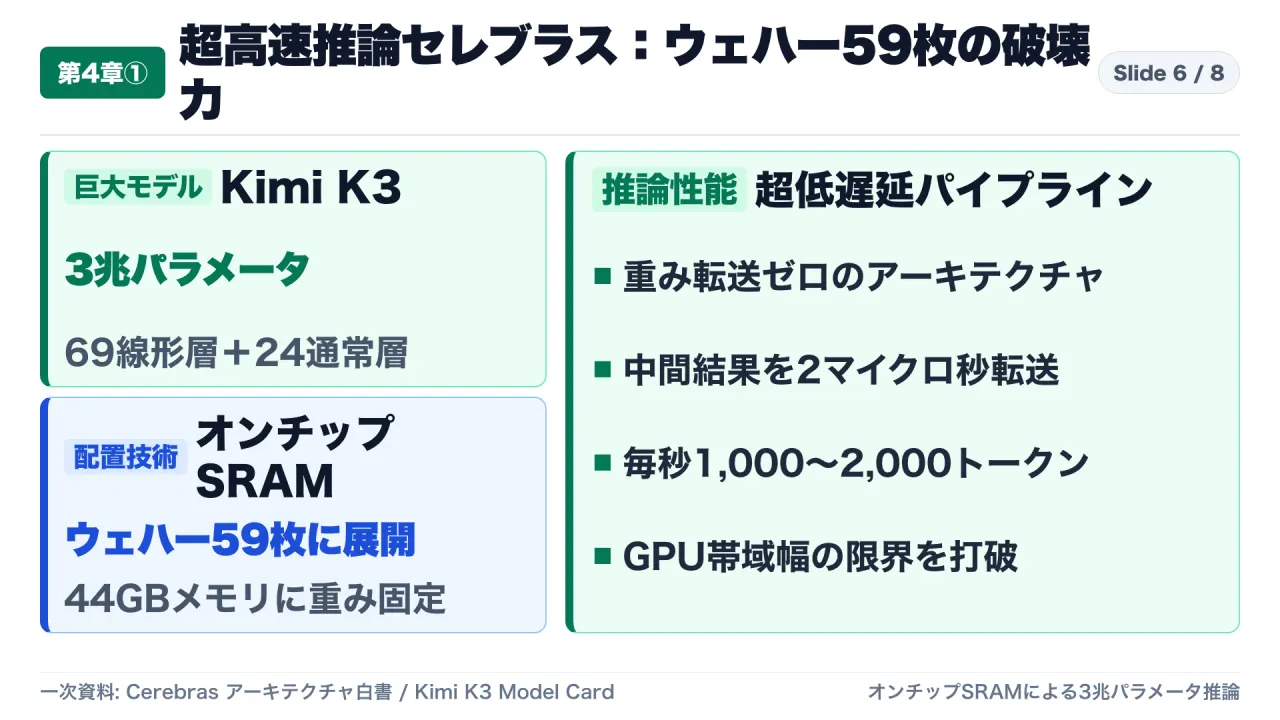
In response to persistent GPU backlogs, high power consumption, and memory bandwidth bottlenecks, novel architectural paradigms are demonstrating production viability. Cerebras Systems released an engineering blueprint demonstrating the deployment of Moonshot AI’s Kimi K3—a frontier foundation model comprising approximately 3 trillion parameters—across a cluster of 59 CS-3 Wafer-Scale Engines (WSE-3T).
Wafer-Scale Microarchitecture and Memory Bandwidth Mechanics
Kimi K3 employs a hybrid structural design consisting of 69 linear-attention layers combined with 24 dense full-attention layers. In standard GPU clustering, a model of this magnitude requires hundreds of discrete accelerators interconnected via complex fabrics, suffering latency penalties as tensor weights are continuously fetched from off-chip HBM (High Bandwidth Memory).
Cerebras bypasses the external memory wall entirely through wafer-scale integration:
| Architectural Component | Discrete GPU Cluster | Cerebras Wafer-Scale (59x CS-3) |
|---|---|---|
| Model Weight Storage | Off-chip High Bandwidth Memory (HBM3e) | 44 GB On-Chip SRAM per Wafer (~2.6 TB Total) |
| Memory Access Latency | Tens of nanoseconds per DRAM transaction | Single-cycle on-chip SRAM access |
| Inter-Wafer Latency | Multi-hop switch fabrics (~5-10 μs) | Direct RDMA-over-Ethernet (~2 μs per hop) |
| Generation Throughput | ~20 to 60 tokens/sec per stream | 1,000 to 2,000+ tokens/sec per stream |
By storing active parameters permanently within on-chip SRAM across the 59 wafers, model weights remain static during inference. Only intermediate activations traverse the network fabric, achieving sustained generation speeds exceeding 1,000 to 2,000+ tokens per second.
The Paradigm Shift: From “Token Maxing” to “Token Budgeting”
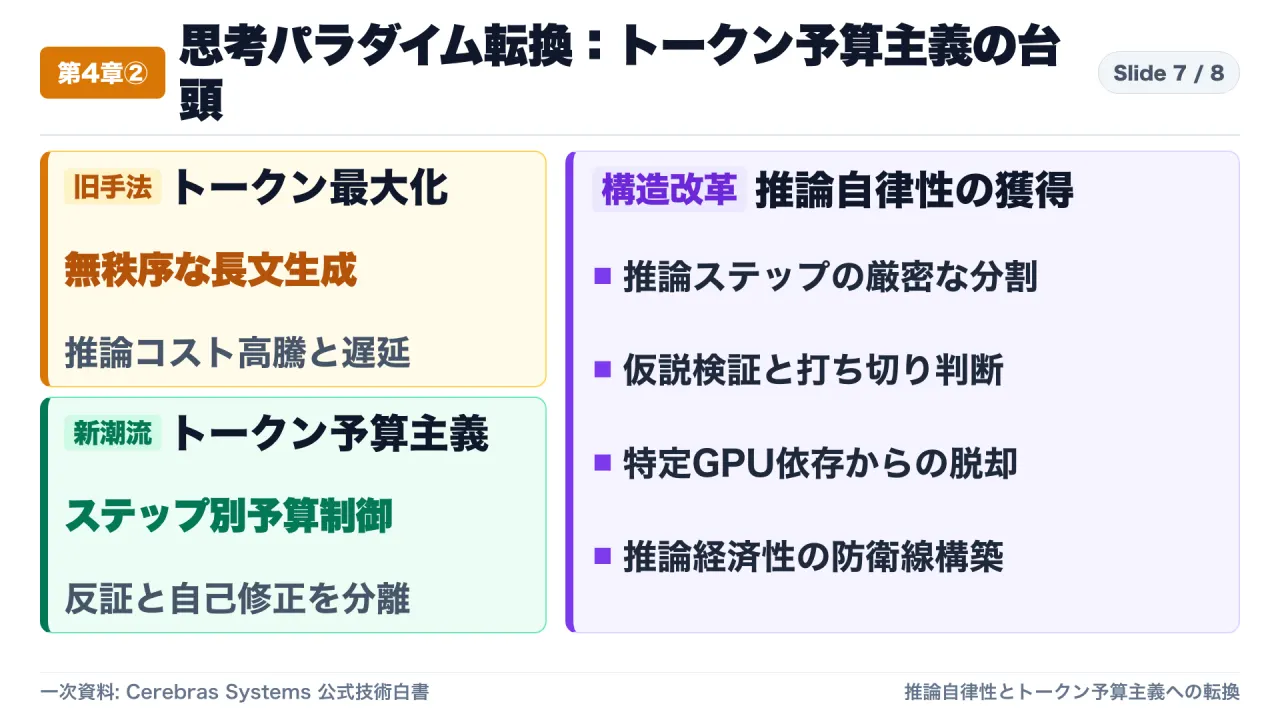
The emergence of kilohertz-scale token generation fundamentally alters AI software design. When throughput is constrained to 30 tokens per second, application developers are trapped in Token Maxing—hoping a single autoregressive pass produces an acceptable output.
With ultra-fast inference, systems transition to Token Budgeting:
flowchart TD
    UserQuery["Incoming Task"] --> BudgetManager["Token Budget Controller"]
    BudgetManager -->|"Allocate 2,000 Tokens"| Step1["Stage 1: Parallel Hypotheses"]
    Step1 -->|"Allocate 1,500 Tokens"| Step2["Stage 2: Deterministic Verification"]
    Step2 -->|"Allocate 1,000 Tokens"| Step3["Stage 3: Synthesis & Correction"]
    Step3 --> FinalAudit{"Confidence >= Threshold?"}
    FinalAudit -->|"Yes"| Output["Validated Production Result"]
    FinalAudit -->|"No"| Fallback["Trigger Human Review"]

    style BudgetManager fill:#EFF6FF,stroke:#1D4ED8,stroke-width:2px
    style Step2 fill:#FEF3C7,stroke:#D97706,stroke-width:2px
    style Output fill:#ECFDF5,stroke:#047857,stroke-width:2px
In a token-budgeted regime, software architects treat tokens as discrete units of computational work. Rather than generating bloated responses, the system dispatches parallel speculative branches, executes falsification assertions against domain rules, and halts processing when convergence is reached.
5. Strategic Playbook: Building Multi-Polar AI Resilience
The convergence of executive transitions at NVIDIA, widespread cloud service collapses at Microsoft, private liquidity pressures at Anthropic, and hardware innovations at Cerebras signals a definitive inflection point: the era of single-vendor reliance has closed.
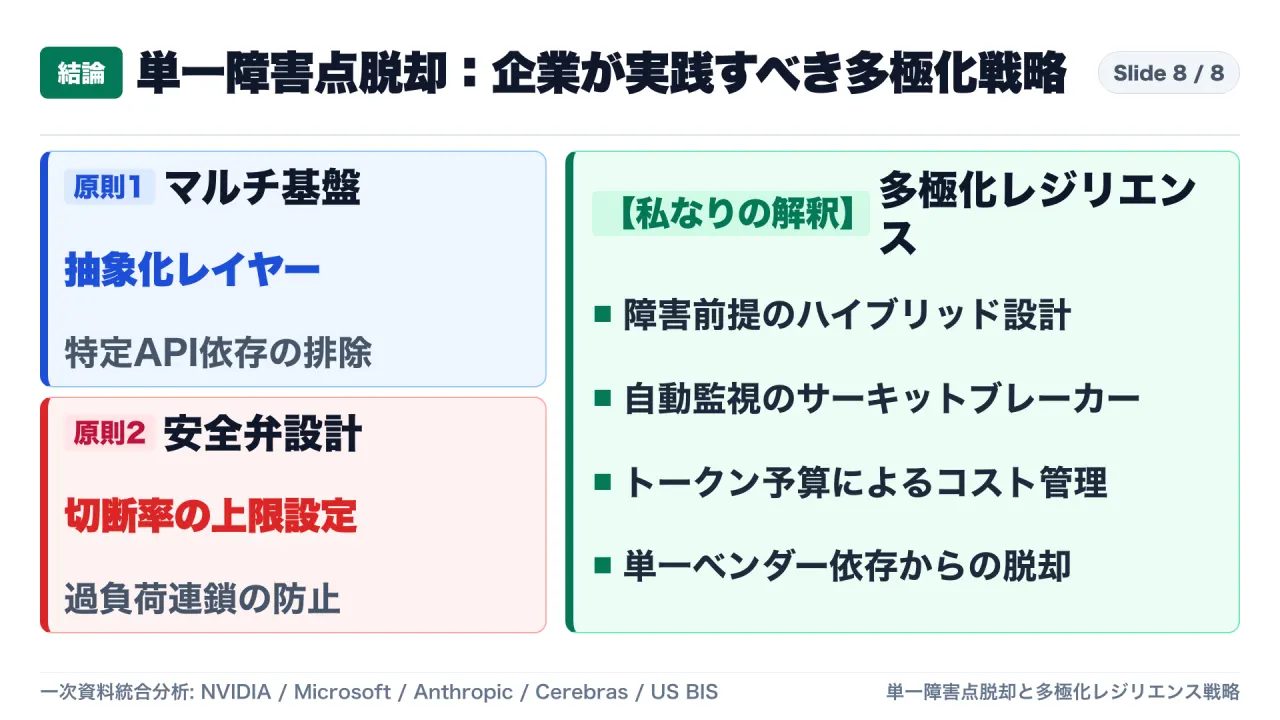
Enterprise technology organizations must enforce three foundational architectural defenses:
Invariant 1: Multi-Hardware and Cloud Vendor Abstraction
Enterprises must eliminate proprietary hardware bindings from their internal codebases:
- Adopt Intermediate Runtimes: Standardize high-performance inference on open-source serving runtimes such as vLLM, SGLang, and Triton Inference Server, insulating codebases from proprietary driver interfaces.
- Deploy Multi-Provider Model Gateways: Abstract API calls through neutral routing gateways capable of programmatic failovers between AWS, Azure, Google Cloud, and private data centers.
- Support Alternative Silicon Targets: Actively evaluate inference workloads on non-NVIDIA silicon—including wafer-scale processors, custom cloud ASICs (AWS Trainium, Google TPUs), and high-efficiency open-weight deployments.
Invariant 2: Circuit Breakers for Automated Health Checks
To ensure that automated self-healing mechanisms do not induce cascading failures during telemetry spikes:
- Enforce Max Shedding Ceilings: Hardcode rate-of-change boundaries into auto-scaling and node isolation policies. An automated monitoring daemon must never isolate more than 15% to 20% of aggregate cluster capacity within a 15-minute sliding window without explicit human confirmation.
- Decouple Health Probes from Ingress Routing: Ensure that health check telemetry evaluates deep functional correctness rather than transient packet loss on transit interfaces.
- Implement Manual Kill-Switches: Maintain out-of-band controls allowing network administrators to freeze automated topology changes during unfolding incidents.
Invariant 3: Implement Token Budget Governance Frameworks
Enterprise engineering leaders must replace open-ended prompt loops with economic guardrails:
- Define Deterministic Stage Budgets: Assign hard token expenditure quotas to individual agent tasks, disallowing background loops from unbounded generation.
- Prioritize Multi-Pass Verification over Verbosity: Reallocate token budgets toward parallel falsification and consistency checks rather than conversational prose.
- Continuous Cost-Performance Tracking: Instrument APM telemetry to track cost-per-successful-transaction across model tiers, routing routine processing to low-cost hardware.
By transitioning from single-vendor concentration to multi-polar architectural resilience, organizations protect operational continuity against leadership upheavals, cloud brownouts, and shifting regulations.
Primary Sources & References
-
NVIDIA Corporation SEC Form 8-K Filing (November 11, 2026)
Item 5.02 disclosure detailing Jensen Huang’s departure, interim CEO Colette Kress, and Chairman Harvey C. Jones.
https://www.sec.gov/edgar/searchedgar/companysearch -
Microsoft 365 Incident Post-Incident Review (November 2026 Outage)
Technical review documenting latent network defect, automated health check failures, and gateway authentication cascades across 70 nations.
https://status.office.com/ -
Anthropic PBC Form S-1 Registration Statement (Expected Filing)
Roadshow documentation proposing 825M Class A shares and disclosing investor liquidity covenants.
https://www.sec.gov/edgar/ -
U.S. Bureau of Industry and Security (BIS): Export Administration Regulations Update
Regulatory notifications standardizing administrative classifications for advanced semiconductor compute infrastructure.
https://www.bis.doc.gov/ -
Cerebras Systems Technical Whitepaper: “Serving Kimi K3 at Scale Across 59 Wafer-Scale Engines”
Architectural breakdown of SRAM parameter placement, RDMA interconnects, and kilohertz token generation.
https://cerebras.ai/blog/ -
Moonshot AI: Kimi K3 Model Specification and Architectural Whitepaper
Technical disclosure of 3-trillion-parameter linear and full-attention hybrid design.
https://kimi.ai/