The Reality Behind OpenAI's $50B Revenue Claim: Agent Auto-Billing Traps, Cloud Data Residency Failures, and Defensive Price Cuts
An architectural and financial audit of OpenAI’s Exit ARR metrics, the November 18, 2026 “Dots” autonomous agent billing deadline, cross-border data routing in AWS Bedrock, and the competitive pressures driving Luna’s 80% price reduction.
Japanese Edition (Original Article): Read on note Video Episode: Watch on YouTube
Disclaimer: This publication provides objective technical, architectural, and governance analysis based on primary sources. It does not constitute commercial endorsement or investment advice.
Executive Summary: Enterprise Realities Behind the Hype
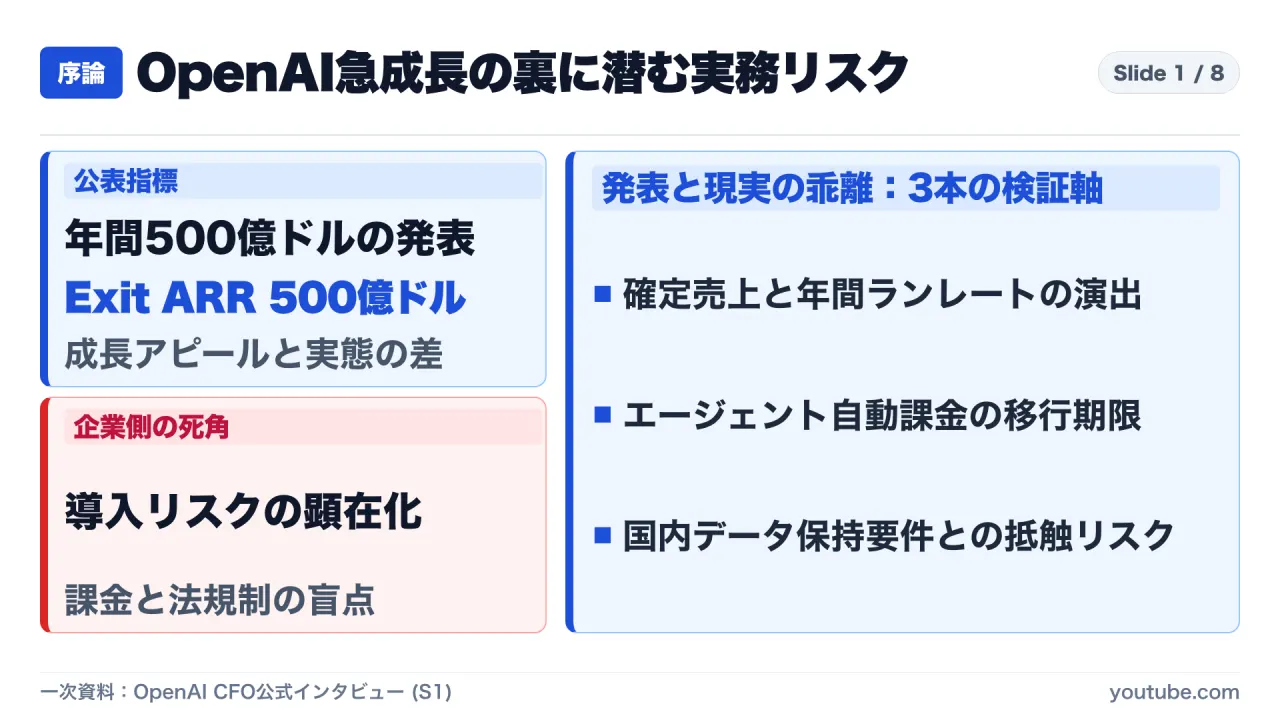
On November 11, 2026, OpenAI’s Chief Financial Officer publicly detailed the company’s unprecedented commercial trajectory in an extensive broadcast interview. Key metrics presented included reaching an annualized run-rate of approximately $50 billion (Exit ARR), achieving a +70% quarter-over-quarter growth pace, expanding weekly active users (WAU) past 1.2 billion, and doubling the enterprise share of total revenue to 50%.
However, when these figures are cross-referenced with GAAP accounting standards, cloud provider technical documentation, and product terms of service, a starkly different operational picture emerges for enterprise IT leaders.
Critical operational risks identified across primary technical sources include:
- Financial Metric Distortion: The “$50 billion” figure represents an annualized run-rate (Exit ARR) calculated from peak month performance, contrasting with actual Q3 GAAP revenue of approximately $10 billion (+50% QoQ).
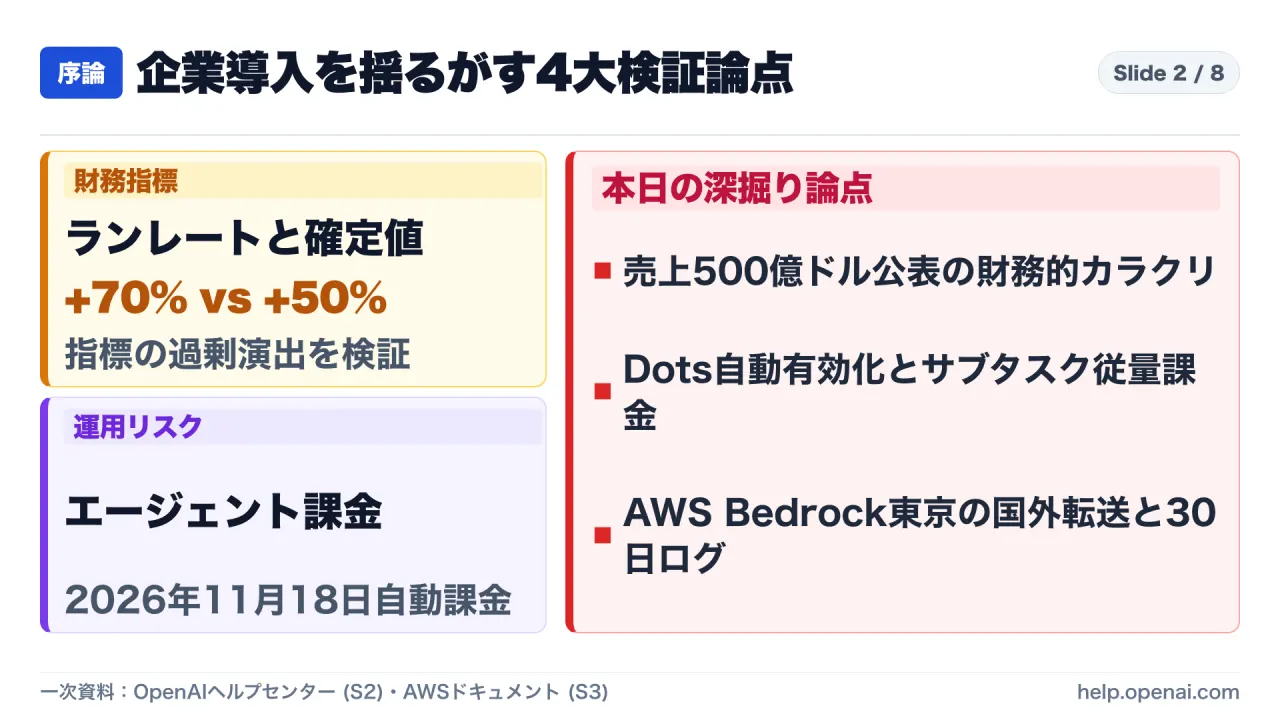
- Autonomous Agent Auto-Billing (November 18, 2026): Free preview access for the GPT-6.1 Terra-backed “Dots” agent terminates on November 18, 2026, transitioning unconfigured enterprise tenants into paid billing with separate unmetered sub-task charges for delegated Codex and ChatGPT Work routines.
- AWS Bedrock Data Residency Breakdown: Deploying OpenAI models on AWS Bedrock from Tokyo or Osaka offers zero domestic data residency guarantees due to missing
jp.inference profiles, routing Japanese enterprise workloads to US and Indian infrastructure while retaining safety logs abroad for up to 30 days. - Vulnerability Disclosure Exaggeration: The narrative of OpenAI independently resolving PHP’s zero-day
php2shellvulnerability (CVE-2026-109618 / 109619) misrepresents independent discoveries by Calif and Wiz, and multi-vendor coordination by the PHP Foundation. - Defensive Price Cuts Amid Open-Weight Surge: The 80% price drop for OpenAI’s “Luna” ($0.20/$1.20 per 1M tokens) was a defensive response against Chinese open-weight models commanding a 66% market share on OpenRouter.
1. Deconstructing the $50B Metric: Exit ARR vs. Realized GAAP Revenue
In corporate financial communications and software industry analysis, the operational distinction between Annual Recurring Revenue (ARR) and Realized GAAP Revenue is paramount. Run-rate calculations extrapolate temporary, high-velocity momentum across an entire forward-looking twelve-month period, whereas recognized GAAP figures represent audited historical receipts.
graph LR
    A["Peak Month Run-Rate ($4.17B/mo)"] -->|"x12 Annualized"| B["Exit ARR: ~$50B (+70% QoQ pace)"]
    C["Q3 Recognized GAAP Revenue"] -->|"Actual Quarter"| D["Q3 Revenue: ~$10B (+50% QoQ)"]
    style B fill:#EFF6FF,stroke:#1D4ED8,stroke-width:2px
    style D fill:#ECFDF5,stroke:#047857,stroke-width:2px
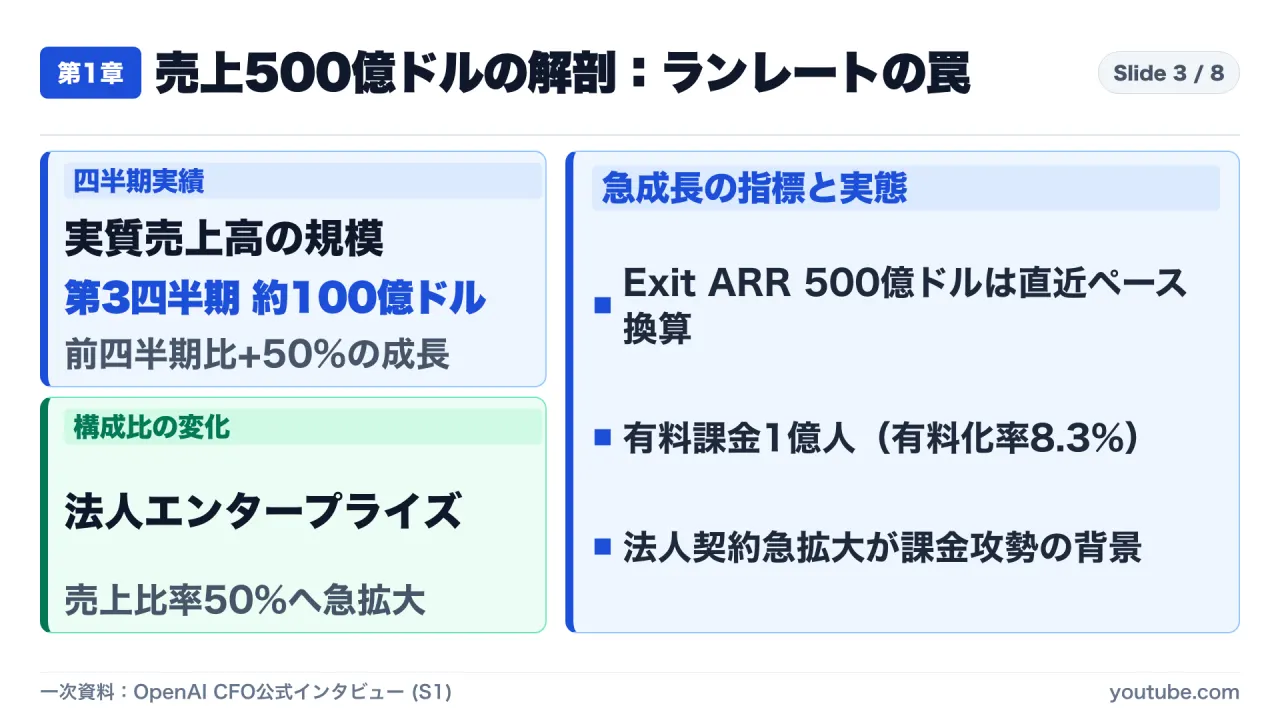
OpenAI’s CFO cited an Exit ARR approaching $50 billion, supported by an annualized quarter-over-quarter expansion pace of approximately +70%. However, regulatory filings and industry corporate audits confirm that realized Q3 GAAP revenue stood at approximately $10 billion, representing a recognized quarter-over-quarter growth rate of +50%.
While $10 billion in quarterly software receipts represents an extraordinary milestone in modern technology history, conflating annualized exit velocity with audited annual revenue obscures crucial underlying dynamics:
| Financial / Operational Metric | Publicly Promoted Claim | Audited Reality (Q3 2026) | Governance & Enterprise Implications |
|---|---|---|---|
| Topline Revenue | Annualized ~$50B Exit ARR | Realized Q3: ~$10B | Run-rate assumes linear persistence without seasonality or churn |
| QoQ Growth | +70% QoQ Velocity | +50% QoQ Audited Growth | Peak-month velocity reflects launch spikes rather than normalized run-rates |
| User Footprint | 1.2 Billion WAU | ~100M Paid Subscribers | Free tier represents ~91.7% of total infrastructure load |
| Enterprise Share | 50% Enterprise Share | Doubled from historical 25% | Aggressive enterprise billing enforced to cover infrastructure Capex |
Historically, consumer subscriptions drove most of OpenAI’s cash receipts. The doubling of enterprise revenue from 25% to 50% represents a foundational shift in commercial strategy. Maintaining compute clusters for 1.2 billion weekly active users requires billions in server leases, power procurement, and hardware depreciation. Because roughly 91.7% of users do not pay recurring fees, enterprise customers must bear the cost recovery burden. This structural reality explains why OpenAI instituted default-enabled billing features across its enterprise offerings.
2. Autonomous Agent “Dots”: The November 18 Auto-Billing Trap
OpenAI’s autonomous workspace agent, designated internally as “Dots” and powered by the GPT-6.1 Terra reasoning model, was designed to operate as a persistent, 24/7 background agent executing multi-step workflows.
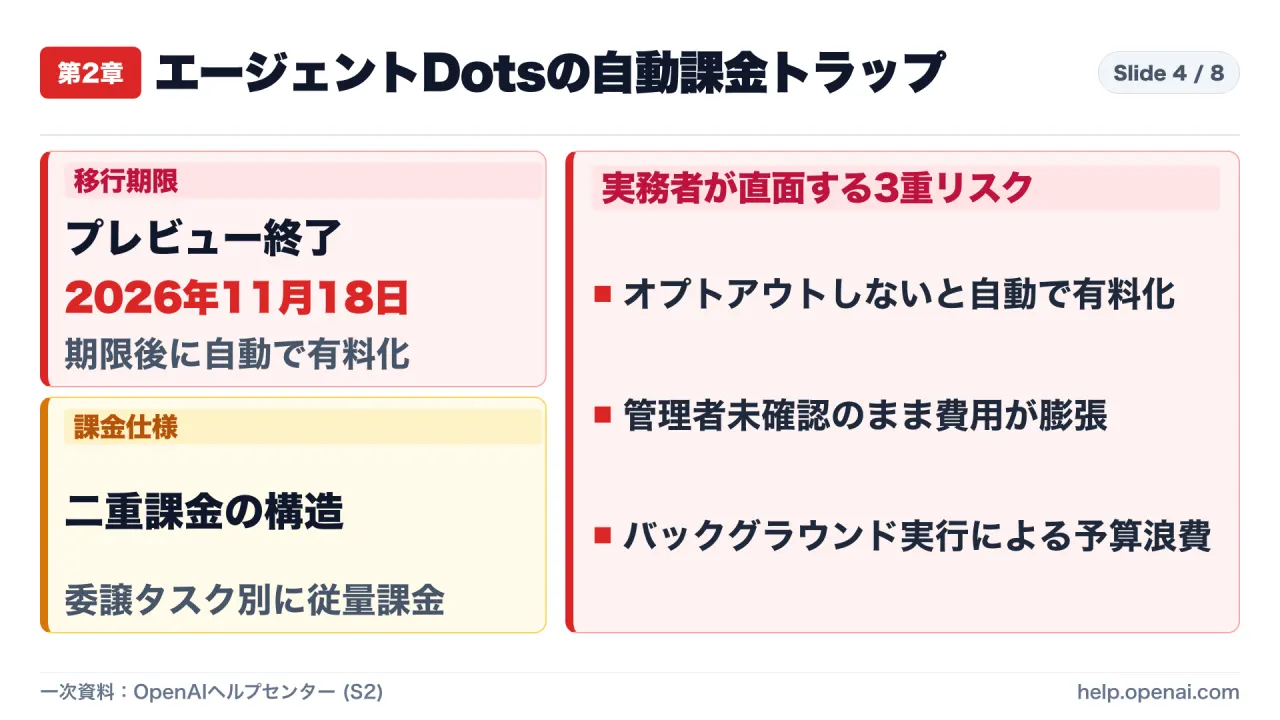
According to OpenAI Help Center documentation published between November 12 and November 14, 2026 (Article 20001530: Getting started with your dot), the free enterprise preview concludes definitively on November 18, 2026.
The Default-Enabled Opt-Out Mechanism
The primary operational risk for enterprise IT administrators is that the preview does not terminate into a disabled or dormant state. Instead, enterprise tenants that have not completed an explicit administrative opt-out will transition automatically into billed production status upon the November 18 deadline.
sequenceDiagram
    autonumber
    actor Admin as IT Administrator
    participant Workspace as OpenAI Enterprise Tenant
    participant Dots as Always-On Agent (Terra)
    participant Sub as Codex / Work Sub-Agents

    Note over Admin,Workspace: Prior to Nov 18, 2026: Default opt-out required
    alt No Explicit Opt-Out Recorded
        Workspace->>Dots: Automatically enables billed agent tier
        Dots->>Sub: Spawns recursive coding and drafting tasks
        Sub-->>Workspace: Generates unmetered consumption charges
        Workspace-->>Admin: Unexpected enterprise invoice inflation
    else Administrative Opt-Out Applied
        Workspace->>Dots: Halts unauthorized agent provisioning
        Admin->>Workspace: Explicitly bounds per-seat token and dollar quotas
    end
Unmetered Sub-Task Delegation Charges
The financial exposure of Dots is intensified by its recursive execution architecture. When Dots processes a broad business objective—such as auditing an enterprise codebase or reconciling monthly financial schedules—it delegates specialized sub-routines to external system components:
- Code Engineering Workloads: Delegated directly to specialized Codex backend routines.
- Document & Content Generation: Routed through ChatGPT Work execution pipelines.
- External System Orchestration: Executed via background tool-calling loops.
Under the revised billing framework, these delegated sub-tasks are billed as independent, unmetered API transactions above and beyond the baseline agent seat fee. An unconstrained autonomous agent executing iterative self-debugging loops can easily trigger hundreds of sub-routine calls overnight, transforming a standard workspace subscription into an uncontrolled cost center generating thousands of dollars in surprise monthly fees.
3. Data Residency Breakdown: AWS Bedrock Regional Routing Realities
Many enterprise compliance frameworks—especially within regulated industries across Japan, the European Union, and financial centers—mandate that proprietary customer data and prompts remain strictly within domestic territorial borders.
Enterprises deploying OpenAI models through AWS Bedrock under the assumption that deploying within the Tokyo Region (ap-northeast-1) or Osaka Region (ap-northeast-3) guarantees domestic data residency face significant compliance exposures.
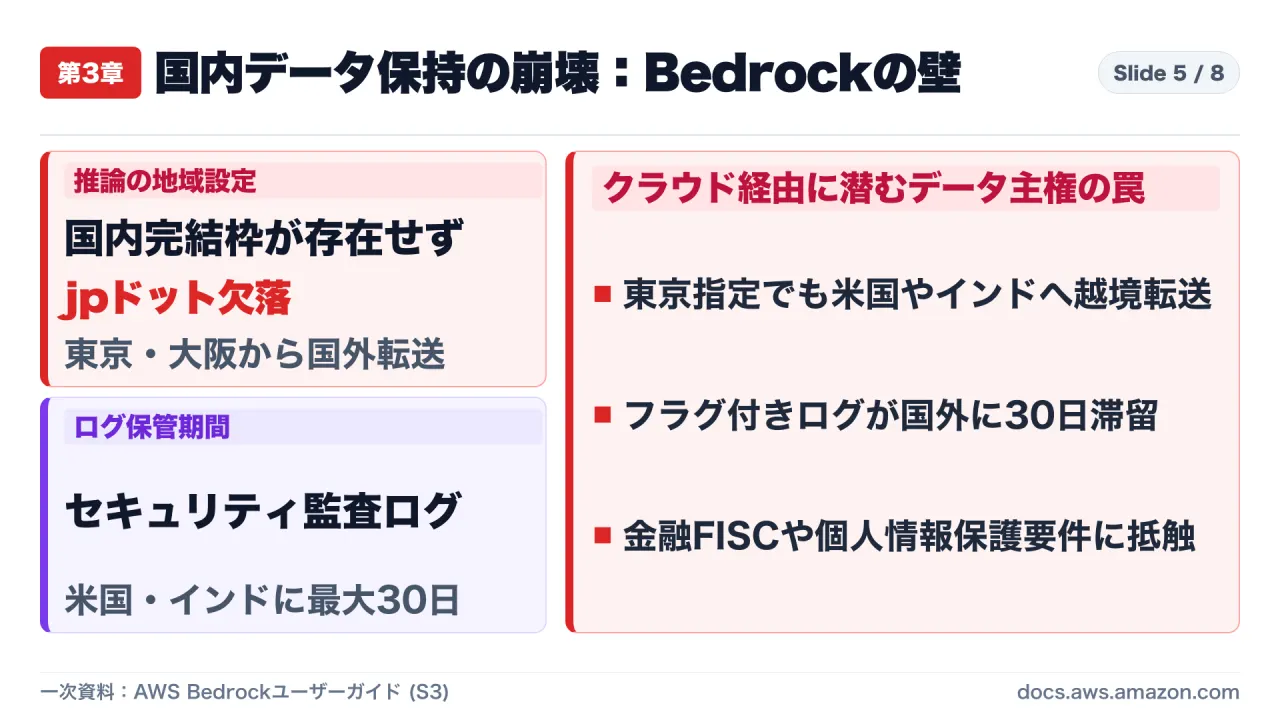
The Structural Absence of jp. Inference Profiles
AWS Bedrock enforces geographic isolation and routing boundaries through Inference Profiles. Model families such as Anthropic Claude or Amazon Titan provide dedicated domestic regional identifiers (such as jp.anthropic.claude...), ensuring that token processing, key-value caching, and inference remain physically confined to Japanese availability zones.
In contrast, technical documentation for OpenAI models on AWS Bedrock reveals that no jp. prefix profile exists. The service exclusively exposes global cross-region routing profiles. Consequently, when an application in Tokyo or Osaka dispatches an API request to an OpenAI model endpoint, Bedrock’s dynamic load balancer inspects global cluster capacity and routes prompt tokens across international boundaries—most commonly terminating in data centers located in the United States or India.
The 30-Day Foreign Safety Log Retention Clause
The compliance exposure is compounded by hyperscaler trust and safety policies. Under AWS Bedrock terms, whenever an inference request or completion triggers an automated safety classifier, the corresponding input prompt and output completion may be retained within foreign logging infrastructure for up to 30 calendar days for review and auditing.
For Japanese financial institutions governed by FISC Security Guidelines, healthcare entities subject to domestic medical privacy standards, and organizations operating under the Act on the Protection of Personal Information (APPI), transmitting unencrypted enterprise data across sovereign borders without explicit contractual authorization constitutes a direct regulatory violation.
4. Competitive Dynamics: Zero-Day Attribution and the Luna Price Collapse
In public messaging, proprietary model vendors frequently attribute technological and pricing moves to altruistic safety leadership or unassisted engineering breakthroughs. A rigorous audit of primary technical disclosures paints a far more nuanced, multi-vendor picture.
The PHP php2shell Vulnerability (CVE-2026-109618 / 109619)
During public interviews, OpenAI leadership highlighted the automated discovery and remediation of the critical PHP php2shell vulnerability as definitive proof of proprietary frontier model superiority in proactive cybersecurity defense.
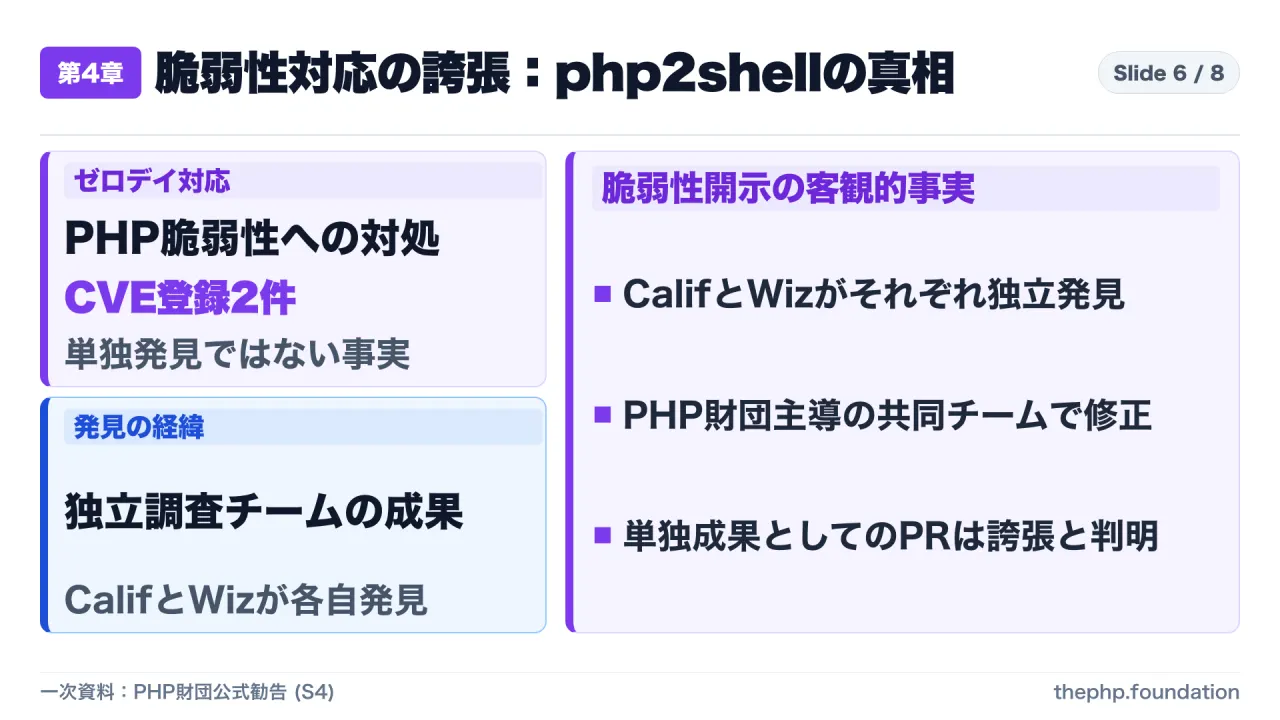
However, official advisories published by the PHP Foundation on October 21, 2026, document a collaborative disclosure timeline:
- Independent Discovery: The underlying vulnerability was identified independently by cybersecurity researchers at Calif (who utilized GPT-5.6 Sol) and cloud security provider Wiz.
- Coordinated Industry Remediation: Remediation was not an isolated proprietary achievement. An industry-wide task force—comprising the PHP Foundation, Google, Wiz, Cloudflare, and OpenAI—worked jointly across multiple weeks to design, verify, and deploy binary patches across the global PHP runtime ecosystem.
- Attribution Distortion: Framing the mitigation of
php2shellas an exclusive proprietary breakthrough obscures standard coordinated vulnerability disclosure (CVD) protocols established across the global cybersecurity community.
Open-Weight Surge and Luna’s 80% Defensive Price Cut
Concurrently, OpenAI introduced an 80% price reduction for its compact reasoning model “Luna,” pricing input tokens at $0.20 per 1M and output tokens at $1.20 per 1M. While publicly celebrated as an engineering efficiency milestone, empirical market telemetry reveals a defensive commercial reaction to open-weight model adoption.
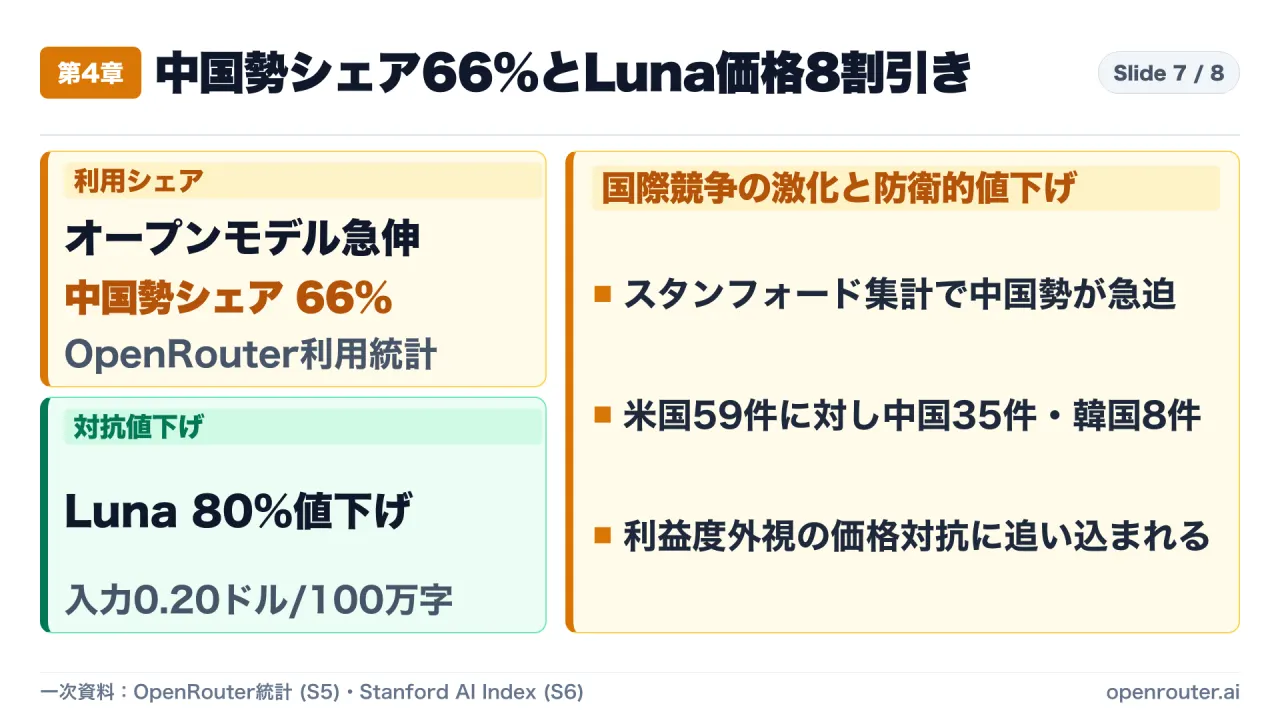
According to global routing metrics from OpenRouter, developer API traffic shifted dramatically throughout late 2026. Open-weight foundation models developed by Chinese research organizations—most notably the DeepSeek-V3 series and Alibaba’s Qwen-2.5 architecture—captured an unprecedented 66% market share of developer prompt volume.
Data from the Stanford AI Index Report 2026 illustrates this intensifying geopolitical race: while the United States produced 59 prominent foundation models, China deployed 35, and South Korea introduced 8. OpenAI’s drastic margin compression on Luna reflects an urgent necessity to stem enterprise and developer attrition toward low-cost open-weight alternatives.
5. Enterprise Action Plan: Three Strategic Invariants
To safeguard enterprise budgets, ensure strict data residency compliance, and prevent vendor lock-in, chief technology officers and IT security architects must enforce three mandatory governance invariants:
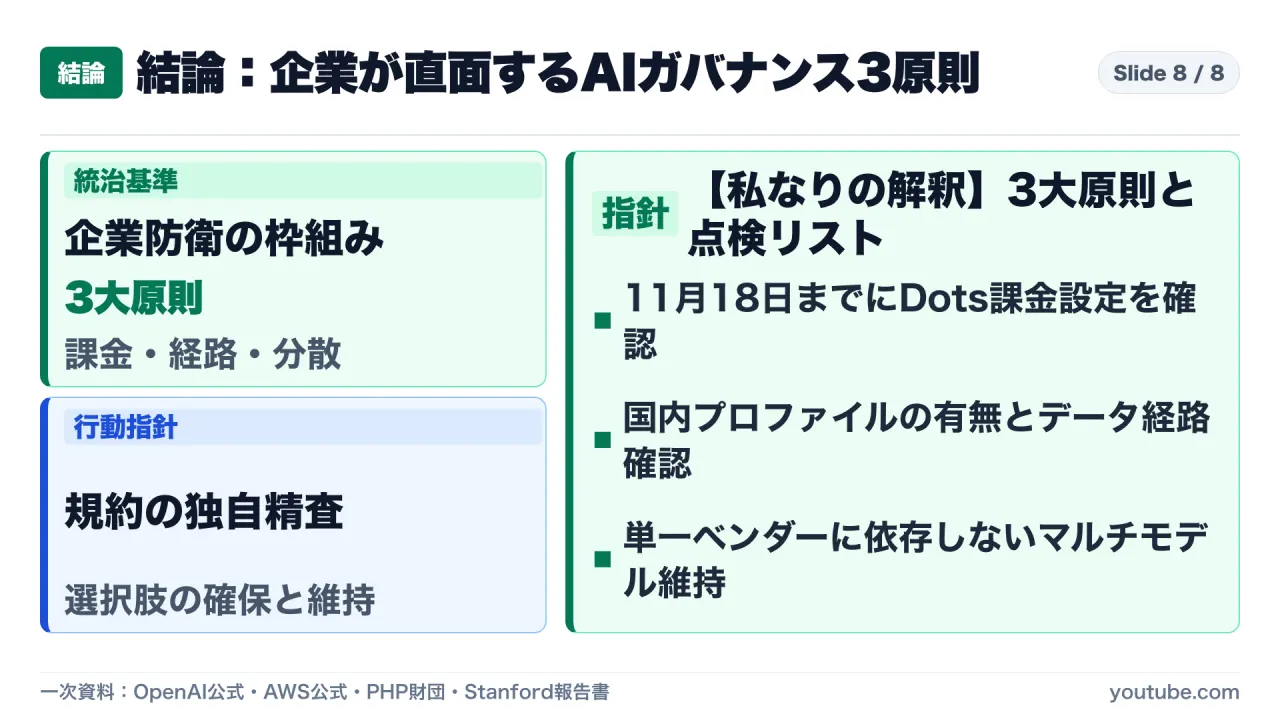
Invariant 1: Execute Immediate Administrative Opt-Out for Dots (Deadline: November 18, 2026)
Enterprise IT administrators must access their organization’s tenant management console immediately and execute the following configuration checklist:
- Disable Default Agent Provisioning: Set global workspace policies to disallow automatic provisioning of persistent background agents.
- Enforce Per-Seat Hard Dollar Caps: Configure hard spending limits that terminate agent execution when monthly thresholds are reached, preventing recursive delegation loops.
- Isolate Sub-Task Delegation Permissions: Explicitly restrict autonomous background tools from dispatching unmetered sub-routines to external Codex and ChatGPT Work endpoints without human-in-the-loop authorization.
Invariant 2: Audit Cloud Hyperscaler Inference Profiles and Data Sovereignty
Organizations processing regulated, confidential, or personal data must audit all cloud API configurations:
- Inspect Inference Profile Identifiers: In AWS Bedrock, verify whether endpoints employ domestic routing prefixes (
jp.for Japan,eu.for European jurisdictions). Acknowledge that OpenAI models route globally and lack domestic boundary confinement. - Review Content Safety Logging Exceptions: Negotiate custom Business Associate Agreements (BAAs) or enterprise data handling addenda to disable 30-day overseas retention of flagged safety prompts.
- Establish Air-Gapped Fallbacks: Where regulatory localization is legally non-negotiable, deploy self-hosted open-weight architectures within enterprise Virtual Private Clouds located strictly in domestic availability zones.
Invariant 3: Implement an Abstracted Multi-Model Gateway
To prevent commercial hostage scenarios arising from sudden terms-of-service shifts or pricing changes, enterprise software stacks should never couple directly to proprietary client libraries:
- Deploy Model Agnostic Proxy Gateways: Standardize internal application requests on an abstracted proxy layer.
- Dynamic Cost and Health Routing: Configure the proxy gateway to route standard requests to high-efficiency models while reserving expensive frontier reasoning models exclusively for mission-critical logic.
- Automated Failover Architecture: Maintain pre-configured failover endpoints that switch production traffic to alternative hyperscalers or sovereign self-hosted instances whenever outages or policy revisions occur.
Primary Sources & References
-
OpenAI CFO Broadcast Interview (November 11, 2026)
Official discussion of Exit ARR, quarterly financial milestones, enterprise user growth, and autonomous agent roadmaps.
https://www.youtube.com/watch?v=TLBXR0VZIOk -
OpenAI Help Center: “Getting started with your dot” (Article 20001530)
Technical documentation defining the conclusion of the free preview period and subsequent default billing mechanisms.
https://help.openai.com/en/articles/20001530-getting-started-with-your-dot -
AWS Bedrock User Guide: “Inference profiles and data residency”
AWS official architectural reference detailing geographic routing constraints, regional prefix profiles, and safety logging policies.
https://docs.aws.amazon.com/bedrock/latest/userguide/inference-profiles.html -
PHP Foundation: “PHP php2shell vulnerability joint disclosure (CVE-2026-109618/109619)”
Official security disclosure detailing multi-vendor discovery, verification, and patch development.
https://thephp.foundation/blog/2026/10/21/php2shell-vulnerabilities/ -
OpenRouter Analytics: Model Usage and Open-Weight Share Telemetry
Aggregated developer telemetry tracking inference traffic distributions between proprietary and open-weight models.
https://openrouter.ai/models -
Stanford Institute for Human-Centered AI (HAI): “Artificial Intelligence Index Report 2026”
Annual research study evaluating the geographic dispersion and capability trajectories of frontier foundation models.
https://aiindex.stanford.edu/report/