The Architecture of Speed: Inside Elon Musk's 5-Step "Algorithm", Fact-Checking Tesla's Hypergrowth, and the Hidden Costs of Radical Efficiency
A comprehensive analysis of Jon McNeill’s interview on Tesla’s ruthless process elimination, the reality of SEC-filed growth metrics, the architectural peril of “Human DDoS”, and the repairability tradeoffs of gigacasting.
Japanese Edition: Read the original Japanese article on Substack
Video Episode (Japanese Audio): Watch on YouTube
Disclaimer: This publication provides objective technical, architectural, and organizational analysis based on primary sources. It does not constitute commercial endorsement or investment advice.
1. The Siren Song of Relentless Velocity
Across Silicon Valley and global engineering organizations, few operating playbooks have exerted as much gravitational pull as Elon Musk’s “The Algorithm.” Designed to strip bureaucracy to the bone across Tesla and SpaceX, this five-step framework dictates that engineers must question every requirement, aggressively delete process steps, optimize manually, accelerate cycle times, and automate only as an absolute last resort.
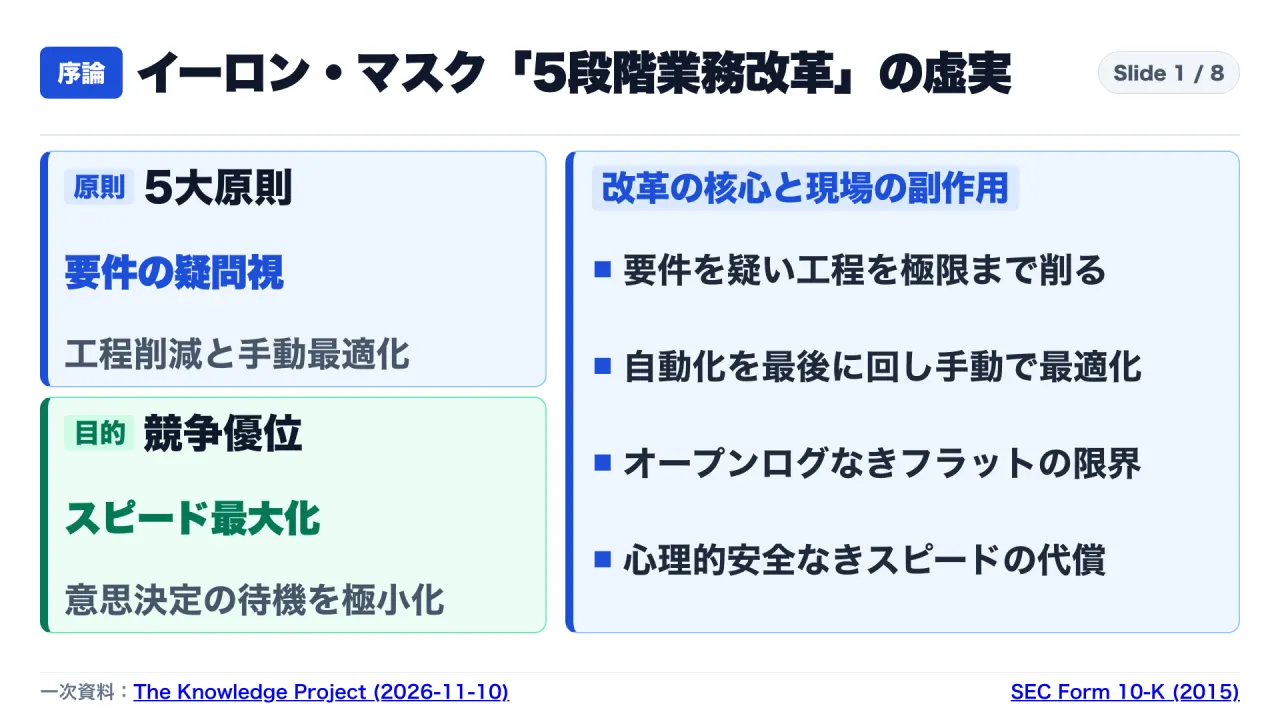
In an in-depth interview on The Knowledge Project, former Tesla President Jon McNeill—who oversaw global sales, marketing, delivery, and service from November 2015 to February 2018—offered an insider account of how this philosophy transformed manufacturing throughput and corporate communication during the critical Model S, Model X, and Model 3 production ramps.
However, behind the triumphant narrative of rapid production ramps lies a complex architectural reality. Radical flatness without structured context logging inevitably triggers a “Human DDoS” on key technical personnel. Monolithic integration via massive die-casting (gigacasting) slashes factory floor assembly time while dramatically expanding the post-collision blast radius and repair costs. Most critically, relentless emergency pacing without psychological safety extracts a severe personal toll, culminating in executive burnout.
Furthermore, a forensic comparison between McNeill’s interview recollections and official regulatory filings (such as Tesla’s SEC Form 10-K) reveals necessary factual corrections regarding headcount trajectory, vehicle sales rankings, and historical tech precedents.
flowchart TD
    A["The 5-Step Algorithm<br>& Flat Communication"] --> B["Hyper-Velocity Execution"]
    B --> C["Structural Side Effects<br>・Human DDoS on Top Talent<br>・Gigacasting Repair Blowout<br>・Systemic Burnout Risk"]
    C --> D["Sustainable Architecture<br>・Open-by-Default Logging<br>・Modular Fault Boundaries<br>・Psychological Safety"]
2. Deconstructing “The Algorithm”: The Five Steps to Process Elimination
At Tesla and SpaceX, process improvement is governed by a strict sequential order. The foundational premise is counter-intuitive: the most dangerous failure mode in industrial engineering is not inefficiency, but optimizing something that should not exist in the first place.
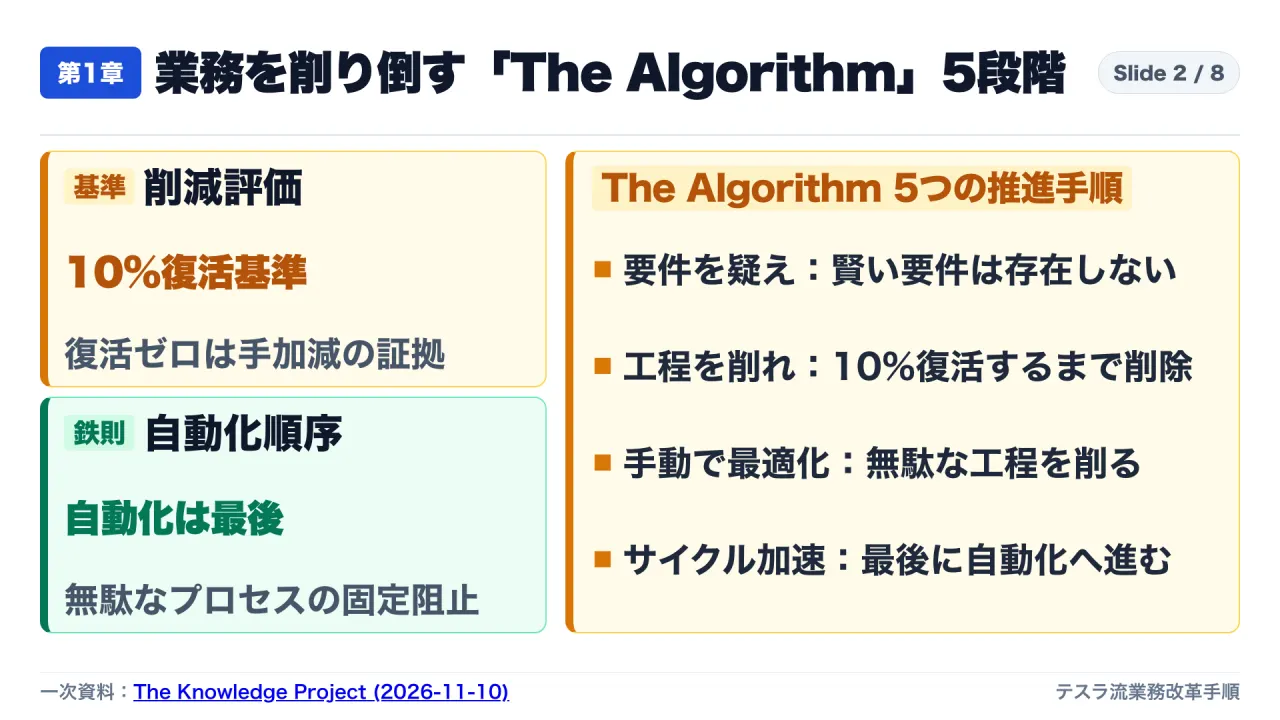
flowchart LR
    S1["1. Question Requirements"] --> S2["2. Delete Process Steps"]
    S2 --> S3["3. Optimize Manually"]
    S3 --> S4["4. Accelerate Cycle Time"]
    S4 --> S5["5. Automate LAST"]
| Step | Mandate | Operating Principle | Primary Antipattern Prevented |
|---|---|---|---|
| 1 | Question Requirements | Identify the specific human author. Reject departmental abstractions such as “Legal says” or “Safety demands.” | Treating institutional requirements as immutable physical laws. |
| 2 | Delete Steps & Parts | If you are not forced to restore at least 10% of deleted steps later, you did not delete enough. | Timid, incremental trimming that leaves obsolete legacy gates intact. |
| 3 | Optimize Manually | Streamline the surviving workflow by hand before introducing digital scaffolding. | Expending engineering resources to polish workflows that ought to be excised. |
| 4 | Accelerate Cycle Time | Shorten execution latency; velocity is treated as the primary competitive barrier. | Mistaking thorough deliberation for risk mitigation in fast-evolving markets. |
| 5 | Automate LAST | Never automate before steps 1 through 4 have converged on minimal complexity. | Mechanizing and entrenching an inefficient or broken manual procedure. |
The Three-Sentence Email Protocol
Supporting this algorithmic discipline was a radical flattening of company communication. Traditional corporate email hierarchies were replaced with mandatory brevity:
- Sentence 1: What is broken (the core problem).
- Sentence 2: What is needed (the specific action).
- Sentence 3: When it must be completed (deadline and ownership).
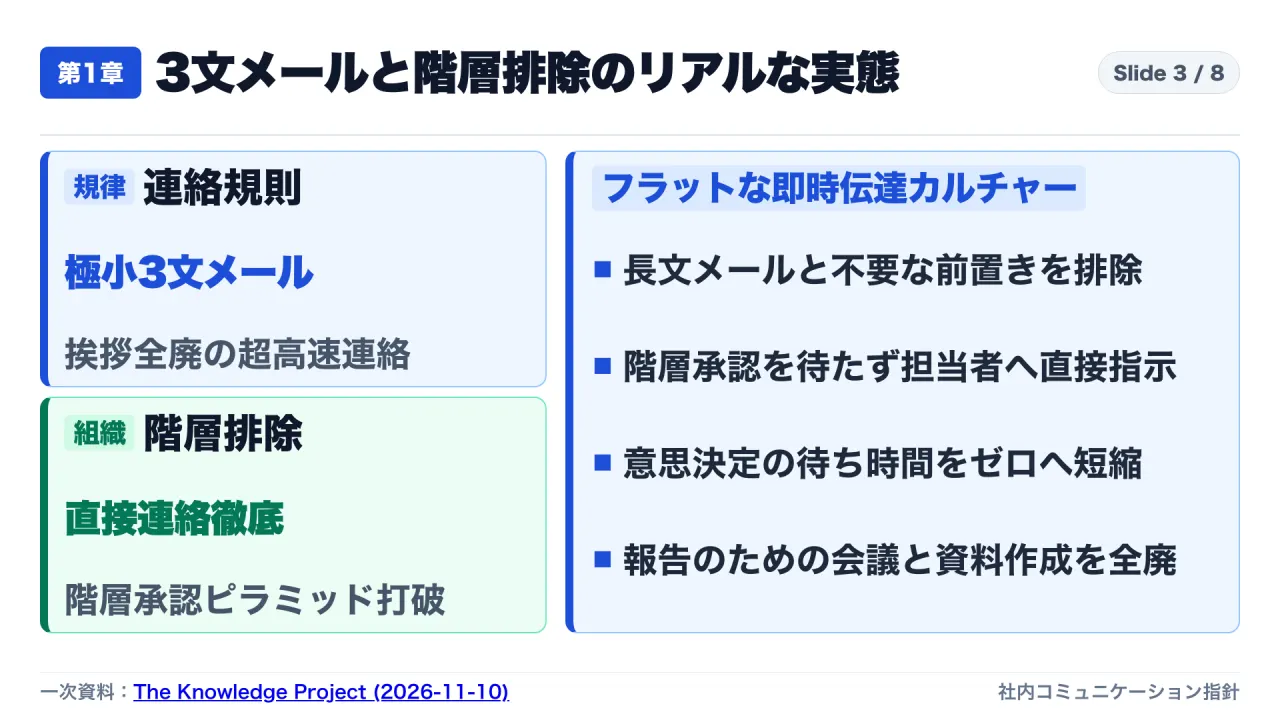
Engineers were explicitly empowered to bypass organizational chains of command, reaching out directly to whoever possessed the domain knowledge or access permissions required to unblock progress.
3. Fact-Checking Hypergrowth: Official SEC Filings vs. Interview Recollections
While McNeill’s account provides valuable operational insights, evaluating corporate transformation requires anchoring oral history against audited regulatory records.
flowchart LR
    Recollection["Interview Narrative / 4,000 to 40,000 Employees (10x)"] -.->|SEC Form 10-K Audit| Reality["Audited Trajectory / 13,058 to 37,543 Employees (2.9x) / Revenue: $4.0B to $11.8B (2.9x)"]
Headcount and Revenue Realities
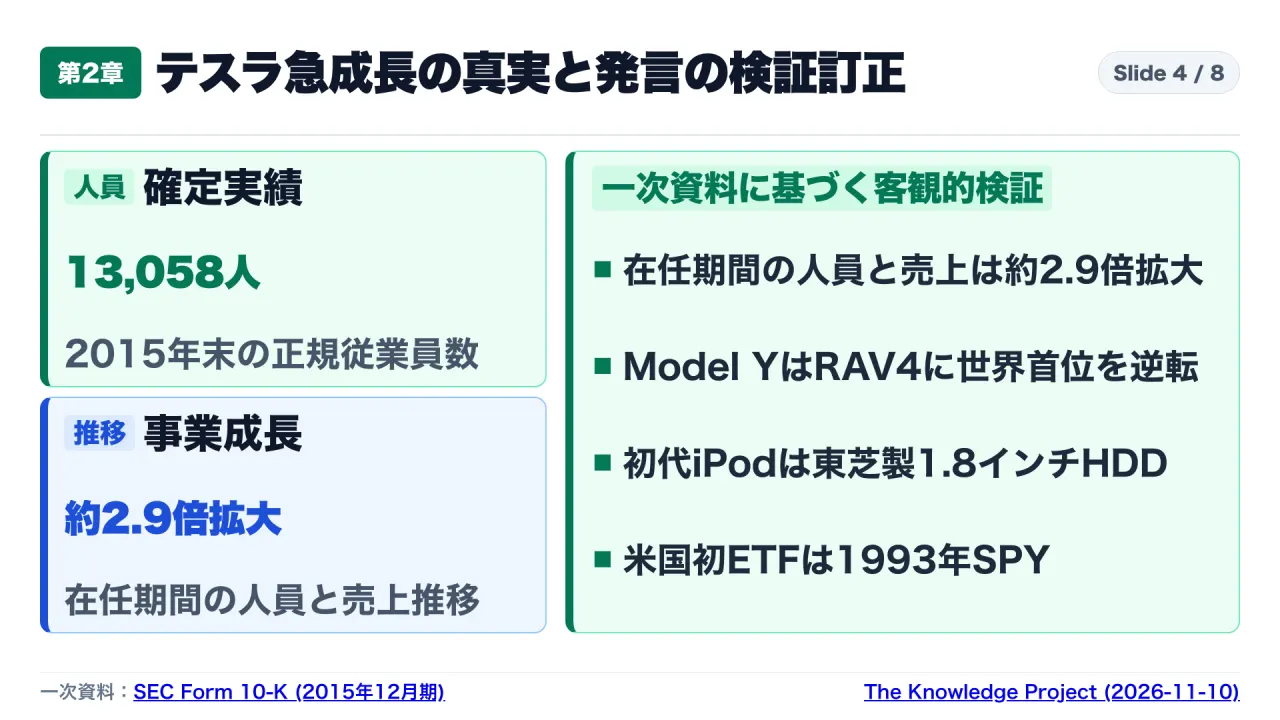
During the interview, McNeill recalled Tesla growing from 4,000 employees to 40,000 employees during his tenure. However, Tesla’s audited Form 10-K filed with the US Securities and Exchange Commission (SEC) paints a more grounded, though still extraordinary, growth trajectory:
- Baseline at Year-End 2015: As disclosed in the 2015 Form 10-K (Item 1, Employees), Tesla had already reached 13,058 full-time employees as of December 31, 2015.
- Scale at Year-End 2017: By December 31, 2017, Tesla’s full-time headcount had expanded to 37,543 employees.
- Calculated Growth Multiplier: Total headcount grew approximately 2.9x (not 10x). Simultaneously, annual revenue expanded from roughly $4.0 billion in 2015 to $11.8 billion in 2017—also an approximate 2.9x expansion.
| Metric | Interview Claim | Audited SEC Form 10-K Reality | Audit Conclusion |
|---|---|---|---|
| Initial Headcount | ~4,000 Employees | 13,058 Employees (Dec 31, 2015) | Baseline was already 3.2x larger than recalled |
| Final Headcount | ~40,000 Employees | 37,543 Employees (Dec 31, 2017) | Net growth was 2.9x rather than 10x |
| Topline Revenue | Not explicitly stated | ~$4.0B to ~$11.8B | Revenue scaled in lockstep with headcount (2.9x) |
Corrections on Industry and Historical Precedents
Several historical anecdotes cited in the conversation also warrant factual clarification:
- Model Y Global Sales Hierarchy: While the Tesla Model Y achieved the title of the world’s best-selling vehicle across all powertrains in 2023, global automotive industry delivery data indicates that the Toyota RAV4 regained the top global volume ranking across 2024 and 2025.
- Original iPod (2001) Storage Architecture: The original 2001 Apple iPod utilized a mechanical 1.8-inch spinning hard disk drive manufactured by Toshiba, not solid-state flash memory (SSD).
- The First US Exchange-Traded Fund (ETF): The first US ETF was State Street’s SPDR S&P 500 ETF (SPY), launched in January 1993, following the Toronto Stock Exchange’s TIPs 35 in Canada in 1990. Vanguard launched its index ETF offerings years later.
- Lyft COO Appointment Timeline: McNeill assumed the Chief Operating Officer position at Lyft in February 2018, more than a full year after the viral consumer #DeleteUber campaign erupted in January 2017.
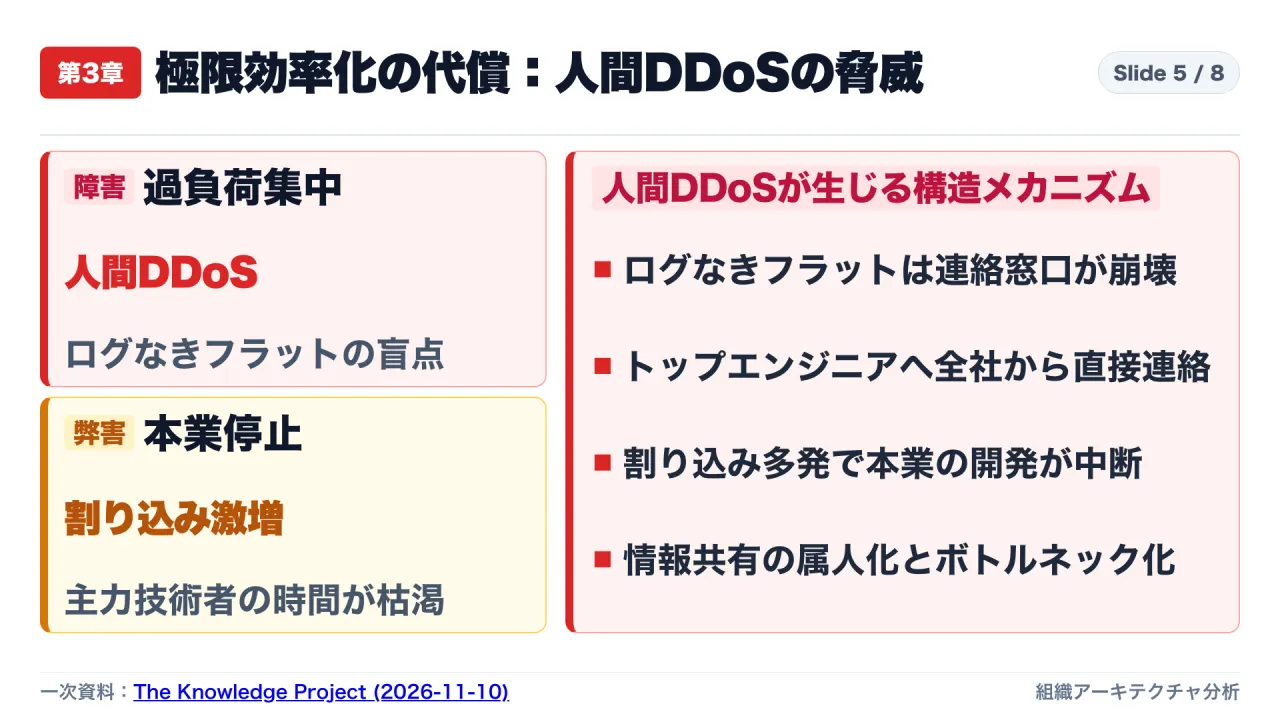
4. The Structural Side Effects: Human DDoS and Gigacasting Repairability
Pushing organizations and physical hardware toward maximum theoretical density inevitably generates systemic failure modes.
The “Human DDoS” of Unstructured Flat Organizations
When an enterprise eliminates managerial routing without instituting open, searchable context logs, the organization suffers from what systems engineers term a “Human DDoS.”
flowchart TD
    subgraph Flat Organization with No Open Logs
        A1["Sales Team"] --> Lead["Lead Battery Engineer"]
        A2["Service Center"] --> Lead
        A3["Factory Floor"] --> Lead
        A4["Executive Suite"] --> Lead
        A5["Supplier Liaison"] --> Lead
    end
    Lead --> Collapse["Human DDoS<br>・100+ context switches daily<br>・Primary engineering blocked<br>・Extreme cognitive exhaustion"]
Because junior staff and cross-functional teams lack a centralized architectural decision log (ADR) to understand why a design choice was made, they default to messaging the known domain expert directly. The top 5% of technical talent becomes overwhelmed by ad-hoc queries, converting high-leverage builders into full-time triage dispatchers.
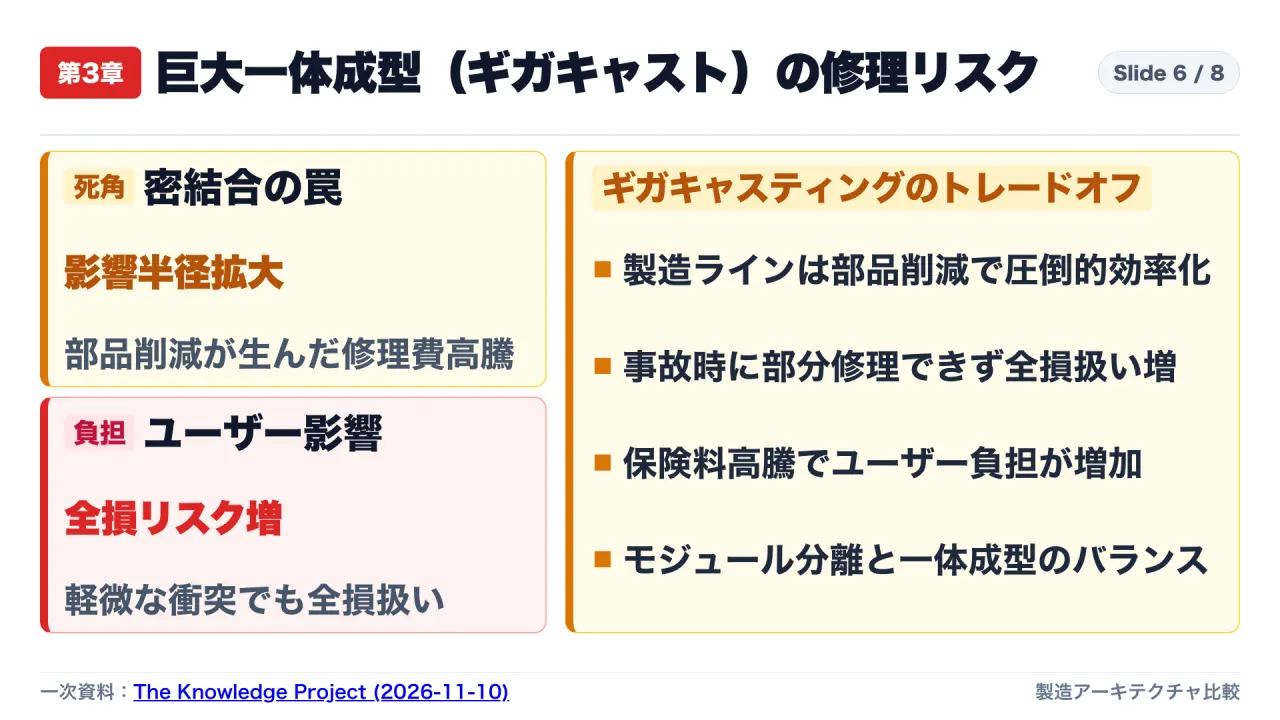
The Repairability Blast Radius of Gigacasting
In manufacturing, Tesla pioneered gigacasting—using immense 6,000-to-9,000-ton die-casting presses manufactured by Idra Group to stamp entire front and rear underbody structures as single monolithic aluminum alloy castings.
flowchart LR
    subgraph Assembly Benefit
        Multi["70+ Welded Stampings"] -->|Gigacasting| Mono["1 Monolithic Casting / ・Robots eliminated / ・Factory cycle accelerated"]
    end
    subgraph Operational Cost
        Mono --> Impact["Low-Speed Impact"]
        Impact --> Damage["Unrepairable Structural Warp<br>・Modular section swap impossible<br>・Vehicle declared total loss<br>・Insurance premiums surge"]
    end
While gigacasting eliminates hundreds of welding robots and tightens production cycle times, it represents an aggressive tradeoff between manufacturing optimization and field maintainability:
- Monolithic Blast Radius: In traditional multi-panel architectures, a minor rear collision crumples an isolated, bolt-on crush can or stamped steel rail that can be pulled and replaced by an independent repair facility.
- The Total-Loss Threshold: In a monolithic aluminum casting, micro-fractures or structural deformations across the main casting cannot be safely straightened or section-welded. Minor structural accidents frequently lead insurance carriers to write the entire vehicle off as a total loss, inflating lifetime total cost of ownership (TCO) through elevated insurance premiums.
5. The Personal Cost: Psychological Safety and Executive Burnout
The most acute point of failure in hyper-accelerated organizations is human sustainability.
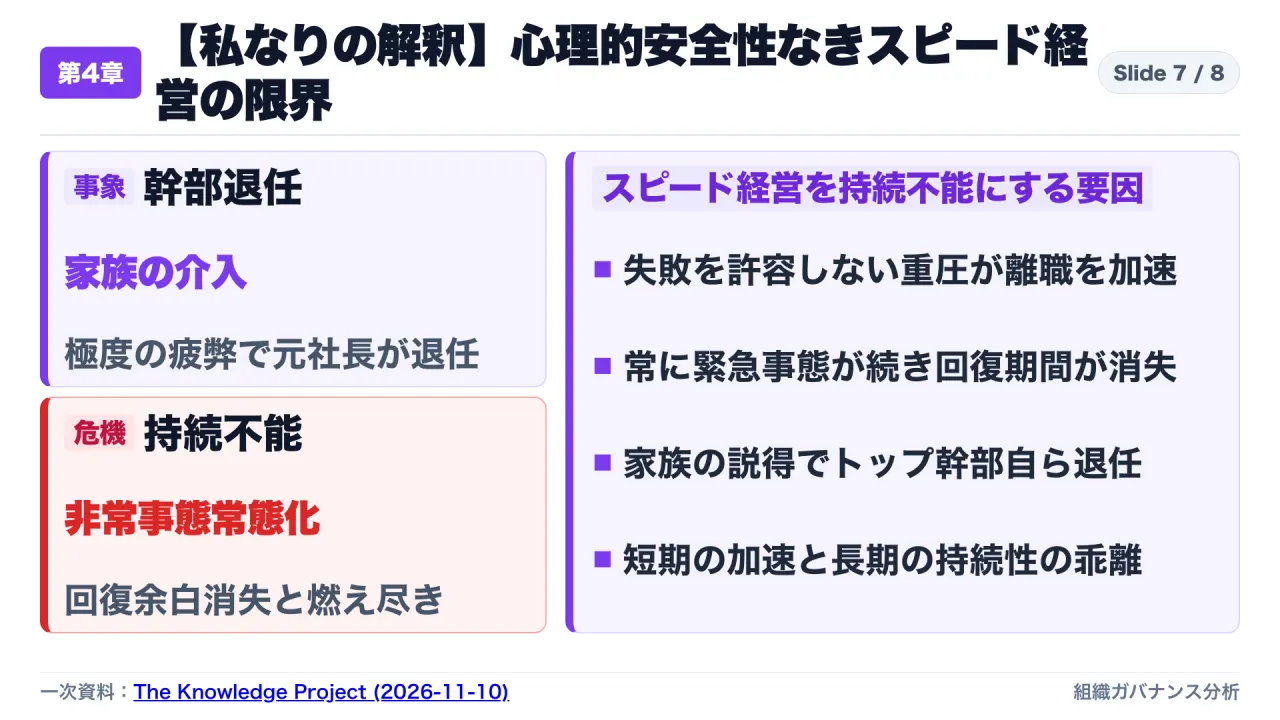
At Tesla, operating under perpetual crisis conditions created an environment where missed targets were met with public humiliation and immediate termination. While this fear-driven urgency produced remarkable short-term engineering sprints (such as the Model 3 assembly tent erected in the Fremont factory courtyard), it eliminated the psychological safety necessary for sustainable long-term execution.
McNeill’s departure from Tesla in February 2018 was precipitated by a formal “family intervention.” After years of relentless 80-to-100-hour workweeks managing continuous supply-chain emergencies, McNeill’s family confronted him, warning that the physical and mental strain had reached dangerous proportions.
An operating model that relies on continuous adrenaline is inherently fragile. When key personnel leave due to exhaustion, institutional memory evaporates, resulting in repeated design errors and cyclical turnover.
6. Architectural Takeaways: Building Sustainable High-Velocity Systems
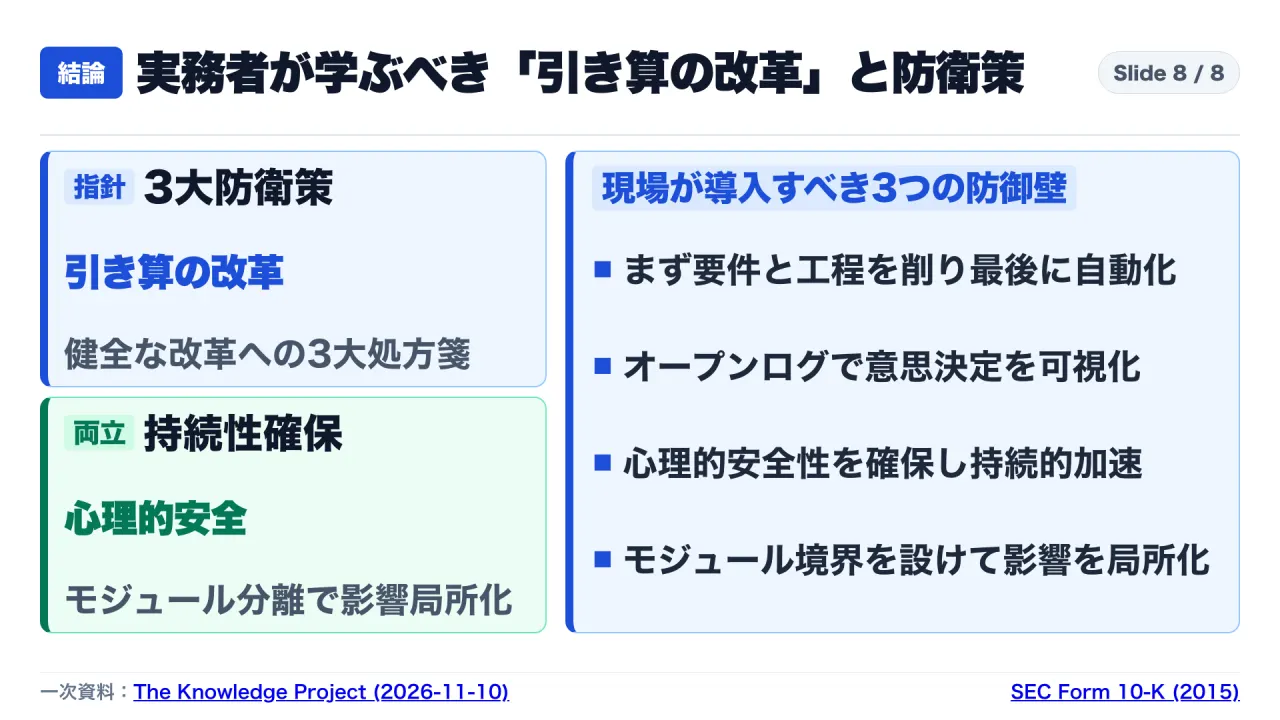
For software architects, technical founders, and enterprise engineering leaders, McNeill’s experience provides three critical defensive design rules:
flowchart TD
    R1["Rule 1: Subtract Before You Automate<br>Validate necessity before writing code or buying tools."]
    R2["Rule 2: Mitigate Human DDoS with Open Logs<br>Document architectural context publicly to deflect direct inquiries."]
    R3["Rule 3: Maintain Explicit Fault Boundaries<br>Avoid monolithic tight-coupling in software and hardware alike."]
Invariant 1: Enforce Deletion Before Automation
Never deploy workflow automation, AI agents, or SaaS integrations over an unvetted business process. The first response to any proposed initiative must be questioning its necessity. If a process cannot survive aggressive attempts at deletion, it should never be codified into software.
Invariant 2: Guard Against Human DDoS with Open-by-Default Context
Flattening communication hierarchies only works when paired with rigorous, public documentation. Engineering teams must maintain public Architectural Decision Records (ADRs), post-mortems, and searchable issue trackers. When context is discoverable, direct interruptions drop, allowing senior engineers to maintain deep work states.
Invariant 3: Maintain Decoupled Boundaries and Sustainable Recovery Cycles
Just as gigacasting highlights the peril of removing repair boundaries in mechanical hardware, monolithic software architectures risk catastrophic blast radiuses when modular boundaries are abandoned for speed. High-performing engineering organizations maintain well-defined interface contracts, clear isolation of fault domains, and predictable cadence rhythms that preserve human cognitive capacity.
Primary Sources & References
-
The Knowledge Project: Jon McNeill Interview (Episode 2026-11-10)
Former Tesla President discusses operational execution, the 5-step algorithm, and executive burnout.
https://www.youtube.com/watch?v=pRXMqm5bMFk -
Tesla, Inc. SEC Form 10-K Annual Report (Fiscal Year Ended December 31, 2015)
Discloses baseline full-time headcount of 13,058 employees and financial metrics.
https://www.sec.gov/Archives/edgar/data/1318605/000156459016013195/tsla-10k_20151231.htm -
Tesla, Inc. SEC Form 10-K Annual Report (Fiscal Year Ended December 31, 2017)
Discloses ending headcount of 37,543 employees and annual revenue of $11.76 billion.
https://www.sec.gov/Archives/edgar/data/1318605/000156459018002956/tsla-10k_20171231.htm -
Global Automotive Sales Telemetry (2023-2025 Volume Rankings)
Audited delivery figures confirming Model Y and Toyota RAV4 global sales trajectories.
https://www.marklines.com/ -
Apple Computer Historical Product Specifications (iPod 2001 Archive)
Technical specifications confirming mechanical Toshiba 1.8-inch HDD integration.
https://support.apple.com/kb/SP102