55% Faster Coding, 7.2% Lower Delivery Stability: Automated Verification and Supply Chain Defense for AI Code
An empirical engineering analysis based on Google Cloud’s 2024 DORA Report, GitClear’s 153-million-line code study, and the OWASP Top 10 CI/CD Security Risks.
Disclaimer: This publication provides objective technical and security analysis based on primary research and industry standards. It does not constitute commercial endorsement.
1. The Speed-Stability Paradox in AI-Assisted Engineering
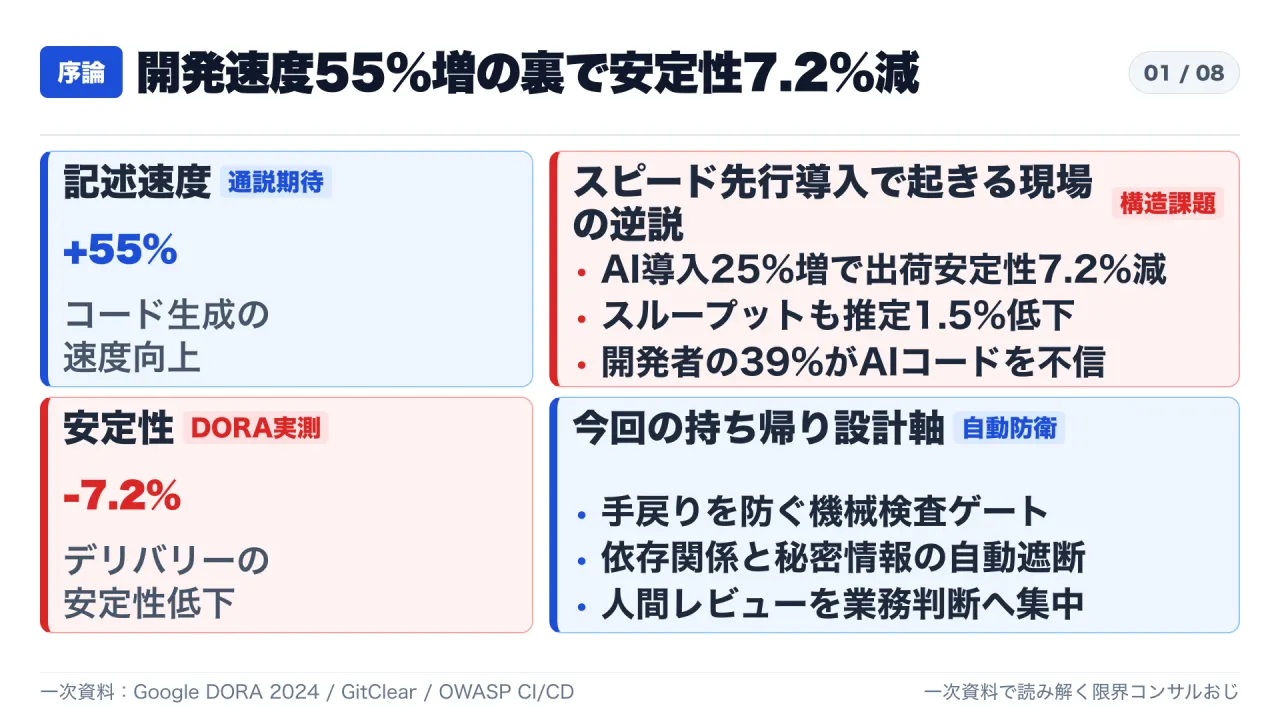
While widely cited benchmarks claim developers write code 55% faster with AI coding assistants, organization-level telemetry tells a more complex story. According to Google Cloud’s 2024 DORA Report, a 25% increase in AI adoption correlates with local improvements—a 7.5% increase in documentation quality, 3.4% in code quality, and 3.1% in code review speed—yet is accompanied by an estimated 1.5% decrease in delivery throughput and a 7.2% reduction in delivery stability.
Furthermore, 39% of respondents reported little to no trust in AI-generated code. GitClear’s analysis of approximately 153 million changed lines of code (January 2020 to December 2023) helps explain why: AI adoption coincided with a significant uptick in code churn (code revised or reverted shortly after being written) and a concerning decrease in code reuse.
2. CI/CD and Supply Chain Exposure Under OWASP Standards
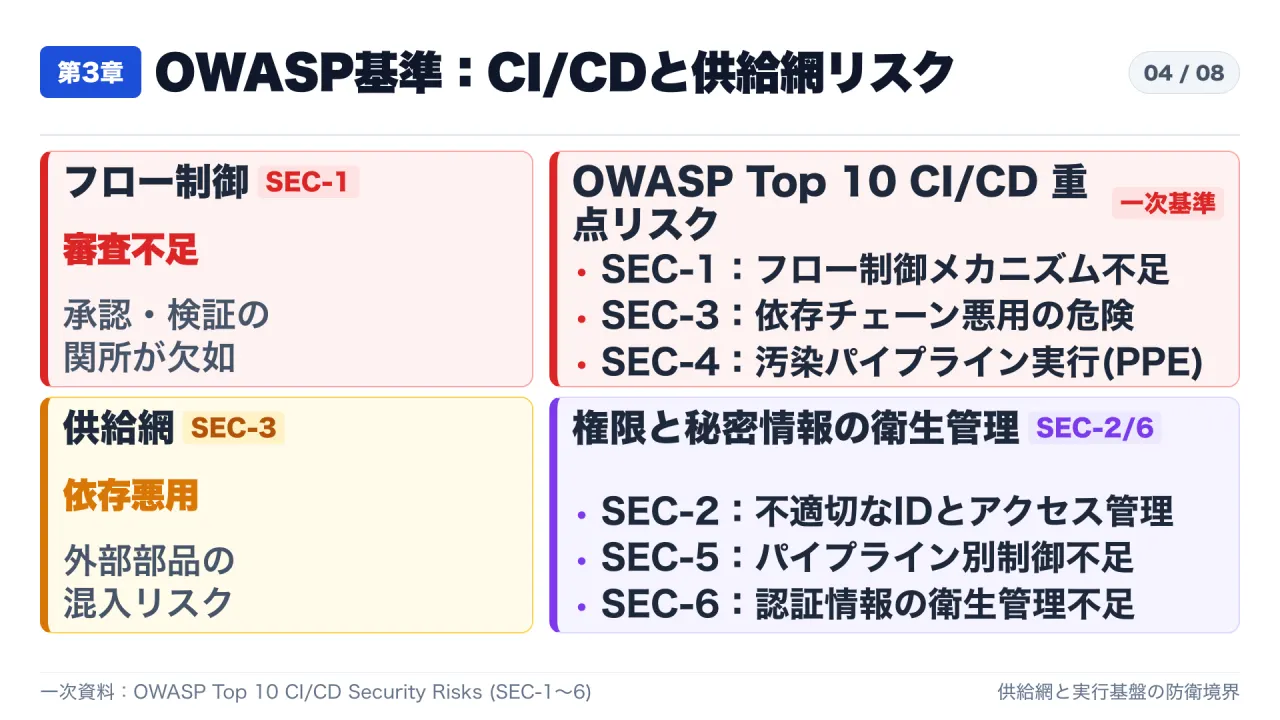
When AI increases pull-request volume, manual review alone cannot catch subtle security flaws or hallucinated dependencies. The OWASP Top 10 CI/CD Security Risks highlight the exact control planes under pressure:
- CICD-SEC-1 (Insufficient Flow Control Mechanisms): Unchecked code changes bypassing deterministic verification gates.
- CICD-SEC-2 (Inadequate Identity and Access Management) & CICD-SEC-5 (Insufficient PBAC): Over-privileged pipelines executing untrusted code.
- CICD-SEC-3 (Dependency Chain Abuse): Malicious or hallucinated third-party packages entering builds without lockfile governance.
- CICD-SEC-4 (Poisoned Pipeline Execution / PPE) & CICD-SEC-6 (Insufficient Credential Hygiene): Secrets exposed to unapproved build runs.
flowchart LR
    AI["AI-Generated Code (+55% Volume)"] -->|"Large PRs + Manual Review Only"| Drop["Code Churn & Missed Flaws (-7.2% Stability)"]
    AI -->|"Small PRs + Automated Gates + OWASP CI/CD Controls"| Safe["Low Rework & Protected Supply Chain"]
3. Three Automated Gates for Zero-Rework Delivery
- Small-Batch PRs Behind Deterministic CI Gates: Enforce unit tests, static analysis, type checks, and duplicate-code detection before any pull request reaches human reviewers, freeing humans to focus on business logic and architecture.
- Automated Dependency Governance (CICD-SEC-3): Inspect lockfile diffs automatically in CI, blocking unapproved package additions and known vulnerabilities before merge.
- Dual Secret Scanning & Isolated Execution (CICD-SEC-2/4/6): Run secret scanners both pre-commit and in CI, and isolate untrusted PR test environments from production credentials and short-lived tokens.