Escaping the AI PoC Trap: Why Only 3.9% of Firms Achieve Revenue or Profit Growth and How Workflow Redesign Closes the Gap
An organizational and operational analysis based on IPA “DX Trend 2026,” CTC comparative enterprise surveys, and Stanford HAI 2026 AI Index findings.
Disclaimer: This publication provides objective operational and strategic analysis based on published survey data and primary institutional reports. It does not constitute investment or commercial advice.
1. The 91.6% vs. 3.9% Paradox in Enterprise AI
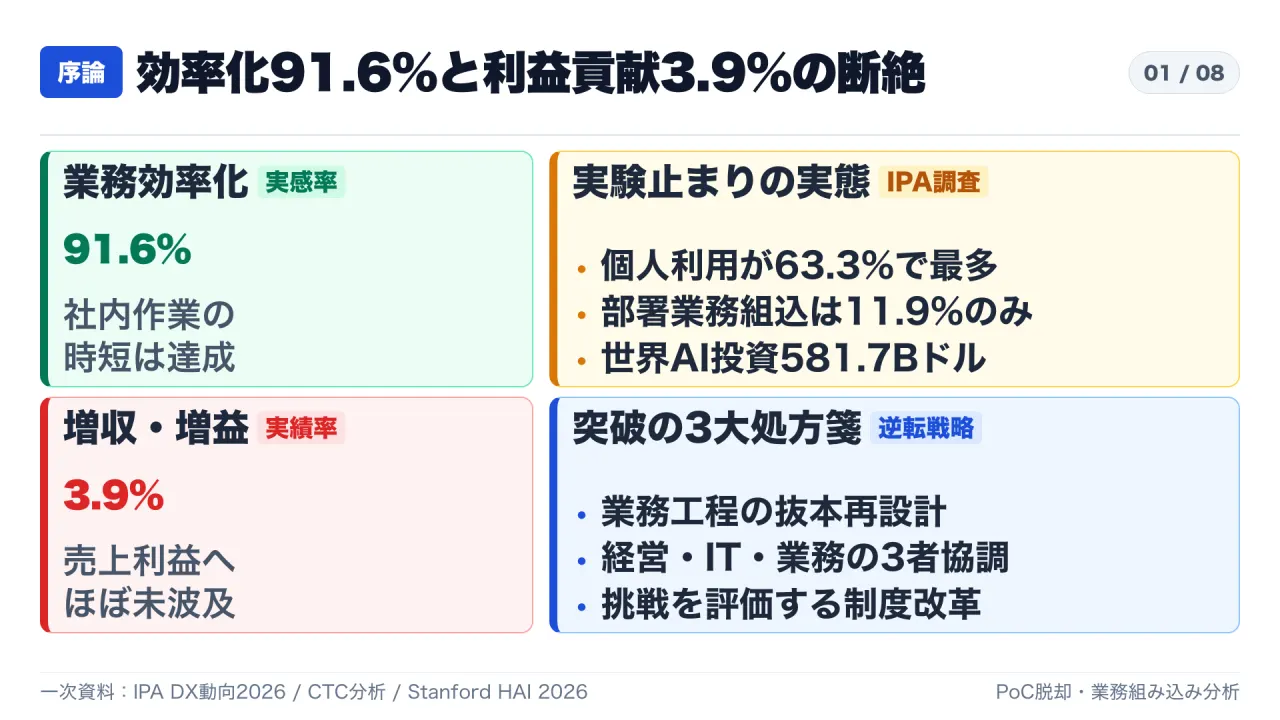
Across enterprise AI deployments, a striking gap has emerged between perceived efficiency and bottom-line financial impact. According to comparative enterprise survey data from CTC and IPA’s “DX Trend 2026,” 91.6% of AI-adopting organizations report improvements in operational efficiency or speed—yet only 3.9% report measurable increases in revenue or profit.
The root cause lies in how AI is deployed inside organizations:
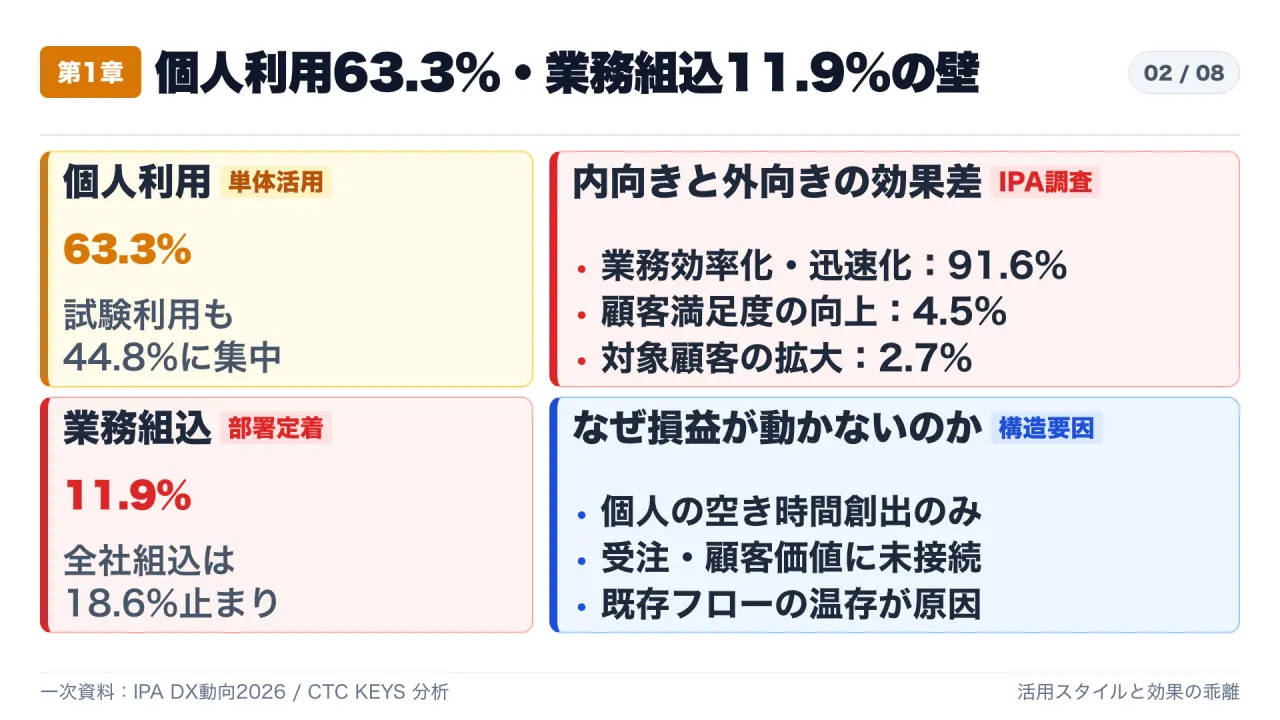
- 63.3% of usage remains concentrated in individual productivity tasks (drafting, summarizing, personal search).
- 44.8% remains confined to experimental pilots and Proofs of Concept (PoCs).
- Only 11.9% of organizations have embedded AI directly into core departmental business workflows.
2. The 35.8-Point Alignment Gap & Legacy Cost Lock-In
Why do some enterprises convert AI pilots into measurable business outcomes while the majority stall? Primary survey comparisons highlight three structural bottlenecks:
- Three-Party Alignment (35.8-Point Gap): Among companies achieving concrete business outcomes, 72.9% maintain active coordination across Executive Management, IT, and Business Operations—compared to just 37.1% among stalled peers (a 35.8 percentage-point gap).
- Maintenance-Heavy IT Budgets: Legacy maintenance and operations continue to consume roughly 80% of IT budgets, leaving minimal capacity for cross-functional workflow redesign.
- Failure-Averse Evaluation & Reactive Skill Mapping: Traditional performance evaluations penalize short-term experiment failures, while only 23.8% of lagging firms proactively map changing roles and skills—compared to 37.6% among high-performing adopters.
3. Three Prescriptions to Break Out of PoC Purgatory
- Shift from Individual Tools to Departmental Workflow Integration: Redesign end-to-end approval, handoff, and exception-handling processes around AI rather than bolting chat interfaces onto legacy steps.
- Institutionalize Management–IT–Operations Governance: Establish joint KPIs shared across business units, IT, and executive sponsors to bridge the 35.8-point alignment gap.
- Reform Evaluation Criteria and Map Role Shifts Early: Replace failure-avoidant pilot metrics with learning-velocity milestones and proactively retrain teams for AI-augmented workflows.