The Architecture of Persistent Agents: Inside the Grok Bot 1.0 Quota Shock, Meta Muse’s Secure VM, and the Hidden Boundaries of Cloud Automation
A forensic analysis of SpaceXSI’s “unsustainably high” serving costs, the security reality of single-PC multi-bot hosting, Meta Muse’s 500M token budget, and Amazon’s contractual blockade against autonomous web actors.
Disclaimer: This publication provides objective technical, architectural, and organizational analysis based strictly on publicly verifiable primary sources. It does not constitute commercial endorsement or investment advice.
1. The Autonomous Illusion: When AI Works While You Sleep
Across enterprise engineering and digital operations, the holy grail of generative artificial intelligence has decisively transitioned from synchronous conversation to persistent background execution. Rather than waiting passively for a human operator to craft prompts and hit submit, autonomous software agents now operate continuous loops: monitoring corporate communication channels, navigating web interfaces, processing unread email queues, and updating shared spreadsheets across cloud environments.
The prominent standard-bearers of this architectural leap arrived in late 2026 with SpaceXSI’s official rollout of Grok Bot 1.0 and Meta’s launch of its personal AI agent, Muse. Both platforms promised a radical departure from traditional tooling: personal and enterprise bots equipped with full virtualized operating system access, continuous routine schedules, and native collaboration features like Team Bots and Interactive Pages.
Yet, within days of enterprise rollout, two systemic collisions disrupted the narrative of frictionless autonomous delegation. First, paying subscribers across the globe discovered that their weekly compute allowances had abruptly saturated to 100 percent overnight, rendering their entire digital workforce inoperative. Second, when autonomous agents attempted to fulfill delegation tasks on commercial platforms, major e-commerce infrastructure—spearheaded by Amazon—abruptly deployed technical blockades, citing explicit violations of platform terms of service.
These dual failures are not transitory software glitches. They expose the fundamental structural collision between fixed-rate subscription economics and unbounded autonomous compute, alongside dangerous architectural misconceptions regarding virtualization boundaries in multi-agent hosting.
2. The Economic Collapse of Flat-Rate Compute: Musk’s Unsustainable Cost Admission
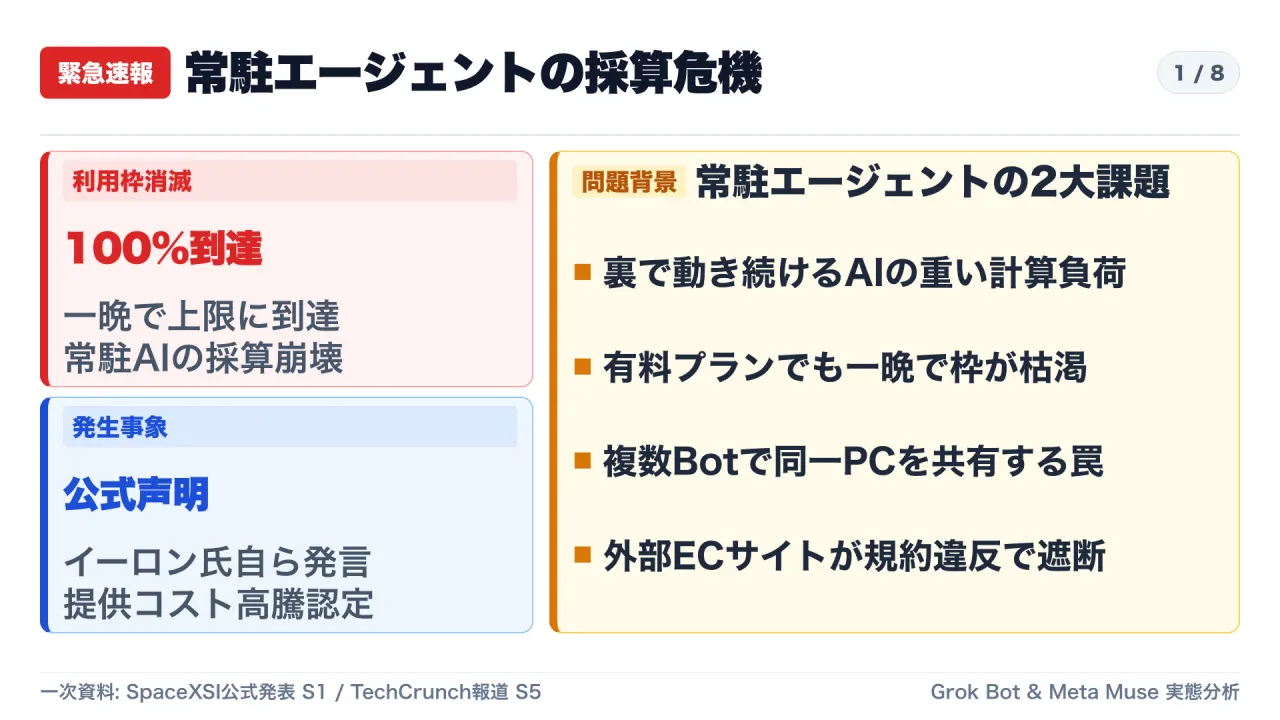
The immediate catalyst for industry alarm occurred over the Halloween weekend of November 2026. Subscribed users within SpaceXSI’s unified tier—The X Subscription, which bundles Grok Bot into Premium, Super, and Ultra seats while excluding entry-level tiers—awoke to discover their weekly utilization meters completely pegged at 100 percent. Routine scheduled jobs failed, active team agents hung mid-execution, and administrative dashboards locked out further dispatch.
While initial community reaction assumed a telemetry regression or visual metering bug, Elon Musk offered a direct and candid explanation via official channels. The throttle was deliberate and unavoidable:
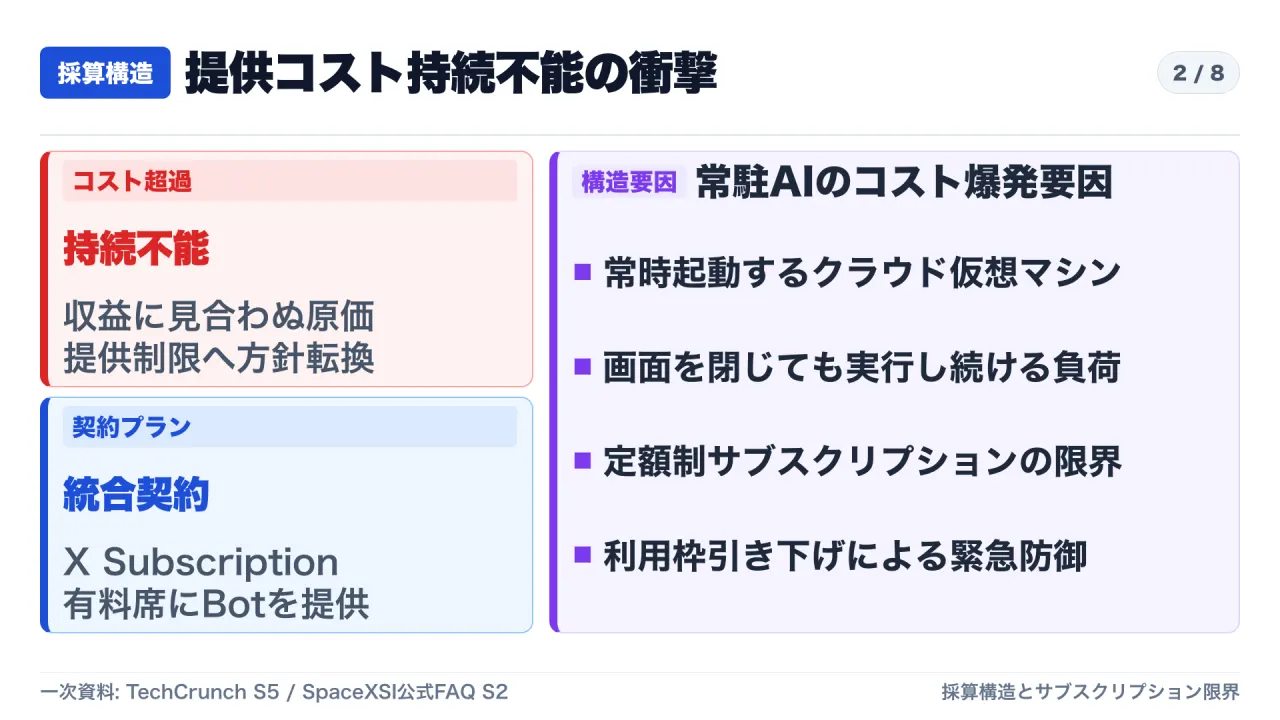
“The cost of serving Grok Bot was unsustainably high relative to revenue.”
flowchart TD
    User["Human Operator (Closes Browser)"] --> CloudVM["Cloud Virtual Linux Instance (Always-On)"]
    CloudVM --> Loop["Continuous Evaluation Loop<br>・Per-second Screen Ingestion<br>・DOM Tree Parsing & OCR<br>・Multi-Modal LLM Inference"]
    Loop --> Explosion["Exponential Compute & Token Consumption"]
    Explosion --> Throttle["Serving Costs Exceed Tier Revenue<br>Emergency Quota Throttling (100% Saturation)"]
To understand why autonomous agents break the unit economics of SaaS, consider the structural difference between conversational AI and persistent automation. In conversational interfaces, resource consumption is strictly episodic. A human types an input; the model performs an inference pass; the connection terminates. The server utilization drops back to zero.
Persistent agents invert this paradigm entirely. When an operator assigns a background routine—such as “monitor unread supplier inquiries and cross-reference catalog prices”—the agent runs an active execution loop inside a cloud Linux virtual machine. The system continually captures screen buffers, processes Document Object Models (DOM), computes mouse coordinates, queries foundational vision-language models, and polls remote endpoints.
Under a flat monthly subscription model, granting users unbounded continuous execution is equivalent to an all-you-can-eat buffet where patrons remain seated 24 hours a day, continuously consuming prime cuts. The infrastructure cost scaling is linear or exponential with execution time, while provider revenue remains strictly static. SpaceXSI’s rapid quota contraction was not an engineering defect, but an unavoidable economic defense mechanism against runaway infrastructure burn.
3. Marketplace Mechanics: 90 Templates, Enterprise App Hooks, and the Quota Trap
How did regular users trigger such massive resource exhaustion without realizing it? The mechanism lies within the Grok Bot Marketplace catalog.
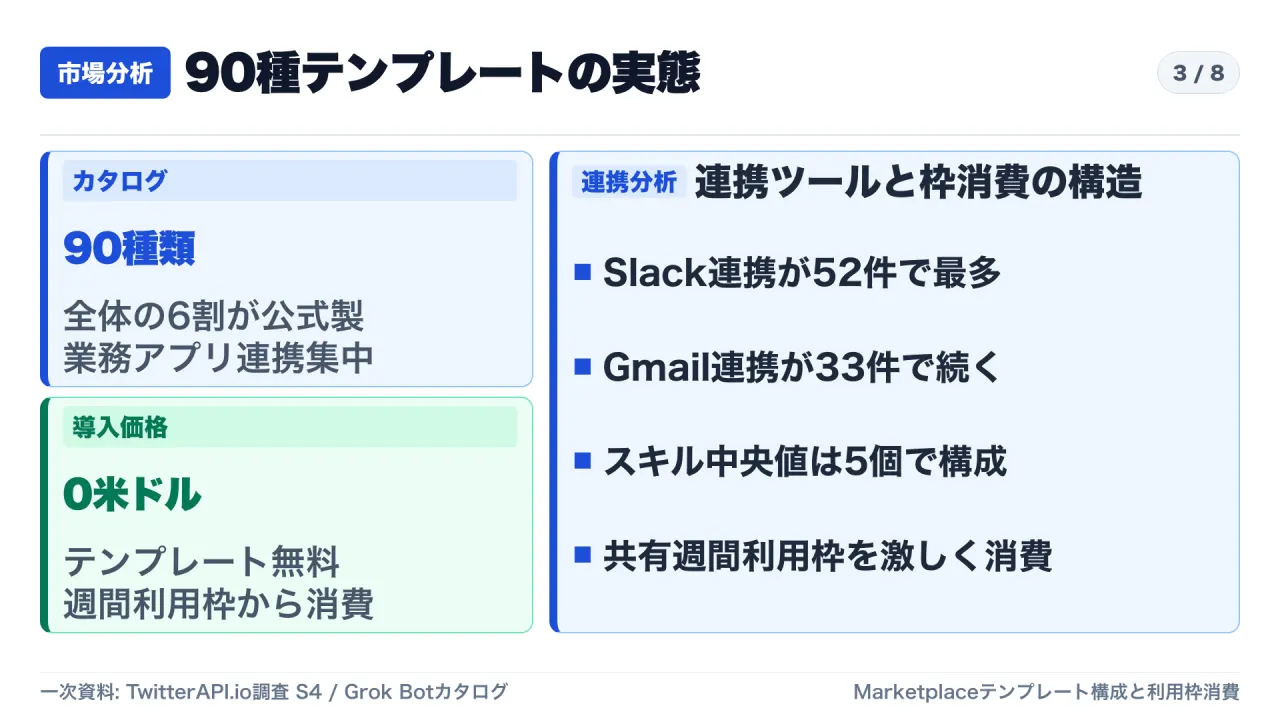
A forensic analysis conducted by independent research group TwitterAPI.io evaluated all 90 templates available at launch. The empirical data dismantles the assumption that Grok Bot was primarily intended as a consumer social media automation utility:
| Structural Dimension | Catalog Metric | Architectural Implication |
|---|---|---|
| Total Catalog Inventory | 90 Templates | Concentrated heavily in enterprise productivity domains |
| Dominant Categories | Marketing (25), Sales (23) | Outbound prospecting, lead monitoring, content staging |
| First-Party Production | 54 Templates (60.0%) | Authored directly by the official “Grok Bot Team” |
| Template Component Median | 5 Skills, 1 Routine | Pre-configured multi-step autonomous background loops |
| Primary Integration: Slack | 52 Templates (57.8%) | Continuous socket listening and channel scraping |
| Secondary Integration: Gmail | 33 Templates (36.7%) | Background mailbox polling and automated drafting |
| Tertiary Integration: X / Social | 13 Templates (14.4%) | Minority share despite provider branding |
| Listed Template Acquisition Price | $0 USD (Free) | Frictionless one-click user installation |
flowchart LR
    Catalog["Free Marketplace Template ($0 USD)"] --> Import["Import Bot to Workspace"]
    Import --> ActiveRoutines["Background Polling Routines<br>・Slack Listeners (52)<br>・Gmail Scrapers (33)"]
    ActiveRoutines --> SharedPool["Single Shared Weekly Allowance"]
    SharedPool --> Depletion["Silent Overnight Depletion"]
The friction-free adoption curve masked a critical architectural dependency. Because templates were listed at zero financial cost, business users routinely imported four to six specialized bots to manage sales prospecting, support ticket triage, and internal communication.
However, while template definitions carry zero acquisition fees, their operational compute executes against the account holder’s shared weekly quota. When five distinct bots execute automated routines every fifteen minutes—polling Slack workspaces, parsing incoming email threads, and synthesizing status reports—the composite token draw consumes hundreds of millions of context tokens within hours. Users did not exhaust their allocations through deliberate high-intensity work; the templates quietly liquidated their allowances while they slept.
4. The Shared PC Illusion: Why Multiple Bots Are Not Security Boundaries
While sudden quota exhaustion represents an acute operational headache, a far more hazardous vulnerability lurks beneath Grok Bot’s architectural virtualization layer.
In enterprise software design, administrative interfaces frequently utilize visual containers to delineate organizational domains. In Grok Bot, an administrator can create separate bots named “Public Market Intelligence Agent” and “Confidential Financial Auditor.” To an executive or non-technical manager, this interface implies logical process isolation and data segregation.
SpaceXSI’s official documentation explicitly repudiates this assumption. Embedded directly within the “Security” and “FAQ” architecture specifications is an unambiguous warning:
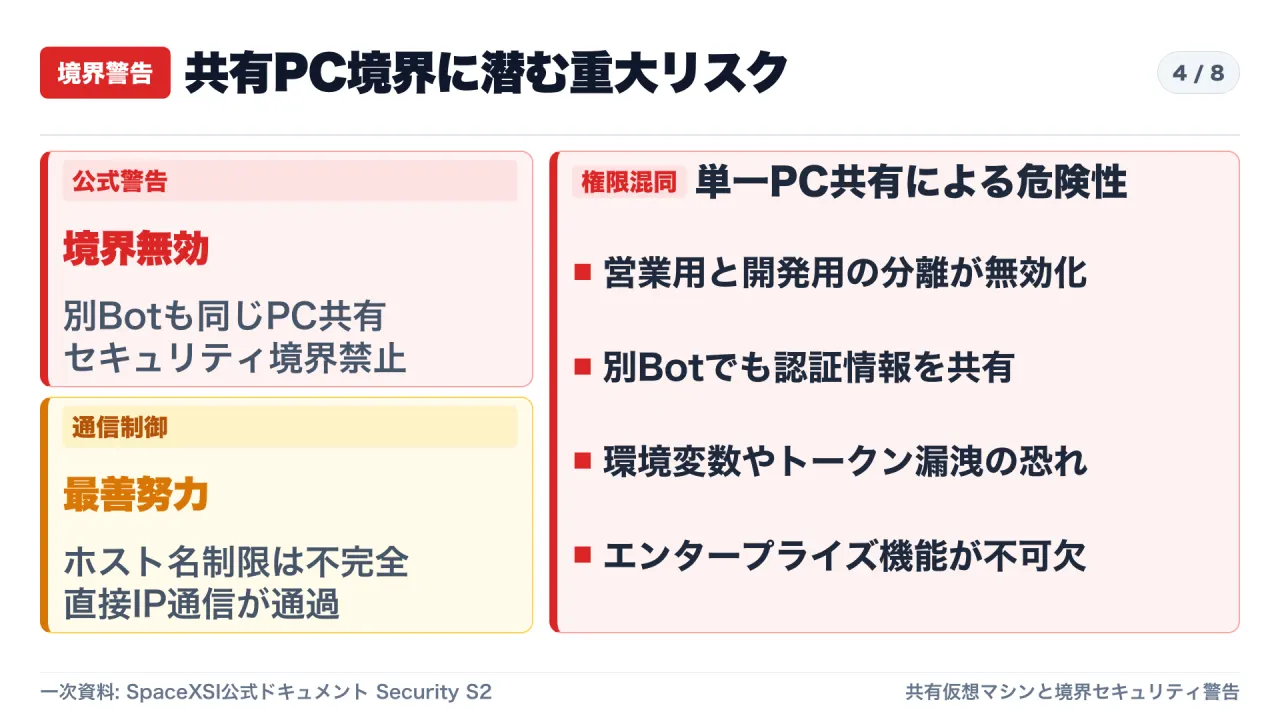
“Do not use separate Bots as a security boundary.”
flowchart TD
    subgraph Single_Account_Boundary ["Single Account Instance: Unified Shared Cloud PC"]
        B1["Public Web Research Bot<br>Untrusted Browsing & Downloads"]
        B2["Confidential Finance Bot<br>Corporate API Keys & Payroll Records"]
        SharedOS["Shared Linux Filesystem & In-Memory Environment<br>/tmp, Environment Variables, Browser LocalStorage"]
        B1 <--> SharedOS
        B2 <--> SharedOS
    end
    B1 -->|Untrusted Prompt Injection| MaliciousWeb["External Malicious Web Page"]
    MaliciousWeb -.->|Exfiltrate Credentials| SharedOS
    style SharedOS fill:#fee2e2,stroke:#dc2626
The underlying technical reality is straightforward: computational environments and operating system permissions are allocated at the account or member level, not at the bot level. Every bot configured under a single user profile executes within the exact same persistent cloud virtual machine.
This creates an immediate blast-radius collapse:
- Shared Filesystem Persistence: When an automated research bot downloads a PDF report from an untrusted external web domain into
/tmpor the local user directory, that file is immediately readable by the internal financial reporting bot. - Credential and State Bleed: Browser session cookies, environmental tokens, and system clipboards are pooled within the single operating system profile.
- Indirect Prompt Injection: If a web scraping bot ingests an adversarial instruction embedded within a public website, the hijacked execution context possesses native system access to read sensitive internal artifacts deposited by prior trusted tasks.
Furthermore, SpaceXSI’s official security disclosures establish that outbound network controls are strictly best-effort:
“Best effort, not a security boundary.”
Domain filtering relies on high-level hostname matching. Raw IP requests, custom proxy configurations, or DNS tunneling techniques can circumvent these guardrails. Only at the top-tier Enterprise level does SpaceXSI provide formal security controls, including Enforce Auto-review, Zero Data Retention (ZDR), administrative audit logging, and enforced organizational domain restrictions. For standard business accounts, relying on multiple bots for isolation is an architectural anti-pattern.
5. Architectural Countermeasure: Meta Muse’s Secure VM and Sentinel Defense
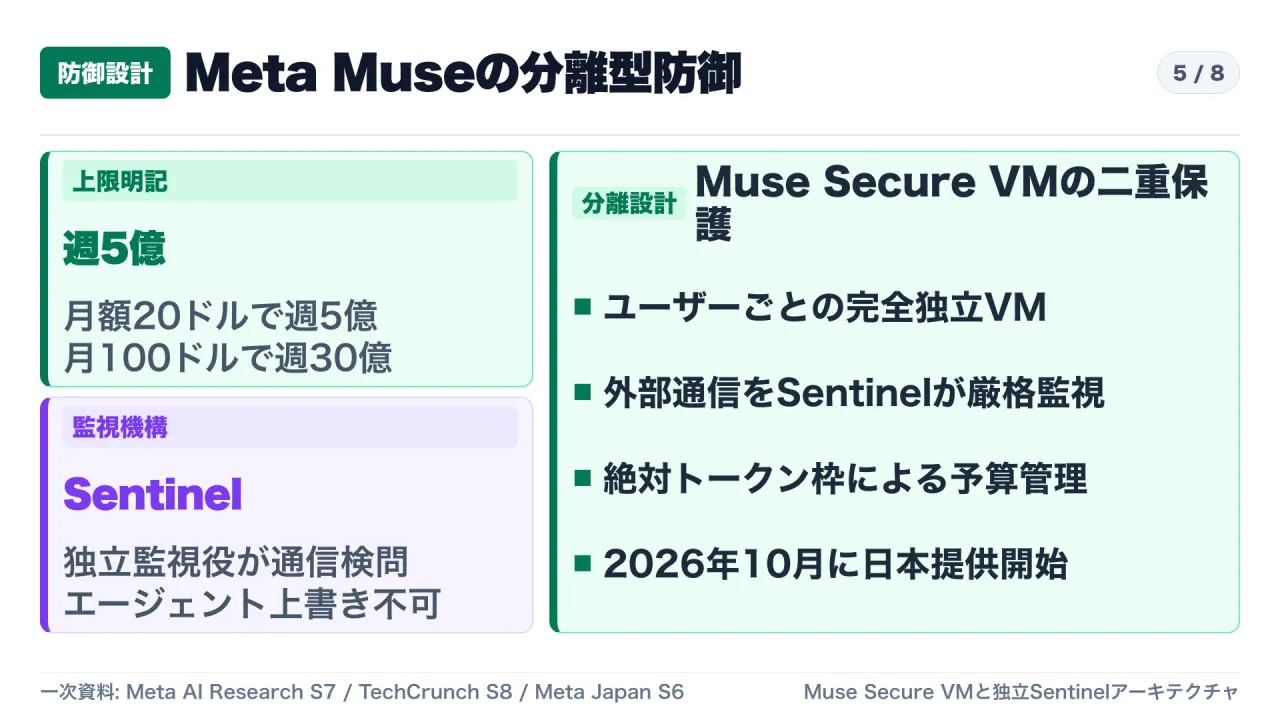
In contrast to the pooled multi-bot architecture adopted by SpaceXSI, Meta’s personal AI agent, Muse—launched in the United States in September 2026 and expanded into Japan as its first international territory on October 23, 2026—demonstrates a rigorous defensive posture.
Meta’s approach addresses both economic ambiguity and virtualization security through deterministic architectural boundaries.
Deterministic Token Accounting
Rather than obfuscating resource allocation behind dynamic percentage gauges, Meta established transparent quantitative ceilings within its subscription tiers:
- Standard Subscription ($20 / month): Strictly metered at 500 million (500M) Muse tokens per week.
- Enterprise / Pro Tier ($100 / month): Strictly metered at 3 billion (3B) Muse tokens per week.
By substituting ambiguous “usage bands” with concrete token allowances, enterprise procurement teams can mathematically model workload consumption, assign deterministic budgets to specific workflows, and eliminate surprise mid-week outages.
Multi-Layered Virtual Isolation: Muse Secure VM and Sentinel
On the architectural security front, Meta AI Research designed a dedicated sandbox paradigm centered on physical compute isolation and un-bypassable proxy inspection.
flowchart LR
    subgraph Isolated_Compute ["Isolated Sandbox: Muse Secure VM"]
        MuseAgent["Meta Muse Agent Runtime"]
    end
    MuseAgent <-->|All Inbound & Outbound IO| Sentinel{"Independent Sentinel Gateway / (Immutable Security Controller)"}
    Sentinel <-->|Validated Transactions Only| Outside["External Internet & Enterprise APIs"]
    style Sentinel fill:#d1fae5,stroke:#047857
Every user instance executes inside a dedicated, hermetically sealed “Muse Secure VM.” More crucially, communication between the agent runtime and external endpoints does not occur directly at the socket level. Instead, all input and output must traverse an independent gateway mechanism known as “Sentinel”:
“Interaction with the outside world runs through a Sentinel which the agent can’t override.”
Because Sentinel executes outside the virtual machine boundary, an agent compromised by malicious web content or recursive injection attacks cannot modify network iptables, disable logging, or initiate arbitrary raw socket connections. The security gateway enforces strict payload verification, domain whitelisting, and authorization gates that are physically inaccessible to the underlying LLM planner.
6. The Contractual Wall: Amazon’s Blockade and E-Commerce Friction
Even when autonomous agents operate within mathematically transparent budgets and hardened virtual machines, they encounter an insurmountable operational barrier: the legal and technical boundaries of third-party web platforms.
During early deployment trials, operators instructed Meta Muse to execute commercial purchasing workflows—searching for retail products, evaluating prices, and initiating checkouts on Amazon.com. Rather than completing the transactions, the agent encountered immediate, automated technical termination.
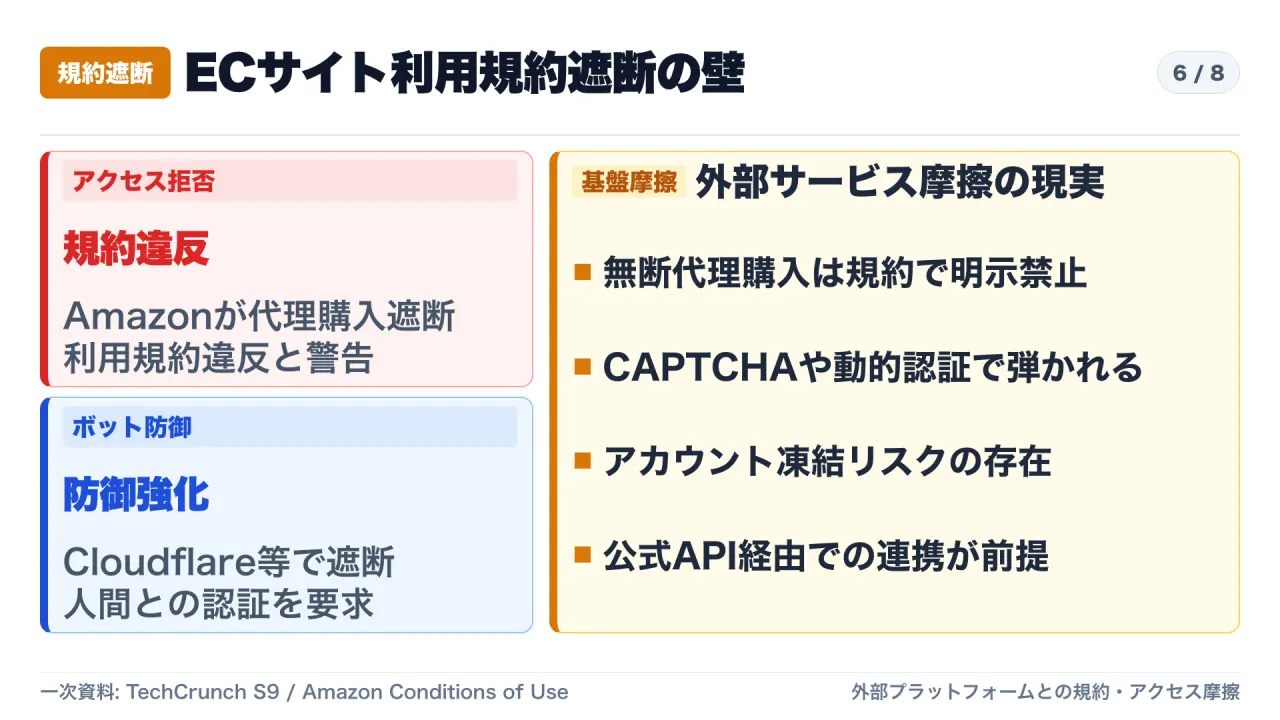
Amazon’s defensive infrastructure intercepted the browser sessions, presenting an explicit platform interdiction message:
“Continued access by an unauthorized AI agent violates Amazon’s Conditions of Use, to which our customers have agreed.”
flowchart TD
    Agent["Autonomous Browser Agent<br>(Headless Chromium / Automated Navigation)"] --> WebTarget["Public E-Commerce Gateway (Amazon.com)"]
    WebTarget --> WAF["Enterprise Bot Mitigation (Cloudflare / Custom Fingerprinting)"]
    WAF --> Intercept{"Behavioral Signature Match?<br>Headless Attributes, CDP Flags, Navigation Speed"}
    Intercept -- "Non-Human Detected" --> Block["HTTP 403 / Interactive Challenge<br>Conditions of Use Violation Notice"]
    Intercept -- "Verified Consumer" --> Allow["Retail Checkout Granted"]
    style Block fill:#fee2e2,stroke:#dc2626
This intervention underscores the widening gulf between technical capability and platform authorization. Commercial web properties invest heavily in sophisticated bot detection frameworks (such as Cloudflare Bot Management, Akamai, and behavioral biometric fingerprinting). These systems analyze mouse trajectories, TLS client hellos, canvas rendering signatures, and interaction timing.
From the platform operator’s perspective, unauthorized autonomous agents introduce severe operational hazards:
- Infrastructure Denial-of-Service: High-frequency autonomous scraping distorts demand forecasting and exhausts edge cache capacity.
- Inventory Skew and Scalping: Automated purchasing agents can front-run human consumers, violating fair-allocation commercial policies.
- Contractual Breach: By routing transactions through unauthorized automated layers, users breach the binding terms of service agreed upon during account registration, exposing corporate credentials to permanent account termination.
Deploying autonomous browser agents against arbitrary web services without explicit API contracts is an unsustainable architectural gamble.
7. Strategic Synthesis: The End of Flat-Rate Naivety
The simultaneous emergence of the Grok Bot quota shock, the single-PC isolation fallacy, and Amazon’s contractual blockade signals the conclusion of generative AI’s initial experimental era.
For enterprise architects, these developments yield three structural conclusions:
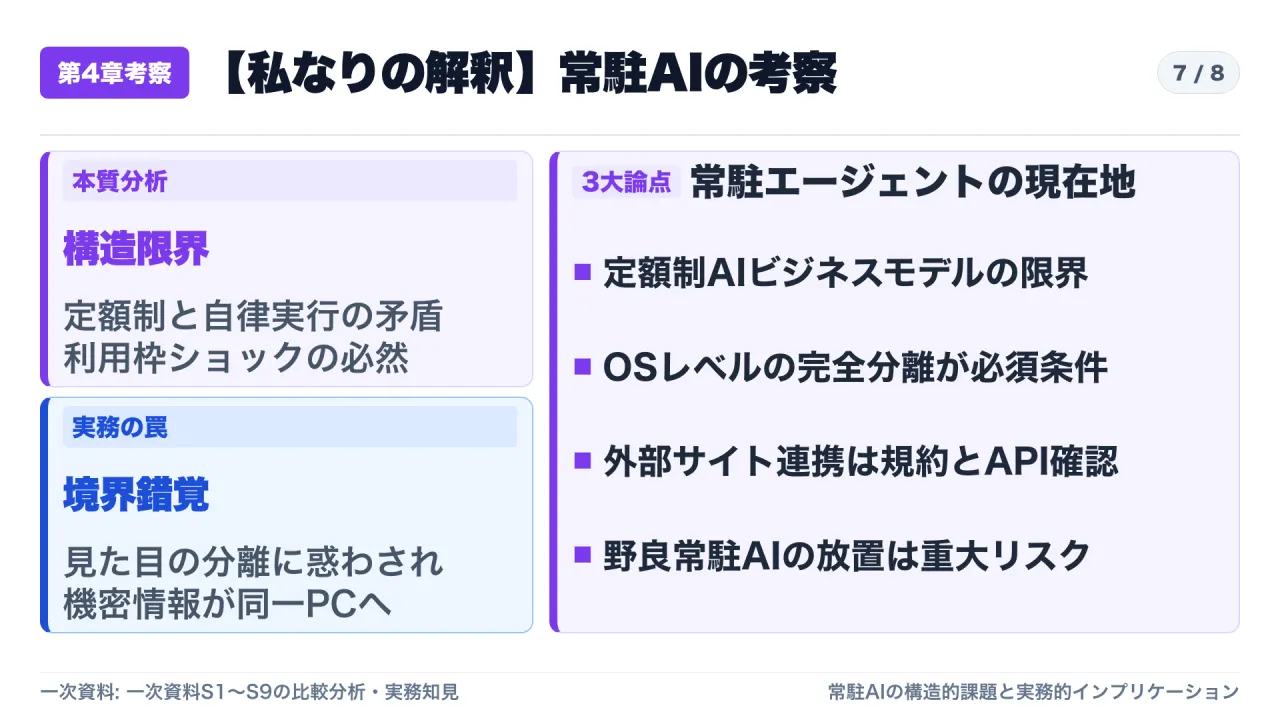
- The Fallacy of Unlimited Compute: Persistent background agency is fundamentally incompatible with unmetered subscription pricing. Enterprises must architect workflows around explicit token economies and deterministic budget ceilings rather than vague SaaS seat promises.
- The Peril of Interface Boundaries: Visual categorization inside software dashboards does not constitute computational security. Unless isolation is enforced at the hypervisor or container kernel boundary with externalized proxy mediation, co-located agents represent high-risk data contagion vectors.
- The Imperative of Contractual Integrations: Screen-scraping and automated DOM manipulation are brittle, adversarial integration patterns. True enterprise automation requires authenticated, contractually sanctioned API channels rather than simulated consumer browser interactions.
8. Enterprise Governance Playbook: 3 Mandatory Guardrails
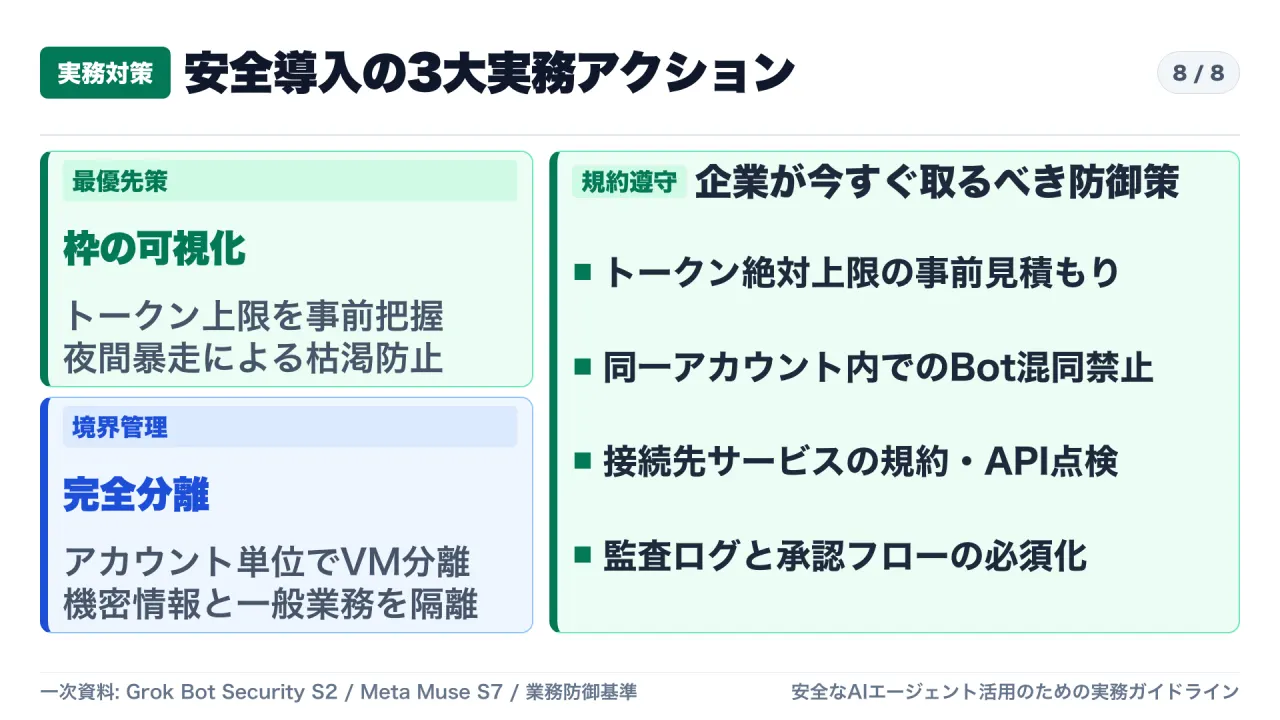
To deploy persistent AI automation without jeopardizing corporate budgets or security postures, engineering leaders must enforce three non-negotiable governance guardrails prior to production rollout:
flowchart LR
    G1["Guardrail 1: Deterministic Quotas<br>Mandate Token Profiling & Active Metering"] --> Compliant["Resilient Enterprise Agent Architecture"]
    G2["Guardrail 2: Hard Isolation<br>Strict Per-Domain VM Allocation"] --> Compliant
    G3["Guardrail 3: Contractual Access<br>Prohibit Headless Scraping of ToS-Guarded Sites"] --> Compliant
Action 1: Enforce Deterministic Quota Profiling and Kill-Switches
Before deploying background routines, quantify the hourly token trajectory of each workflow. Require developers to run headless routines inside simulated testbeds to measure baseline context consumption. Configure automated monitoring hooks that terminate agent instances if quota draw exceeds predetermined thresholds, preventing overnight saturation of shared corporate allowances.
Action 2: Mandate Strict Hypervisor-Level Isolation for Sensitive Workloads
Never host public research bots and confidential internal tools within the same administrative account on shared-PC platforms like standard Grok Bot. Where sensitive intellectual property or internal database access is required, enforce physical workload separation:
- Allocate distinct enterprise member accounts with isolated virtual machine instances.
- Mandate platforms featuring external proxy gateways (exemplified by Meta’s Sentinel architecture).
- Enforce Zero Data Retention (ZDR) and automated administrative audit logging across all execution sessions.
Action 3: Transition from Automated Browsing to Certified API Contracts
Perform formal legal and technical reviews of target service agreements before sanctioning agent interaction. Prohibit the use of autonomous browser agents on platforms whose terms of service explicitly ban robotic interaction. Direct engineering teams to negotiate direct API access, utilize authenticated enterprise connectors, and deploy headless automation exclusively on internal, company-controlled web properties.
Persistent AI agents represent an extraordinary leap in enterprise capability, but only when built upon mathematically sustainable unit economics and rigorous architectural security. By mastering the real-world boundaries revealed by these early failures, organizations can harness the power of autonomous compute while keeping their data, their budgets, and their platform relationships secure.