The 86.4% AI Adoption Illusion: Inside Japan's 11.9% Enterprise Workflow Gap, Infrastructure Realities, and the Physical AI Playbook
A rigorous empirical analysis of ministerial white paper headlines versus IPA’s 1,799-firm census, GPU infrastructure utilization corrections, Stanford HAI Index metrics, and the architectural path to operational advantage.
Disclaimer: This publication provides objective technical, architectural, and organizational analysis based on verified primary sources. It does not constitute commercial endorsement or investment advice.
1. The Siren Song of Headline Adoption Metrics
A prominent narrative in business media suggests rapid generative AI adoption across corporate Japan. The Ministry of Internal Affairs and Communications (MIC) reported in its White Paper that 86.4% of surveyed enterprises utilize generative AI in business operations, implying widespread operational transformation.
Yet within enterprise IT departments and factory floors, a persistent cognitive dissonance remains. Despite widespread corporate accounts, productivity statistics remain flat, overtime hours show negligible decline, and measurable return on investment remains elusive.
The empirical explanation was documented by the Information-technology Promotion Agency (IPA) under the Ministry of Economy, Trade and Industry. In its landmark investigation of 1,799 domestic corporations titled DX Trends 2026, the agency uncovered a stark operational divide.
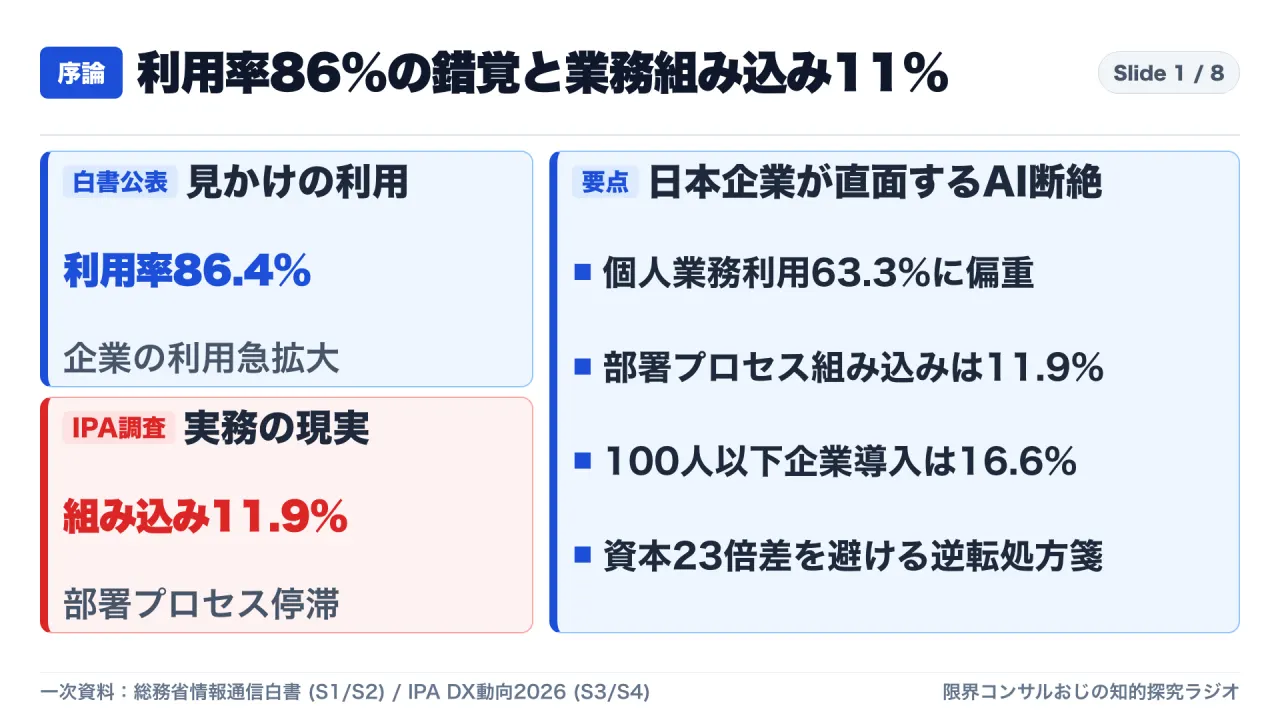
While individual employee experimentation reached 63.3%, the proportion of enterprises that have formally integrated generative AI into departmental business workflows stands at a meager 11.9%.
Employees utilize web chatbots individually for drafting and summarization, but core transaction processing, ERP records, supply chain scheduling, and engineering design remain entirely manual.
Domestic compute providers have experienced this bottleneck directly. Sakura Internet reduced annual GPU infrastructure revenue projections from 15.8 billion yen to 8.5 billion yen—a 46% cut driven by project completions and lagging application-layer demand.
2. Forensic Statistical Dissection: Sampling Divergence Between White Paper and Census
The 74.5 percentage point gap between the MIC White Paper figure (86.4%) and IPA’s integration metric (11.9%) demonstrates the risk of conflating employee exploration with systemic transformation.
flowchart TD
    A["Government White Paper Metric<br>86.4% Adoption"] --> B["Pre-filtered Management Sample<br>Prompting Once = Active User"]
    C["IPA 1,799-Firm Census<br>11.9% Workflow Integration"] --> D["Broad Enterprise Cross-Section<br>Rigorous API & Workflow Auditing"]
    B -.->|Perception Gap| D
When primary methodologies are cross-examined, the underlying mechanics of this divergence become immediately apparent.
| Evaluation Metric | MIC White Paper Secondary Source | IPA DX Trends 2026 Official Census |
|---|---|---|
| Surveying Authority | Ministry of Internal Affairs & Communications | Information-technology Promotion Agency (IPA) |
| Target Population | Corporate managers at digitally committed enterprises | Representative cross-section of Japanese industry |
| Audited Sample Size | Limited targeted managerial cohort | 1,799 validated domestic enterprises |
| Headline Metric | “86.4% utilize generative AI in business” | “44.0% officially deployed” (58.0% incl. trials) |
| Core Workflow Rate | Unmeasured (broad informal utilization) | 11.9% integrated into departmental processes |
| Enterprise Service Rate | Unmeasured | 18.6% integrated into enterprise offerings |
The MIC citation derives from a query directed at managerial personnel within organizations with pre-existing digital transformation budgets. If a single manager experimented with market research prompting or synthesized meeting minutes, the entire enterprise was classified as an active AI adopter.
Conversely, the IPA census systematically sampled 1,799 enterprises spanning small-and-medium enterprises (SMEs) to Tokyo Stock Exchange Prime-listed conglomerates. Under this forensic lens, the baseline formal adoption rate drops to 44.0%. Even with informal divisional trials (14.0%), total enterprise exposure reaches only 58.0%.
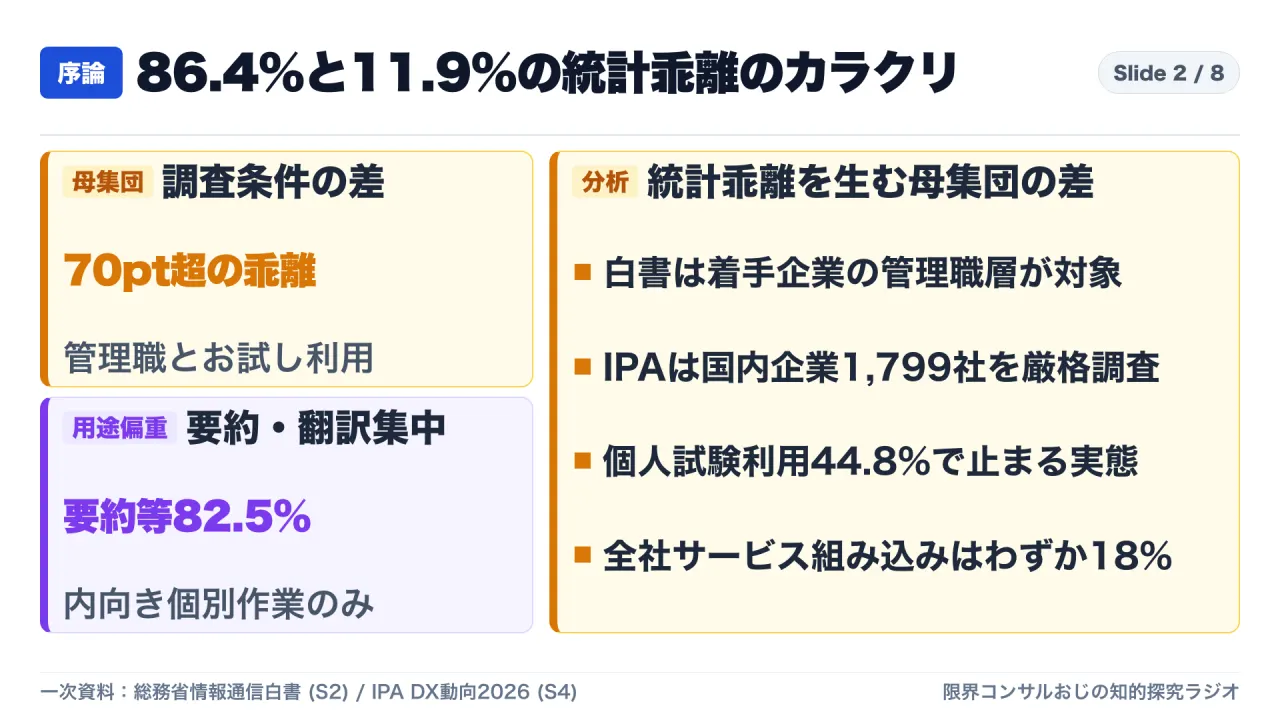
More revealing is the granular taxonomy of functional utilization documented by the IPA:
- Text and audio summarization, translation, and proofreading: 82.5%
- Document, slide, and report generation: 80.5%
- Informational retrieval and background research: 71.2%
- Source code generation and technical review: 34.8%
- Embedded departmental workflow integration: 11.9%
- Enterprise customer-facing service integration: 18.6%
Over 80% of corporate usage focuses on peripheral administrative tasks. While employees save minutes drafting emails, the broader operational pipeline remains untouched. Without direct API integration into ERP, CRM, and production databases, cumulative economic impact remains negligible.
3. Structural Fractures: The 4.7x Firm Size Divide and Human Capital Paralysis
The 11.9% workflow integration rate conceals sharp corporate stratification. Among large enterprises (1,001+ employees), adoption reached 78.3% (89.4% including trials), backed by enterprise sandbox environments and acceptable-use policies.
Conversely, among firms with 100 or fewer employees, formal adoption drops to 16.6%, creating a 4.7x divide across enterprise tiers.
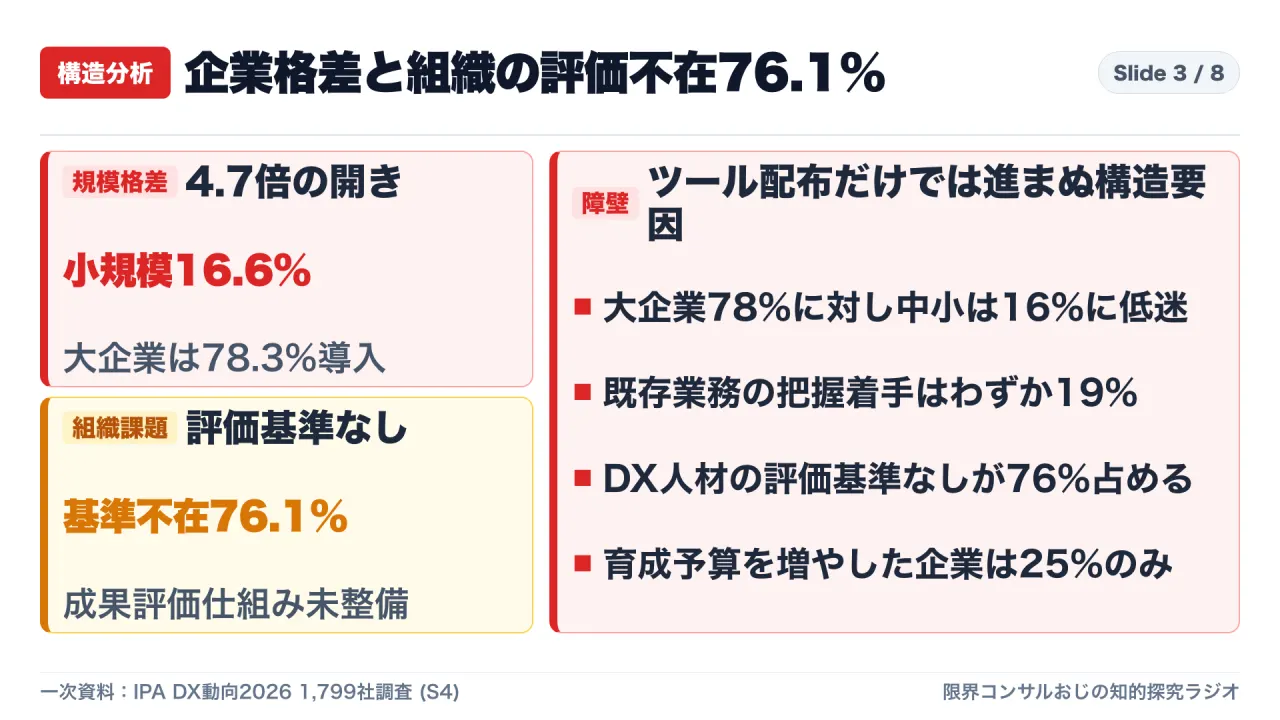
However, technical infrastructure availability does not guarantee organizational efficacy. The IPA survey identified three governance pathologies that actively suppress workflow integration:
- Absence of DX personnel performance evaluation criteria: 76.1%
- Failure to increase dedicated transformation training budgets: 74.4% (only 25.6% expanded budgets)
- Formal accounting and profiling of automatable baseline workflows: 19.0%
This organizational gridlock can be understood through an industrial manufacturing analogy. An enterprise purchases cutting-edge high-torque electric drills for every worker on the factory floor. However, plant management leaves the assembly blueprints, conveyor speeds, and quality assurance checkpoints configured for manual hand tools.
Furthermore, when an enterprising floor technician uses the new tool to cut operational assembly times in half, human resources provides zero formal mechanism to recognize, promote, or reward the innovation. The worker is simply assigned additional legacy tasks.
Without explicit performance incentives and structural workflow decomposition, distributing conversational AI access amounts to little more than subsidizing localized administrative distraction.
4. Compute Realities: The Lessons of Sakura Internet’s 46% Guidance Revision
The limitations of compute-centric strategies are equally evident on the infrastructure supply side. On July 28, 2025, Sakura Internet announced a major revision to its full-year earnings guidance for the fiscal year ending March 2026.
Projected annual net sales for its dedicated GPU Infrastructure Service were slashed from an initial budget of 15.8 billion yen to 8.5 billion yen, representing a 46.2% downward adjustment.
flowchart LR
    subgraph InitialExpectation["Initial Model-Centric Thesis"]
        IE1["GPU Cluster Procurement"] --> IE2["Continuous Training Demand"]
        IE2 --> IE3["15.8 Billion Yen Target"]
    end

    subgraph EmpiricalReality["Empirical Reality"]
        ER1["Project Completion"] --> ER2["Workflow Application Deficit"]
        ER2 --> ER3["8.5 Billion Yen Revised"]
    end
The underlying catalyst was straightforward: major domestic generative AI research and development projects concluded their initial pre-training cycles, and secondary commercial demand failed to materialize at anticipated volumes. Concurrently, Sakura’s traditional cloud and hosting services expanded from 5.7 billion yen to 8.7 billion yen, underscoring stable baseline utility demand.
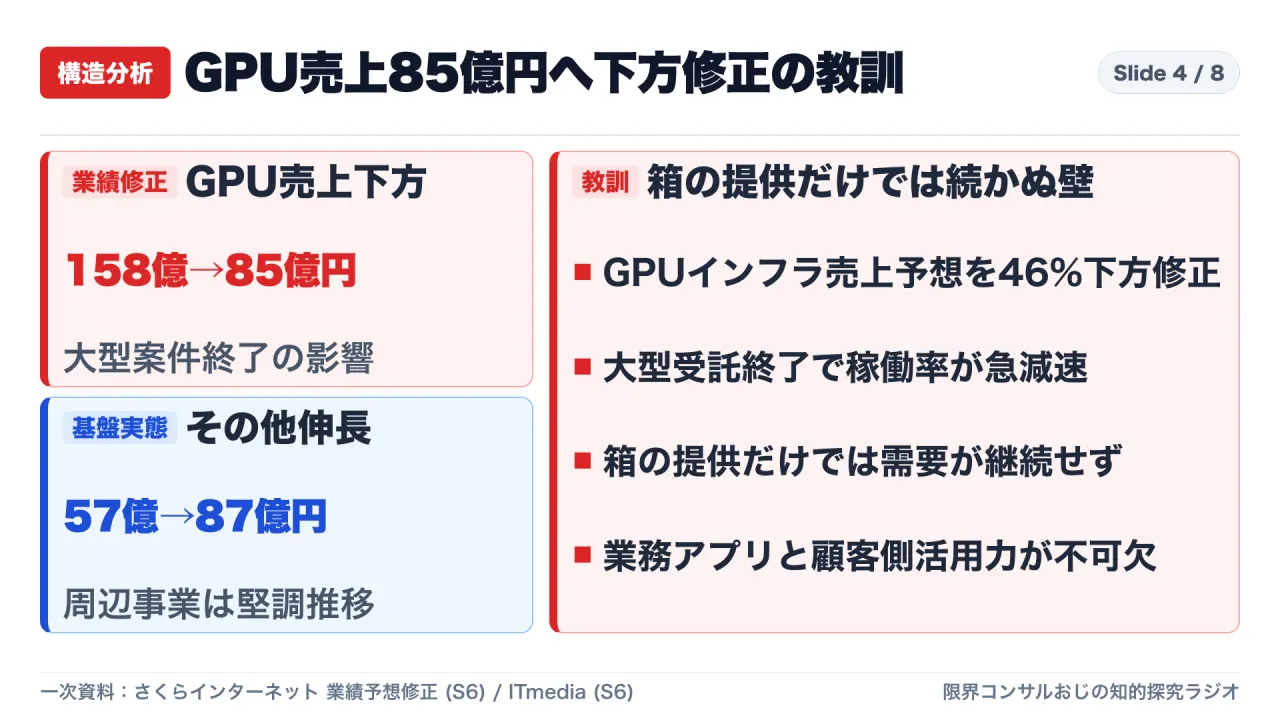
Much like outfitting an industrial kitchen with high-end appliances before developing recipes or securing ingredient supply chains, compute infrastructure cannot generate value without functioning commercial workflows.
While the MIC documents an expanding “digital balance deficit” from software payments to overseas hyperscalers and promotes regional “Watt-Bit Coordination” demonstrations, domestic compute hosting alone cannot generate economic surplus without application-layer integration.
5. The Global Horizon: Stanford HAI 2026 and the 12% Physical AI Wall
To formulate an effective enterprise posture, corporate leaders must contextualize domestic challenges against broader macroeconomic realities. The Stanford Institute for Human-Centered Artificial Intelligence (Stanford HAI) released its definitive AI Index Report 2026, establishing crucial empirical benchmarks.
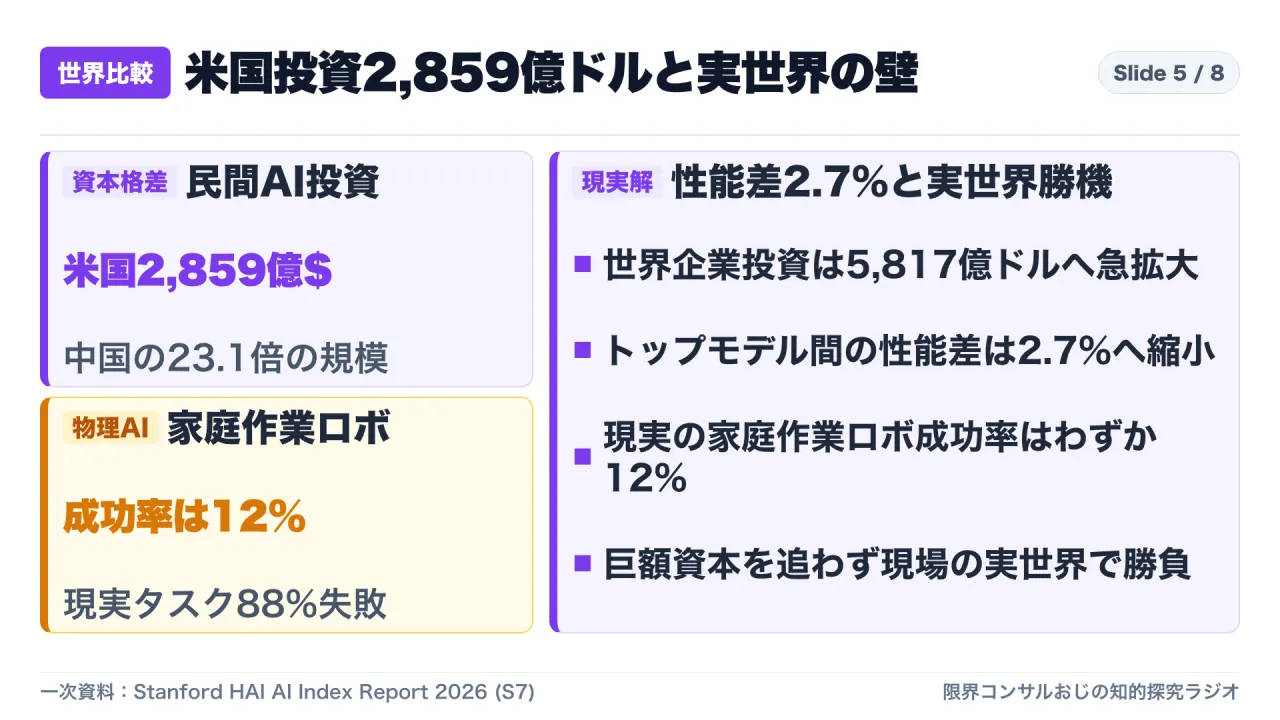
Global corporate AI expenditure reached 581.7 billion dollars (up 130%), with private investment at 344.7 billion dollars. The United States represented 285.9 billion dollars in private capital—23.1 times China’s 12.4 billion dollars. Directly challenging this capitalization via domestic foundation model pre-training is financially unviable.
However, the Stanford HAI findings document two critical counter-trends that redefine the competitive arena:
1. Rapid Convergence of Frontier Linguistic Capabilities
By March 2026, the performance delta between top-tier proprietary American models and leading open-weight architectures had compressed to an unprecedented 2.7% on standardized benchmarks. Linguistic reasoning, text synthesis, and code completion have entered an aggressive commoditization curve. Raw model intelligence is increasingly available as an affordable utility.
2. The 12% Operational Ceiling of Embodied Physical AI
When foundational models are transferred from text windows into unstructured real-world environments, their operational reliability collapses. The Stanford HAI report evaluated state-of-the-art domestic robotic platforms attempting routine household chores, including folding laundry and washing dishes.
Under real-world conditions, robotic task execution achieved a success rate of only 12%, resulting in an 88% systemic failure rate.
While models navigate sanitized lab environments accurately, unconstrained physical spaces cause high failure rates. This gap highlights the strategic opportunity for industrial manufacturing and field operations: real-world advantage belongs to domain-dense physical coordination, precision machining, and industrial telemetry.
6. Operational Blueprints: Panasonic Connect and the Digital Agency’s Gennai Standard
Pioneering domestic organizations have begun to demonstrate how the 11.9% workflow barrier can be dismantled through systematic system integration rather than generic chatbot deployment.
Panasonic Connect: 788,000 Hours of Annual Enterprise Recovery
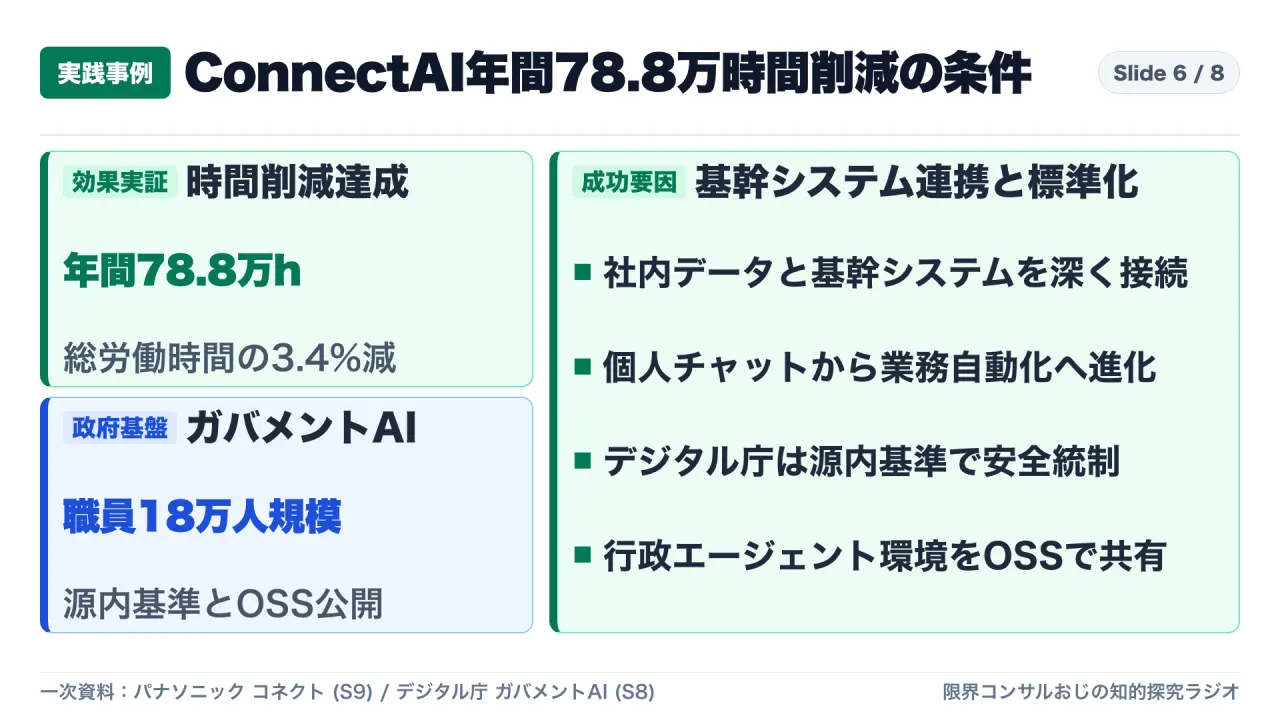
On July 29, 2026, Panasonic Connect released audited operational metrics for its internal enterprise platform, “ConnectAI.” Over the preceding fiscal year, the company documented an aggregate reduction of 788,000 operational working hours across its workforce, representing 3.4% of total enterprise labor capacity.
Panasonic Connect achieved this outcome by rejecting static chat interfaces in favor of staged architectural evolution:
- Tier 1 (Safe Foundation): Universal employee access within a zero-retention security perimeter to eliminate shadow IT usage.
- Tier 2 (Authoritative Retrieval): Connecting internal knowledge repositories, ERP tables, and procurement schemas to grounded retrieval pipelines.
- Tier 3 (Agentic Action Execution): Autonomous agent routines that ingest structured enterprise triggers to reconcile purchase orders, audit inventory anomalies, and draft engineering compliance filings.
Digital Agency: Gennai Architecture and Open Safety Standards
On November 6, 2026, the Digital Agency published comprehensive specifications for “Government AI Gennai,” deploying autonomous agent environments across approximately 180,000 central government personnel.
The deployment bifurcates operational workflows into two functional engines: “Agent Chat” for interactive collaborative synthesis, and “Gennai Studio” for structured administrative execution.
Crucially, the Digital Agency formulated and published the “Gennai Standard”—a deterministic security framework defining human approval thresholds, role-based tool execution boundaries, and immutable audit logging.
Furthermore, the agency designated the entire architectural stack as open-source software (OSS), enabling regional municipal bodies and private commercial enterprises to implement standardized agent governance without proprietary vendor lock-in.
7. Strategic Synthesis: The Three-Tier Architectural Inversion
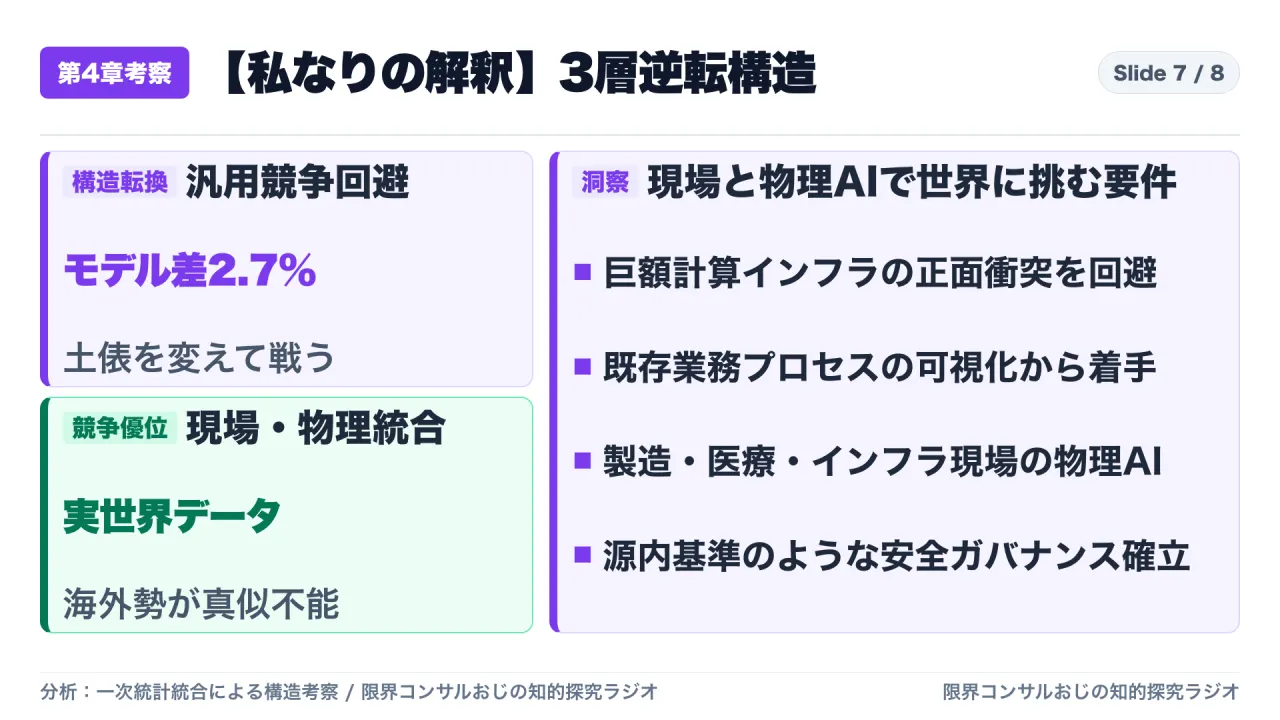
Synthesizing these empirical findings establishes a clear imperative: Japanese corporations must terminate capital-destructive attempts to build generic linguistic foundation models, focusing resources on areas where physical and operational domain density provides an unassailable moat.
We formalize this strategy as the Three-Tier Architectural Inversion:
flowchart TD
    subgraph Layer3["Tier 3: Domain Operation & Physical Integration (Primary Strategic Moat)"]
        T3A["Industrial CNC, Robotics & Sensor Integration"]
        T3B["Critical Infrastructure, Grid & Transport Maintenance"]
        T3C["Proprietary Tacit ERP & Procurement Workflows"]
    end

    subgraph Layer2["Tier 2: Governed Agent Orchestration (Standardized Middleware)"]
        T2A["Digital Agency Gennai Standard Compliance"]
        T2B["Deterministic Human-in-the-Loop Approval Gates"]
        T2C["ConnectAI-Style Multi-System API Gateways"]
    end

    subgraph Layer1["Tier 1: Commodity Foundation Models (Utilitarian Infrastructure)"]
        T1A["Global Frontier Models (2.7% Capability Convergence)"]
        T1B["Open-Weight Local Weights & Commodity Inference APIs"]
    end

    Layer1 --> Layer2
    Layer2 --> Layer3
- Tier 1 (Commodity Intelligence): Treat frontier language models as standard utility services. Procure best-of-breed inference via competitive multi-provider APIs or run compact open-weight models within local VPCs, completely bypassing pre-training capital wars.
- Tier 2 (Governed Middleware): Implement standardized, open agentic frameworks adhering to the Gennai Standard. Enforce strict isolation between model reasoning and underlying database read/write permissions.
- Tier 3 (Operational Reality): Channel engineering capital into digitizing and structuring the physical world: sensor telemetry, factory floor feedback loops, equipment maintenance histories, and proprietary administrative rules.
8. Pragmatic Playbook: Three Operational Directives for Enterprise Leaders
To transition an organization from the 86.4% adoption illusion into the 11.9% reality of deep workflow automation, executive leadership must execute three disciplined operational mandates.
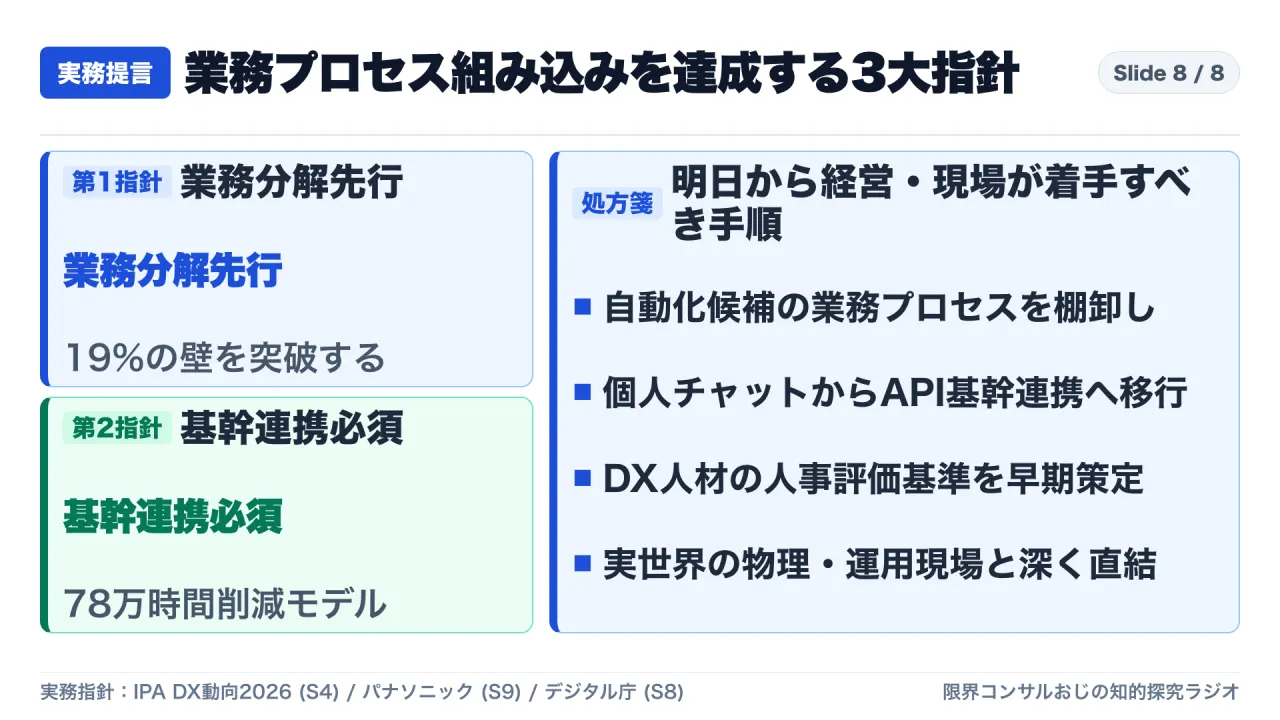
Directive 1: Mandate Exhaustive Workflow Profiling Prior to Tool Rollout
- The Failure Mode: Distributing conversational AI licenses before mapping baseline workflows yields isolated personal drafting tricks with zero structural labor impact.
- The Operational Fix: Audit individual business units to systematically break down recurring operations into three deterministic vectors: Input Artifacts, Heuristic Logic, and System Outputs. Identify processes where decision criteria are codified, designating these as target candidates for autonomous agent integration.
Directive 2: Pivot from Conversational Interfaces to API-Integrated Agent Pipelines
- The Failure Mode: Treating AI as an isolated web browser tab ensures data remains siloed in employee memory.
- The Operational Fix: Emulate Panasonic Connect by wiring language models directly to corporate databases and core software schemas. Establish programmatic pipelines where incoming invoices, maintenance requests, or supply anomalies automatically generate auditable system actions.
Directive 3: Institutionalize DX Personnel Governance and Gennai Compliance
- The Failure Mode: Leaving AI-driven workflow reform unrewarded within traditional human resource evaluation frameworks guarantees grassroots abandonment.
- The Operational Fix: Establish explicit career progression, performance evaluation metrics, and financial incentive bonuses for personnel who successfully refactor legacy business workflows. Concurrently, adopt the Digital Agency’s Gennai Standard as the enterprise governance baseline, establishing strict human authorization gates and comprehensive access telemetry.
Conclusion: Bridging the Real-World Execution Chasm
The narrative that corporate Japan is falling hopelessly behind in artificial intelligence is a fundamental misdiagnosis born of superficial metric tracking. The true crisis is not a shortage of compute chips or conversational prompts, but an organizational failure to re-engineer core enterprise processes.
When frontier model capability convergence renders raw textual intelligence a cheap commodity, competitive differentiation shifts entirely to execution fidelity within complex operational environments.
By abandoning the illusion of vanity adoption statistics, confronting the 11.9% workflow gap, and anchoring intelligent agents directly into physical manufacturing and enterprise infrastructure, Japanese industry can forge an enduring operational advantage that capital alone cannot duplicate.