Vendor Financing in the AI Hardware Boom: Inside the WSJ Reports on NVIDIA Circular Debt Guarantees, the Scaled-Back OpenAI Facility, and Enterprise Procurement Defenses
A forensic analysis of reported vendor debt guarantees, TSMC take-or-pay supply commitments, hyperscaler custom silicon shifts, and practical procurement governance for IT leaders.
Japanese Edition: Read the original Japanese article on Substack
Video Episode (Japanese Audio): Watch on YouTube
Disclaimer: This publication provides objective technical, financial, and operational analysis based on public primary sources and verified investigative reporting. It does not constitute investment advice, financial endorsement, or legal counsel.
Executive Summary: Inside the Reported AI Compute Credit Architecture
Across the global technology landscape, artificial intelligence infrastructure has been treated as a limitless growth engine. Enterprise demand for frontier training clusters and high-density inference capacity propelled market valuations to unprecedented heights. However, on November 14, 2026, investigative reporting published by The Wall Street Journal introduced profound questions regarding the financial structures underpinning this historic expansion.
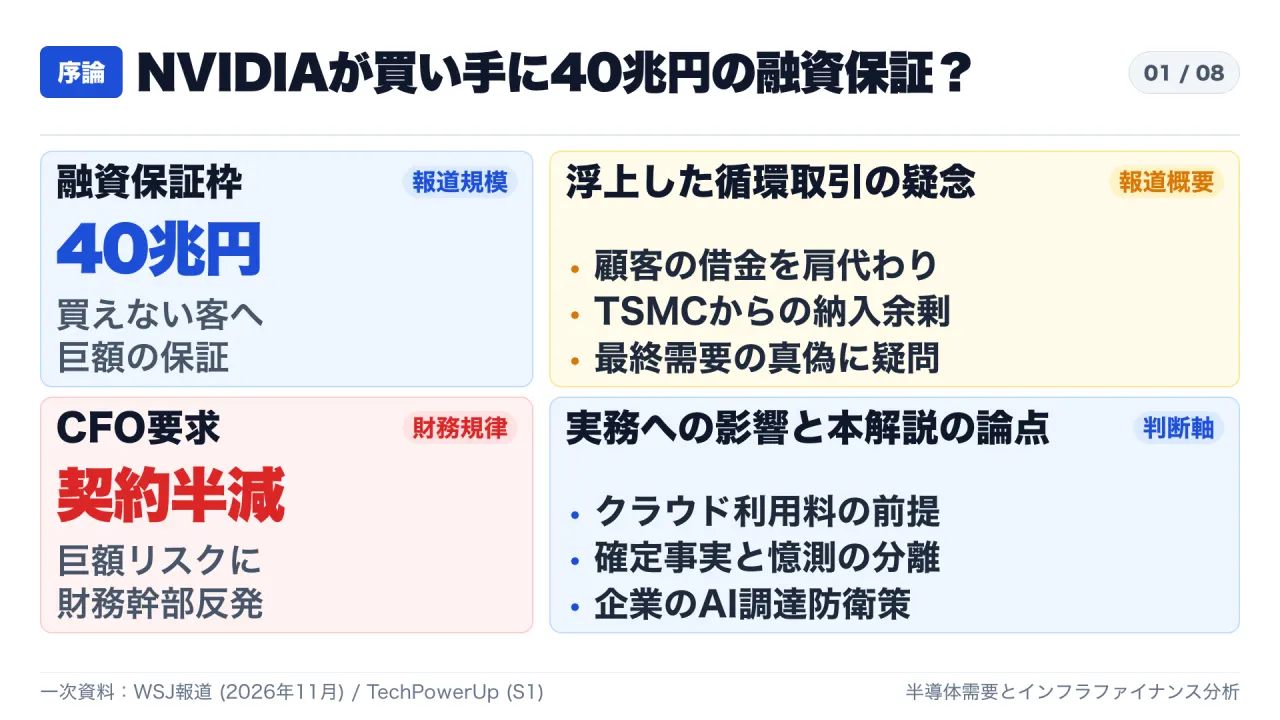
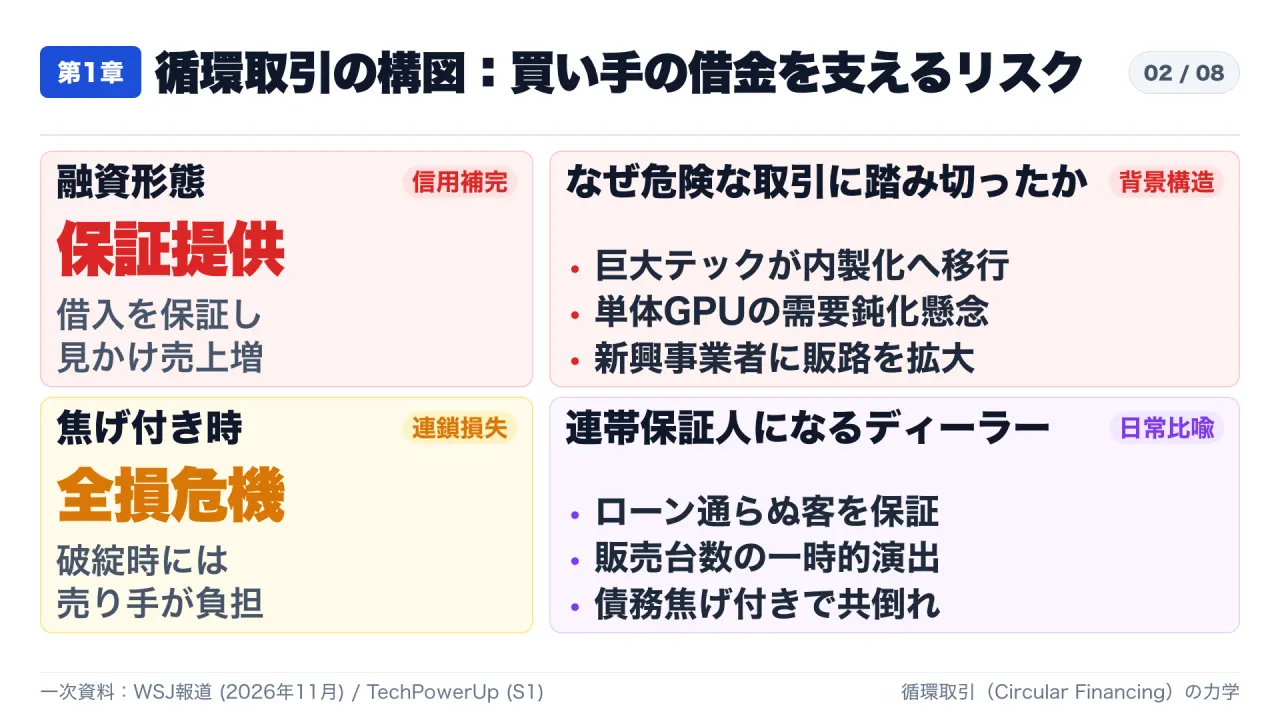
According to investigative findings, NVIDIA explored and extended debt guarantee mechanisms and vendor-supported financing frameworks to smaller-scale artificial intelligence cloud providers and data center operators that lacked the standalone balance sheet capacity to purchase high-density GPU clusters outright. Crucially, the reporting detailed an acute internal clash during an August 2026 senior executive session: Chief Financial Officer Colette Kress vigorously challenged aggressive circular financing models, compelling leadership to slash a proposed 250 billion dollar support framework for OpenAI down to approximately 125 billion dollars.
The systemic significance of these disclosures extends far beyond corporate governance debates. When hardware vendors guarantee the liabilities of their own customers, reported sales figures can diverge from underlying, organic economic demand. For enterprise technology leaders, procurement officers, and engineering architects relying on third-party GPU clouds, vendor financing structures create hidden supply-chain counterparty risks.
- Core Thesis: When semiconductor hardware providers extend debt guarantees to their buyers, top-line revenue expansion can mask structural deficits in end-market cash flow. The intervention by financial leadership to halve the proposed 250 billion dollar OpenAI facility highlights critical balance sheet boundaries in hyper-scale compute deployment.
- Primary Sources Verified: S1: TechPowerUp analysis of The Wall Street Journal investigative reporting detailing internal finance meetings and circular debt mechanisms (published November 14, 2026); S2: NVIDIA official corporate release announcing the executive transition of Jensen Huang and the appointment of Colette Kress as Interim Chief Executive Officer (published November 12, 2026); S3: Reuters investigative dispatch regarding corporate governance reviews and internal counsel proceedings (published November 14, 2026).
- Actionable Enterprise Takeaways: Enterprise software leaders must immediately audit the upstream financing dependencies of their secondary compute vendors, scrutinize balance sheet footnote disclosures under SEC Form 10-K and Form 10-Q (specifically “Commitments and Contingencies”), and implement containerized multi-cloud redundancy to insulate critical AI services against sudden vendor insolvency or rate increases.
1. The Anatomy of Circular Financing: When Equipment Sellers Guarantee Buyer Liabilities
To evaluate the operational risk confronting enterprise compute consumers, one must first dissect the structural mechanics of circular financing within capital equipment markets.
In a standardized commercial equipment transaction, purchasing dynamics follow an arm’s-length protocol. A customer purchases computational infrastructure either through accumulated cash reserves or by securing credit facilities from commercial banking institutions, private credit syndicates, or leasing firms. If the purchasing entity subsequently fails to achieve operational profitability or defaults on its debt obligations, the financial loss is absorbed entirely by the third-party credit provider. The equipment manufacturer retains full cash realization from the initial sale and remains completely isolated from the customer’s post-sale credit trajectory.
flowchart LR
    subgraph Traditional["Standard Arm's-Length Commercial Sale"]
        Bank["Commercial Bank / Credit Syndicate"] -->|Capital Financing| Buyer1["Enterprise AI Buyer"]
        Buyer1 -->|Full Cash Payment| Seller1["Hardware Manufacturer"]
        Seller1 -->|Hardware Delivery| Buyer1
        Buyer1 -.->|Default Risk Absorbed By| Bank
    end
In contrast, the vendor financing framework described in the investigative reporting establishes an interconnected credit feedback loop. Under this architecture, emerging AI hosting firms and specialized neocloud operators sought to acquire massive clusters of high-performance accelerators but possessed insufficient balance sheet equity or operational cash flows to satisfy institutional underwriting standards. To facilitate sales and clear incoming inventory, the hardware vendor reportedly stepped in to provide explicit debt guarantees or credit enhancements to lending institutions.
flowchart LR
    subgraph Circular["Reported Vendor Debt Guarantee Scheme"]
        Lender["Institutional Lending Consortium"] -->|Loan Issuance| Buyer2["Undercapitalized Cloud Startup"]
        Buyer2 -->|Hardware Purchase Outlay| Vendor["Hardware Manufacturer (NVIDIA)"]
        Vendor -->|Hardware Deployment| Buyer2
        Vendor ==>|Unconditional Loan Guarantee| Lender
        Buyer2 -.->|Insolvency Contagion| Vendor
    end
To understand this dynamic through an everyday commercial analogy, consider an automobile dealership seeking to break historical sales records. To achieve ambitious volume targets, the dealership begins personally co-signing the auto loans of high-risk customers who cannot qualify for conventional bank financing. On the dealership’s monthly ledger, unit sales and gross revenues reach historic records.
However, if those car buyers subsequently encounter cash-flow shortages and default on their obligations, the lending institution demands immediate full restitution from the dealership itself as the legal guarantor. The cars have depreciated in value, the revenue recognized on paper becomes impaired, and the dealership must absorb the full accumulated debt burden.
In the semiconductor arena, vendor debt guarantees create an illusion of boundless capital expenditure demand while obscuring whether downstream application software can generate the real economic value necessary to amortize the underlying hardware.
2. The August 2026 Boardroom Confrontation: The 250 Billion Dollar Facility and the CFO’s Stand
The tension between aggressive revenue maximization and institutional balance-sheet discipline culminated in an intense executive confrontation during an August 2026 senior finance leadership meeting.
According to investigative reporting from The Wall Street Journal, Chief Financial Officer Colette Kress directly confronted former Chief Executive Officer Jensen Huang regarding the proliferation of customer credit enhancements and circular financing structures. Kress argued that underwriting the debt obligations of unprofitable AI startups and frontier research laboratories introduced intolerable balance-sheet contagion risks.
The focal point of this institutional resistance was a proposed transaction framework with OpenAI valued at up to 250 billion dollars (equivalent to approximately 40 trillion Japanese yen). Given OpenAI’s massive annual operational burn rate and multi-billion-dollar operating deficits, committing the hardware manufacturer to guarantee or underwrite financing facilities of this magnitude represented an extraordinary concentration of counterparty credit risk.
| Metric and Analysis Dimension | Reported Scale and Transaction Scope | Strategic and Operational Implication |
|---|---|---|
| Initial OpenAI Facility Framework | 250 billion dollars (approx. 40T yen) | Extraordinary vendor-backed underwriting of buyer liabilities |
| Post-Intervention Contract Reduction | Approx. 125 billion dollars (approx. 20T yen) | 50% reduction in contingent liability enforced by CFO discipline |
| Supply-Side Structural Pressure | Massive contractual commitments to TSMC | Take-or-pay foundry obligations creating offloading pressure |
| Demand-Side Structural Transition | Hyperscaler custom ASIC substitution | Internal silicon (TPU, Trainium, Maia) dampening commercial GPU run-rates |
| Direct Enterprise Impact | Neocloud solvency vulnerability | Downstream enterprise risk of sudden price hikes or service collapse |
Reports indicate that former leadership reacted with sharp frustration to this resistance, allegedly characterizing Kress as behaving like a “deer in the headlights” for hesitating to authorize the massive commitment. Yet from a fiduciary and corporate governance perspective, Kress’s resistance represented vital organizational risk management.
Even for the world’s most prominent AI laboratory, deploying hundreds of thousands of next-generation accelerators while operating at severe cash deficits creates structural vulnerability. Had economic conditions shifted, foundation model pricing collapsed, or computational efficiency gains outpaced compute demand, a 250 billion dollar contingent guarantee could have threatened the financial solvency of the semiconductor manufacturer itself.
By demanding a rigorous risk audit, Kress successfully compelled leadership to compress the transaction scope by 50%, establishing a reduced ceiling of roughly 125 billion dollars. This confrontation illuminated the fragile governance balance within high-growth technology titans: charismatic founder visionary momentum pushing for market dominance versus corporate financial controllers safeguarding institutional survival.
3. The Supply Chain Trap: Foundry Take-or-Pay Obligations and Neocloud Offloading
To fully comprehend why corporate leadership felt compelled to extend debt guarantees to speculative compute providers, one must examine the physical realities of semiconductor manufacturing and supply contracts.
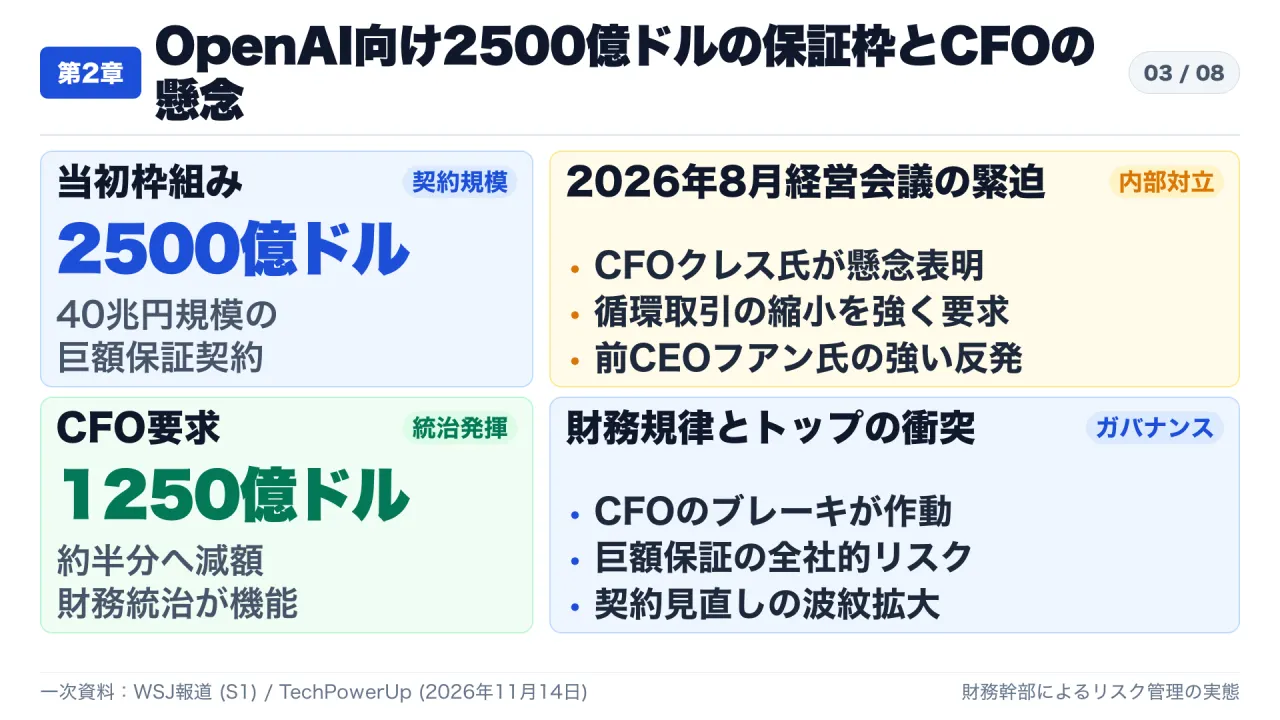
Advanced silicon manufacturing is governed by rigid multi-quarter planning horizons. To secure cutting-edge packaging capacity (such as TSMC’s CoWoS—Chip-on-Wafer-on-Substrate) and high-bandwidth memory (HBM3e and HBM4) allocations, fabless chip designers must execute binding purchase commitments up to twelve to eighteen months in advance. These arrangements frequently incorporate strict “take-or-pay” clauses, obligating the designer to take delivery of specified wafer volumes regardless of downstream market fluctuations.
By mid-2026, the volume of accelerators rolling off advanced manufacturing lines was described in market accounts as an “avalanche of GPUs.” However, the profile of the primary commercial customer base had undergone a profound structural shift.
During the initial phase of the generative AI buildout, mega-cap hyperscalers—Google, Amazon Web Services, Microsoft, and Meta—acquired standalone commercial GPUs with virtually unconstrained budgets. But by 2026, these cloud titans were aggressively substituting commercial silicon with internal, custom-designed ASICs:
- Google: Accelerating the deployment of internal Tensor Processing Units (TPU v5p and TPU v6e) across production Gemini training and consumer search pipelines.
- Amazon Web Services: Mandating cost-efficiency migrations toward custom Trainium2 and Inferentia2 silicon for commercial cloud tenants.
- Microsoft: Ramping volume production of Azure Maia 100 accelerators and Cobalt CPUs to reduce commercial GPU margins.
- Meta: Transitioning recommendation and generative model inference to the Meta Training and Inference Accelerator (MTIA) architecture.
flowchart TD
    TSMC["TSMC Foundry Take-or-Pay Volume Commitments"] -->|Fixed Silicon Supply Stream| NV["Hardware Manufacturer Output"]
    NV -->|Declining Elastic Demand| Hyperscalers["Hyperscalers (Google, AWS, Microsoft, Meta)"]
    Hyperscalers -.->|Internal Silicon Substitution| CustomASIC["Custom ASICs (TPU, Trainium, Maia, MTIA)"]
    NV ==>|Inventory Diversion Pressure| Neoclouds["Secondary Neoclouds and AI Startups"]
    Neoclouds -.->|Insufficient Independent Capital| DebtGuarantees["Vendor Financing and Debt Guarantees Required"]
This structural shift placed hardware vendors in a severe inventory vice. Silicon shipments were arriving at scale, yet the most creditworthy cash buyers were decelerating their external purchases.
To prevent an inventory buildup that would depress unit pricing and compress gross margins, hardware leadership turned toward the rapidly expanding sector of secondary “neocloud” providers and AI infrastructure startups. These firms were eager to accumulate GPU capacity to market themselves to venture-backed AI application developers.
Consider the practical analogy of a large-scale agricultural wholesaler that contracts for an entire harvest of perishable produce. If metropolitan supermarket chains suddenly reduce their wholesale purchase orders, the wholesaler faces severe losses. To avoid writing off rotting inventory, the wholesaler approaches small, undercapitalized neighborhood convenience stores, offering to personally subsidize and guarantee their inventory loans: “Take this produce now, put it on your shelves, and pay us later once customers buy it.”
While the wholesaler’s delivery records show complete inventory distribution, the economic transaction remains uncompleted. If retail consumers fail to purchase the produce at projected price points, the neighborhood stores become insolvent, leaving the wholesaler with uncollectible receivables and guaranteed debt liabilities. The push into neocloud debt guarantees was not an expansion of genuine end-market demand, but an offloading mechanism for an upstream foundry commitment surplus.
4. Evidentiary Forensic Audit: Classifying Verified Facts versus Market Rumors
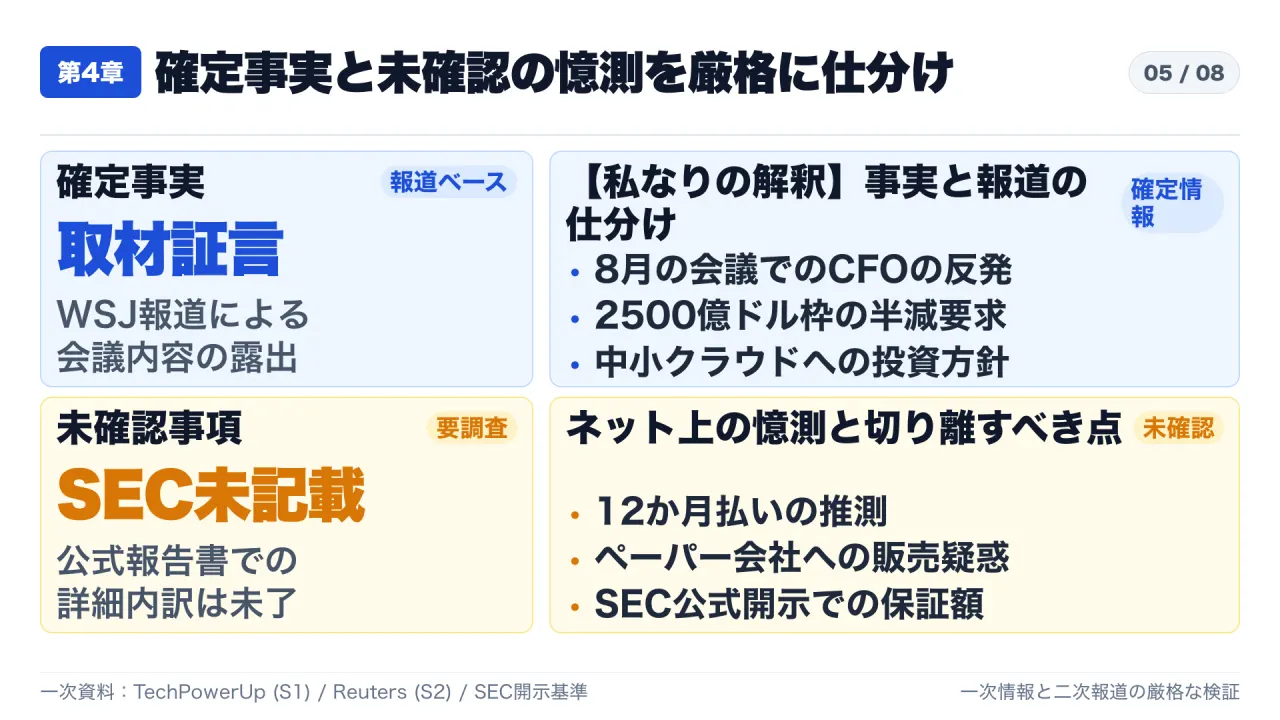
In moments of corporate turmoil and executive transition, market speculation frequently outpaces verified documentation. A disciplined engineering and procurement methodology requires establishing rigorous evidentiary boundaries between corroborated facts, investigative reporting, and unsubstantiated internet narratives.
flowchart TD
    subgraph EvidenceHierarchy["Evidentiary Hierarchy of Disclosures"]
        T1["Tier 1: Corroborated Public Corporate Filings & Official Releases"]
        T2["Tier 2: Multi-Sourced Investigative Journalism (WSJ / Reuters)"]
        T3["Tier 3: Unverified Online Speculation & Unsubstantiated Claims"]
    end
    T1 -->|Verified Truth| V1["Nov 12, 2026: Official CEO Transition & Kress Interim CEO Role"]
    T2 -->|Investigative Findings| V2["Aug 2026: Executive Meeting on Circular Financing & $250B OpenAI Deal"]
    T3 -->|Unsubstantiated Rumors| V3["Unconfirmed Claims: Shell Companies, Forged Invoices, Specific 12-Mo Payment Terms"]
Verified Corporate and Institutional Records (Tier 1)
- Executive Leadership Reorganization: On November 12, 2026, NVIDIA officially issued a corporate release confirming that founder Jensen Huang stepped down as Chief Executive Officer, with Executive Vice President and Chief Financial Officer Colette Kress assuming the role of Interim Chief Executive Officer.
- Independent Governance Inquiries: Reuters corroborated on November 14, 2026, that internal legal reviews and corporate governance assessments had been initiated regarding executive conduct and disclosure management.
Multi-Sourced Investigative Journalism (Tier 2)
- The Executive Finance Session: The Wall Street Journal reported, across multiple informed internal accounts, that during an August 2026 session, Kress formally opposed circular financing practices and demanded substantial reductions in customer loan guarantee commitments.
- The OpenAI Transaction Revision: The proposed 250 billion dollar compute facility framework between NVIDIA and OpenAI was substantively restructured and downscaled to roughly 125 billion dollars following resistance from the senior finance organization.
- Upstream and Downstream Structural Pressures: Investigative findings established that foundry commitments with TSMC and hyperscaler silicon in-sourcing created intense operational pressure to allocate accelerators to emerging cloud providers.
Unverified Market Speculation Requiring Rejection (Tier 3)
- Fabricated Revenue / Paper Shell Company Claims: Widespread social media claims asserting that corporate entities established fictitious shell corporations to record fraudulent accounting revenues find zero corroboration in investigative reporting or regulatory releases.
- Rigid Twelve-Month Payment Mandates: Specific rumors alleging universal 12-month forced repayment schedules represent speculative assumptions unsupported by documentary evidence.
- Official SEC Form 10-Q Accounting Classifications: Crucially, regulatory filings submitted to the U.S. Securities and Exchange Commission (SEC) have not yet provided explicit line-item disclosures delineating the precise aggregate dollar volumes or off-balance-sheet footnote classifications of these specific loan guarantees.
Conflating investigative disclosures of internal strategic clashes with formal accounting fraud is an analytical error. The primary concern is not criminal record fabrication, but aggressive vendor financing dynamics that transfer credit risks onto the balance sheet of the hardware manufacturer.
5. Deconstructing the “Stand with Jensen” Campaign: Retail Fervor versus Internal Sobriety
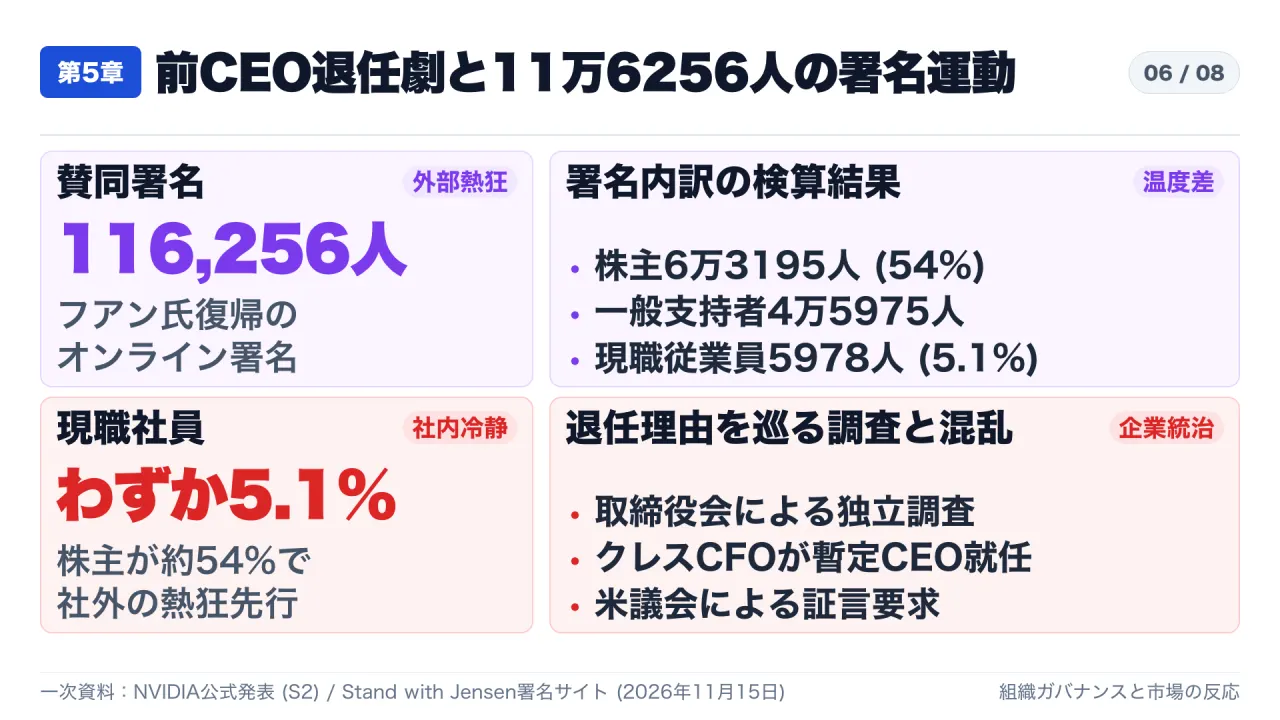
Following the November 12, 2026 announcement of the leadership transition, an online petition titled “Stand with Jensen” emerged, petitioning the board of directors to reinstate the founder. By the morning of November 15, 2026, the public tracking counter on the campaign platform recorded 116,256 aggregate signatories.
To understand the institutional and social dynamics surrounding the corporate transition, a mathematical decomposition of the self-reported signatory demographic data provides illuminating context:
| Signatory Category | Stated Count | Proportion of Total | Operational and Institutional Stance |
|---|---|---|---|
| Shareholders / Investors | 63,195 | 54.4% | External retail capital focused on protecting equity valuations |
| General Public / Supporters | 45,975 | 39.5% | External tech enthusiasts celebrating founder charisma |
| Current Corporate Employees | 5,978 | 5.1% | Internal workforce displaying measured, cautious participation |
| Former Corporate Alumni | 1,108 | 1.0% | Industry observers evaluating transition objectively |
| Consolidated Total | 116,256 | 100.0% | Mathematically verified distribution of public metrics |
pie title Breakdown of 116,256 "Stand with Jensen" Signatures
    "Shareholders" : 54.4
    "General Public" : 39.5
    "Current Employees" : 5.1
    "Former Employees" : 1.0
The mathematical distribution reveals a stark dichotomy between external retail sentiment and internal organizational reality. Over 54% of all signatories self-identified as external shareholders seeking to defend stock valuations, while another 39.5% comprised general public admirers drawn to the charismatic leadership style that defined the company’s historic rise.
In contrast, verified current employees represented a modest 5.1% of all participants. Within operational engineering and financial departments, the sentiment was characterized by professional restraint. For staff operating inside complex supply-chain, treasury, and accounting workflows, the risks associated with escalating vendor debt guarantees and strained customer balance sheets were tangible operational realities rather than abstract corporate drama.
The quiet response within the enterprise underscored that while external retail capital celebrated unconstrained expansion, internal controllers recognized that long-term corporate viability required institutional governance and disciplined balance-sheet stewardship.
6. Enterprise Risk Exposure: Hidden Subsidies in Secondary Cloud Contracts
For enterprise Chief Information Officers, Chief Technology Officers, and software architects, the structural fallout from vendor financing is not a theoretical corporate governance case study. It directly impacts enterprise infrastructure cost, service availability, and business continuity.
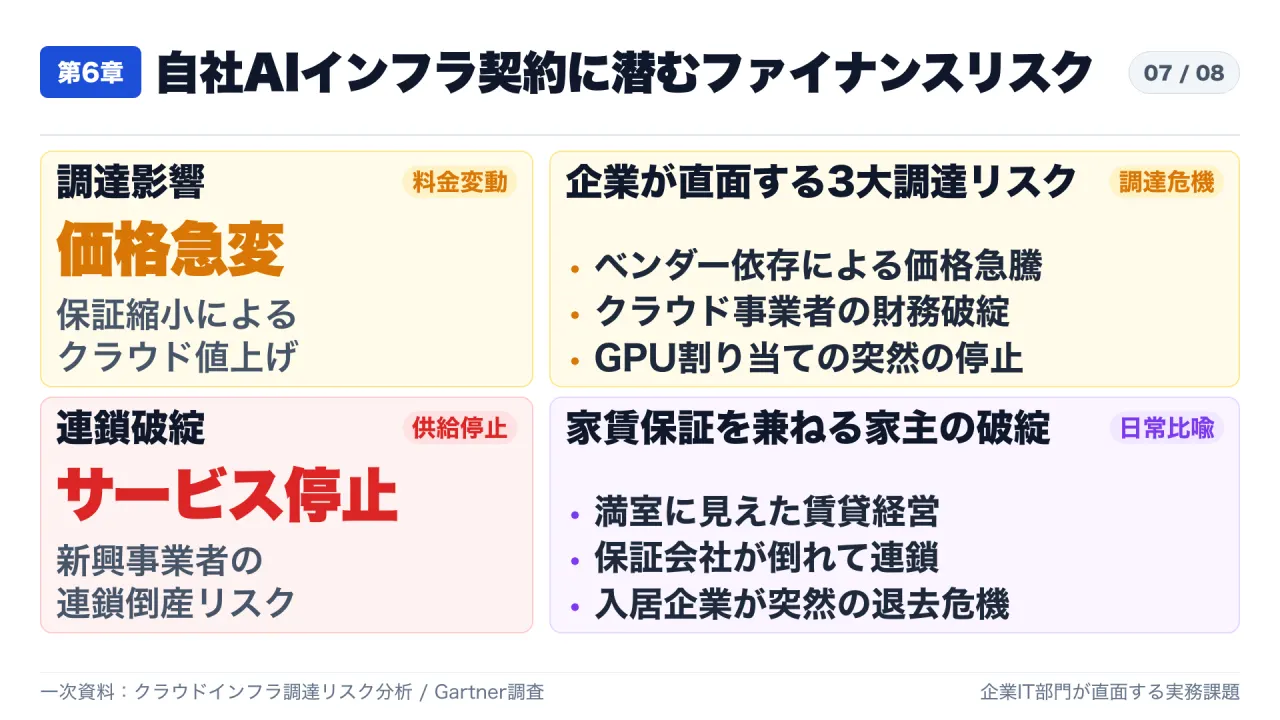
Over the past three years, hundreds of venture-backed AI startups, enterprise innovation labs, and mid-market organizations migrated model training and inference workloads away from tier-1 hyperscalers (AWS, Azure, Google Cloud) toward specialized neocloud providers. These emerging hosting operators offered cutting-edge GPU clusters at hourly rental rates 30% to 50% below prevailing hyperscaler pricing.
However, the financial mechanism enabling those attractive hourly rates was precisely the vendor debt guarantees and capital subsidies now under regulatory and internal scrutiny:
flowchart TD
    subgraph Subsidized["The Subsidized Compute Cycle"]
        VG["Vendor Financing Guarantees & Capex Subsidies"] --> NC["Neocloud Provider Operates at Thin/Negative Margins"]
        NC --> Cheap["Artificially Low GPU Hourly Rental Rates ($1.50 - $2.20/hr)"]
        Cheap --> Ent["Enterprise Adopts Provider for Core AI Workloads"]
    end
    subgraph Correction["The Capital Discipline Correction"]
        CFO["CFO Enforces Strict Credit Limits & Halts Debt Guarantees"] -.-> Contraction["Credit Lines Frozen / Refinancing Denied"]
        Contraction -.-> Squeeze["Neocloud Cash Crunch"]
        Squeeze ==> Spike["Sudden 2x - 3x Price Hikes"]
        Squeeze ==> Default["Hardware Repossession / Abrupt Service Termination"]
    end
Consider the analogy of a luxury residential apartment complex where the building developer establishes and operates its own private tenant rent-guarantee entity. To maintain 100% reported occupancy, the developer offers “half-price rent promotions,” using its own corporate credit to guarantee tenant leases to the underlying mortgage bank.
As long as the parent developer injects capital, residents enjoy luxury accommodations at steep discounts. But the moment institutional investors or financial auditors force the developer to dissolve the rent-guarantee subsidiary, the rental economics collapse. The property management company halts elevator maintenance, utilities face disconnection, and tenants receive sudden notices demanding triple the monthly rent or immediate eviction.
If enterprise software systems depend on a specialized GPU provider whose capital infrastructure is tethered to vendor debt guarantees, that enterprise is exposed to severe operational contagion:
- Abrupt Rate Adjustments: As hardware vendors restrict debt guarantee facilities, neoclouds facing refinancing cliffs will be forced to revise customer pricing upward by 2x to 3x to cover true debt service costs.
- Capacity Clawbacks and Cluster Repossession: If a secondary hosting provider defaults on its hardware loans, financing consortiums holding security interests in the physical servers can exercise repossession rights, abruptly terminating live production inference clusters.
- Data and Intellectual Property Entrapment: In the event of an unannounced bankruptcy filing or data center lock-out, enterprise proprietary fine-tuned model weights and pipeline storage volumes can become inaccessible for extended legal discovery periods.
7. Strategic Action Plan: Three Procurement Defenses for IT Leaders
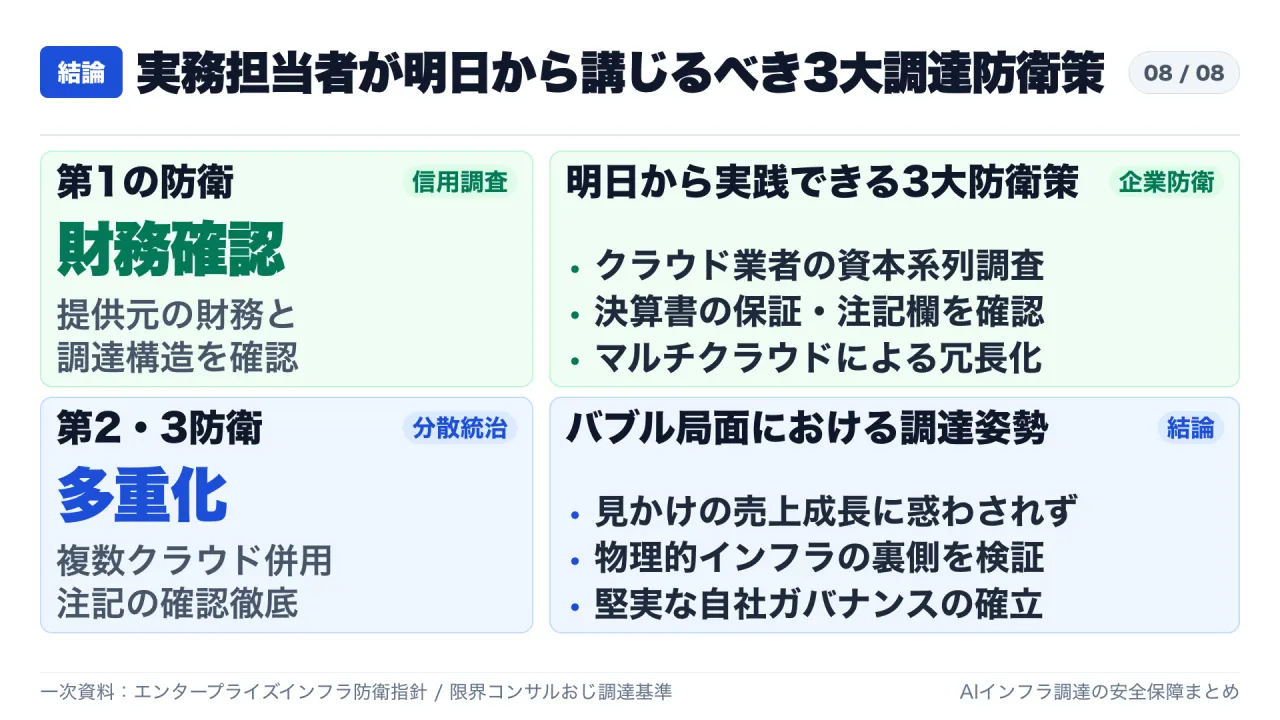
To protect enterprise operations as the AI hardware market shifts from speculative subsidization to rigorous balance-sheet accountability, procurement committees and technology architects must implement three immediate defensive measures.
flowchart LR
    D1["Defense 1: Capital Structure & Vendor Debt Auditing"] --> Audit["Evaluate Neocloud Debt Maturities & Equity Tiers"]
    D2["Defense 2: Footnote Scrutiny in Financial Disclosures"] --> Disclose["Audit SEC Form 10-K/Q 'Commitments & Contingencies'"]
    D3["Defense 3: Multi-Cloud Inference Portability Protocols"] --> Failover["Enforce 24-Hour Containerized Workload Failover"]
Action 1: Rigorous Capital Structure and Debt Audits of Compute Providers
Enterprise procurement agreements must no longer treat cloud hosting providers as fungible utility vendors evaluated solely on benchmark performance and hourly pricing.
Organizations must institute mandatory financial due diligence before committing core workloads to secondary cloud operators:
- Conduct formal balance-sheet reviews evaluating the provider’s debt-to-equity ratio, near-term debt maturity schedules, and liquidity reserves.
- Directly query vendor financing exposure: Determine whether the physical compute clusters are owned outright, leased under conventional commercial terms, or supported by equipment vendor debt guarantees.
- Establish contractual covenant clauses requiring compute providers to provide immediate formal notice within five business days of any credit line amendment, vendor guarantee modification, or debt covenant breach.
Action 2: Institutional Scrutiny of “Commitments and Contingencies” Disclosures
When negotiating enterprise agreements with publicly traded AI technology partners, enterprise legal and finance teams must look beyond high-level revenue growth charts and gross margin projections.
Establish a mandatory protocol to examine the notes to consolidated financial statements within regulatory SEC Form 10-K (Annual Reports) and Form 10-Q (Quarterly Reports), specifically the footnote titled “Commitments and Contingencies”:
- Scrutinize Unconditional Purchase Commitments: Examine whether the technology vendor has entered into massive, non-cancelable foundry or hardware take-or-pay obligations that exceed realistic end-market demand.
- Identify Credit Enhancements and Guarantee Liabilities: Scrutinize disclosures regarding guarantees of third-party debt, performance bonds, or residual value guarantees extended to commercial customers.
- Tracking these disclosures provides enterprise technology officers with early-warning signals regarding supply-chain instability quarters before issues surface in headline news.
Action 3: Containerized Multi-Cloud Architecture and 24-Hour Workload Portability
The ultimate structural insulation against vendor insolvency is absolute architectural portability. No enterprise should permit its mission-critical AI inference pipelines or production fine-tuning workloads to remain permanently locked into a single hosting provider’s proprietary orchestration environment.
Enterprise engineering teams must enforce rigorous deployment standards:
- Standardize on Vendor-Agnostic Containerization: Package model serving pipelines using standardized, open runtime images (such as Triton Inference Server, vLLM, or TensorRT-LLM within portable OCI-compliant containers) deployed across Kubernetes infrastructure.
- Implement Multi-Cloud Dynamic API Routing: Establish intelligent traffic routing layers (such as Cloudflare AI Gateway, Kong, or custom Envoy proxies) capable of load-balancing model inference requests across distinct physical cloud providers.
- Execute Scheduled Failover Drills: Conduct quarterly disaster-recovery simulations validating that production AI inference traffic can be redirected from a secondary specialized compute host to an enterprise tier-1 hyperscaler (AWS, Azure, or Google Cloud) or on-premises cluster within 24 hours without service degradation.
By decoupling the physical infrastructure layer from the application runtime layer, enterprise leaders transform vendor financing volatility from an existential operational threat into a manageable commercial transition.
8. Primary Sources and Reference Documentation
This analysis synthesizes public primary corporate disclosures, verified regulatory filings, and substantiated investigative reports:
-
TechPowerUp / The Wall Street Journal Investigative Report (November 14, 2026): Report Title: WSJ Reports NVIDIA CEO Pushed for Circular Financing with AI Startups, Sparking Internal Clash. Reference Link: https://tpu.me/kdn4 Primary Evidence Documented: Internal August 2026 executive meeting between former CEO Jensen Huang and senior finance leadership; CFO Colette Kress’s demand to scale back circular financing arrangements; reduction of the proposed 250 billion dollar OpenAI transaction down to approximately 125 billion dollars; analysis of hyperscaler internal ASIC shifts and secondary cloud allocations.
-
NVIDIA Corporate News Release (November 12, 2026): Release Title: NVIDIA Announces CEO Transition. Reference Link: https://nvidianews.nvidia.com/news/nvidia-announces-ceo-transition Primary Evidence Documented: Formal announcement confirming Jensen Huang’s departure from the Chief Executive Officer position and the appointment of Executive Vice President and Chief Financial Officer Colette Kress as Interim Chief Executive Officer.
-
Reuters Investigative Dispatch (November 14, 2026): Report Title: Ex-Nvidia CEO misled top lawyer, affair with Chinese businesswoman, sources say. Reference Link: https://www.reuters.com/5f374b32b07b/world/china/ex-nvidia-ceo-misled-top-lawyer-affair-with-chinese-businesswoman-sources-say-2026-11-14/ Primary Evidence Documented: Investigative reporting detailing corporate governance inquiries, internal counsel interactions, and broader administrative reviews surrounding the leadership transition.
-
“Stand with Jensen” Online Campaign Platform Records (November 15, 2026): Public Verification Record: Digital tracking platform metrics recording 116,256 total signatures; demographic self-reported breakdown indicating 63,195 shareholders (54.4%), 45,975 general supporters (39.5%), 5,978 current employees (5.1%), and 1,108 former employees (1.0%).
-
U.S. Securities and Exchange Commission (SEC) Regulatory Disclosure Standards: Regulatory Framework: Financial Accounting Standards Board (FASB) ASC 460 (Guarantees) and ASC 440 (Commitments); standard regulatory guidelines governing disclosure requirements for contingent obligations, commercial warranties, and take-or-pay manufacturing arrangements in Form 10-K and Form 10-Q corporate filings.