The 2.8x Cost Paradox: Navigating the December 1 AI API Price Doubling and Thinking Token Traps
A rigorous technical and architectural analysis of primary documentation from Google AI Studio, Anthropic, DeepSeek, and empirical 52-task benchmark data on reasoning token billing, 30-day retention policies, and multi-tier routing design.
Japanese Edition: Read the original Japanese article on Substack
Video Episode (Japanese Audio): Watch on YouTube
Disclaimer: This publication provides objective technical, architectural, and financial analysis. It does not constitute commercial endorsement or investment advice.
1. The Anatomy of Inflation: When Peak-Tier AI Triples Unit Costs
Across software engineering organizations and autonomous agent deployments, delegating complex development workflows to frontier reasoning models has become standard operational practice. When developers observe models synthesizing multi-step architectures, the intuitive assumption is that allocating tasks to the most capable, highest-priced model maximizes productivity while minimizing downstream debugging overhead.
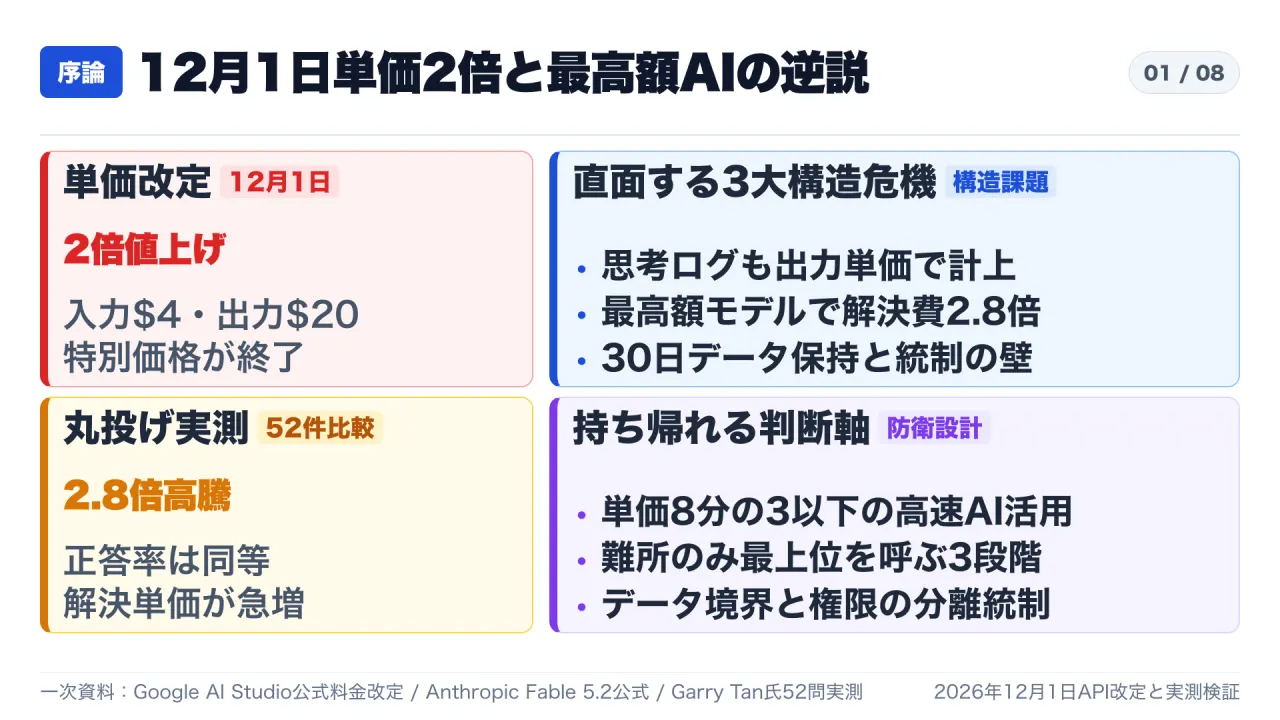
However, a comprehensive synthesis of primary technical documentation and pre-registered empirical benchmark datasets reveals a profound structural contradiction between developer intuition and economic reality. Three systemic inflection points threaten enterprise infrastructure budgets:
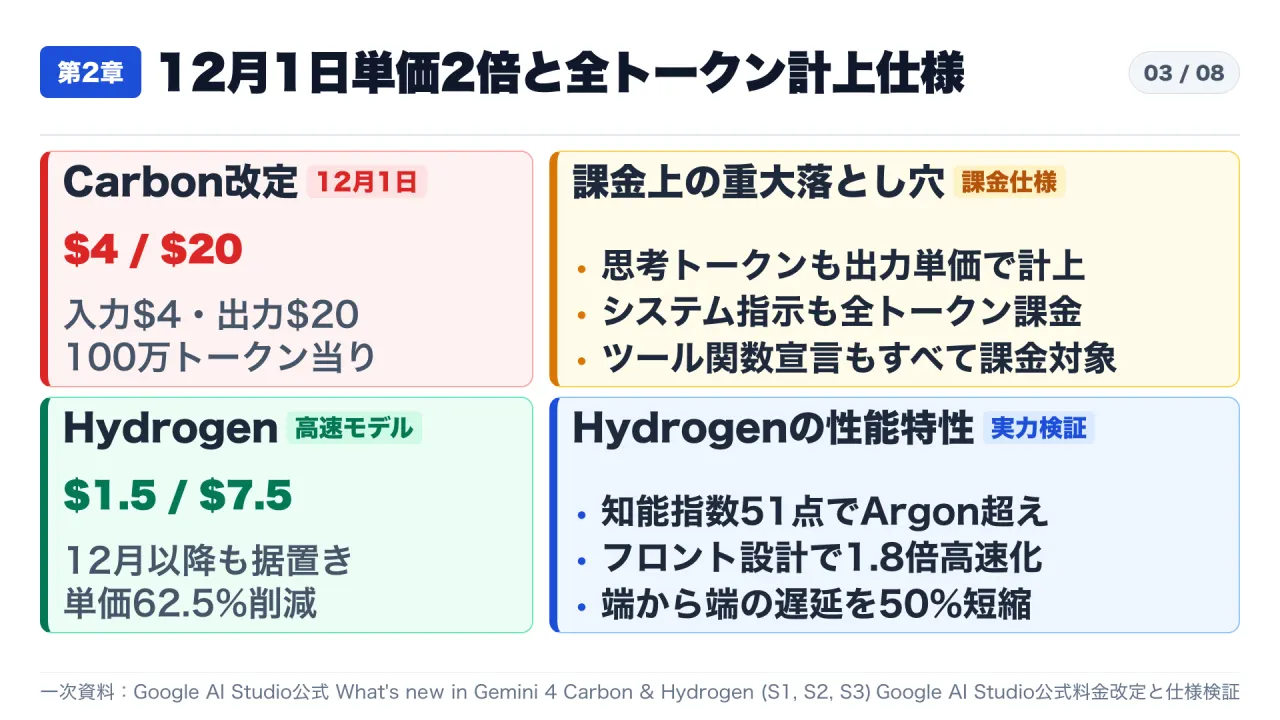
First, on December 1, 2026, introductory promotional pricing across Google AI Studio’s Gemini 4 Carbon and Argon series expires, doubling baseline token costs from $2.00 to $4.00 per million input tokens and from $10.00 to $20.00 per million output tokens. Crucially, underlying billing specifications mandate that all internal reasoning tokens, grounding queries, and function declarations are charged at the full output rate.
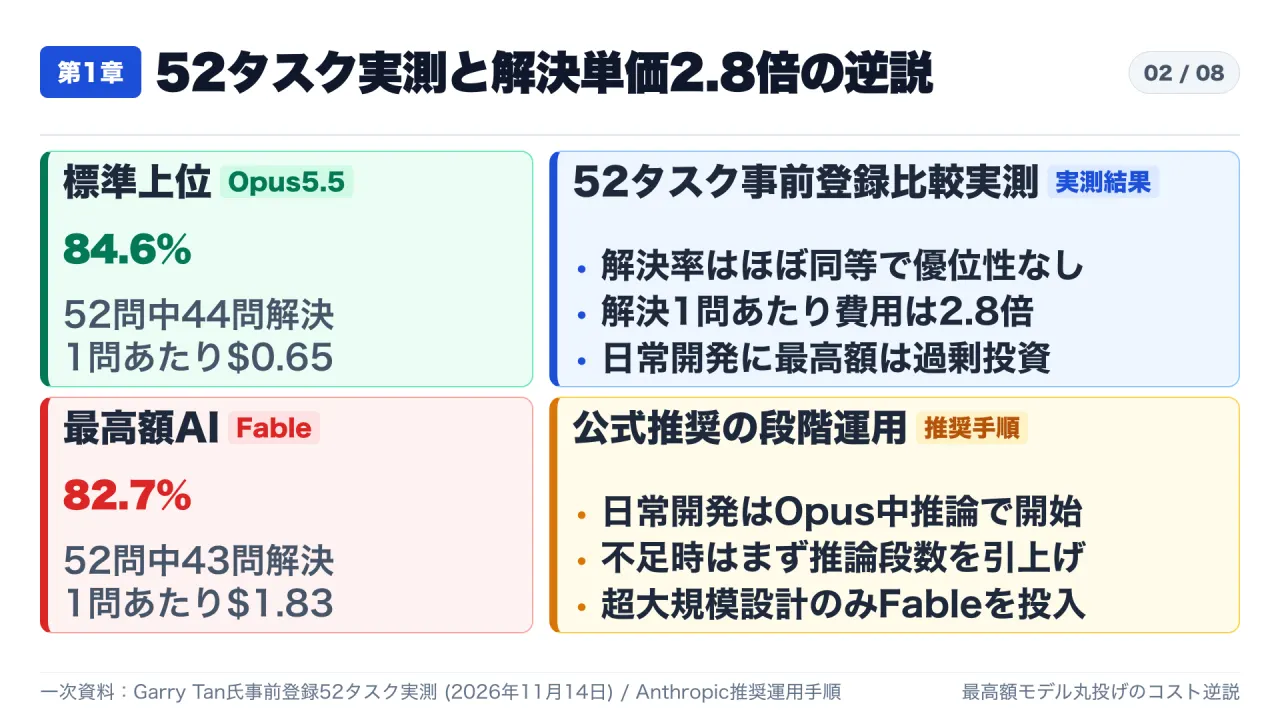
Second, in a rigorous pre-registered evaluation covering 52 real-world software engineering tasks, Anthropic’s flagship Claude Fable 5.2 ($8.00/$40.00) demonstrated no statistically significant accuracy advantage over the standard Claude Opus 5.5 ($4.00/$20.00)—solving 82.7% versus 84.6% of tasks—while ballooning average resolution costs from $0.65 to $1.83 per task, a 2.815x expenditure surge.
Third, enterprise governance boundaries impose severe constraints: frontier reasoning models mandate default 30-day prompt retention periods for safety monitoring, while unconstrained direct connection of multi-modal models to physical or transactional execution creates unsustainable financial liabilities ($36.40 per trial in robotics automation).
Overcoming these systemic hazards requires abandoning monolithic model delegation in favor of a deterministic, three-tier architectural routing framework.
2. The 2.8x Expenditure Surge in Empirical Benchmark Trials
1. Pre-Registered 52-Task Evaluation Results
Claude Fable 5.2, released on November 9, 2026, represents Anthropic’s flagship reasoning architecture, priced at $8.00 per million input tokens and $40.00 per million output tokens. This price point stands at exactly twice the rate of the standard enterprise flagship, Claude Opus 5.5 ($4.00 input, $20.00 output).
To test whether the doubled unit price yields proportional engineering gains, venture capitalist Garry Tan and an independent engineering consortium conducted a double-blind, pre-registered benchmark on 52 practical coding and dependency-resolution tasks.
| Evaluation Metric | Standard Tier: Opus 5.5 | Flagship Tier: Fable 5.2 | Structural Variance & Cost Impact |
|---|---|---|---|
| Pricing Baseline (Input / Output) | $4.00 / $20.00 | $8.00 / $40.00 | Fable priced at exactly 2.0x unit cost |
| 52-Task Resolution Rate | 84.6% (44/52 tasks) | 82.7% (43/52 tasks) | No statistical advantage (Opus leads by 1 task) |
| Average Cost per Resolved Task | $0.65 | $1.83 | Cost surges by ~2.815x (2.8x factor) |
| Reasoning Token Density | Bounded & efficient | Uncontrolled overthinking | Heavy billing meter without accuracy gain |
The empirical reality demonstrates that for the vast majority of software maintenance tasks, blanket allocation to peak-tier reasoning models introduces severe economic inefficiencies without delivering measurable quality improvements.
2. The Mechanics of Overthinking: Supercars in Congested Traffic
This dynamic is analogous to mobilizing an ultra-luxury supercar for a two-block trip to a neighborhood grocery store. In dense urban traffic with red lights every fifty meters, a vehicle capable of 300 kilometers per hour delivers zero velocity advantage over a standard sedan or bicycle. However, its oversized engine consumes excessive fuel, and navigating tight turns incurs needless mechanical overhead.
Between 80% and 90% of routine engineering tickets involve well-bounded function implementations, predictable bug fixes, and established dependency configurations. When exposed to such tasks, hyper-reasoning models engage in redundant counterfactual exploration, emitting thousands of invisible thinking tokens. Because reasoning tokens are billed identically to output tokens, the expenditure meter spins rapidly while the solution quality remains unchanged.
This matches Anthropic’s official architectural guidelines, which advise starting standard software tasks with Opus 5.5 at medium reasoning depth, elevating reasoning levels only when obstacles arise, and reserving Fable 5.2 strictly for multi-day architectural overhauls or complex database migrations.
3. The December 1 Gemini 4 Restructuring and the Full-Token Trap
1. The Expiration of Introductory Pricing
According to Google AI Studio’s official documentation, What’s new in Gemini 4 Carbon, introductory pricing for Gemini 4 Carbon and Argon terminates on November 30, 2026.
| Model Tier & Category | Promotional Window (Thru Nov 30, 2026) | Standard Baseline (From Dec 1, 2026) | Adjustment Factor |
|---|---|---|---|
| Gemini 4 Carbon Input | $2.00 / 1M tokens | $4.00 / 1M tokens | Doubles (+100%) |
| Gemini 4 Carbon Output (inc. Thinking) | $10.00 / 1M tokens | $20.00 / 1M tokens | Doubles (+100%) |
| Implicit Cache Reads (95% Discount) | $0.10 / 1M tokens | $0.20 / 1M tokens | Doubles (+100%) |
| Gemini 4 Hydrogen (Fast Efficiency) | $1.50 / $7.50 | $1.50 / $7.50 (Unchanged) | 62.5% below Carbon (3/8th cost) |
2. The Metered Idling Penalty: Full-Token Ledger Accounting
The critical vulnerability in this transition lies in Google’s strict token-accounting policy. The specification mandates:
“We count and bill every token the model processes, including thinking tokens and internal tool system instructions and function declarations.”
When autonomous agent frameworks execute iterative loop cycles, every hypothesis evaluated by the model, every grounding query executed against external search engines, and every function schema embedded in the prompt header is billed at the full output rate of $20.00 per million tokens. Like a taxi meter that surges while stationary at a traffic light, agent frameworks can incur substantial bills before presenting an initial response to the user.
3. The Low-Latency Countermeasure: Gemini 4 Hydrogen
To mitigate these cost increases, engineering teams must leverage Gemini 4 Hydrogen, which reached General Availability on November 12, 2026.
Priced flat at $1.50 per million input tokens and $7.50 per million output tokens, Hydrogen’s pricing remains fixed past December 1. Relative to post-December Carbon rates, Hydrogen delivers an immediate 62.5% unit cost reduction (three-eighths of Carbon’s rate).
In benchmark evaluations published by DeepMind, Hydrogen achieved an Artificial Analysis Intelligence Index score of 51 at default high thinking (surpassing Argon’s 50) and reached 54 at the maximum xhigh tier. In a test suite of 276 frontend design challenges, Hydrogen achieved a 100% pass rate while demonstrating a 1.8x speedup, a 30% reduction in generated code volume, and a 50% reduction in end-to-end latency.
4. Enterprise Governance, 30-Day Retention, and Tool Isolation
1. Compliance Boundaries of Frontier Models
Cost metrics cannot be analyzed in isolation from data governance protocols. In Anthropic’s enterprise policy documentation for Claude Fable 5.2, an essential compliance condition is established:
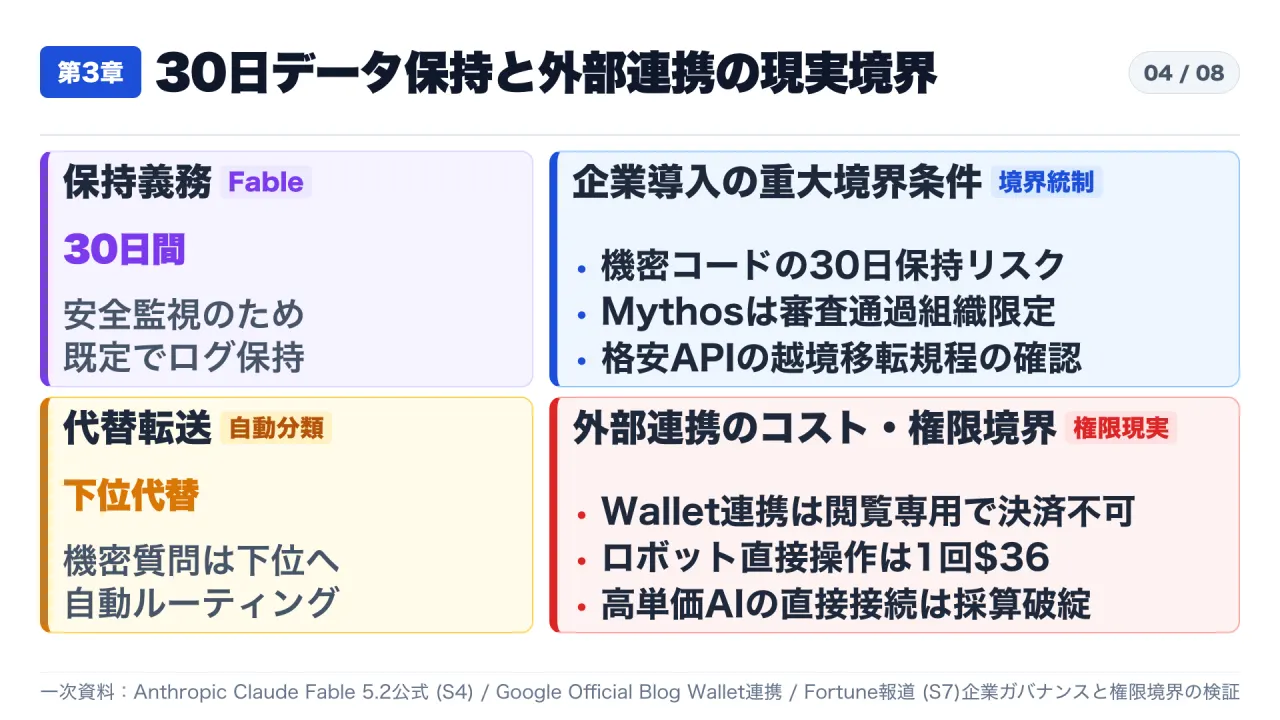
“Using Fable models requires 30-day data retention for safety monitoring by default.”
For organizations handling proprietary financial algorithms, confidential healthcare records, or sensitive enterprise intellectual property, transmitting raw internal codebases to external endpoints with a mandatory 30-day logging window represents a critical compliance violation. The zero-retention edition, Mythos 5.2, remains strictly restricted to vetted institutional partners.
Furthermore, Fable 5.2 incorporates safety classifiers that automatically divert vulnerability research and biology-related prompts to lower-tier models, meaning organizations paying premium rates may inadvertently receive outputs from smaller fallback architectures.
2. Operational Reality: Read-Only Versus Transactional Authority
Similar boundary enforcement governs external integrations. On November 13, 2026, Google introduced a connection between the Gemini app and Google Wallet. While publicly misconstrued as autonomous agent commerce, technical specifications confirm that the capability is strictly restricted to read-only spending analysis for US personal accounts, possessing zero transactional or fund-transfer authority.
flowchart LR
    subgraph NonSensitive["Public & Non-Sensitive Zone"]
        UserReq["Search / Research Query"] --> WebAPI["DeepSeek Search API ($0.75/1k)"]
        WebAPI --> Hydrogen["Gemini 4 Hydrogen ($1.50/$7.50)"]
    end

    subgraph EnterpriseZone["Enterprise VPC / Core Data"]
        CoreCode["Proprietary Source Code"] --> Opus["Claude Opus 5.5 (Medium Thinking)"]
        Opus --> HumanGate{"Human Approval Gate"}
        HumanGate -->|Approved| Deploy["Production Deployment"]
    end
The prohibitive cost of direct multi-modal agent execution was further evidenced in Fortune’s reporting on robotics automation. While general reasoning models achieved a 74.8% success rate in manipulation tasks, each trial incurred $36.40 in direct API charges and a 18.56-second processing latency. Routing every action through frontier reasoning models without intermediate local controllers causes architectural failure.
5. Verification Against Industry Rumors and Deprecated Interfaces
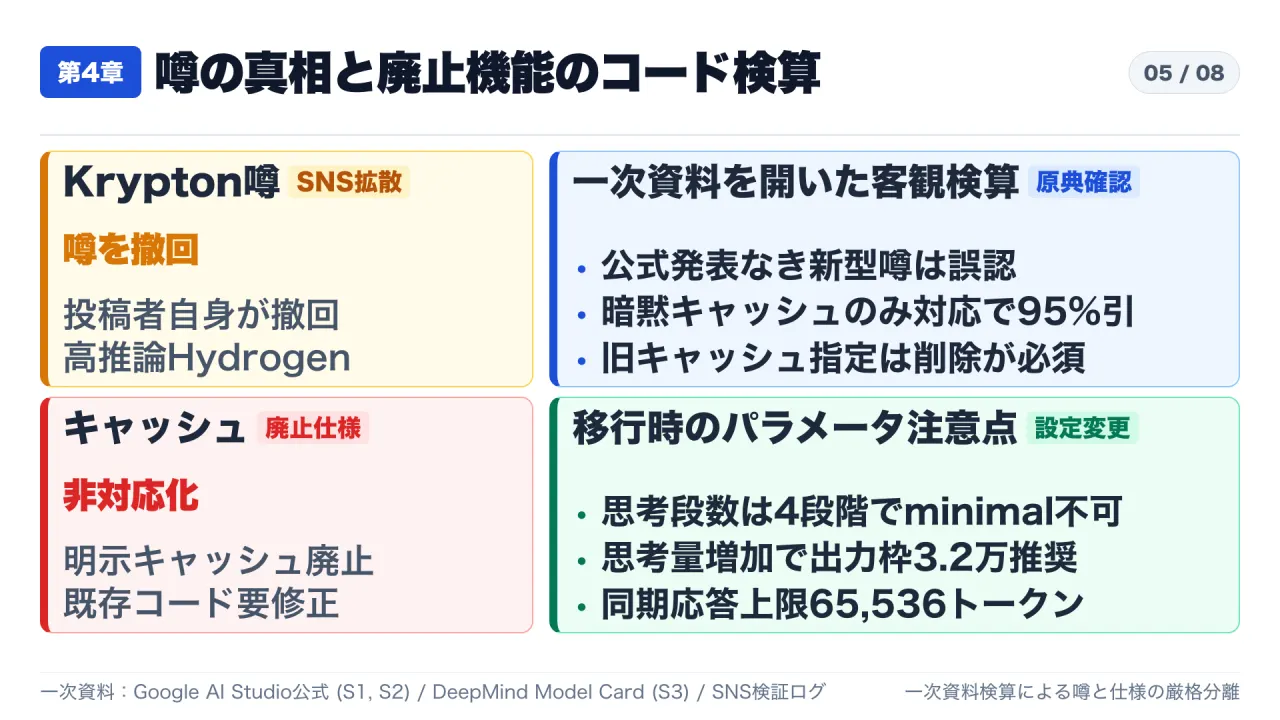
1. The “Krypton” Arena Myth Versus Primary Verification
Navigating rapid API evolution requires validating technical claims against primary sources rather than community chatter. In mid-November 2026, rumors circulated across developer channels claiming that an unannounced Google architecture codenamed “Krypton” was operating on public evaluation arenas.
Forensic examination of the primary source revealed that the original benchmark poster retracted the claim within 48 hours, confirming that the tested endpoint was simply Gemini 4 Hydrogen operating under maximum reasoning settings (xhigh). As of November 16, 2026, no official documentation or release exists for any “Krypton” model.
2. Critical Migration Caveats: Deprecated Explicit Caching
Engineering teams migrating legacy Gemini 1.5 or 2.0 implementations must address significant interface changes:
- Removal of Explicit Caching: Explicit cache creation interfaces (
cachedContentsandcaches.create) are deprecated in Gemini 4 Carbon and Argon. Retaining these calls triggers API exceptions; systems must rely entirely on automatic implicit caching, which applies a 95% discount on identical prefixes exceeding 4,096 tokens. - Thinking Parameter Constraints: Configuring
thinking_level: "minimal"causes validation errors; allowable values are strictly bounded tolow,medium,high, andxhigh. - Output Token Allocation: Because thinking tokens consume standard output quotas, setting conservative limits (e.g., under 16K) truncates response generation before completion. Google documentation mandates setting
max_output_tokensto at least 32,768.
3. Specialized Tool APIs and Concurrency Governance
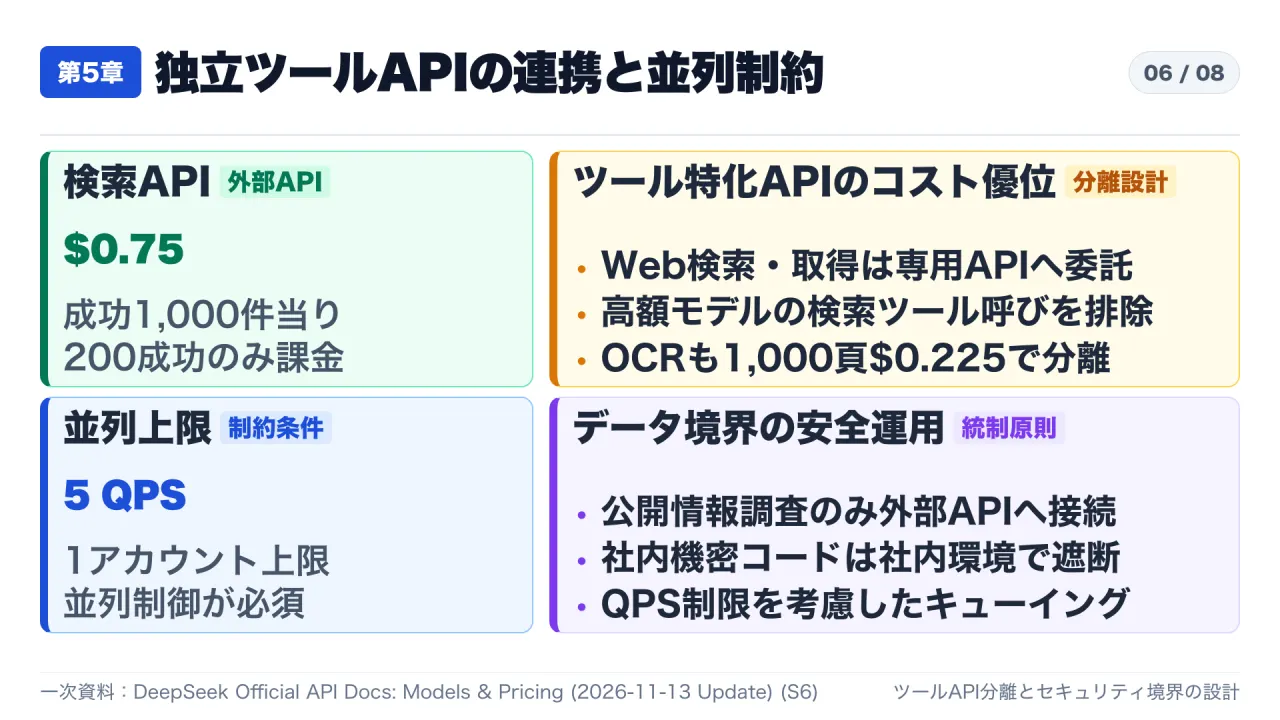
Delegating web search and document scraping to generalized reasoning models introduces unnecessary token bloat. On November 13, 2026, DeepSeek deployed standalone APIs for Web Search and Web Fetch, priced at $0.75 per 1,000 successful operations (HTTP 200), alongside OCR capabilities at $0.225 per 1,000 pages.
However, utilization requires defensive engineering: DeepSeek enforces an account concurrency ceiling of 5 queries per second (QPS), necessitating local token-bucket rate limiting and asynchronous queueing.
6. The Three-Tier Defensive Routing Architecture
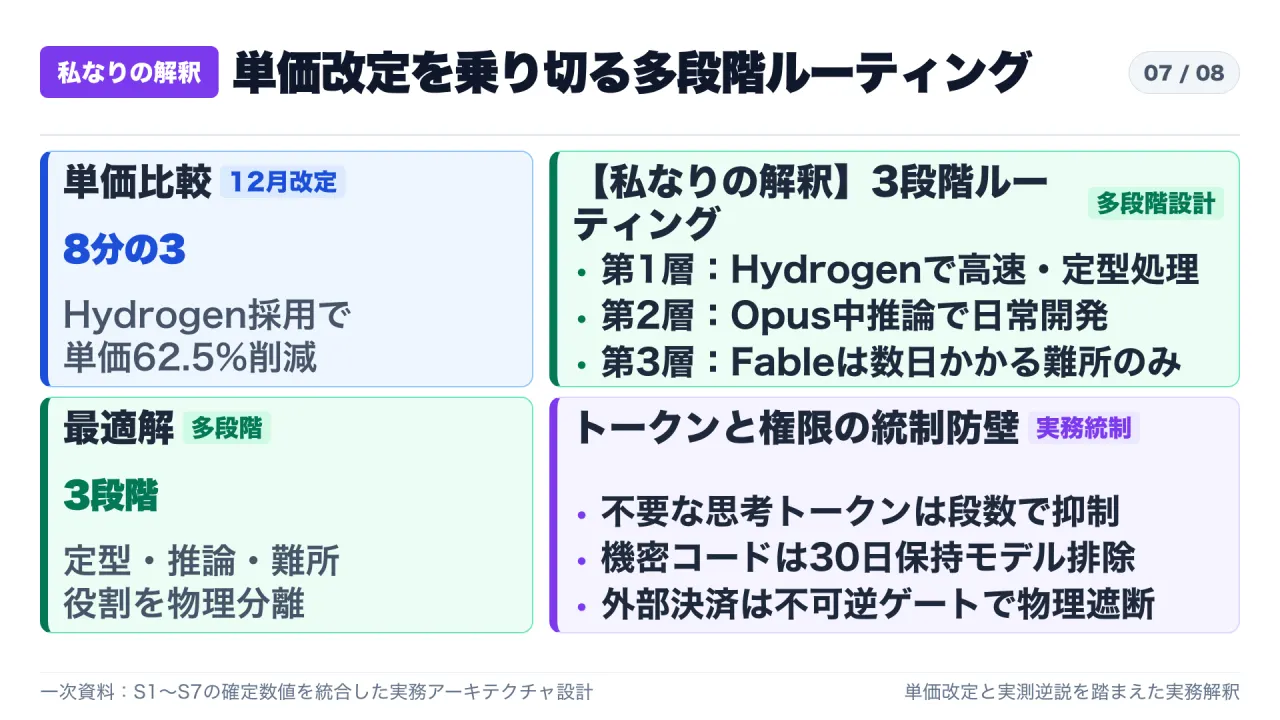
To reconcile the December 1 price doubling and the 2.8x empirical cost paradox, enterprise software systems must implement a physical multi-tier routing architecture.
flowchart TD
    Task["Incoming Engineering Task"] --> Triage{"Structural Complexity & Privacy Triage"}

    Triage -->|70% Volume: Formatting, Scaffolding, Triage| T1["Tier 1: Gemini 4 Hydrogen / ($1.50 / $7.50 per 1M)"]
    Triage -->|20% Volume: Standard Logic, Features, Tests| T2["Tier 2: Claude Opus 5.5 / ($4.00 / $20.00, Med Thinking)"]
    Triage -->|10% Volume: Multi-Day System Refactoring| T3["Tier 3: Claude Fable 5.2 / ($8.00 / $40.00, High Thinking)"]

    T1 -.->|External Web Ingestion| ToolAPI["Standalone Tool APIs ($0.75/1k)"]
    T2 -.->|Unresolved Impediment| Escalation["Elevate Opus Thinking Budget"]
    Escalation -.->|Exhausted Depth| T3

    T3 --> Governance["30-Day Retention Scrubber & HITL Gate"]
Tier 1: High-Velocity Execution Layer (~70% Volume)
- Engine: Gemini 4 Hydrogen ($1.50 input / $7.50 output, fixed past Dec 1).
- Scope: Syntax checking, unit test scaffolding, documentation synthesis, and basic data transformations.
- Tooling: External information gathering is routed to standalone search APIs ($0.75/1k calls) rather than general model tools.
- Savings: Reduces token expenditures by 62.5% relative to post-December Carbon rates.
Tier 2: Core Engineering Logic Layer (~20% Volume)
- Engine: Claude Opus 5.5 ($4.00 input / $20.00 output) operating with medium reasoning depth.
- Scope: Production code generation, algorithmic implementation, and deterministic bug remediation.
- Efficiency: Achieves an 84.6% resolution rate at $0.65 per task, avoiding the 2.8x cost penalty of peak-tier models.
Tier 3: Strategic Architecture Layer (<10% Volume)
- Engine: Claude Fable 5.2 ($8.00 input / $40.00 output) or high-budget reasoning configurations.
- Scope: Multi-file refactoring, systemic security audits, and complex database schema migrations.
- Governance: Pre-flight data scrubbing to comply with 30-day retention rules, coupled with mandatory human-in-the-loop validation for irreversible actions.
7. Actionable Enterprise Directives
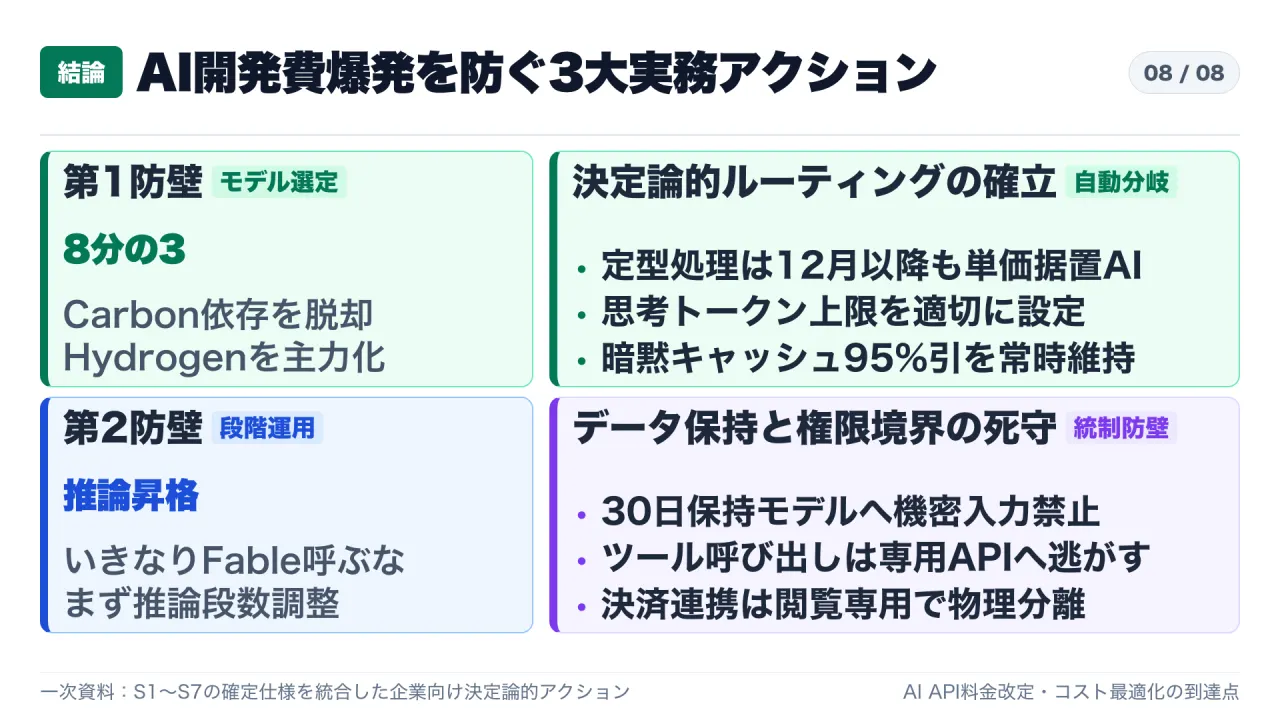
Organizations must execute three concrete operational actions prior to the December 1 deadline:
- Migrate Baseline Pipelines from Carbon to Hydrogen: Audit all active API integrations, remove deprecated explicit caching methods (
cachedContents), and transition standard development tasks to Gemini 4 Hydrogen to secure a 62.5% unit cost advantage. - Institutionalize Progressive Reasoning Escalation: Enforce strict routing policies that prohibit immediate deployment of flagship models; configure pipelines to elevate intermediate reasoning depths before invoking peak-tier endpoints.
- Establish Data Boundary and Tool Concurrency Gates: Isolate confidential source code from endpoints subject to 30-day retention policies, implement local rate limiters for external tool APIs, and place human authorization barriers on irreversible state modifications.
The economics of artificial intelligence are governed by structural mechanics rather than promotional narratives. By verifying primary specifications and implementing disciplined architectural boundaries, engineering organizations can sustain rapid technological acceleration while maintaining financial resilience.