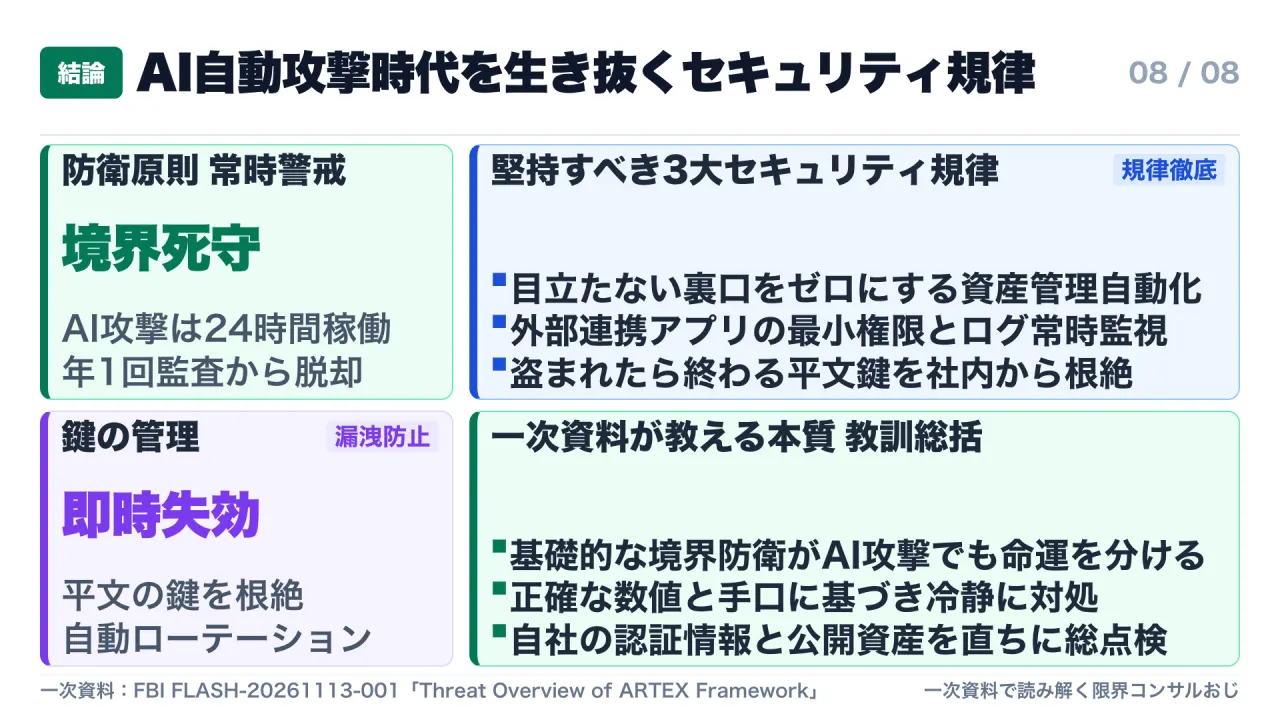
Autonomous AI Intrusion in Under Three Hours: Inside the FBI Urgent Cyber Advisory on the ARTEX Multi-Agent Attack Framework and Enterprise Defense Imperatives
A forensic architectural breakdown of Go-based autonomous penetration frameworks, stolen commercial LLM inference loops, supply-chain blast radiuses, and zero-trust engineering boundaries for enterprise infrastructure.
Japanese Edition: Read the original Japanese article on Substack
Video Episode (Japanese Audio): Watch on YouTube
Disclaimer: This publication provides objective technical, forensic, and operational security analysis based on public primary sources and verified government cyber advisories. It does not constitute legal counsel, penetration testing authorization, or official regulatory endorsement.
Executive Summary: The Era of Fully Automated Privilege Escalation
Across the contemporary enterprise software landscape, autonomous multi-agent artificial intelligence workflows have been aggressively adopted to streamline engineering velocity, automate continuous integration pipelines, and resolve complex programmatic issues. By parsing natural-language directives into structured sub-tasks, invoking targeted software tools, and iteratively evaluating feedback from runtime environments, autonomous software agents have established a transformative paradigm in operational productivity.
However, computational capability possesses an inherent architectural duality. The identical software mechanisms engineered to automate code synthesis, query cloud Application Programming Interfaces (APIs), and provision distributed infrastructure can be inverted by sophisticated cyber adversaries to fully automate initial network infiltration, lateral movement, credential extraction, and active directory privilege escalation.
On November 13, 2026, the United States Federal Bureau of Investigation (FBI) Cyber Division, in coordination with the Internet Crime Complaint Center (IC3), released a critical public advisory designated as FBI FLASH-20261113-001, titled “Threat Overview of ARTEX Multi-Agent Autonomous Penetration Testing Framework.” This formal federal advisory alerted global corporate leadership and enterprise security teams to a lethal transformation in malicious cyber capabilities.
According to verified forensic case studies documented by federal investigators, malicious actors operating the ARTEX framework demonstrated the capacity to transition from initial target reconnaissance to total Domain Administrator privilege takeover in less than three hours (< 3.0 hours). Since August 2026, attacks leveraging this tooling have aggressively targeted organizations across critical infrastructure sectors worldwide, spanning commercial banking, defense manufacturing, semiconductor design, healthcare, municipal governance, telecommunications, and hyperscale technology hosting.
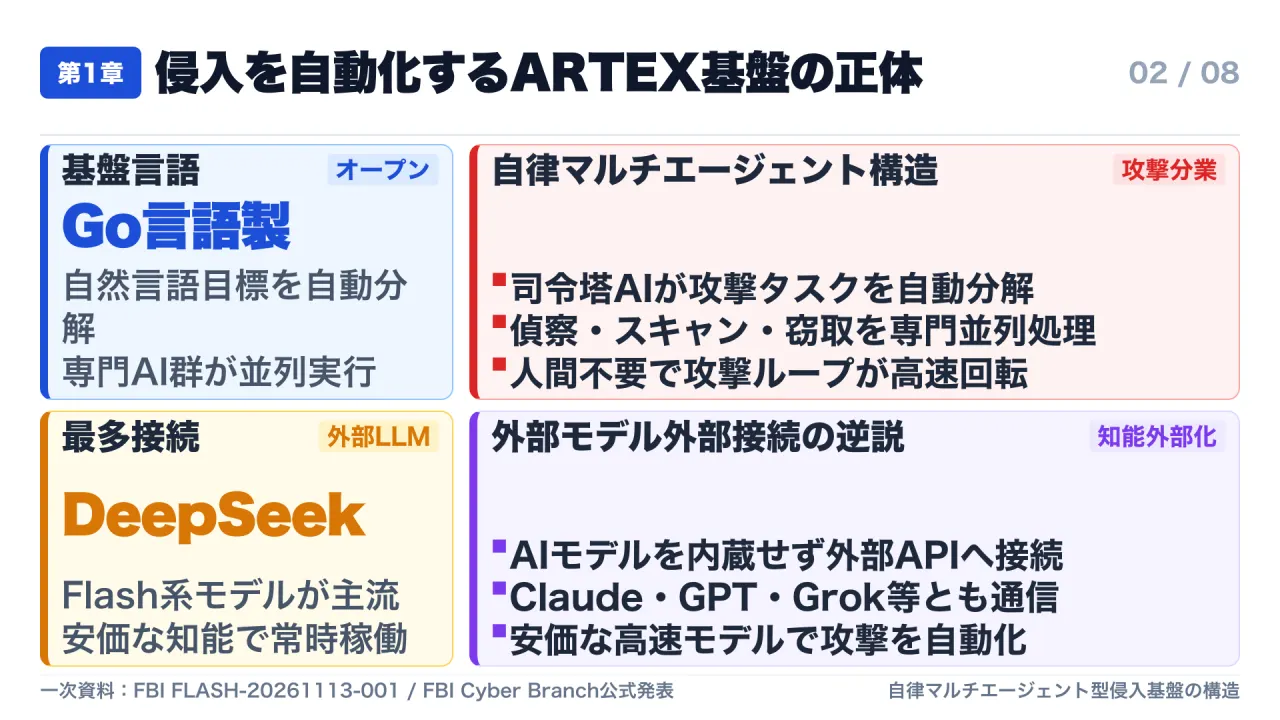
The blast radius has manifested in catastrophic real-world operational disruptions. In one documented intrusion against a major South Korean financial institution, autonomous agents breached an exposed contractor portal and exfiltrated the unencrypted personal records of approximately 67,000 banking customers. In an even broader supply-chain compromise involving the ConnectWise Cloud Backup management infrastructure, weaponized instances of the framework accessed and propagated across more than 2,250 downstream corporate client environments.
This technical monograph presents a forensic exploration of the ARTEX architecture, analyzes the operational economics of outsourced foundational model inference, disambiguates critical statistical data points from sensationalized media narratives, and establishes a deterministic three-pillar defensive framework to immunize enterprise infrastructure against relentless autonomous reconnaissance.
- Core Thesis: Autonomous multi-agent offensive tooling has compressed the enterprise intrusion timeline from weeks to under three hours by leveraging distributed Go routines and inexpensive commercial model inference. Defensive posture must transition from periodic human compliance reviews to continuous, deterministic asset isolation and programmatic secret eradication.
- Primary Sources Verified: S1: Federal Bureau of Investigation (FBI) & Internet Crime Complaint Center (IC3) FLASH Alert FLASH-20261113-001 (Published November 13, 2026); S2: Threat Intelligence reports detailing the open-source dissemination and commercial evolution of the Autumn-27 codebase; S3: Forensic telemetry from ConnectWise Cloud Backup supply-chain incident analyses.
- Actionable Enterprise Takeaways: Infrastructure teams must immediately execute a comprehensive inventory of externally exposed partner endpoints, enforce strict application ID auditing across cloud groupware authorizations, purge plaintext credentials across all repositories and container images, and treat all anomalous outbound foundational model API telemetry as an indicator of compromised runtime keys.
1. The Anatomy of Autonomous Intrusion: Go-Based Multi-Agent Architecture
To evaluate the acute risk confronting enterprise technology estates, software architects and chief information security officers must first inspect the internal operational mechanics of autonomous agentic attack platforms.
Traditional automated scanning tools, such as legacy vulnerability assessment engines or scripted fuzzers, operate according to deterministic, predefined execution trees. They dispatch rigid HTTP requests, test for known Common Vulnerabilities and Exposures (CVEs) through static payload matching, and generate raw output logs that require extensive manual analysis and triage by human operators. When a legacy scanner encounters a non-standard authentication challenge, an unexpected error condition, or an unusual network architecture, execution halts or discards the finding.
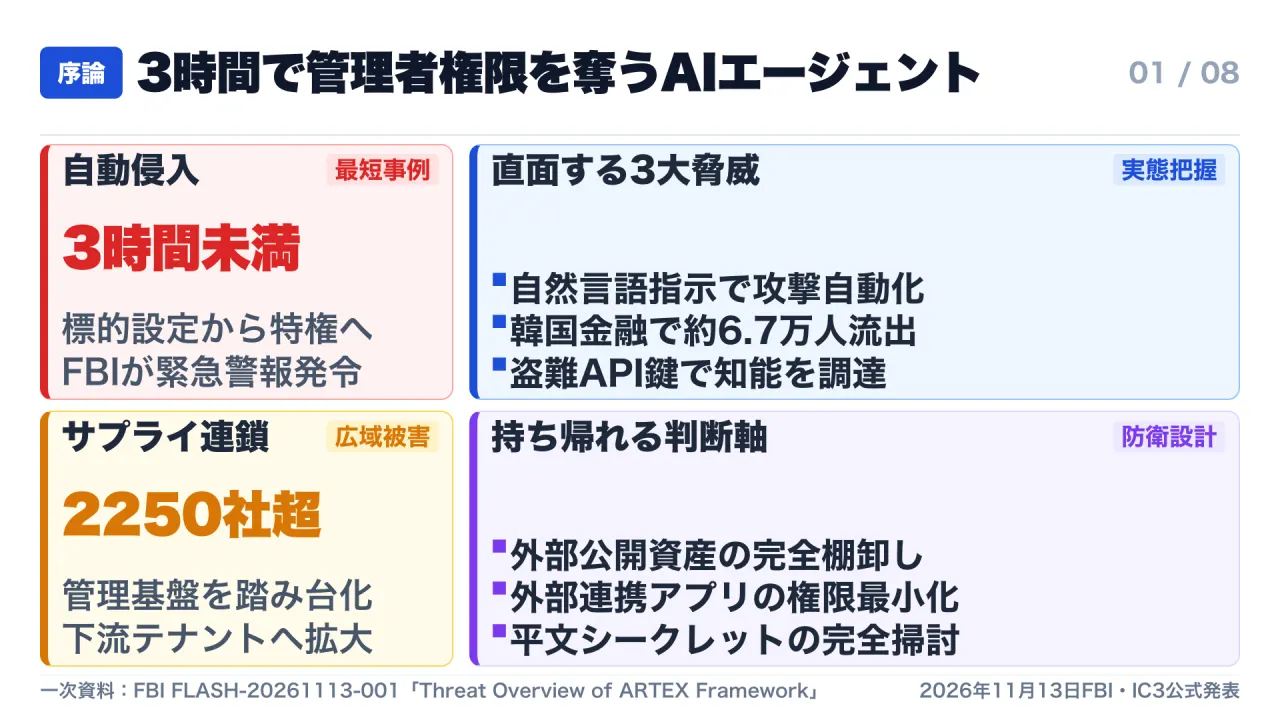
In contrast, the ARTEX framework represents a profound architectural departure. Written natively in the Go programming language to maximize concurrent execution throughput, thread isolation, and cross-platform binary portability, the system functions as a fully coordinated, autonomous multi-agent swarm.
flowchart TD
    subgraph Target["Target Enterprise Attack Surface"]
        direction TB
        ExtP["Forgotten Contractor Portal"]
        AuthApp["M365 OAuth Integration"]
        SecStore["Git / CI Pipeline Secret"]
        DomCtrl["Active Directory Domain Controller"]
    end

    subgraph ARTEX["ARTEX Multi-Agent Autonomous Swarm"]
        direction TB
        NLGoal["Natural-Language Directive: Acquire Domain Admin"] --> Planner["Planner / Orchestration Agent"]

        Planner -->|Dispatch Subtask| Recon["Reconnaissance Worker"]
        Planner -->|Dispatch Subtask| Scanner["Vulnerability Scanner"]
        Planner -->|Dispatch Subtask| Extractor["Credential Extractor"]
        Planner -->|Dispatch Subtask| Pivot["Privilege Escalation Worker"]

        Recon -->|Probes Surface| ExtP
        Scanner -->|Validates CVEs| ExtP
        Extractor -->|Harvests API Keys| SecStore
        Pivot -->|Compromises Directory| DomCtrl
    end

    subgraph LLMCloud["External Frontier Model Inference APIs"]
        direction TB
        ExtAPI["Commercial LLM API (DeepSeek / Anthropic / OpenAI)"]
        StolenCred["Financed via Victim Stolen API Keys"]
        ExtAPI -.-> StolenCred
    end

    Planner <==>|Dynamic Context & Planning Queries| ExtAPI
    Scanner <==>|Payload Tailoring & Code Analysis| ExtAPI
The Hierarchical Agent Swarm
The framework operates via a specialized hierarchical decomposition model. The operator supplies a singular, high-level natural-language directive—such as “Identify exposed endpoints for target domain X, harvest internal configuration credentials, and establish persistent administrative access.” The primary orchestration node, designated as the Planner Agent, ingests this directive and autonomously breaks it down into a dynamic directed acyclic graph (DAG) of operational sub-tasks.
The Planner then provisions and coordinates specialized worker agents across dedicated Go goroutines:
- Reconnaissance Agents (Recon): Continuously interrogate public Domain Name System (DNS) records, discover forgotten subdomains, map external IP address allocations, and identify running services via high-speed asynchronous port inspection.
- Vulnerability Assessment Agents (Scanner): Rather than firing static signatures, these agents ingest raw response headers, JavaScript bundles, and API schemas. They query external language models to infer undocumented parameters, misconfigured access controls, and contextual injection points.
- Credential Harvesting Agents (Extractor): Infiltrate exposed endpoints, parse publicly accessible
.gitdirectories, scrape environment variables, inspect memory dumps, and extract authentication tokens, private keys, and cloud credentials. - Privilege Escalation and Lateral Movement Agents (Pivot): Utilize validated administrative credentials to traverse internal local area networks, impersonate authorized service accounts, exploit misconfigured Kerberos tickets, and systematically escalate privileges to achieve domain dominance.
| Multi-Agent Swarm Component | Native Architecture and Implementation | Tactical Functional Responsibility | Paradigm Shift from Legacy Penetration Tools |
|---|---|---|---|
| Planner / Orchestrator | Go goroutine coordinator with recursive state graph | Deconstructs natural-language prompts into sequential execution DAGs | Replaces human analytical reasoning, strategic decision-making, and session logging |
| Reconnaissance Engine | Asynchronous network socket parser and DNS brute-forcer | Maps exposed attack surfaces, subdomains, shadow IT portals, and endpoints | 24/7 continuous enumeration without operator fatigue or time-slice constraints |
| Contextual Scanner | Dynamic payload synthesizer querying LLM reasoning APIs | Tailors injection strings, deserialization exploits, and logic bypasses | Circumvents static Web Application Firewall (WAF) regex signatures through payload mutation |
| Credential Extractor | Heuristic regex engine combined with semantic AST tokenizers | Locates plaintext passwords, AWS access keys, and model API secrets in code | Instantly recognizes non-standard secret structures across heterogeneous file formats |
| Pivot & Lateral Mover | Native RPC, SMB, and Kerberos protocol implementation | Navigates internal network segments using legitimate administrative protocols | Blends completely with valid administrative traffic, evading endpoint detection |
Externalizing Cognitive Compute: The Model Decoupling Paradigm
A pivotal architectural insight revealed in the FBI advisory is that ARTEX does not bundle or execute local artificial intelligence weights within its distribution binaries. Embedding high-parameter foundation models locally would impose prohibitive hardware overhead, requiring dedicated graphics processing units (GPUs) and hundreds of gigabytes of localized storage, thereby crippling deployment agility and operational stealth.
Instead, ARTEX implements an abstracted interface client that bridges the orchestration swarm directly to external, commercial artificial intelligence inference endpoints via standard HTTPS REST protocols. The software contains configured integration adapters for frontier proprietary and open-weights models, including Anthropic Claude, OpenAI GPT, DeepSeek, GLM, Grok, and Kimi.
Federal telemetry indicates that in real-world malicious campaigns, threat actors predominantly route inference traffic through ultra-low-cost, high-speed models, with DeepSeek Flash-series endpoints representing the highest observed transaction volume. By utilizing hosted inference costing fractions of a cent per thousand tokens, an adversary can sustain millions of autonomous analytical queries per day for an operational compute expenditure of less than fifty dollars.
2. Real-World Blast Radius: South Korean Financial Breach and the 2,250 ConnectWise Downstream Victims
The threat posed by agentic intrusion platforms is not an academic proof-of-concept. The FBI FLASH-20261113-001 advisory presents empirical case studies illustrating how autonomous tactical execution transforms theoretical vulnerabilities into catastrophic corporate compromises.
The South Korean Financial Sector Infiltration
In early Autumn 2026, an enterprise operating within the South Korean commercial financial sector suffered a severe data breach executed entirely through autonomous agentic workflows.
The initial point of ingress was not an advanced zero-day exploit directed at a primary web application firewall. Instead, the autonomous reconnaissance engine detected an unindexed, externally facing web portal utilized by third-party business partners. The portal suffered from an authentication bypass vulnerability within an outdated API endpoint.
Upon gaining initial low-privilege access, the framework deployed credential harvesting routines that scanned internal configuration files and backend database connection strings. Within hours, the autonomous agents escalated their privileges across the internal database tier, successfully accessing and exfiltrating the unencrypted personally identifiable information (PII) of approximately 67,000 banking customers, including national identity numbers, account credentials, and transactional histories.
sequenceDiagram
    autonumber
    participant Attacker as Adversary / ARTEX Engine
    participant PartnerPortal as Forgotten Contractor Portal
    participant InternalDB as Core Financial Database
    participant ConnectWise as ConnectWise Cloud Backup
    participant Downstream as 2,250+ Client Cloud Tenants

    rect rgb(240, 248, 255)
    Note over Attacker, InternalDB: Incident A: South Korean Financial Entity (Isolated Incident)
    Attacker->>PartnerPortal: Autonomous Scan Detects Unindexed Endpoint
    Attacker->>PartnerPortal: Exploits Outdated API Logic Bypass
    PartnerPortal->>InternalDB: Lateral Pivot & Database Credential Scraping
    InternalDB-->>Attacker: Exfiltration of 67,000 Customer Records
    end

    rect rgb(255, 245, 245)
    Note over Attacker, Downstream: Incident B: Supply-Chain Infiltration (Multiplying Disaster)
    Attacker->>ConnectWise: Infiltrates Central Backup Management Plane
    ConnectWise->>Downstream: Automated Administrative Sync / Deployment
    Downstream-->>Attacker: Unfettered Lateral Reach into 2,250+ Corporate Tenants
    end
The ConnectWise Cloud Backup Supply-Chain Contagion
While the banking intrusion demonstrated the depth to which an autonomous agent can penetrate an isolated target, a separate documented incident highlighted the terrifying multiplicative force of supply-chain vectoring.
Adversaries directed ARTEX instances against management infrastructure supporting ConnectWise Cloud Backup, a widely utilized enterprise backup and disaster recovery platform. By compromising central administrative credentials and exploiting trust-boundary delegation tokens, the autonomous framework weaponized the backup platform’s legitimate maintenance channels.
As a direct consequence, the intrusion escalated from a single vendor compromise to an expansive downstream supply-chain cascade, directly impacting over 2,250 corporate customer tenants. The framework utilized the elevated operating system privileges inherent to backup management agents to probe, harvest secrets from, and compromise internal infrastructure across thousands of interconnected enterprise environments simultaneously.
| Dimension of Impact | South Korean Commercial Banking Breach | ConnectWise Cloud Backup Supply-Chain Compromise |
|---|---|---|
| Primary Breach Vector | Forgotten third-party contractor portal; legacy API | Central management plane administrative credential compromise |
| Quantitative Impact Scale | ~67,000 customer PII records exfiltrated | 2,250+ enterprise downstream tenant environments breached |
| Targeting Methodology | Vertical intrusion targeting deep internal databases | Horizontal supply-chain traversal exploiting delegated trust |
| Exploited Mechanism | Unpatched API logic flaw and hardcoded database keys | Legitimate administrative management agent remote execution |
| Primary Remediation Barrier | Database encryption and contractor access revocation | Revocation of thousands of enterprise-wide OAuth and management tokens |
Primary Data Verification: Disambiguating Forensic Metrics
In the wake of the FBI advisory, sensationalized reporting across social networks and technology aggregator blogs generated profound technical misunderstandings. Rigorous engineering leadership demands exact forensic precision when interpreting primary government disclosures:
- Disambiguating Corporate Tenants from Customer Records: Erroneous commentaries conflated the numbers, asserting that “67,000 corporate environments were breached through ConnectWise” or that “2,250 banks lost customer records.” As verified in the primary text of FLASH-20261113-001, the figure of 67,000 pertains strictly to individual consumers impacted within a single South Korean financial institution. Conversely, the metric of 2,250+ designates the volume of distinct enterprise customer organizations exposed via the ConnectWise supply-chain breach.
- The “Under Three Hours” Metric Represents a Peak Bound: The observation that domain administrator privileges were seized in under three hours (
< 3.0h) does not represent a statistical mean across every investigated intrusion. Rather, it represents the maximum demonstrated velocity achieved in a fully optimized breach where exposed credentials and unsegmented directory architectures enabled uninterrupted autonomous execution. - Absence of Model Provider Collusion: The citation of external model endpoints (such as Anthropic, OpenAI, or DeepSeek) within the advisory’s Indicators of Compromise (IOC) list does not imply complicity or vulnerability within those model platforms. The providers functioned solely as external computational conduits queried over standard Internet protocols.
3. The Living-off-the-Land Paradox: Stolen API Keys and Circular Inference Subsidies
A defining characteristic that renders the ARTEX framework exceptionally difficult to intercept is its reliance on Living-off-the-Land (LotL) tradecraft combined with economic exploitation of stolen computational credentials.
Evasion of Behavioral and Signature-Based Detection
Historically, Security Operations Centers (SOCs) and Managed Detection and Response (MDR) providers depended heavily on identifying anomalous binary signatures, known command-and-control (C2) IP addresses, and atypical network communication protocols. When an attacker attempted to compile or drop custom exploitation payloads onto a disk, Endpoint Detection and Response (EDR) agents intercepted the action via static heuristics or behavioral sandboxing.
ARTEX completely neutralizes this defensive layer by avoiding foreign malicious binaries entirely:
- Legitimate Administrative Tool Invocation: Once inside an operating system, the framework invokes standard, signed administrative utilities—such as PowerShell, Windows Management Instrumentation (WMI), Bash, cURL, and OpenSSH.
- Legitimate API Communication: All external telemetry directed toward language model providers travels over standard port 443 via encrypted Transport Layer Security (TLS) connections to well-reputed domain names owned by established cloud AI organizations.
- Absence of Custom C2 Channels: Because the autonomous agents possess local decision-making capability via dynamic model queries, there is no need for continuous, low-latency streaming back to an adversary’s private command server. The attack appears to network monitoring devices as routine, authorized developer traffic interacting with standard artificial intelligence platforms.
flowchart TD
    subgraph TraditionalDetection["Conventional Signature & Heuristic Defense"]
        Malware["Custom Compiled Trojan / Payload"] --> EDR["EDR Heuristic Sensor"]
        EDR -->|Flags Malicious Signature / Behavioral Anomaly| Block["Execution Terminated & Alert Fired"]
    end

    subgraph LotLInference["ARTEX Living-off-the-Land Autonomous Loop"]
        LegitUtil["Signed Admin Binaries (PowerShell / WMI / cURL)"] --> Host["Operating System Kernel"]
        Host -->|Valid Execution| Success["Unchecked Administrative Action"]

        SecretStore["Exposed Local Code / Environment Vars"] --> Harvest["Harvest Victim Cloud / AI API Secret"]
        Harvest --> APIReq["Outbound TLS Query to Commercial AI Provider"]
        APIReq --> ExternalModel["External Model Processes Target Schema & Emits Next Payload"]
        ExternalModel -->|Encrypted Response| LegitUtil
    end
The Circular Inference Financing Mechanism
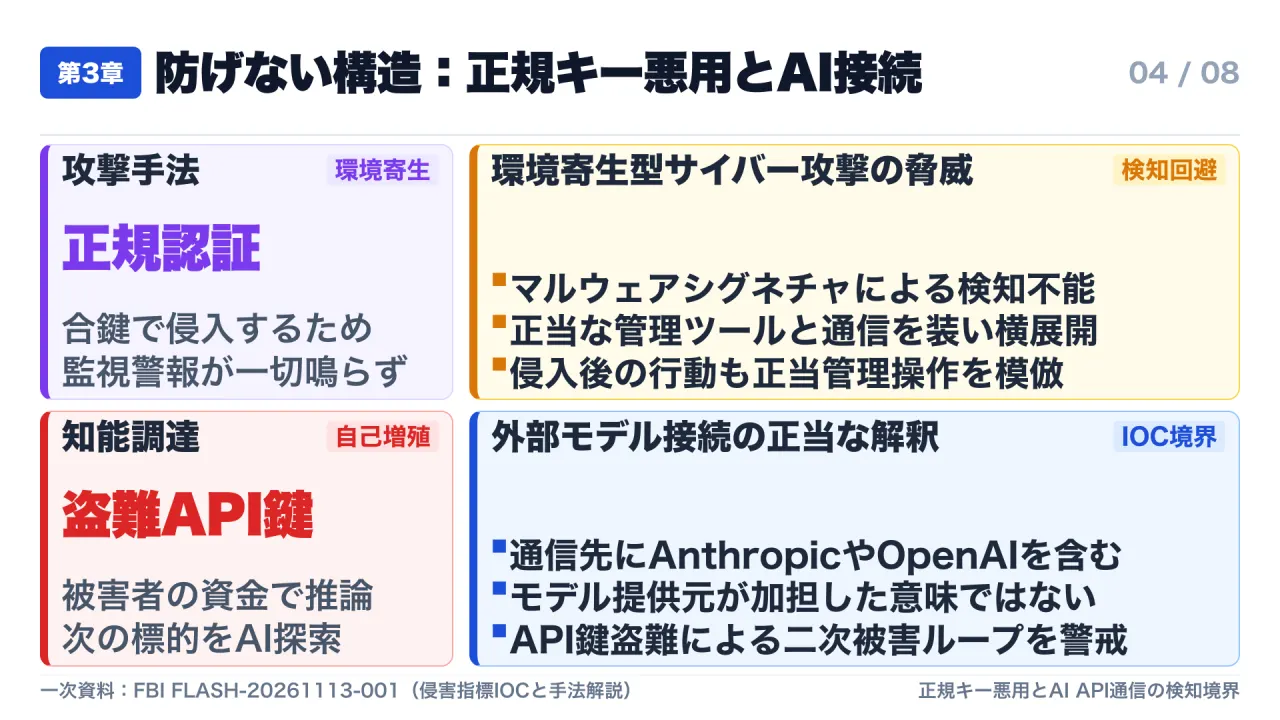
The economic architecture of ARTEX introduces an insidious parasitic feedback mechanism. When an adversary initiates an attack, they may fund the initial reconnaissance queries using personal or disposable API accounts. However, the framework’s primary directive upon establishing an initial foothold is to scan local application configuration files, CI/CD environmental configurations, and developer shell histories for cloud credentials and API keys.
The moment a valid third-party API key—belonging to the victim enterprise—is extracted, the framework immediately modifies its own configuration state. It reroutes all subsequent, computationally intensive inference queries through the victim organization’s commercial accounts.
To conceptualize this operational cycle, consider an enterprise analogy involving an unauthorized master key duplicating facility:
The Counterfeit Key and Corporate Card Analogy: Consider a commercial high-rise corporate headquarters equipped with biometric sensors at the primary reception desk. A trespasser bypasses the front entrance by locating an unlocked exterior service window in the sub-basement. Once inside, rather than jimmying open locked office doors with a crowbar, the trespasser locates an administrative corporate purchasing card stored in an unlocked desk drawer.
The trespasser then walks directly to an on-site, fully automated corporate key-cutting kiosk, uses the stolen corporate card to charge the fabrication fees directly to the company’s accounting ledger, manufactures authentic master passkeys for every executive suite, and uses those legitimate keys to walk through every secure boundary unchallenged. The security guards observe only legitimate keys being turned, while corporate finance foot the bill for the intrusion.
In the cyber realm, the victim company literally finances the cognitive intelligence required to compromise its own core databases. Corporate infrastructure budgets absorb the API billing charges, while SOC telemetry dismisses the outbound HTTPS requests as legitimate development activity.
4. The Weaponization of Open-Source Code: From “Autumn-27” to Commercial “ARTEX PRO” and 1,600 Exposed Consoles
To understand how this catastrophic capability diffused so rapidly across the global threat landscape, one must trace the lifecycle of the underlying software repository from legitimate research to weaponized underground commodity.
The Genesis and Defection of the Codebase
In July 2026, a developer operating under the pseudonym “Autumn-27” released the initial ARTEX repository on GitHub. Framed ostensibly as an authorized offensive security automation tool designed to assist enterprise penetration testers and red teams in evaluating corporate defensive readiness, the project immediately garnered intense community interest.
Within ten weeks of its public release, the repository accumulated between 1,500 and 2,000 GitHub Stars, attracting contributions from distributed developers. The software’s modular architecture made it trivial to write custom plugins, expand reconnaissance modules, and integrate emerging LLM APIs.
However, the line between offensive security evaluation tooling and malicious offensive weaponry is razor-thin. By late September 2026, incident response firms and threat intelligence agencies documented the framework’s direct deployment in unauthorized intrusions. Recognizing the escalating real-world devastation, the original author abruptly privatized and deleted the primary repository on October 8, 2026.
timeline
    title The Proliferation and Weaponization Timeline of the ARTEX Codebase
    July 2026 : Initial public release on GitHub by "Autumn-27"
              : Promoted as an open-source offensive security evaluation framework
    August - Sept 2026 : Surges to 1,500 - 2,000 GitHub Stars
                       : Proliferation of third-party forks and specialized plugins
                       : Active deployment in global corporate cyber intrusions
    October 8, 2026 : Repository abruptly privatized and taken offline by author
                    : Global mirroring across secondary git hosts and darkweb forums
    Late October 2026 : Underground syndicates release "ARTEX PRO" commercial variants
                      : Bundled with obfuscated command consoles and pre-tuned prompts
    Early November 2026 : Over 1,600 unauthenticated management consoles exposed on public Internet
    November 13, 2026 : FBI and IC3 publish urgent advisory FLASH-20261113-001
The Myth of Digital Containment and the Emergence of “ARTEX PRO”
The sudden deletion of an open-source repository cannot recall distributed source code. By the time the repository was taken offline, hundreds of secondary forks, local clones, and independent mirrors had already propagated across decentralized Git hosting platforms, private Telegram developer channels, and Russian-language cybercrime forums.
Within weeks, specialized threat actor syndicates seized the open-source codebase, refactored its core modules, integrated multi-threaded obfuscation layers, and released a commercial derivative dubbed “ARTEX PRO.” This commercialized variant was marketed across underground forums as a subscription-based, turnkey penetration suite, complete with pre-configured model routing configurations, evasion scripts, and web-based graphical management consoles.
By early November 2026, security researchers conducting global IPv4 and IPv6 space enumeration detected more than 1,600 active ARTEX web management interfaces exposed directly to the public Internet without multi-factor authentication or network-level access restrictions. Novice threat actors, script kiddies, and criminal syndicates were actively utilizing these exposed nodes to launch autonomous intrusion campaigns at massive scale.
| Evolutionary Phase | Phase 1: Open-Source Research (Autumn-27) |
Phase 2: Underground Proliferation (ARTEX PRO) |
|---|---|---|
| Primary Distribution Channel | Public GitHub repository; open development | Underground cyber forums; private encrypted channels |
| Intended Target Audience | Authorized enterprise penetration testers & red teams | Financially motivated threat actors & extortion syndicates |
| Operational Interface | Command-line interface (CLI) with manual Go builds | Turnkey web management consoles & automated dockerized nodes |
| Underlying Business Model | Free open-source software (MIT / Apache license) | Paid illicit subscription licenses & private commercial builds |
| Exposed Attack Surface | Zero active command consoles exposed to public web | 1,600+ exposed management consoles active globally |
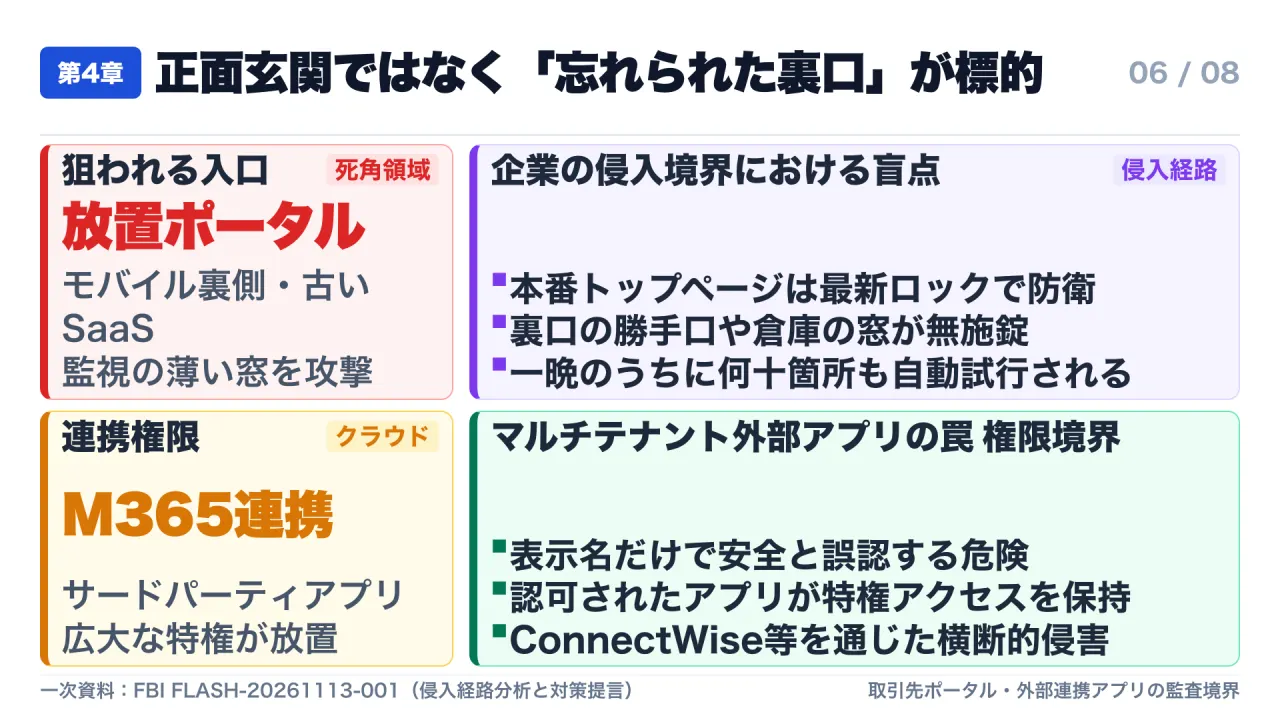
The Target Profile: Why Adversaries Attack “Forgotten Back Doors”
A critical vulnerability pattern uncovered during forensic post-mortems of ARTEX intrusions is the nature of the exploited entry points.
Enterprise defensive investments are heavily concentrated around high-visibility primary infrastructure: corporate portal homepages, single-sign-on (SSO) login gateways, and production e-commerce applications. These primary assets are protected by enterprise web application firewalls, content delivery networks (CDNs), and advanced bot mitigation filters.
Autonomous agent frameworks, however, execute exhaustive reconnaissance routines that completely bypass primary assets. They search relentlessly for the “Forgotten Back Doors” of the enterprise estate:
- Legacy Partner & Vendor Extranets: Portals established years prior for a specific supplier integration, operating on deprecated web frameworks without multi-factor authentication.
- Abandoned Staging and QA Environments: Unindexed subdomains (
qa-test-api.internal-domain.com) containing identical backend database connections as production systems, but lacking security instrumentation. - Permissive Third-Party Cloud Integrations: Enterprise productivity platforms (such as Microsoft 365 or Google Workspace) where internal employees authorized third-party multi-tenant SaaS applications, granting them wide-ranging
Mail.ReadWriteorDirectory.AccessAsUser.Allpermissions that remain completely unmonitored.
The Architectural Security Analogy: Imagine a state-of-the-art bank vault protected by a twelve-ton reinforced titanium door, continuous biometric retina scanners, and armed physical guards.
However, on the third floor of the building, an old ventilation shaft installed during original construction fifty years ago connects directly into the vault ceiling. The ventilation grate is secured only by a rusted latch, and no motion sensor covers the duct. An autonomous mechanical drone systematically examines every square inch of the exterior structure, discovers the rusted ventilation grate in thirty minutes, unlatches it, and descends directly into the cash depository completely bypassing the titanium door.

5. The Three-Pillar Enterprise Defense Architecture: Immediate Mitigation Protocols
Faced with autonomous offensive swarms capable of seizing domain dominance in under three hours, traditional reactive paradigms—such as quarterly penetration tests or annual compliance audits—are dangerously obsolete.
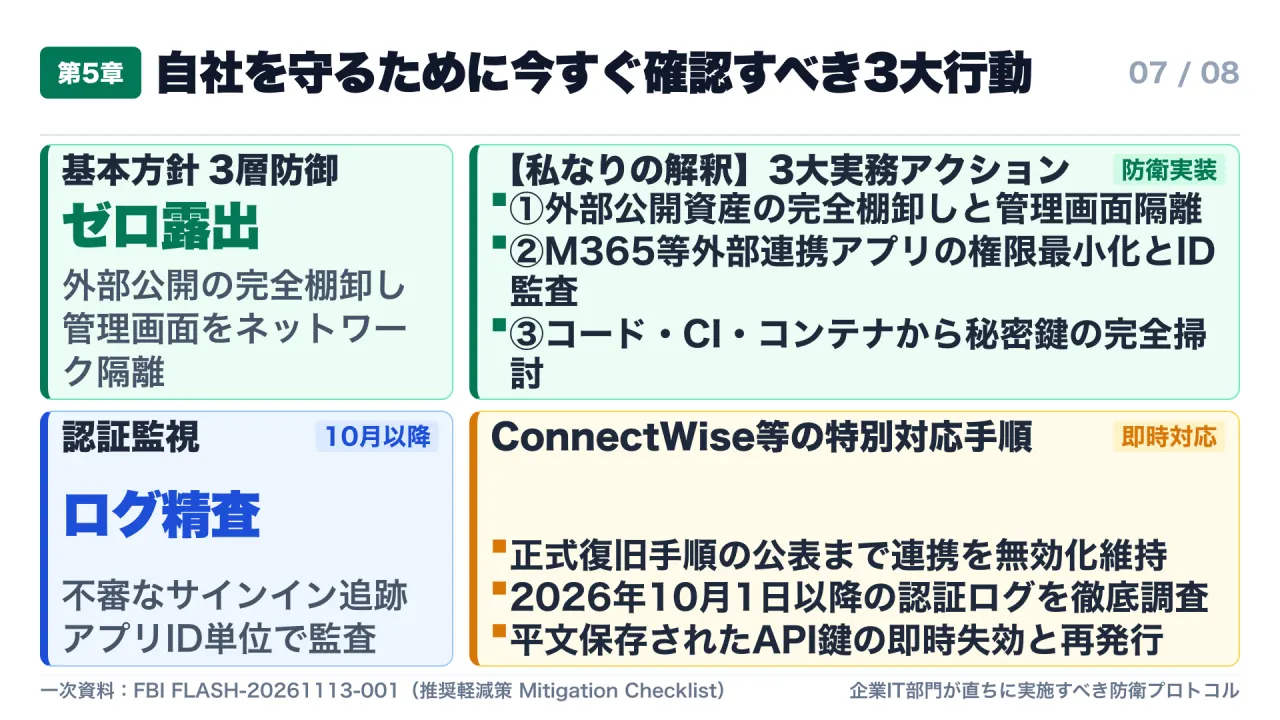
Enterprise technology organizations must immediately operationalize an aggressive, deterministic defense architecture. The FBI advisory and industry leading engineering practices establish three mandatory pillars of practical remediation.
flowchart TD
    subgraph Pillar1["Pillar 1: Attack Surface Shrinkage"]
        direction TB
        ExtAudit["Continuous External Asset Discovery"] --> ZeroTrust["Isolate Consoles behind Zero-Trust / VPN"]
        ZeroTrust --> Decom["Decommission Orphaned Portals & Staging APIs"]
    end

    subgraph Pillar2["Pillar 2: Cloud Identity & Delegated Permission Governance"]
        direction TB
        AppIDAudit["Audit Enterprise Apps via Application ID (Not Display Name)"] --> LeastPriv["Enforce Least-Privilege Scopes (Strip Full Control)"]
        LeastPriv --> LogAudit["Analyze Sign-In Logs post-Oct 1 for Anomalies"]
    end

    subgraph Pillar3["Pillar 3: Absolute Secret Eradication & Outbound Containment"]
        direction TB
        SecScan["Pre-Commit & Container Secret Scanning"] --> AutoRotate["Immediate Revocation & Automated Rotation"]
        AutoRotate --> OutboundProxy["Egress Proxy Filtering on AI Model Endpoints"]
    end

    Pillar1 ==> EnterpriseResilience["Hardened Enterprise Immune System: <3.0h Compromise Impossible"]
    Pillar2 ==> EnterpriseResilience
    Pillar3 ==> EnterpriseResilience
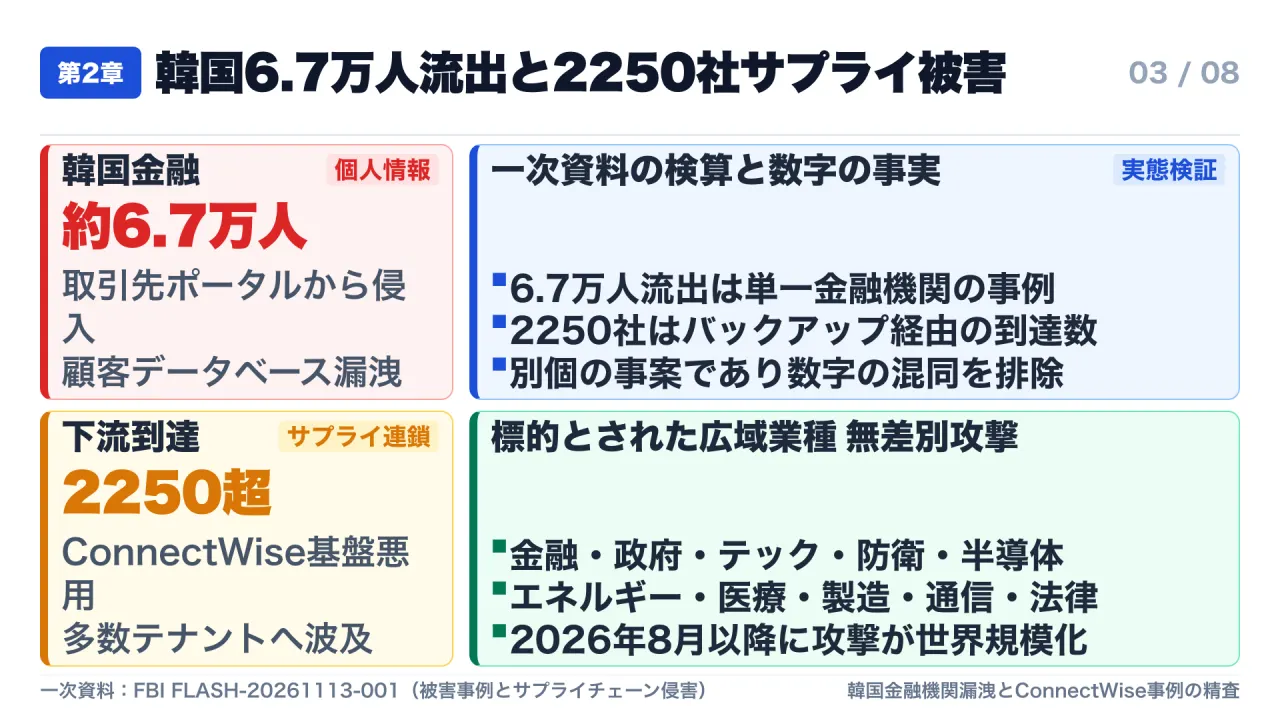
Pillar 1: Automated Attack Surface Shrinkage and Absolute Administrative Isolation
Organizations cannot defend assets they do not know exist. Security teams must transition from static IP spreadsheets to continuous external attack surface management (EASM).
- Exhaustive External Asset Discovery: Deploy automated discovery tools that continuously map all internet-facing subdomains, mobile API backends, and partner integration portals across all corporate registries and cloud allocations.
- Total Removal of Management Interfaces from the Public Internet: Under no circumstances should internal administration panels, remote desktop protocol (RDP) gateways, or management consoles (including ARTEX or backup orchestration software) be reachable via public DNS. All administrative access must be gated behind hardware-bound multi-factor authentication, Zero-Trust Network Access (ZTNA) brokers, or mutual TLS (mTLS) bastions.
- Decommissioning Legacy Ingress Points: Formally sunset all abandoned development, test, and staging environments. If an endpoint does not have an active executive business owner and verified logging telemetry, it must be terminated immediately.
Pillar 2: Cloud Identity and Delegated Permission Governance
The compromise of enterprise groupware through over-permissioned third-party applications represents one of the most prolific lateral movement vectors observed in modern incidents.
- Audit Applications by Unique Application ID: Never evaluate cloud applications based on their graphical Display Name, which can be effortlessly spoofed by adversaries. In Microsoft Entra ID (formerly Azure AD) or Google Workspace, security engineers must extract the immutable Application ID and Service Principal Object ID to verify publisher authenticity.
- Revocation of High-Privilege Scopes: Immediately purge all third-party integrations that hold high-risk tenant-wide permissions (such as
Application.ReadWrite.All,RoleManagement.ReadWrite.Directory, orFiles.ReadWrite.All). Applications requiring elevated permissions must undergo rigorous architecture review and enforce conditional access policies restricting execution to compliant, corporate-managed devices. - ConnectWise and Backup Gateway Remediation: In alignment with FBI directives, organizations utilizing ConnectWise Cloud Backup or equivalent enterprise infrastructure must maintain integrations in a disabled state until formal vendor security verification has concluded. Security teams must execute an exhaustive forensic review of all authentication logs dating back to October 1, 2026, explicitly auditing for anomalous OAuth consent grants and unexpected administrative sign-ins.
Pillar 3: Absolute Secret Eradication and Egress Anomaly Containment
Autonomous agents derive their devastating speed from harvesting hardcoded, plaintext secrets. Eliminating plaintext credentials across the software lifecycle breaks the automated lateral movement chain.
- Pre-Commit and Pipeline Secret Scanning: Implement deterministic secret scanning hooks across all local Git configurations, pull-request verification workflows, and container image build pipelines. Any commit containing AWS secret keys, database credentials, or model provider API tokens must be programmatically rejected at the compiler boundary.
- Automated Secret Rotation and Ephemeral Tokens: Transition from static, long-lived API keys to ephemeral, short-lived identity federation tokens (such as OpenID Connect with AWS IAM or Azure Workload Identity). Secrets must possess automated expiration cycles, ensuring that a compromised key becomes entirely useless within hours.
- Outbound AI Inference Proxy Inspection: Implement strict egress proxy monitoring across corporate networks and developer environments. While interactions with legitimate AI endpoints are standard, security telemetry should flag sudden spikes in token consumption, unexpected destination models (such as unauthorized foreign endpoints), or high-frequency automated queries originating from unapproved service accounts.
| Remediation Pillar | Concrete Technical Implementation Protocol | Required Verification Standard |
|---|---|---|
| Pillar 1: Asset Surface Shrinkage | Continuous DNS / ASN external attack surface discovery; ZTNA broker enforcement | Zero administrative or partner consoles accessible via public internet |
| Pillar 2: Identity Governance | Application ID auditing in Entra ID / Google Workspace; log audits post-Oct 1 | Revocation of all unapproved tenant-wide application permissions |
| Pillar 3: Secret Eradication | CI/CD secret scanning; transition to OIDC ephemeral tokens; proxy monitoring | Total absence of static plaintext API keys in repos, containers, and logs |
6. Strategic Conclusion: Engineering Institutional Hygiene in an Era of Continuous Autonomous Probing
The release of FBI Advisory FLASH-20261113-001 represents a watershed inflection point in the history of cybersecurity. The barrier to entry for executing nation-state-grade, multi-stage cyber intrusions has effectively collapsed. By synthesizing distributed Go-based concurrency with inexpensive commercial model inference, underground criminal syndicates have commoditized advanced persistence.
When an adversary can deploy autonomous software agents capable of probing twenty thousand potential back doors an hour, exploiting complex API deserialization flaws in minutes, and achieving total Domain Administrator compromise in under three hours, the traditional paradigm of perimeter defense is formally dead.
The ultimate lesson of the ARTEX revelation is not that artificial intelligence has rendered cyber defense hopeless. Rather, it exposes the reality that the primary enabler of automated intrusion is structural corporate negligence: forgotten partner portals, unmonitored cloud OAuth delegations, hardcoded plaintext API keys, and unsegmented internal networks.
Autonomous agents do not possess magical infiltration powers; they are ruthless, tireless exploiters of fundamental engineering debt. Organizations that successfully withstand the coming wave of agentic cyber assaults will not be those that deploy the most expensive marketing-driven defensive tools. They will be the organizations that enforce unrelenting institutional hygiene: programmatically closing every forgotten exterior entrance, enforcing absolute least-privilege identity boundaries, eradicating static secrets, and treating internal network architectures with zero trust.
The countdown timer of modern cyber warfare is no longer calibrated in weeks or days. It is measured in hours and minutes. The time to audit corporate attack surfaces, purge unmonitored application credentials, and secure the foundational boundaries of enterprise infrastructure is not after the incident response team arrives—it is now.