30-Day Vulnerability Disclosure: Autonomous Exploit AI vs. Google AI Threat Defense
Google Project Zero and Anthropic cut vulnerability disclosure to 30 days as AI turns patch diffs into live exploits within hours—examining GTIG data, CodeMender limits, and four enterprise defense boundaries.
Japanese Edition: Read the original Japanese article on Substack
Video Episode (Japanese Audio): Watch on YouTube
On November 16, 2026, two major security organizations—Google Project Zero and Anthropic—published major revisions to their coordinated vulnerability disclosure timelines, shifting the industry standard from the long-standing 90-day window toward 30 days. During the same reporting cycle, the Google Threat Intelligence Group (GTIG) disclosed that its researchers had observed an autonomous multi-agent attack framework, named exploit_agent, running on an exposed staging server and generating functional exploits directly from public patch diffs without human intervention.
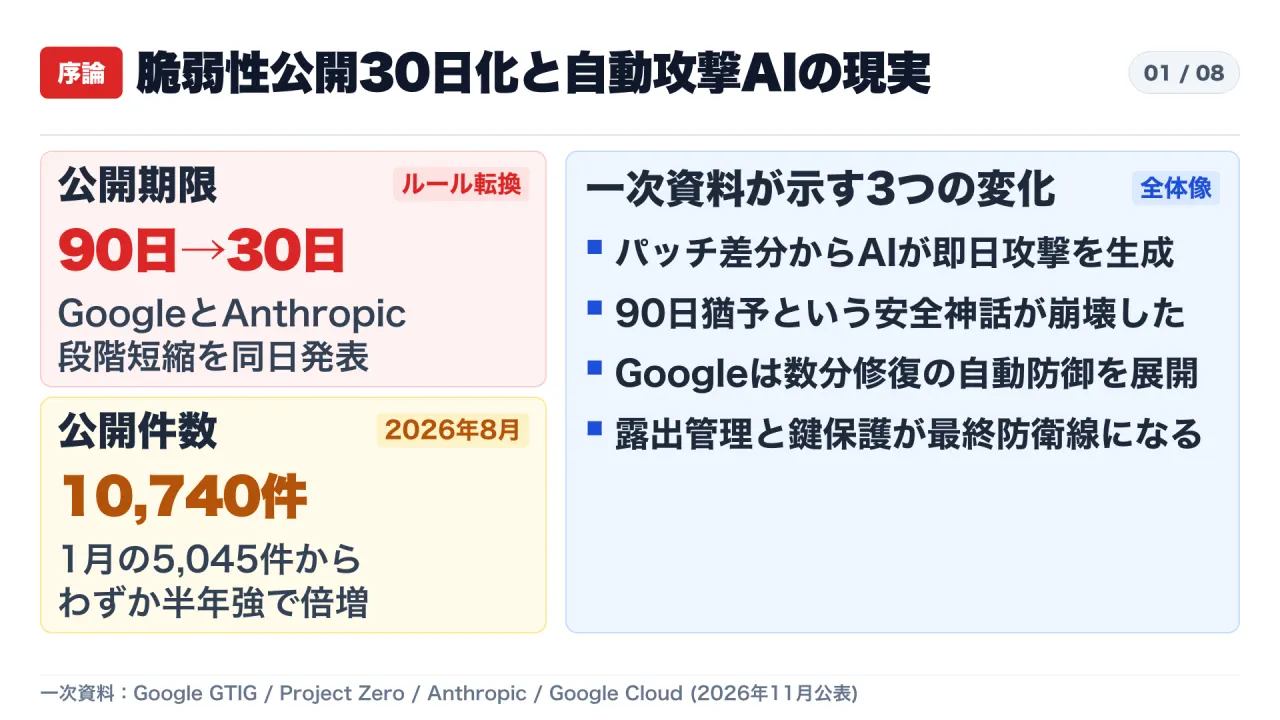
For enterprise security engineers, platform architects, and technology executives, this convergence marks a structural break in how software risk operates. When monthly vulnerability disclosures double from 5,045 in January 2026 to 10,740 in August 2026—a 128 percent surge—while remediation windows shrink to one-third of their former length, legacy patch calendars fail under basic arithmetic. Cross-referencing eight primary sources from GTIG, Project Zero, Anthropic, Google Cloud, Google DeepMind, and GreyNoise clarifies what autonomous attack and defense systems actually achieve in November 2026, where Google’s own defensive automation stops short, and which four operational boundaries organizations must enforce immediately.
- Core Thesis: Autonomous AI systems have collapsed the post-patch secrecy buffer by turning narrow code diffs into live attacks within 24 hours, pushing disclosure rules toward 30 days and multiplying daily enterprise triage pressure by roughly 6.4x—yet human review remains mandatory on the defensive side, and breaches still stem from exposed management interfaces, missing authorization checks, and stolen credentials.
- Primary Sources Verified: GTIG AI Threat Tracker (November 16, 2026), GTIG Vulnerability Trends in the AI Era (October 2026), Google Project Zero 2026 Disclosure Policy (November 13, 2026), Anthropic CVD Timeline Update (November 16, 2026), Google Cloud AI Threat Defense launch and product overview, Google DeepMind CodeMender report (72 patches across repositories up to 4.5 million lines), and GreyNoise’s PaperCut NG/MF campaign telemetry (more than 223 compromised hosts).
- Actionable Strategic Takeaways: Security teams cannot patch every vulnerability uniformly at 6.4x daily load; organizations must prioritize internet-reachable attack paths, monitor noisy automated scan signatures, audit AI developer configuration files alongside production code, and replace monthly compliance percentages with Time to Remediate as their primary metric.
1. Eight Primary Sources and Why the 90-Day Buffer Collapsed
For more than a decade, coordinated vulnerability disclosure rested on a practical compromise: give software vendors 90 days to build a fix—often paired with extra time for customers to apply patches—before publishing technical details. That model assumed secrecy protected defenders while patches rolled out slowly. In November 2026, primary telemetry and policy updates across eight authoritative disclosures demonstrate why that assumption no longer holds.
| Source Organization | Publication / Report | Key Verified Findings |
|---|---|---|
| Google GTIG | GTIG AI Threat Tracker (November 16, 2026) | Observed exploit_agent on staging infrastructure, Spectra plugin diff analysis, 22 zero-days in August 2026, PaperCut and PHP PoC floods |
| Google GTIG | Vulnerability Trends in the AI Era (October 2026) | Monthly disclosures doubled from 5,045 (January) to 10,740 (August, +128%); exploited flaws rose to 18 per month |
| Google Project Zero | Policy and Disclosure: 2026 Edition (November 13, 2026) | Eliminated the extra 30-day grace period immediately; moves to 60 days in February 2027 and 30 days in January 2028 |
| Anthropic | Updating our CVD policy timelines (November 16, 2026) | Cut high and critical disclosure deadlines from 90 days to 30 days (45 days for other severities); escalation shortened to 15 days |
| Google Cloud | Introducing Google AI Threat Defense / Product Overview | Integrates Gemini, Wiz (Red/Green/Blue Agents), CodeMender, and Mandiant to compress remediation from weeks to minutes |
| Google DeepMind | Introducing CodeMender | Landed 72 security patches over six months across open-source codebases up to 4.5 million lines; mandatory human review before landing |
| GreyNoise | PaperCut NG/MF AI-Orchestrated Campaign | Tracked AI-orchestrated attacks starting August 31, 2026; more than 223 hosts breached, domain admin compromised in minutes |
Once attackers use large language models to compare pre-patch and post-patch source code minutes after a vendor releases an update, withholding a security advisory does not buy safety. Instead, delaying public transparency leaves defenders blind while automated scripts already know exactly which function changed and how to trigger the unpatched branch.
2. Inside exploit_agent and Same-Day Patch-Diff Weaponization
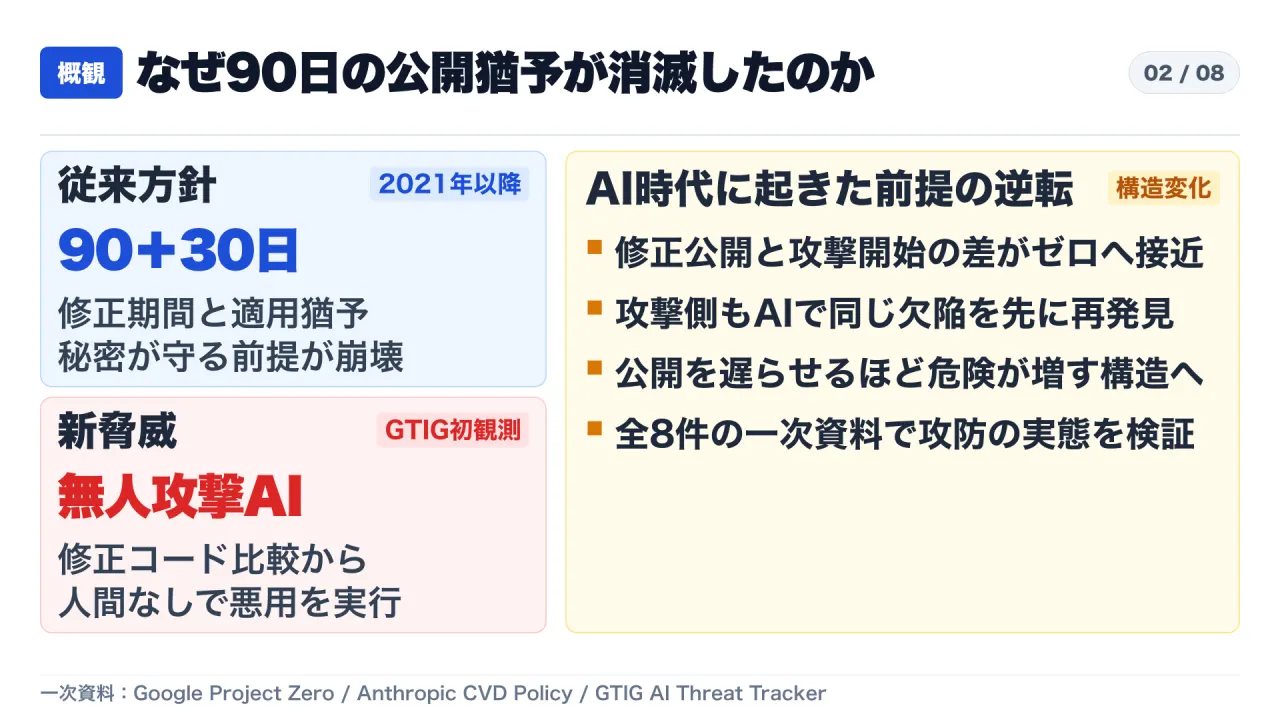
The concrete mechanics of automated exploitation are documented in GTIG’s November 16, 2026 Threat Tracker report. On an exposed staging server, Google analysts captured exploit_agent, a multi-agent orchestration framework that combines frontier commercial models with locally hosted open-weight LLMs to continuously monitor popular web applications, inspect source-code diffs between releases, synthesize working exploits, and execute them autonomously without a human operator in the loop.
Crucially, exploit_agent does not spend most of its compute hunting blindly for unknown zero-day flaws across millions of lines of unfamiliar code. Instead, it concentrates on n-day vulnerabilities—flaws where a vendor has already shipped a fix. Searching an entire codebase for an unknown bug is computationally expensive and uncertain; comparing two adjacent releases isolates the exact lines that changed. In one documented trace, the framework parsed version 2.19.25 of the WordPress plugin Spectra and focused directly on authorization checks inside the function restrict_popup_rest_access. Configuration comments left on the server in Russian referenced LLM API keys dedicated to automated exploitation testing, and target notes showed interest in French news, entertainment, and education portals.
Think of this dynamic like a precision automated key-cutting machine watching a lock manufacturer publish a service bulletin. The moment the manufacturer announces which pin inside a lock was replaced, the machine inspects the before-and-after blueprint and mills a working skeleton key around the clock—long before building managers replace the cylinders on their doors.
Independent telemetry from Huntress and GreyNoise confirms how rapidly this timeline has compressed in production environments. When two chained vulnerabilities affecting PaperCut NG/MF print management servers (CVE-2026-81578 and CVE-2026-82078) became public in late August 2026, security researchers demonstrated LLM-assisted proof-of-concept exploits within one day. Four days later, beginning August 31, 2026, hundreds of coordinated AI-driven agents launched global exploitation waves. GreyNoise recorded unauthorized intrusions across more than 223 exposed hosts, with the fastest attacks escalating from initial compromise to domain administrator control within minutes.
Automation also degrades defender bandwidth through sheer noise. Following PHP vulnerability fixes disclosed on October 21, 2026 (CVE-2026-109618 and CVE-2026-109619), hundreds of AI-generated proof-of-concept scripts flooded public channels immediately. Most failed to execute reliably, yet incident response teams still had to spend hours separating broken hallucinations from genuine attack payloads.
3. Monthly Disclosures Top 10,740 as 30-Day Rules Take Hold
Quantitative trend data from GTIG’s October 2026 report shows that these incidents sit atop a steep structural curve rather than an isolated anomaly:
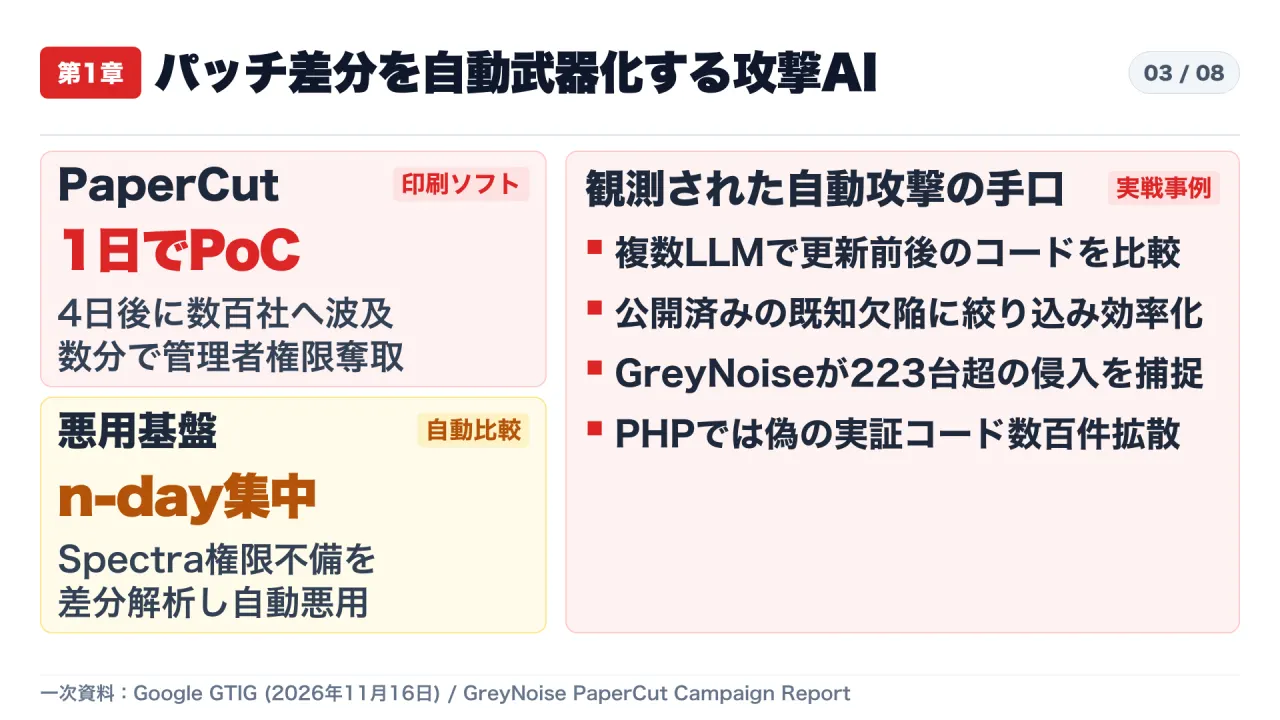
- Vulnerability volume doubled in seven months: Monthly public vulnerability disclosures climbed from 5,045 in January 2026 to 10,477 in July and 10,740 in August—a 128 percent expansion driven heavily by automated discovery and triage.
- Confirmed in-the-wild exploitation accelerated: Exploited flaws averaged 10.5 per month across 2025, rising to an average of 18 per month between January and August 2026. The eight-month cumulative total of 141 exploited vulnerabilities already surpassed the 127 recorded across all of 2025.
- Zero-day spikes accompanied n-day compression: Zero-day exploitation rose from an average of 8 per month in 2025 to 11 per month in 2026, peaking at 22 in August 2026, even as the bulk of operational damage shifted toward rapid n-day weaponization.
In response to these numbers, both Google Project Zero and Anthropic rewrote their disclosure rules in November 2026. On November 13, 2026, Project Zero abolished the extra 30-day “grace period” introduced in 2021, moving immediately to a strict 90-day ceiling, followed by a scheduled cut to 60 days on February 2, 2027, and 30 days on January 3, 2028. On November 16, 2026, Anthropic announced an even faster schedule effective for reports filed from January 1, 2027 onward: 30 days for high and critical vulnerabilities, 45 days for other severities, and 15 days before escalating unresponsive vendor reports to external coordination bodies.
4. How Google AI Threat Defense and CodeMender Operate
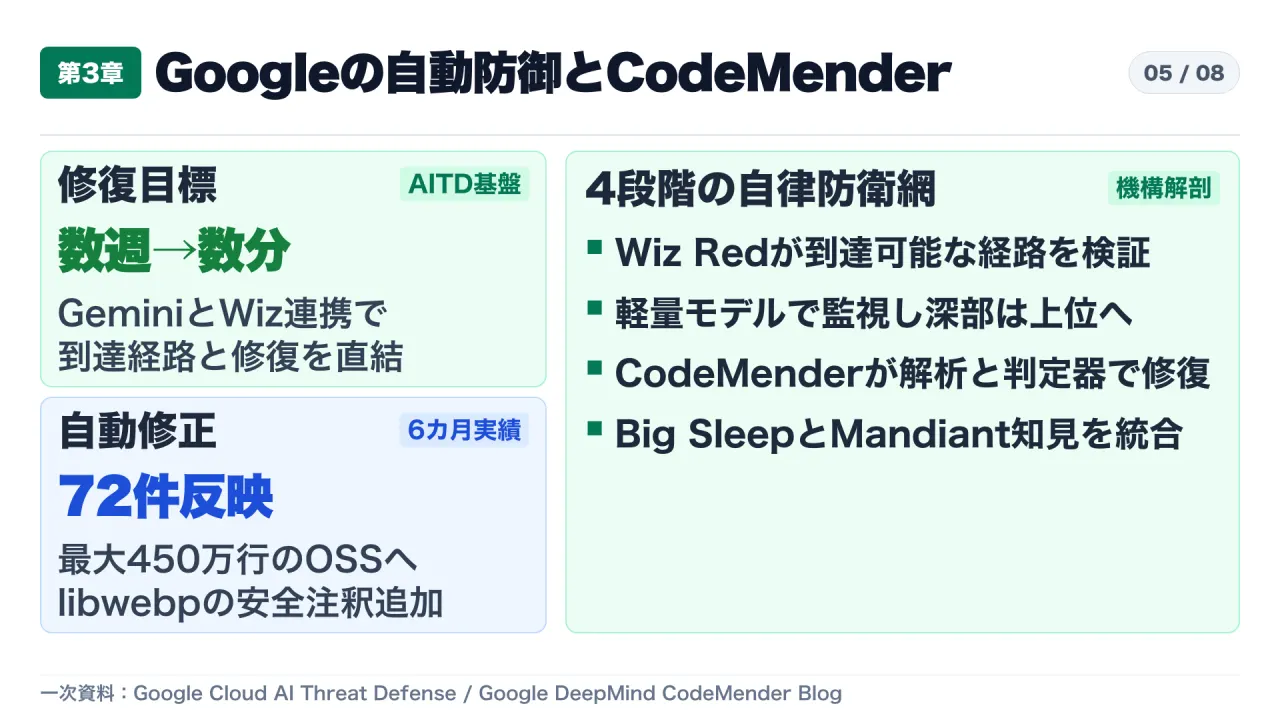
To counter machine-speed exploitation, Google Cloud introduced Google AI Threat Defense in May 2026, positioning it as an autonomous four-stage loop covering Prepare, Scan and Prioritize, Remediate, and Monitor. Rather than flooding engineering queues with thousands of generic scanner alerts, the architecture links cloud topology visibility from Wiz with Gemini-powered reasoning, CodeMender patching, and Mandiant threat intelligence.
In the prioritization phase, Wiz’s Security Graph maps which vulnerable components are actually reachable from external networks, and a specialized Red Agent validates realistic attack paths from an adversary’s perspective. Once a reachable path is confirmed, remediation shifts to Wiz’s Green Agent and Google DeepMind’s CodeMender. CodeMender pairs Gemini Deep Think reasoning with static analysis, dynamic testing, fuzzing, and SMT solvers to pinpoint root causes, then checks candidate fixes through an automated LLM equivalence judge to verify that intended application behavior stays intact.
Google DeepMind reported that during its initial six months, CodeMender landed 72 security patches into open-source projects spanning up to 4.5 million lines of code, including adding -fbounds-safety annotations to libwebp to eliminate entire classes of memory-corruption bugs structurally. Alongside the Big Sleep vulnerability discovery agent introduced in 2024, Google frames this stack as a way to compress remediation timelines from weeks down to minutes.
5. Arithmetic Check: Why Daily Triage Pressure Multiplies by 6.4x
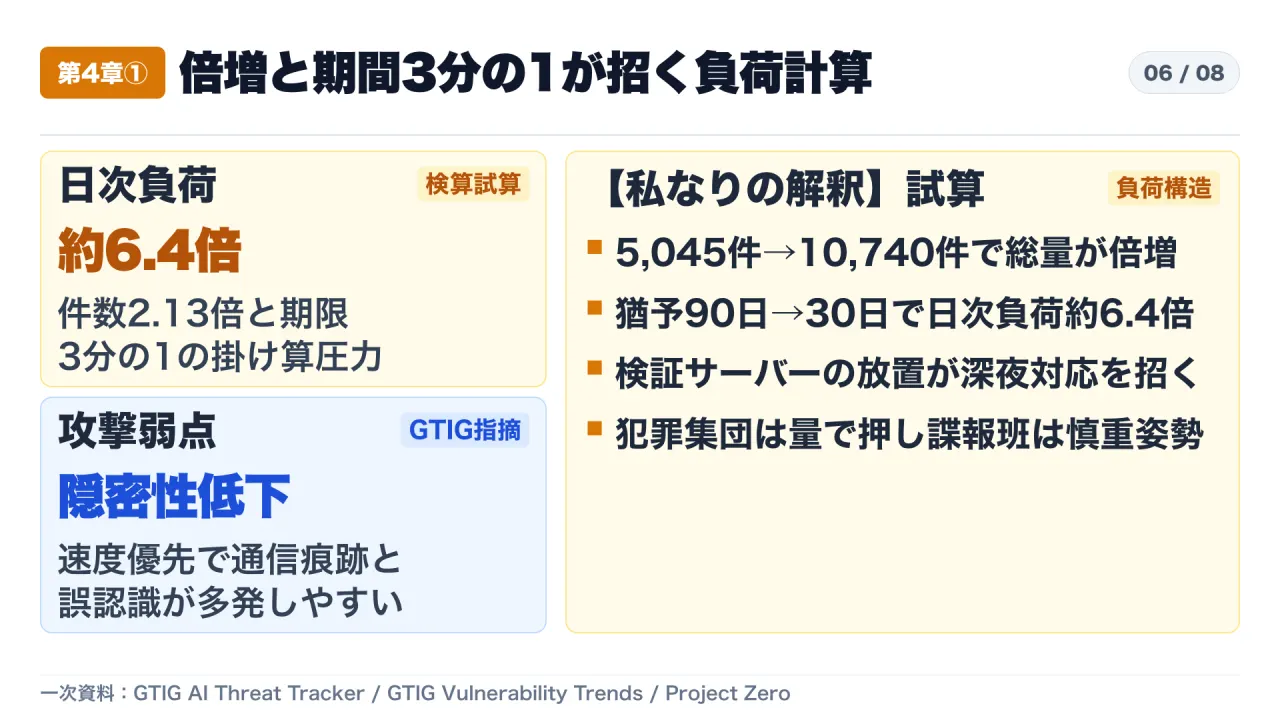
Verifying the primary figures side by side reveals the operational squeeze facing enterprise IT and product teams. When monthly vulnerability disclosures grow from 5,045 in January to 10,740 in August—a factor of roughly 2.13x—and the allowable response window for critical flaws drops from 90 days to 30 days—one-third of the previous horizon—the required daily throughput for triage, verification, and patch deployment increases by approximately 6.4x.
In practical operations, that arithmetic leaves zero margin for forgotten staging servers or unmonitored admin consoles. Security teams often verify that production servers received an emergency patch and relax, only to discover days later that an exposed test instance or legacy management interface on a secondary subdomain was swept up by automated scanners.
At the same time, GTIG’s November 2026 findings expose clear operational weaknesses in current autonomous attack tools. Today’s agentic attack platforms trade stealth for speed: they generate noisy traffic spikes, leave recognizable behavioral fingerprints, and frequently fail due to model hallucinations—such as probing nonexistent paths or misreading target environments. Because of those flaws, disciplined state-sponsored espionage groups remain cautious about deploying autonomous agents in sensitive operations, whereas financially motivated cybercrime crews embrace them to overwhelm targets through sheer volume.
6. Three Sobering Limits of Automated Defense
Decision-makers evaluating autonomous defensive platforms need the same analytical skepticism toward vendor claims as toward attacker hype:
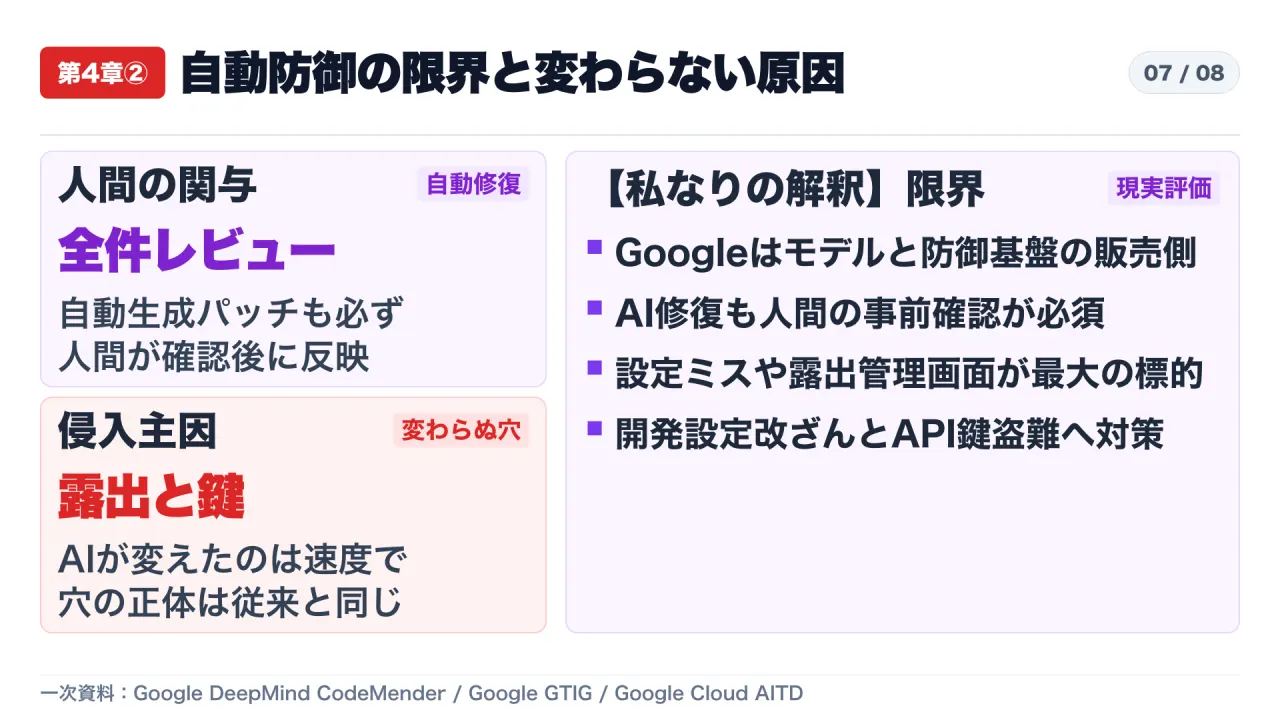
- Vendor alignment: Google simultaneously develops the underlying Gemini models and sells cloud infrastructure and security platforms. Product announcements naturally emphasize best-case integration scenarios.
- Mandatory human review remains intact: DeepMind’s CodeMender documentation explicitly states that every AI-generated patch is reviewed by human researchers before upstream submission. Autonomous remediation does not yet equate to unattended production deployment without human approval gates.
- Root causes have not changed: AI accelerated the speed of exploitation, not the underlying weaknesses. Across GTIG and GreyNoise case files, breaches continue to exploit missing authorization checks (
Spectra), internet-exposed administration panels (PaperCut), stolen long-lived API keys, and tampered developer configuration files for AI coding tools.
Adding automated remediation tools without fixing basic access hygiene resembles installing an advanced fire-sprinkler system in an office while leaving the back door unlocked and vault combinations taped to a monitor. Automation mitigates fallout, yet basic locking discipline remains irreplaceable.
7. Four Defense Boundaries Enterprises Must Enforce Now
To survive 30-day disclosure cycles and same-day n-day weaponization, engineering and security leaders should implement four concrete operational boundaries:
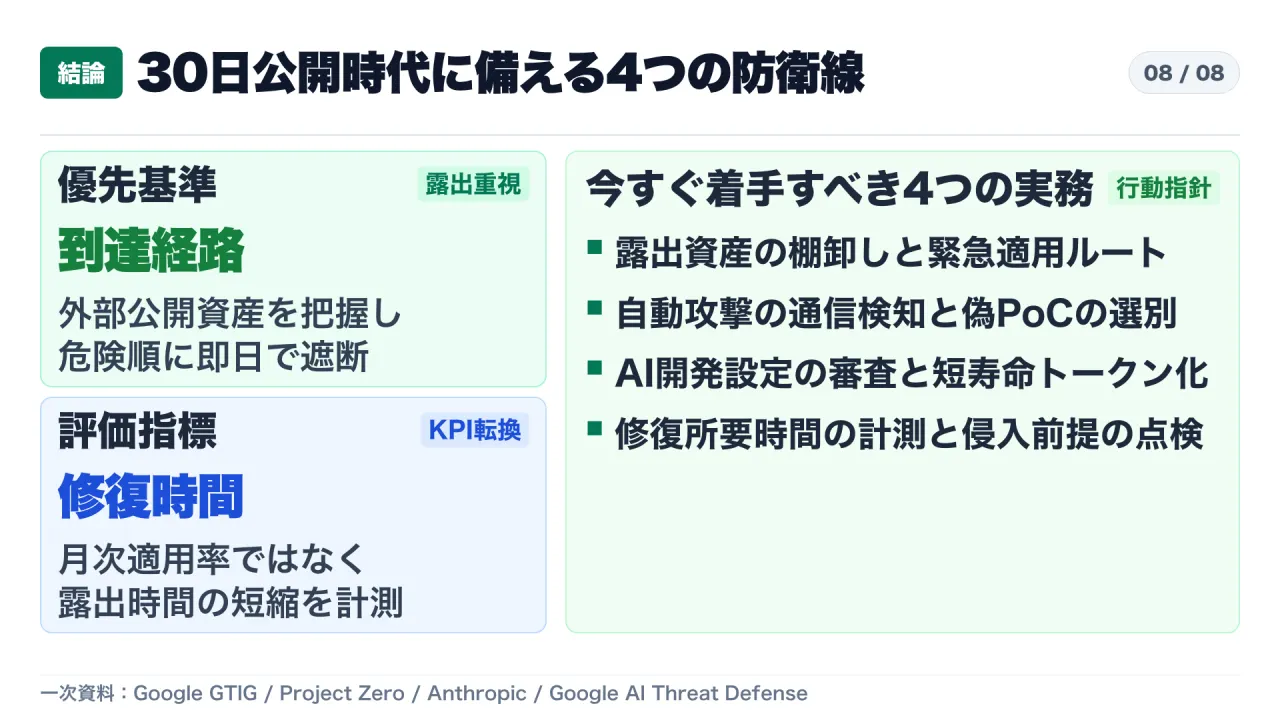
- Inventory internet-exposed assets and patch by reachability: With daily triage pressure up roughly 6.4x, uniform monthly patching cycles fail. Map every externally reachable web portal, print server, API gateway, and test environment, and establish emergency virtual-patching or isolation paths measured in hours rather than weeks.
- Detect noisy automated attack traffic and filter fake PoCs: Because autonomous attack agents sacrifice stealth for velocity, tune egress filtering and web application telemetry to catch sudden automated scan bursts, while standardizing a safe sandbox pipeline to verify whether circulating proof-of-concept scripts are real or broken noise.
- Protect AI developer configurations and eliminate long-lived tokens: Treat AI coding assistant configuration files, hooks, and MCP integration manifests with the same code-review rigor as application source code, replace static API keys with short-lived scoped credentials, and enforce automated spending caps and circuit breakers.
- Shift executive KPIs from monthly patch coverage to Time to Remediate: Measure exposure duration from disclosure or detection to verified mitigation on critical paths, and operate under an assume-breach checklist that inspects for newly created accounts or persistence backdoors whenever a patch lands late.
Primary Sources and References
- Google Threat Intelligence Group (GTIG): GTIG AI Threat Tracker: Agentic Threat Activity Crosses a Significant Threshold (November 16, 2026)
- Google GTIG: Vulnerability Discovery and Exploitation Trends in the AI Era (October 2026)
- Google Project Zero: Policy and Disclosure: 2026 Edition (November 13, 2026)
- Anthropic: Updating our coordinated vulnerability disclosure policy timelines (November 16, 2026)
- Google Cloud: Introducing Google AI Threat Defense
- Google Cloud: Google AI Threat Defense Product Overview
- Google DeepMind: Introducing CodeMender: an AI agent for code security
- GreyNoise: PaperCut NG/MF AI-Orchestrated Campaign