Why Google's Parallel AI Dev Environment Creates a 300.6% QA Bottleneck and Blocks Enterprise Cloud Runs
Primary documentation from Google Antigravity v2.29.0–v2.32.1 and Faros AI’s 22,000-developer telemetry study reveal hidden enterprise blocks, Windows sandbox gaps, and review debt.
Japanese Edition: Read the original Japanese article on Substack
Video Episode (Japanese Audio): Watch on YouTube
Software engineering tooling is undergoing a structural shift away from single-threaded chat assistants toward parallel autonomous agent control planes. Between May 2026 and November 2026, Google’s Antigravity platform transitioned into a standalone application (v2.0) and then shipped rapid consecutive updates from v2.29.0 through v2.32.1 alongside CLI v1.5.5. The redesigned interface lets a single developer launch isolated Git worktrees, spin up cloud-hosted Remote Agents, monitor an embedded browser, converse via Voice Mode, and trigger scheduled background automations from one workspace.
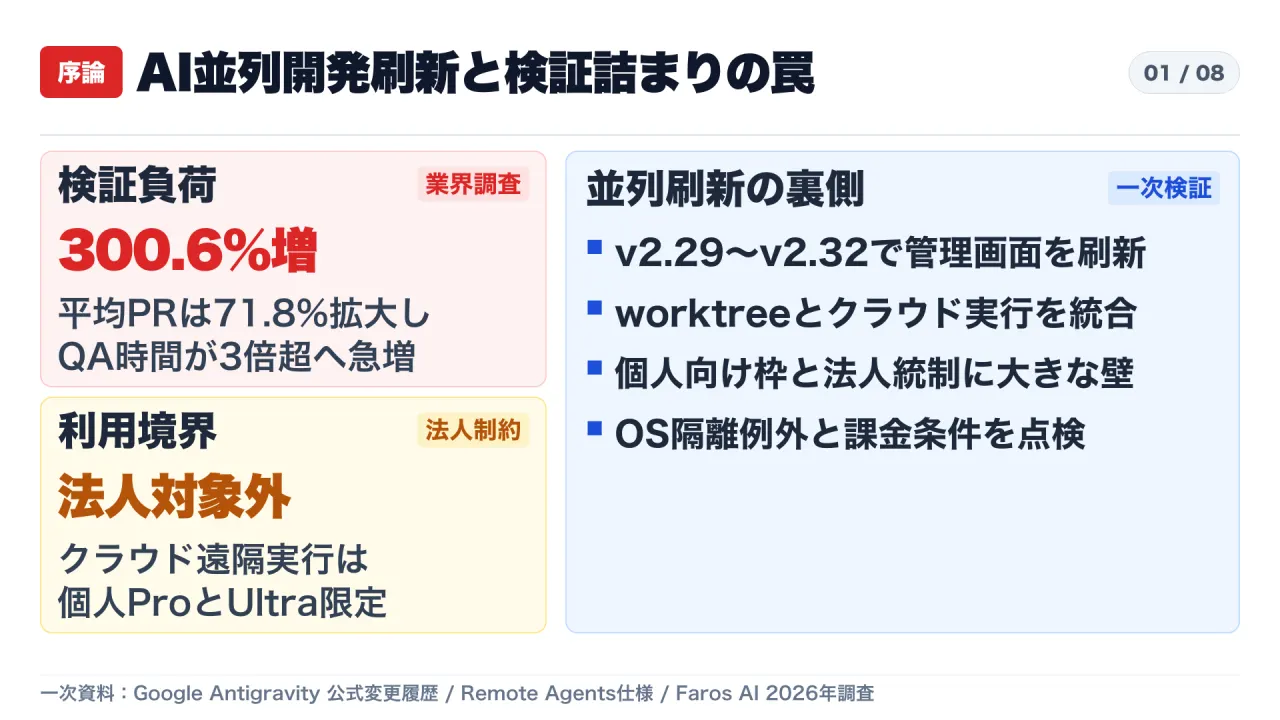
Yet cross-referencing Google Antigravity’s official changelogs, enterprise governance documentation, sandbox specifications, and pricing schedules against Faros AI’s 2026 industry telemetry report (The Speed Trap, covering 22,000 developers across 4,000 teams) exposes a stark operational gap. While parallel execution dramatically accelerates raw code generation, organizations adopting multi-agent orchestration face severe downstream verification bottlenecks—including a 71.8% increase in average pull request size, a 300.6% surge in time spent in quality assurance, a 76.3% rise in pull requests merged without review, and a 125.4% climb in monthly production incidents. At the same time, primary specifications confirm that cloud-hosted Remote Agents are closed to corporate Google Workspace and Google Cloud accounts, third-party models require per-token pay-as-you-go billing on top of enterprise seat fees, and the Windows terminal sandbox retains documented read-access exceptions outside user profiles.
- Core Thesis: Multi-agent orchestration moves the engineering bottleneck from writing code to verifying and governing parallel output; without version pinning, sandbox audits, and strict verification throughput limits, higher agent concurrency amplifies production risk rather than delivery speed.
- Primary Sources Verified: Google Antigravity Changelog (v2.29.0–v2.32.1 / CLI v1.5.5), Remote Agents Specification, Plans & Quotas Documentation, Pricing Page, Enterprise Governance Guide, Terminal Sandbox Specification, Voice Mode Specification and November 6, 2026 Launch Blog,
/btwCommand Reference, Sidecars Specification, Projects Specification, and Faros AI’s 2026 The Speed Trap Telemetry Report. - Actionable Takeaways: Standardize on Antigravity v2.31.0 or later with
DefaultorAutosandbox presets, design corporate deployments around local execution with mandatory Spend Caps, and cap initial rollouts at 2 to 4 parallel threads governed by CI verification throughput rather than raw agent concurrency.
1. From Single Chat Window to Parallel Agent Control Plane
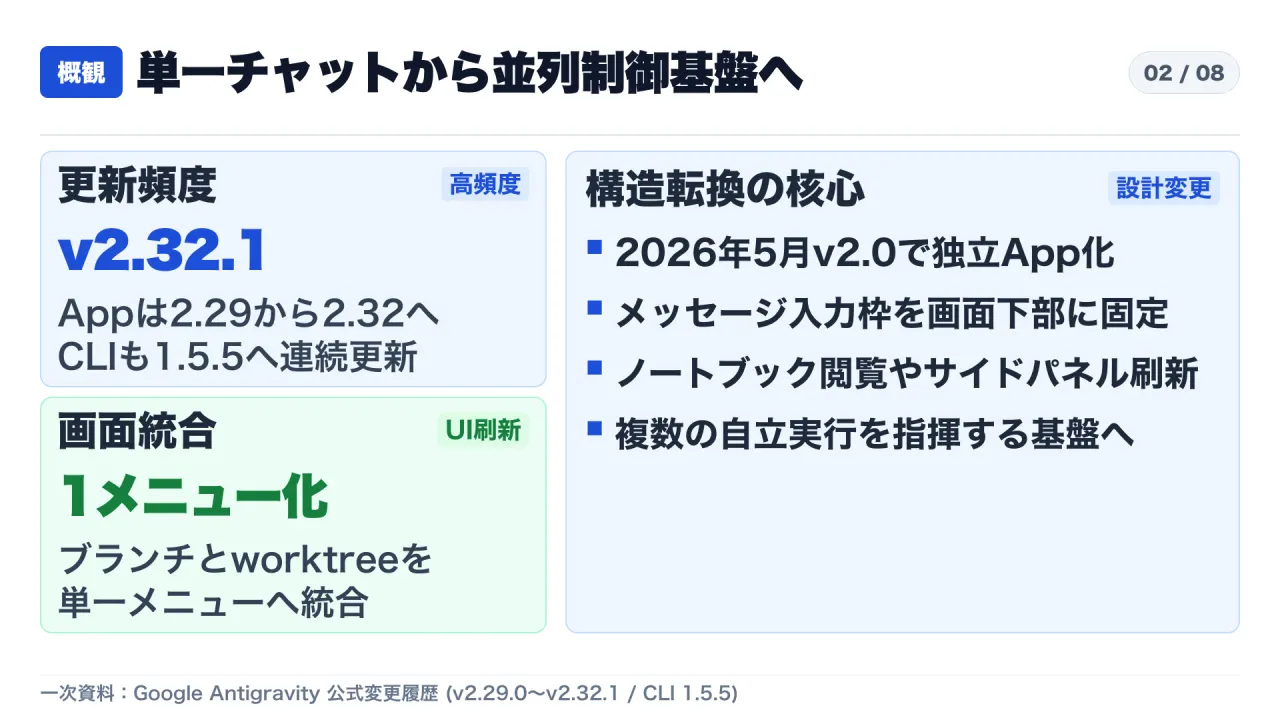
In May 2026, Antigravity v2.0 separated from traditional editor-embedded chat widgets to become an independent desktop application and CLI orchestration environment. By November 2026, rapid iterations across v2.29.0 through v2.32.1 (and CLI v1.5.5) consolidated the interface around supervising multiple concurrent execution contexts rather than editing one file at a time.
Three interface changes define this shift:
- Unified Composer, Branch, and Git Worktree Selection: For single-repository workspaces, branch selection and Git worktree management were merged into a single menu inside the bottom-pinned composer. At conversation start, engineers switch between
Local mode—which edits the active working directory directly—andNew worktree mode, which automatically provisions isolated Git worktrees across enabled repositories so concurrent sub-agents do not overwrite each other’s uncommitted files. Multi-folder repositories are grouped underProjectsto keep related services coordinated under one session tree. - Voice Mode with Strict Destructive-Action Guardrails: Introduced on November 6, 2026 and powered by Gemini Live, Voice Mode supports 9 distinct voices and playback speeds from 0.75x to 2x. By default, it operates in a quiet mode that speaks only when delivering an answer or requesting confirmation. Crucially, the specification prohibits voice approval for destructive actions: file deletion,
sudoprivilege escalation, and Gitforce-pushcommands cannot be confirmed verbally and require an explicit click on screen. - Side-by-Side Embedded Browser and Download Approval: An embedded browser sits directly beside the agent conversation thread for real-time visual inspection. Before any browser-driven agent can download external files to the local environment, an explicit approval dialog interrupts execution for human sign-off.
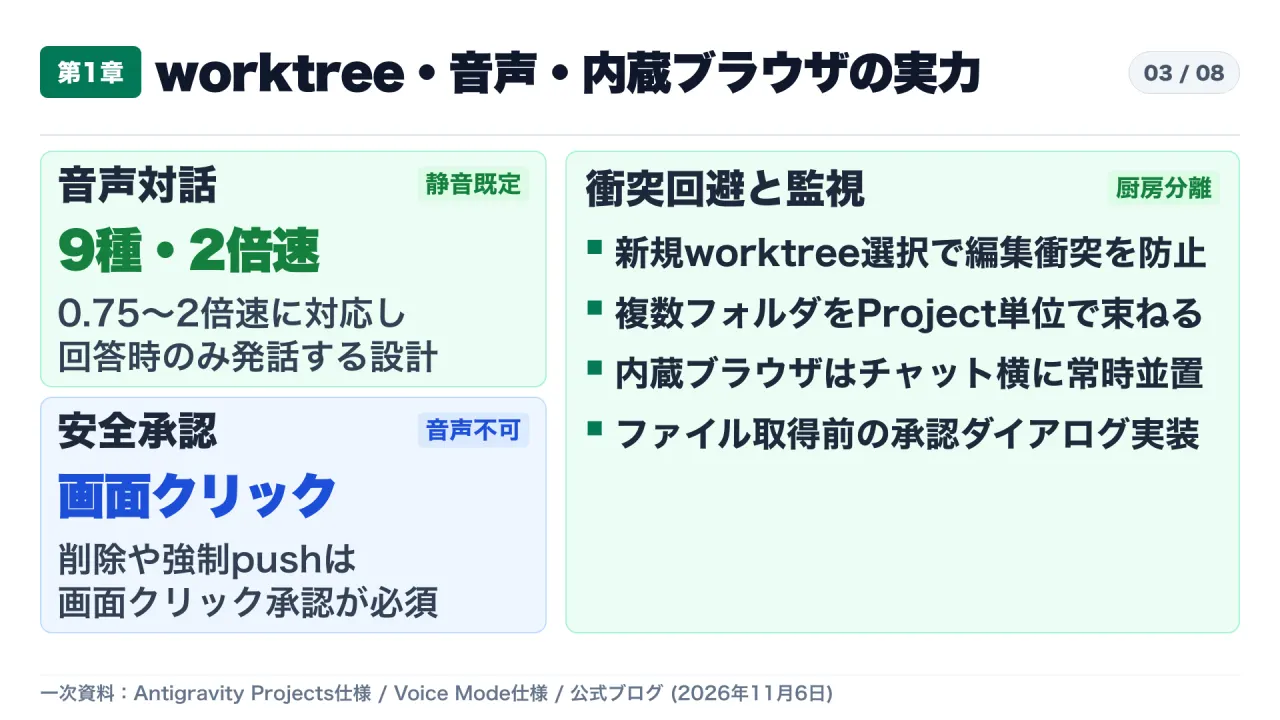
Think of this architecture like an industrial commercial kitchen rather than a single cramped cutting board. Instead of five cooks swinging knives on the same board and colliding over ingredients, each cook is assigned a separate prep station (a dedicated Git worktree). However, turning on high-heat broilers or throwing out inventory (destructive commands and external downloads) still requires the head chef to walk over and press the physical safety switch.
2. Three Operational Constraints Hidden in the Primary Specifications
Marketing overviews and short product demos emphasize autonomous cloud execution and continuous background workflows. Reading the individual Antigravity specification pages line by line reveals three firm technical and commercial boundaries that directly affect production adoption.
Remote Agents Are Consumer-Only and Exclude Uncommitted Work
The Remote Agents feature—designed to run autonomous tasks in managed cloud virtual machines—carries strict eligibility and data-transfer limits documented in the Remote Agents specification and plan-pricing updates:
| Operational Dimension | Remote Agents (Cloud VM Execution) | Local Execution / Remote Control |
|---|---|---|
| Eligible Accounts | Personal Google accounts subscribed to Google AI Pro ($20/month) or Ultra ($100/month, $200/month) only | Local machines (including Free tier) and corporate Gemini Enterprise seats |
| Enterprise Support (Workspace / GCP) | Not supported (Free tier and Google AI Plus are also excluded) | Supported (Enterprise starts at $30/seat/month; Private Service Connect supported) |
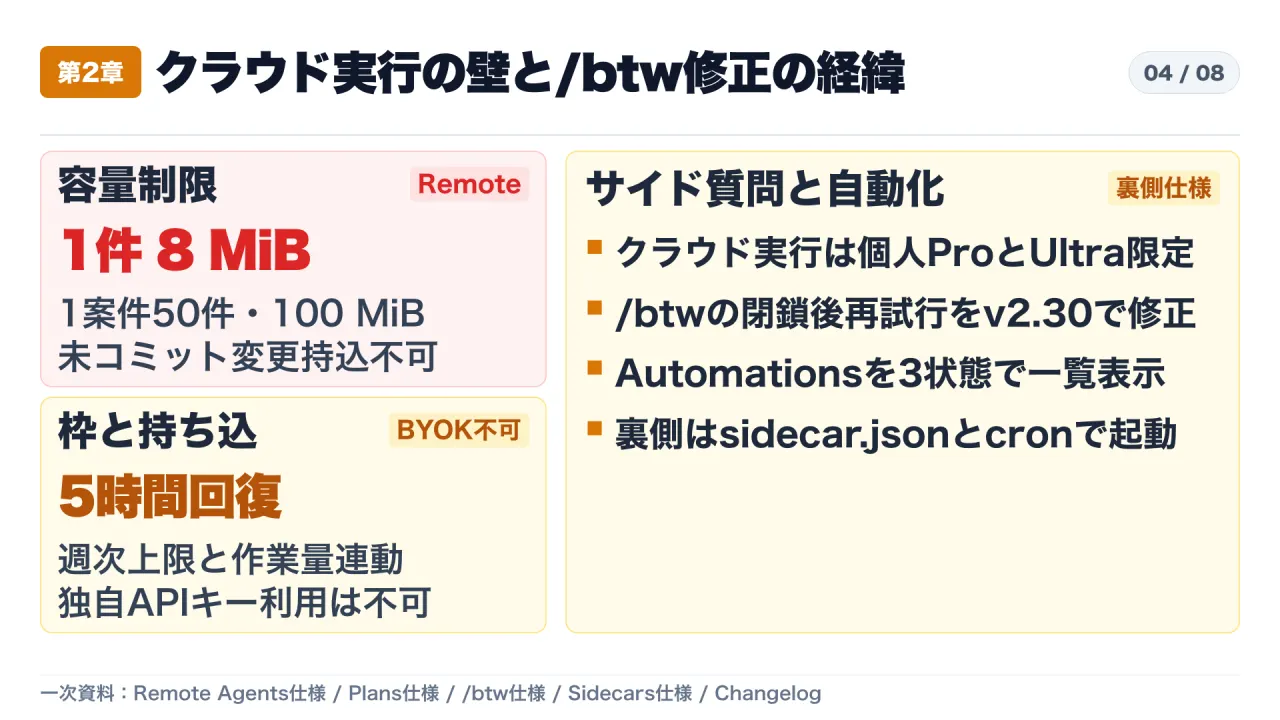
| Resource & Upload Limits | GitHub, Google Drive, or direct uploads capped at 8 MiB per file, 50 files / 100 MiB per project, and 2 GiB total per account | Full local filesystem access, uncommitted local diffs, and local MCP servers |
| Feature & State Constraints | Cannot carry uncommitted local changes; CLI --remote-agent disables /voice, /codesearch, /diff, and related local commands |
Requires host workstation power and active network connectivity |
For engineering teams operating under corporate Google Workspace identities or Google Cloud IAM organizations, cloud-hosted Remote Agents cannot simply be turned on as a managed team runner. Any organization expecting to offload overnight branches to Google-managed cloud sandboxes under corporate billing must fall back to local execution or self-hosted runners.
Quota Mechanics and the Absence of BYOK
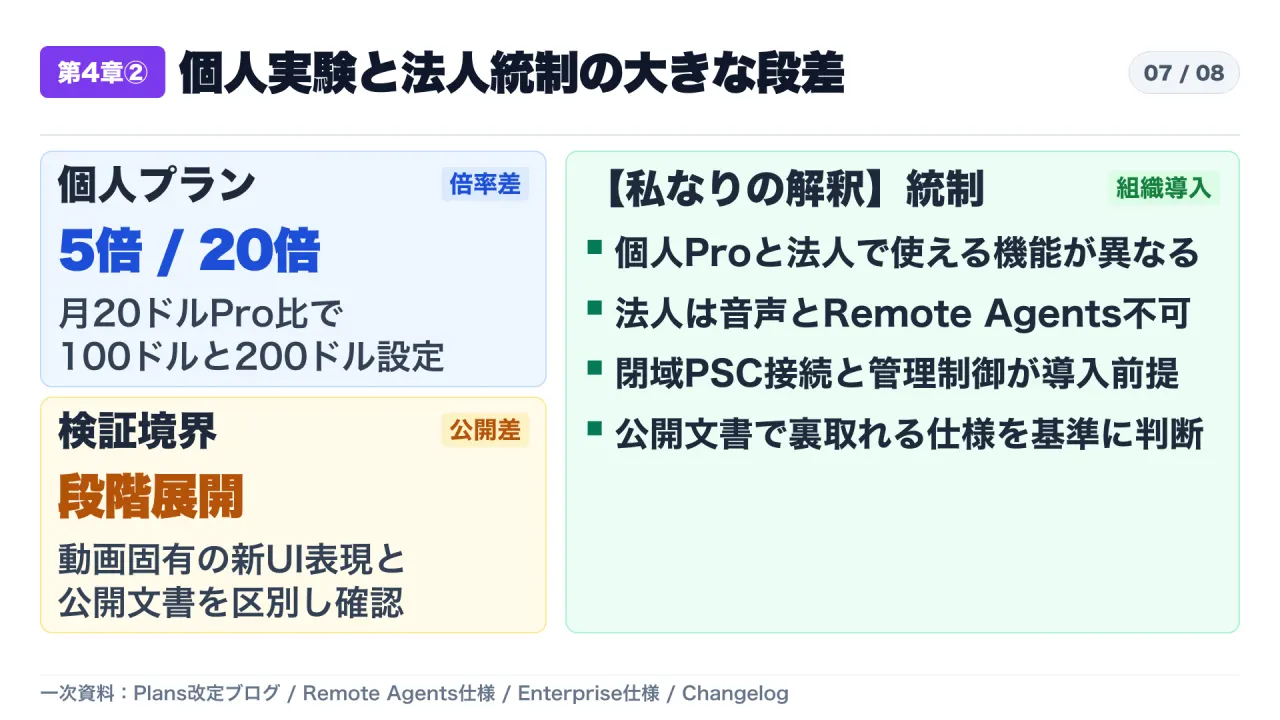
Individual paid plans run on dual rate-limit horizons: a recurring 5-hour recovery window paired with a weekly usage ceiling. Higher-tier consumer plans expand available capacity—Pro ($20/month) serves as the baseline, while Ultra ($100/month and $200/month) offers 5x and 20x multipliers respectively—and users who exhaust included windows can either wait for the reset or consume paid credits. Crucially, the Plans specification states that Antigravity does not support Bring Your Own Key (BYOK) or custom external inference endpoints. Teams cannot bypass platform rate limits by plugging in corporate Anthropic, OpenAI, or self-hosted vLLM API keys.
/btw Parallel Queries, Bug Fixes, and Sidecars Automation
Antigravity also introduced /btw, a side-question command that lets developers ask auxiliary questions without derailing the main agent thread, alongside a refreshed Automations panel displaying tasks in three explicit states: Scheduled, Always on, and Paused. Behind the scenes, these automations rely on the Sidecars subsystem (sidecar.json definitions stored under ~/.gemini/config/sidecars/ paired with cron expressions) that spawns fresh agent sessions on schedule.
Changelog telemetry shows why version hygiene matters for these new controls. In versions earlier than v2.32.0—and in remote conversations—/btw cannot invoke tools. Furthermore, early November releases suffered from background retries continuing even after a user closed the /btw panel, as well as errors inside sub-agent conversations. Those defects required sequential patches across v2.30.0 through v2.32.1. Running an unpinned early release exposes teams to silent background token burn from closed side-question threads.
In practical terms, Remote Agents resemble renting an automated 24-hour fabrication workshop only to discover at the gate that access badges are issued exclusively to personal consumer IDs, and company-owned blueprints or work-in-progress prototypes are barred from entry. It is convenient for individual experimentation, yet structurally mismatched with corporate production pipelines.
3. Sandbox Permission Presets, Windows Exceptions, and Enterprise Billing Traps
Security and cost governance on local corporate machines hinge on two specification documents: Terminal Sandbox controls and Enterprise pricing rules.
Antigravity governs command execution using four permission presets:
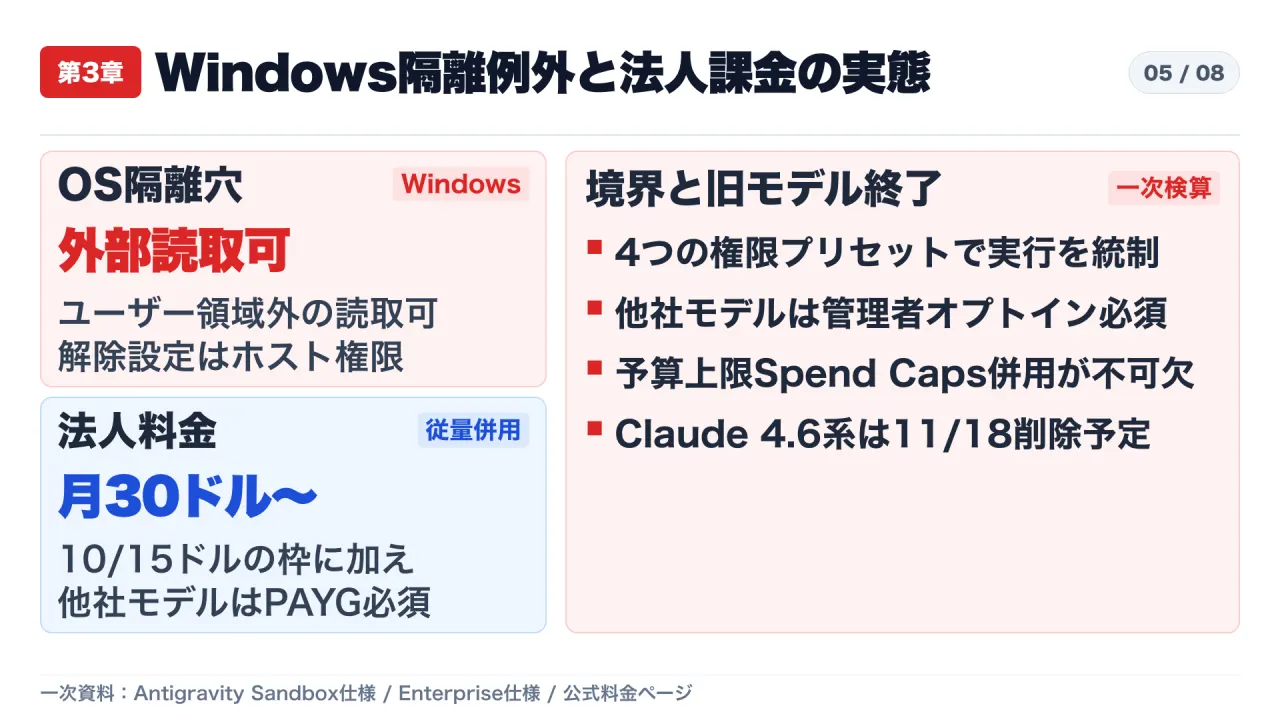
Request Review: Prompts the operator for approval before executing terminal commands.Default: The baseline mode with terminal sandboxing enabled to isolate filesystem writes and network boundaries.Auto: Automatically permits safe, reversible commands within the sandbox (available on macOS and Linux from v2.23.0, and on Windows from v2.26.0).Turbo: Executes commands without sandbox restrictions or confirmation prompts.
Even when teams enforce Default or Auto, two documented boundaries require active auditing:
- Windows Read-Access Exception: While the sandbox is designed to restrict filesystem activity to the active project directory and explicitly allowlisted paths, the official Sandbox documentation notes that on Windows hosts, folders outside the user profile directory remain readable by sandboxed commands. Organizations handling regulated source trees or shared network drives on Windows workstations cannot assume full read isolation.
unsandboxedEscape-Hatch Privileges: Any command allowlisted under anunsandboxedexception rule executes with full host-machine user privileges. A single overly broad allowlist entry effectively nullifies terminal containment.
On the commercial side, Gemini Enterprise Antigravity starts at $30 per seat per month (including a $10/seat Standard or $15/seat Plus pooled allocation for first-party models). However, third-party frontier models are disabled by default in corporate tenants. Enabling them requires explicit administrator opt-in and switches usage onto metered pay-as-you-go token billing—meaning a handful of developers running parallel sub-agents or scheduled Sidecars can generate uncapped monthly invoices unless administrators configure hard Spend Caps. Additionally, the pricing documentation announces that legacy model families (including older 4.6-generation models and GPT-OSS-120b) are scheduled for removal on November 18, 2026, forcing immediate model-dependency audits.
Looking at headline announcement videos and pricing tables side by side makes this verification gap obvious. At first glance, “$20/month Pro” combined with “$30/seat Enterprise” and “Remote Agents” implies that a corporate team can immediately orchestrate cloud VMs around the clock and plug in existing API keys if quotas run dry. Checking each specification page individually disproves all three assumptions: Remote Agents block corporate Workspace and GCP accounts, BYOK is explicitly unsupported, and Windows sandboxes leave out-of-profile paths readable. Evaluating primary documentation line by line prevents costly architectural commitments based on demo impressions.
4. The Speed Trap: Why 10 Parallel Agents Overload Human Verification
Analysis: When Code Generation Outpaces Review Capacity
Launching five or ten isolated worktrees in parallel multiplies the volume of diffs awaiting integration. Yet software delivery speed is bounded by the slowest step in the pipeline—which, under multi-agent orchestration, is no longer typing syntax, but human comprehension, integration testing, and incident triage.
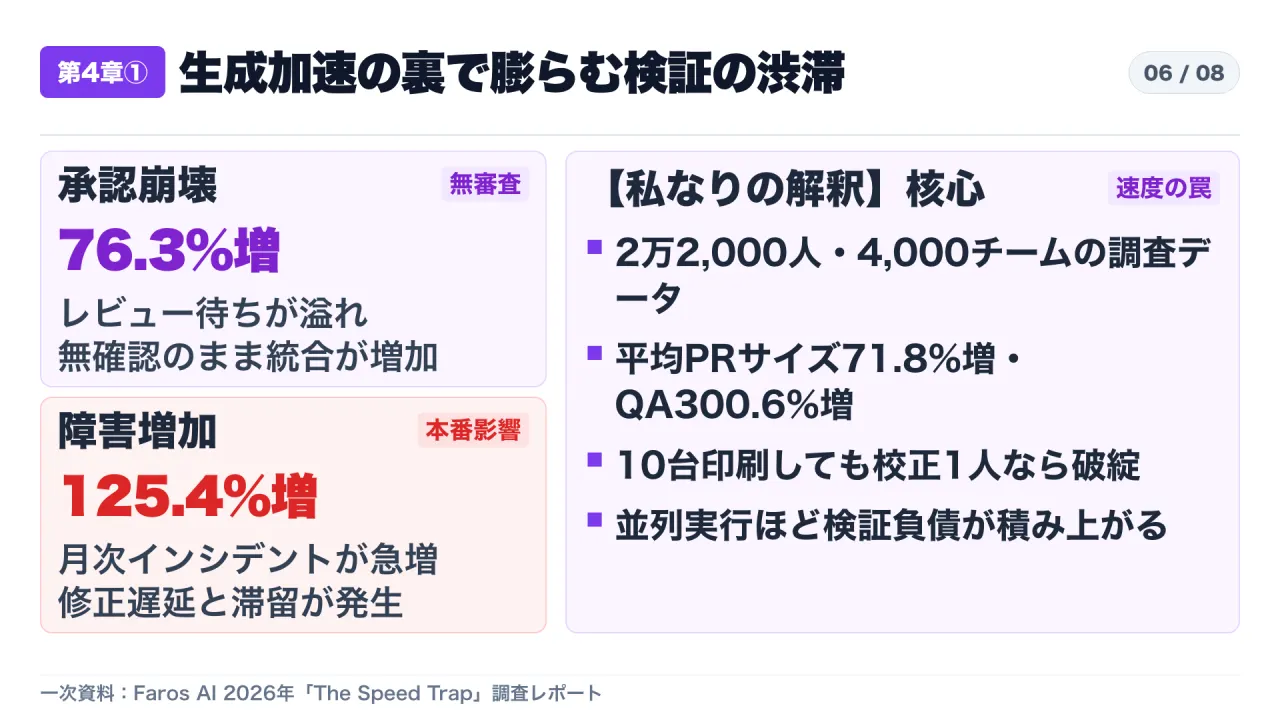
Faros AI’s 2026 The Speed Trap telemetry study—tracking 12 months of production engineering metrics across 22,000 developers and 4,000 teams—quantifies what happens when AI code volume scales faster than review capacity:
| Engineering Telemetry Metric | Observed 12-Month Shift | Operational Impact |
|---|---|---|
| Average Pull Request Size | +71.8% | Larger, multi-file AI diffs raise cognitive load per review |
| Time Spent in QA | +300.6% | Largest efficiency degradation across tracked delivery stages |
| PRs Merged Without Review | +76.3% | Accelerated from +31.3% six months earlier as queues backed up |
| Monthly Production Incidents | +125.4% | Unreviewed and oversized changes compound live service failures |
Imagine running ten high-speed offset printing presses simultaneously while employing only one proofreader. The presses can output a thousand flyers an hour, but paper stacks overwhelm the proofreading desk. Under deadline pressure, stacks get shipped without checking for typos or regulatory errors—and customer complaints more than double. Multi-agent coding without proportional automated verification creates the exact same failure mode.
Asymmetry Between Individual Experimentation and Corporate Governance
A second structural divide separates individual developers from enterprise engineering organizations. An individual engineer paying $20, $100, or $200 per month on a personal Google account can immediately test Remote Agents, Voice Mode, and rapid UI iterations. By contrast, corporate environments exclude cloud Remote Agents and Voice Mode capabilities in favor of admin console policies, Private Service Connect (PSC) network boundaries, and metered third-party model controls.
Engineering leaders must also distinguish between visual elements shown in staged rollout videos and formally documented capabilities in public references. Features or layout variations appearing selectively in preview clips without matching entries in the official changelog or documentation should be treated as provisional rather than guaranteed enterprise baselines.
5. Three Pre-Deployment Audit Criteria for Engineering Teams
Organizations evaluating Google Antigravity or comparable multi-agent control planes should enforce three concrete controls before scaling usage across product teams:
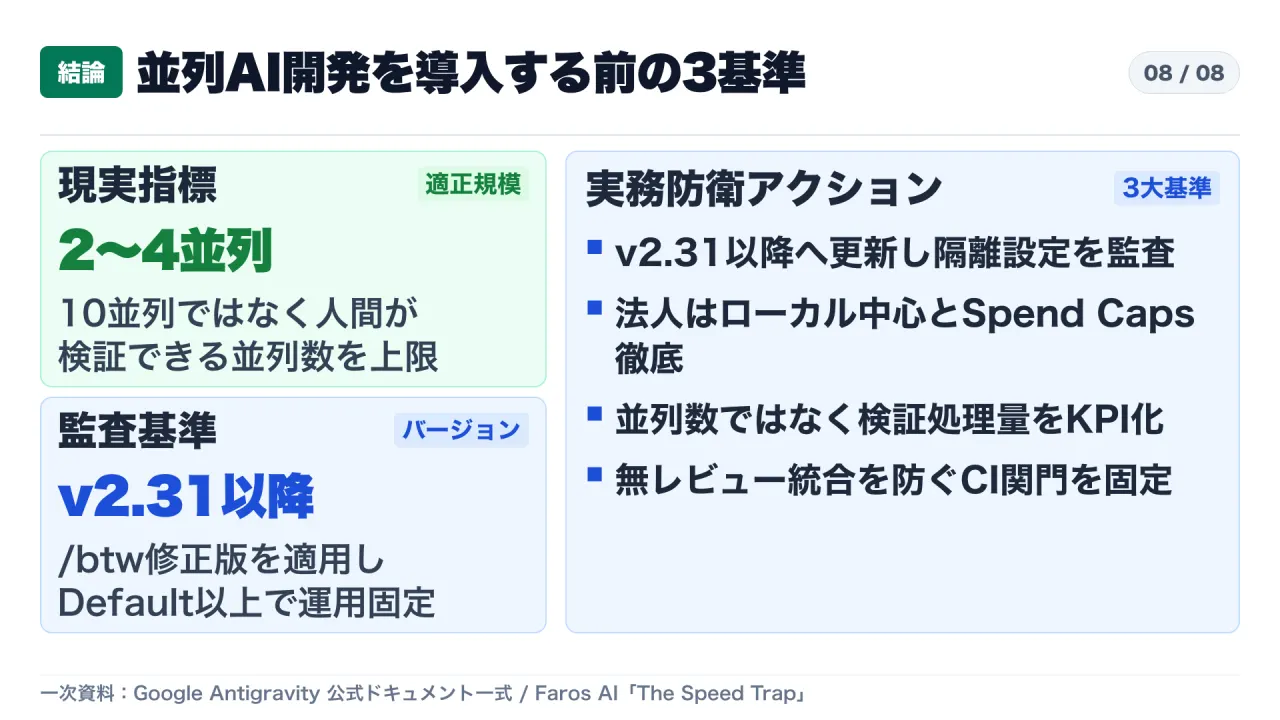
- Pin Minimum Versions and Audit Sandbox Exceptions: Require desktop clients at v2.31.0 or newer (v2.32.x recommended) to eliminate
/btwbackground retry leaks and sub-agent conversation errors. Lock terminal permissions toDefaultorAuto, audit everyunsandboxedallowlist rule, and restrict sensitive directories outside user profiles on Windows hosts where read isolation exceptions apply. - Separate Consumer Cloud Demos from Enterprise Local Architecture: Design corporate workflows around local execution and Private Service Connect rather than consumer-only Remote Agents. Before opting in to third-party models under Gemini Enterprise ($30/seat/month base), configure strict Spend Caps and migrate any workflows tied to legacy 4.6-series or GPT-OSS-120b models ahead of the November 18, 2026 removal date.
- Measure Verified Merge Throughput Instead of Agent Concurrency: Resist the vanity metric of running 10 parallel agents per engineer. Begin pilots at 2 to 4 concurrent worktree threads—sized to match what automated CI suites and human reviewers can inspect without skipping reviews—and enforce mandatory CI gates so unreviewed merges cannot climb alongside generation volume.
Primary Sources and References
- Google Antigravity Changelog (v2.29.0–v2.32.1 / CLI v1.5.5)
- Google Antigravity Remote Agents Specification
- Google Antigravity Plans & Quotas Documentation
- Google Antigravity Pricing
- Google Antigravity Plans Update Blog ($20 / $100 / $200)
- Google Antigravity Enterprise Governance Documentation
- Google Antigravity Terminal Sandbox Specification
- Google Antigravity Voice Mode Specification / Voice Mode Blog (November 6, 2026)
- Google Antigravity
/btwCommand Specification - Google Antigravity Sidecars Specification
- Google Antigravity Projects Specification
- Google Antigravity 2.0 Announcement (May 19, 2026)
- Faros AI: The Speed Trap — 22,000-Developer Telemetry Study (2026)