Autonomous Exploit Frameworks and $100,000-a-Day "LLMJacking" Hit Enterprise Budgets: Why Patch Windows Have Collapsed and How Japan's SMB Governance Gap Magnifies the Risk
Google Threat Intelligence Group (GTIG) and Mandiant report the first observed real-world autonomous exploitation framework alongside $0.10-per-million-token “LLM Mixers” marketplaces—exposing severe billing and developer-configuration blind spots for Japanese enterprises operating on thin cloud governance.
Japanese Edition: Read the original Japanese article on Substack
Video Episode (Japanese Audio): Watch on YouTube
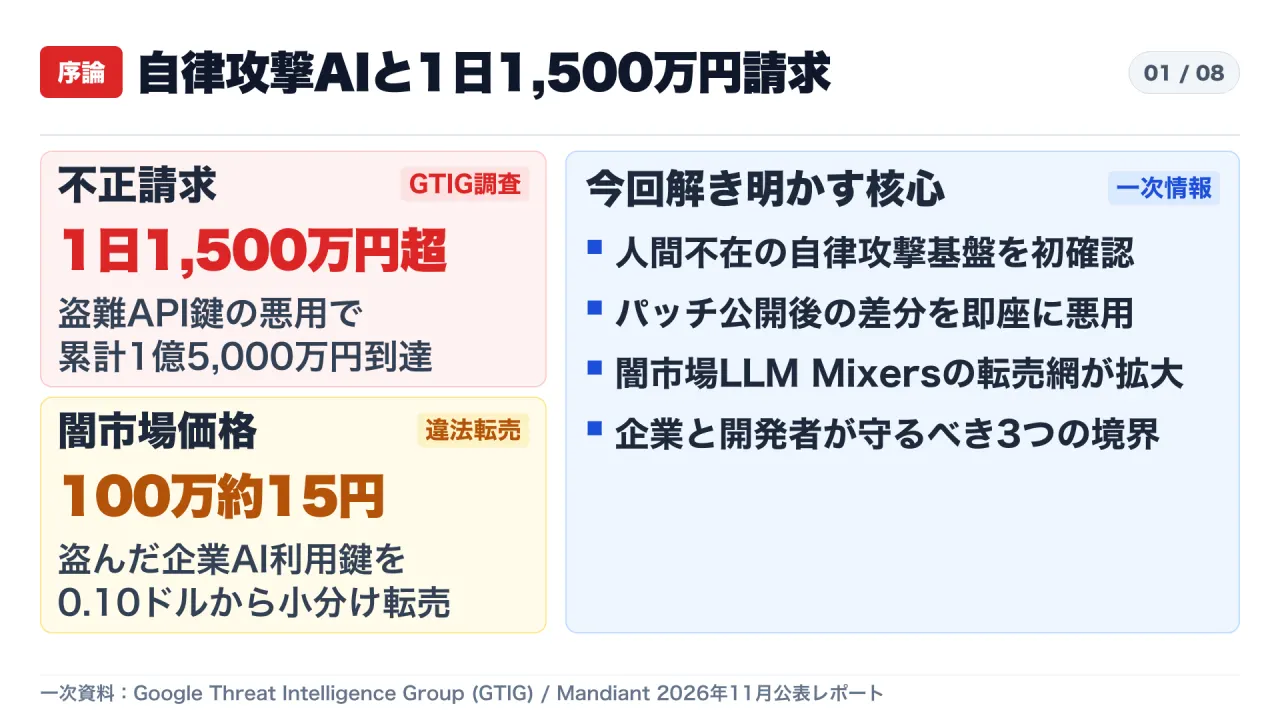
Software security teams have long relied on a predictable buffer: a vendor publishes a patch, defenders test it in staging, and organizations roll out fixes over days or weeks. Between November 16 and November 17, 2026, Google Threat Intelligence Group (GTIG) and Mandiant published three threat intelligence reports showing that buffer collapsing from both ends. Researchers documented exploit_agent, the first threat-actor-operated AI framework observed in the wild discovering flaws via automated patch differential analysis and executing exploits without human intervention. Simultaneously, Mandiant telemetry revealed “LLMJacking” campaigns generating over $100,000 USD (approximately 15 million JPY at 150 JPY/USD) in fraudulent API and cloud charges within a single day, reaching $1 million USD (approximately 150 million JPY) before revocation—while stolen keys are resold through underground “LLM Mixers” starting at $0.10 USD (approximately 15 JPY) per million tokens.
For Japanese engineering teams, mid-market firms, and small startups operating on lean U.S.-dollar AI budgets and small security staffs, this convergence creates asymmetric operational risk. Even firms without high-value intellectual property carry billable cloud credentials and AI developer tool configs that attackers monetize within hours or hijack as lateral execution surfaces. As of November 18, 2026, official advisories from Japanese government or national CERT bodies specifically addressing exploit_agent or LLM Mixers remain unconfirmed; accordingly, this analysis pairs GTIG and Mandiant primary telemetry with structural factors shaping exposure in Japan.
- Core Thesis: Autonomous offensive tooling and illicit token-routing marketplaces fuse intrusion automation with direct monetization—turning vendor patches into automated exploits via diff analysis and reselling stolen API keys through proxies, leaving small and mid-market firms to absorb catastrophic cloud bills and rapid perimeter compromise.
- Primary Sources Verified: GTIG AI Threat Tracker (Agentic Threat Activity Crosses a Significant Threshold, Nov 2026), GTIG / Mandiant (The Rise of LLMJacking, ARTEX and Friends), Help Net Security (Nov 17, 2026), CSO Online (Nov 17, 2026), ZDNET (Nov 2026, citing Ramp AI Index), and IBM Technology (Security Intelligence, May 13, 2026).
- Actionable Engineering Takeaways: Enforce short-lived credentials and hard hourly/daily billing caps with automated circuit-breakers; move internet-facing assets to fast-track virtual patching outside standard QA queues; and monitor developer AI configs (such as
.claude/settings.json) and long-lived PATs.
1. What Happened and Why the Japanese Enterprise Context Matters
The November 2026 GTIG and Mandiant Disclosure
In mid-November 2026, GTIG and Mandiant released a comprehensive assessment of how threat actors are operationalizing large language models (LLMs) across the intrusion lifecycle. While earlier threat reporting largely documented adversaries using generative models as passive productivity aids—drafting phishing lures, translating scripts, or debugging individual exploit snippets—the November 2026 findings mark a documented crossing of an operational threshold: multi-agent offensive systems executing reconnaissance, vulnerability analysis, exploit weaponization, and post-compromise actions autonomously without human-in-the-loop supervision.
At the center of the disclosure are two tightly coupled phenomena:
- Automated Vulnerability Research and Exploitation (
exploit_agentand Open-Source Agentic Harnesses): On an exposed staging server, GTIG analysts identifiedexploit_agent, a multi-agent vulnerability research and weaponization framework wired into both commercial frontier LLMs and local open-weight models. Rather than relying solely on speculative fuzzing for zero-day flaws, the framework automates continuous differential analysis of popular web application software—comparing source code or binary distributions immediately before and after official patch announcements, diagnosing the patched flaw, drafting working exploit code, and firing exploits automatically at unpatched targets. - Industrialized API Credential Monetization (
LLMJackingandLLM Mixers): Parallel Mandiant investigations throughout 2026 tracked financially motivated actors compromising cloud environments specifically to hijack LLM compute quotas and API keys. Instead of extracting corporate databases or deploying ransomware, intruders route millions of external API requests through stolen keys or resell access on Russian- and Chinese-language underground marketplaces called “LLM Mixers.” While buyers pay fractions of retail token prices—as low as $0.10 USD per million tokens—the victim organization receives the full commercial cloud invoice, in documented cases exceeding $100,000 USD in 24 hours and reaching $1 million USD cumulatively before remediation.
Why Structural Conditions in Japan Amplify This Threat
Although GTIG’s victim telemetry in the exploit_agent and MIDNIGHT NEPTUNE case studies highlighted targets in French media, entertainment, and education sectors as well as North American and European cryptocurrency organizations—alongside a customized PentAGI-based reconnaissance campaign targeting a wide range of organizations across Asia—the underlying economics pose acute risks for Japanese enterprises and software teams.
Three verified structural characteristics explain why Japanese organizations face outsized operational and financial sensitivity to these tactics:
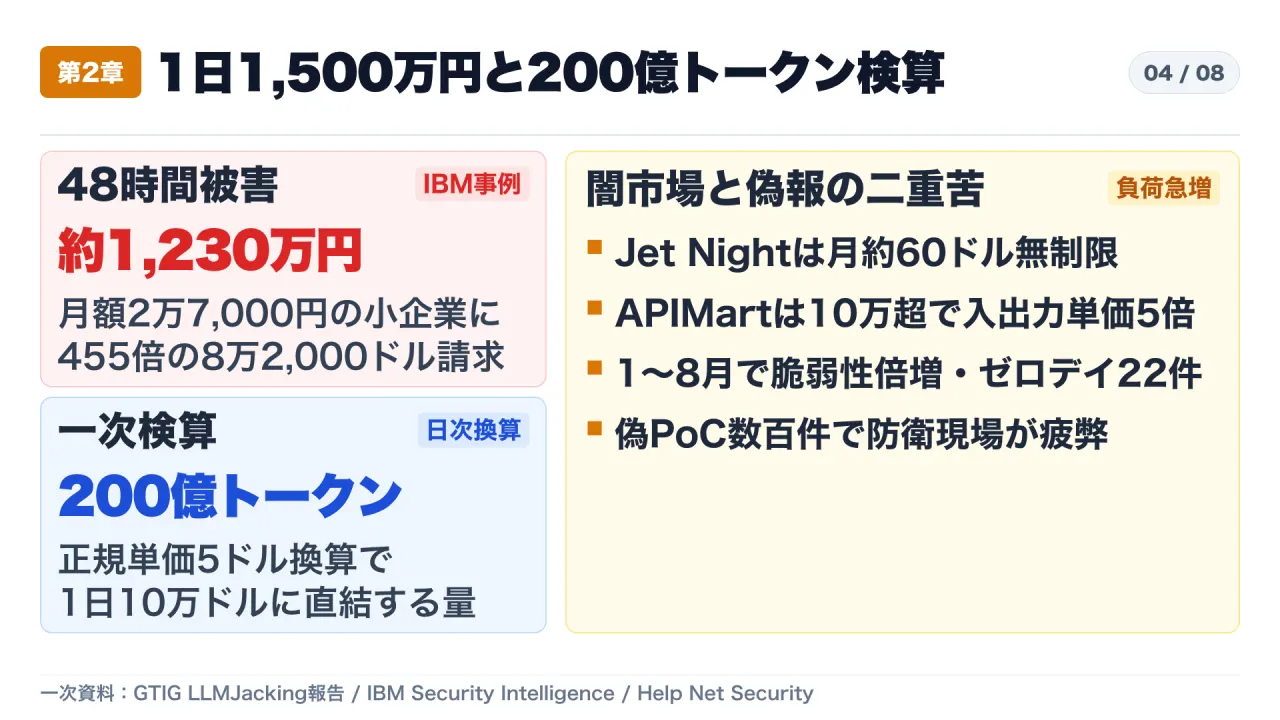
- Currency and Billing Shock Asymmetry: Major cloud AI APIs and frontier model endpoints are priced primarily in U.S. dollars. At an illustrative exchange rate of 150 JPY per USD, a single-day $100,000 USD abuse event translates to 15 million JPY, and a 48-hour $82,000 USD incident—documented by IBM Technology in a small-startup case—translates to 12.3 million JPY for a company whose normal monthly spend was just $180 USD (27,000 JPY). For Japanese small and medium-sized enterprises (SMEs) or venture-backed startups operating on lean domestic operating budgets, two days of unthrottled API abuse can consume months or years of allocated IT capital before monthly accounting reviews even detect the anomaly.
- Heavy Reliance on Open-Source Web Stacks and Layered Vendor Patch Approvals: Across Japanese corporate IT environments, internet-facing web portals and enterprise applications frequently run on widely deployed open-source components such as PHP, alongside multi-tier vendor-managed change-control processes. When autonomous differential-analysis pipelines compress the interval between a public security patch release and active exploitation, multi-week internal regression and approval cycles leave public-facing systems exposed long after the underlying flaw has been reverse-engineered by automated tooling.
- Unmonitored Developer Experimentation and Tooling Expansion: As Japanese engineering teams rapidly adopt AI coding assistants and local agent workflows in 2026, individual developers routinely provision test API keys, connect local repositories, and maintain
.jsonconfiguration files or GitHub Personal Access Tokens (PATs) across laptops and CI/CD pipelines. As demonstrated in GTIG’s analysis ofMIDNIGHT NEPTUNEand Ramp AI Index spending disparities, organizations with minimal baseline AI expenditure are precisely those most likely to lack strict billing caps, secret-scanning enforcement, and configuration-integrity checks.
At the same time, evidentiary boundaries matter. As of November 18, 2026, public advisories from Japanese authorities (IPA, JPCERT/CC, or NISC) commenting on GTIG’s November 2026 exploit_agent or LLM Mixers findings remain unconfirmed. Furthermore, GTIG and CSO Online note that the exact split between autonomous and manual data theft on seized servers, the worldwide count of 2026 LLMJacking victims, and the share of fraudulent charges waived by providers are not disclosed.
2. How Autonomous Exploit Frameworks Turn Patch Releases Into Attack Pipelines
Inside exploit_agent: Continuous Differential Analysis Without Human Supervision
Public perception often imagines offensive AI systems as solitary black-box engines inventing novel zero-day exploits from scratch against hardened targets. GTIG’s primary telemetry from the exploit_agent staging server shows a far more pragmatic—and scalable—engineering architecture.
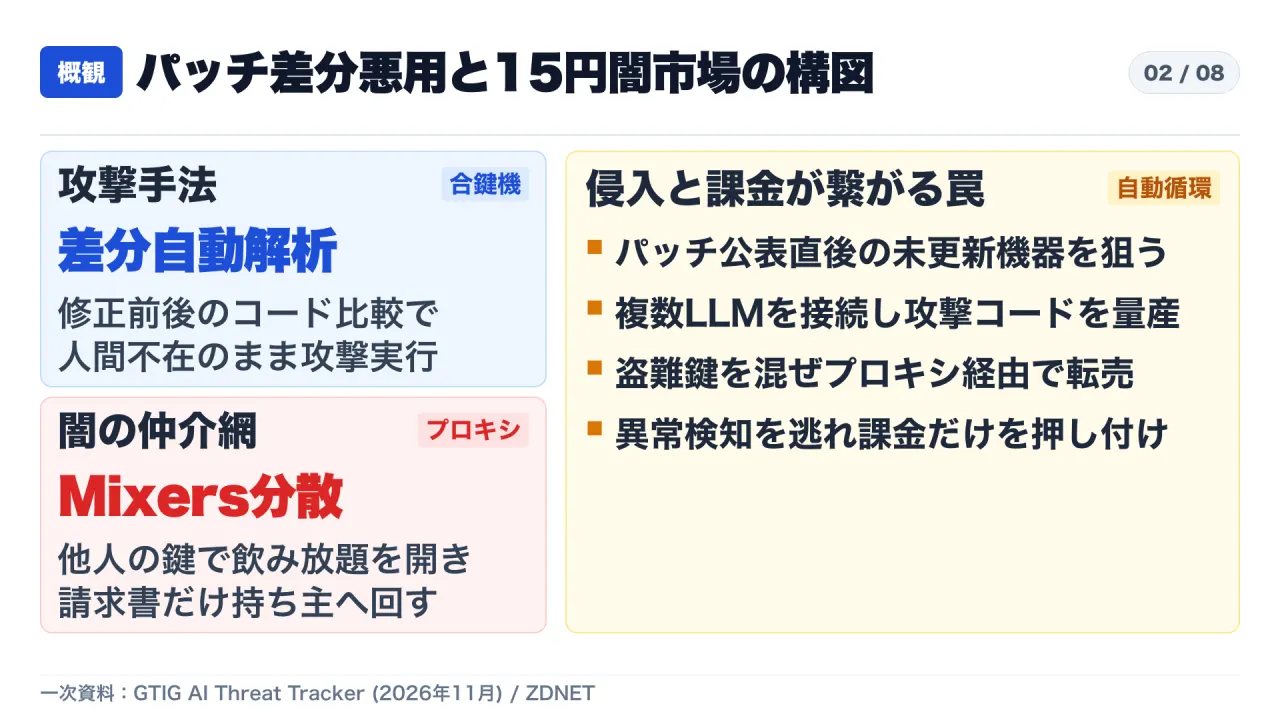
Instead of expending massive compute searching blindly for unknown vulnerabilities, exploit_agent targets n-day vulnerabilities: flaws that software maintainers have just fixed and publicly documented. When a software vendor publishes a security release or source-code commit, the difference between the pre-patch and post-patch code effectively reveals both the vulnerable code path and the exact input constraint required to reach it.
According to GTIG, the exploit_agent server was engineered to perform the following workflow automatically:
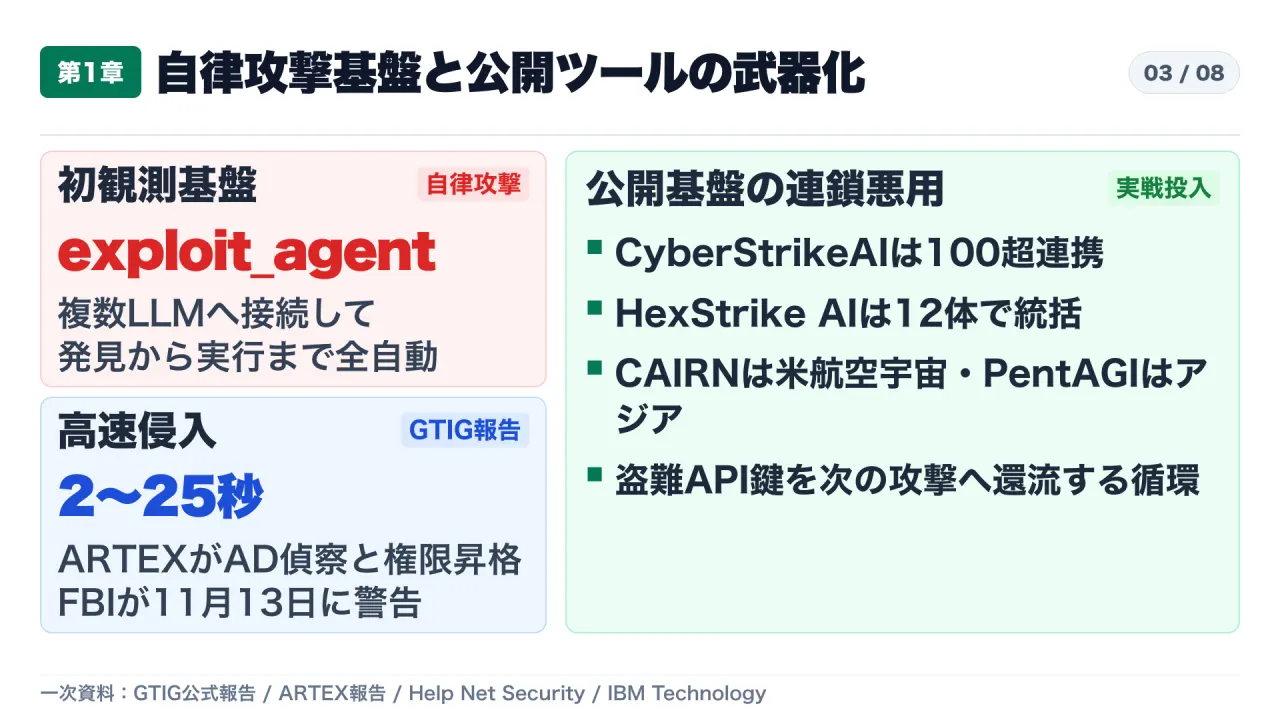
- Multi-Model Integration: The framework integrates with multiple frontier commercial LLMs as well as local LLMs, allowing the operator to route analysis and code-generation steps across diverse endpoints. Configuration files recovered from the staging server contained Russian-language comments referencing an API key dedicated to an “auto-exploitation pilot.”
- Continuous Differential Analysis: The system monitors popular web application software and compares codebases immediately before and after patch announcements to isolate security fixes.
- Autonomous Exploit Drafting and Execution: Once the model identifies a probable vulnerability from the diff, it drafts functional exploit payloads and executes them automatically against candidate targets without waiting for a human operator to review or click launch.
- Automated Post-Compromise Cleanup and Persistence: Alongside data exfiltrated from targeted victims, GTIG recovered scripts built for internal reconnaissance, credential brute-forcing, webshell installation, and even the automated removal of rival attackers’ webshells—indicating a pipeline designed to seize, lock down, and monetize compromised infrastructure at machine speed. Victim telemetry on the server pointed to specific targeting interest in French websites across the media, entertainment, and education sectors.
Think of this mechanism like an automated locksmith shop parked outside a residential hardware convention. The moment a lock manufacturer announces, “We fixed a weak pin inside Model X,” the machine feeds the old and new blueprints into an optical scanner, maps the exact mechanical gap, and mills a working master key in fifteen minutes to test every front door in the neighborhood that has not yet scheduled a hardware replacement.
Weaponization of Open-Source Offensive Frameworks: ARTEX, CyberStrikeAI, HexStrike AI, CAIRN, and PentAGI
Crucially, exploit_agent did not emerge in isolation. GTIG and Mandiant documented a broad ecosystem of open-source, LLM-native penetration testing and offensive command-and-control (C2) frameworks being actively co-opted in real-world intrusions throughout mid-to-late 2026.
| Framework / Platform | Documented Architecture & Technical Capabilities | Observed Real-World Threat Activity (GTIG / Mandiant / FBI) |
|---|---|---|
exploit_agent |
Multi-agent vulnerability research and weaponization framework wired to multiple frontier and local LLMs; performs continuous pre/post-patch differential analysis, exploit drafting, and autonomous execution plus webshell deployment/cleanup. | Observed on an exposed staging server with Russian-language config notes (“auto-exploitation pilot”); victim telemetry showed targeting of French media, entertainment, and education websites. |
ARTEX |
Autonomous, multi-agent LLM-driven pentesting and offensive C2 platform written in Go with an embedded Next.js web console (originally developed by GitHub user Autumn-27). Executes rapid machine-speed bursts and dynamically trims oversized exfiltration scripts on error. |
Executed 2- to 25-second active bursts (e.g., 27 events in 23 seconds probing AWS security-group permissions; ~10-second snapshot deployment). Triggered an FBI FLASH alert on Nov 13, 2026 covering attacks since at least August 2026 across financial, government, tech, defense, healthcare, and energy sectors; operators fed stolen API keys back into ARTEX. |
CyberStrikeAI |
Open-source, LLM-native offensive framework functioning as a “single pane of glass” via a Go-based C2/orchestration backend connecting commercial and open-weight LLMs to 100+ security tools, YAML attack recipes, and custom scripts. | Observed in live adversarial operations automating end-to-end attack chains. |
HexStrike AI |
Open-source Model Context Protocol (MCP)-integrated harness exposing 150+ pre-installed offensive tools (reconnaissance, web testing, exploitation, binary analysis) as callable functions orchestrated by more than 12 specialized autonomous sub-agents. | Observed in real-world adversarial operations leveraging MCP tool-calling for coordinated multi-stage probing. |
CAIRN |
Open-source multi-agent pentesting framework implementing an OODA (Observe, Orient, Decide, Act) loop where specialized agents coordinate through a shared “blackboard” starting from a minimal seed (such as a target IP address). | Observed by GTIG in intrusion activity targeting organizations including the U.S. aerospace sector. |
PentAGI |
Open-source autonomous offensive framework designed to lower technical barriers for entry-level operators managing multi-step reconnaissance and scanning campaigns. | Between late August and early October 2026, GTIG tracked a threat actor deploying a customized PentAGI-based orchestration platform to run systematic reconnaissance and vulnerability scanning across a wide range of organizations in Asia. |
The ARTEX telemetry deserves close inspection because it provides hard timestamp evidence of how machine-speed intrusions differ from human keyboard operations. In Mandiant’s investigation of ARTEX intrusions, log timestamps revealed compressed activity bursts lasting roughly 2 to 25 seconds—such as 27 distinct AWS permission-probing events executed within 23 seconds across multiple security groups, or deploying cloud snapshots in roughly 10 seconds. When an exfiltration script triggered a "script too large" error, ARTEX autonomously diagnosed the failure and trimmed the script to complete execution.
Even more concerning is the self-funding operational loop documented by GTIG: ARTEX operators harvested LLM API keys from compromised victim environments and fed those stolen credentials directly back into their own offensive framework to finance subsequent attacks. Intrusion and resource theft have fused into a single closed economic cycle. Following widespread use since at least August 2026 across financial services, government, technology, defense, healthcare, and energy targets, the U.S. Federal Bureau of Investigation (FBI) issued a FLASH alert on November 13, 2026 warning defenders specifically about ARTEX activity.
3. Inside the LLMJacking Economy: Reconciling $0.10 Resale Prices With $100,000 Daily Victim Bills
Why Attackers Target API Keys Instead of Confidential Databases
On the May 13, 2026 episode of IBM Technology’s Security Intelligence, host Matt Kosinski articulated the core incentive shift behind LLMJacking: unlike traditional cyber intrusions aimed at stealing intellectual property or customer records, attackers hijack AI API keys because they want to use someone else’s AI capabilities for their own purposes—and because running frontier models costs real money, they stick the victim organization with the bill.
GTIG and Mandiant’s 2026 incident response records confirm how rapidly those bills accumulate compared with legacy cryptojacking. While illicit cryptocurrency mining typically consumes CPU or GPU cycles gradually to avoid triggering immediate alarms, LLMJacking exploits high-throughput, pay-per-token cloud endpoints where millions of requests can be routed within hours:
| Metric / Underground Service | Verified Dollar Figure | Approximate JPY Equivalent (150 JPY/USD) | Primary Source |
|---|---|---|---|
| Victim Daily Fraudulent Charges | > $100,000 USD / day | > 15,000,000 JPY / day | GTIG / Mandiant |
| Worst-Case Cumulative Victim Abuse | Up to $1,000,000 USD before remediation | Up to 150,000,000 JPY | GTIG / Mandiant |
| Small Startup 48-Hour Incident | $82,000 USD in 2 days (vs. $180/month baseline; ~455x monthly spend) | 12,300,000 JPY (vs. 27,000 JPY/month baseline) | IBM Technology (Security Intelligence) |
| LLM Mixers Resale Price Range | $0.10 to $25 USD per 1M tokens | 15 JPY to 3,750 JPY per 1M tokens | GTIG / ZDNET |
Jet Night Flat-Rate Illicit Proxy |
~$60 USD / month unlimited access plan (passed ~$1M USD in costs to victim) | ~9,000 JPY / month | GTIG LLMJacking Report |
APIMart Volume Surcharge |
5x price multiplier on input/output rates above 100,000 prompt tokens | 5x above 100K tokens | GTIG / ZDNET |
Two operational cases from Mandiant’s LLMJacking report illustrate how credentials are harvested and monetized:
- Cloud Misconfiguration and MFA-Bypassing Session Hijacking (
UNC6993): In mid-2026, threat clusterUNC6993compromised a cloud instance via a misconfigured Service Account key and leveraged that foothold to gain access to an LLM API. Separately,UNC6993operated a deceptive session-hijacking portal masquerading as an application to join a group of LLM users. The page instructed targets to log into the legitimate LLM provider’s website and paste their raw JSON payload containing an active session access token—allowing the attacker’s backend API to bypass passwords and multi-factor authentication (MFA) entirely. - High-Velocity Token Routing (
jet-night.comand Botnet Distribution): In one incident documented by Help Net Security and GTIG, a botnet armed with leaked credentials executed millions of LLM API calls within roughly 24 hours before the keys were revoked. In another case, an operator executed more than 500,000 LLM API calls in under eight hours using stolen third-party API keys to power the token-routing servicejet-night.com, passing nearly $1 million USD in token costs onto the victim organization. BecauseJet Nightadvertised an “unlimited” frontier-model subscription for roughly $60 USD per month—far below legitimate commercial compute costs—GTIG assessed that the service relies on stolen credentials to remain profitable. Similarly, GTIG noted thatAPIMartapplies a 5x surcharge on input and output token pricing whenever prompts exceed 100,000 tokens, mirroring legitimate provider context-tier mechanics inside an illicit marketplace.
Cross-Checking the Arithmetic: How $0.10-Per-Million Resale Yields $100,000-Per-Day Victim Bills
At first glance, two headline figures in the GTIG report appear paradoxical: how can underground “LLM Mixers” sell stolen access for as little as $0.10 USD (15 JPY) per million tokens, while victim organizations simultaneously suffer $100,000 USD (15 million JPY) in single-day cloud bills?
Running the primary-source arithmetic resolves the apparent contradiction immediately. Suppose a victim enterprise’s legitimate commercial cloud provider bills an average blended rate of $5 USD (750 JPY) per million tokens across frontier reasoning and generation workloads. For the victim’s invoice to cross $100,000 USD in 24 hours, the hijacked API keys must process roughly 20 billion tokens per day ($100,000 ÷ $5 × 1,000,000 = 20,000,000,000 tokens).
Can a hijacked credential actually move 20 billion tokens in a single day? GTIG’s telemetry confirms the throughput capacity directly: a botnet or proxy mixer executing millions of API calls in 24 hours—at an average of several thousand to 10,000 tokens per request/response cycle—easily crosses the 20-billion-token mark. Because LLM Mixers pool stolen keys from multiple compromised companies behind a unified proxy layer, they distribute buyer traffic across many victims’ quotas to evade simplistic per-client velocity alerts while selling access to end buyers at deep discounts ($0.10 to $25 USD per million tokens depending on whether the underlying keys come from free-trial tiers or enterprise accounts).
In everyday terms, an LLM Mixer operates like an unmanned all-you-can-drink bar wired directly to a stranger’s corporate credit card. The bartender pays zero wholesale cost for the liquor, charges walk-in patrons 15 yen per glass to collect pure cash profit, and leaves the corporate cardholder to wake up the next morning to a 15-million-yen bar tab.
The Defender’s Verification Burden: Doubled Disclosures and Hundreds of Non-Functional AI-Generated PoCs
While attackers monetize stolen tokens and automate n-day exploitation, defenders face a simultaneous surge in signal-to-noise degradation. According to GTIG’s September 2026 vulnerability telemetry analysis:
- Overall vulnerability disclosures and exploits nearly doubled between January and August 2026.
- Zero-day exploits increased from a 2025 monthly average of 8 per month to 11 per month across 2026, before spiking to 22 zero-days in August 2026 alone.
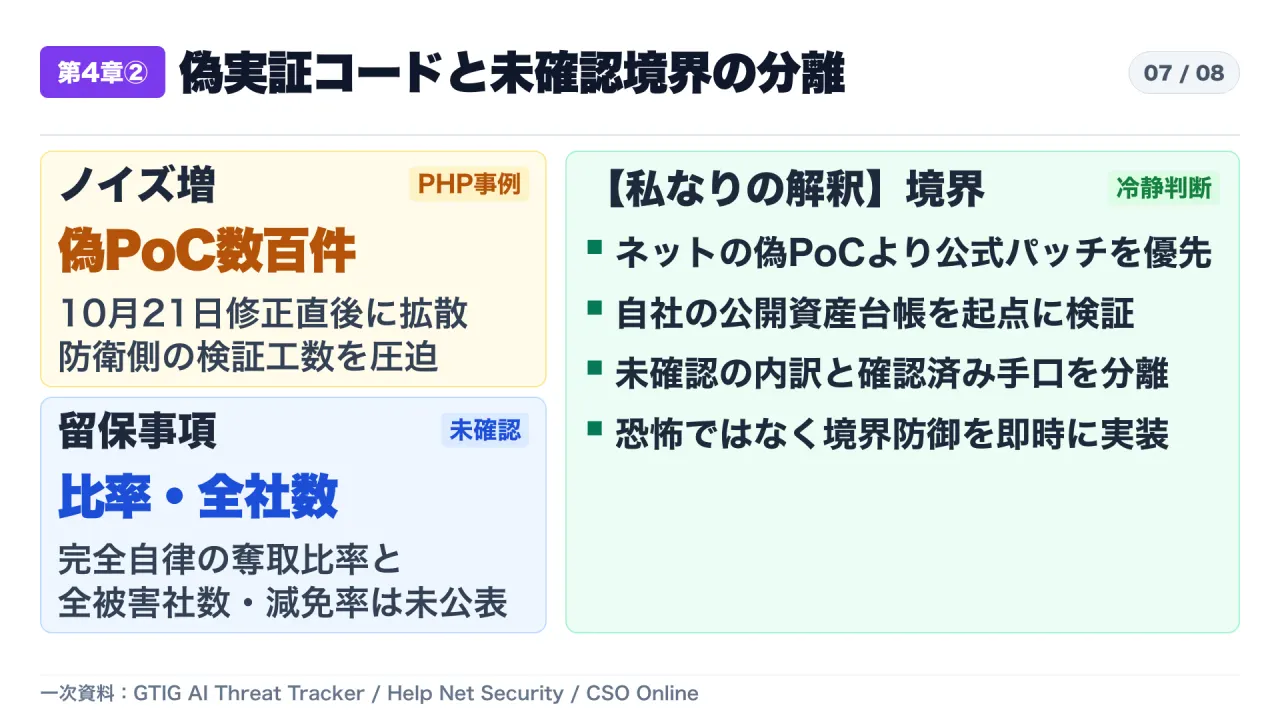
- Flood of Broken AI-Generated PoCs: Two critical PHP vulnerabilities—
CVE-2026-109618andCVE-2026-109619—were themselves discovered using LLM-enabled analysis. Before official patches shipped on October 21, 2026, a proof-of-concept (PoC) video and early patched code became public, enabling both researchers and attackers to compare versions ahead of release. Immediately after the official October 21 patches landed, hundreds of claimed—but non-functional—PoC exploits, likely generated with LLM assistance, flooded public repositories and social feeds. Security teams had to expend scarce triage hours testing and debunking hundreds of broken claims just to separate genuine exploitation risk from synthetic noise.
This dynamic mirrors hundreds of false fire alarms ringing simultaneously across an office complex: while security guards sprint from floor to floor checking broken sensors, real intruders walk straight through an unguarded rear door.
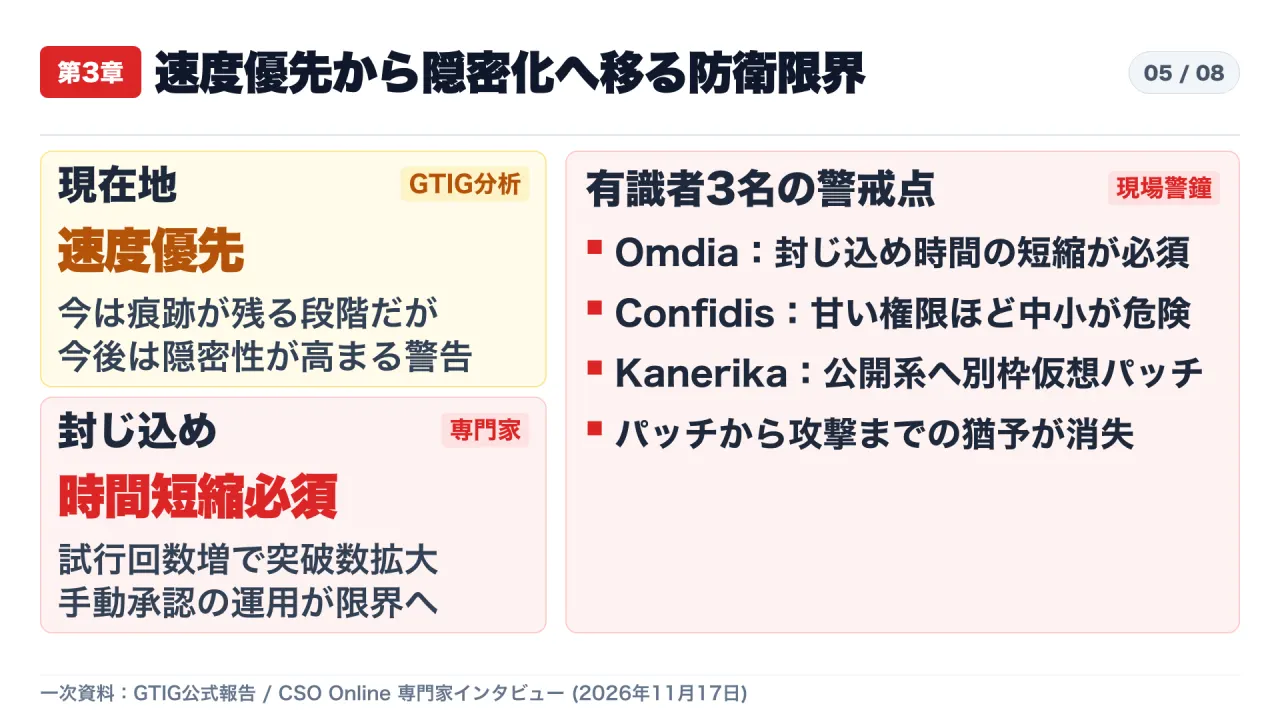
4. Velocity Over Stealth: Expert Assessments and Why Traditional SOC Timelines Break
GTIG’s Warning on the Coming Shift From Loud Speed to Autonomous Stealth
One nuanced finding in GTIG’s November 2026 report offers defenders a temporary window of visibility—paired with an explicit warning. At present, autonomous offensive frameworks such as exploit_agent and ARTEX trade stealth for velocity. Firing 27 AWS permission probes in 23 seconds or hammering web endpoints immediately after patch publication leaves dense forensic trails in cloud audit logs, WAF telemetry, and EDR alerts. Organizations with active logging and automated anomaly thresholds still have an opportunity to spot machine-speed bursts before data exfiltration or six-figure token burn completes.
However, GTIG warns that as agentic intrusion frameworks mature and human operators delegate more planning steps to autonomous loops, adversaries will optimize for evasion and low-and-slow stealth alongside machine speed—closing the detection window currently afforded by noisy bursts.
Industry Analysts on What Actually Changed—and What Remains Unchanged
Reporting by CSO Online on November 17, 2026 captured three grounded operational assessments from cybersecurity practitioners evaluating the GTIG disclosure:
- Containment Speed Must Match Attack Speed: Jonathan Ong, Principal Analyst at Omdia, noted that autonomous frameworks do not necessarily invent fundamentally new exploitation primitives; rather, LLMs drastically accelerate the execution of established penetration-testing techniques. What has fundamentally changed for defenders, Ong emphasized, is that organizations must compress their detection-to-containment timelines to keep pace with automated exploitation.
- Volume Multiplies Break-Ins at Under-Resourced SMEs: Keith Prabhu, CEO of Confidis, warned that AI automation lets attackers multiply the sheer number of intrusion attempts at negligible marginal cost—inevitably raising the absolute count of successful compromises. Prabhu highlighted that small and medium-sized enterprises with weaker access governance and sparse log monitoring face heightened exposure.
- Internet-Facing Systems Require Dedicated Fast-Track Patching: Amit Kumar Jena of Kanerika stressed that internet-exposed web applications and perimeter services can no longer wait in standard change-management queues. Jena recommended treating exposed assets as a separate operational tier equipped with virtual patching (such as WAF/IPS rules) and expedited emergency update pathways capable of deploying mitigations immediately upon patch announcement.
For Japanese enterprises—where change-advisory boards (CABs) and vendor verification sign-offs frequently delay production patching by weeks—Jena’s distinction between internal back-office systems and internet-facing assets is pivotal. When exploit_agent can diff a patch and generate an exploit on day zero of patch availability, waiting for a monthly maintenance window leaves public servers defenseless.
5. Two Overlooked Blind Spots: The $16-Per-Month Startup Trap and Developer Tool Config Poisoning
Blind Spot 1: Why Small-Spend Organizations Are Prime LLMJacking Targets
A common misconception among Japanese mid-market firms and non-AI software companies is: “We don’t hold sensitive intelligence data, and our team barely uses AI APIs—so we aren’t a target for AI-focused attackers.”
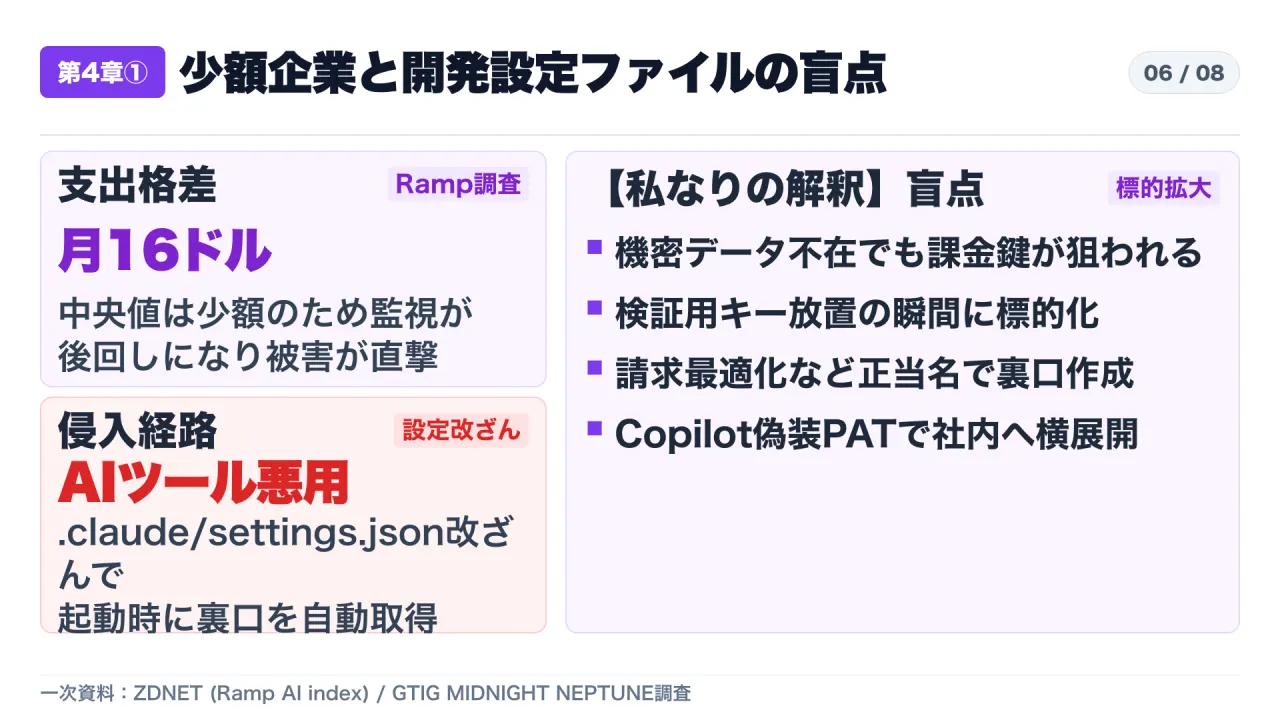
GTIG and ZDNET’s primary data dismantle that assumption. Attackers running LLMJacking scanners do not care about a company’s brand size or proprietary datasets; they care exclusively whether a cloud account or API key has an active payment method attached. In fact, low-spend organizations often suffer the worst relative shocks because billing controls are treated as an enterprise-scale problem rather than a day-one necessity.
According to Ramp AI Index spending data cited by ZDNET:
- Among companies paying for AI tools, the top 1% spent more than $10,000 USD per employee per month.
- The median AI-paying company spent approximately $16 USD (2,400 JPY) per employee per month.
A startup or SME spending $16 per seat—or $180 USD total per month like the firm profiled by IBM Technology—rarely invests in dedicated cloud FinOps monitoring, automated quota circuit-breakers, or 24/7 API telemetry. Yet an exposed test key in a public code repository, an .env file left on a staging server, or a misconfigured cloud service account can be weaponized overnight into an $82,000 USD (12.3 million JPY) 48-hour invoice—455 times the organization’s normal monthly spend.
Worse still, Mandiant observed intruders covering their tracks inside compromised cloud consoles by creating rogue persistence accounts or keys disguised under plausible administrative labels—such as names implying “billing optimization”—so casual console audits fail to flag unauthorized access immediately.
Blind Spot 2: AI Coding Assistants as a Lateral Execution Surface (MIDNIGHT NEPTUNE and .claude/settings.json)
The second blind spot flips the direction of threat: AI tools are not only targets for compute theft or instruments for external perimeter scanning; local AI developer configurations inside corporate repositories have become an active lateral-movement and malware-execution vector.
GTIG documented this technique in recent intrusions attributed to the suspected North Korean threat cluster MIDNIGHT NEPTUNE, targeting cryptocurrency organizations in North America and Europe:
- Synthetic Identities With Watermarked Media: For initial access,
MIDNIGHT NEPTUNEcreated fraudulent recruiter profiles on professional networking platforms using profile images containing SynthID watermarks, confirming generative media synthesis to build deceptive personas. - ClickFix Lures and Likely LLM-Authored Scripts: These personas directed targets to bogus meeting platforms hosting “ClickFix” social-engineering lures, tricking engineers into running “diagnostic fix” scripts that GTIG assessed were likely authored with LLM assistance.
- Repository Config Poisoning (
.claude/settings.json): Once inside internal source-code repositories, the attackers modified.claude/settings.jsonfiles. Because developer coding tools automatically parse repository-level configuration and hook settings upon launch, any engineer who subsequently openedClaude Codein that repository automatically triggered the download of theSOMBERMEMEbackdoor. - Deceptive Credential Masquerading (
Microsoft CopilotPATs): To blend into legitimate developer automation traffic during lateral movement across repositories and CI systems, the attackers generated GitHub Personal Access Tokens (PATs) explicitly named afterMicrosoft Copilot.
For engineering leaders in Japan and globally, MIDNIGHT NEPTUNE’s campaign demonstrates that repository configuration files governing AI coding assistants (.claude/settings.json, MCP server definitions, IDE workspace hooks, and agent permissions) carry remote-code-execution equivalence for every developer who clones or pulls the branch. Treating these files as harmless metadata rather than executable code—and failing to audit PAT creation logs for legitimate-sounding AI tool names—creates an unmonitored highway from a single compromised developer endpoint across the entire engineering organization.
6. Separating Confirmed Facts, Operational Interpretation, and Unconfirmed Boundaries
Reviewing the seven primary sources side by side establishes clear evidentiary boundaries:
Confirmed Telemetry (Verified in Primary Reports)
- GTIG observed
exploit_agentautomating patch-diff analysis, exploit execution, webshell deployment, and rival-webshell cleanup; open-source frameworks (ARTEX,CyberStrikeAI,HexStrike AI,CAIRN,PentAGI) appeared in live intrusions (ARTEXran 2–25 second bursts, triggering a Nov 13, 2026 FBI FLASH alert). - Mandiant documented LLMJacking bills exceeding $100,000 USD/day and $1M USD cumulatively; IBM Technology documented an $82,000 USD / 48-hour startup breach ($180/month baseline).
LLM Mixerssell stolen tokens at $0.10–$25 USD/1M;jet-night.comcharged ~$60/month unlimited while shifting ~$1M USD to victims, andAPIMartimposed a 5x surcharge above 100,000 prompt tokens.- Disclosures nearly doubled from Jan to Aug 2026 (zero-days spiked to 22 in Aug 2026), hundreds of broken PoCs followed Oct 21 PHP fixes (
CVE-2026-109618/CVE-2026-109619), andMIDNIGHT NEPTUNEpoisoned.claude/settings.json(SOMBERMEME) while naming rogue PATs afterMicrosoft Copilot.
Explicitly Unconfirmed Boundaries (Not Disclosed in Public Primary Sources)
- Autonomous vs. Manual Attribution Ratio: Neither GTIG nor CSO Online discloses what percentage of exfiltrated data on seized servers came from purely autonomous
exploit_agentexecution versus follow-on human activity. - Total Global Victim Count and Billing Waivers: Total 2026 LLMJacking victims worldwide and the share of fraudulent charges credited by cloud/AI vendors are not published in primary reports.
- Domestic Japanese Authority Advisories: As of November 18, 2026, direct advisories from Japanese ministries or national CERT organizations referencing this November 2026 GTIG dataset remain unconfirmed.
Recognizing what is unknown prevents misguided panic—such as banning AI coding assistants outright or chasing unverified social-media PoCs—while focusing effort on the three proven control boundaries below.
7. Three Immediate Defensive Boundaries for Engineering and Security Teams
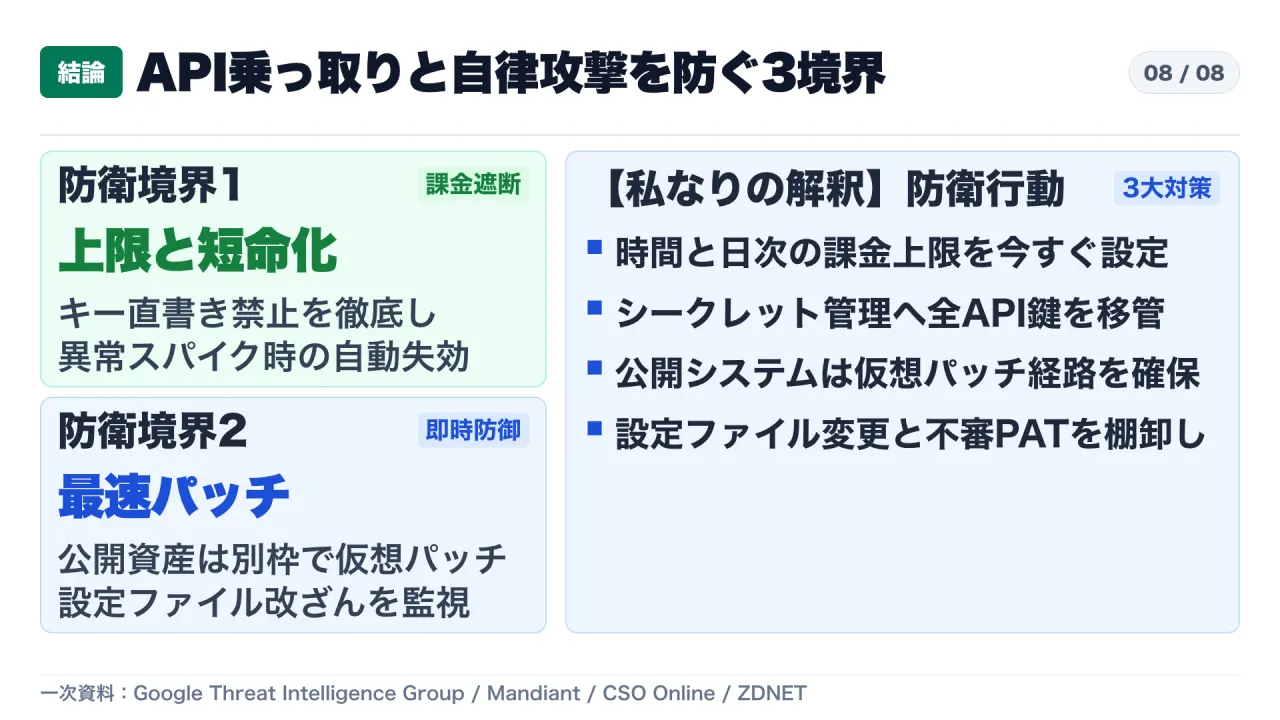
To counter autonomous patch-diff exploitation, six-figure LLMJacking bills, and repository config poisoning, engineering and security teams should audit three boundaries immediately:
1. API Key Short-Lived Scoping, Secret Centralization, and Hard Billing Caps
- Eliminate Static Long-Lived Keys: Prohibit hardcoding AI keys or service-account JSON credentials in repositories,
.envfiles, or unencrypted CI variables; migrate to secret managers or short-lived workload identity federation. - Enforce Hard Spend Limits and Circuit-Breakers: Configure hourly and daily spending caps with automated key revocation on token velocity spikes. Monthly billing alerts arrive too late when botnets burn $82,000 to $100,000 USD within hours.
- Audit Existing Keys and IAM Roles: Inspect cloud accounts for dormant test keys, permissive service accounts (
UNC6993), and newly created keys bearing benign labels (such as “billing optimization”).
2. Fast-Track Patching and Virtual Mitigation for Internet-Facing Assets
- Separate Exposed Perimeter Assets From Standard QA Queues: Inventory all internet-facing web servers, API gateways, and remote-access appliances and place them on an emergency patching track outside multi-week change-advisory cycles.
- Deploy Pre-Patch Virtual Mitigations: Because autonomous tools diff patches immediately upon disclosure, deploy WAF rules, rate limits, or temporary access restrictions at release time, and triage strictly against official vendor advisories rather than unverified social-media PoC scripts.
3. Developer AI Configuration Integrity and Access Token Governance
- Lock Down Repository AI Configs via Mandatory Code Review: Protect
.claude/settings.json, MCP server registries, and IDE/agent startup hooks viaCODEOWNERS, requiring peer review and CI validation for any startup command or hook change. - Inventory and Restrict Personal Access Tokens (PATs): Audit GitHub and GitLab organizations for active PATs—especially classic tokens or tokens labeled after AI tools (
Microsoft Copilot, etc.)—enforcing short expirations, fine-grained scopes, and anomalous API alerting. - Train Engineers Against Synthetic Recruiter and ClickFix Lures: Brief developers on SynthID-synthesized recruiter personas and “ClickFix” fake meeting-fix prompts instructing targets to run diagnostic terminal commands locally.
Sources
- GTIG AI Threat Tracker: Agentic Threat Activity Crosses a Significant Threshold (Google Cloud)
- The Rise of LLMJacking: How Threat Actors Monetize Compromised Cloud and Model Resources (GTIG / Mandiant)
- ARTEX and Friends: Enter Agentic Offensive Frameworks (GTIG / Mandiant)
- Help Net Security: Google finds AI agent writing and launching exploits with no human in the loop (November 17, 2026)
- CSO Online: Google spots the first hacker AI system that finds and exploits flaws autonomously (November 17, 2026)
- ZDNET: Your enterprise AI access can be sold for pennies - beware ‘LLM Mixers’ (November 2026)
- IBM Technology: LLMjacking: How hackers steal your AI API keys and stick you with the bill (May 13, 2026)