Saving the U.S. Navy's Shipbuilding Fleet: Hadrian's $300 Million AI Foundry Modernization
A comprehensive technical, industrial, and macroeconomic analysis of how physical casting bottlenecks, decades of software-only capital misallocation, and autonomous machine tool setup are reshaping submarine and defense manufacturing.
Japanese Edition: Read the original Japanese article on Substack
Video Episode (Japanese Audio): Watch on YouTube
Disclaimer: This publication provides objective technical, architectural, and financial analysis. It does not constitute commercial endorsement or investment advice.
1. The Shipbuilding Paralysis: Why Advanced Fleets Wait on Rusty Foundry Castings
Across the global technology sector and venture capital ecosystem, unprecedented billions have flowed into artificial intelligence algorithms, generative models, and hyperscale compute clusters. The prevailing narrative of the past two decades has insisted that pure software businesses—characterized by zero marginal reproduction costs, instant worldwide digital distribution, and minimal capital expenditures—represent the pinnacle of economic value creation. Yet, while software developers celebrate breakthroughs in code generation and synthetic reasoning, the sovereign physical infrastructure that underpins national security faces a quiet, devastating crisis of material obsolescence.
In mid-November 2026, defense manufacturing startup Hadrian, led by Chief Executive Officer Chris Power, announced a decisive strategic move to confront this reality: committing $300 million in dedicated capital to acquire and comprehensively modernize a historic foundry in Pennsylvania. The explicit objective of this massive capital deployment is not to construct another cloud data center or train another conversational parameter suite, but rather to revitalize the domestic production of critical casting and forging components indispensable to the United States Navy’s surface combatants and nuclear-powered submarine fleets.
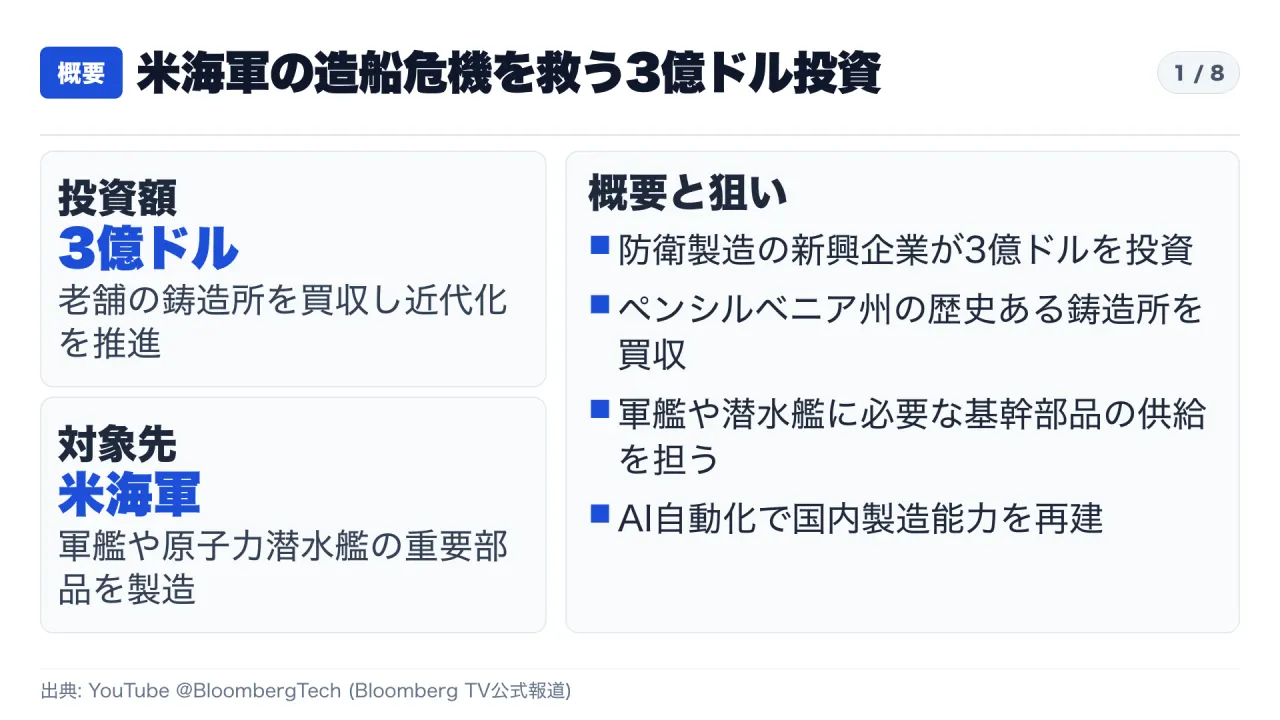
The strategic context behind this $300 million acquisition exposes a profound contradiction at the heart of modern industrial policy. The U.S. Navy is currently engaged in the most technologically ambitious fleet recapitalization program since the Second World War, highlighted by the construction of the next-generation Columbia-class ballistic missile submarines and the continuous procurement of Virginia-class fast-attack submarines. These multi-billion-dollar maritime platforms represent the apex of naval architecture, incorporating advanced acoustic quieting, integrated electric drive systems, and state-of-the-art combat control architectures.
However, despite Congress allocating hundreds of billions of dollars to shipbuilding accounts and defense prime contractors possessing extensive backlogs, shipyards across the Eastern Seaboard and Gulf Coast are suffering catastrophic delivery delays. Capital warships and nuclear submarines sit marooned in dry docks for months—and in some instances, over a year—not because engineers cannot design advanced guidance systems, but because the domestic industrial base cannot supply basic, high-integrity metallic castings. A single custom valve, high-pressure steam manifold, or structural hull fitting that fails to arrive on schedule can freeze an entire construction sequence involving thousands of shipyard workers.
Hadrian’s initiative marks a pivotal inflection point where advanced software engineering and automation technologies are forced to confront the stubborn, unforgiving laws of physical matter. By transforming a legacy Pennsylvania casting house into an automated, software-driven manufacturing node, the venture aims to prove that the true frontier of industrial competitive advantage lies at the intersection of bits and atoms.
2. The Decades-Long Atrophy of Domestic Casting and Forging Capacity
To understand the severity of the bottleneck that Hadrian is targeting, one must examine the structural deindustrialization that has hollowed out the Western defense manufacturing base over the past four decades. The casting and forging sector, colloquially known as the “foundry trade,” is one of the oldest industrial disciplines in human history. It involves melting raw alloys—specialty steels, titanium, nickel-aluminum bronze, and high-nickel superalloys—at temperatures exceeding 1,500 degrees Celsius and pouring the molten metal into precision molds to create solid, seamless components capable of withstanding extreme mechanical pressures and corrosive marine environments.
Following the end of the Cold War and the subsequent “Peace Dividend” consolidations of the 1990s, the economic incentives governing manufacturing shifted violently. Commercial foundries faced severe downward margin pressure from globalized supply chains, where environmental compliance, energy costs, and labor rates were substantially lower in emerging markets. Meanwhile, venture capital and institutional finance systematically reallocated capital away from physical plants, equipment, and real assets, directing funds almost exclusively into asset-light software, mobile applications, and digital marketplaces.
| Structural Dimension | Legacy Commercial Casting Sector | Software & Venture Focus (1995–2025) | Resulting Defense Supply Reality |
|---|---|---|---|
| Capital Allocation | Severe underinvestment; 50-year-old equipment | Massive liquidity; zero-CapEx multiples | Acute domestic supply contraction |
| Workforce Dynamics | Aging master artisans; median age > 55 years | Influx of software and digital engineers | Complete rupture of generational tacit skills |
| Regulatory Burden | Extreme MIL-SPEC & NAVSEA quality audits | Low initial compliance; iterative releases | High barrier to entry, low incentive for small shops |
| Lead Times | Multiplied from 8–12 weeks to 12–18 months | Instantaneous digital delivery | Naval shipyards paralyzed by missing hardware |
| Operational Moat | Bespoke physical plants; unscalable manual setups | Readily commoditized software codebases | Physical manufacturing becomes absolute chokepoint |
The consequences for national defense were catastrophic. Over the past forty years, the total number of operational metalcasting facilities across the United States declined by more than 70%. The facilities that survived were predominantly small, family-owned machine shops and regional foundries operating with tooling and furnaces installed during the 1970s and 1980s. When defense prime contractors required highly complex, low-volume casting runs for nuclear submarine hulls, they encountered an ecosystem of subcontractors that was financially fragile, technologically stagnant, and severely bottlenecked.
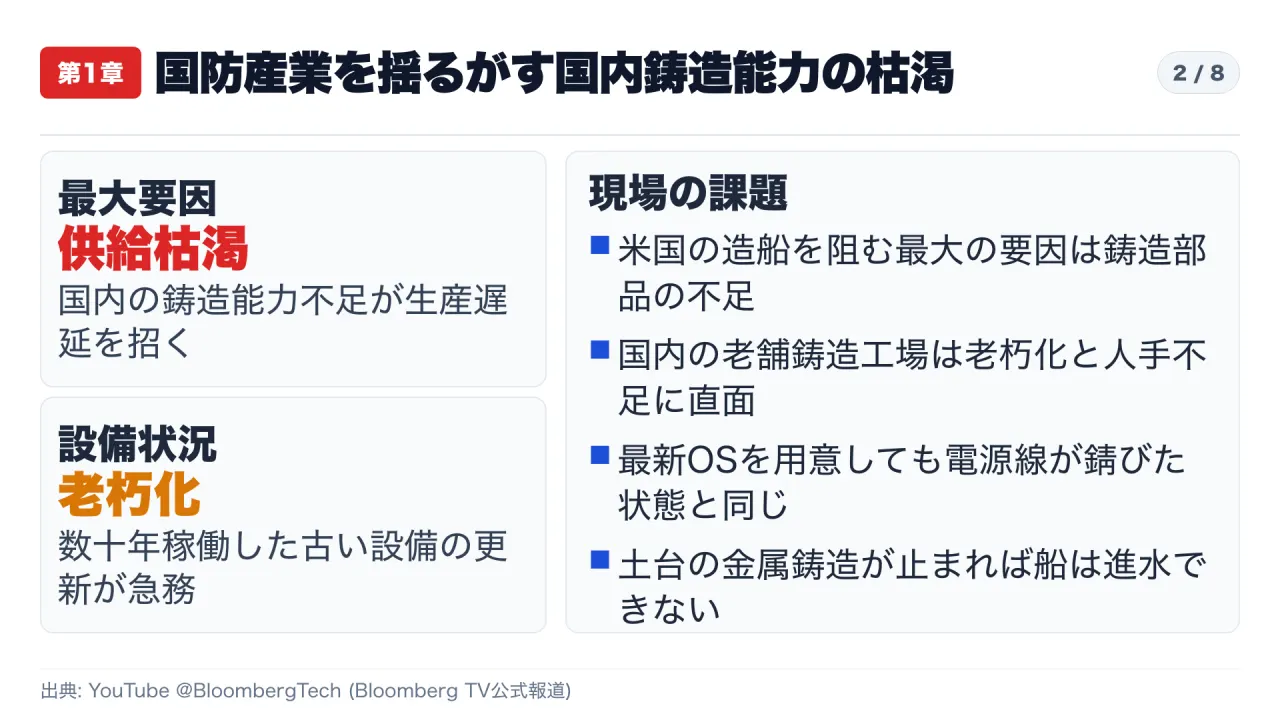
This operational fragility is analogous to assembling an ultra-high-performance supercomputer with the fastest available graphics processors and multi-terabyte memory bandwidth, only to plug it into an ancient electrical wall outlet wired with corroded copper cables that cannot carry nominal current without tripping the circuit breaker. In this architectural comparison, the sophisticated naval weapons systems, sensor suites, and autonomous mission software represent the cutting-edge computer, while the foundry capacity represents the electrical grid. When the physical foundation cannot bear the current, the entire multi-billion-dollar enterprise grinds to an absolute halt.
Specialized naval castings cannot be easily substituted with commercial off-the-shelf equivalents. A submarine diving-plane mechanism or primary reactor coolant loop casting must endure cyclic hydrostatic pressures at operational depths while resisting seawater corrosion over a planned service life of forty years. Every internal grain boundary, tensile tolerance, and non-destructive radiographic inspection must comply with non-negotiable military specifications. When the few surviving domestic suppliers face equipment failures or workforce shortages, there are simply no alternative domestic sources available.
3. The Macroeconomic Illusion: Screen-Centric AI vs. The Laws of Physical Matter
The broader macroeconomic significance of Hadrian’s Pennsylvania foundry acquisition lies in its direct rebuke of the “screen-centric AI bubble.” For years, technologists and investors operated under the tacit assumption that breakthroughs in artificial intelligence would primarily manifest as software entities: automated customer support agents, synthetic text creators, algorithmic traders, and digital design copilots. The implicit economic thesis held that digitizing cognitive tasks was the highest-leverage endeavor, while physical fabrication was a commoditized, secondary execution detail that could always be outsourced or solved later.
This worldview has collided directly with the harsh constraints of physical reality. While an automated conversational agent can generate a synthetic technical specification in seconds, it cannot pour fifty tons of molten HY-80 high-yield structural steel into an investment mold. It cannot machine a twelve-foot marine propeller shaft to a tolerance of five microns without a rigid, physically calibrated multi-axis CNC milling center anchored to vibration-dampened concrete foundations.
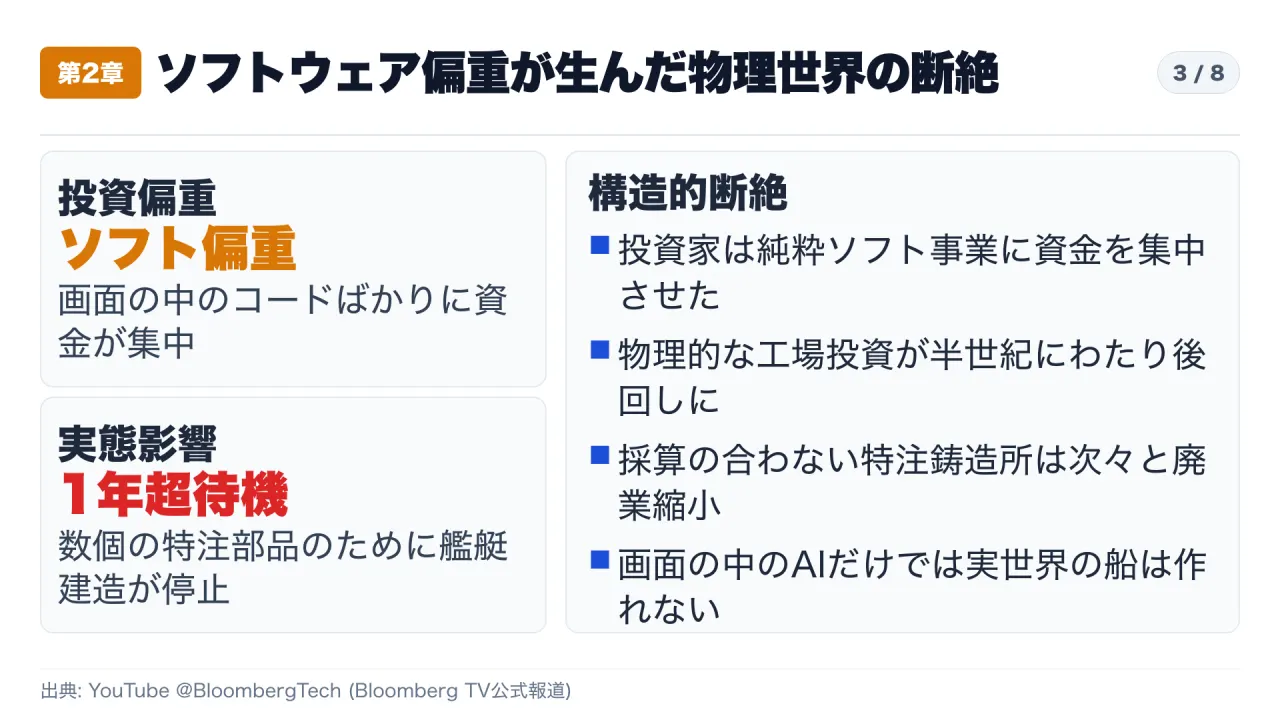
The operational absurdity created by this imbalance is visible across commercial and defense shipyards today. Project management teams utilize sophisticated enterprise resource planning (ERP) suites and automated scheduling software that provide real-time 3D telemetry of ship assembly progress. Yet, despite having instant digital visibility that a specific nickel-alloy valve is delayed, the software has no physical power to accelerate the manual machining process at a distant subcontractor.
Consider the physical bottleneck through the everyday analogy of a massive commercial construction site. A property developer may employ world-class architects, deploy drones to capture real-time volumetric scans of the excavation pit, and coordinate concrete deliveries via an automated logistics dashboard. But if the local batching plants run out of Portland cement or the fleet of ready-mix concrete trucks is delayed by road closures, the tower cranes standing overhead cannot lift a single beam. The hundreds of ironworkers, electricians, and interior glaziers waiting on the upper levels are completely immobilized. The speed of the most sluggish, physical, non-negotiable process dictates the velocity of the entire multi-hundred-million-dollar skyscraper.
In defense shipbuilding, that missing concrete mixer is the specialty casting. Public procurement logs and Government Accountability Office (GAO) audits repeatedly document that lead times for critical maritime forgings and castings expanded from historical averages of 12 to 16 weeks to staggering intervals of 52 to 78 weeks. Shipbuilders are routinely forced to alter standard assembly sequences, closing ship compartments out of order and sealing bulkheads with temporary openings because internal piping castings have not arrived. When the missing component finally reaches the shipyard a year later, workers must cut through completed structures to install it, incurring massive rework costs and inducing schedule ripples that cascade across future vessel builds.
4. Inside Hadrian’s Technical Engine: Automating Machine Tool Setup and Metrology
The central technical question raised by Hadrian’s Pennsylvania acquisition is straightforward: How does a software and robotics company propose to solve a century-old physical manufacturing bottleneck that has resisted conventional capital expenditure?
The primary operational impediment in precision manufacturing—particularly for low-volume, high-mix defense parts—is not the time the cutting tool actually spends shearing metal. In a conventional machine shop, the physical spindle runtime often accounts for less than 30% of total machine operational hours. The overwhelming majority of factory floor time is consumed by non-cutting overhead: manual setup, fixture engineering, workpiece alignment, cutting tool selection, and iterative metrology inspection.
+---------------------------------------------------------------------------------------+
| Traditional Legacy Foundry Workflow (Spindle Utilization: ~25-35%)                   |
|                                                                                       |
| [Raw Casting]                                                                         |
|      |                                                                                |
|      v                                                                                |
| [Manual Fixture Fabrication & Clamping] -----> (4 to 8 Hours Manual Setup)            |
|      |                                                                                |
|      v                                                                                |
| [Trial Cutting Pass & Manual Caliper Probe] --> (2 to 4 Hours Iterative Alignment)    |
|      |                                                                                |
|      v                                                                                |
| [Production Machining Pass] -----------------> (1 to 2 Hours Spindle Runtime)         |
|      |                                                                                |
|      v                                                                                |
| [Off-Line CMM Metrology Lab Transit] --------> (12 to 48 Hours Queue Latency)         |
|      |                                                                                |
|      v                                                                                |
| [Manual Deburring & Final Polish] -----------> (4 to 6 Hours Manual Labor)            |
+---------------------------------------------------------------------------------------+
                                          vs.
+---------------------------------------------------------------------------------------+
| Hadrian Software-Defined Automated Foundry (Spindle Utilization: > 75%)               |
|                                                                                       |
| [Raw Precision Casting with Digital Twin]                                             |
|      |                                                                                |
|      v                                                                                |
| [Algorithmic CAM Toolpath & Modular Fixture] -> (< 15 Minutes Autonomous Setup)       |
|      |                                                                                |
|      v                                                                                |
| [In-Situ Optical / Touch-Probe Calibration] --> (< 5 Minutes Automated Verification)  |
|      |                                                                                |
|      v                                                                                |
| [Adaptive High-Speed Multi-Axis Machining] ---> (Optimized Spindle Runtime)           |
|      |                                                                                |
|      v                                                                                |
| [Closed-Loop Robotic Metrology & Feedback] ---> (Continuous In-Machine Verification)  |
|      |                                                                                |
|      v                                                                                |
| [Robotic Finishing & Digital Quality Cert] ---> (Automated Traceability Compliance)   |
+---------------------------------------------------------------------------------------+
In a traditional job shop environment, whenever a contract calls for ten submarine hull valves rather than ten thousand automotive brake rotors, a master machinist must interpret complex 2D blueprints, fabricate bespoke holding jaws or clamps, mount the heavy casting inside a 5-axis CNC machining center, and spend hours using dial indicators to align the casting datum points. After a test cut, the part is removed and transported across the facility to a separate coordinate measuring machine (CMM) quality control room, where it sits in an inspection queue for hours or days. If the dimensions deviate by twenty microns, the part returns to the machine, and the setup process restarts.
Hadrian attacks this systemic inefficiency through a proprietary software and robotics architecture that automates machine tool setup, part programming, and quality verification.
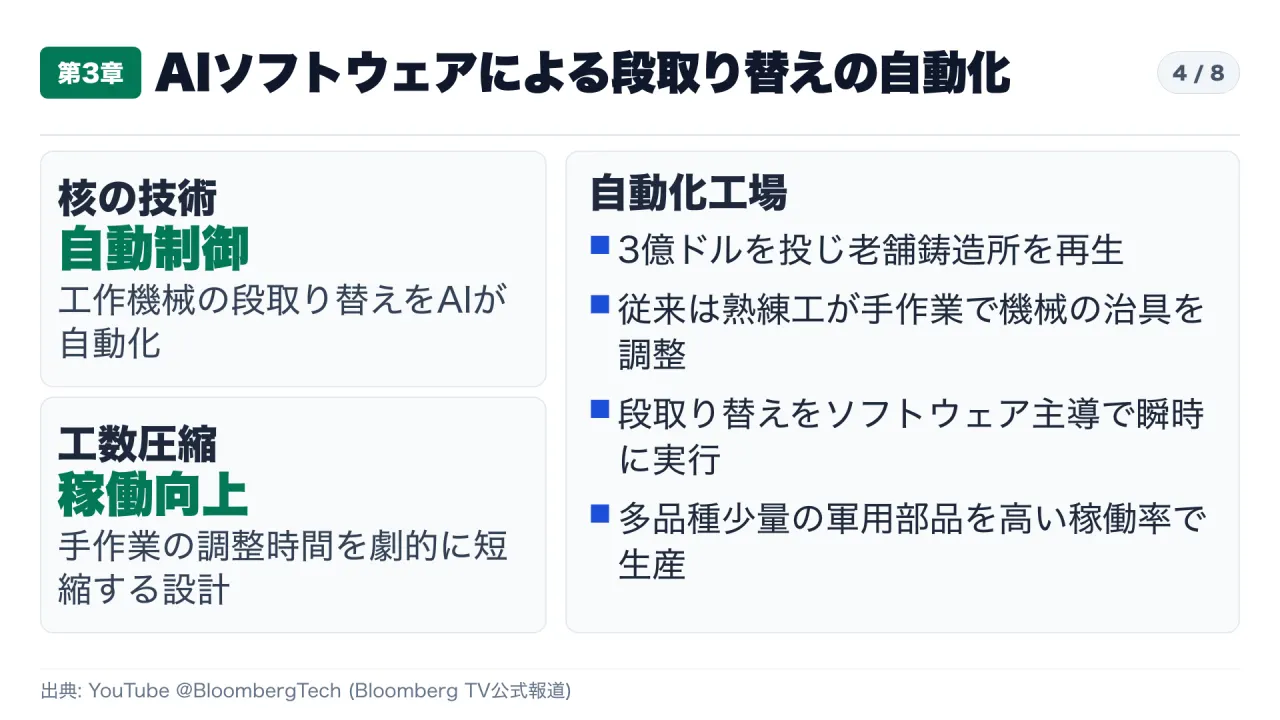
1. Algorithmic Computer-Aided Manufacturing (Autonomous CAM)
Rather than relying on human programmers to spend days manually defining tool trajectories, entry angles, spindle speeds, and feed rates in standalone CAM software, Hadrian’s algorithmic pipeline ingests 3D CAD models and automatically generates optimized multi-axis G-code instructions. The software evaluates cutting forces, thermal dissipation, and tool deflection dynamics in real time, selecting cutting sequences that maximize material removal rates while guaranteeing dimensional stability across difficult-to-machine alloys like Inconel, Monel, and titanium.
2. Universal Dynamic Workholding and Adaptive Clamping
To eliminate the requirement for custom-machined metal fixtures for every unique part geometry, Hadrian utilizes modular, reconfigurable workholding systems integrated with automated touch probes and optical vision sensors. When a raw casting is loaded into the machining envelope by a robotic arm, the machine does not assume the casting is perfectly positioned. Instead, automated probes scan key reference features, map the casting’s actual spatial orientation in three dimensions, and dynamically transform the machine’s internal coordinate coordinate frame to match the workpiece. Setup times that previously demanded an entire eight-hour shift are compressed into less than fifteen minutes.
3. Closed-Loop In-Situ Metrology
Rather than decoupling machining from quality inspection, Hadrian integrates metrology directly into the cutting cycle. High-precision laser scanners and tactile probing systems inspect critical tolerances while the workpiece remains clamped on the machine table. If tool wear or thermal expansion causes a bore diameter to drift toward the upper boundary of allowable tolerance, the supervisory control software detects the trend immediately and applies micro-offsets to subsequent cutting passes. This closed feedback loop eliminates scrap rates and provides an unalterable, automated digital inspection record that complies with stringent military quality assurance standards.
5. The Shipbuilding Procurement Cascade: Breaking the 12-to-18 Month Lead-Time Trap
The operational objective of applying this automated manufacturing framework to the Pennsylvania foundry is nothing less than collapsing defense production lead times by orders of magnitude. In naval shipbuilding, the gap between placing an order for a critical casting and receiving the fully machined, inspected, and certified component has historically functioned as an unbridgeable operational chasm.
The underlying failure mode in legacy defense procurement can be illustrated by the familiar mechanics of a mobile food delivery application. Imagine an urban consumer opening a smartphone app, selecting a gourmet dish, entering payment information, and receiving instant digital confirmation that the order has been logged and assigned to a driver. The digital layer operates with millisecond latency. However, imagine that the restaurant kitchen preparing the meal does not possess modern stoves, refrigeration, or automated ovens. Instead, the kitchen staff must manually gather firewood, strike flint to start a fire, and wait hours for cast-iron embers to reach cooking temperature before they can begin boiling water.
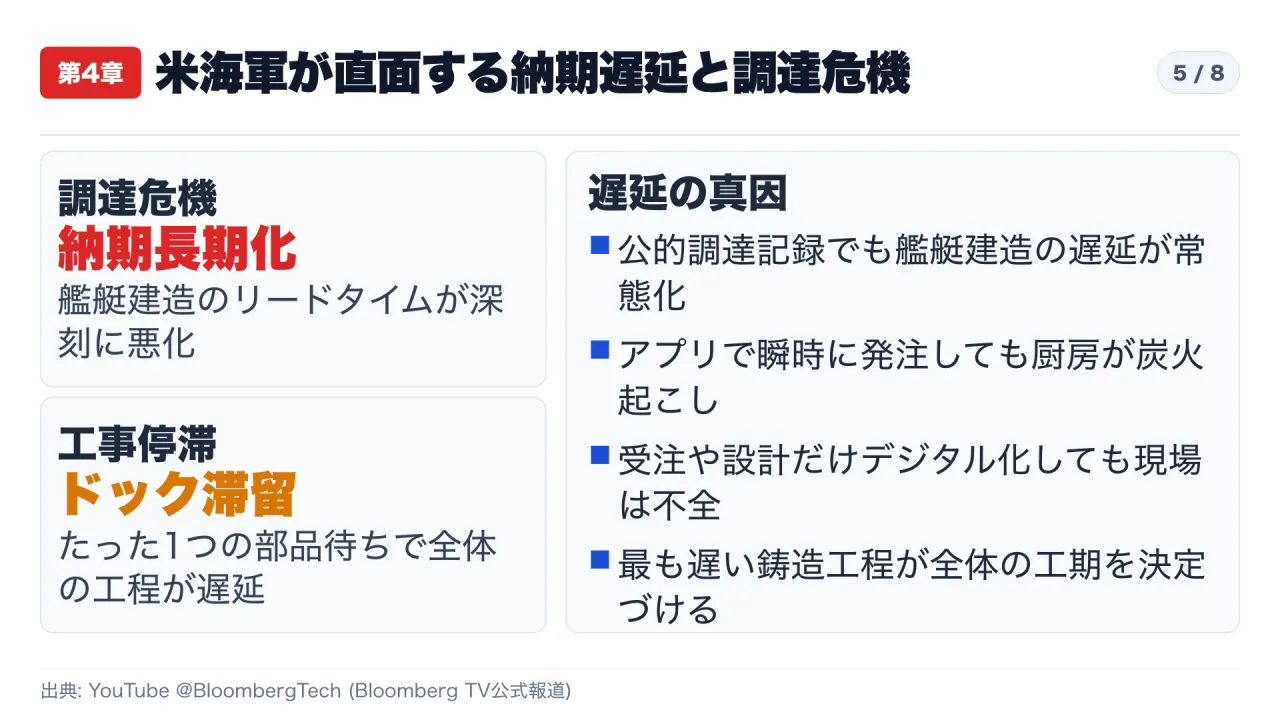
No degree of optimization within the consumer’s mobile app, no algorithmic route planning for the delivery courier, and no financial incentive can compress the physical cooking duration if the thermal foundation of the kitchen relies on raw wood combustion.
This is precisely the reality of defense shipbuilding. A procurement officer at Naval Sea Systems Command (NAVSEA) can issue a digital purchase order in seconds. The prime shipyard can integrate the part requisition into its high-speed cloud resource planning architecture instantly. But when the purchase order reaches the second- and third-tier supplier base, it lands in foundries where manual pattern-making, sand casting, cooling cycles, manual deburring, and artisanal CNC setup proceed at the exact same pace they did during the Vietnam War.
By acquiring the physical foundry and replacing artisanal manual setups with algorithmic machining cells, Hadrian targets the critical path identified by the Theory of Constraints. Formulated by industrial physicist Eliyahu Goldratt, the Theory of Constraints dictates that the throughput of any complex manufacturing system is determined strictly by the capacity of its most constrained bottleneck. Investing capital to accelerate non-bottleneck processes—such as writing faster shipyard management software or adding more welders to ship hulls—yields zero overall throughput improvement if the flow of raw castings remains choked.
| Production Metric | Legacy Subcontractor Network | Hadrian Automated Foundry Target | Net Systemic Improvement |
|---|---|---|---|
| Setup Time per Part Geometry | 6 to 12 Hours (Manual Machinist) | < 30 Minutes (Autonomous CAM & Fixturing) | > 90% Reduction in non-cutting dead time |
| Spindle Utilization Rate | 25% to 35% of total shift hours | 70% to 80% continuous uptime | 2.2x to 3.0x physical capacity multiplier |
| Component Lead Time | 48 to 72 Weeks (12 to 18 Months) | 6 to 12 Weeks end-to-end | 75% to 85% Compression in procurement cycle |
| Scrap & Rework Frequency | 8% to 15% due to manual error | < 1.5% with closed-loop in-situ metrology | Substantial material & alloy cost savings |
| Traceability Overhead | Manual paper binders, physical sign-offs | Immutable digital twins & sensor telemetries | Automated compliance with NAVSEA standards |
When lead times for naval castings are compressed from fifty weeks to eight weeks, the compounding benefits to the broader shipyard ecosystem are transformative. Shipbuilders can shift from brittle, speculative long-range ordering toward responsive, just-in-time synchronization. Ship modules can be fully outfitted with internal machinery before being welded into hermetically sealed hull cylinders, dramatically reducing the dangerous, labor-intensive practice of cutting and re-welding completed ship structures in dry dock.
6. Digitizing the Artisan: From Tacit Machining Intuition to Deterministic Physics Models
Beyond solving immediate schedule delays, Hadrian’s automation strategy directly confronts the demographic catastrophe silently sweeping through Western manufacturing: the extinction of the master craftsman.
The manufacturing of complex cast components has historically relied on what cognitive psychologists and industrial sociologists term “tacit knowledge”—deeply intuitive, unwritten expertise accumulated over decades of physical trial and error. A veteran foundry worker or toolmaker knows through subtle sensory cues that a molten pour of bronze is fifty degrees too cold because of the specific tint of the slag crust. A master machinist knows that an Inconel casing is about to undergo severe work hardening because of the high-pitched harmonic resonance vibrating through the machine enclosure, prompting them to manually dial back the feed rate override by eight percent.
The fatal systemic vulnerability of tacit knowledge is that it resides exclusively inside human nervous systems. It cannot be checked into a version-controlled software repository, duplicated across ten server instances, or transmitted over an optical fiber network.
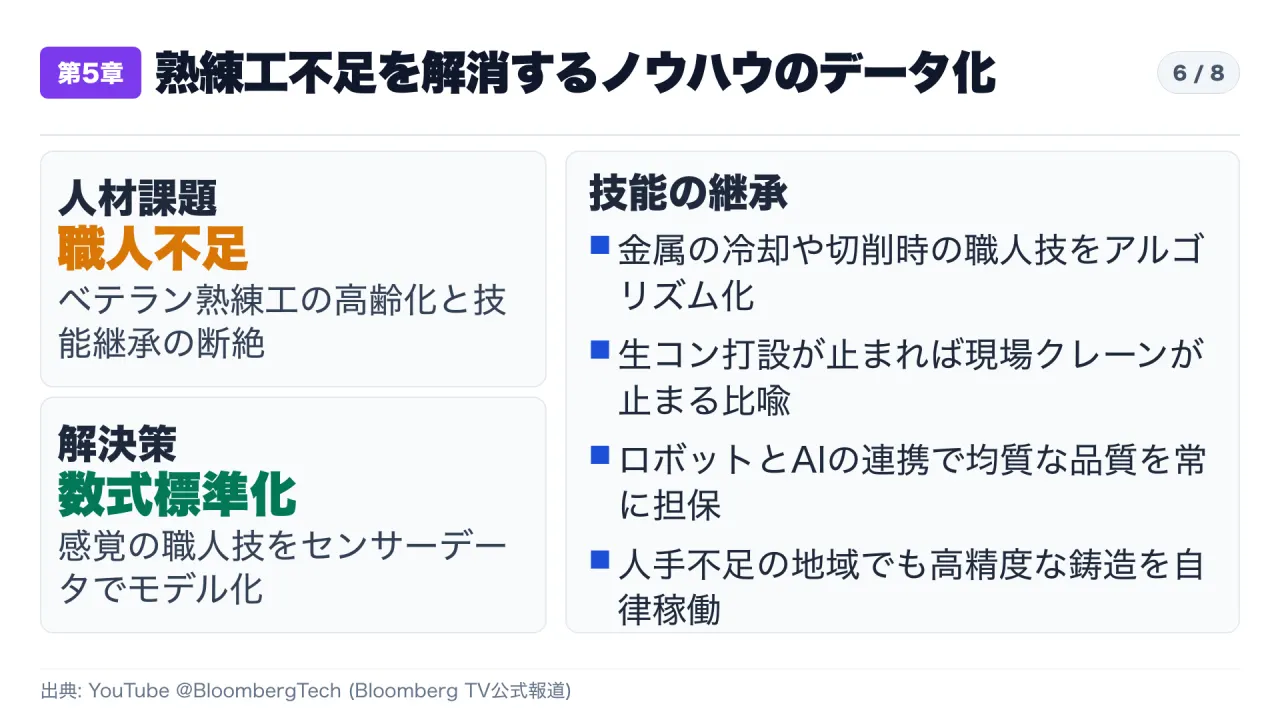
Across the American manufacturing heartland, that human repository is vanishing. According to industry surveys, the median age of skilled machinists, tool-and-die makers, and foundry supervisors in the United States exceeds 55 years, with more than a quarter of the active workforce eligible for immediate retirement. Younger generations of workers have overwhelmingly pursued professional careers in software, healthcare, financial services, or creative media, leaving industrial apprenticeships barren. When an expert machinist retires from a legacy Pennsylvania foundry after forty-four years on the floor, centuries of institutional knowledge regarding how to fixture, cut, and finish erratic defense castings depart the facility with them.
Hadrian’s technical approach explicitly rejects the futile strategy of attempting to reverse broad societal workforce trends through conventional recruitment drives alone. Instead, the company focuses on instrumenting machines with high-density physical sensors to capture, parameterize, and algorithmically codify the physical phenomena that artisans previously managed by instinct.
1. High-Bandwidth Acoustic and Vibration Telemetry
By mounting tri-axial piezoelectric accelerometers and acoustic emission sensors directly on machine tool spindles and workholding tables, the system continuously samples high-frequency dynamic vibrations during cutting passes. Machine learning models trained on structural mechanics and chip formation physics process these telemetry streams, identifying regenerative chatter and micro-instabilities milliseconds before they damage cutting tool edges or induce surface roughness violations.
2. Thermal Field Modeling and Dynamic Tool Compensation
Machining dense defense castings generates immense localized friction, elevating tool tip temperatures beyond 800 degrees Celsius and inducing uneven thermal expansion across both the cutting tool and the workpiece. Rather than relying on a veteran machinist to pause the cycle and wait for the metal to cool, Hadrian’s supervisory controllers model the transient thermal field in real time, calculating instantaneous dimensional expansion and dynamically modifying tool offset vectors to maintain tolerances within single-digit microns.
3. Digitizing the Casting Crystallization Process
In the foundry casting stage itself, automated thermal cameras and pyrometric sensors record the exact cooling and solidification curve of molten metal poured into sand molds. By correlating solidification temperature gradients with downstream radiography and ultrasonic flaw detection data, the system refines the mold gating and riser designs algorithmically. Tacit rules of thumb regarding how to vent gases and prevent shrinkage cavities are converted into deterministic finite-element fluid and thermodynamics simulations.
Through this methodology, the unique capabilities of the master artisan are decoupled from individual biology and transformed into persistent software assets. When a new automated production cell is deployed—whether in Pennsylvania, California, or a regional supplier node—the collective operational intelligence accumulated across millions of cutting cycles is instantly available, ensuring uniform manufacturing quality regardless of localized labor shortages.
7. The Industrial Shift to Physical AI: Building Unassailable Moats in Hard Infrastructure
The macroeconomic implications of Hadrian’s capital allocation extend far beyond naval defense contracting. They signal a profound macro-regime rotation within the technology sector: the structural transition from “pure digital SaaS” to “cyber-physical industrial infrastructure.”
For the past decade, enterprise software companies enjoyed historic valuation multiples based on the perception that software was fundamentally superior to physical business because of its limitless scalability and insulated gross margins. However, the rapid advancement of foundational language models and synthetic code generation has paradoxically undermined this economic moat. When software code itself becomes cheap and instantaneous to generate, the barrier to entry for developing standard SaaS platforms collapses. A business whose sole competitive advantage is a digital interface, a dashboard, or a wrapper around a commercial LLM API is inherently vulnerable to rapid commoditization.
+-----------------------------------------------------------------------------------------+
| The Evolutionary Paradigm Shift in Enterprise Technology Valuation                     |
|                                                                                         |
| 2012–2022: The Pure Digital SaaS Era                                                    |
| ------------------------------------                                                    |
| Competitive Moat: Intellectual property, rapid user onboarding, cloud distribution.     |
| Vulnerability: Zero physical presence; code easily duplicated by competing models.      |
| Capital Posture: Asset-light, negative working capital, avoidance of tangible assets.   |
| Outcome in 2026: Rapid margin erosion, feature commoditization, AI API price pressures.  |
|                                                                                         |
| 2026+: The Cyber-Physical Moat Era (Hadrian Paradigm)                                  |
| -----------------------------------------------------                                   |
| Competitive Moat: Dual-layer synthesis of proprietary software + real manufacturing.    |
| Physical Barrier: NAVSEA/DOD facility certifications, heavy machine tools, metallurgy.  |
| Capital Posture: Strategic CapEx, acquiring physical chokepoints, automating execution.  |
| Outcome in 2026: Absolute pricing power, captive government demand, insurmountable moat.|
+-----------------------------------------------------------------------------------------+
In sharp contrast, an enterprise that successfully merges advanced automation software with capital-intensive physical infrastructure establishes an almost unassailable competitive fortress.
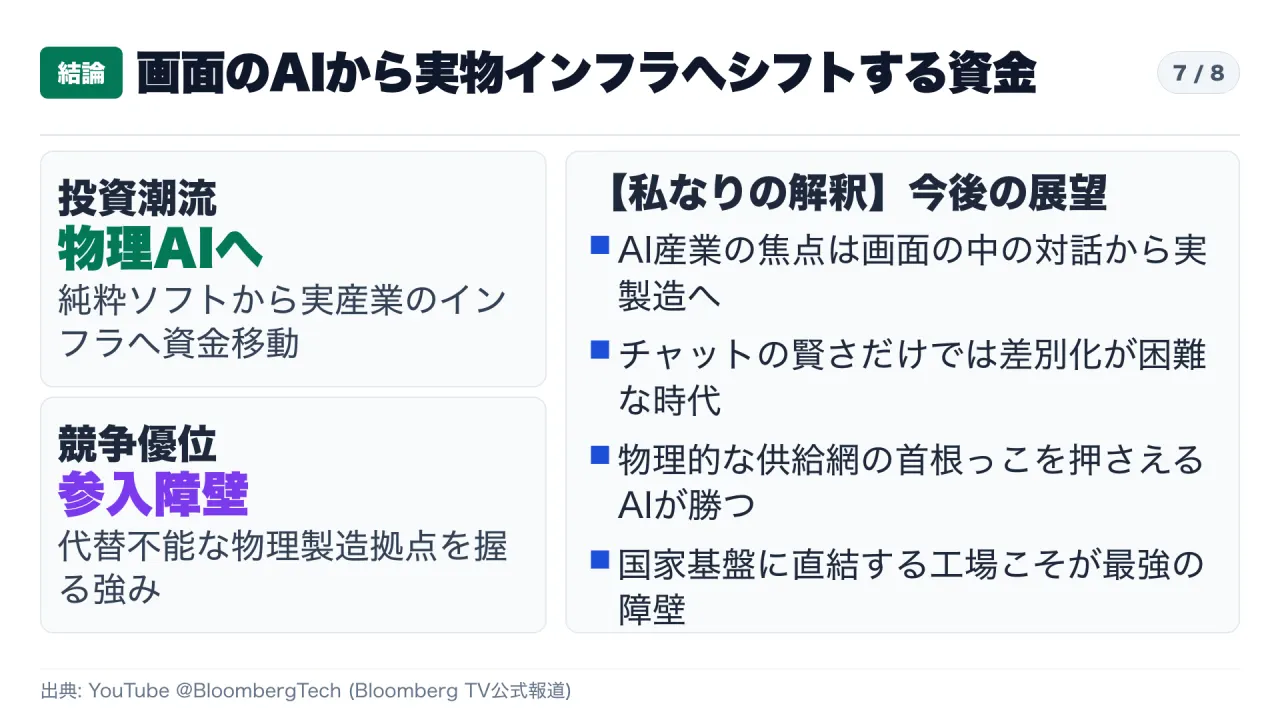
Consider the structural barriers protecting an automated defense foundry:
First, Regulatory and Certification Barriers: Qualifying a manufacturing facility to produce primary structural castings for nuclear submarines is an arduous multi-year process. It mandates rigorous audits by the Naval Sea Systems Command, compliance with strict military quality management standards (ISO 9001 / AS9100 / NAVSEA 0900-LP-001-7000), non-destructive testing qualifications, and personnel security clearances. A competing software startup cannot replicate this physical compliance infrastructure through software alone.
Second, Physical Asset Scarcity: Heavy industrial casting equipment, vacuum induction melting furnaces, large-envelope 5-axis gantry mills, and high-tonnage forging presses cannot be spun up on demand like virtual cloud instances. Lead times for procuring advanced European or Japanese machine tools frequently span eighteen to thirty months. By acquiring an operational Pennsylvania foundry, Hadrian secures scarce physical real estate, grid electrical power connections, environmental permits, and heavy industrial zoning that would take years to establish from scratch.
Third, The Sovereign Priority of Supply: Defense hardware procurement is fundamentally non-discretionary. During periods of heightened geopolitical tension and naval fleet expansion, the sovereign customer cannot simply decide to delay vessel construction to save budget. The Navy must procure nuclear submarines and surface combatants, and it will allocate premium contract pricing to any domestic supplier capable of guaranteeing on-time delivery. Controlling the physical chokepoint grants the automated foundry immense long-term pricing power and captive multi-decade revenue visibility.
This convergence of software economics with physical manufacturing assets represents the true meaning of “Physical AI.” Rather than designing artificial agents that merely converse or hallucinate text on computer monitors, pioneering technology enterprises are deploying intelligence directly into kinetic machine tools to dominate the indispensable supply chains of the real world.
8. Strategic Architecture: Three Guiding Principles for Enterprise Leaders
The lessons embedded in Hadrian’s $300 million foundry modernization provide actionable strategic guidance for executive leadership, engineering directors, and supply chain architects across both commercial and defense sectors. As the global economy navigates supply chain fragmentation, industrial reshoring, and the maturation of autonomous systems, organizations must align their operating models around three foundational principles.
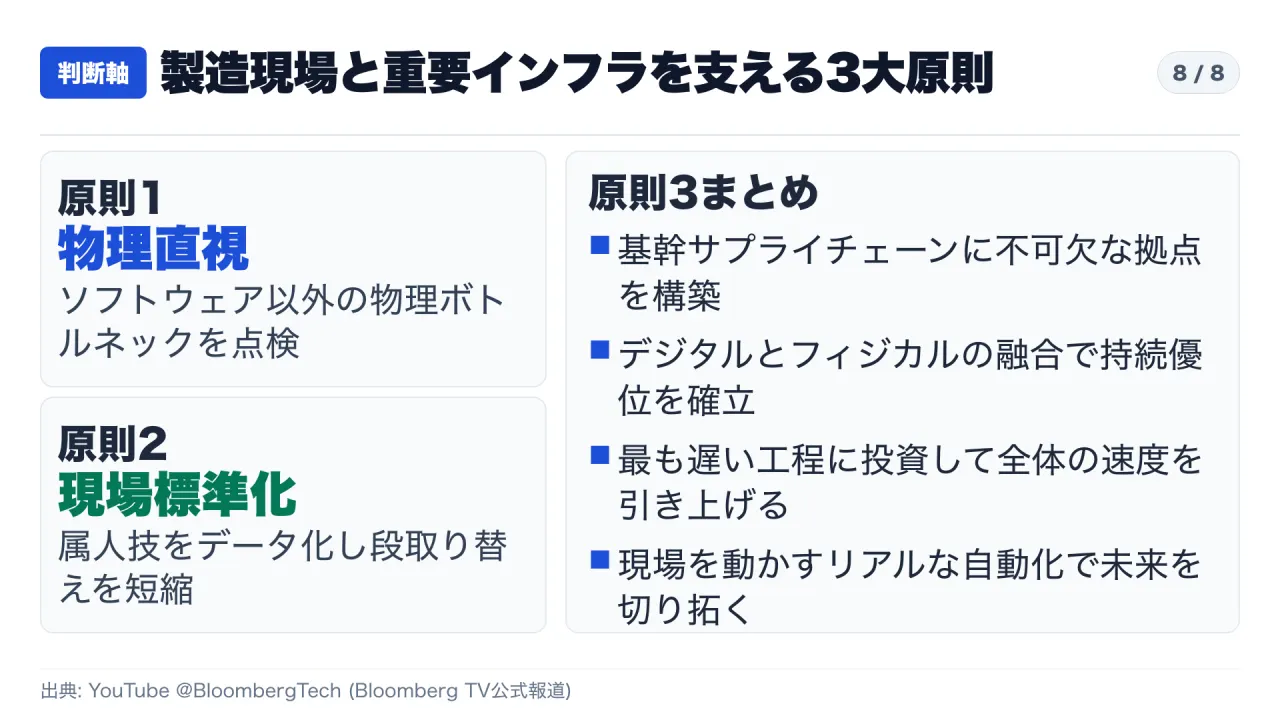
Principle 1: Physical Reality First (Auditing Single Points of Material Failure)
Enterprise leadership must perform rigorous, adversarial audits of their entire operational value chain, looking past digital dashboards to uncover single points of physical failure. Software efficiency gains are completely neutralized if an organization’s primary revenue engine depends on unhedged, brittle physical suppliers.
Whether an enterprise manufactures aerospace components, medical diagnostic hardware, automotive power electronics, or energy distribution gear, management must map every tier-2 and tier-3 dependency down to the raw material, casting, and wafer level. If an essential hardware subcomponent relies on a sole-source legacy workshop operating with 40-year-old machinery or located in a geopolitically vulnerable trade corridor, that dependency represents an existential corporate risk that cannot be mitigated by software optimizations alone.
Principle 2: Software-Driven Standardization of Tacit Operational Workflows
Organizations must cease treating artisan knowledge and operational craftsmanship as romantic, untouchable mysteries. While honoring the expertise of experienced personnel, engineering leaders must aggressively deploy sensor instrumentation, high-rate data capture, and physics-informed computational models to capture and standardize tacit workflows.
Every operational procedure—from machine tool setup and thermal compensation to batch quality inspection and assembly calibration—must be converted into repeatable, algorithmic software assets. When process knowledge is codified into deterministic control software, organizations insulate themselves against catastrophic demographic turnover while unlocking the ability to scale specialized production across geographically distributed manufacturing cells.
Principle 3: Securing Chokepoint Assets Through Cyber-Physical Moats
Technology companies and industrial enterprises must recognize that the era of uncontested, asset-light software dominance has passed. The most defensible, high-margin market positions of the next quarter-century will belong to enterprises that combine proprietary automation algorithms with irreplaceable physical assets, regulatory certifications, and specialized manufacturing plants.
By identifying and controlling the physical chokepoints of foundational industries—metallurgy, power infrastructure, advanced microelectronics packaging, chemical processing, and naval fabrication—enterprises build structural moats that cannot be erased by next-generation algorithm releases. Sustainable competitive advantage belongs to those who govern the physical choke points of the real world.
Technical Appendix: Structural Specification Matrix
The following table summarizes the comparative operational architecture between traditional manual foundry job shops and software-defined automated casting facilities:
| Architectural Domain | Traditional Manual Foundry Baseline | Hadrian Software-Defined Automation | Performance Differential |
|---|---|---|---|
| G-code & Toolpath Generation | Manual CAM programming; 2–4 days per part | Algorithmic automated toolpath synthesis (< 1 hour) | 95% Reduction in engineering lead time |
| Workpiece Clamping & Alignment | Bespoke manual fixtures, dial test indicators (4–8 hours) | Universal dynamic fixturing with automated probing (< 15 min) | 90% Reduction in setup downtime |
| Dimensional Metrology | Separate CMM inspection room; manual queue (12–48 hours) | In-situ laser scanning & closed-loop probe feedback (Real-time) | Instantaneous quality verification |
| Process Knowledge Retention | Tacit artisan memory; lost upon worker retirement | Immutable digital twins & physics-informed sensor models | 100% Retained institutional knowledge |
| Production Flexibility | Optimized solely for high-volume, low-mix standard runs | High-mix, low-volume agile production at scale | Economic viability for bespoke defense runs |
| NAVSEA Compliance Traceability | Manual paper logbooks, physical stamped certifications | Cryptographically sealed digital telemetry & inspection logs | Zero administrative audit latency |
Concluding Assessment
The $300 million investment to transform an aged Pennsylvania foundry into an automated naval manufacturing powerhouse is not merely a localized corporate event. It is a defining milestone in the industrial history of the 2020s—a decisive recognition that modern computational intelligence achieves its highest purpose not when generating synthetic text on computer displays, but when commanding physical steel, alloys, and machine tools to safeguard the material foundations of the real world.