Why Apple's First Foldable iPhone Survived 450,000 Folds—Yet Still Carries a $1,500 Repair Trap
Primary data from CNET’s 451,000-fold lab test, iFixit’s CT-scan teardown, and Apple Japan’s official repair schedule exposes the gap between clean-room durability and real-world cost risk.
Japanese Edition: Read the original Japanese article on Substack
Video Episode (Japanese Audio): Watch on YouTube
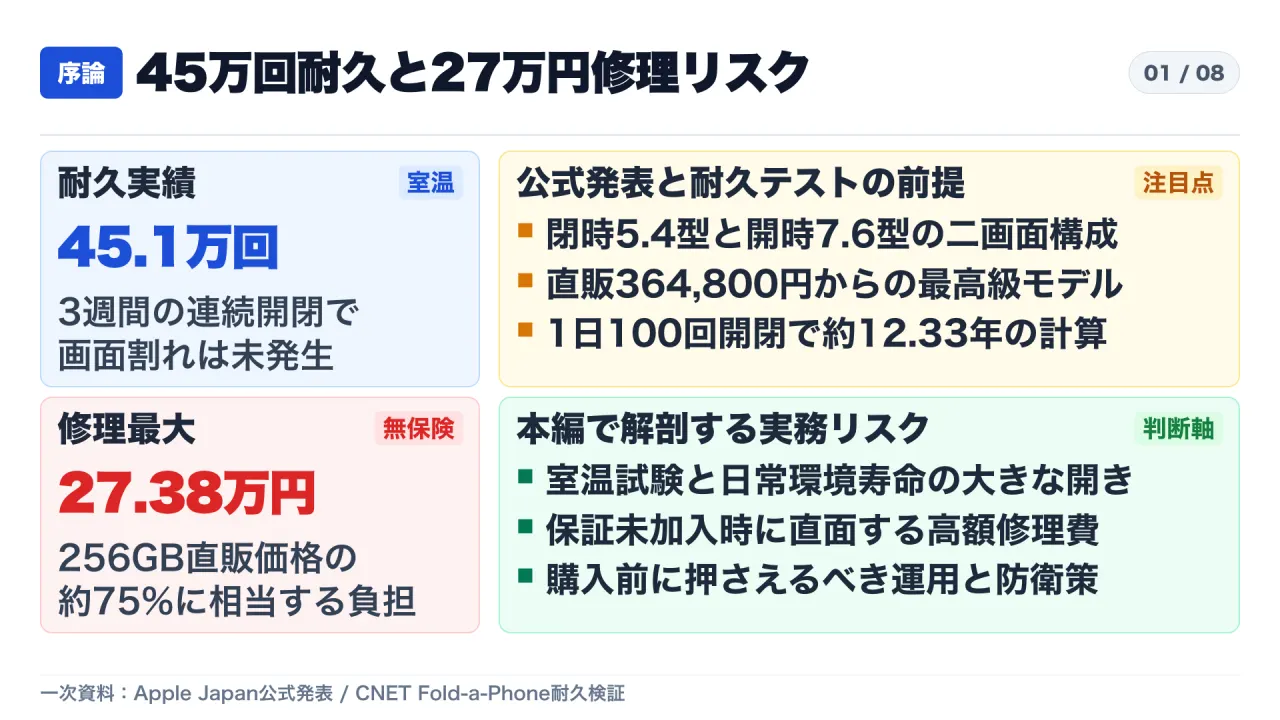
Apple’s entry into the foldable smartphone market has prompted buyers and IT procurement teams to ask one practical question: does the first-generation “iPhone Duo” finally overcome the mechanical fragility of folding hardware? Priced in Japan starting at 364,800 JPY (tax included) for the 256 GB model—pairing a 5.4-inch outer screen with a 7.6-inch inner folding display—the device arrives with high expectations for build precision. Early lab results appeared encouraging. In a continuous livestreamed test conducted by CNET using its custom “Fold-a-Phone” robotic actuator, the iPhone Duo surpassed 451,000 open-and-close cycles over roughly three weeks without cracking its inner display or losing video output, continuing toward the 500,000-fold mark.
Yet headline lab endurance inside a clean studio tells only part of the story. Cross-referencing robotic test logs against iFixit’s October 25, 2026 teardown and 3D CT scan, Apple’s October 26, 2026 acknowledgment of early hinge-axis cracking, dust-and-ice testing, thermal chamber OLED data, and Apple’s out-of-warranty repair schedule reveals a sharp operational gap. Clean-room glass survival does not guarantee multi-year hinge rigidity, environmental protection, or predictable total cost of ownership (TCO). Without AppleCare+, an inner-display replacement costs 182,800 JPY ($999 in the U.S.), while full-device or hinge-assembly damage reaches 273,800 JPY ($1,499)—roughly 50% to 75% of the phone’s retail price.
- Core Thesis: Separate clean-room panel fatigue (451,000+ folds) from real-world hinge and environmental limits (75,003 folds under dust and ice, and an eightfold drop in OLED bend tolerance at -20°C), and build warranty costs into TCO from day one.
- Primary Sources Verified: Apple Japan Newsroom (September 2026), Apple Store Japan pricing and AppleCare+ schedule, CNET Fold-a-Phone report and livestream (November 2026), iFixit teardown and CT scan (October 25, 2026), 9to5Mac reporting on Crackgate (October 26, 2026) and U.S. out-of-warranty repair pricing (October 14, 2026).
- Actionable Takeaways: Treat AppleCare+ (~29,800 JPY/year or 54,800 JPY for two years) as a mandatory fixed cost, choose a case that covers the hinge spine, and avoid forcing cold or gritty hinges flat.
1. What the 451,000-Fold Test Actually Revealed About the Hinge
Tactile Degradation Before Electrical Failure
To evaluate Apple’s first foldable under sustained mechanical load, CNET programmed its Fold-a-Phone rig to cycle an iPhone Duo every four seconds around the clock starting at launch. Statistically, 451,000 folds equals roughly 12.33 years at 100 folds per day, or over 24 years at 50 folds per day (73,000 cycles over four years). Because the screen kept displaying cleanly past 451,000 cycles, casual headlines framed the result as complete mechanical invulnerability.
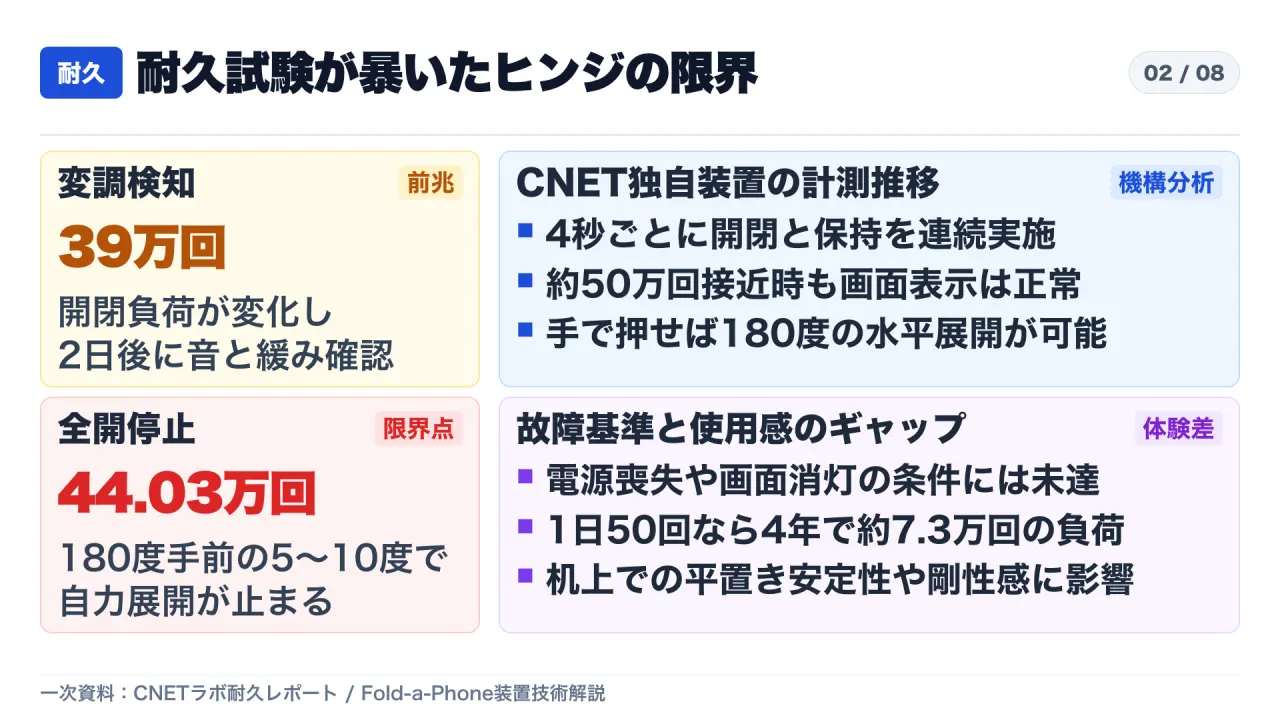
CNET’s telemetry reveals a more nuanced trajectory. Around 390,000 folds, testers noticed subtle changes in actuation force and opening feel. By the afternoon of November 12, 2026, audible clicking and hinge looseness appeared. Around 440,300 folds, the hinge stopped opening under its own tension to a full 180° flat plane, pausing 5° to 10° shy of horizontal unless pressed open manually by hand.
| Endurance Milestone | Cycle Count | Observed Mechanical & Display Behavior |
|---|---|---|
| First Actuation Shift | ~390,000 folds | Subtle shift in motor torque and opening resistance; hinge sound and play followed |
| Loss of Self-Locking Flatness | ~440,300 folds | Stopped 5°–10° short of 180° horizontal without manual pressure |
| Interim Benchmark | >451,000 folds | Zero screen cracking or pixel loss; device remained electrically functional toward 500,000 folds |
| Typical 4-Year Usage | 73,000 folds (50/day) | Indoor metal fatigue alone is unlikely to break the panel inside a standard upgrade cycle |
Lab Failure Criteria vs. Real-World Expectations
Under CNET’s formal protocol, a run ends only upon power loss, sensor failure, or screen blackout. A hinge resting at 170°–175° that still flattens under light hand pressure does not trigger an electrical failure flag.
For buyers spending 364,800 JPY or more, usability thresholds differ from lab thresholds. Think of a well-used business laptop or attaché case whose detent loses its crisp final snap after years of commuting: it still opens and functions, yet it rocks slightly when laid flat on a desk and no longer feels rigid. Furthermore, robotic actuators apply balanced torque in clean, temperature-controlled air—conditions far removed from pockets, lint, and winter weather.
2. Early Screen Cracking (“Crackgate”) and Internal Mechanics
Apple’s October 26 Response to Launch-Week Failures
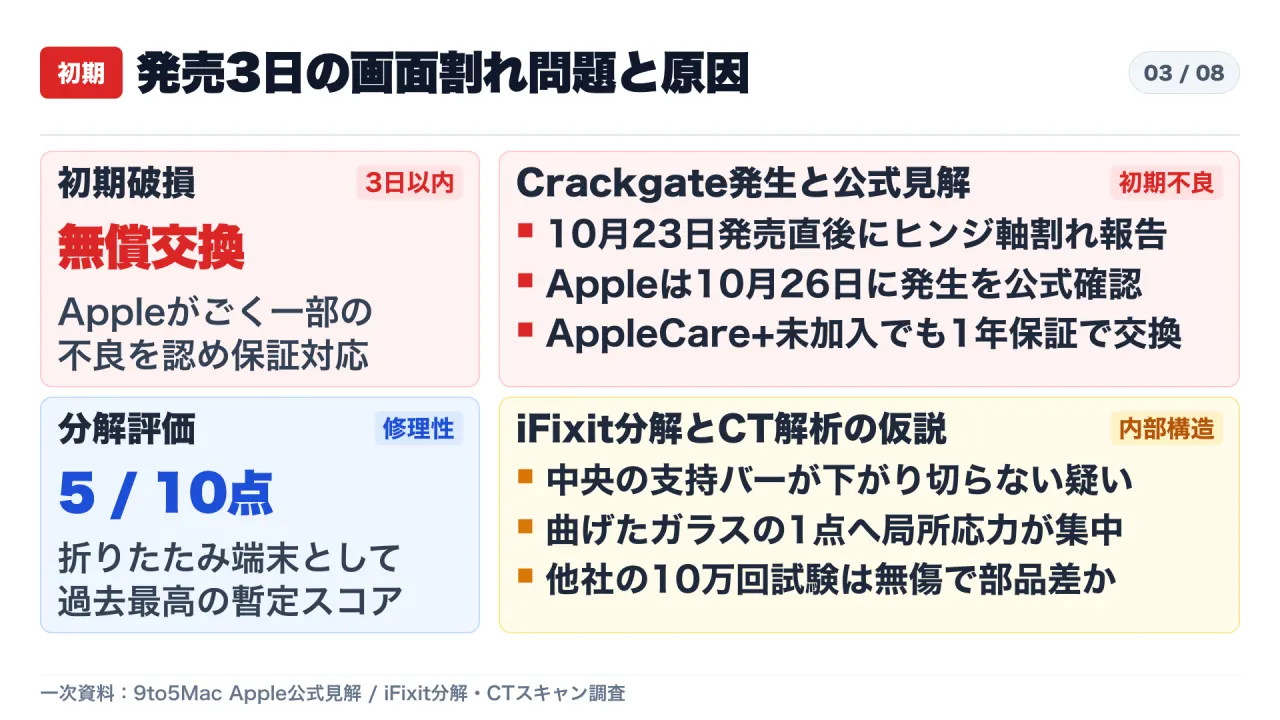
Continuous lab cycling measures gradual wear, not assembly tolerances. Within three days of the October 23, 2026 release, owners began reporting inner-display fractures along the central fold axis—an issue quickly labeled “Crackgate.” On October 26, 2026, Apple confirmed to 9to5Mac that a “very small number” of units exhibited an issue affecting the inner folding screen early in ownership.
Apple pledged free device replacements under its standard one-year limited warranty through official AppleCare support channels, even for buyers without AppleCare+. While that response protected early adopters from immediate loss, Apple did not disclose root-cause telemetry or affected production batches.
iFixit’s CT Scan Hypothesis: The Retracting Support Bar
Hardware forensics provided the clearest structural clue. In an October 25, 2026 teardown and 3D X-ray CT scan, iFixit examined the hinge cavity and identified a central support bar designed to sit flush behind the screen when open and retract into the body when closed, forming a teardrop bend cavity for the ultra-thin glass.
iFixit hypothesized that if that central support bar fails to drop completely flush during closure, the bending glass presses against a rigid edge along a single line, concentrating stress until the panel cracks. Separate 100,000-fold media tests ran without damage, suggesting batch-level manufacturing variation rather than a universal design defect. Meanwhile, iFixit’s provisional repairability score of 5 out of 10—the highest yet for a foldable—reflects easier battery removal via electrically debonding adhesive rather than straightforward inner-screen or hinge repairs.
3. Clean-Room 450,000 Folds vs. Real-World Dust, Crease Growth, and Cold
Why IP68 Resistance Does Not Seal the Hinge Against Grit
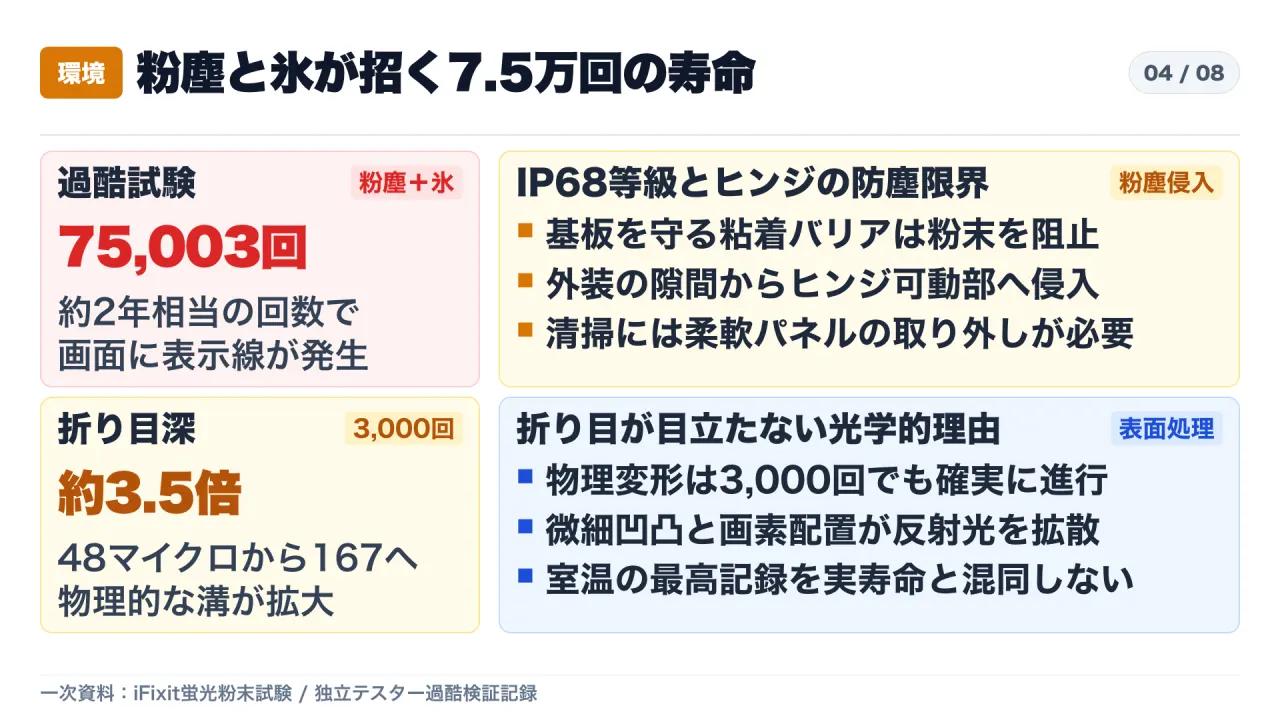
Apple rates the iPhone Duo at IP68 (dust protection and water immersion up to 6 meters for 30 minutes). However, iFixit’s fluorescent-powder test showed that internal adhesive seals protect the logic board rather than external moving hinge seams.
When cycled inside a bag of fine fluorescent powder, the phone kept dust off the main PCB, but particles slipped past outer trim and mesh gaps into the geared hinge tracks, causing audible grinding. Although less powder entered than on competing foldables, cleaning trapped grit still requires disassembling the fragile inner display. An independent manual test underscored this risk: after surviving 50,000 clean folds, a unit exposed to dust developed crease damage at 60,000 folds and permanent display lines at 75,003 folds—about two years of use at 100 folds per day—once ice was added.
Optical Masking vs. Physical Crease Deepening
Early reviews praised the iPhone Duo for its subtle central crease. Surface profiling by HTX Studio shows why visual impressions can mislead: after just 3,000 folds and closed storage, physical crease depth grew from 48 micrometers at launch to 167 micrometers—roughly 3.5 times deeper.
The crease looks muted straight-on because Nano-texture surface roughness and elliptical subpixel geometry scatter ambient light, hiding a physical groove that still deepens with use. This mirrors a common industrial procurement mistake: trusting a vendor’s “500,000-cycle climate-controlled test” without checking how metal dust and winter condensation affect the mechanism on a real factory floor.
4. Competitive Benchmarks and the Eightfold Sub-Zero Penalty
Apples-to-Oranges Testing Across Rival Foldables
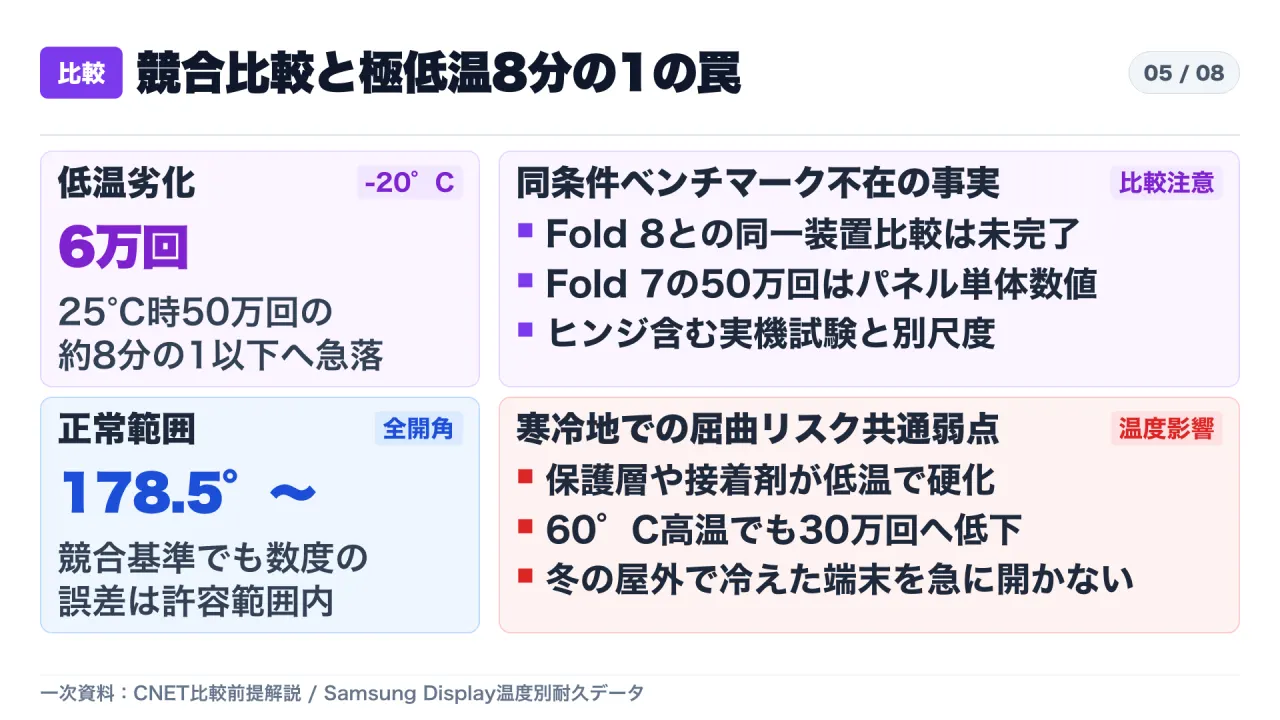
Comparing the iPhone Duo against Samsung’s Galaxy Z Fold series requires checking test boundaries carefully. CNET has not yet run an identical Fold-a-Phone test on the Galaxy Z Fold 8, leaving no direct apples-to-apples benchmark for motorized hinge longevity.
The 500,000-fold rating cited for the Galaxy Z Fold 7 comes from Bureau Veritas testing on the standalone OLED panel at 25°C—not a complete handset with hinge gears and chassis adhesives. Comparing standalone panel flexing against full-device robotic folding is like comparing indoor drum mileage on an unmounted tire against rough-road endurance on a loaded car.
What Thermal Testing Proves About Winter Usage
Temperature testing by Samsung Display highlights a physical constraint common to all folding polymers and adhesives. At 25°C, the flexible panel endured 500,000 folds. At 60°C, endurance fell to 300,000 folds. At -20°C, folding life collapsed to 60,000 cycles—about one-eighth of room-temperature endurance—as protective layers and adhesives stiffen and amplify bending strain.
Even in normal winter weather, snapping open a cold phone pulled from a coat pocket stresses internal layers. Under Samsung’s own service rules, full-open angles between 178.5° and 181.5° count as normal, and owners are warned against forcing stiff hinges flat. Against an industry range of 200,000 to 500,000 clean-room cycles, Apple’s 440,300 flat cycles are technically competitive when environmental limits are respected.
5. Repair Economics and the AppleCare+ Break-Even Math
Out-of-Warranty Costs Reaching 75% of Device Price
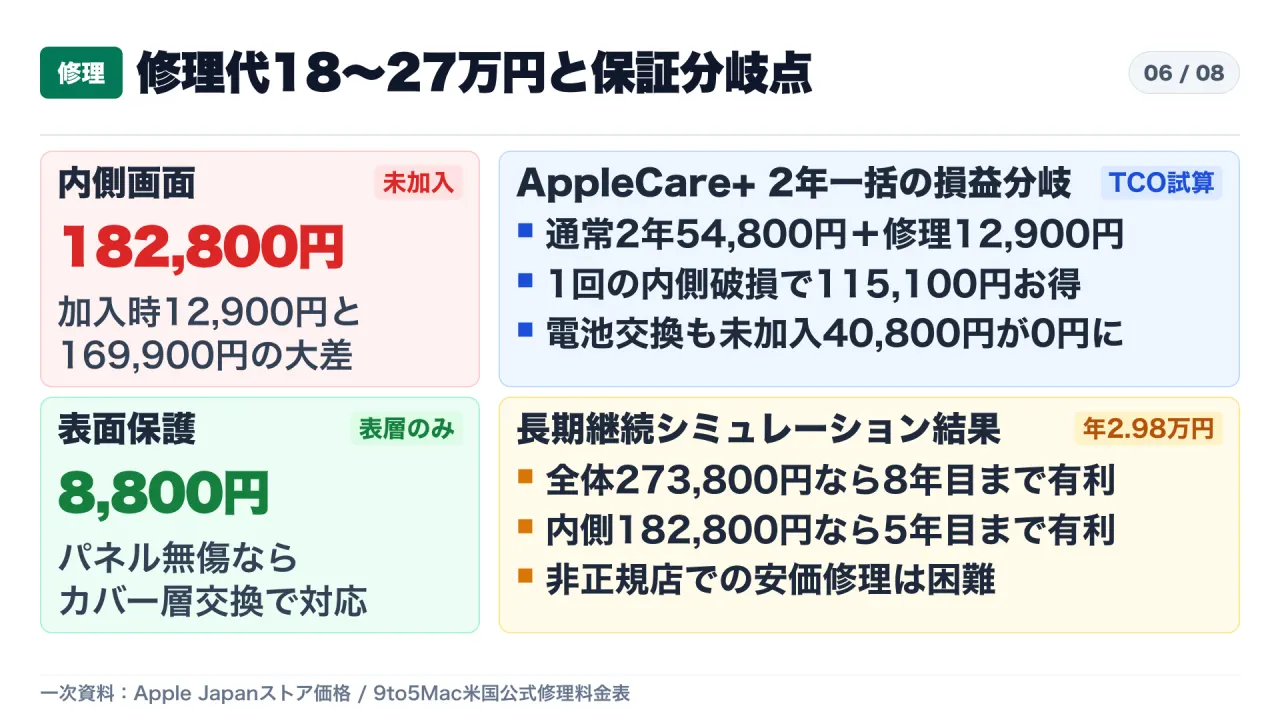
Where the iPhone Duo differs most from traditional flagships is financial downside. Apple created a welcome 8,800 JPY ($49 U.S.) tier when damage affects only the top cover layer (3,200 JPY with AppleCare+). Beyond that surface film, repair prices escalate sharply.
| Repair Category | Without AppleCare+ (Japan) | With AppleCare+ (Japan) | Out-of-Pocket Gap |
|---|---|---|---|
| Top Cover Layer Only | 8,800 JPY (U.S. $49) | 3,200 JPY | 5,600 JPY |
| Battery Service | 40,800 JPY (U.S. $229) | 0 JPY (eligible threshold) | 40,800 JPY |
| Outer Cover Display | 64,800 JPY (U.S. $379) | 3,700 JPY | 61,100 JPY |
| Inner Folding Display | 182,800 JPY (U.S. $999) | 12,900 JPY (U.S. $99) | 169,900 JPY |
| Other Damage (Chassis / Hinge) | 273,800 JPY (U.S. $1,499) | 12,900 JPY | 260,900 JPY |
Even battery service costs 40,800 JPY—roughly 1.8 times standard Pro Max rates—due to complex disassembly. Because genuine folding parts and calibration tools are tightly controlled, third-party repair shops rarely offer safe low-cost alternatives.
Calculating the Warranty Break-Even Horizon
Simple TCO math settles the warranty question. Standard two-year AppleCare+ costs 54,800 JPY upfront. One inner-display repair under warranty brings total spend (54,800 JPY plus 12,900 JPY service fee) to 67,700 JPY—saving 115,100 JPY versus the 182,800 JPY unassisted fee.
On the Theft and Loss plan at 2,980 JPY/month (29,800 JPY/year): coverage stays cheaper than one 182,800 JPY inner-screen repair through Year 5, and cheaper than one 273,800 JPY full-device repair through Year 8. Like collision insurance on an expensive car whose body panel costs half the vehicle’s price, skipping coverage on a 364,800 JPY foldable invites asymmetric loss.
6. Resale Blind Spots and Three Practical Rules for Ownership
No OS Fold Counter and Exposed Standard Cases
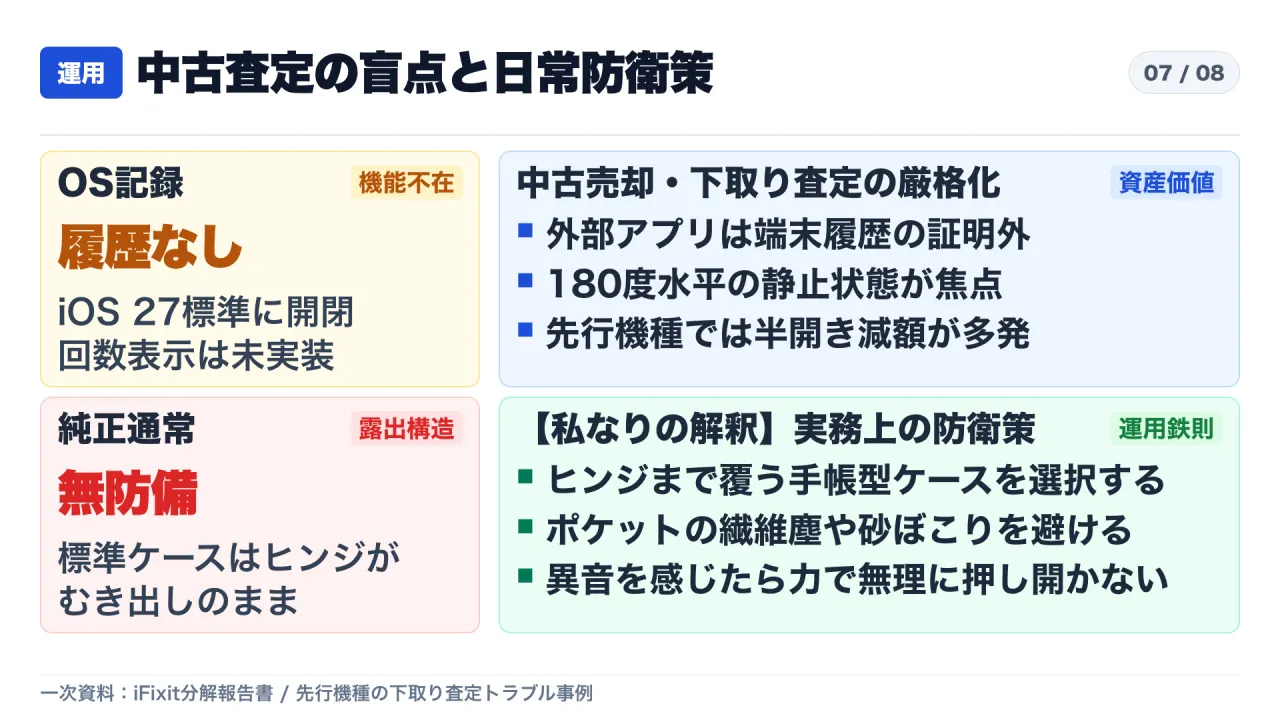
Resale economics present another hidden risk. While iOS 27 shows battery capacity and cycle counts in Settings, it lacks a native, tamper-proof hinge fold counter. Third-party shortcut logs cannot verify hardware history for buyers.
Consequently, trade-in appraisers rely on physical inspection: whether the device opens flat to 180° and moves smoothly without grinding. On earlier foldables, pocket lint preventing full opening has caused steep trade-in deductions and buyer returns. Meanwhile, Apple’s standard cases leave the hinge spine exposed.
Three Deterministic Guidelines Before Buying
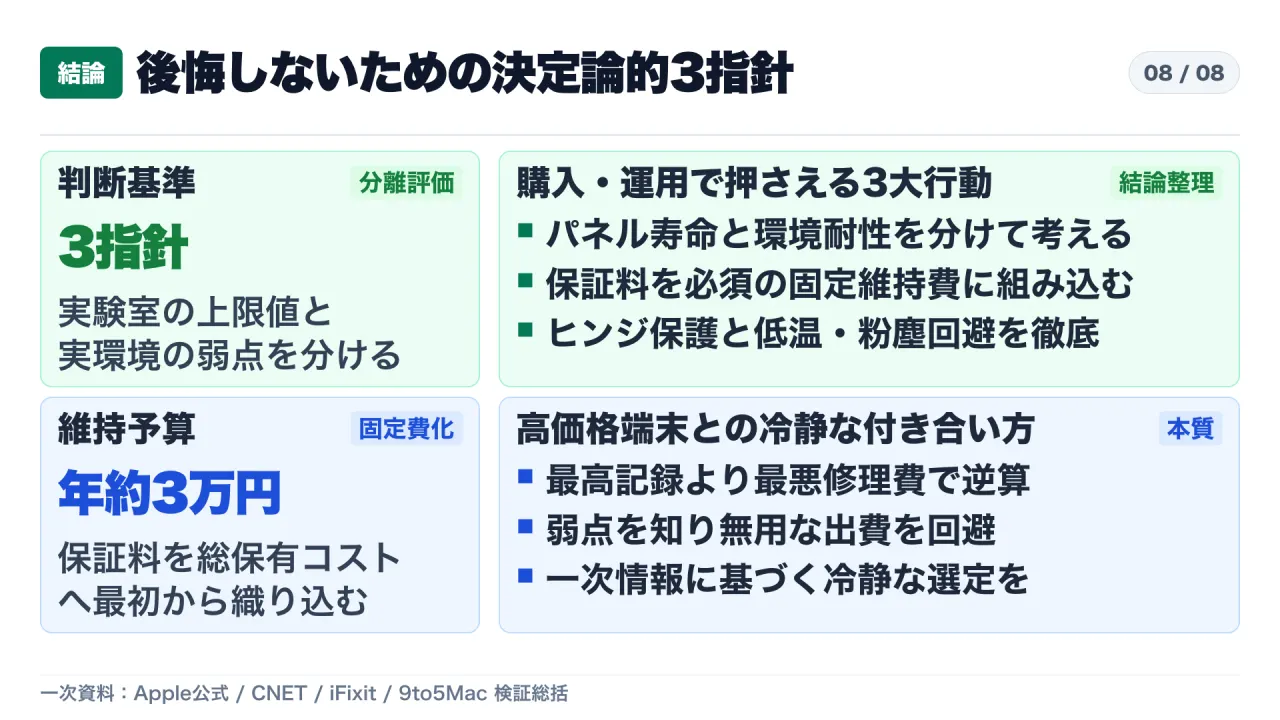
- Separate Panel Fatigue From Environmental Fragility: View 451,000 clean-room folds as proof of indoor glass endurance, while recognizing that pocket grit, ice, and freezing weather can cut real-world hinge life toward 75,000 cycles.
- Build ~30,000 JPY/Year Warranty Cost Into Purchase TCO: Treat AppleCare+ as a fixed ownership expense alongside the 364,800 JPY retail price, backed by a 5-to-8-year break-even cushion against 182,800–273,800 JPY repairs.
- Shield the Hinge Spine and Never Force Resistance: Choose a case that covers the hinge, keep pockets free of lint and sand, let chilled devices warm up before opening, and never force a stiff hinge flat.
Expensive first-generation hardware rewards buyers who plan around worst-case repair costs and environmental weak points rather than headline studio numbers.
Verified Primary Sources
- CNET: After 3 Weeks and More Than 451,000 Folds, the iPhone Duo’s Hinge Is Finally Starting to Fail
- CNET: Live Now! The iPhone Duo Is Crossing 500K Folds in Our Custom Machine
- CNET: Meet the Custom-Built Machine That Has Folded the iPhone Duo Nearly 500,000 Times
- Apple Japan Newsroom: Apple Unveils iPhone Duo
- Apple Store Japan: iPhone Duo Pricing and AppleCare+ Information
- iFixit: iPhone Duo Teardown
- 9to5Mac: Apple Responds to Reports of iPhone Duo’s Inner Display Cracking
- 9to5Mac: Here’s How Much iPhone Duo Costs to Repair Out of Warranty