Can Seven Nuclear Reactors Solve Japan's AI Power Crunch? Next-Gen Limits and Realistic Paths
Primary data from the IEA, U.S. DOE, and Japan’s OCCTO shows next-gen SMRs and fusion will miss the 2030 AI demand surge—while restarting 7 idle reactors and securing turbines offer a realistic path.
Japanese Edition: Read the original Japanese article on Substack
Video Episode (Japanese Audio): Watch on YouTube
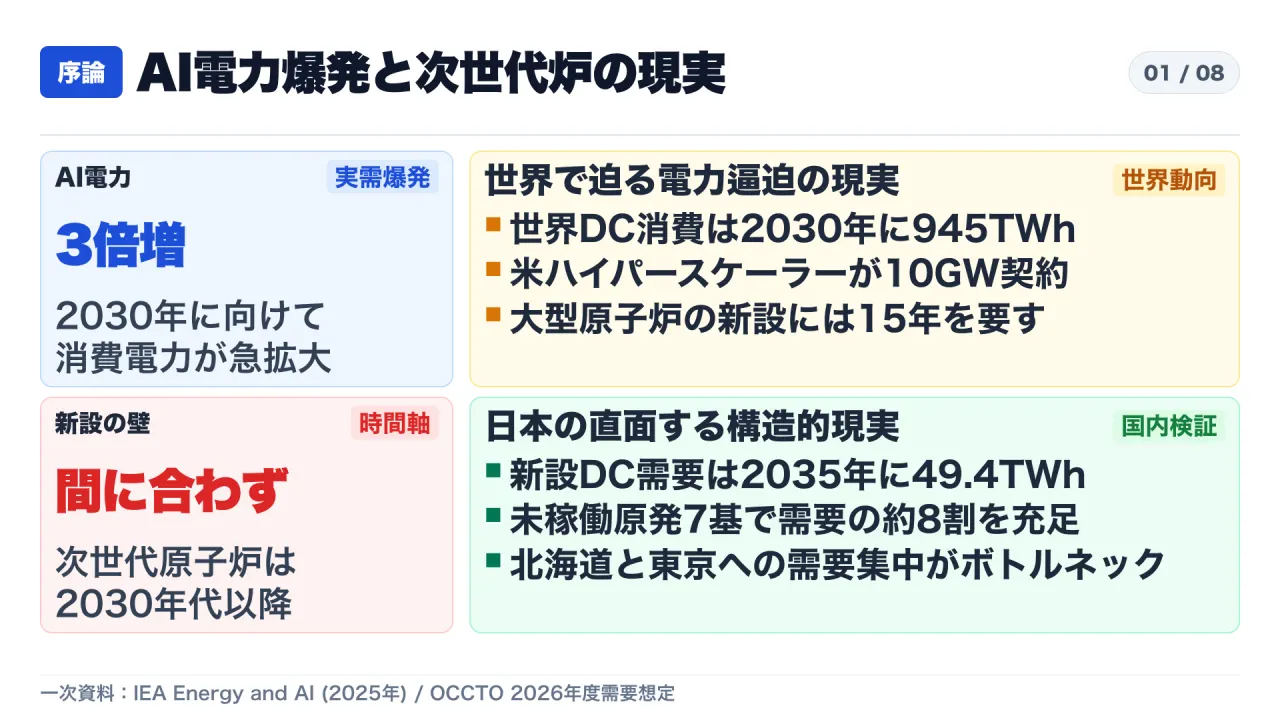
As artificial intelligence training and inference workloads scale across global cloud regions, expectations surrounding “next-generation nuclear power” have reached fever pitch. Major U.S. hyperscalers have signed more than 10 GW of combined nuclear power purchase agreements (PPAs), positioning small modular reactors (SMRs) and commercial fusion as the clean baseload backbone for future AI data centers.
Yet a rigorous examination of primary filings from energy agencies, nuclear regulators, and heavy-equipment manufacturers reveals an uncomfortable timeline gap. Across Western markets, virtually no next-generation reactor design can deliver commercial gigawatts in time for the acute demand expansion running through 2030. Large conventional reactors require roughly 15 years from planning to grid connection, which collides directly with the 3-to-5-year investment cycle of AI infrastructure.
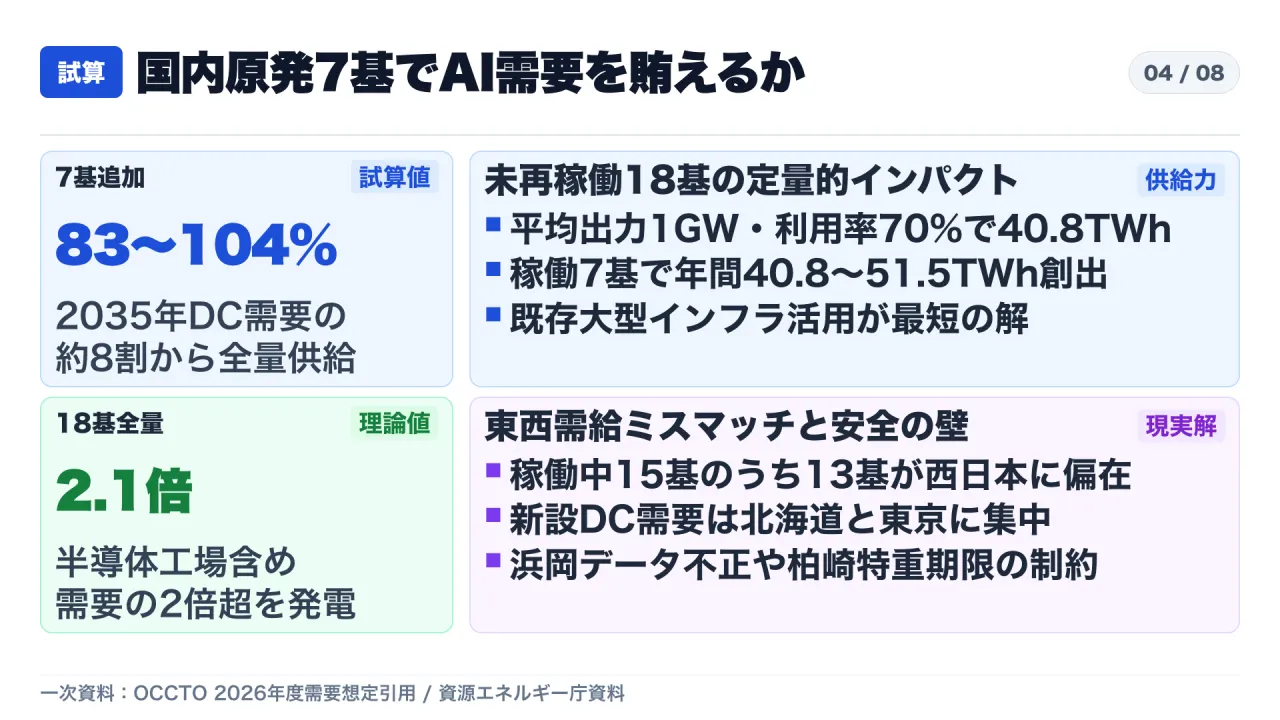
Turning to Japan, official demand projections published by the Organization for Cross-regional Coordination of Transmission Operators (OCCTO—Japan’s national grid coordination body) indicate that newly added data center electricity demand by fiscal year 2035 will reach 49.4 TWh annually, or 6.61 GW of peak load. Against that backdrop, safely restarting just 7 of Japan’s 18 currently idled large light-water reactors could supply roughly 83% to 104% of the nation’s new data center demand. Even so, Japan faces severe geographic mismatches between western generation and eastern load centers, alongside multi-year manufacturing bottlenecks in gas turbines and power transformers.
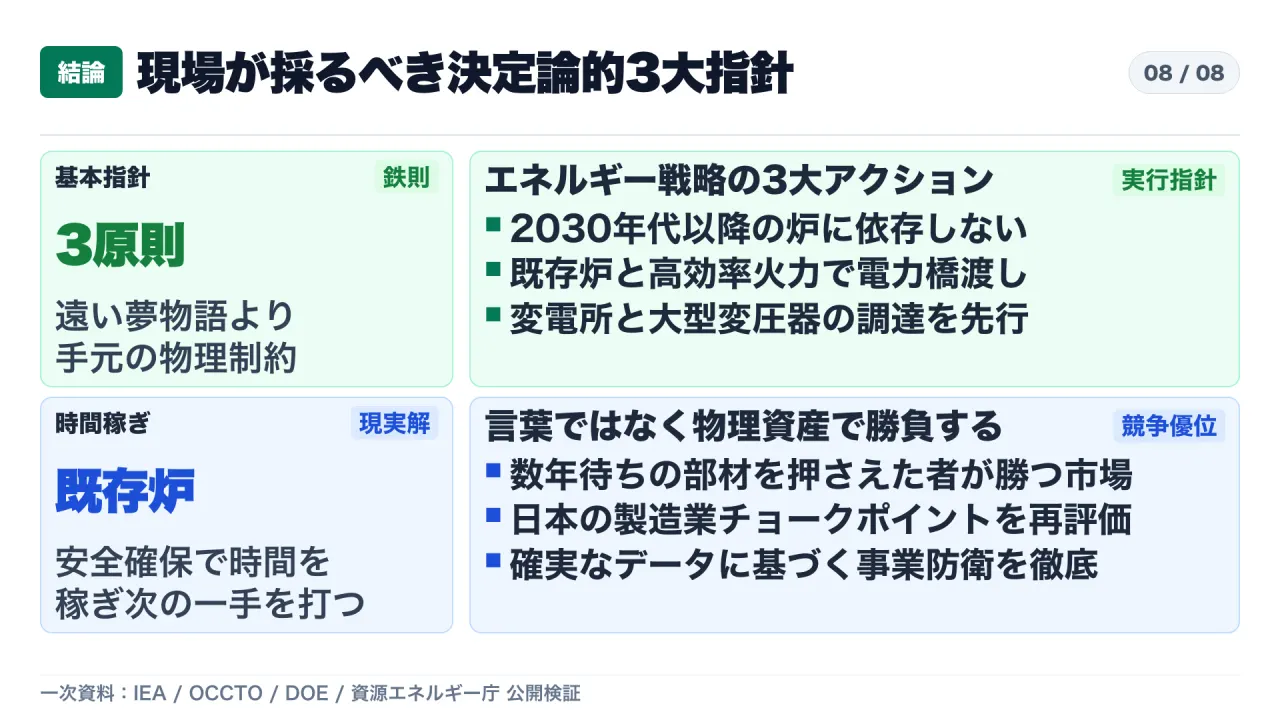
- Core Thesis: Next-generation SMRs and fusion cannot solve the 2026–2030 AI power crunch due to cost escalation, HALEU fuel monopolies, and unresolved physics; Japan’s realistic bridge relies on existing reactor restarts, high-efficiency gas turbines, closed-loop geothermal pilots, and early substation procurement.
- Primary Sources Verified: IEA Energy and AI (2025), U.S. Department of Energy (DOE) Pathways to Commercial Liftoff: Advanced Nuclear, World Nuclear Association (WNA) reports (2026), U.S. Nuclear Regulatory Commission (NRC), ITER and Fusion Science and Technology (2026), Japan’s OCCTO Fiscal Year 2026 Demand Forecast (January 2026), METI Power Generation Cost Verification Working Group, Lawrence Berkeley National Laboratory (LBNL) Queued Up, Japan Steel Works (JSW) and Mitsubishi Heavy Industries (MHI) fiscal 2026 disclosures, Wood Mackenzie, and Japan’s Cabinet Secretariat Growth Strategy 2026 (July 2026).
- Actionable Strategic Takeaways: Do not anchor 2020s power procurement on 2030s reactor promises; leverage existing baseload assets and bridge gas turbines while locking down grid interconnection rights and large transformers years ahead of facility construction.
1. Why Next-Generation Nuclear Misses the 2030 Window
SMR Capital Cost Escalation and Project Cancellations
Small modular reactors (SMRs) were conceived to replace bespoke site construction with factory-built modules, capturing learning-curve savings known as the “Nth-of-a-Kind” (NOAK) effect. In practice, early commercial deployments have collided with steep “First-of-a-Kind” (FOAK) cost inflation across materials, specialized engineering, and regulatory licensing.
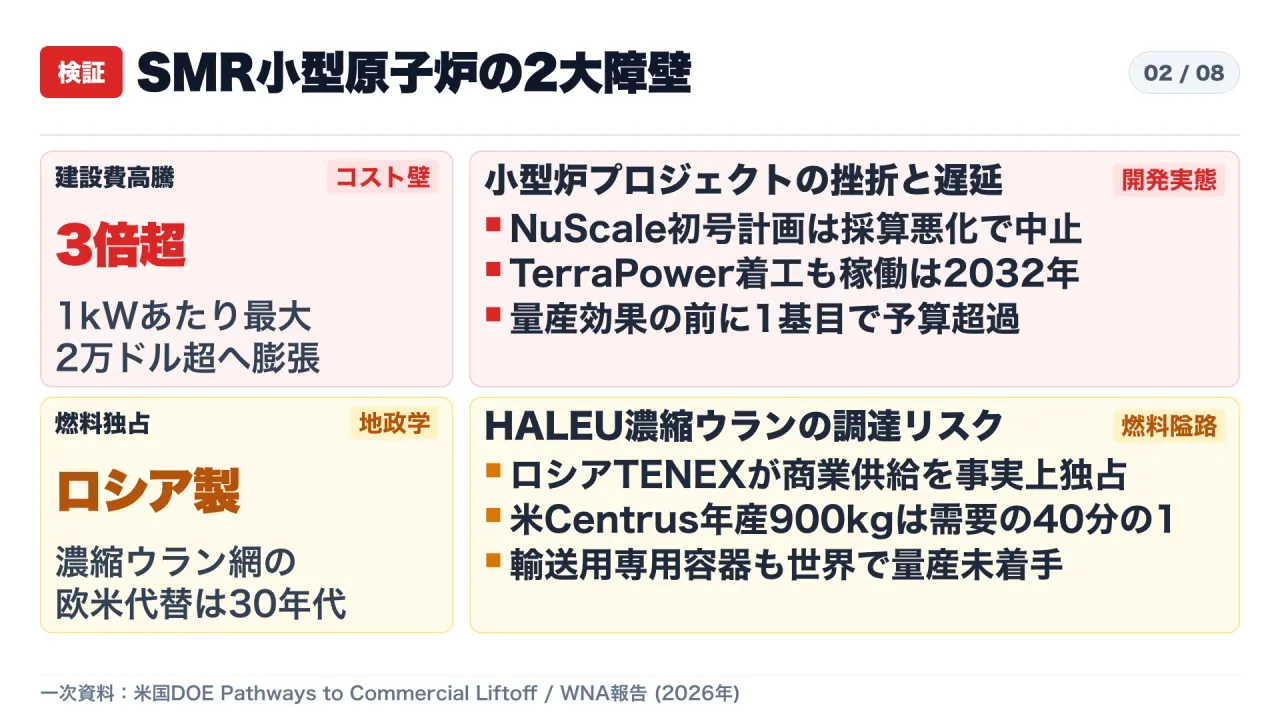
In its initial benchmark targets, the U.S. Department of Energy projected FOAK SMR capital costs at $6,200 per kilowatt, declining to $3,600 per kilowatt after mass production. Industry project tracking demonstrates a starkly different trajectory. On NuScale Power’s flagship Carbon Free Power Project (CFPP) in the United States, total estimated construction costs surged from $5.3 billion to $9.3 billion in under two years, pushing unit capital costs to $20,139 per kilowatt—more than triple the initial DOE target. Unable to absorb the deteriorating economics, participating municipal utilities withdrew, forcing the cancellation of the CFPP before ground was broken in November 2023.
Other Western advanced-reactor projects confirm that commercial timelines extend well into the 2030s. Ontario Power Generation’s (OPG) Darlington project in Canada, comprising four 300 MW light-water SMRs, received construction authorization in 2025 with a combined budget of CAD 20.9 billion (roughly $12,500 per kilowatt) and targets first grid power in 2030. Meanwhile, TerraPower’s 345 MW sodium-cooled fast reactor (Natrium) in Wyoming broke ground in April 2026 with a maximum budget near $4.0 billion (roughly $11,600 per kilowatt), yet initial commercial delivery is not expected until 2032 or later.
| Project | Country / Type / Capacity | Cost Trajectory & Unit Capex | Current Status & Target Timeline |
|---|---|---|---|
| NuScale CFPP | U.S. / Light-water SMR / 462 MW | $5.3B to $9.3B ($20,139/kW) | Canceled in late 2023 before construction due to cost escalation |
| OPG Darlington | Canada / Light-water SMR / 300 MW x 4 | CAD 20.9B total (~$12,500/kW) | Construction licensed in 2025; first unit grid target 2030 |
| TerraPower Natrium | U.S. / Sodium-cooled fast reactor / 345 MW | Up to $4.0B (~$11,600/kW) | Broke ground April 2026; delivery expected 2032 or later |
| CNNC ACP100 | China / Light-water SMR / 125 MWe | Undisclosed | Construction began 2021; hot functional testing phase |
Consider a practical analogy from commercial construction: imagine signing a custom building contract priced at $800 per square foot, only to receive a revised contractor quote of $2,400 per square foot immediately before excavation begins. Rather than absorbing a threefold cost overrun, the project sponsor terminates the contract and leaves the site vacant. That structural dynamic is precisely what halted early U.S. SMR deployment.
The HALEU Fuel Monopoly and Supply Vacuum
Even when non-light-water Generation IV reactors or advanced SMR designs clear capital hurdles, they confront a critical upstream choke point: nuclear fuel enrichment. Unlike conventional light-water reactors that operate on low-enriched uranium (LEU) below 5% uranium-235, most advanced SMR designs require high-assay low-enriched uranium (HALEU) enriched between 5% and 20%.
According to World Nuclear Association (WNA) assessments in 2026, the only entity supplying HALEU at commercial scale to Western markets has been TENEX, a subsidiary of Russia’s state-owned Rosatom. Although the United States enacted legislation in 2024 prohibiting Russian uranium imports, domestic replacement capacity remains severely constrained. Centrus Energy operates the sole licensed U.S. HALEU demonstration cascade, producing roughly 900 kilograms annually. Against projected U.S. domestic demand exceeding 40 metric tons per year by the late 2020s, existing domestic output covers less than one-fortieth of required volume.
European and North American enrichment facilities capable of commercial-scale HALEU production—alongside certified specialized transport casks, which are not yet in mass production—will not reach full maturity until the mid-2030s. Until those plants come online, non-light-water SMRs face an unavoidable fuel supply vacuum. Any enterprise data center plan assuming HALEU-fueled SMRs in 2028 or 2029 fails a basic supply-chain stress test.
2. Three Unsolved Physics Barriers in Fusion Power
Beyond fission SMRs, private fusion startups have attracted more than $14 billion in cumulative venture and institutional capital across over 56 companies worldwide. However, transitioning from laboratory ignition to a reliable 24/7 utility power plant requires overcoming three formidable physical and engineering walls.
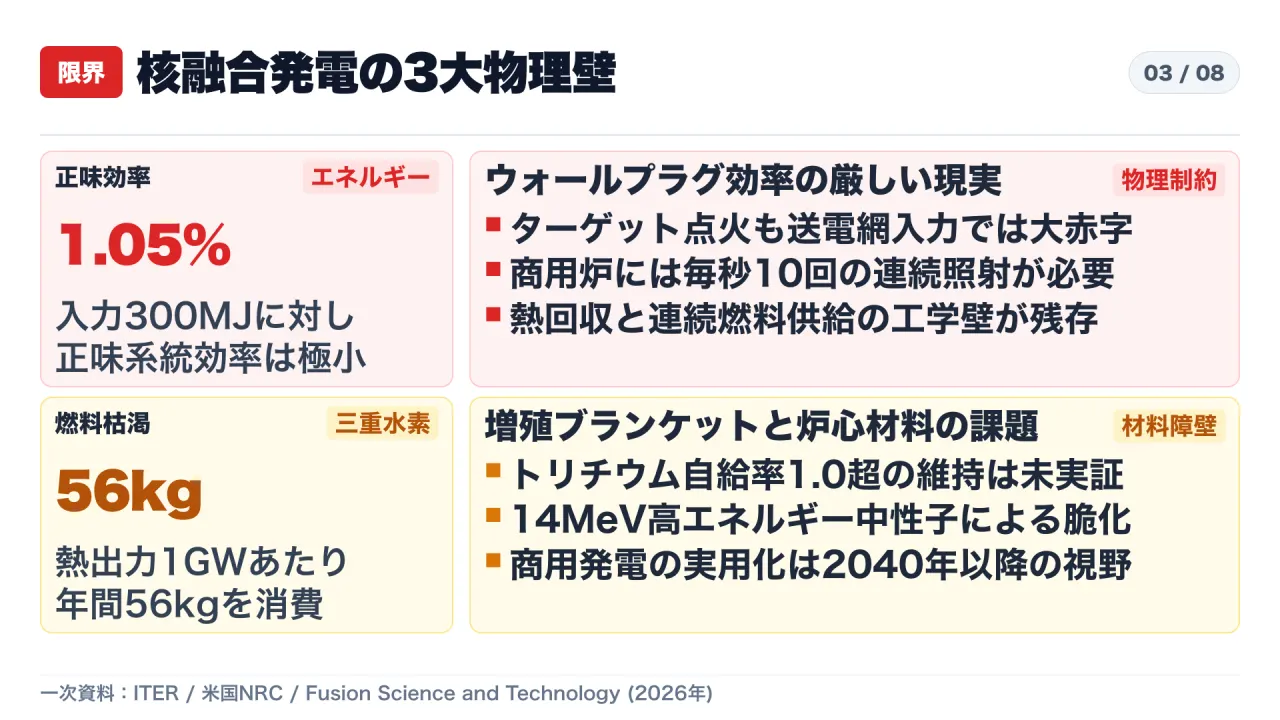
- Net Wall-Plug Efficiency Deficit: In 2022, the U.S. National Ignition Facility (NIF) achieved scientific breakeven by generating 3.15 MJ of fusion output from 2.05 MJ of laser energy delivered onto the target capsule. What headlines frequently omit is total grid power consumption: driving the laser array required approximately 300 MJ drawn from the electrical grid. Dividing 3.15 MJ of fusion yield by 300 MJ of grid input produces a net wall-plug efficiency of just 1.05%. Operating a commercial laser-fusion plant requires repeating target injection, ignition, fuel replenishment, and thermal energy capture roughly 10 times per second—an industrial engineering loop that remains unproven.
- The Tritium Breeding Self-Sufficiency Paradox: A deuterium-tritium commercial fusion reactor generating 1 GW of thermal output consumes roughly 56 kilograms of tritium per year. Because natural tritium supplies are negligible, the reactor must breed more tritium than it burns using a lithium-6 blanket surrounding the plasma chamber, achieving a tritium breeding ratio (TBR) sustainably above 1.0. Yet adding structural steel and cooling pipes inside the blanket to extract usable heat absorbs neutrons and depresses the breeding ratio—creating a direct mechanical conflict between thermal extraction and fuel self-sufficiency.
- Lack of Structural Materials Resistant to 14 MeV Neutrons: Deuterium-tritium fusion emits 14 MeV high-energy neutrons—far more energetic and damaging than fission neutrons—causing severe atomic displacement and helium embrittlement in reactor walls. Qualification data for low-activation ferritic steels and advanced alloys capable of enduring years of continuous 14 MeV bombardment does not yet exist at commercial scale.
Taken together, these physical constraints mean fusion electricity will not contribute meaningfully to data center grids before the 2040s at the earliest.
3. Japan’s Quantitative Reality: Can 7 Reactors Cover AI Demand?
OCCTO Demand Forecasts vs. Idle Nuclear Fleet Capacity
When policy discussions shift from distant breakthroughs to existing infrastructure, Japan’s balance sheet looks unexpectedly resilient on paper. According to the Fiscal Year 2026 Demand Forecast published by OCCTO in January 2026, newly constructed and expanded data centers across Japan will add 6.61 GW of peak power demand and 49.4 TWh of annual electricity consumption by fiscal year 2035. Including newly planned semiconductor fabrication plants raises the combined incremental demand to 7.62 GW and 56.8 TWh annually. Globally, the International Energy Agency (IEA) estimates total data center electricity demand will roughly triple to 945 TWh by 2030.
To benchmark Japan’s domestic requirement against existing assets, examine the nation’s commercial large light-water reactor fleet. Excluding units already slated for decommissioning, Japan maintains 33 operable commercial reactors. Following the restart of Tokyo Electric Power Company’s (TEPCO) Kashiwazaki-Kariwa Unit 6 in April 2026, 15 reactors have returned to commercial operation, leaving 18 reactors currently idled.
Assuming an average rated electrical capacity between 0.95 GW and 1.05 GW per unit and accounting for scheduled refueling and safety inspections at realistic capacity factors of 70% to 80%, the output math is straightforward:
| Restart Scenario | Assumed Capacity & Load Factor | Annual Generation Output | Coverage of FY2035 DC Growth (49.4 TWh) |
|---|---|---|---|
| Add 7 of 18 Idle Reactors | 0.95 GW / 70% capacity factor | 40.8 TWh | 83% |
| Add 7 of 18 Idle Reactors | 1.05 GW / 70% capacity factor | 45.1 TWh | 91% |
| Add 7 of 18 Idle Reactors | 0.95–1.05 GW / 80% capacity factor | 46.6–51.5 TWh | 94–104% |
| Restart All 18 Idle Reactors | 0.95–1.05 GW / 70–80% factor | 104.9–132.5 TWh | 212–268% |
Safely bringing just 7 additional idled reactors online generates 40.8 to 51.5 TWh per year—covering 83% to 104% of Japan’s projected 2035 incremental data center demand without building a single greenfield nuclear plant.
East-West Grid Mismatch and Regulatory Friction
However, national totals conceal Japan’s acute geographic bottleneck. Out of the 15 reactors currently operating, 13 are located in Western Japan (Kansai, Kyushu, Shikoku, and Chugoku regions). By contrast, new hyperscale AI data center construction is heavily concentrated in Eastern Japan—specifically the greater Tokyo metropolitan area and Hokkaido, where cooler climates and renewable potential attract compute clusters.
Because Japan operates split grid frequencies (50 Hz in the east and 60 Hz in the west) linked by capacity-constrained interregional transmission lines and frequency converters, surplus nuclear baseload in Western Japan cannot simply be wheeled north to Tokyo or Sapporo at will. Consequently, securing safe restarts at eastern sites—such as Hokkaido Electric’s Tomari Unit 3 or TEPCO’s Kashiwazaki-Kariwa Unit 7—becomes pivotal.
At the same time, regulatory governance remains uncompromising. In January 2026, Chubu Electric Power withdrew its safety review application for the Hamaoka Nuclear Power Plant after seismic data irregularities came to light. Even restarted units face strict statutory deadlines: Kashiwazaki-Kariwa Unit 6 faces temporary suspension in 2029 if specialized counter-terrorism backup facilities (known in Japan as “specific severe accident backup facilities”) are not completed on schedule. Safety engineering and local municipal consent remain non-negotiable prerequisites.
4. Realistic Comparison of Four Baseload & Bridge Power Sources
Since greenfield SMRs and fusion miss the 2026–2030 window, Japanese energy planners and corporate buyers must evaluate four practical generation pathways side by side:
| Evaluation Metric | 1. Existing Nuclear Restarts | 2. High-Efficiency Gas Turbines (CCGT) | 3. Next-Gen Geothermal (Closed-Loop) | 4. Solar PV + Grid-Scale Batteries |
|---|---|---|---|---|
| Deployment Lead Time | 1–4 years (where safety upgrades near completion) | Large frames: ~5 years; mid/small: 18–36 months | 3–4 years post-drilling (FY2029 commercial target) | Solar: 1–2 years; batteries face severe grid congestion |
| Generation Cost (LCOE) | Lowest tier on marginal operating cost basis | LNG thermal: ¥16–21/kWh | Under development (drilling cost reduction key) | Solar alone: ¥6.9–8.8/kWh (before storage add-on) |
| Geopolitical Exposure | Low (existing fleet uses standard LEU) | Moderate (seaborne LNG import reliance) | Very low (100% domestic, 24/7 weather-independent) | High (upstream cell supply concentration) |
| Japanese Industrial Edge | Dominant (JSW ultra-heavy reactor forgings) | Dominant (MHI in global top-3 oligopoly) | Medium-high (world’s 3rd largest geothermal resource) | Shift toward grid access rights and EPC execution |
Two hidden supply-chain bottlenecks stand out across these bridge options:
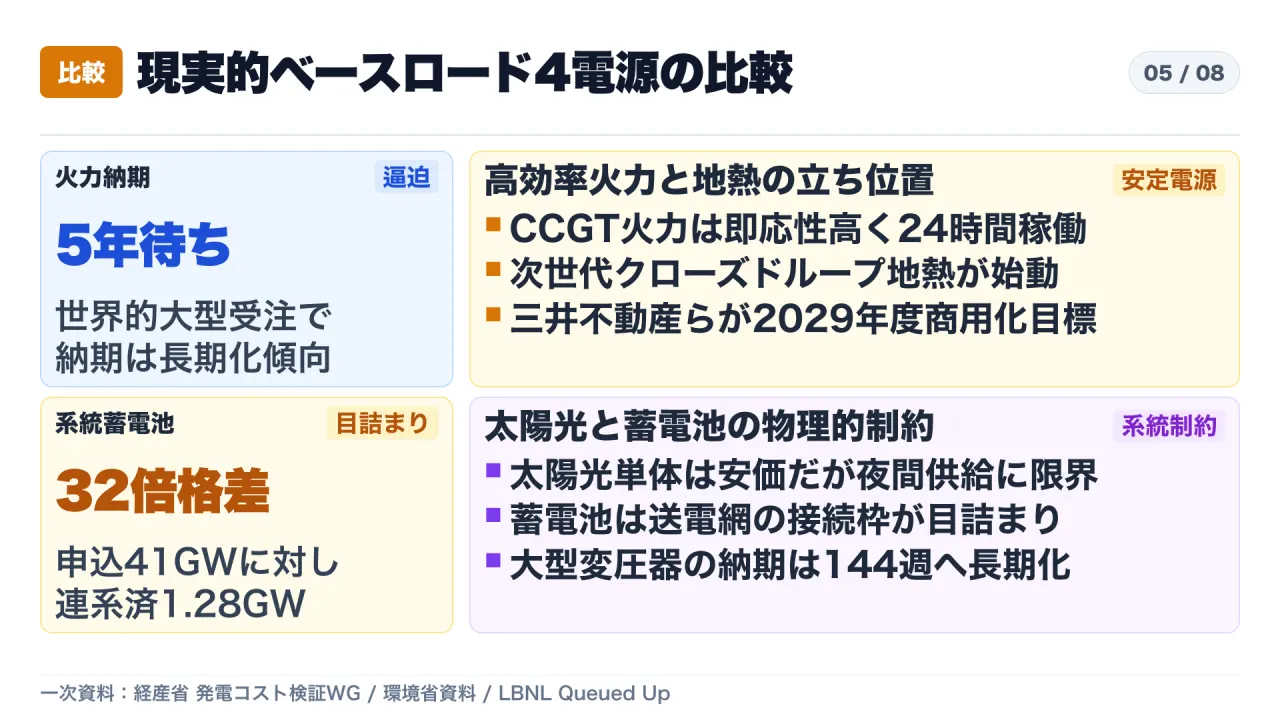
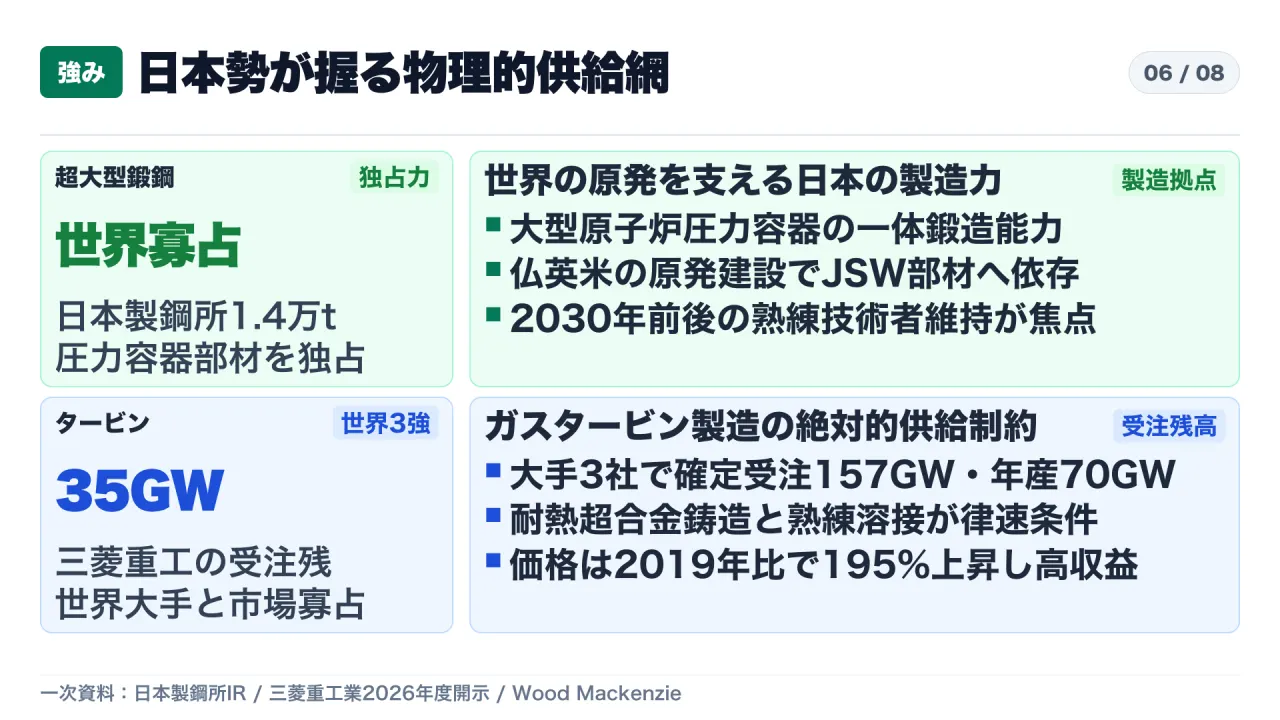
- Gas Turbine Manufacturing Backlog: Across the global big three OEMs—GE Vernova, Siemens Energy, and Mitsubishi Heavy Industries (MHI)—firm order backlogs have reached 157 GW (exceeding 250 GW including slot reservations) against combined global annual manufacturing capacity of 60 to 70 GW. Large combined-cycle gas turbines now carry roughly 5-year lead times, and prices have jumped 195% compared to 2019 levels. Data center developers seeking faster deployment are scrambling for mid-to-small frame units deliverable in 18 to 36 months.
- Substation and Battery Interconnection Congestion: In Japan, grid-scale battery storage connection applications have surged to 41 GW, yet only 1.28 GW has actually been interconnected—a 32-to-1 bottleneck at substation tie-ins. Globally, LBNL and industry data confirm that large power transformer lead times have stretched to 144 weeks (over 2.5 years), with transformer prices up 86%.
5. Physical Choke Points Controlled by Japanese Manufacturers
While Japan frequently lags in frontier AI foundation models, Japanese heavy industry quietly holds irreplaceable manufacturing choke points inside the global power hardware supply chain:
- Ultra-Heavy Reactor Pressure Vessel Forgings (Japan Steel Works): Constructing modern Generation III+ large reactors requires massive seamless forged steel rings for reactor pressure vessels to eliminate structural weld lines. Only two facilities worldwide possess the ultra-heavy hydraulic press capability required at scale: Japan Steel Works (JSW) with its 14,000-ton press in Muroran, and South Korea’s Doosan Enerbility. Western reactor builders in France, the United Kingdom, and the United States remain structurally dependent on JSW forgings, making retention of veteran forging and machining talent around 2030 a strategic priority.
- High-Efficiency Gas Turbines (Mitsubishi Heavy Industries): Mitsubishi Heavy Industries holds 35 GW in firm large-frame gas turbine backlog as of fiscal 2026 disclosures. Precision single-crystal superalloy casting and high-temperature welding constitute binding rate-limiting steps across the industry, allowing top-three turbine suppliers to sustain high margins amid multi-year order visibility.
6. Three High-Conviction Domestic Infrastructure Themes (2026–2030)
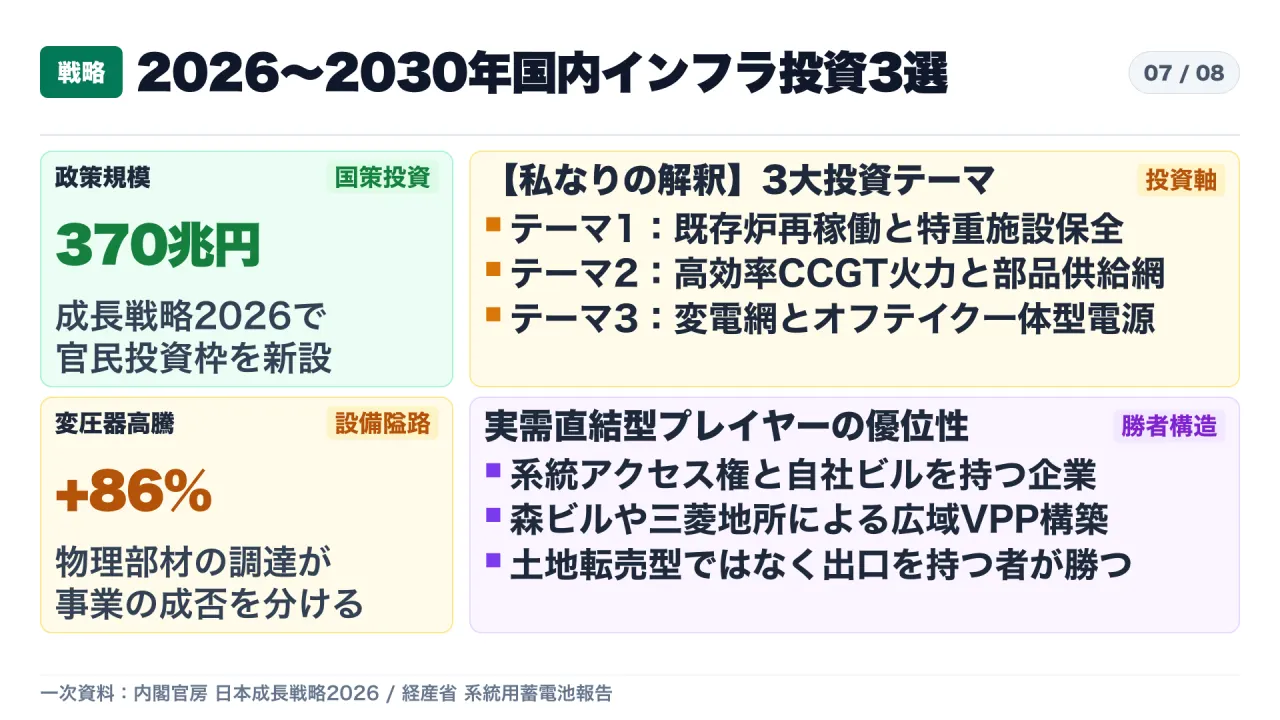
In July 2026, the Japanese Cabinet approved “Japan Growth Strategy 2026,” establishing a public-private investment framework totaling ¥370 trillion across strategic domains. Filtering that macro policy through physical supply-chain constraints highlights three structural infrastructure areas grounded in real demand:
- Theme 1: Existing Reactor Safety Upgrades, Counter-Terrorism Facilities, and Heavy Forgings Engineering, procurement, and construction (EPC) contractors executing seismic retrofits and mandatory counter-terrorism backup facilities for existing reactors, alongside specialty steelmakers led by Japan Steel Works.
- Theme 2: High-Efficiency Gas Turbines, Precision Hot-Section Components, and Mid-Size Units Turbine OEMs led by Mitsubishi Heavy Industries and specialized suppliers of heat-resistant superalloy castings, precision blades, and long-term maintenance services.
- Theme 3: Extra-High-Voltage Substations and “Offtake-Integrated” Distributed Power Substations and large transformer suppliers, paired with real estate and data center operators that directly control both grid access rights and end-user electricity demand—such as major urban developers (including Mori Building and Mitsubishi Estate) deploying wide-area virtual power plants (VPPs), and closed-loop geothermal developers targeting fiscal 2029 commercialization.
In real estate and compute infrastructure alike, participants who hold pure speculative land face multi-year grid waitlists, whereas integrated operators combining physical substation access, equipment procurement slots, and captive offtake demand capture durable pricing power.
7. Conclusion: Three Deterministic Guidelines for Decision-Makers
Solving the AI data center electricity crunch requires trading 20-year technology slide decks for disciplined physical-asset execution. Engineering leaders, corporate executives, and infrastructure planners should enforce three deterministic operating rules:
- Exclude 2030s Next-Gen Nuclear from 2020s Power Plans: Recognize the hard gap between AI compute cycles (3 to 5 years) and nuclear licensing/fuel supply timelines. Do not commit mission-critical capacity roadmaps to unproven SMR or fusion delivery schedules.
- Bridge the Gap with Existing Reactors and High-Efficiency Gas: Treat verified safety upgrades on existing light-water reactors and top-tier CCGT gas turbines—augmented by emerging closed-loop geothermal—as the realistic operational bridge through 2035.
- Lock Down Substations, Transformers, and Grid Access First: Because large power transformers face 144-week lead times and Japanese battery interconnection queues exceed 32 times connected capacity, securing grid access rights and physical electrical hardware ahead of generation assets determines project survival.
In physical infrastructure, outcomes belong not to the boldest vision statement, but to organizations that secure multi-year hardware slots, verified grid interconnections, and reliable primary data before competitors react.