Java 17 Pre-Auth RCE Alert and Oracle's 652-Patch November 2026 CSPU: What Is Verified and What Comes Next
Primary records from Oracle, OpenJDK, NIST NVD, and CISA KEV separate confirmed facts from pre-disclosure gaps around CVE-2026-114938 and outline a three-step production defense plan.
Japanese Edition: Read the original Japanese article on Substack
Video Episode (Japanese Audio): Watch on YouTube
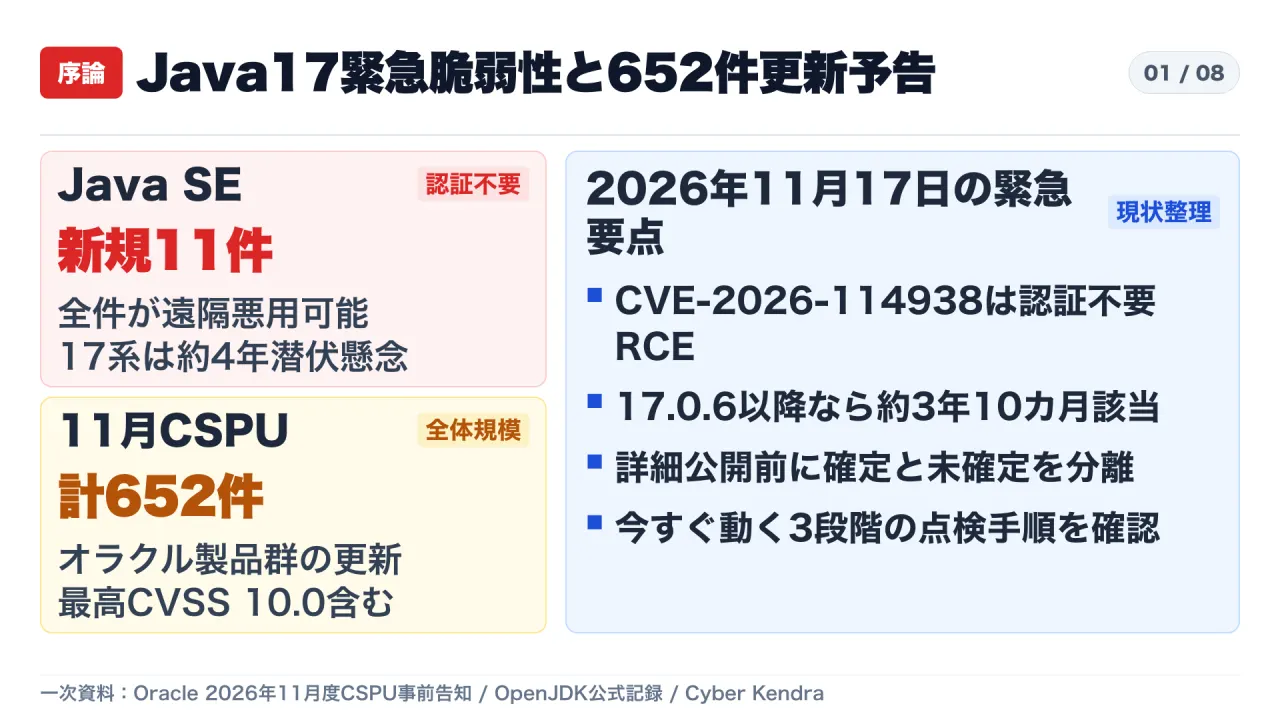
On November 17, 2026, enterprise infrastructure teams and security operations centers faced an urgent wave of advisories concerning CVE-2026-114938, a reserved unauthenticated remote code execution (Pre-Auth RCE) vulnerability reported across OpenJDK 17 builds from 17.0.6 onward, alongside Oracle’s November 2026 Critical Security Patch Update (CSPU) pre-release announcement totaling 652 new fixes across its product portfolio. Because OpenJDK 17.0.6 shipped on January 17, 2023, the reported exposure window spans roughly three years and ten months of production Java 17 deployments.
When an unauthenticated RCE notice arrives hours ahead of the full Risk Matrix, engineering leaders face two competing risks: underreacting to a wormable server flaw or misallocating emergency maintenance based on unverified secondary numbers. Cross-referencing twelve primary sources—including Oracle’s November 2026 CSPU pre-release notice, Oracle’s CPU/CSPU FAQ, JDK 17.0.21 and JDK 21.0.13.0.3 release notes, the Oracle Java SE Support Roadmap, Oracle’s October 2026 CPU advisory, OpenJDK mailing list records, upstream GitHub tags, NIST NVD API 2.0, the CISA Known Exploited Vulnerabilities (KEV) catalog, Oracle’s PHP2Shell alert, and Cyber Kendra’s initial reporting—isolates exactly what is officially confirmed on November 17, 2026, what remains undisclosed pending the formal matrix, and how operations teams should execute a three-stage inventory, exposure-reduction, and verification plan.
- Core Thesis: Oracle officially confirms 11 new Java SE security patches—all remotely exploitable without authentication—within a 652-patch November 2026 CSPU, while NVD holds zero public records for
CVE-2026-114938prior to the 1:00 PM PT release window; furthermore, monthly CSPUs are non-cumulative and Java 17 exited Premier Support in September 2026, making process-level inventory and network-layer isolation essential before patching. - Primary Sources Verified: Oracle November 2026 CSPU Pre-Release Announcement, Oracle CPU/CSPU Program FAQ, Oracle JDK 17.0.21 and 21.0.13.0.3 Release Notes, Oracle Java SE Support Roadmap (updated October 20, 2026), Oracle October 2026 CPU (1,295 fixes) and CA alerts (
CVE-2026-91403,CVE-2026-114820), OpenJDKjdk-updates-devmailing list (January 2023), OpenJDKjdk17u/jdk21utags (17.0.21.1,21.0.13.1), NIST NVD API 2.0, and the CISA KEV feed. - Actionable Strategic Takeaways: Do not rely on
java -versionor perimeter WAF rules; audit live JVM PIDs viaps,readlink, andjcmd, close unnecessary external listeners withss -lntpand allowlists, verify prerequisite October 2026 CPU and commercial OTN licensing status, and confirm post-restart binary paths once17.0.21.1builds ship.
1. Separating Confirmed Official Facts from Pre-Disclosure Gaps
Why are operations teams worldwide mobilizing before the technical CVE text is public, while reported severity figures simultaneously diverge across sources? The answer lies in the gap between early security alerts citing a reserved identifier and Oracle’s pre-release summary published ahead of the formal Risk Matrix.
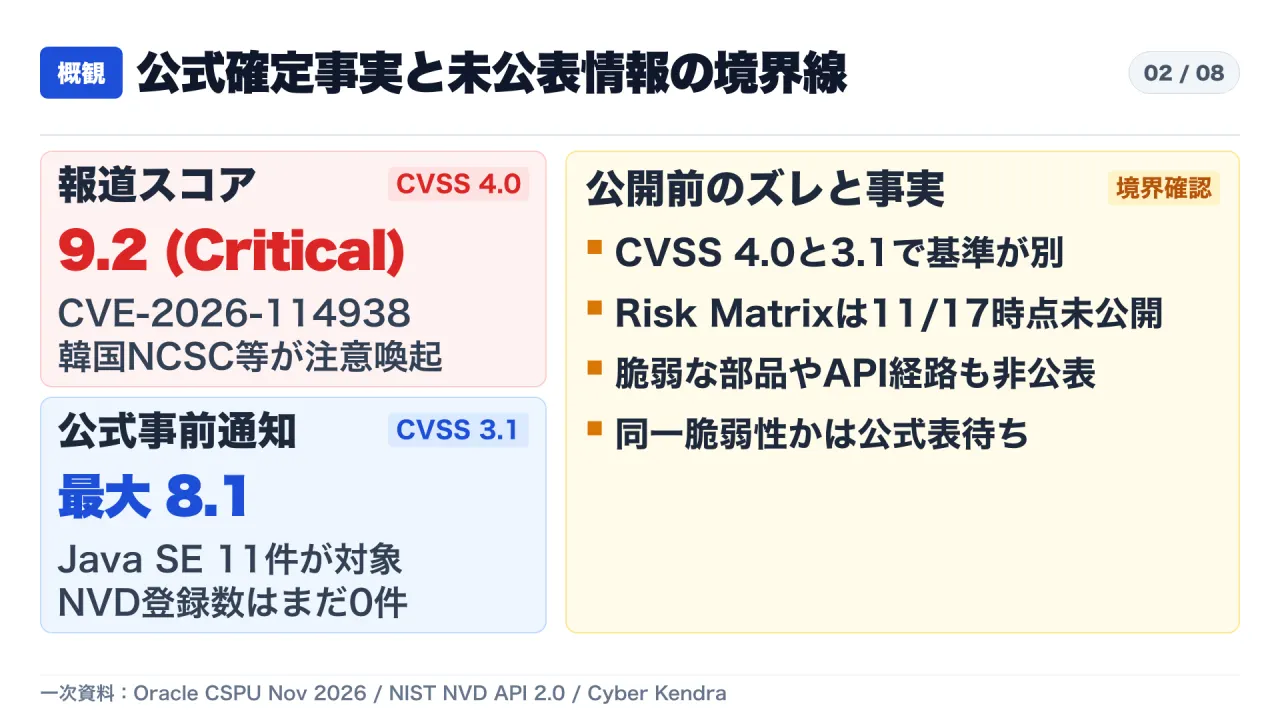
| Dimension | Verified Data as of November 17, 2026 | Unconfirmed Scope / Primary Check Result |
|---|---|---|
| Reserved CVE ID | CVE-2026-114938 (cited by South Korea’s NCSC advisory and technical press) |
NIST NVD API 2.0 query returns totalResults: 0 (no published record) |
| Severity Score | CVSS v4.0: 9.2 (reported) / CVSS v3.1: up to 8.1 (Oracle pre-release) |
Different CVSS versions (4.0 vs. 3.1); exact mapping awaits Oracle’s Risk Matrix |
| Java SE Fix Count | 11 new Java SE patches, all 11 remotely exploitable without authentication |
Individual CVE numbers, affected subsystems, and protocol vectors undisclosed |
| Total CSPU Scale | 652 new security patches across Oracle products (Hyperion 267, EBS 72, Fusion 71) |
Fusion Middleware and Analytics include CVSS v3.1 scores up to 10.0 |
| OpenJDK Exposure | Reported from 17.0.6 onward (roughly 3 years and 10 months since January 17, 2023) |
Impact on Java 8, 11, 21, 25, or 27 awaits upstream OpenJDK advisories |
| Exploitation Status | Zero entries in CISA KEV; no confirmed in-the-wild PoC or exploit payload | Rapid post-patch diffing makes immediate network hardening mandatory |
Oracle’s official November 2026 CSPU pre-release announcement (cspunov2026.html) lists the affected Java SE versions slated for updates: Oracle Java SE 8u511, 8u511-perf, 11.0.33, 17.0.21, 21.0.13, 25.0.5, and 27.0.1; Oracle GraalVM for JDK 17.0.21 and 21.0.13; Oracle GraalVM Enterprise Edition 21.3.20.0.3; and Oracle JavaFX 21.0.13, 25.0.5, and 27.0.1. Notably, Oracle’s October 2026 release notes for JDK 17.0.21 and 21.0.13.0.3 already included explicit expiration warnings stating that continued use after the November 17, 2026 update is not recommended. Upstream OpenJDK repositories (openjdk/jdk17u and openjdk/jdk21u) already contain tagged fix builds such as jdk-17.0.21.1+1 and jdk-21.0.13.1+1.
At the same time, querying the NIST National Vulnerability Database API 2.0 on November 17, 2026 for CVE-2026-114938 returns zero results, confirming that the CVE record has not yet transitioned from reserved status to public disclosure. Until Oracle publishes its full Risk Matrix and upstream OpenJDK distributors publish their security advisories, engineering teams should treat the 11 official unauthenticated Java SE fixes as confirmed scope while treating the exact CVSS 4.0 score of 9.2 and cross-version propagation beyond Java 17 as unverified pending formal release notes.
2. The Four-Year Exposure Window and Oracle’s 652-Patch Portfolio
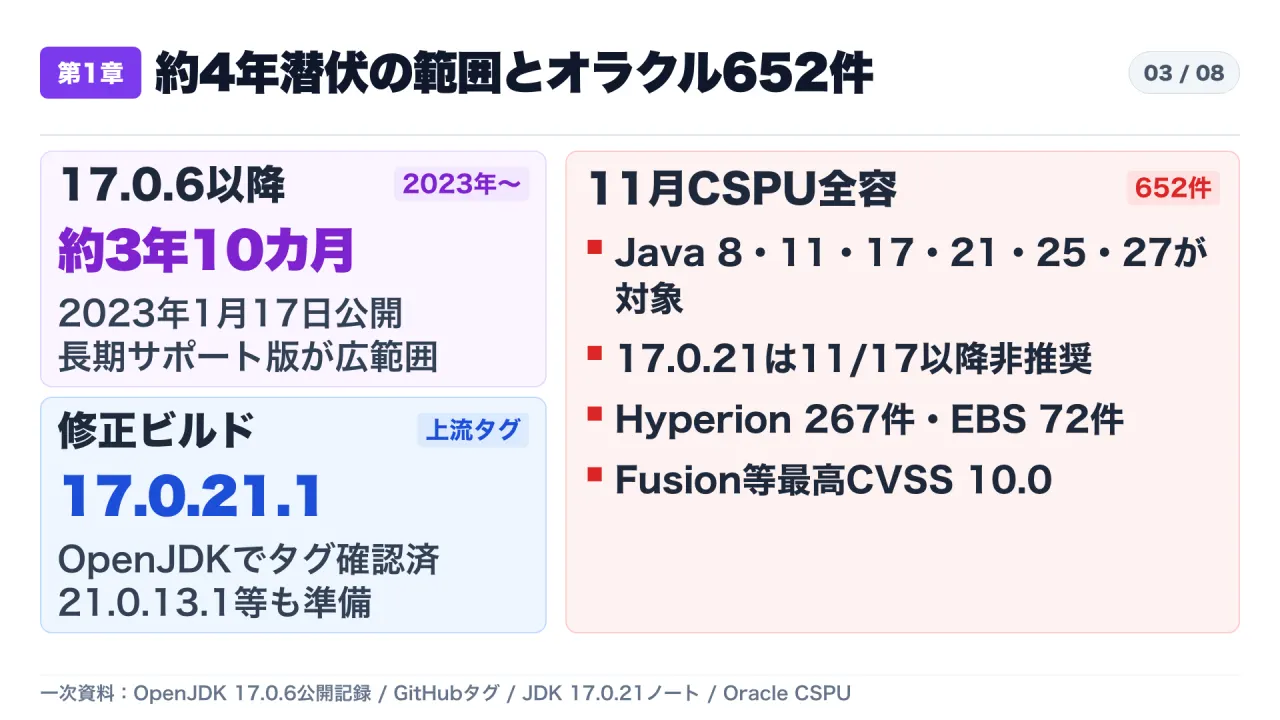
Primary OpenJDK mailing list archives establish why the reported Java 17 exposure window attracts urgent attention. In jdk-updates-dev records from January 2023, OpenJDK 17.0.6 was tagged and released on January 17, 2023. Measuring from January 2023 through November 2026 yields three years and ten months—nearly four years of long-term support (LTS) releases built on top of 17.0.6 if the reported flaw traces back to that baseline.
Consider a concrete analogy: discovering a flaw in a nationwide chain of office buildings constructed nearly four years ago where every branch’s rear entrance can be opened without a key. Even before inspectors publish the exact lock blueprint, facility managers cannot wait to verify which buildings sit directly on public streets and which are enclosed inside gated campuses.
Beyond Java SE itself, Oracle’s November 2026 CSPU covers a broad enterprise footprint totaling 652 new patches:
- Oracle Hyperion: 267 new security patches (including 158 remotely exploitable without authentication).
- Oracle E-Business Suite: 72 new security patches (61 remotely exploitable without authentication).
- Oracle Fusion Middleware: 71 new security patches (36 remotely exploitable without authentication, reaching CVSS v3.1
10.0). - Oracle Analytics: 29 new security patches (reaching CVSS v3.1
10.0). - Oracle Java SE: 11 new security patches, all 11 remotely exploitable without authentication, with a maximum CVSS v3.1 base score of
8.1.
Because enterprise Java applications frequently run inside or alongside Fusion Middleware, E-Business Suite, and Analytics clusters, infrastructure teams must coordinate both runtime updates and middleware patch windows rather than treating the JDK binary in isolation.
3. Two Policy Traps: Non-Cumulative Monthly CSPUs and Java 17 Licensing
Even when engineering teams move quickly to deploy the November 2026 fixes, two structural rules in Oracle’s security and support policies can leave production systems exposed or non-compliant.
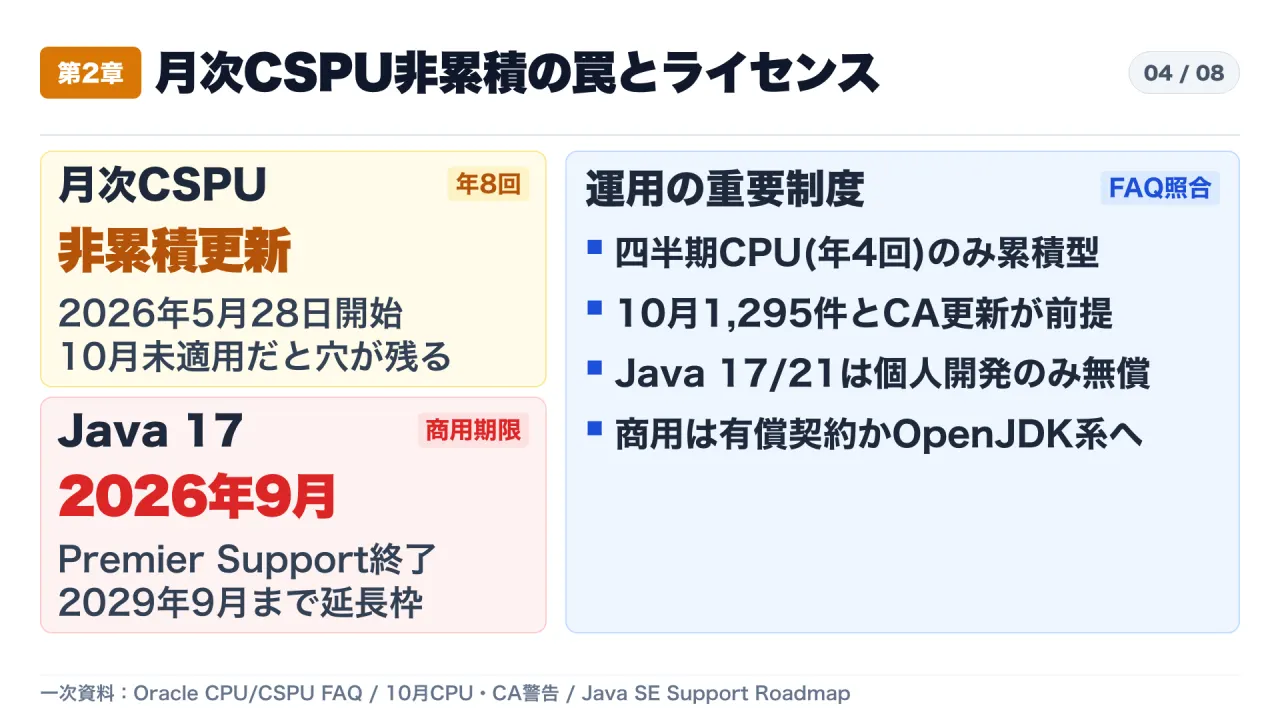
Trap 1: Monthly CSPUs Are Explicitly Non-Cumulative
According to Oracle’s official CPU and Security Alert Program FAQ (cpufaq.html), Oracle delivers two distinct types of scheduled security updates:
- Quarterly Critical Patch Updates (CPUs): Released on the third Tuesday of January, April, July, and October (around 1:00 PM US Pacific Time, corresponding to roughly 6:00 AM Japan Standard Time the following morning). Quarterly CPUs are cumulative—they incorporate all prior security fixes.
- Monthly Critical Security Patch Updates (CSPUs): Introduced starting May 28, 2026 for the remaining eight months of the year (February, March, May, June, August, September, November, and December). Oracle explicitly defines monthly CSPUs as non-cumulative, containing only prioritized critical updates rather than the full historical patch baseline.
If an enterprise server skipped Oracle’s October 2026 quarterly CPU—which contained 1,295 new security fixes—or missed the emergency Security Alerts issued on October 21, 2026 (CVE-2026-91403) and October 30, 2026 (CVE-2026-114820) regarding eMudhra CA certificate distrust, applying only the November 2026 CSPU will not close those earlier vulnerabilities. Think of the quarterly CPU as comprehensive preventative surgery that addresses every accumulated condition, whereas the monthly CSPU acts like an emergency bandage for the highest-priority wound. Applying November’s bandage without October’s treatment leaves older exposures intact.
Trap 2: Java 17 Premier Support Ended in September 2026
Oracle’s Java SE Support Roadmap (updated October 20, 2026) records that Java 17 (LTS) exited Premier Support in September 2026 and entered Extended Support through September 2029. Under the same roadmap, Oracle JDK binaries for Java 8, 11, 17, and 21 are governed by the Oracle Technology Network (OTN) License Agreement: free use is restricted to personal, development, and selected approved uses, while commercial production deployments require a paid support subscription. Free-for-all-users licensing applies only to Java 25 and later under the Oracle No-Fee Terms and Conditions (NFTC) lifecycle.
Organizations running Oracle JDK 17 or 21 in commercial production must verify active support entitlement immediately. Teams without commercial Oracle subscriptions must track patch availability dates across open-source distributions—such as Eclipse Temurin, Amazon Corretto, Azul Zulu, or Linux vendor OpenJDK packages—which often publish hours or days after upstream OpenJDK tags are finalized.
4. Why WAF Rules Fail and How Fast Post-Patch Exploits Arrive
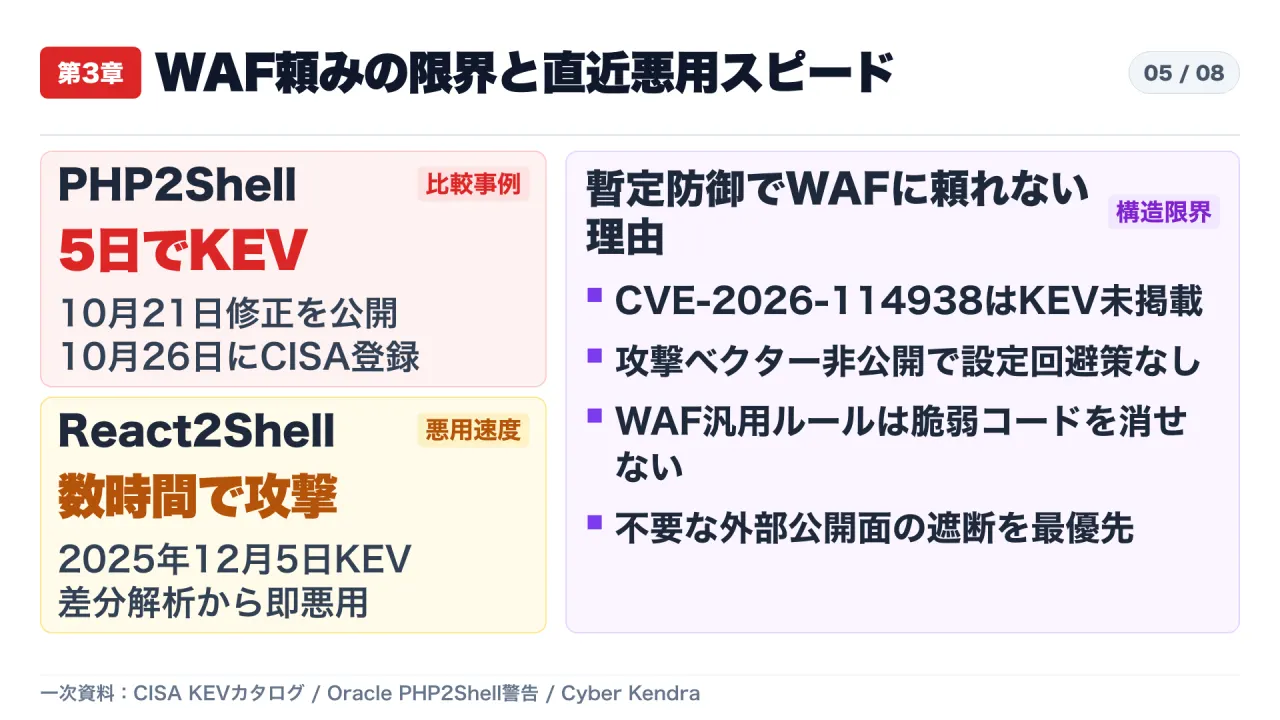
Checking the CISA Known Exploited Vulnerabilities (KEV) catalog on November 17, 2026 confirms zero entries for CVE-2026-114938, and no verified public proof-of-concept exploit has surfaced prior to patch release. However, historical entries in the same KEV catalog demonstrate how rapidly the window between disclosure and mass exploitation collapses once fixes become public.
- PHP2Shell (
CVE-2026-109618/CVE-2026-109619): Patches were released on October 21, 2026, and CISA added the unauthenticated RCE flaws to the KEV catalog just five days later on October 26, 2026. - React2Shell (
CVE-2025-55182): Active exploitation began within hours of public disclosure in early December 2025, prompting KEV addition on December 5, 2025.
When vendors publish updated binaries or source commits, automated diffing allows attackers to isolate modified bounds checks or deserialization paths within hours. Waiting for KEV confirmation before isolating exposed Java services effectively cedes the first wave of exploitation.
Moreover, organizations cannot treat a Web Application Firewall (WAF) as a reliable substitute for network isolation or patching. While the exact vulnerable subsystem, API call, or protocol vector remains undisclosed, neither Oracle nor third-party WAF vendors can guarantee a signature or configuration workaround. Relying purely on generic WAF signatures is like leaving a broken vault door unlocked while asking a lobby guard to stop anyone wearing suspicious clothes: until you know how an intruder opens the vault, the safest move is sealing unnecessary exterior access routes altogether.
5. Practical Triage and Common Inventory Blind Spots
During the pre-disclosure window, security and operations teams need clear triage criteria so emergency work targets genuine exposure rather than creating outages across internal workloads.
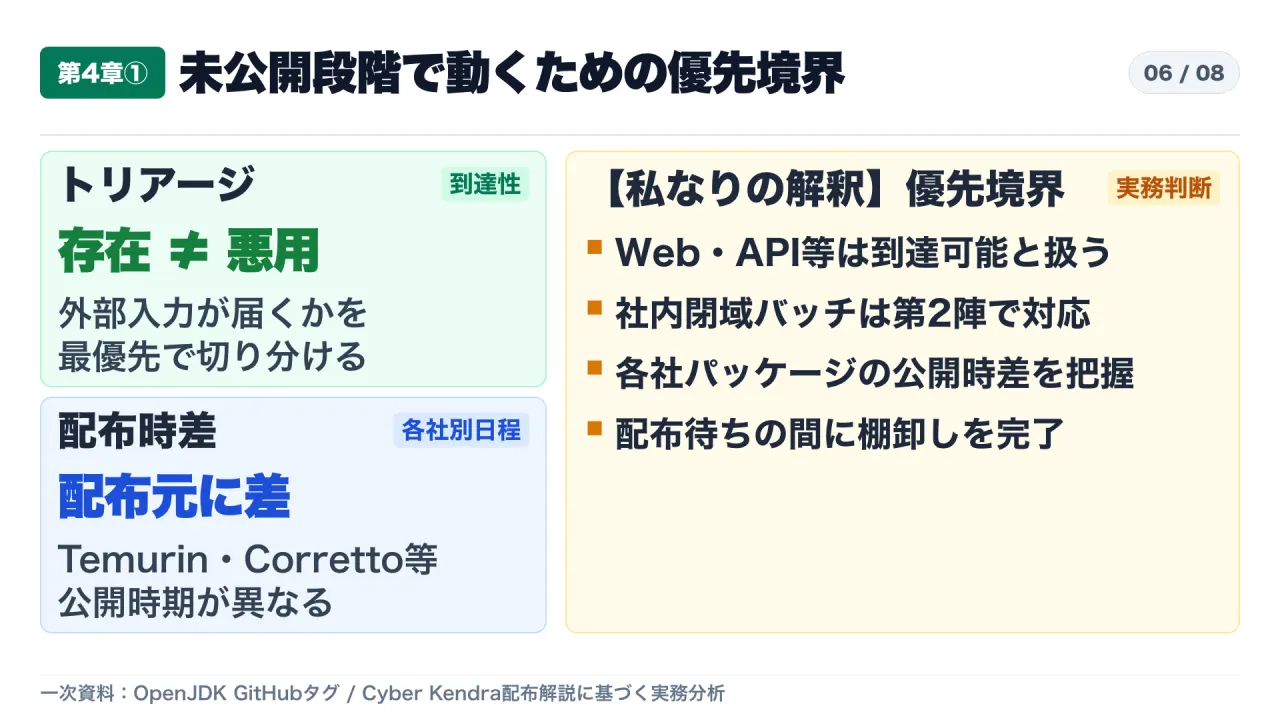
First, separate installation presence from external reachability. As security advisories emphasize, exploiting an unauthenticated RCE requires an attacker’s input to reach the vulnerable Java runtime over the network. Systems directly exposed to the public internet—web applications, API gateways, reverse-proxied microservices, and externally reachable administrative consoles—must be treated as immediately reachable and placed in Wave 1 for containment and patching. Internal batch jobs and isolated back-office JVMs behind private VLANs belong in Wave 2 once inventory is complete.
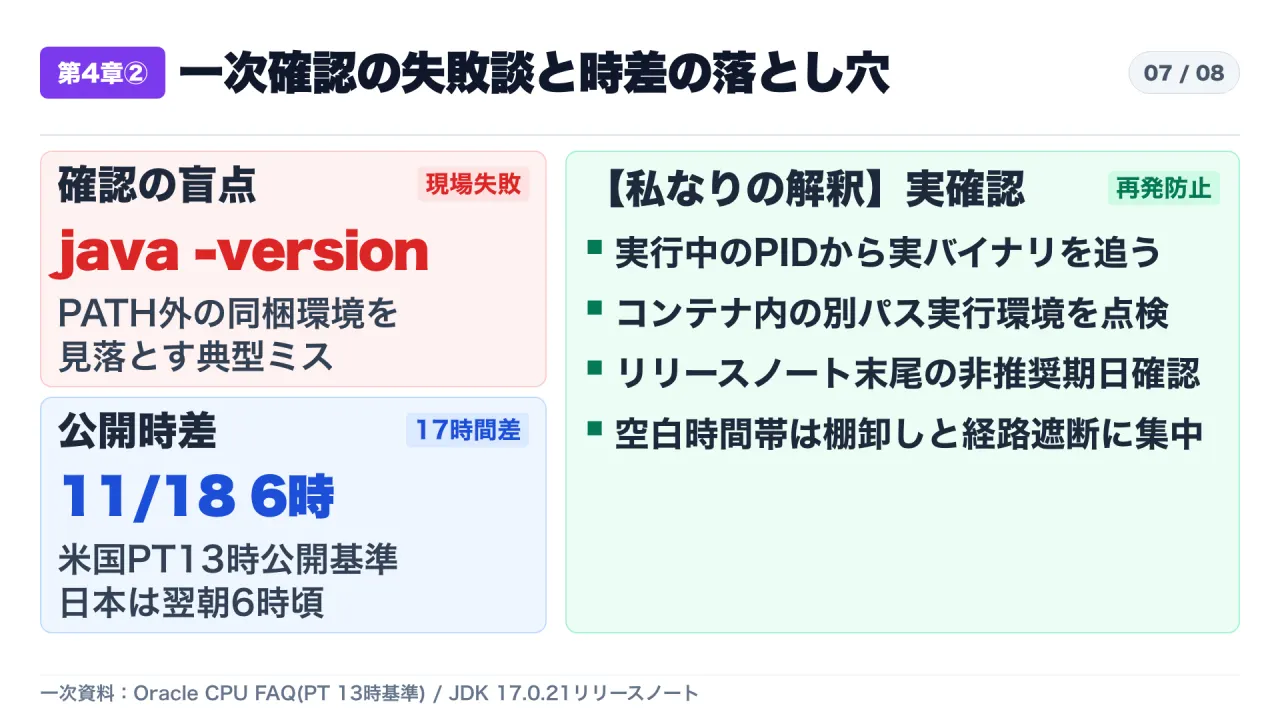
Second, avoid the most common verification blind spot in enterprise Linux and container operations: trusting java -version from a default shell. In production incidents, running java -version only inspects whichever binary happens to sit first in $PATH. Bundled JREs inside vendor appliances, application-specific /opt runtimes, and container images built with multi-stage layers frequently run older Java 17 builds even when the host OS package manager reports an updated version.
Equally important is accounting for release-time differences. Oracle publishes scheduled updates around 1:00 PM US Pacific Time on the third Tuesday of the month—roughly 6:00 AM Japan Standard Time on November 18, 2026—while downstream OpenJDK vendors compile, pass TCK suites, and distribute binary packages on varying schedules afterward. Teams should finish asset discovery and port-exposure reduction during the pre-release window rather than waiting idly for vendor RPMs or Docker tags.
6. Three-Stage Action Plan for Production Operations
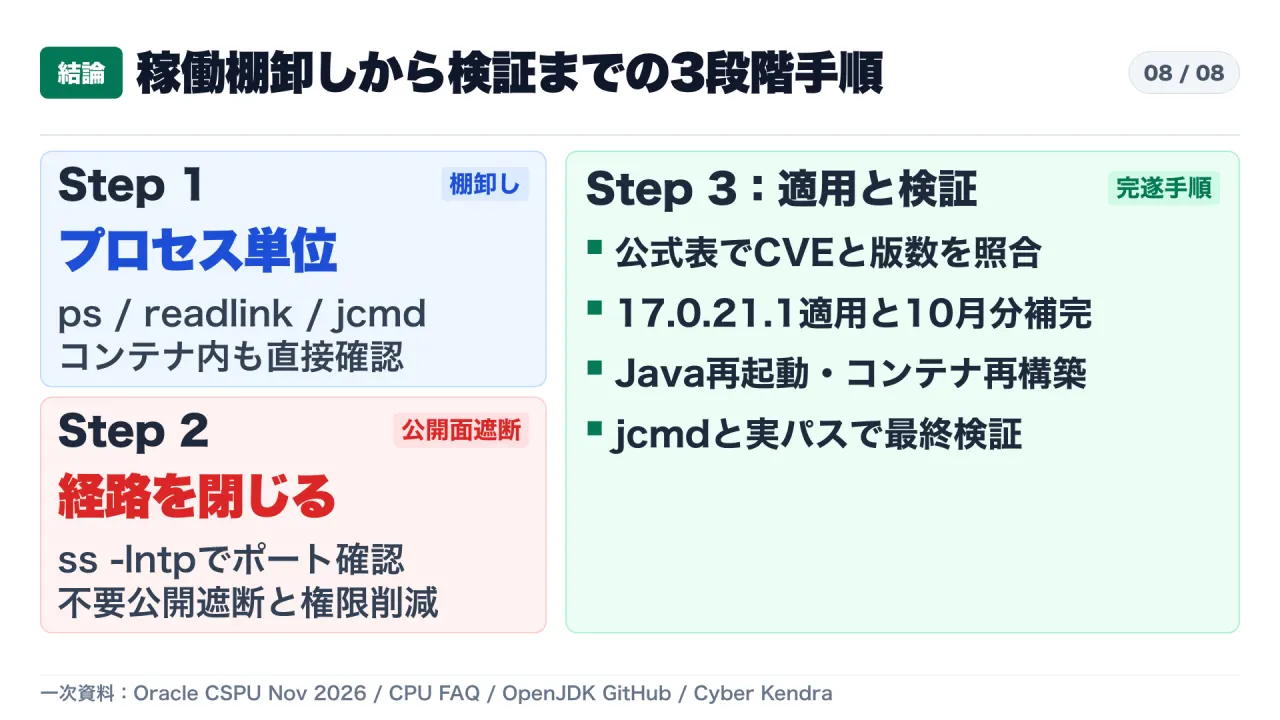
Operations teams can execute a structured three-stage workflow immediately without waiting for every secondary detail to stabilize.
Stage 1: Process-Level Inventory of Live Java Runtimes
Inspect every running JVM by process ID (PID) and container boundary rather than relying on shell defaults:
# Identify live Java processes and resolve actual executable binary paths
ps -eo pid,args | grep '[j]ava'
readlink -f /proc/<PID>/exe

# Query exact JVM version and build metadata under the process owner
jcmd <PID> VM.version

# Inspect runtimes inside running Docker and Kubernetes containers
docker exec <container> java -version
kubectl exec -n <namespace> <pod> -c <container> -- java -version
Record the distribution vendor, exact build tag (for example, 17.0.21 vs. older 17.0.x), binary path, and whether the runtime resides inside a commercial Oracle environment or an OpenJDK downstream build.
Stage 2: Map Listening Ports and Restrict Attack Surfaces
Correlate live Java PIDs with listening network sockets and close unnecessary exposure before exploit diffing begins:
# Map listening TCP sockets to active Java PIDs
sudo ss -lntp
- Restrict administrative consoles, JMX endpoints, and non-public service ports via firewall rules, cloud security groups, or load balancer IP allowlists.
- Apply least-privilege OS user accounts and IAM roles to Java processes to contain post-exploitation lateral movement.
- Verify that HTTP access logs, reverse-proxy logs, JVM stderr/GC logs, and OS process audit logs are actively retained off-host.
Stage 3: Patch Deployment, Full Restart, and Post-Restart Verification
- Once Oracle’s Risk Matrix and your OpenJDK vendor’s formal advisory publish (from 1:00 PM PT / 6:00 AM JST onward), cross-check
CVE-2026-114938and the 11 Java SE CVEs against your Wave 1 inventory. - Deploy
17.0.21.1/21.0.13.1equivalent patched builds to internet-facing services first, verifying whether October 2026 quarterly CPU prerequisites are already in place on Oracle estates. - Restart every host-level Java process and rebuild/redeploy container images from patched base layers—upgrading a package on disk does not replace an executable mapped into memory by a long-running daemon.
- Re-run
readlink -f /proc/<PID>/exeandjcmd <PID> VM.versionacross all Wave 1 and Wave 2 hosts to prove that zero legacy17.0.xbinaries remain active in memory.
Primary Sources and References
- Oracle Critical Security Patch Update Pre-Release Announcement - November 2026
- Oracle Critical Patch Update, Critical Security Patch Update and Security Alert Programs FAQ
- Oracle JDK 17.0.21 Release Notes
- Oracle JDK 21.0.13.0.3 Release Notes
- Oracle Java SE Support Roadmap (Updated October 20, 2026)
- Oracle Critical Patch Update Advisory - October 2026
- OpenJDK 17.0.6 Released (jdk-updates-dev, January 2023)
- OpenJDK jdk17u Tags (jdk-17.0.21.1)
- NIST NVD API 2.0 Query (CVE-2026-114938)
- CISA Known Exploited Vulnerabilities Catalog
- Oracle Security Alert Advisory - CVE-2026-109618 and CVE-2026-109619 (PHP2Shell)
- Cyber Kendra: CVE-2026-114938 Pre-Auth RCE Flaw in Java 17 Puts Servers at Risk