Why Microsoft's 24-Hour Outage Defied Auto-Recovery and Exposed SLA Gaps
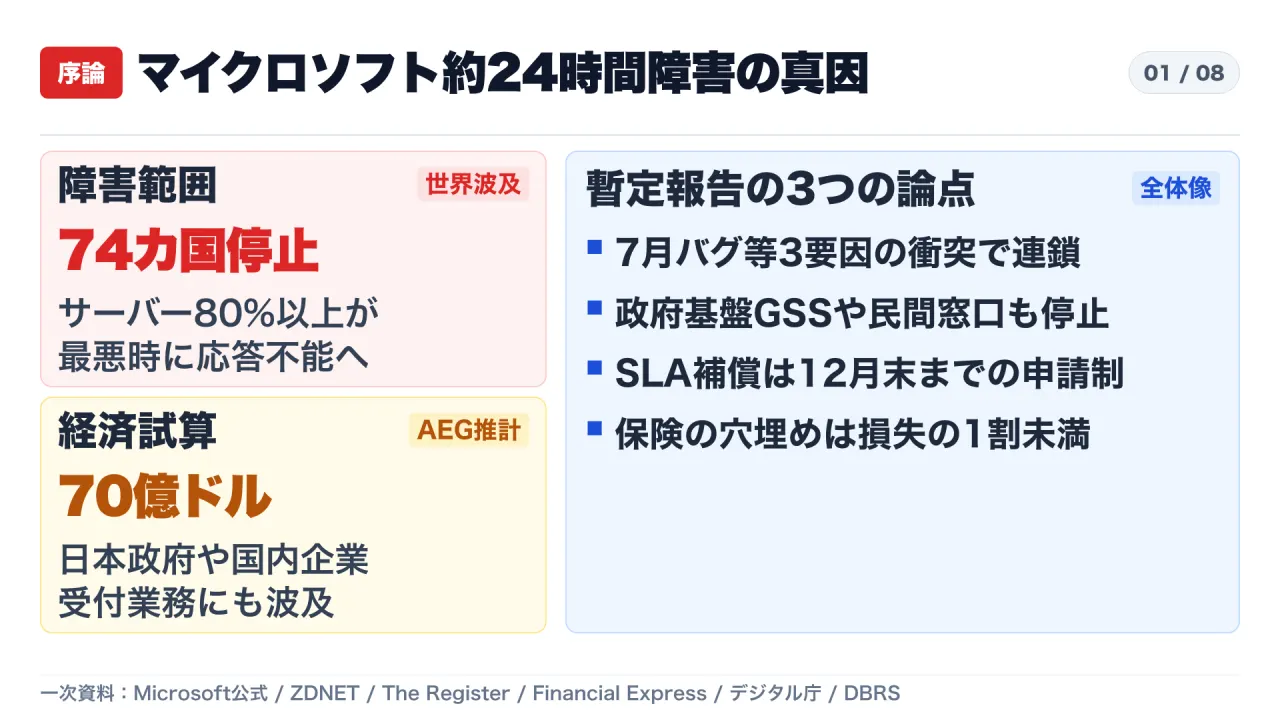
Microsoft’s preliminary PIR reveals three colliding triggers behind the 23h50m outage across 74 countries, Japanese government GSS disruption, and why SLA credits and cyber insurance cover under 10% of estimated losses.
Japanese Edition: Read the original Japanese article on Substack
Video Episode (Japanese Audio): Watch on YouTube
On November 16, 2026, Microsoft released its preliminary Post Incident Report (PIR) covering incident identifiers MO1550821 and EX1550543, alongside official engineering commentary from Corporate Vice President Charles Lamanna, explaining why Microsoft 365 services—including Outlook, Teams, and Copilot—suffered an outage lasting approximately 23 hours and 50 minutes across at least 74 countries. At the peak of the disruption, more than 80% of Microsoft’s network gateway servers stopped responding, automatic recovery mechanisms failed to contain the cascade, and downstream operational impact reached both Japan’s central Government Solution Service (GSS) and major domestic customer service desks.
For enterprise architects, IT procurement leaders, and risk managers globally, this incident exposes two uncomfortable realities that extend far beyond a single cloud provider. First, even hyper-scale cloud infrastructure carrying more than 450 million commercial paid seats can suffer a multi-factor resonance collapse when a dormant software defect stored in a test-environment blind spot meets sudden traffic shifts. Second, when productivity losses are modeled at billions of dollars—Anderson Economic Group estimated at least $7 billion in macroeconomic productivity loss—the contractual reality of Service Level Agreement (SLA) credits and cyber insurance policies leaves enterprises absorbing nearly all of the financial impact unless they proactively preserve evidence and build out-of-band continuity plans.
- Core Thesis: Microsoft’s ~23h50m outage was not caused by a cyberattack or runaway AI, but by three independent triggers colliding simultaneously—a dormant July 2026 gateway lock-contention defect undetected in low-core test labs, a Teams failover 15 hours earlier, and a ~14% gateway capacity deficit from a prior incident—causing automated traffic rerouting to overwhelm surviving nodes while SLA self-filing deadlines and cyber insurance exclusions left over 90% of modeled economic losses uncovered.
- Primary Sources Verified: Microsoft Community Hub (450M+ commercial paid seats), Microsoft Learn PIR framework, ZDNET (Charles Lamanna EVP statement and AEG $7B estimate), The Register / The Next Web / TalkEsport (
MO1550821andEX1550543preliminary PIR details and November 20, 2026 final PIR schedule), Financial Express & Yahoo Finance (SLA credit tiers and December 31, 2026 self-claim deadline), Japan’s Digital Agency & FNN (Minister Furukawa press conference and Prime Minister Takaichi’s three directives), Morningstar DBRS & Insurance Journal ($300M–$500M insured loss estimate within a $100M–$700M industry range), and Sankei Shimbun / J-CAST News (Sagawa Express and NTT East service desk impact). - Actionable Strategic Takeaways: Preserve tenant outage logs and incident IDs (
EX1550543/MO1550821) to file SLA credit claims before the December 31, 2026 deadline, formally authorize out-of-band communication channels (phone, secondary chat, SMS) in business continuity plans to block shadow IT leaks, audit hidden backend dependencies in ticketing and reservation workflows, and review non-malicious cloud outage exclusions in cyber insurance policies ahead of the November 20, 2026 final PIR.
1. Cross-Checking Eight Primary Source Streams
To separate verified engineering facts from speculation, this analysis cross-references eight independent primary source streams spanning Microsoft technical disclosures, Japanese government press briefings, credit rating agency insurance commentary, and domestic operational reports:
| Source Organization | Document / Briefing | Key Verified Facts |
|---|---|---|
| Microsoft Official | Community Hub / Microsoft Learn | Over 450M commercial paid seats; official PIR scope covering outage timestamps, impact, root cause, and continuous improvement plans |
| ZDNET | Lamanna EVP Statement & AEG Reporting | July update lock-contention defect; undetected in low-core test labs; AEG productivity loss model of at least $7B; 74 countries affected |
| The Register / The Next Web / TalkEsport | Preliminary PIR (MO1550821 / EX1550543) Analysis |
~23h50m duration; three colliding triggers (July defect, 15h prior Teams failover, ~14% capacity loss); 80%+ unresponsive; final PIR due November 20, 2026 |
| Financial Express / Yahoo Finance | SLA Credit Mechanics & Claim Window | 25% credit under 99.9% uptime and 50% under 99% (99.5% tiers apply per service); manual self-claim required by December 31, 2026; personal/free plans excluded |
| Digital Agency of Japan / FNN | Minister Furukawa Briefing & PM Directives | Confirmed disruption on Government Solution Service (GSS); shift to phone/chat/SMS; Prime Minister Takaichi issued three cross-ministry directives |
| Morningstar DBRS / Insurance Journal | Cyber Insurance Loss Commentary | Insured loss estimate of $300M–$500M ($100M–$700M industry range); 8–12h waiting periods and non-malicious outage exclusions |
| Sankei Shimbun / J-CAST News | Domestic Japanese Enterprise Impact | Sagawa Express suspended online baggage storage bookings; NTT East experienced back-office processing impact on “113” and “116” support desks |
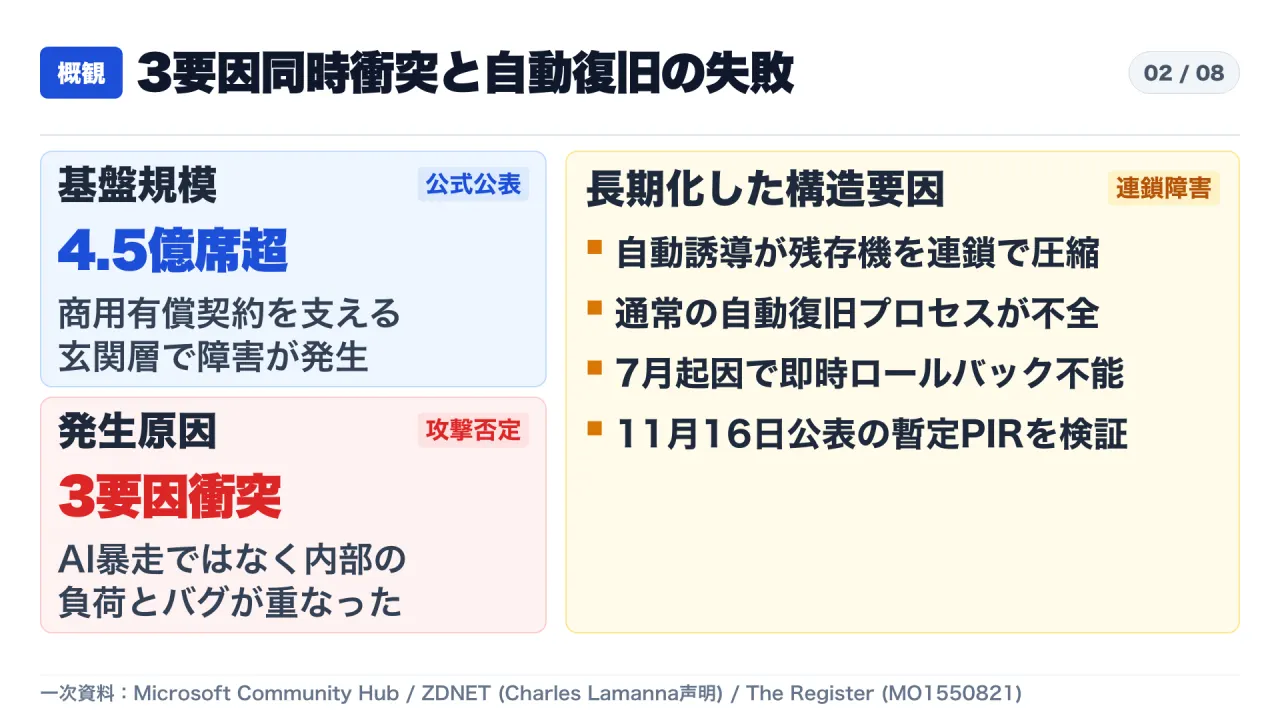
Supporting more than 450 million commercial paid seats globally, Microsoft 365 operates as foundational enterprise infrastructure. In the November 16, 2026 briefing, both Charles Lamanna and the preliminary PIR explicitly ruled out malicious cyberattacks and autonomous AI malfunctions. Instead, the outage stemmed from an internal resonance failure in the network gateway tier: automated failover and traffic-routing mechanisms designed to ensure high availability collided with a latent code defect, driving healthy servers into sequential overload.
2. The Three Colliding Triggers Behind the 80%+ Gateway Collapse
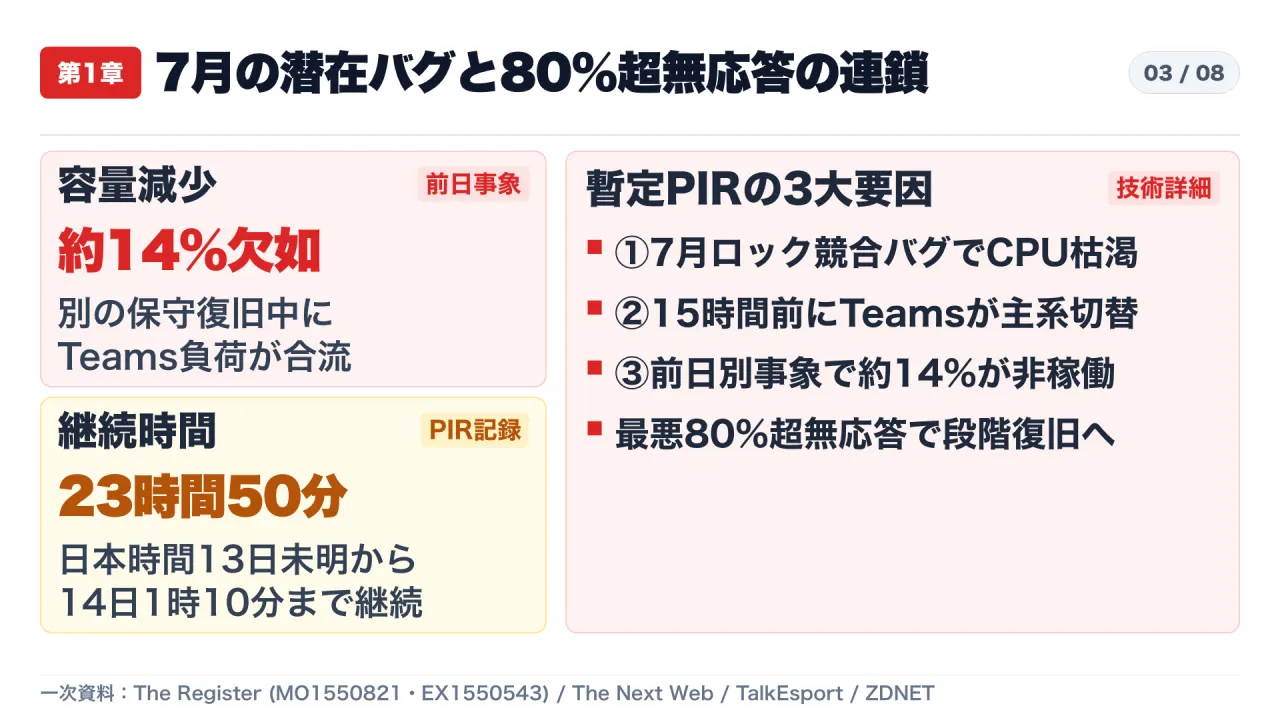
According to Microsoft’s preliminary PIR (MO1550821 / EX1550543) released on November 16, 2026, no single bug brought down the platform alone. Rather, three independent conditions converged at the worst possible moment during peak North American traffic:
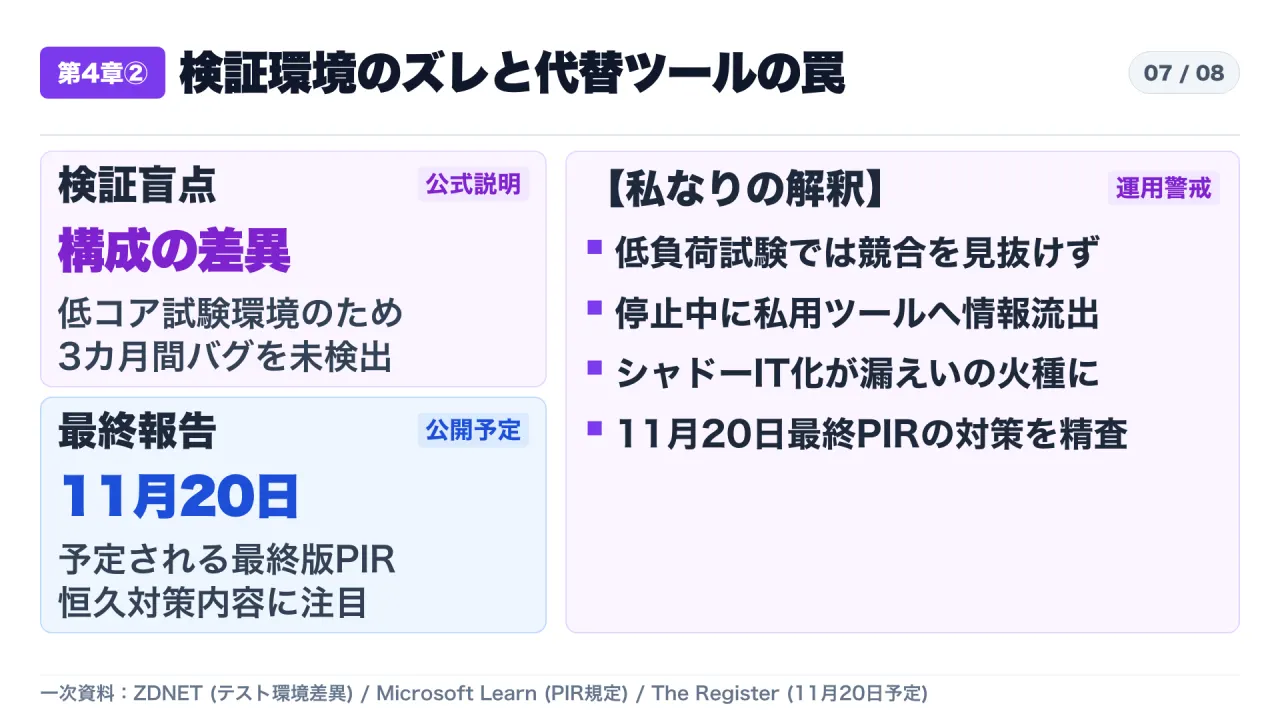
- A Dormant “Lock Contention” Defect Introduced in July 2026: An update deployed specifically to Microsoft 365’s network gateway layer in July 2026 introduced an internal lock-contention defect (it does not affect standard Windows client operating systems). Under specific high-load conditions, internal worker threads competed for shared locks, exhausting CPU and memory until the gateway server stopped responding. The defect survived undetected for more than three months because Microsoft’s validation test labs relied on older, lower-core hardware SKUs whose traffic shapes failed to reproduce production concurrency patterns.
- A Teams Gateway Failover Roughly 15 Hours Earlier: Under normal operations, Microsoft maintains two independent network gateway pathways. Approximately 15 hours before the collapse, Microsoft Teams failed over from its secondary gateway onto the primary gateway shared with Exchange Online, sharply altering both aggregate volume and packet concurrency patterns on the shared tier.
- A ~14% Capacity Deficit From an Unrelated Prior Incident: An unrelated operational issue the day prior had left roughly 14% of total network gateway capacity offline and still undergoing restoration when traffic surged.
Consider a concrete physical analogy: imagine a two-tunnel highway where one tunnel is partially closed for roadwork (14% capacity lost), heavy bus traffic from a detour merges into the remaining lane (Teams failover), and that extra weight triggers a hidden structural flaw poured into the pavement three months earlier (the July defect). The moment the first server stalls, automated traffic management redirects waiting users onto surviving gateway nodes—pushing those surviving nodes past the exact same lock-contention threshold.
Within less than two hours, the cascade swept globally and rendered more than 80% of network gateway servers unresponsive. The outage ran from 16:20 UTC on November 12, 2026 to 16:10 UTC on November 13, 2026 (01:20 JST on November 13 to 01:10 JST on November 14), totaling approximately 23 hours and 50 minutes. Because the faulty code had been baked in since July 2026 rather than pushed in a recent deployment, engineers could not simply roll back a recent release or toggle a feature flag. Automated recovery processes broke down under the scale of simultaneous node failure, forcing engineers to bypass automated routing and manually patch and bring gateway server groups back online in controlled waves.
3. Global Blast Radius, Japan’s Government Platform (GSS), and Domestic Back-Office Spillover
Downdetector telemetry recorded outage reports across at least 74 countries, with Outlook incident reports alone peaking near 83,000 by 13:00 Eastern Time during the event. While Microsoft was able to fail out Teams, OneDrive, SharePoint, and core Office web apps onto alternative gateway infrastructure relatively quickly, the massive Exchange Online email architecture proved far harder to decouple—making email the longest-suffering component.
In Japan, primary government records and corporate disclosures highlight how deeply cloud email sits inside both public administration and physical-world customer operations:
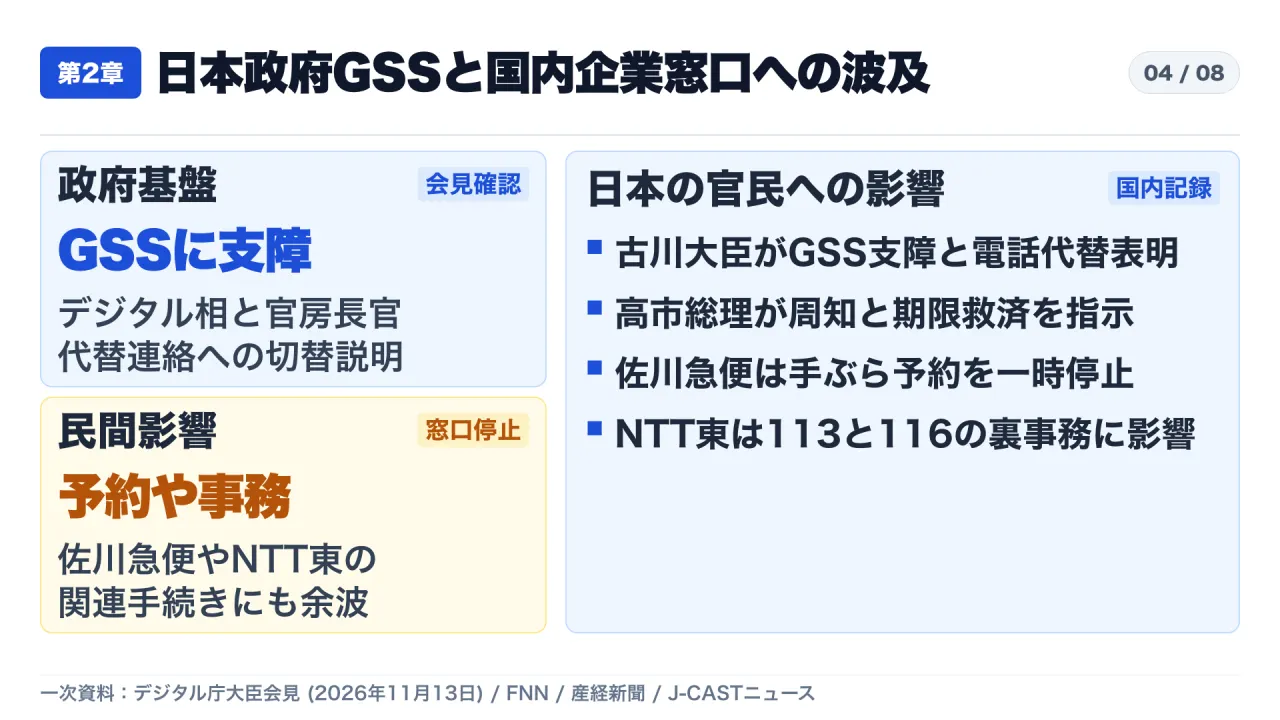
- Japan’s Government Solution Service (GSS): On November 13, 2026, Digital Minister Toshiharu Furukawa confirmed at an official press conference that GSS—the shared cloud workspace provided by the Digital Agency across central government ministries—was experiencing disruption. Minister Furukawa noted candidly that he had noticed the service failing when checking his own terminal in the morning before seeing news reports, and stated that ministries were maintaining essential operations via telephone, alternative chat tools, and SMS.
- Three Directives From Prime Minister Takaichi: During an afternoon briefing on November 13, 2026, Chief Cabinet Secretary Kihara confirmed ongoing GSS disruption and announced three formal instructions from Prime Minister Sanae Takaichi to all ministries: (1) secure and publicize telephone or alternative contact channels for any public consultation desk previously relying solely on email, (2) ensure citizens facing administrative filing deadlines suffer no disadvantage due to the outage, and (3) survey and report operational impact across regulated industries under each ministry’s jurisdiction.
- Sagawa Express and NTT East Service Desk Ripple Effects: Logistics major Sagawa Express suspended online reservations for its “SAGAWA Hands-Free Service” luggage storage counters at train stations and airports, reverting to in-person counter intake. Meanwhile, telecommunications carrier NTT East reported that its “113” (repair) and “116” (subscription) telephone call centers relied on Microsoft 365 for post-call internal back-office processing, creating potential response delays and affecting “Web113” chat replies. Even when a public-facing phone line or storefront stays open, hidden cloud dependencies in back-office workflows create single points of failure.
4. $7 Billion Modeled Loss vs. the Reality of SLA Credits and Cyber Insurance
Economists at Anderson Economic Group (AEG), cited in CNN coverage, estimated global macroeconomic productivity losses from the outage at at least $7 billion. It is essential to distinguish what that number represents: it is a top-down macroeconomic productivity model rather than an aggregate of audited corporate balance-sheet losses. Yet when enterprise buyers compare real-world disruption against contractual remedies, two stark boundaries emerge.
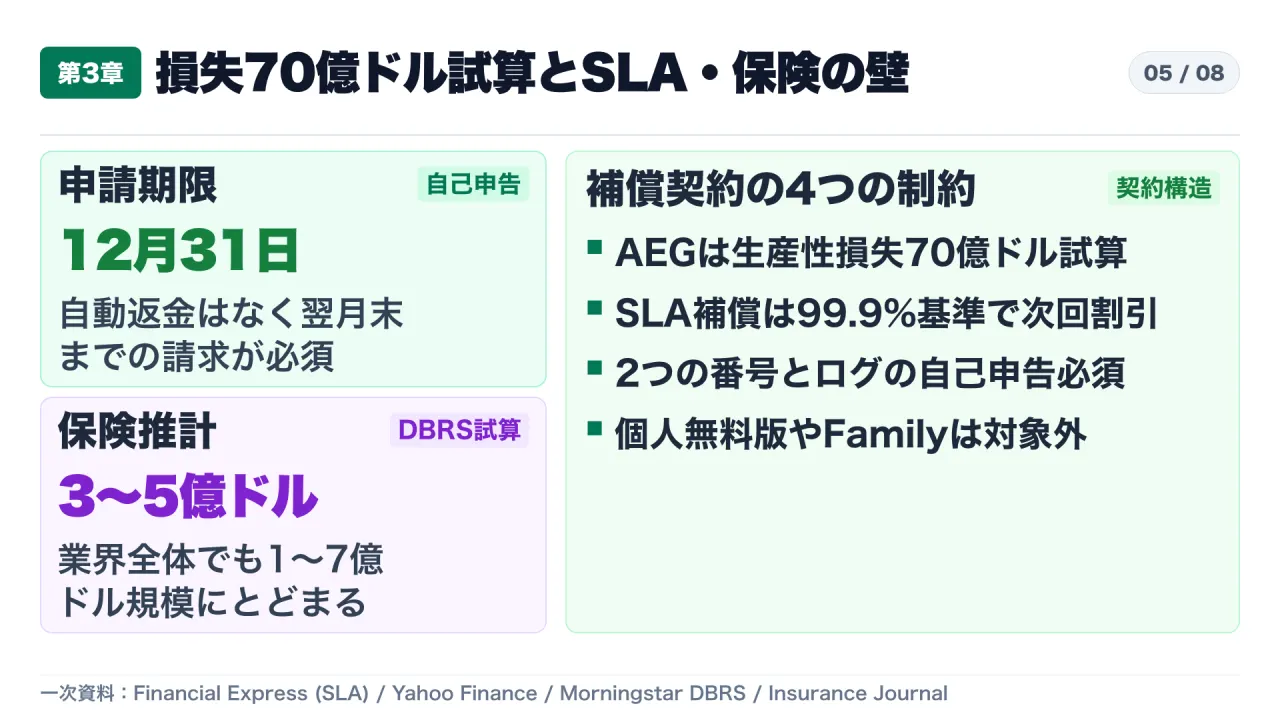
- Microsoft Online Services SLA Credits Are Non-Cash and Self-Filed: Under Microsoft’s commercial SLA framework, monthly uptime below 99.9% triggers a 25% service credit, below 99% triggers a 50% credit, and below 95% reaches 100% (with 99.5% intermediate tiers on certain workloads). Crucially, credits are applied strictly as discounts against future invoices—never cash payouts—and consequential lost profits remain contractually excluded, while consumer Free and Microsoft 365 Family plans receive no SLA coverage at all. Most importantly, credits are not granted automatically: enterprise administrators must actively file claims via the Microsoft 365 Admin Center by the end of the calendar month following the incident—December 31, 2026—citing incident identifiers
EX1550543andMO1550821along with supporting downtime logs. - Cyber Insurance Payouts Projected at $300M–$500M: In a November 16, 2026 commentary, rating agency Morningstar DBRS estimated global insured losses from the outage at $300 million to $500 million (within a broader industry estimate band of $100 million to $700 million), while reinsurance broker Marsh McLennan / Guy Carpenter commentary cited in Insurance Journal characterized the overall impact on the insurance sector as modest.
Checking the Math Behind the Coverage Gap
Running the numbers directly from the primary disclosures makes the protection gap unmistakable:
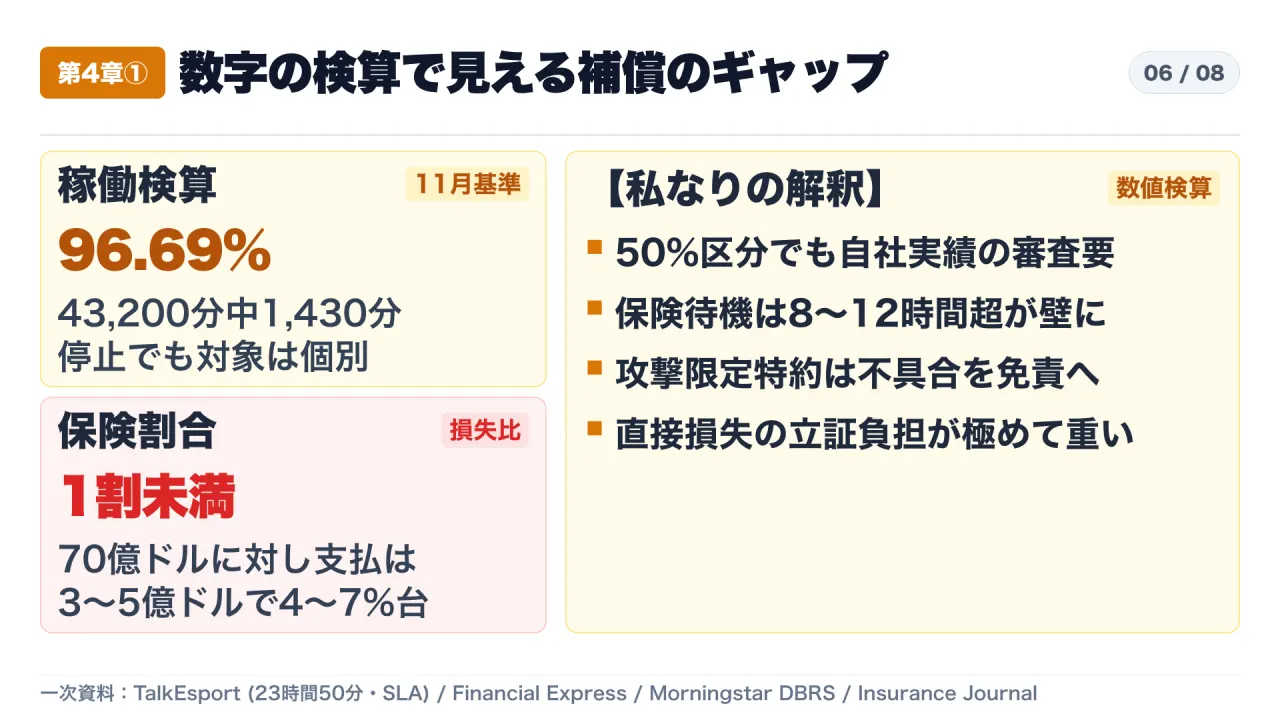
- Monthly Uptime Arithmetic: November contains 30 days, or 720 hours, equal to 43,200 minutes. Subtracting the ~23 hours and 50 minutes (1,430 minutes) reported in the preliminary PIR yields a monthly uptime of
(43,200 - 1,430) / 43,200 = 96.69%(or96.67%for a full 1,440-minute 24-hour window). While 96.69% mathematically falls into the sub-99% tier associated with 50% service credits, eligibility is never blanket-applied across all tenants; Microsoft calculates actual user-minutes affected per specific service and audits each submitted tenant claim, while customers buying through resellers must route claims through their licensing partner before December 31, 2026. - Insurance Coverage Ratio Arithmetic: Dividing Morningstar DBRS’s $300M–$500M insured loss estimate by AEG’s $7B macroeconomic productivity loss estimate shows that cyber insurance covers roughly 4.3% to 7.1%—well under 10%, or roughly 4 to 7 cents on the dollar. Three policy mechanics drive this gap: enterprise business-interruption waiting periods commonly set at 8 to 12 hours or longer, policy language that covers malicious cyberattacks while excluding non-malicious software defects or system failures, and strict evidentiary burdens requiring insureds to prove direct net financial loss rather than general staff downtime.
5. Test-Lab Blind Spots and the “Shadow IT” Trap During Outages
Looking past immediate remediation, two operational hazards stand out for engineering and security leaders. First is the structural gap between test environments and production hardware. As Lamanna acknowledged, a severe lock-contention defect sat undetected for over three months because pre-production testing ran on lower-core older hardware SKUs that never crossed production concurrency thresholds. Testing a bridge solely with compact cars leaves engineers blind until two lanes merge heavy trucks during rush hour.
Second is the secondary data-leakage risk created by ad-hoc workarounds. When corporate email and chat stall for nearly a full day, well-meaning employees trying to keep client deliveries moving naturally gravitate toward personal free messaging apps or private webmail—triggering a wave of shadow IT that can expose confidential customer files far beyond the original outage.
Under Microsoft Learn’s incident reporting standards, final PIRs document confirmed timelines, root causes, and permanent engineering mitigations. The final PIR is scheduled for release on November 20, 2026, making it critical to evaluate whether Microsoft addresses three architectural points: high-core load testing parity, fail-safe isolation for automated traffic routing, and decoupling bottlenecks inside Exchange Online.
6. Four Concrete Defensive Actions for Enterprise IT Teams
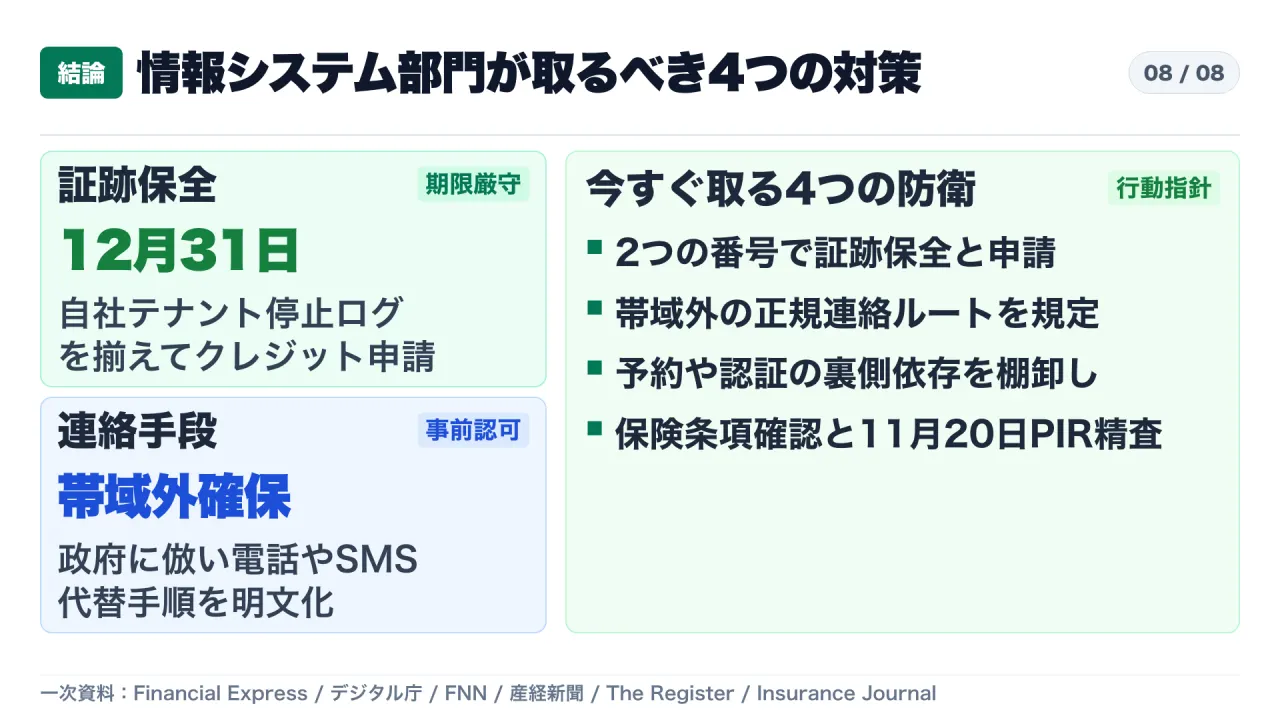
Based on the November 16, 2026 preliminary PIR and verified contractual boundaries, IT and security teams should execute four concrete steps immediately:
- Preserve Evidence and File SLA Credits Before December 31, 2026: Archive Service Health records for
EX1550543andMO1550821inside the Microsoft 365 Admin Center, screenshot or export tenant-specific error timestamps and affected seat counts, and submit claims (directly or via your CSP/reseller) ahead of the December 31, 2026 cutoff. - Pre-Authorize Out-of-Band Communication Channels: Following Japan’s Digital Agency model, explicitly document approved backup channels—telephone trees, secondary non-Microsoft chat tools, or SMS—inside your Business Continuity Plan (BCP) so staff never improvise with personal messaging tools during a cloud blackout.
- Map Hidden Single Points of Failure Behind Customer Desks: Audit reservation, intake, identity authentication, and AI-assisted workflows—as illustrated by Sagawa Express and NTT East’s call-center back office—to identify where non-email workflows silently break when Microsoft 365 or a single identity gateway goes dark.
- Audit Cyber Insurance Wording and Review the November 20, 2026 Final PIR: Inspect existing cyber insurance policies for waiting-period length and “non-malicious third-party cloud failure” coverage, and benchmark Microsoft’s November 20, 2026 final PIR commitments on high-core stress testing and Exchange Online decoupling against your internal resilience thresholds.
Primary Sources Verified
- Microsoft Community Hub: Microsoft 365 Exceeds 450 Million Commercial Paid Seats
- Microsoft Learn: Service Health and Continuity - Service Descriptions
- ZDNET: Microsoft blames major outage on a July update defect – and two other factors (November 16, 2026)
- The Register: Microsoft blames monster email outage on software defect introduced in July fix (November 16, 2026)
- The Next Web: Microsoft blames its Microsoft 365 outage on a dormant July update defect (November 16, 2026)
- TalkEsport: 24-Hour Microsoft 365 Outage Cost & SLA Exposure
- Financial Express: Microsoft outage compensation - How businesses can claim bill credits by Dec 31 (November 16, 2026)
- Yahoo Finance: Microsoft may owe you money after the Outlook outage
- Digital Agency of Japan: Minister Furukawa Press Conference (November 13, 2026)
- FNN Prime Online: Prime Minister Takaichi Issues Directives on Microsoft Outage (November 13, 2026)
- Morningstar DBRS: When Tech Goes Down - What the Microsoft Outage Means for Global Insurers (November 16, 2026)
- Insurance Journal: Insurance Loss Estimates for Microsoft Outage Range From $100M to $700M (November 16, 2026)
- Sankei Shimbun: Sagawa Express Suspends Baggage Reservations Amid Microsoft Outage (November 13, 2026)
- J-CAST News: Microsoft 365 Outage Impact on NTT East 113/116 Operations (November 13, 2026)