Semiconductor Succession Crisis and Anthropic's $1.4T IPO: The $900B Compute Debt Trap
SEC Form 8-K and Form S-1/A filings expose $895B-$901B in off-balance-sheet compute commitments, circular financing loops, and leadership succession risk behind Bill Ackman’s IPO pass.
Japanese Edition: Read the original Japanese article on Substack
Video Episode (Japanese Audio): Watch on YouTube
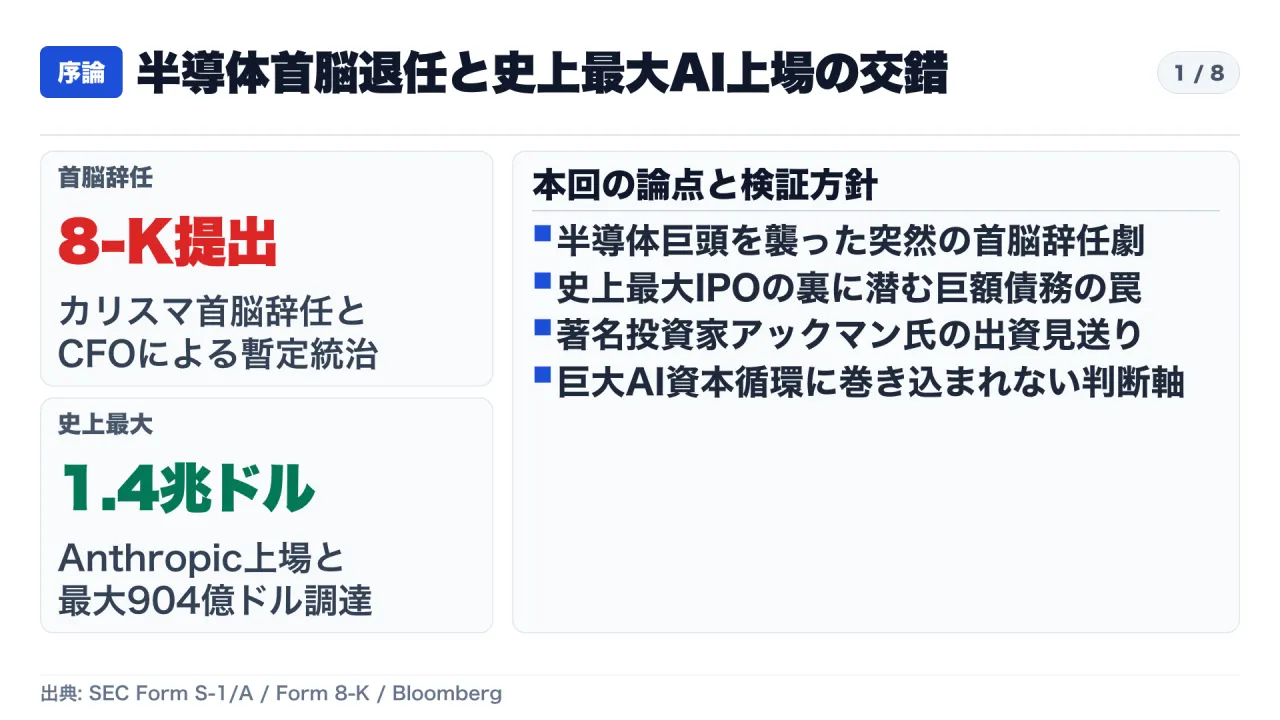
In mid-November 2026, two major governance and capital-structure events converged at the center of the global AI infrastructure market. At the dominant US AI semiconductor supplier, a sudden CEO resignation triggered an unprecedented succession standoff involving CFO interim leadership, external candidate outreach, and explicit political pressure from Washington. At the exact same moment in New York, frontier AI lab Anthropic launched its historic initial public offering roadshow at a fully diluted valuation of $1.404 trillion, seeking to raise up to $90.4 billion.
While retail and institutional investors debated the headline growth numbers, amended regulatory filings with the US Securities and Exchange Commission (SEC) exposed the underlying financial mechanics. Form S-1/A revealed that behind Anthropic’s surging annualized revenue run rate of $81 billion lies between $895.4 billion and $901 billion in long-term compute and lease commitments, paired with intricate circular financing arrangements tying equity investments directly to cloud and silicon consumption.
- Core Thesis: Rapid revenue growth in frontier AI coexists with $895.4B-$901B in long-term compute commitments (approximately 65 times the $13.8B in remaining performance obligations), while a $90%+ data-center B2B semiconductor leader faces acute governance vulnerability during its CEO transition.
- Primary Sources Verified: SEC Form S-1/A (Anthropic, PBC, filed November 10, 2026), SEC Form 8-K Item 5.02 (NVIDIA Corporation, filed November 12, 2026), and Bloomberg coverage of Bill Ackman’s roadshow remarks (November 13, 2026).
- Actionable Engineering & Procurement Takeaways: Audit off-balance-sheet compute commitments, separate genuine enterprise demand from circular vendor-financed usage, and evaluate supplier governance resilience against single-point-of-failure leadership risk.
1. Bill Ackman’s IPO Verdict: Praise Without Writing a Check
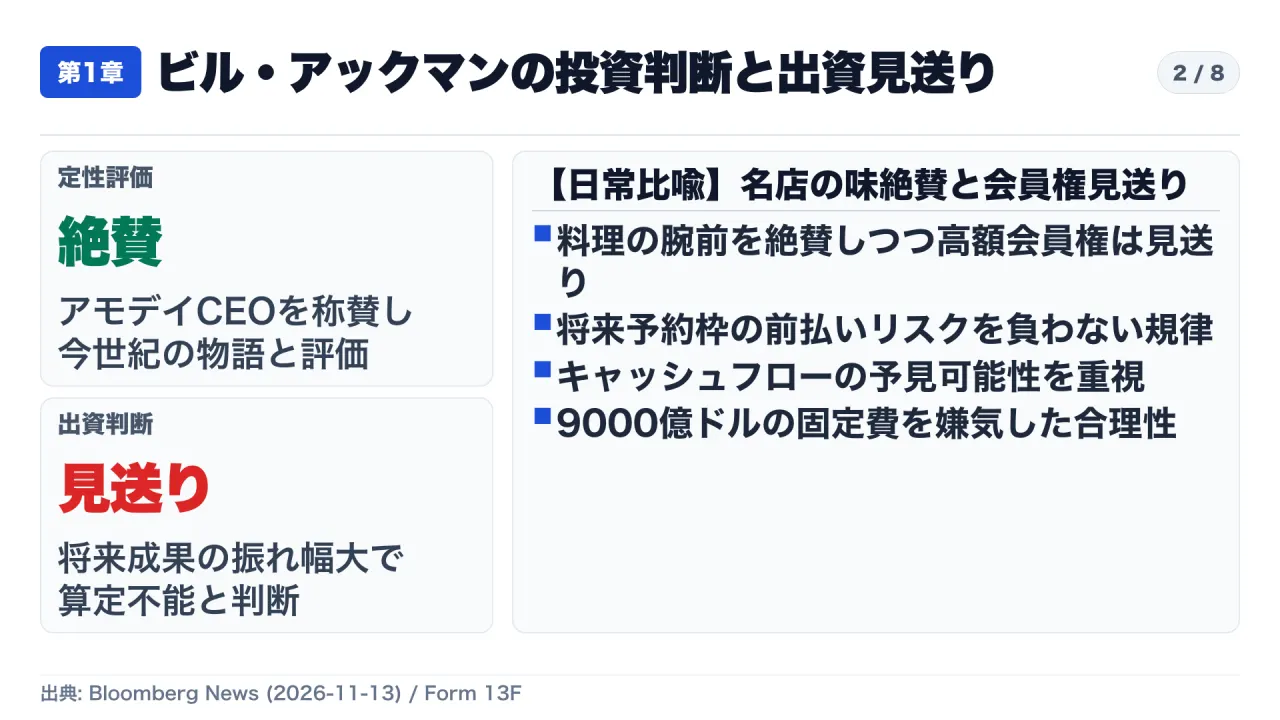
On November 13, 2026, Pershing Square Capital Management founder Bill Ackman attended Anthropic’s IPO roadshow hosted by JPMorgan Chase in New York. In public comments reported by Bloomberg, Ackman offered unusually high praise for Anthropic CEO Dario Amodei, calling him a thoughtful and disciplined executive and describing Anthropic as a company that could become one of the defining stories of the century.
Yet immediately following those remarks, Ackman confirmed that Pershing Square would pass on investing directly in the IPO.
Pershing Square’s investment discipline centers on predictable free cash flow and durable competitive moats that resist rapid technological obsolescence. While Ackman acknowledged the scale of hyperscaler capital expenditure, he pointed to the wide dispersion of future business outcomes for standalone foundation-model developers carrying massive fixed infrastructure obligations. In practical terms, praising a restaurant’s cuisine while declining to prepay for an ultra-expensive lifetime dining membership reflects standard institutional risk management: admiration for product execution does not justify underwriting unbounded fixed-cost leverage when pricing power remains uncertain.
From an institutional perspective in Japan as well, corporate technology buyers and capital allocators reviewing US AI infrastructure disclosures focus heavily on cash-flow visibility rather than top-line valuation multiples alone. When high-conviction fundamental investors step aside during a flagship listing despite praising leadership quality, enterprise architects should treat that divergence as a signal to inspect the underlying unit economics and contract structure.
2. The Semiconductor Succession Standoff and Political Constraints
Meanwhile, following the accepted resignation of its longtime chief executive on November 11, 2026, and the formal disclosure via SEC Form 8-K Item 5.02 on November 12, 2026, the leading AI semiconductor supplier appointed Chief Financial Officer Colette Kress as interim CEO. While Kress commands deep credibility with Wall Street analysts, observers across the hardware industry note the structural tension in expecting a finance executive to permanently direct annual full-stack physical silicon, networking, and software architecture transitions.
On November 15, 2026, US Treasury Secretary Scott Bessent stated publicly in a television interview that the company needed to recruit a new CEO from outside its existing ranks. That intervention narrowed the board’s room to resolve the crisis through a quiet internal promotion.
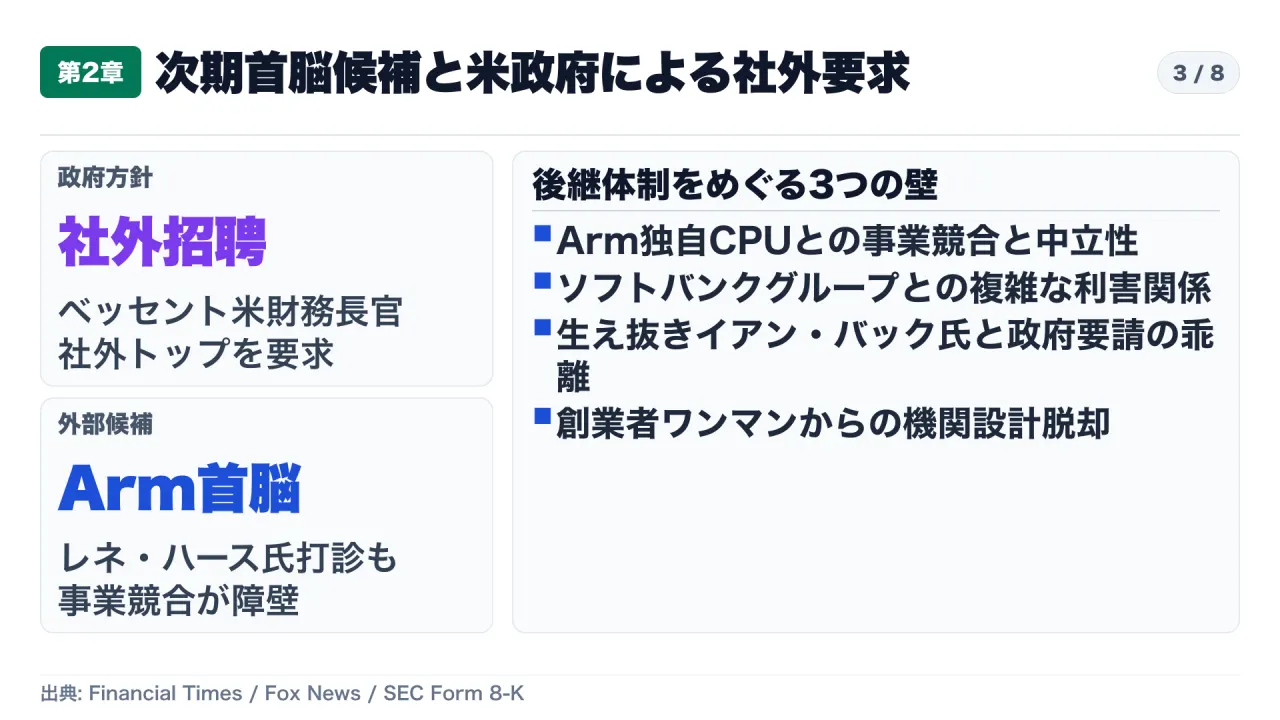
Reports indicate the board sounded out Arm CEO Rene Haas, a former executive deeply familiar with the company’s engineering culture. However, two structural obstacles complicate that path:
- Direct Product Overlap: In March 2026, Arm partnered with Meta to unveil its own data-center CPU initiative (“AGI CPU”), placing Arm in direct competition with the Grace CPU product line.
- Ownership and Antitrust Neutrality: Arm’s relationship with SoftBank Group and renewed regulatory scrutiny around ecosystem neutrality create significant antitrust and non-compete friction for any executive transfer.
Promoting a veteran internal engineering leader such as Ian Buck could stabilize technical teams and prevent talent attrition, yet it would leave unanswered the governance overhaul demanded by policymakers in Washington, where export controls and national security compliance weigh heavily on board legitimacy.
3. Why the “Post-Steve Jobs Apple” Analogy Fails in B2B Silicon
Some market commentators have compared this leadership transition to Apple in 2011, when Tim Cook succeeded Steve Jobs and presided over more than a decade of operational compounding. A closer comparison of customer concentration and competitive dynamics exposes why that analogy breaks down.
When Jobs stepped down in 2011, Apple operated a diversified B2C ecosystem serving hundreds of millions of individual consumers. Individual iPhone buyers do not design proprietary operating systems or custom application processors to replace their supplier. By contrast, roughly 90% of the semiconductor giant’s revenue derives from data-center customers—a hyper-concentrated B2B customer base dominated by Google, Amazon, Meta, and Microsoft.
Crucially, every one of those largest customers is aggressively scaling internal custom ASIC programs—including TPU, Trainium, and Maia—to reduce dependence on merchant GPUs and capture inference cost advantages.
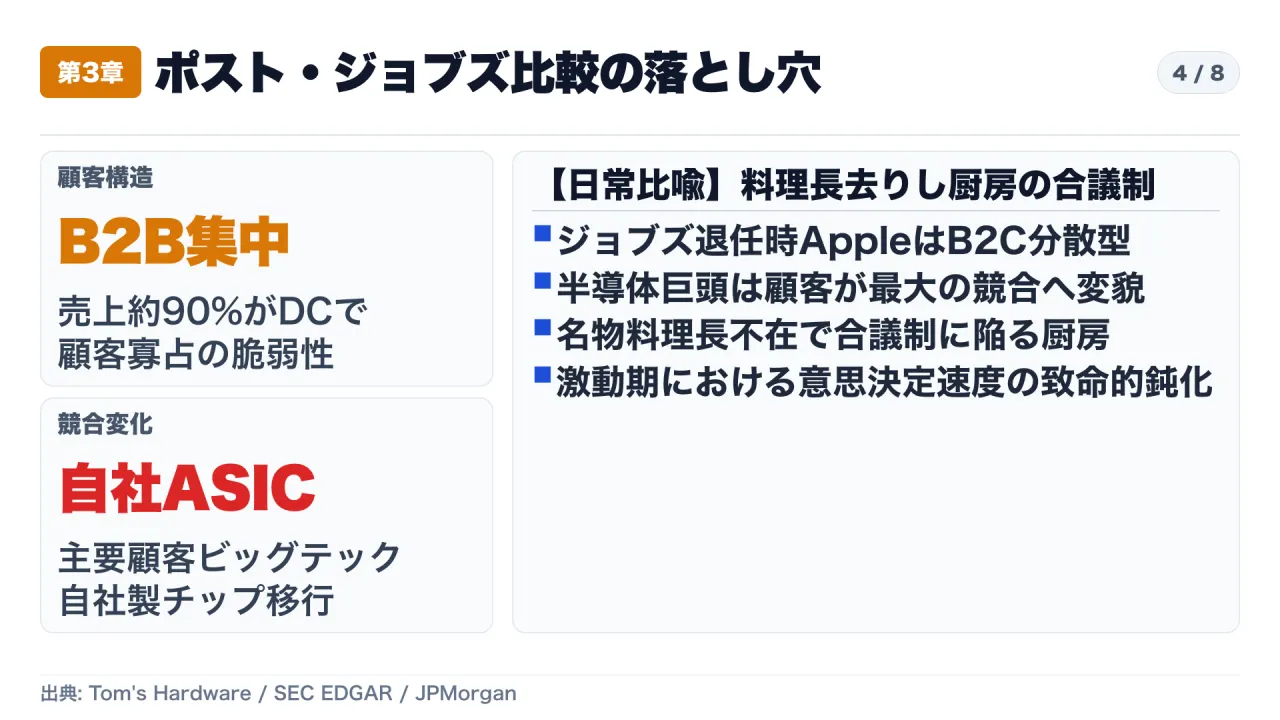
For engineering and supply-chain observers in Japan, this difference between consumer ecosystems and concentrated B2B infrastructure is critical. In a founder-driven organization where major architectural and allocation decisions bypassed intermediate layers, transitioning abruptly to committee-based governance slows negotiation cycles precisely when hyperscale customers are building competing silicon in-house. Without decisive technical leadership backed by clear board authority, supplier leverage erodes rapidly.
4. What Form S-1/A Reveals: $900B in Compute Debt vs. $13.8B in RPO
The sharpest financial warning in mid-November 2026 came from Anthropic’s amended registration statement, Form S-1/A, filed on November 10, 2026. On the surface, growth appears extraordinary: annualized run-rate revenue reached $81 billion as of the end of October 2026, representing more than 1,200% year-over-year expansion driven by enterprise adoption and developer tools such as Claude Code.
However, examining the off-balance-sheet commitments inside the filing reveals a stark mismatch between fixed obligations and contracted customer revenue:
- Long-term compute and lease commitments: Approximately $895.4 billion to $901.0 billion in total binding obligations.
- Near-term maturity: Roughly $70.0 billion due within 12 months, before the end of September 2027.
- Remaining Performance Obligations (RPO): Only $13.8 billion in contracted, unrecognized customer revenue as of the end of September 2026.
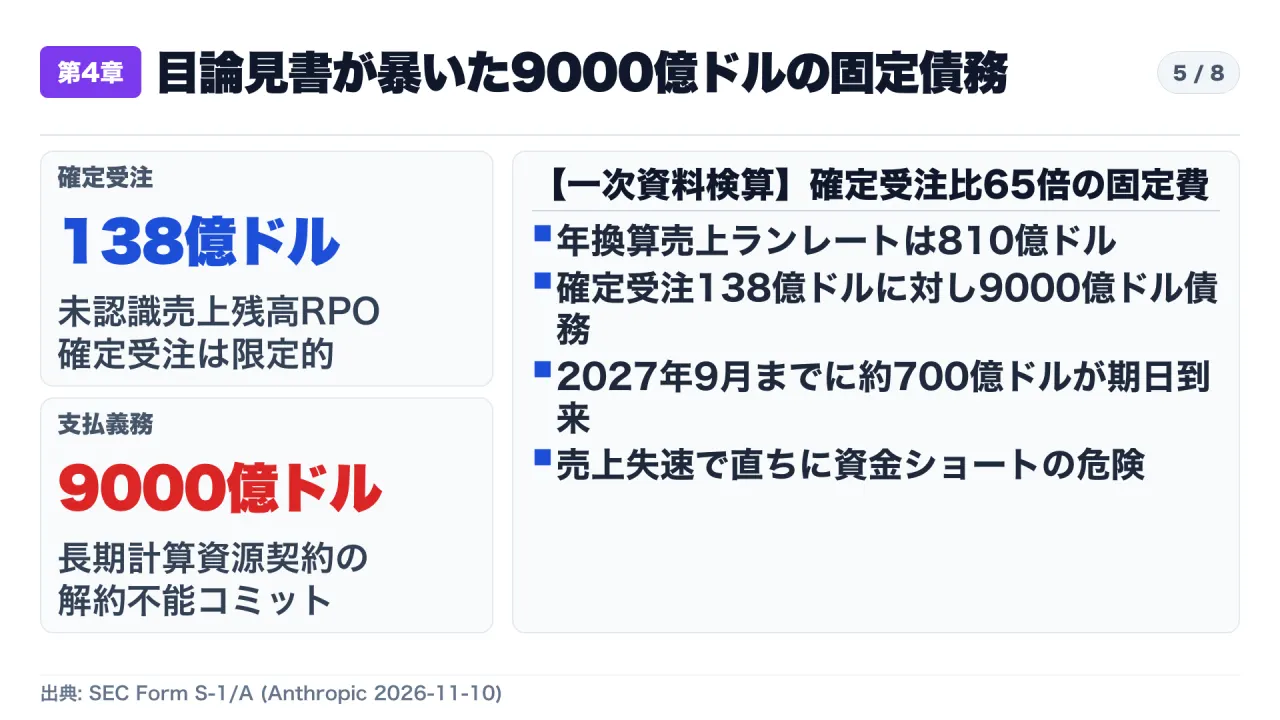
Cross-checking the figures inside Form S-1/A yields a striking ratio: long-term fixed compute commitments equal roughly 65 times contracted remaining performance obligations ($895.4B / $13.8B ≈ 64.9x). Even at an $81 billion annualized revenue pace, locking in nearly $900 billion of non-cancelable infrastructure payments creates severe operating leverage. If enterprise token demand decelerates or competitive pricing compresses gross margins, cash reserves can drain rapidly toward fixed-payment obligations.
5. Circular Financing: How Equity Stakes and Compute Deals Interlock
Form S-1/A also details a dense web of cross-linked equity and infrastructure agreements that industry analysts describe as circular financing:
- Broadcom: Lease obligations totaling approximately $161.2 billion, paired with a convertible bond facility of up to $42.0 billion to support settlement capacity.
- Google: Minimum compute commitments of $114.5 billion, alongside options allowing Google to purchase up to $10.0 billion in non-voting shares at the IPO price.
- Amazon: Minimum commitments of $110.0 billion, structured with preferred and non-voting share issuances tied to infrastructure milestones.
- Semiconductor supplier commitment: A $10.0 billion IPO equity commitment from the leading GPU supplier itself.
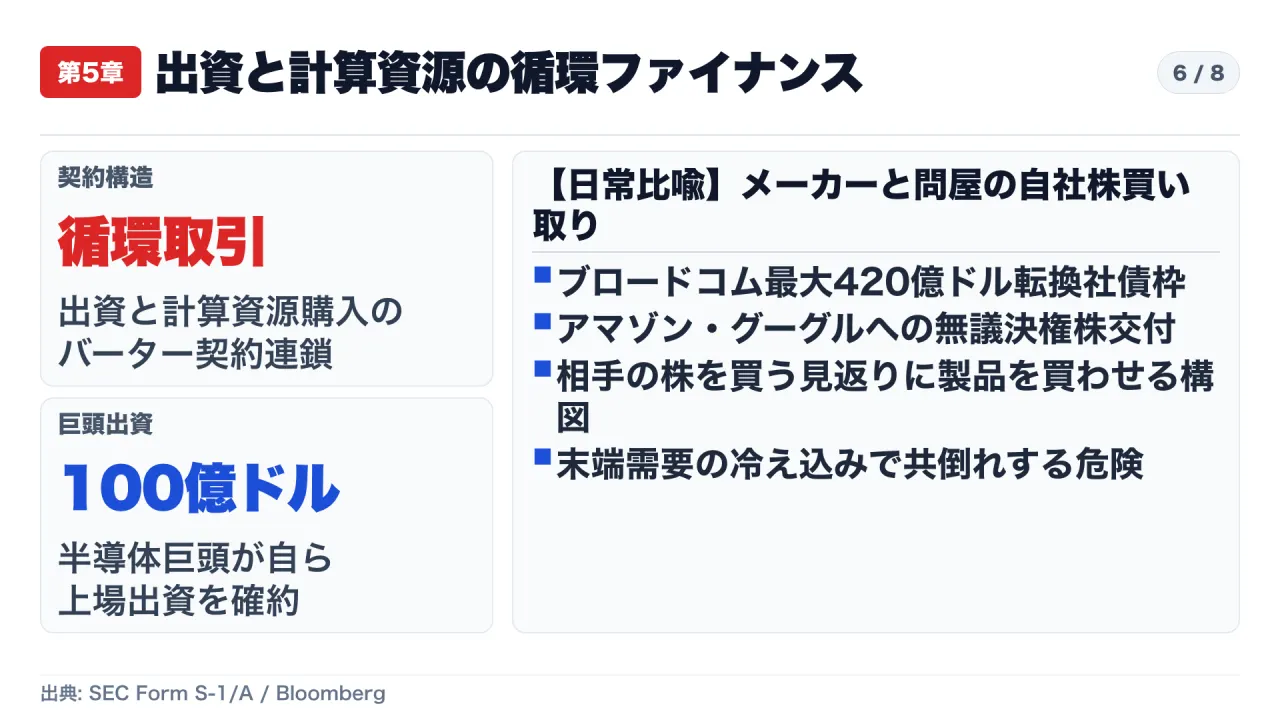
Mechanically, this resembles a vendor-distributor arrangement in which a supplier buys equity in a customer on the condition that the customer commits to multi-year inventory purchases. As long as external capital flows smoothly into the ecosystem, circular commitments amplify reported infrastructure demand and top-line momentum across both parties. Yet if genuine end-user willingness to pay fails to keep pace with depreciation and lease schedules, asset write-downs and utilization shortfalls reinforce one another on the downside.
6. Entering the Cash-Flow Filter Phase: Three Principles for Practitioners
Taken together, the semiconductor leadership crisis and the disclosures inside Anthropic’s IPO prospectus mark a structural transition for the AI industry: moving from narrative-driven capital expansion into a strict cash-flow and governance filter phase.
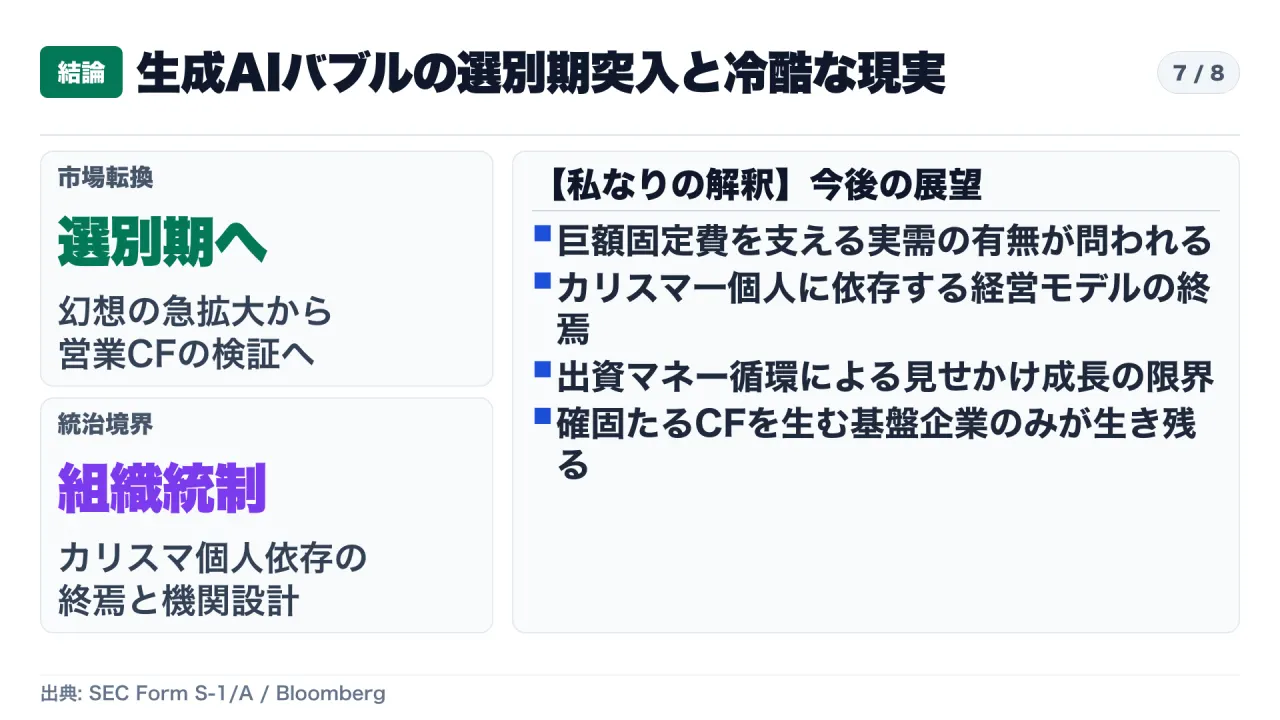
In Japan’s enterprise IT and semiconductor supply chains, procurement teams and technology leaders often assume that mega-cap US vendors carry negligible counterparty risk. The November 2026 filings demonstrate why that assumption requires updating. Technical superiority alone does not insulate an organization from off-balance-sheet fixed-cost rigidity or single-point leadership concentration.
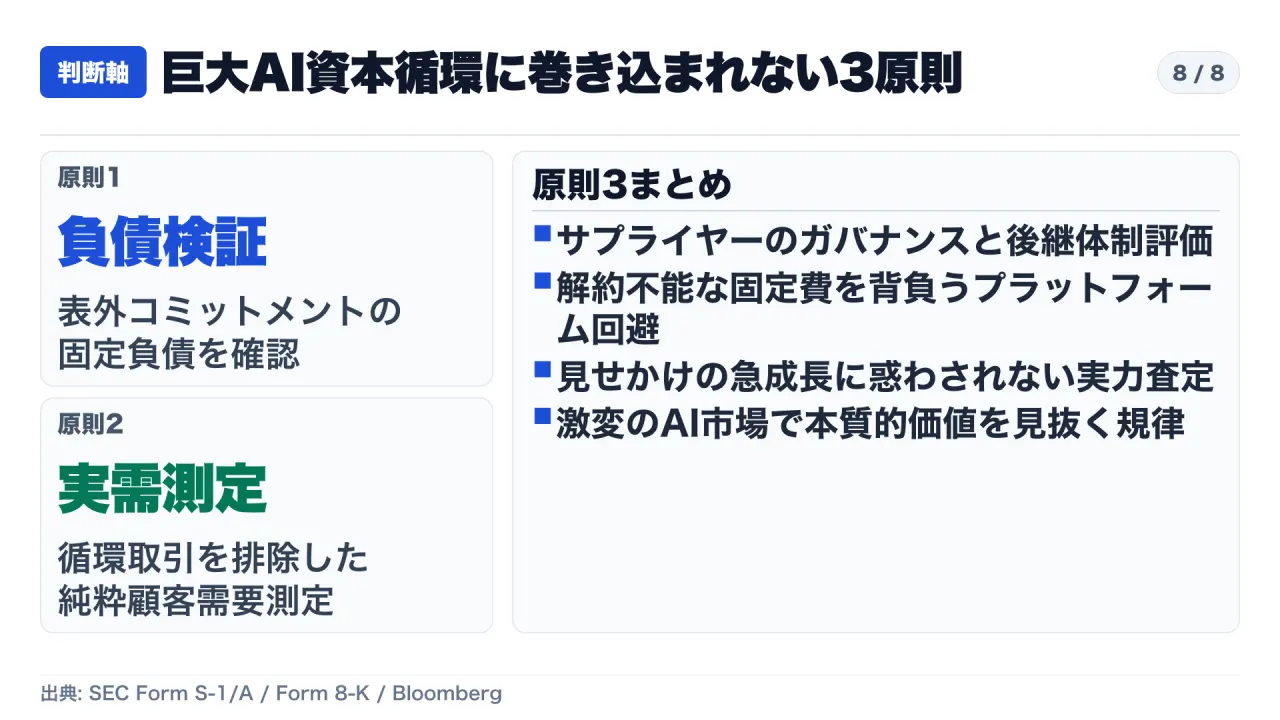
Enterprise architects, engineering managers, and procurement leaders can apply three concrete verification principles immediately:
- Inspect Off-Balance-Sheet Compute Commitments Alongside Revenue Growth: When evaluating critical AI model providers or cloud platforms, check whether non-cancelable lease and compute commitments dwarf contracted RPO. Vendors carrying extreme fixed-cost overhangs face structural pressure to raise API pricing, alter model tiers, or throttle free capacity when capital markets tighten.
- Separate Circular Financing From Organic End-User Demand: Treat headline ecosystem investment announcements cautiously until verified by independent enterprise adoption metrics and net cash retention. Avoid locking mission-critical workflows into a single vendor solely on the strength of partner equity announcements.
- Audit Supplier Governance and Succession Resilience: Evaluate whether key hardware or AI suppliers rely excessively on a single founder or charismatic executive without documented succession depth and board independence. Concentrated leadership creates acute operational and regulatory exposure when geopolitical rules or leadership crises hit unexpectedly.
What remains uncertain is whether enterprise AI productivity gains over the next 24 months will scale fast enough to absorb nearly $900 billion in committed compute capacity without repricing, and whether the semiconductor board can install an external or consensus chief executive capable of retaining top silicon architects. Tracking quarterly RPO growth relative to maturing lease schedules, alongside formal SEC 8-K governance disclosures, provides an objective yardstick for navigating the next stage of the AI infrastructure cycle.