How Plaid's KARTE Breach Exposed 79,249 Emails and Downstream API Key Risks
Primary disclosures from Plaid, KARTE Status, and eight enterprise customers reveal how a single SaaS compromise halted a 1.2B-MAU platform and why leaked integration keys outlast shutdowns.
Japanese Edition: Read the original Japanese article on Substack
Video Episode (Japanese Audio): Watch on YouTube
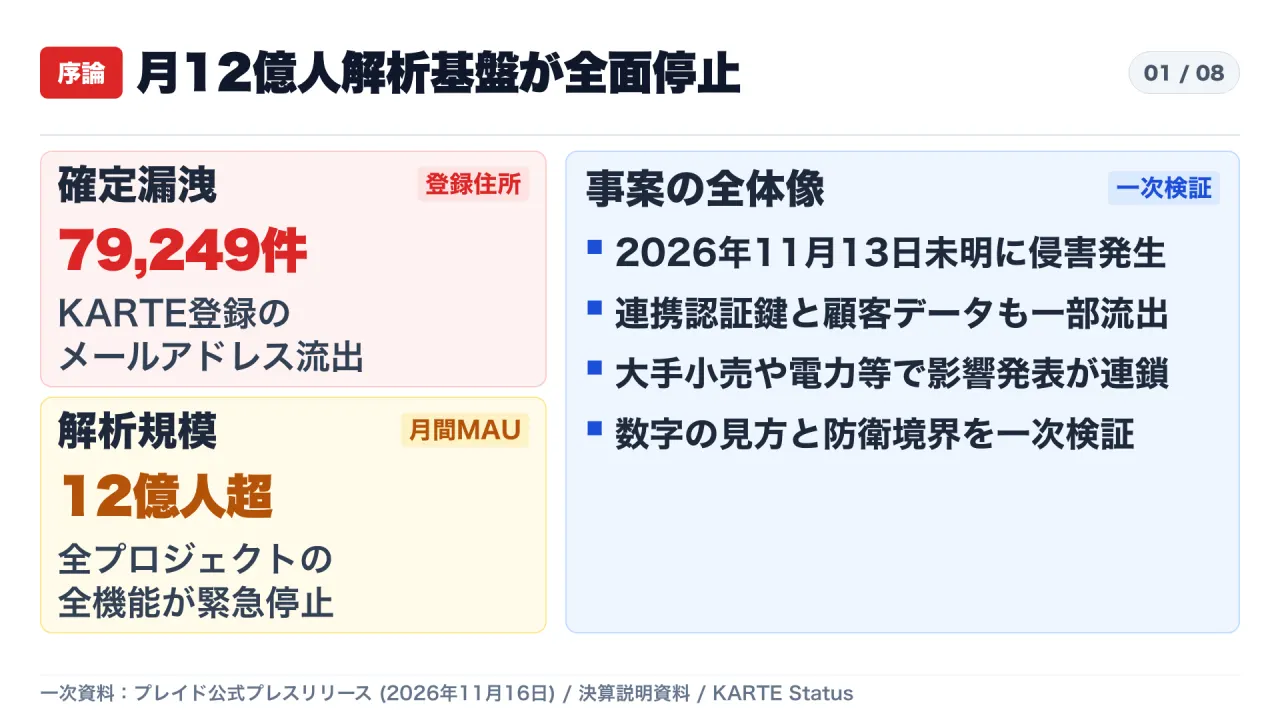
In the early hours of November 13, 2026 (JST), Plaid Inc. (Tokyo Stock Exchange Growth: 4165), the provider of Japan’s widely deployed customer experience (CX) and customer data platform KARTE, suffered an unauthorized third-party intrusion. Within hours, Plaid placed every KARTE project and function into emergency suspension. By November 16, 2026, formal regulatory disclosures confirmed three categories of compromised assets: 79,249 KARTE account-registered email addresses, external service integration credentials (including secret keys and access tokens), and portions of imported customer data stored via features such as KARTE’s “linking tables” (himozuke table). On November 17, 2026, Plaid’s shares hit the daily lower price limit, falling 100 yen from the prior trading session to close at 549 yen.
For security architects, enterprise IT leaders, and SaaS buyers outside Japan, the KARTE incident serves as a live case study in two structural vulnerabilities that rarely appear in standard vendor checklists. First, concentrating web analytics, app messaging, email delivery, and customer data synchronization inside a single external SaaS creates a single point of operational failure—even when a client company’s own web servers remain completely untouched. Second, taking the SaaS vendor offline does not neutralize stolen third-party integration keys; credentials held by the compromised platform remain valid at connected external services until revoked individually on the destination side.
- Core Thesis: A single server vulnerability at Plaid led to 79,249 leaked account emails, stolen third-party integration credentials, and an emergency shutdown across a platform analyzing over 1.2 billion monthly active users (MAU), forcing enterprise adopters to distinguish upper-bound exposure ceilings from confirmed breach counts and revoke external tokens immediately.
- Primary Sources Verified: Plaid official security notices (November 13 and November 16, 2026), Plaid TSE timely disclosure PDF (November 16, 2026), KARTE Status incident timeline (updated November 17, 2026), Plaid Q4 FY2026 financial presentation, Kabutan market data (November 17, 2026), and official customer advisories from JINS, Francfranc, AINZ & TULPE / AYURA, Shikoku Electric Power (Yonden Concierge), Hankyu-Hanshin Hotels, Social Interior, Morisawa, and OPTAGE (mineo).
- Actionable Strategic Takeaways: Immediately revoke secret keys and access tokens inside external destinations (email, LINE, ad platforms, BigQuery), audit destination logs prior to revocation, avoid summing headline maximum customer counts across overlapping brands, and tighten SaaS data minimization and deletion synchronization—especially for former members.
1. Single-Point Concentration and Market Reaction Even When Client Servers Are Clean
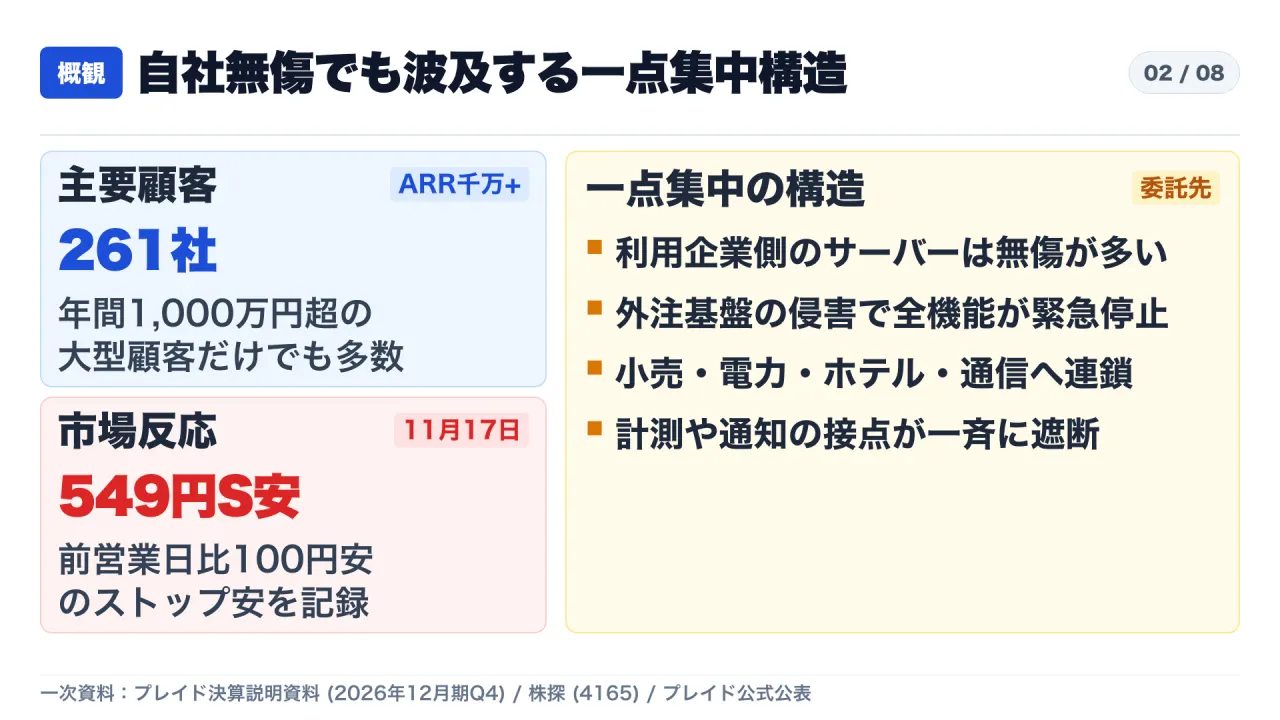
According to Plaid’s Q4 FY2026 financial presentation, KARTE analyzed more than 1.2 billion monthly active users (MAU) as of September 2026 and served 261 major enterprise customers generating over 10 million yen in annual recurring revenue (ARR) each, alongside a broader base of commercial adopters across retail, utilities, hospitality, telecommunications, and software publishing. In the Japanese enterprise ecosystem, KARTE functions as a central nervous system connecting website behavioral tracking, mobile push notifications, email campaigns, LINE official account messaging, and customer profile enrichment.
Because KARTE operates as an embedded customer-engagement layer rather than a peripheral reporting tool, the compromise immediately created a painful paradox for client organizations. Nearly every affected enterprise confirmed in its public advisory that its own corporate web servers, e-commerce backends, and authentication databases had not been directly breached. Yet because their shared customer-touchpoint platform went into emergency shutdown for containment, client companies across retail, electric power, hotels, telecom, and font-licensing simultaneously lost analytics tracking, automated notification triggers, and outbound messaging pipelines.
Financial markets reacted sharply once Plaid released its detailed disclosure on the evening of November 16, 2026. On the following trading day, November 17, 2026, Plaid’s stock dropped 100 yen from the previous close to hit the Tokyo Stock Exchange Growth market’s daily limit-down price of 549 yen, reflecting investor concern over an indefinite service halt, ongoing forensic review, and potential customer churn or remediation liabilities.
2. Official Attack Timeline and the Three Confirmed Categories of Leaked Data
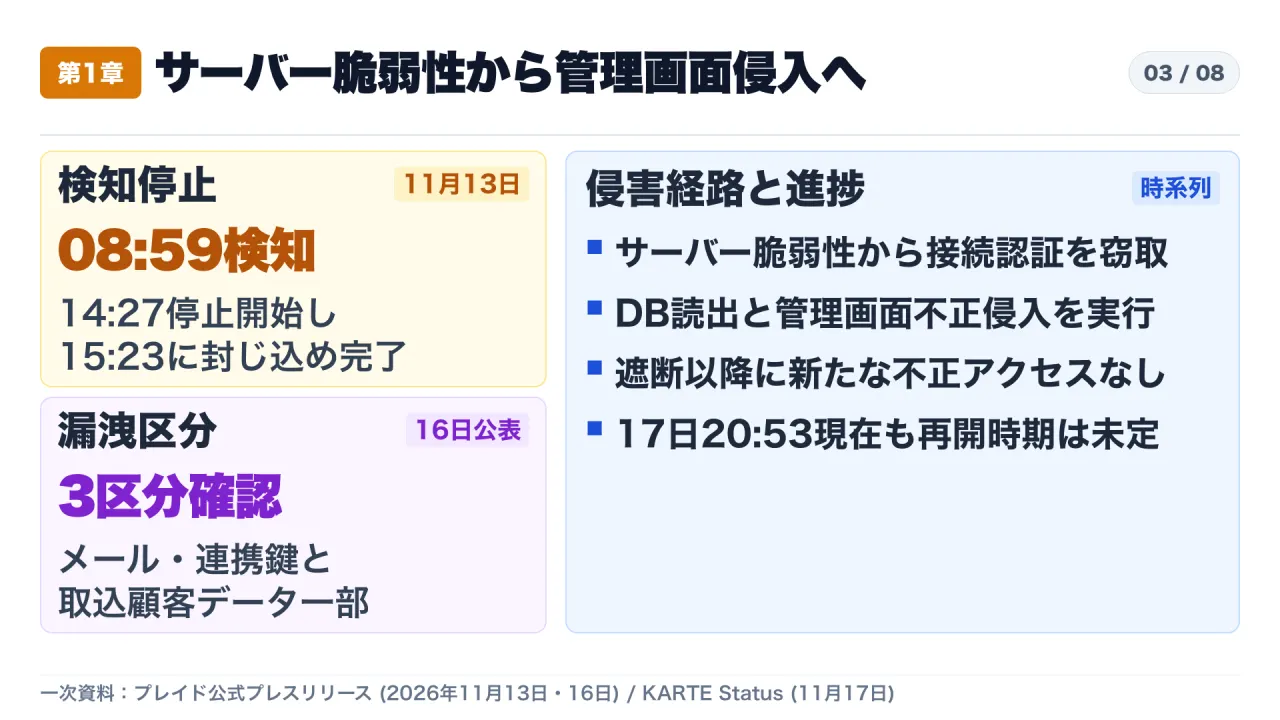
Cross-referencing Plaid’s November 13 and November 16 official statements with the KARTE Status incident log establishes a precise chronology from initial server exploitation to containment and customer data delivery:
| Timestamp (JST, 2026) | Source | Verified Event / Operational Status |
|---|---|---|
| November 13 (Early Morning) | Plaid (Disclosed Nov 16) | An external attacker exploited a vulnerability on a Plaid server, stole authentication credentials for system and database connections, read data externally, and hijacked accounts to access the administrative interface. |
| November 13, 08:59 | Plaid (Disclosed Nov 16) | Plaid detected unauthorized access and began invalidating compromised internal credentials. |
| November 13, ~14:27 | Plaid (Disclosed Nov 16) | Plaid initiated server shutdowns and sequentially transitioned KARTE services into maintenance mode. |
| November 13, 14:44 | KARTE Status | Emergency suspension of all projects and all features (Web/app measurement, delivery, admin console, KARTE Message, KARTE Datahub, etc.) was announced. |
| November 13, ~15:23 | Plaid (Disclosed Nov 16) | Network blocking of attacker traffic and credential invalidation completed; no further unauthorized access detected after isolation. |
| November 15, 10:37 & 16:01 | KARTE Status | Confirmed network isolation, began direct outreach to affected enterprise clients, and urgently requested revocation of external integration credentials. |
| November 16, 19:00 | Plaid Timely Disclosure | Confirmed three leaked categories: (1) 79,249 KARTE account-registered email addresses, (2) external service integration credentials, and (3) portions of imported customer data. |
| November 17, 20:53 | KARTE Status | Began sending imported data logs to requesting clients for victim identification and customer notification preparation; service resumption date remained undetermined. |
Two operational details in this timeline warrant close attention from security teams. First, between initial detection at 08:59 JST and full containment around 15:23 JST on November 13, roughly six and a half hours elapsed while engineers investigated and executed a platform-wide shutdown. Second, the confirmed leak of 79,249 KARTE account-registered email addresses represents business and operator accounts registered to KARTE itself—making those 79,249 corporate operators prime targets for follow-on credential stuffing and vendor-impersonation phishing emails.
3. Reading Enterprise Disclosures Accurately: Upper-Bound Ceilings vs. Confirmed Counts
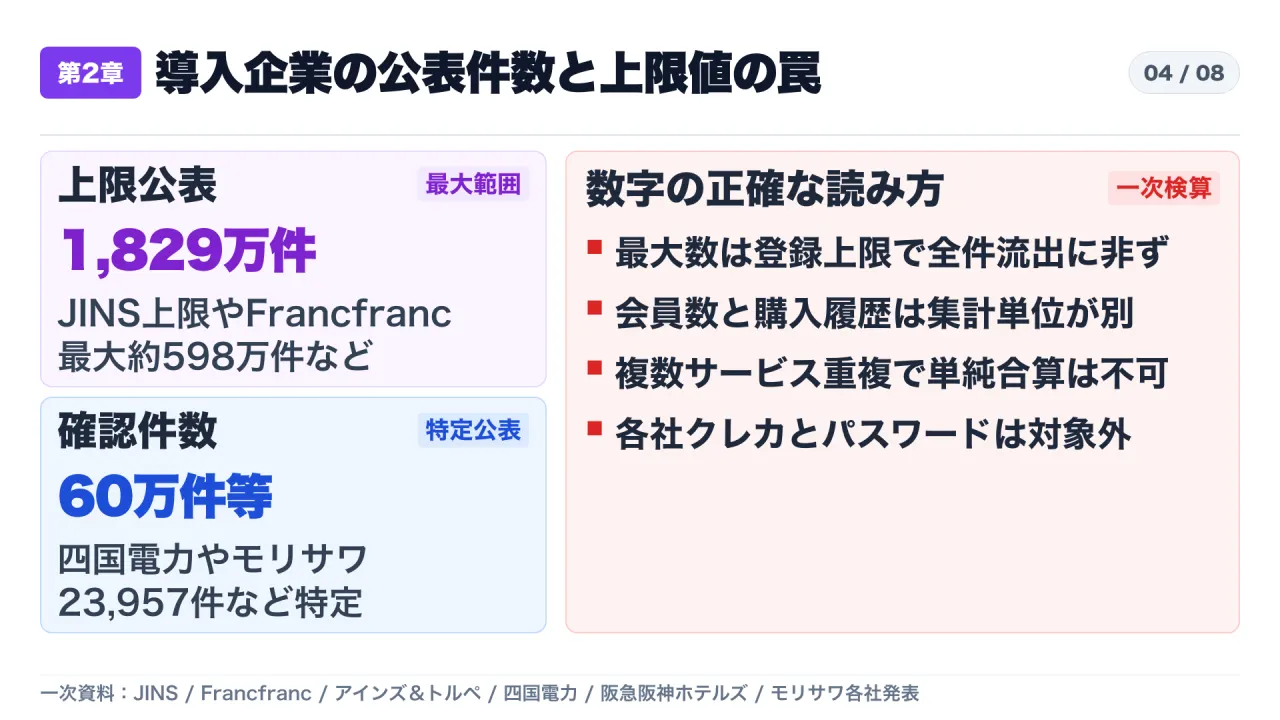
Between November 16 and November 17, 2026, major KARTE adopters published individual incident notices. Media summaries that add those headline figures together risk wildly misrepresenting the actual number of affected individuals, because companies used fundamentally different reporting definitions: some published the maximum theoretical ceiling of all records stored in KARTE pending log verification, while others reported confirmed leaked counts extracted from Plaid’s early forensic logs.
| Company / Brand | Disclosure Category | Published Scale | Included & Excluded Data Fields |
|---|---|---|---|
| JINS | Maximum Ceiling (Under Investigation) | Up to ~18.29 million accounts | Member ID, email, family name, birth date, age, gender, postal code, prefecture (passwords, credit cards, and offline-only store members excluded) |
| Francfranc | Maximum Potential Scope | Up to ~5.98M members / ~4.00M e-commerce purchase records | Name, birth date, ID, municipality / gender, postal code, age bracket (passwords and credit cards excluded) |
| AINZ & TULPE / AYURA | Maximum Potential Scope | Up to ~2.60M combined across both brands | Name, birth date, gender, email, phone number (passwords, credit cards, and unlinked members excluded) |
| Shikoku Electric Power (Yonden Concierge) | Published Leak Count | ~600,000 records | Customer name, email (ID), address, email opt-in flag (passwords, credit cards, and bank accounts excluded) |
| Hankyu-Hanshin Hotels | Current Maximum Scope | 331,586 total records (may decrease) | Name, age, address, phone number, email (may include former members; credit cards and passport data excluded) |
| Social Interior | Confirmed Leak | 29,194 records | Name, email, and LINE user ID for subsclife by TOKYOROOMS |
| Morisawa | Confirmed Leak | 23,957 records | Name, email, and ID for Morisawa Fonts buyers since May 2023 (passwords and credit cards excluded) |
| OPTAGE (mineo) | Under Investigation | Count under verification | Possible email address leak (credit cards, bank accounts, and ID verification documents were never provided to KARTE) |
Look closely at the structural traps hidden inside this table. In Francfranc’s notice, the ~5.98 million member figure and the ~4.00 million e-commerce purchase history figure count different table types that overlap across the same shoppers. Across all eight organizations, a single consumer in Japan can easily appear in JINS, Francfranc, AINZ & TULPE, and Hankyu-Hanshin Hotels simultaneously. Treating an “upper-bound ceiling prior to forensic narrowing” as identical to a “confirmed exfiltrated record count”—or summing them into a single multi-million-person total—distorts both regulatory risk assessment and public communication. Equally important, across these major disclosures, payment card numbers and authentication passwords were consistently excluded because those fields were not ingested into KARTE.
4. The Downstream API Key Time Bomb and Prolonged Service Disruption
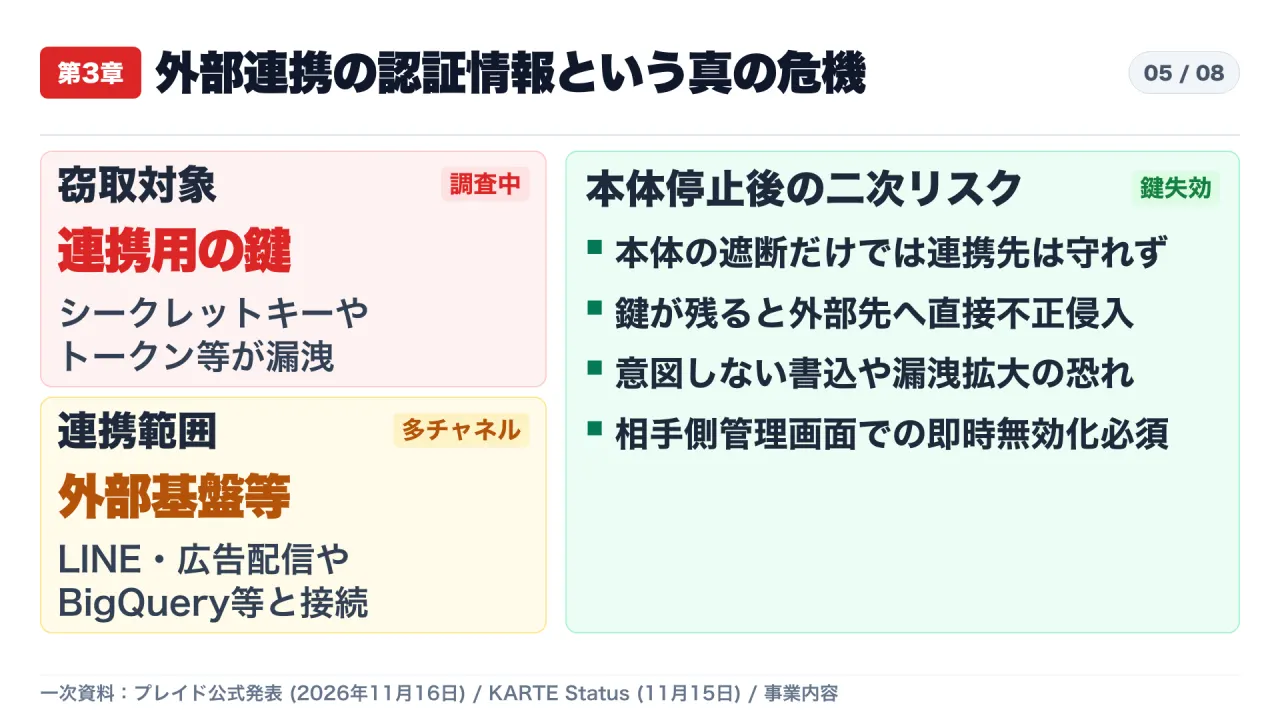
From an architecture standpoint, the most dangerous item in Plaid’s November 16 disclosure is neither the 79,249 operator emails nor the bounded customer tables—it is the compromise of external service integration credentials (secret keys and access tokens).
Modern CX platforms sit at the hub of a sprawling API mesh. Organizations routinely store API keys, OAuth tokens, webhook secrets, or service-account credentials inside KARTE so the platform can push messages via email providers and LINE, sync audience segments to ad networks, and query or write back customer attributes from cloud data warehouses such as BigQuery. Consider a straightforward physical analogy: if a central concierge company loses the master keycard ring holding keys to your partner offices, locking the concierge company’s front door does not protect those partner offices. An attacker who copied the keys before the shutdown can bypass KARTE entirely and authenticate directly against the connected external platforms.
That is why KARTE Status issued urgent requests on November 15 and again on November 16 urging client companies to invalidate external integration credentials immediately. Even while KARTE itself remains offline, any unrotated secret key or token stored inside a client’s project configuration could allow unauthorized data reads, unauthorized message broadcasts, or unintended writes in downstream systems.
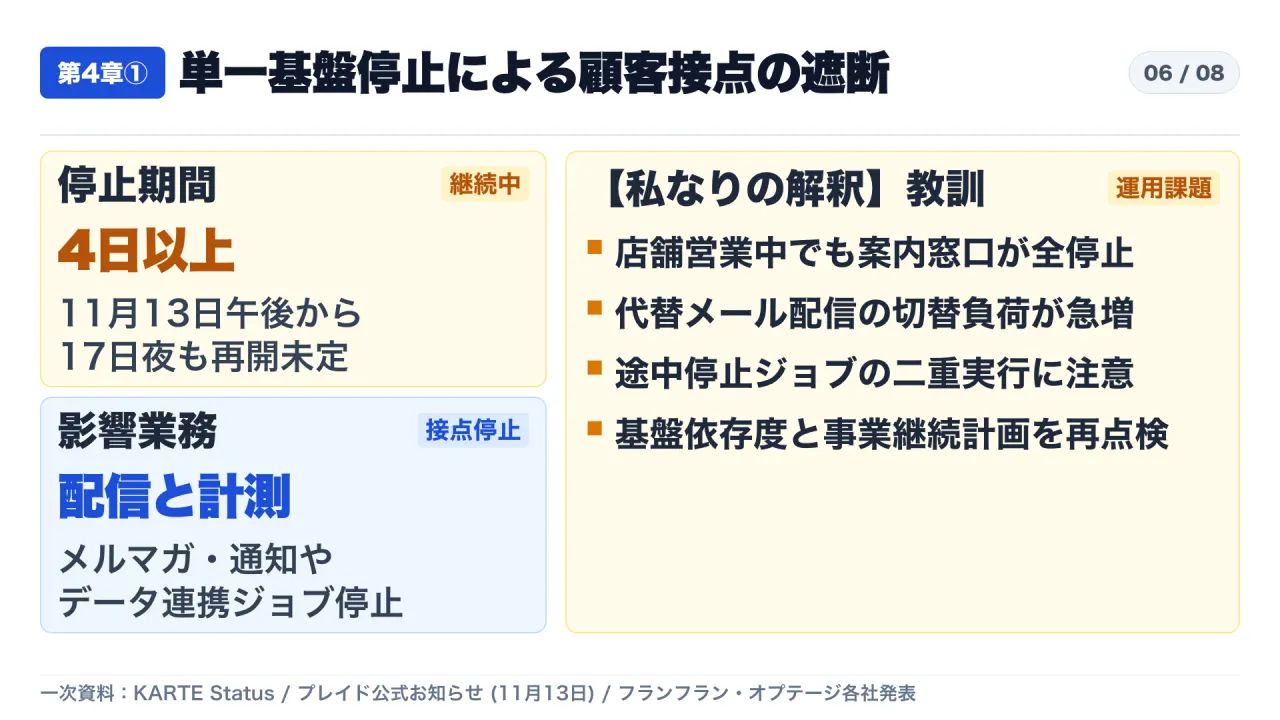
Meanwhile, keeping all KARTE projects offline for more than four days—from the afternoon of November 13 through the evening of November 17, with no confirmed resumption date—exposed the operational cost of single-vendor dependency. Retail campaigns, customer announcements, behavioral measurement, and scheduled data-sync jobs froze simultaneously. Companies forced to switch abruptly to fallback email distribution tools also face a secondary operational hazard when KARTE eventually restarts: queued or interrupted delivery jobs from November 13 could fire twice if teams do not reconcile pre-shutdown state before re-enabling integrations.
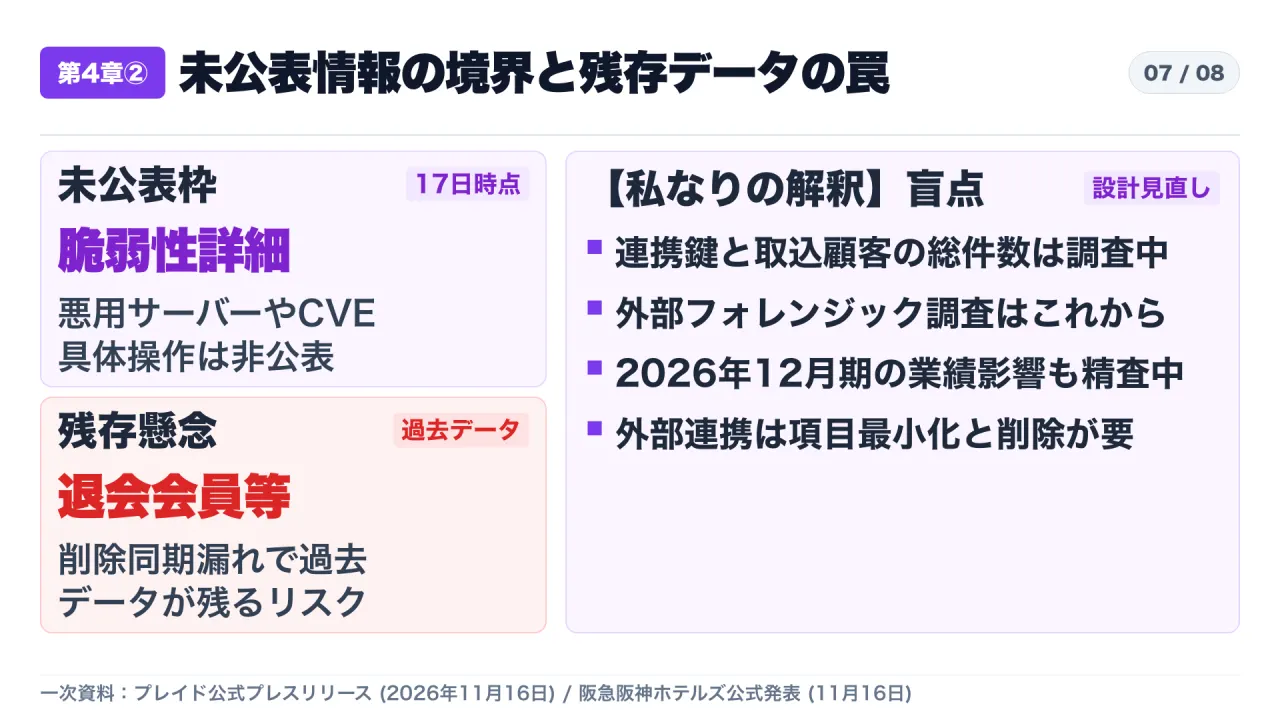
At the same time, responsible risk management requires marking the exact boundary of what remained undisclosed as of November 17, 2026. Plaid had not yet published the specific exploited server component, any associated CVE identifier, the exact actions executed inside the hijacked administrative interface, the total aggregate count of leaked integration keys and imported customer records across all clients, the full-year financial impact for FY2026 (ending December 2026), or a target recovery date, with external forensic investigation still underway.
Furthermore, Hankyu-Hanshin Hotels’ explicit caveat that former, unsubscribed members may be included in its 331,586-record ceiling highlights an overlooked governance failure in SaaS data pipelines. Many enterprises automatically push new member sign-ups into analytics and CX platforms every night, yet fail to build automated deletion-sync workflows when a user cancels an account—leaving stale personal data sitting inside third-party SaaS tables years after the customer relationship ended.
5. Immediate Defense Checklist for Enterprise Teams and End Users
Whether an organization uses KARTE directly or relies on comparable multi-integration SaaS platforms, the incident establishes concrete verification steps that security and engineering teams should execute immediately:
For Enterprise Security and Engineering Teams
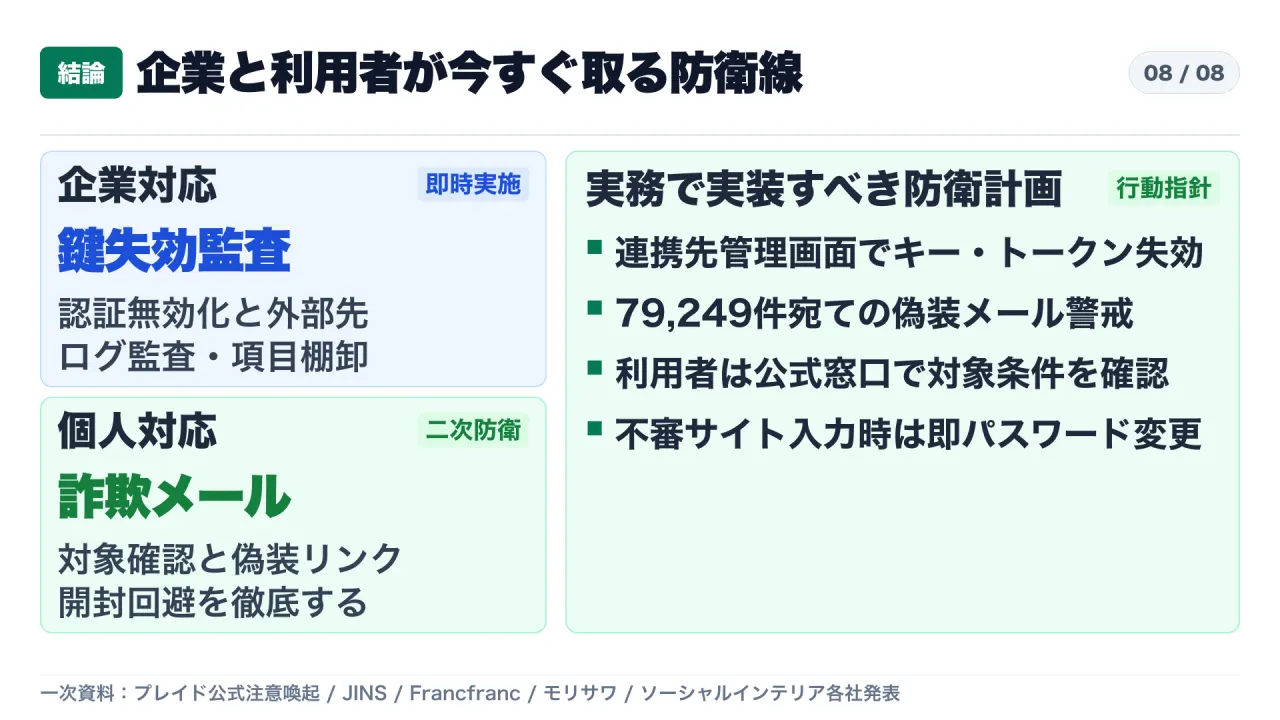
- Revoke External Integration Keys Immediately and Audit Downstream Logs: Do not wait for a SaaS vendor to finish forensics or restore service. Log into every connected external platform—email delivery services, LINE messaging APIs, advertising accounts, and cloud data warehouses—and revoke or rotate all secret keys, API tokens, and service credentials previously configured inside the vendor platform. Inspect destination audit logs prior to revocation for anomalous data exports, unauthorized writes, or permission modifications.
- Inventory Outbound Data Schemas and Deletion Sync: Audit every attribute pushed via linking tables or batch connectors, confirm exact retention windows, and verify whether deletion events for unsubscribed or dormant users actually propagate to external SaaS tables. Prepare regulatory notifications (such as Japan’s Personal Information Protection Commission filings) and customer notices based on verified log data rather than raw table ceilings.
- Guard Against Operator Phishing and Post-Recovery Duplicate Jobs: Warn internal administrators whose emails were among the 79,249 registered KARTE accounts to watch for fake vendor recovery emails, and audit queued delivery jobs from November 13 before reconnecting outbound messaging to prevent duplicate customer blasts.
For Individual Consumers and End Users
- Verify Scope Through Official Merchant Notices: Having an account at a listed retailer or hotel does not automatically mean personal data was exfiltrated. Check each company’s official notice and individual email notification to confirm whether your specific membership scope or purchase window is affected.
- Treat Personalized Follow-Up Links with Extreme Caution: Because leaked datasets at some brands combine names, email addresses, birth dates, and postal codes, attackers can craft convincing phishing emails or SMS messages. Never log in, enter passwords, or follow refund links embedded inside unsolicited notifications; always navigate directly to the merchant’s official website or app.
- Update Credentials Only If Exposed Elsewhere: While passwords and payment card numbers were excluded across the major enterprise disclosures reviewed here, anyone who inadvertently enters credentials into a lookalike phishing page should change that password immediately across all reusing accounts.
Primary Sources Verified
- Plaid Official Press Release (November 16, 2026)
- Plaid Official Incident Notice (November 13, 2026)
- KARTE Status Official Incident Log (
rs1gsmckc197) - Plaid Q4 FY2026 Financial Presentation (Official IR PDF)
- Plaid Timely Disclosure PDF (November 16, 2026)
- Plaid Official Business Overview
- Kabutan Stock News: Plaid (4165) Limit-Down Report (November 17, 2026)
- JINS Official Customer Notice (November 17, 2026)
- Francfranc Official Customer Notice (November 17, 2026)
- AINZ & TULPE Official Customer Notice (November 17, 2026)
- Shikoku Electric Power Official Press Release PDF (November 16, 2026)
- Hankyu-Hanshin Hotels Official Customer Notice (November 16, 2026)
- Social Interior Official Customer Notice (November 17, 2026)
- Morisawa Official Customer Notice (November 17, 2026)
- OPTAGE Official Press Release (November 16, 2026)