Rakuten Securities Test Environment Breach: 4.47M and 11.25M Account Exposure Explained
Comparing Rakuten Securities’ November 17 disclosure, phishing alerts, and regulatory rules to separate confirmed exposure scope from unverified gaps—plus four immediate defenses.
Japanese Edition: Read the original Japanese article on Substack
Video Episode (Japanese Audio): Watch on YouTube
On November 17, 2026, Rakuten Securities published an official incident notice disclosing that customer information managed inside one of its test environment systems may have leaked externally on November 11, 2026. The announcement arrived alongside an emergency phishing alert issued on the same day by Japan’s Council of Anti-Phishing Japan, reporting a sharp spike in fraudulent emails impersonating securities firms and active phishing websites operating by noon.
For retail investors, former account holders, and enterprise security teams alike, headline numbers alone rarely clarify the real operational risk. A 1-to-1 verification across seven primary documents—Rakuten Securities’ November 17 notice, its two earlier vendor-related notices from October 31 and November 5, its 2026 corporate news release data, the Council of Anti-Phishing Japan’s November 17 alert, the Financial Services Agency’s November 13 guidance, and the Personal Information Protection Commission’s statutory reporting framework—draws a clear line between confirmed facts and boundaries that remain unconfirmed in the public record.
- Core Thesis: Although Rakuten Securities reports no confirmed leak of login passwords, PINs, or unauthorized trades as of November 17, 2026, the potential exposure of real personal attributes—including home addresses, employers, withdrawal bank account numbers, and asset figures for up to approximately 4.47 million accounts, including closed accounts—creates severe secondary risk for targeted social-engineering and phishing attacks.
- Primary Sources Verified: Rakuten Securities official notices (October 31, November 5, and November 17, 2026), Rakuten Securities 2026 news release JSON (15 million total accounts on November 2 and 7 million Money Bridge accounts on August 25, 2026), Council of Anti-Phishing Japan emergency alert (November 17, 2026), Japan Financial Services Agency notice (updated November 13, 2026), and Japan Personal Information Protection Commission breach-response guidance.
- Actionable Strategic Takeaways: Even when more than 90 percent of daily active users rely on passkey authentication, passkeys cannot stop criminals from exploiting leaked personal records in phone calls, SMS messages, or emails; account holders and former customers must verify communications exclusively through official apps or bookmarks and follow four concrete defense steps immediately.
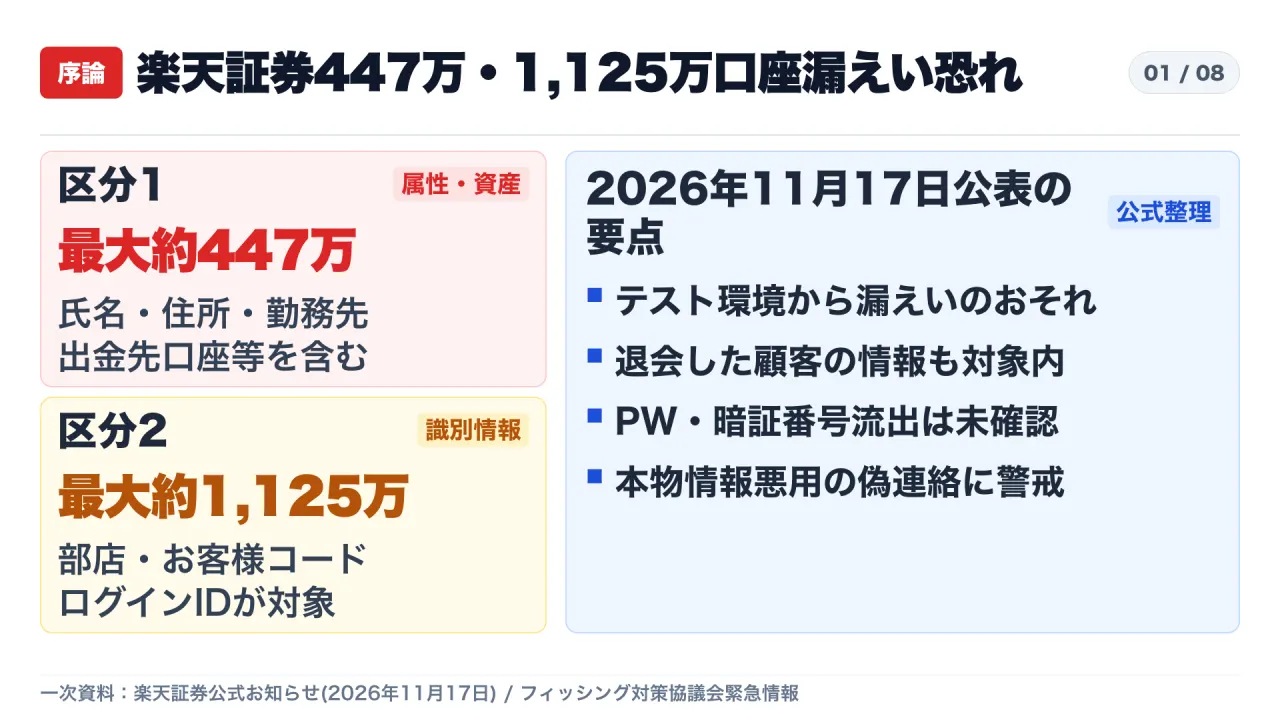
1. Confirmed Timeline and the Five-Day Detection Gap
The verified timeline from Rakuten Securities’ November 17, 2026 disclosure establishes a five-day window between the potential exfiltration event and the company’s containment action:
| Event | Confirmed Details as of November 17, 2026 |
|---|---|
| Date of potential data leak | November 11, 2026 (identified during subsequent investigation) |
| Date of detection and access blocking | November 16, 2026 (external access blocked and system fixes applied) |
| Date of public disclosure | November 17, 2026 |
| Affected environment | Test environment system operated by Rakuten Securities |
| Scope identification status | Affected customers already identified; individual notifications planned |
| Login passwords and PINs | No leakage confirmed |
| Unauthorized logins or trades | None confirmed as of the November 17, 2026 notice |
According to the disclosure, Rakuten Securities detected possible third-party unauthorized access to part of its systems on November 16, 2026, and immediately blocked access and implemented remediation measures. Further investigation then indicated that some customer records stored in the test environment may have leaked externally five days earlier, on November 11, 2026.
The root cause and detailed attack path remain under active investigation. At the same time, the company stated that it has already identified the affected customer records and intends to contact those individuals directly. Because the potential leak occurred on November 11 and public warning arrived on November 17, attackers had a multi-day head start before customers learned that real account attributes might be circulating externally.
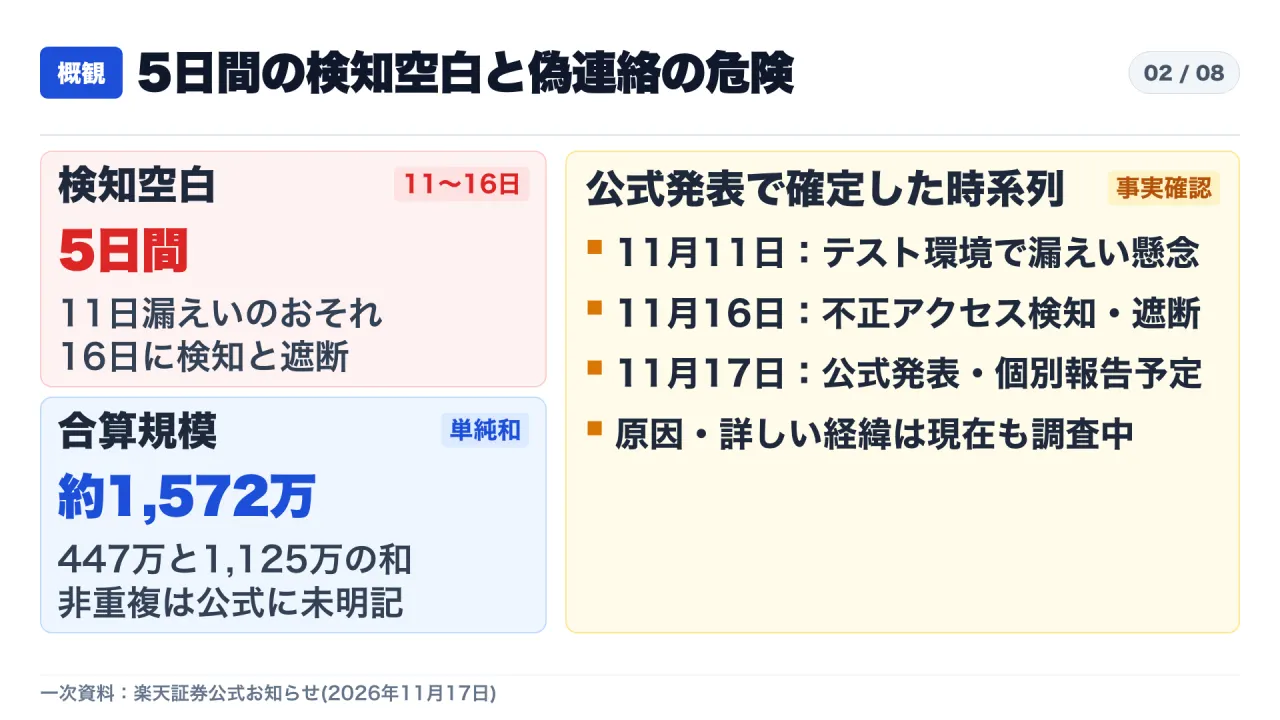
2. Category 1 (Up to 4.47M Accounts) vs. Category 2 (Up to 11.25M Accounts)
Rakuten Securities divided the potentially exposed records into two distinct categories, and crucially, both categories include customers who have already closed their accounts:
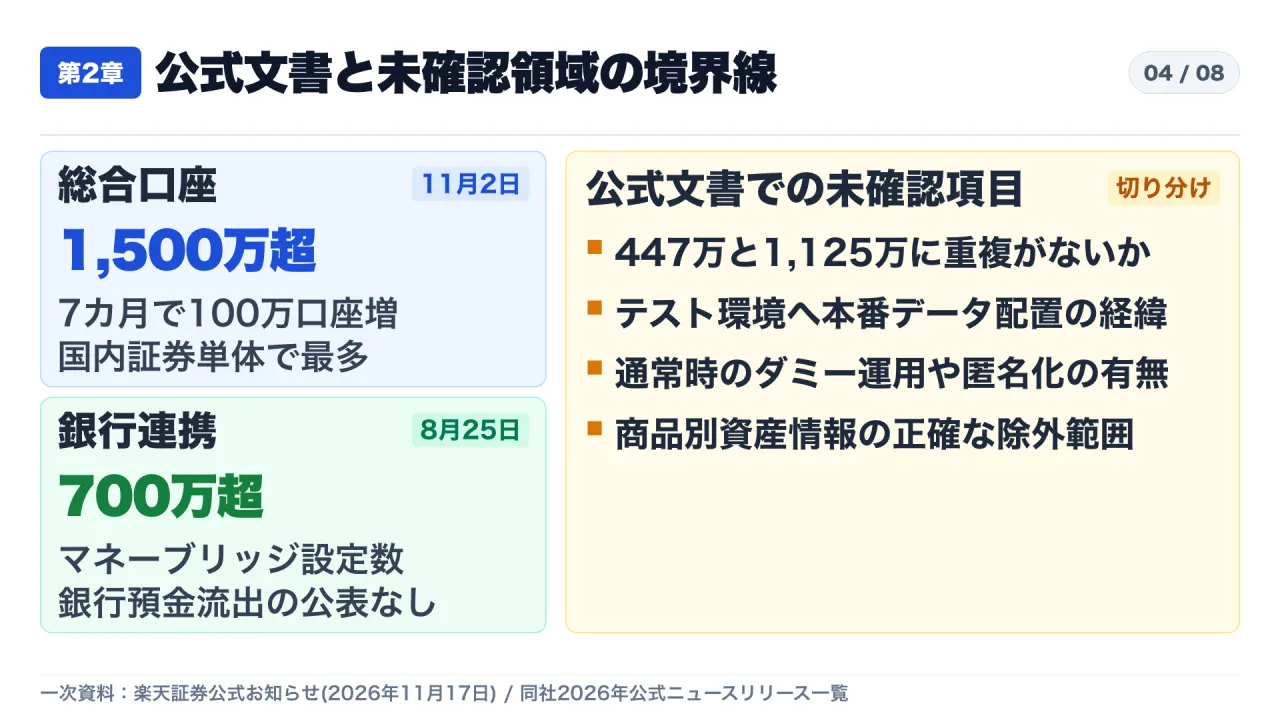
- Category 1 (up to approximately 4.47 million accounts): Branch and customer codes, Rakuten Securities login IDs (explicitly noted as separate from general Rakuten Ecosystem IDs), full names, phonetic kana names, dates of birth, residential addresses, telephone numbers, email addresses, employer names, withdrawal bank account details (financial institution name, account number, and account holder name), declared annual income and financial asset tiers, asset information broken down by product category, and last login dates.
- Category 2 (up to approximately 11.25 million accounts): Branch codes, customer codes, and Rakuten Securities login IDs (again distinct from general Rakuten IDs).
Think of Category 1 not as a stolen vault key, but as a complete resident registry left inside a lightly guarded temporary storage unit—including records of former residents who moved out years ago. Even if login passwords and trading PINs remain uncompromised, possessing an authentic dossier containing someone’s employer, home address, bank account number, and declared net worth gives fraudsters an exceptionally convincing script for telephone, postal, SMS, or email impersonation.
Meanwhile, Category 2 covers up to approximately 11.25 million accounts with identifiers (branch code, customer code, and login ID). While those fields alone do not expose home addresses or asset balances, they still provide valid account identifiers that attackers can combine with external breaches or credential-stuffing lists if passkey or multi-factor protections are absent.
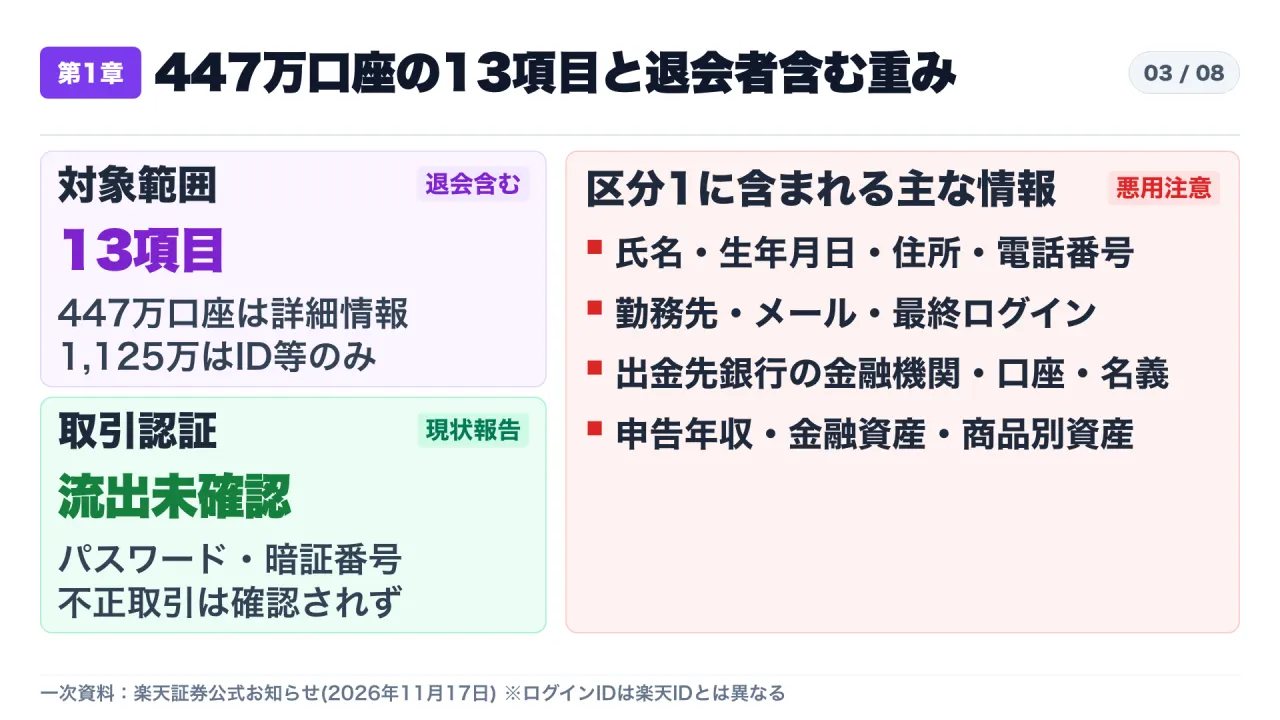
3. Confirmed Facts vs. Unverified Boundaries in Official Filings
Cross-referencing Rakuten Securities’ 2026 news release archive clarifies the broader scale of the brokerage. On November 2, 2026, Rakuten Securities surpassed 15 million general securities accounts—adding 1 million accounts in roughly seven months after passing 14 million—maintaining the largest standalone account base among domestic Japanese brokerages. Earlier, on August 25, 2026, its Money Bridge account-linkage service with Rakuten Bank exceeded 7 million accounts.
However, reading the November 17, 2026 disclosure strictly on its own terms reveals three boundaries where the official document provides no definitive answer:
- Whether Category 1 and Category 2 overlap: Adding 4.47 million and 11.25 million yields a simple sum of approximately 15.72 million accounts—close to the 15 million active base plus closed accounts. Yet the official notice uses “up to approximately” for both figures and does not explicitly state whether the two groups are mutually exclusive.
- Why production customer data sat in a test environment: The notice does not explain whether dummy data is normally required in testing, why live personal attributes and asset records were present on November 11, 2026, or whether masking, anonymization, and network isolation controls were applied.
- Exact boundaries of “asset information by product”: The announcement lists the category name without specifying whether individual equity holdings, unrealized gains and losses, or linked Rakuten Bank deposit balances via Money Bridge are excluded. The only banking data explicitly named in Category 1 is registered withdrawal bank account details; no leakage of Rakuten Bank deposit balances has been announced.
Separating confirmed operational disclosures from these unverified technical details prevents false reassurance while avoiding unsubstantiated speculation about system architecture or banking exposure.
4. Distinguishing Three Separate Notices Between October 31 and November 17, 2026
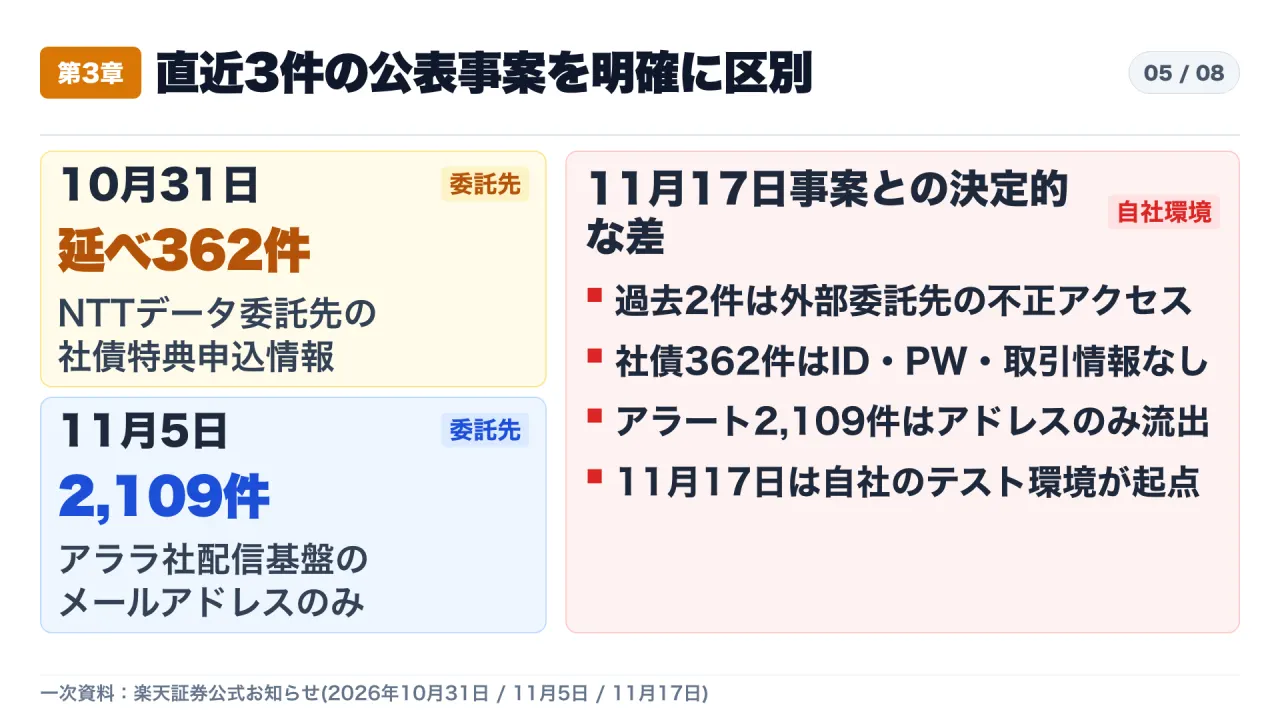
Over less than three weeks, Rakuten Securities published three notices regarding potential information exposure. Treating them as a single incident obscures vital differences in root-cause ownership, data sensitivity, and affected population:
| Publication Date | Origin System | Scope and Scale | Exposed Data Scope |
|---|---|---|---|
| October 31, 2026 | External vendor platform (“Digital Securities Platform” via NTT Data contractor; occurred October 30, 2026) | 362 cumulative entries across buyers of three digital-perk corporate bond offerings | Bond purchase application details (no brokerage login IDs, passwords, or securities trading data) |
| November 5, 2026 | External vendor email platform (Arara Inc., subcontracted by Minkabu; occurred October 27, confirmed November 4, 2026) | 2,109 records of “Economic Indicator Alert Email” subscribers (service suspended October 28, 2026) | Email addresses only (no names, login IDs, passwords, or account details confirmed) |
| November 17, 2026 | Rakuten Securities’ own test environment (potential leak November 11; blocked November 16, 2026) | Up to ~4.47M accounts (Category 1) plus up to ~11.25M accounts (Category 2), including closed accounts | Category 1: names, addresses, employers, withdrawal bank accounts, income/asset tiers, login IDs; Category 2: branch/customer codes and login IDs |
The October 31 and November 5 incidents originated in third-party SaaS and email-delivery infrastructure and affected hundreds to low thousands of records without exposing core brokerage profiles. By contrast, the November 17 incident occurred inside Rakuten Securities’ own internal test environment and encompasses millions of current and former customer records.
5. Why Over 90 Percent Passkey Adoption Does Not Stop Secondary Fraud
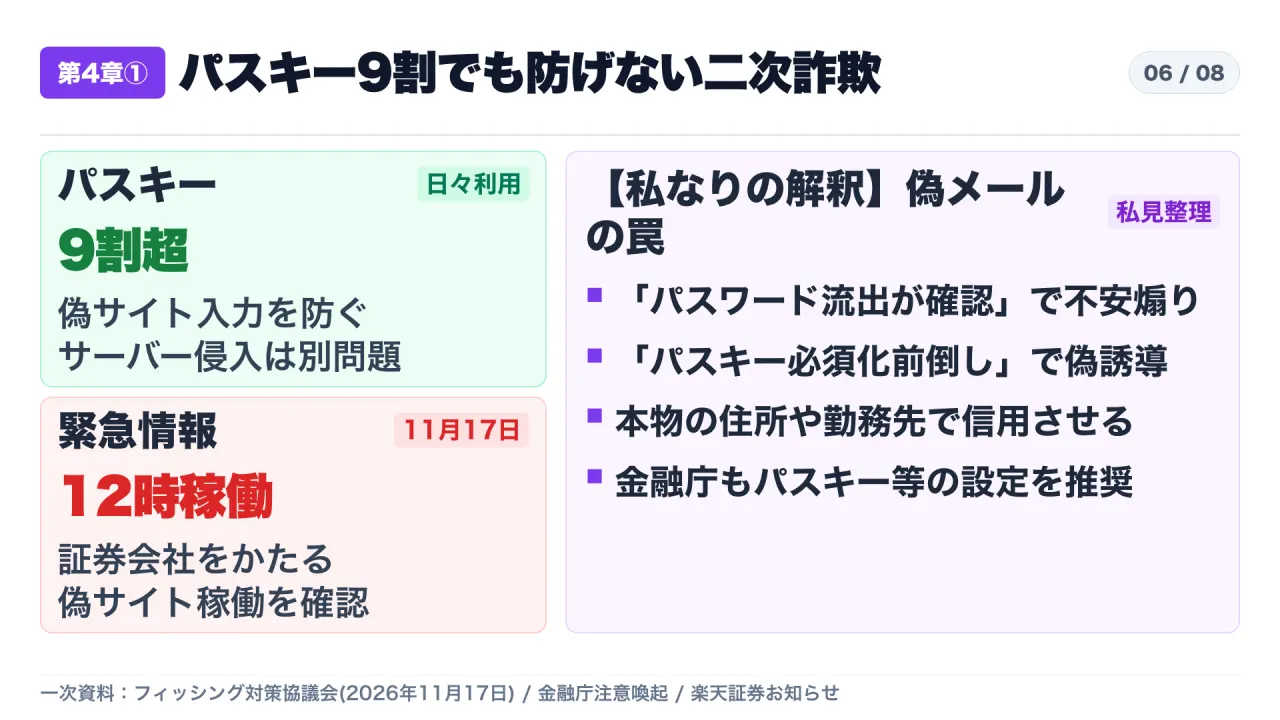
Rakuten Securities emphasized in its November 17, 2026 announcement that more than 90 percent of its daily active login users already authenticate with passkeys, a phishing-resistant authentication standard. Japan’s Financial Services Agency also updated its public investor advisory on November 13, 2026, urging users to enable passkeys and strong multi-factor authentication to counter unauthorized brokerage logins and fraudulent trades.
Yet passkey authentication protects one specific boundary: it prevents a victim from entering static credentials into a spoofed login webpage. Passkeys do not stop server-side unauthorized access inside an internal test environment, nor do they stop criminals from weaponizing leaked personal details through phone calls, text messages, postal mail, or urgent phishing emails.
In fact, at 12:00 PM on November 17, 2026, the Council of Anti-Phishing Japan issued an emergency warning regarding a surge in phishing emails impersonating securities firms, confirming that fraudulent websites were already live. Reported subject lines exploit panic directly—claiming that a customer’s password leak has been confirmed or that mandatory passkey deadlines have been moved forward, pressuring recipients to click embedded links for identity verification.
When a caller or email cites your real home address, employer name, or registered withdrawal bank account number, standard intuition fails. Attackers do not need your password if they can persuade you over the phone or via a spoofed support page to authorize a fraudulent transfer, install remote-control software, or disclose one-time verification codes.
6. The Blind Spot for Former Customers and the 60-Day Regulatory Clock
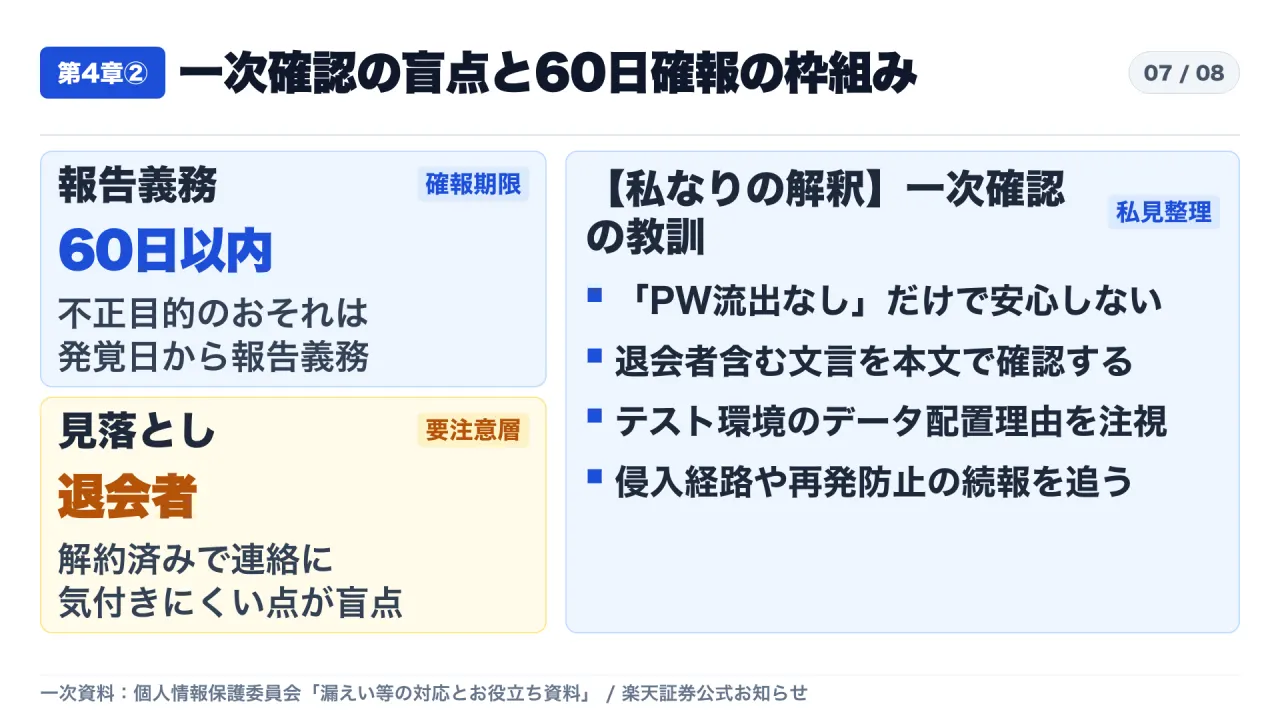
Two structural blind spots deserve particular attention as follow-up investigations unfold. First, reassuring headlines stating that “passwords were not leaked” can lull current and former customers into skipping verification altogether. Closed-account holders are especially vulnerable: someone who deactivated an account years ago rarely monitors brokerage announcements, yet their historical address, employer, bank account number, and email address remain valid targets for tailored scams directed at an older inbox.
Second, under Japan’s Personal Information Protection Commission guidelines on personal data breaches, organizations facing incidents suspected of involving unauthorized or malicious purpose are required to submit a definitive statutory report within 60 days of discovery. That regulatory timeline means stakeholders should monitor subsequent disclosures over the coming two months for confirmed findings on the intrusion vector, the presence or absence of data masking in test environments, and any verified overlap between Category 1 and Category 2.
For security architects and governance teams across financial services, the broader engineering lesson is equally stark: test environments frequently sit outside production zero-trust perimeters and SIEM alerting rules, yet if they hold unmasked customer exports even temporarily, they carry full production blast radius.
7. Four Immediate Defense Actions for Investors and Former Account Holders
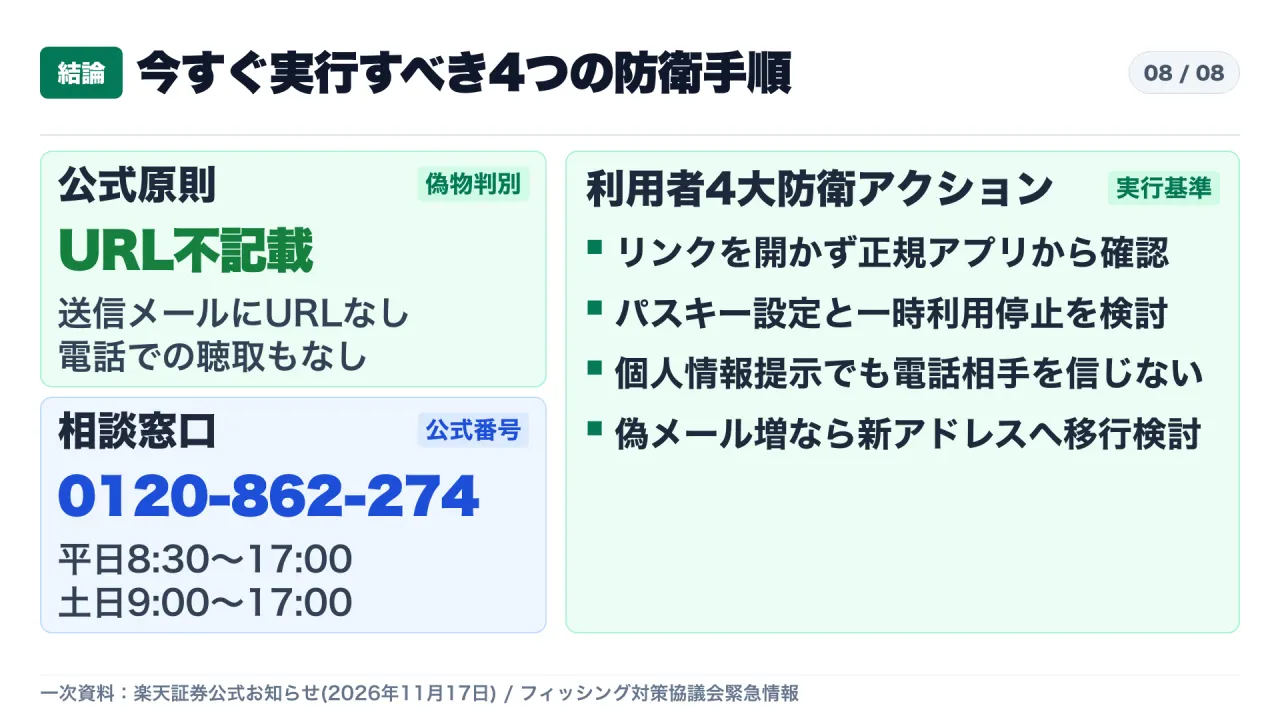
Based strictly on Rakuten Securities’ official rules and guidance from the Council of Anti-Phishing Japan and the Financial Services Agency, current and former users can execute four concrete defensive steps immediately:
- Never open links in emails or SMS messages; verify only via official bookmarks or apps: Rakuten Securities states explicitly that its outbound notification emails do not contain URLs and that staff will never ask for personal or login information by phone. Access account notices solely through the official smartphone app or a previously saved browser bookmark.
- Enable passkeys and consider temporary service suspension: Active account holders who have not yet activated passkey authentication should enable it immediately. Users who do not plan to trade or withdraw funds in the near term can also review the temporary suspension option inside the security settings menu after logging into the official website—checking beforehand whether suspension affects existing recurring investment plans.
- Treat personal details recited on phone calls or letters as non-proof of identity: Even if a caller or letter accurately quotes your residential address, employer, or withdrawal bank account number, those items overlap directly with Category 1 exposure and cannot verify legitimacy. When in doubt, hang up and dial Rakuten Securities’ official customer support center directly (
0120-862-274, weekdays 8:30 AM to 5:00 PM, weekends 9:00 AM to 5:00 PM Japan Standard Time). - Migrate away from exposed email addresses if phishing volume spikes: The Council of Anti-Phishing Japan advises that a sudden flood of phishing messages indicates an email address is circulating in attacker lists. In addition to tightening spam filters and using mail clients that clearly display verified sender domains, migrating critical financial logins to a dedicated, unexposed email address sharply reduces social-engineering exposure.
Primary Sources and Official References
- Rakuten Securities: Apology and Notice Regarding Potential Leakage of Customer Information (November 17, 2026, Japanese)
- Council of Anti-Phishing Japan: Emergency Alert on Phishing Impersonating Securities Firms (November 17, 2026, Japanese)
- Rakuten Securities: Notice Regarding Potential Leakage via Unauthorized Access to External Service Provider (October 31, 2026, Japanese)
- Rakuten Securities: Notice Regarding Potential Email Leakage via Subcontractor Access (November 5, 2026, Japanese)
- Rakuten Securities: 2026 Official News Release Index (15M Accounts Milestone and 7M Money Bridge Accounts, Japanese)
- Financial Services Agency of Japan: Advisory on Unauthorized Access and Trading in Online Securities (Updated November 13, 2026, Japanese)
- Personal Information Protection Commission of Japan: Guidance on Data Breach Reporting and Response (Japanese)