Why Nvidia's Former CEO Cannot Simply Return: Form 8-K and Governance Boundaries
SEC Form 8-K Item 5.02 filings and Bradley Tusk’s Bloomberg Tech analysis reveal why founder concentration creates a single point of failure that fiduciary governance and export rules cannot bypass.
Japanese Edition: Read the original Japanese article on Substack
Video Episode (Japanese Audio): Watch on YouTube
Executive Summary: When Charisma Collides with Public-Company Governance
In November 2026, a major leadership transition shook the foundational compute infrastructure of the artificial intelligence industry. According to a Form 8-K filing (Item 5.02) submitted to the U.S. Securities and Exchange Commission (SEC) on November 12, 2026, the long-serving founder and chief executive of Nvidia stepped down, and Chief Financial Officer Colette Kress assumed interim governance responsibilities as acting chief executive.
The announcement immediately sparked intense debate across financial markets and policy circles. External voices—including prominent political commentators and market participants—began floating the possibility of an informal or rapid return of the former chief executive to stabilize operations. Yet institutional investors, governance specialists, and venture strategists pushed back sharply against that notion. Appearing on Bloomberg Tech, Tusk Ventures co-founder Bradley Tusk articulated why a charismatic founder cannot simply walk back into the corner office of a publicly traded semiconductor giant once statutory resignation procedures have been triggered.
At the core of the controversy lies a structural tension common to hyper-growth technology companies that mature into critical national infrastructure: founder concentration as a Single Point of Failure (SPOF). For years, having roughly 60 direct reports answer straight to a single visionary leader enabled unmatched execution speed and architectural coherence. Once that leader steps away, however, the very absence of intermediate delegation turns organizational strength into systemic fragility. At the same time, public-company fiduciary duties, SEC disclosure boundaries, and U.S. Department of Commerce export control obligations establish strict legal guardrails that no external pressure or sentiment can override.
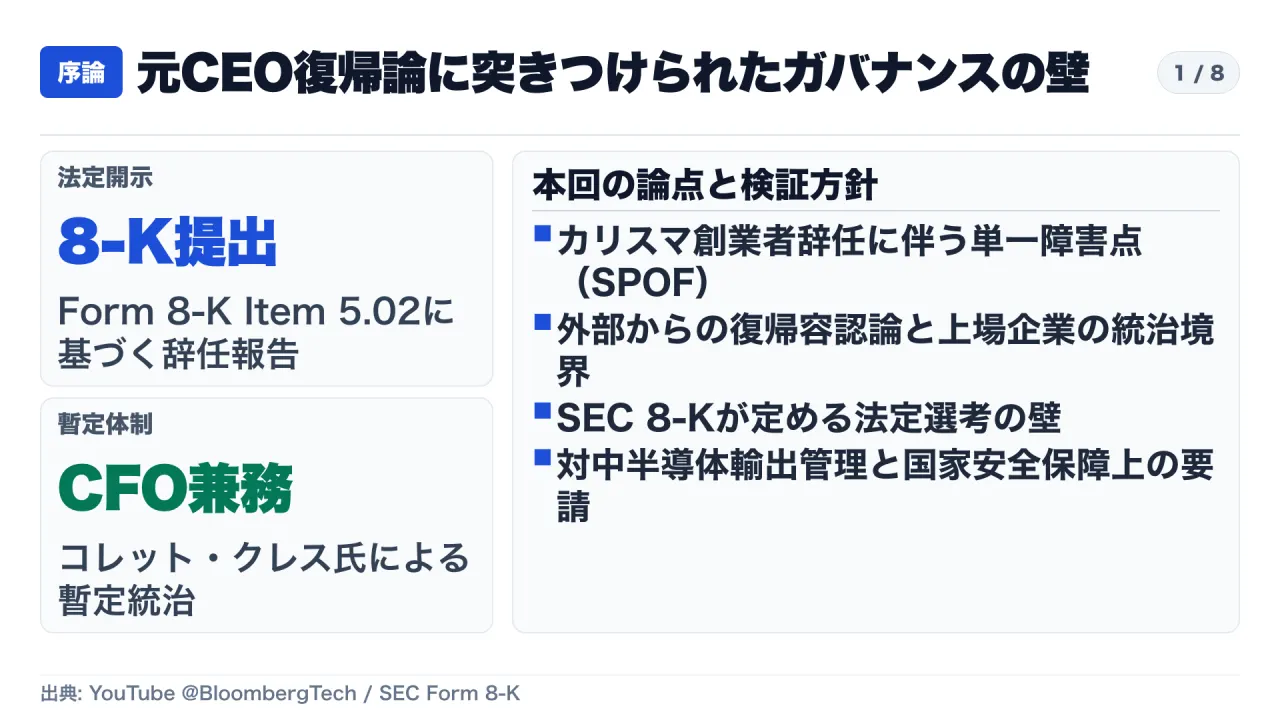
This analysis dissects the primary SEC Form 8-K and DEF 14A filings alongside the Bloomberg Tech commentary to clarify why formal board nomination procedures, statutory compliance, and institutional succession planning now supersede founder-centric authority across the global AI ecosystem.
1. The Single Point of Failure: Inside the 60-Direct-Report Bottleneck
In the early growth stages of a technology enterprise—and even during rapid market expansion—centralizing decision-making under a technically brilliant founder creates a formidable competitive moat. Direct communication lines eliminate bureaucratic latency, keep engineering roadmaps tightly aligned, and allow a company to outmaneuver slower incumbents. When an enterprise reaches multi-trillion-dollar scale and underpins global artificial intelligence compute supply chains, however, extreme centralization transforms from an advantage into an acute governance vulnerability.
During his Bloomberg Tech interview, Bradley Tusk highlighted the structural hazard of an executive reporting tree where approximately 60 senior managers report directly to the chief executive. In such a flat, hub-and-spoke command structure, middle-tier executive empowerment and cross-functional succession pipelines often remain underdeveloped. Strategic context, supplier negotiations, and operational trade-offs reside inside one individual’s judgment rather than within documented institutional processes. When that hub disappears unexpectedly, the organization confronts a classic Single Point of Failure: operational continuity stalls because no designated deputy possesses the broad mandate or institutional authority to bridge every domain simultaneously.
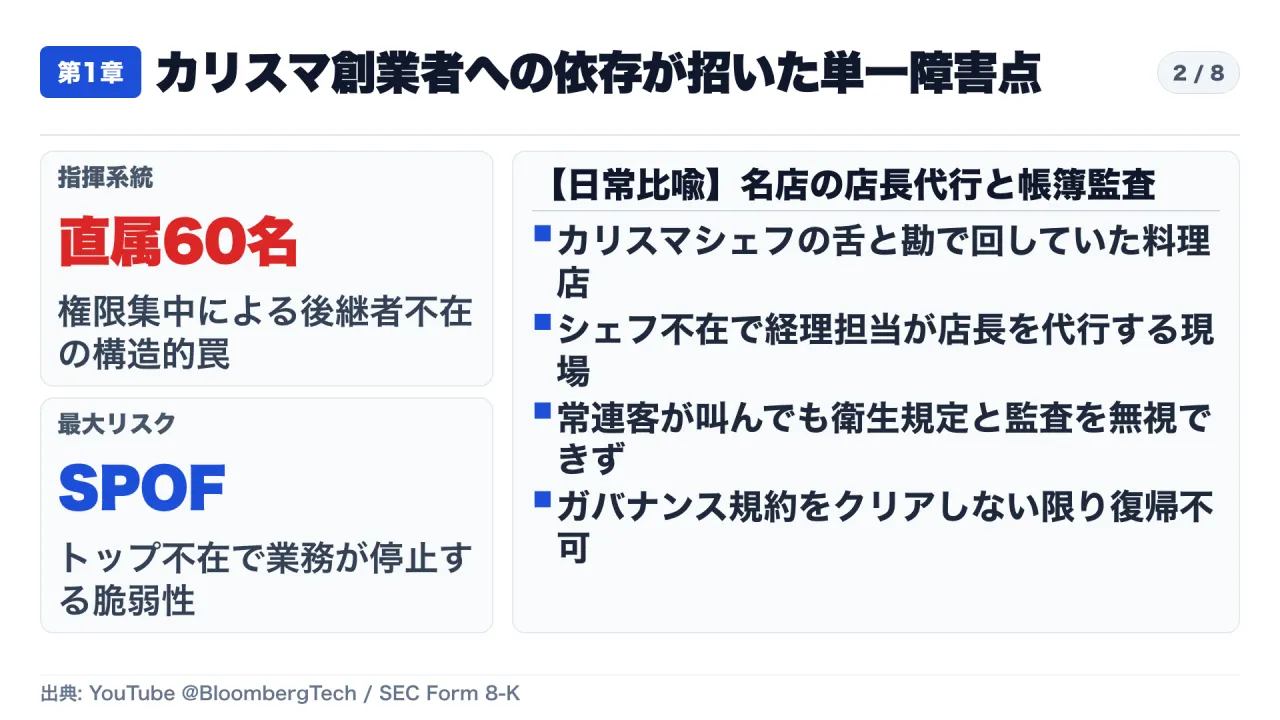
Consider a practical analogy from everyday business operations. Imagine a celebrated restaurant where every procurement decision, recipe calibration, and kitchen timing call has relied exclusively on the palate and intuition of a legendary head chef-owner. If that chef abruptly steps out of the kitchen, placing the accounting manager in charge as interim general manager exposes how little of the craft was codified into standardized kitchen manuals. Even if loyal regular patrons clamor outside the door demanding that the former chef return immediately to the stove, the parent group cannot simply wave the chef back inside without clearing formal food-safety inspections, internal accounting audits, and franchise governance protocols.
For global semiconductor infrastructure, the stakes are infinitely higher than a restaurant kitchen. Investors holding trillions of dollars in equity—and enterprise customers whose data center roadmaps depend on predictable silicon deliveries—cannot rely on informal personalities to resolve executive discontinuities. They require verifiable, auditable governance continuity.
2. SEC Form 8-K Item 5.02 and the Fiduciary Boundary of Public Boards
Regardless of how forcefully external commentators or political figures advocate for a former chief executive’s reinstatement, a U.S.-listed corporation operates inside strict statutory boundaries governed by federal securities law and corporate charters.
On November 12, 2026, Nvidia filed Form 8-K under Item 5.02 (Departure of Directors or Certain Officers; Election of Directors; Appointment of Certain Officers; Compensatory Arrangements of Certain Officers) with the SEC EDGAR database. That official disclosure formally notified shareholders and capital markets of two binding facts: the resignation of the former chief executive and the appointment of CFO Colette Kress to serve concurrently in an interim executive capacity.
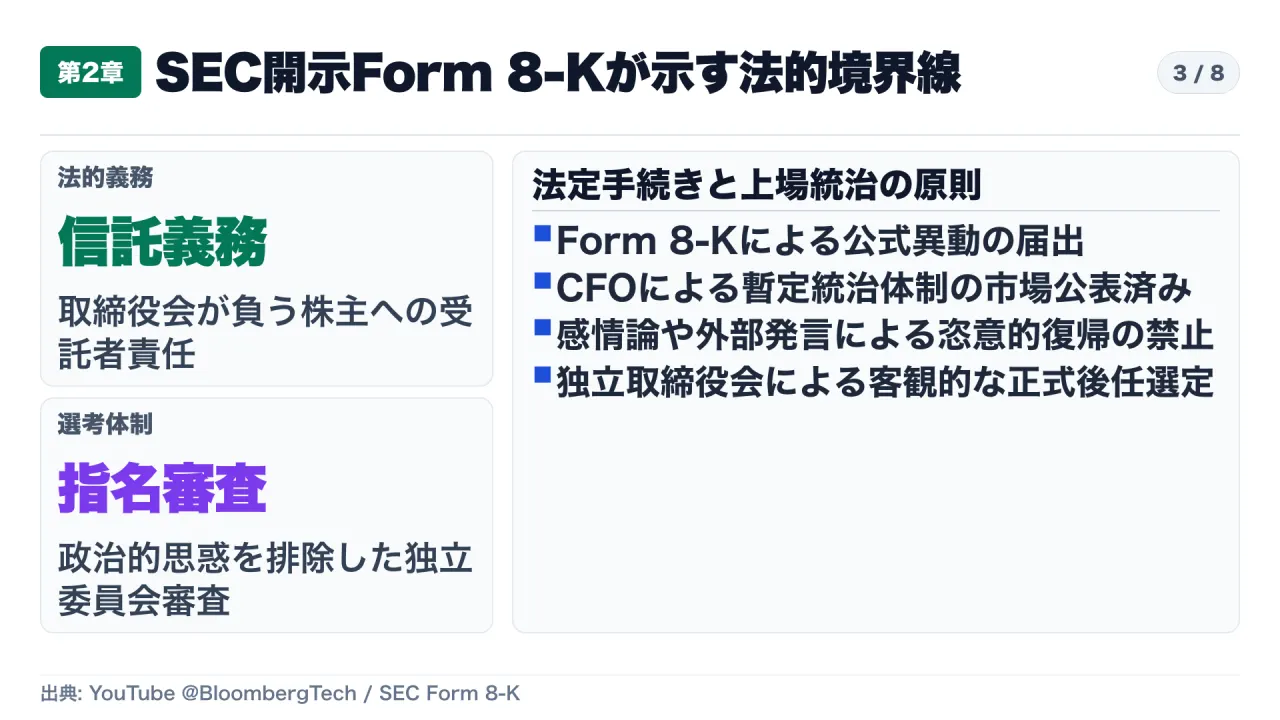
Once a Form 8-K Item 5.02 filing becomes part of the public record, executive authority is no longer an internal family affair; it is an audited commitment to public shareholders. Under Delaware corporate law and exchange listing standards, the board of directors—particularly its independent nominating and corporate governance committee as well as its audit committee—owes a strict fiduciary duty to all shareholders. That duty requires the board to execute an objective, well-documented evaluation and selection process for permanent leadership, insulated from external political pressure or emotional appeals.
Attempting to bypass formal board nomination procedures to reinstate a departed leader based on informal consensus or outside lobbying would expose the company and its directors to severe legal jeopardy:
- Shareholder Derivative Litigation: Institutional investors could challenge board independence, alleging that directors abdicated their oversight responsibilities in favor of arbitrary personal arrangements.
- Regulatory and Listing Scrutiny: Circumventing established committee charters and disclosure controls undermines internal control over financial reporting and corporate governance attestations required by public exchanges.
- Market Confidence Erosion: Public equity markets price predictability and rule-based oversight. Reversing a formal Item 5.02 transition through backchannel maneuvering signals institutional instability rather than strength.
In short, separating emotional narratives from statutory procedures is not bureaucratic pedantry—it is the foundational safeguard that protects shareholder value and market integrity.
3. Owner-President Transitions Meets Export Control Compliance
The tension surrounding a founder’s departure and rumored return mirrors a pattern frequently seen in large corporations across both the United States and Japan. When a founder who built an enterprise from a small shop steps down, any subsequent attempt to retain de facto control as an informal advisor or “shadow executive” immediately triggers pushback from listing-standard governance committees and external auditors. Ambiguity over who actually holds decision-making authority—and who bears legal accountability for corporate actions—is incompatible with modern public-company oversight.
In the advanced semiconductor sector, that internal governance requirement is compounded by an unforgiving external constraint: U.S. national security and export administration compliance.
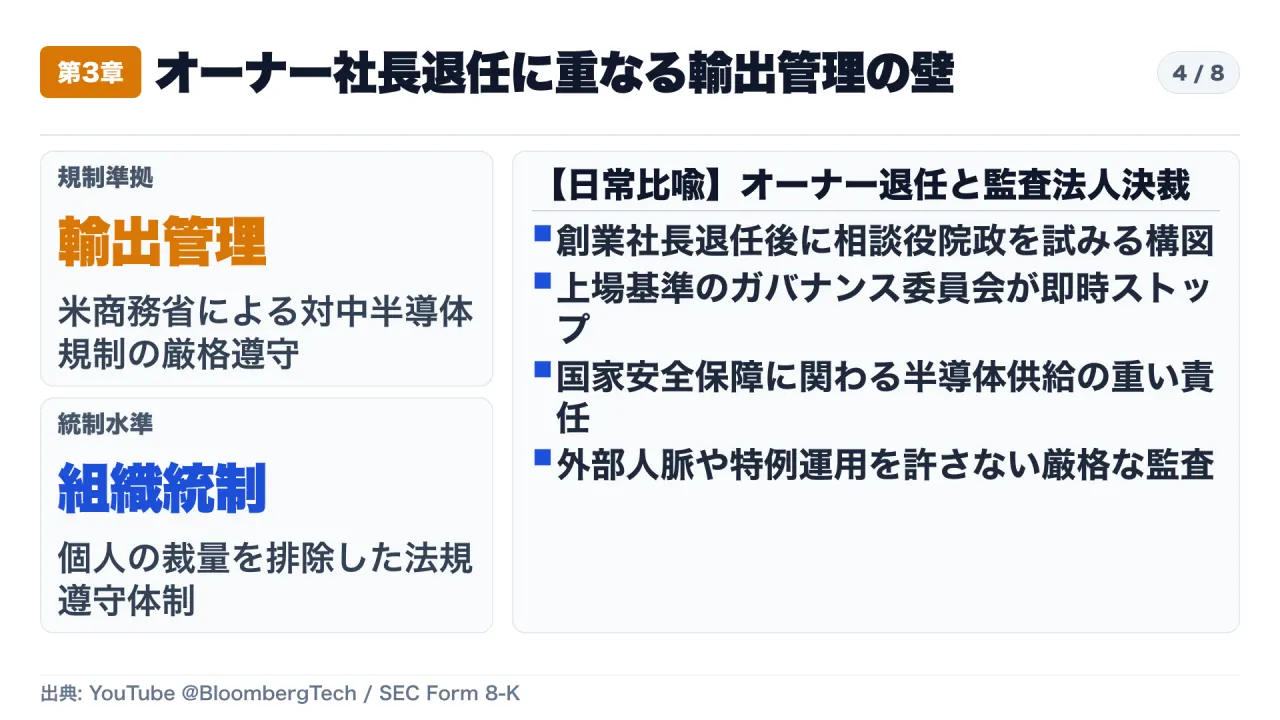
Leading-edge AI accelerators and high-bandwidth compute architectures sit directly at the center of U.S. Department of Commerce Export Administration Regulations (EAR) and cross-border technology restrictions toward China. Managing licensing boundaries, customer screening, supply-chain traceability, and government reporting requires rigorous institutional controls that survive independent third-party audits.
Under these regulatory conditions, personal charisma, political connections, or informal deal-making cannot substitute for documented compliance workflows. If a single former executive were permitted to re-enter strategic decision-making outside formal board authorization and statutory officer accountability, every export-control attestation and regulatory assurance signed by the company could be called into question. Public semiconductor suppliers must demonstrate to regulators and allied governments alike that compliance resides in repeatable organizational systems—not in the personal discretion of any one individual.
4. Auditing the EDGAR Record: Lessons from Critical Infrastructure Access Control
A second and equally instructive analogy comes from physical and logical access governance inside critical infrastructure facilities such as power plants.
When a veteran plant director retires from a high-security power generation facility, no amount of praise from outside stakeholders—and no informal recommendation from external officials—allows security personnel to reactivate that former director’s facility keycard without a full background re-verification, role-based authorization review, and formal sign-off under established security policies. Separation of duties and mandatory re-certification exist precisely to prevent unauthorized or unmonitored access to sensitive operational controls.
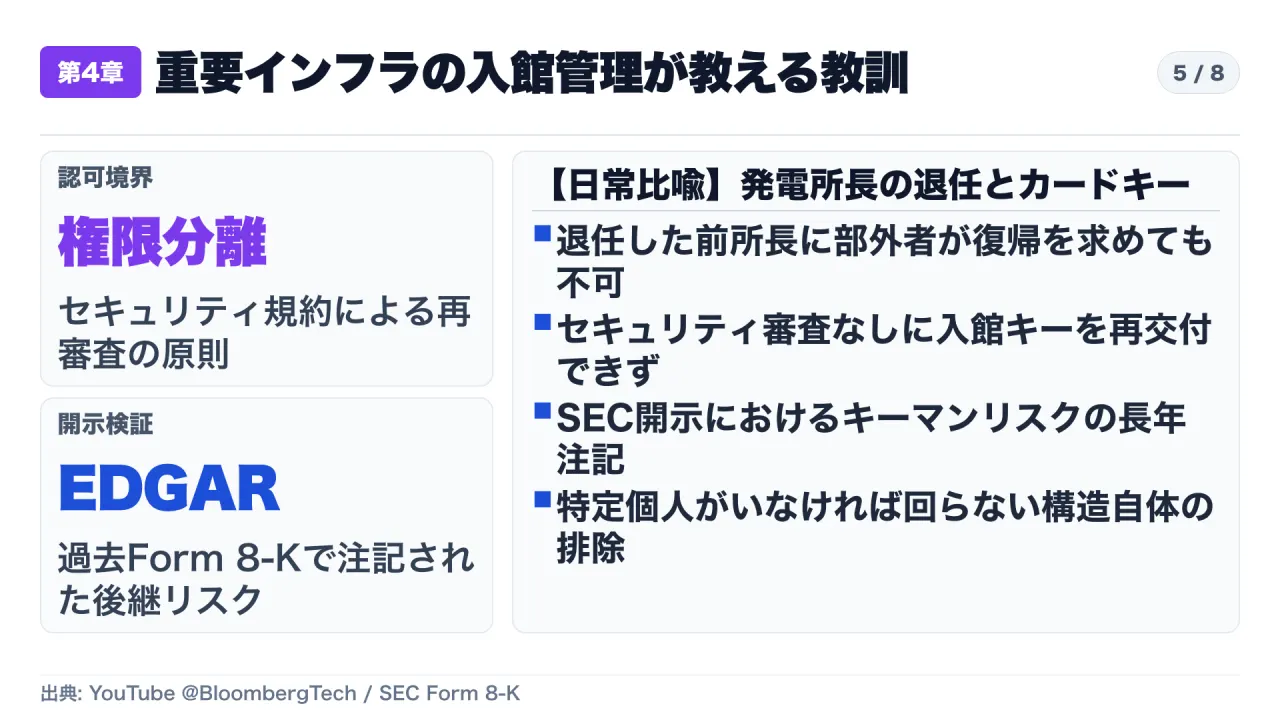
Examining the historical SEC EDGAR record reinforces why this strict boundary matters. Across prior Form 8-K filings and annual proxy statements (DEF 14A) submitted by large technology issuers, board-level risk disclosures and executive governance reviews have repeatedly flagged succession planning and key-person dependency as structural risk factors. For years, institutional analysts noted that an enterprise whose operational execution depends disproportionately on a single irreplaceable executive carries latent downside risk that can materialize abruptly upon health, personal, or regulatory transitions.
When an abrupt leadership change occurs in an organization with a long-documented key-person risk profile, the transition forces a long-delayed structural reckoning. Rather than attempting to restore the previous single-person dependency, boards must use the statutory transition window to institutionalize multi-layered executive oversight, clarify deputy mandates, and verify that compliance, engineering, and capital allocation committees operate independently of any individual personality.
5. Silicon Valley’s Structural Shift: From Founder Worship to Institutional Governance
The implications of this governance inflection point extend far beyond one semiconductor company. Across Silicon Valley, the entire AI hardware and frontier software ecosystem is undergoing a fundamental maturation test.
For the past two decades, venture-backed technology culture celebrated “founder mode” and absolute executive concentration as the ultimate engine of hyper-growth. While that model excels at zero-to-one product invention, the AI industry of late 2026 no longer consists solely of nimble software startups. Leading AI model laboratories, cloud compute providers, and semiconductor designers are raising unprecedented capital, preparing for public-market listings, and constructing physical power and data center infrastructure critical to national economies.
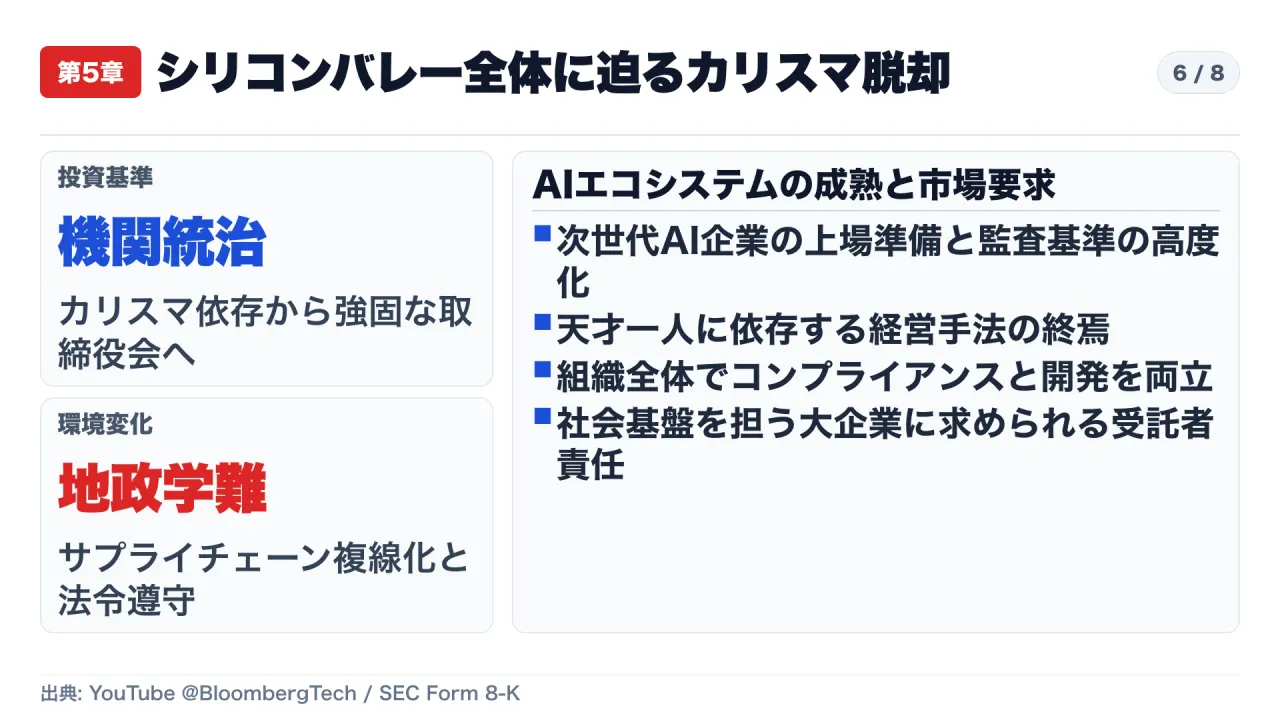
As these organizations transition from startup exuberance to foundational economic infrastructure, capital markets and sovereign regulators are imposing non-negotiable expectations:
- Pre-IPO Audit Readiness: Next-generation AI companies preparing to enter public markets face intense institutional scrutiny over board independence, related-party controls, and executive succession depth.
- End of Single-Genius Governance: Public pension funds, sovereign wealth funds, and global asset managers cannot underwrite multi-decade infrastructure buildouts if strategic continuity hinges on a single executive’s presence.
- Geopolitical Supply-Chain Resilience: Navigating tightening export controls and multi-jurisdiction hardware supply chains demands distributed compliance leadership capable of operating seamlessly across legal, engineering, and finance teams.
In this matured environment, balancing rapid technical innovation with auditable legal compliance requires institutional governance structures that outlast any individual founder.
6. Three Operational Principles to Eliminate Single Points of Failure
The governance clash triggered by the November 2026 Form 8-K transition illustrates a broader reality: the AI industry has entered an era where institutional discipline supersedes individual charisma. Even the most accomplished founder cannot step over statutory fiduciary duties or federal disclosure boundaries once a formal transition is underway.
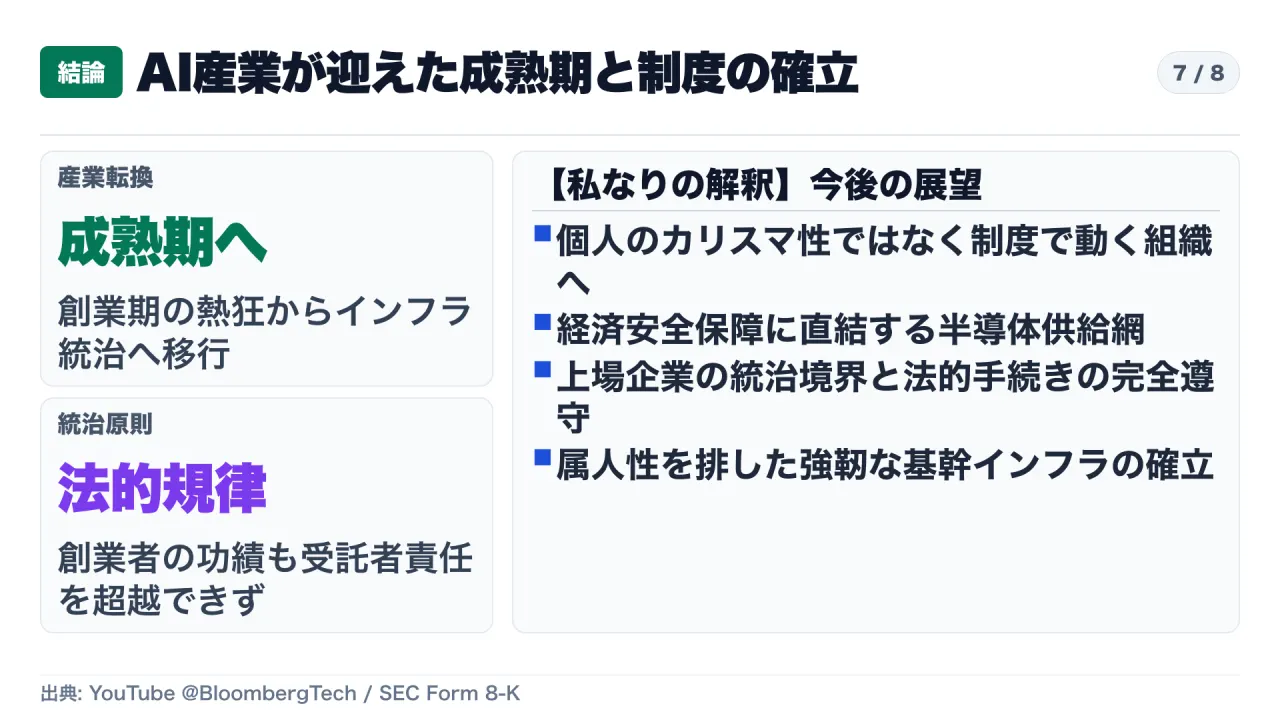
For engineering leaders, corporate executives, and technical managers—whether inside listed enterprises or growing technology teams—this episode yields three concrete operational principles to audit and apply immediately:
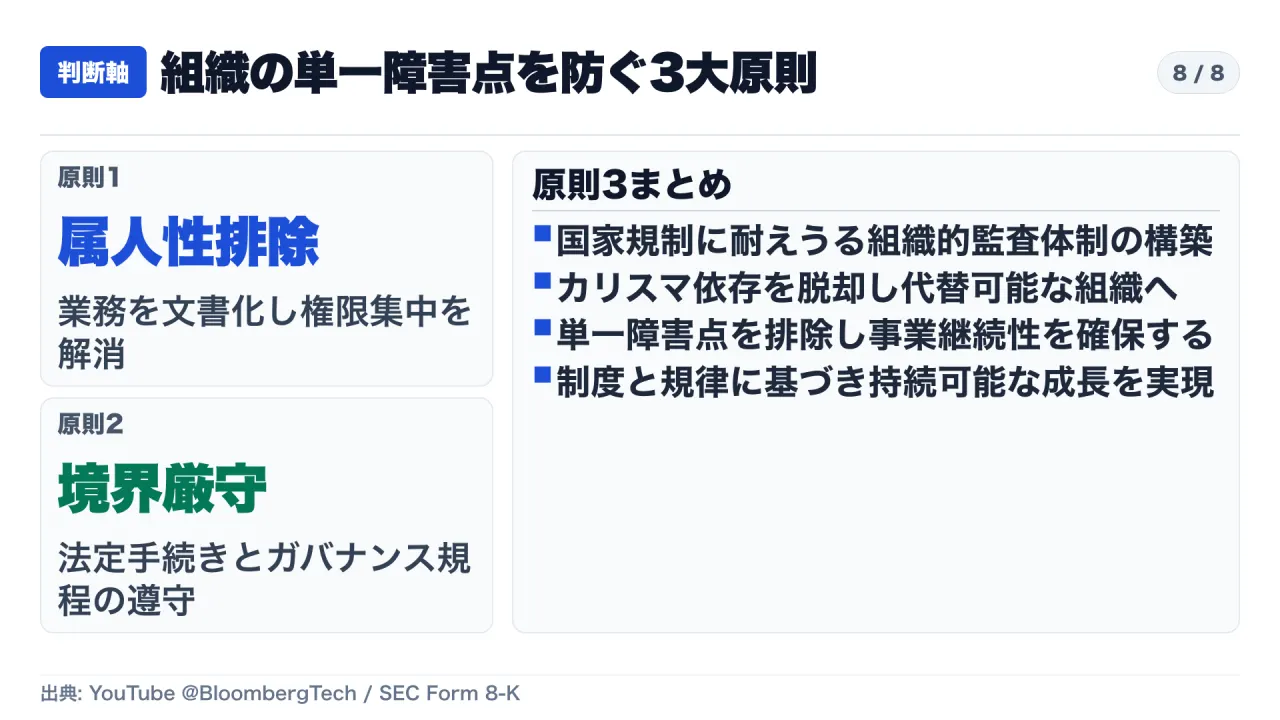
Principle 1: Eliminate Person-Dependent Bottlenecks Through Documentation and Delegation
Audit your organization to identify where critical operational knowledge, architectural decisions, or approval authority is concentrated in a single leader or top engineer. Systematically document core workflows, establish deputy ownership for every critical function, and prevent flat reporting structures from masking the absence of viable successors.
Principle 2: Enforce Governance Boundaries Over Sentiment and Informal Influence
Establish clear, written escalation and authorization rules—analogous to public-company board charters and SEC Item 5.02 protocols—so that personnel transitions, role reinstatements, and emergency powers follow objective procedural checks rather than personal lobbying or external pressure.
Principle 3: Embed Regulatory and Security Compliance Into Organizational Systems
Ensure that export controls, data governance, and security access re-certification operate as automated, auditable team processes rather than personal exceptions. When compliance is built into standard operating procedures and dual-control reviews, organizational continuity remains intact regardless of executive turnover.