U.S. BIS Expands AI Chip Controls to 5 Nations: 90-Day Deadline and the Remote Compute Threshold
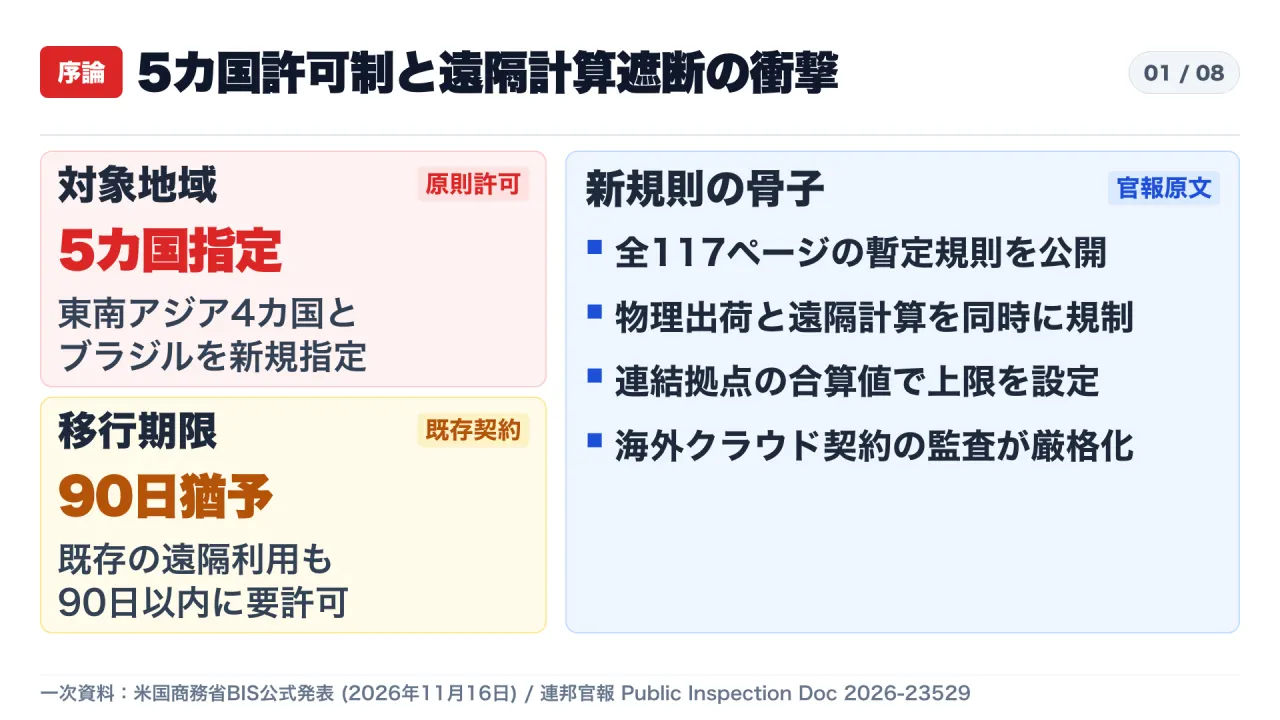
On November 16, 2026, the U.S. Department of Commerce’s Bureau of Industry and Security (BIS) released a 117-page Interim Final Rule (Docket No. 261116-0005 / RIN 0694-AK50; Federal Register Public Inspection Doc 2026-23529, scheduled for publication on November 19, 2026) that imposes licensing requirements on advanced AI semiconductor exports to four Southeast Asian nations and Brazil while bringing cross-border remote compute services directly under export control jurisdiction.
Japanese Edition: Read the original Japanese article on Substack
Video Episode (Japanese Audio): Watch on YouTube
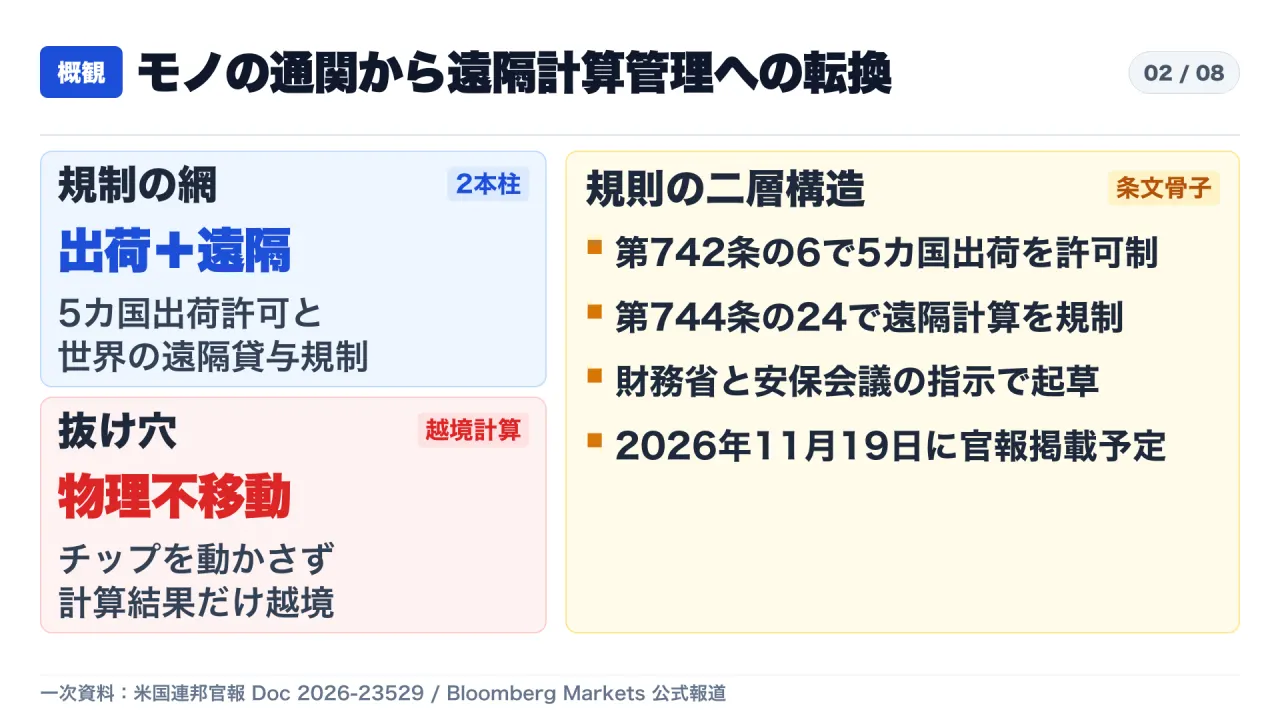
Historically, U.S. semiconductor export controls focused primarily on physical customs borders—stopping advanced GPUs at ports and airports. Yet if a provider deploys high-performance chips inside data centers located in non-restricted jurisdictions and sells cloud compute access across borders, frontier model training can proceed without moving a single physical server across an embargoed frontier. The new rule closes that structural gap through a two-tier framework combining a five-country hardware licensing regime with a worldwide remote-access ceiling.
- Core Thesis: U.S. export enforcement has shifted from physical customs checkpoints to computational capacity and network-linked infrastructure, introducing a 90-day licensing clock, a
12,000,000aggregate TPP remote compute ceiling, and asymmetric compliance costs between U.S.-headquartered cloud providers and non-U.S. operators. - Primary Sources Verified: U.S. BIS Press Release (November 16, 2026), U.S. Federal Register Public Inspection Doc 2026-23529 (117 pages), Singapore MDDI–METI Joint Media Statement (November 17, 2026), U.S. House Committee Chairmen Joint Statement (November 13, 2026), and Bloomberg Markets reporting.
- Actionable Strategic Takeaways: Enterprise legal and infrastructure teams using Southeast Asian or Brazilian GPU clusters must inventory provider ultimate-parent nationality, audit total linked-cluster TPP capacity against the 12,000,000 limit, and enforce beneficial-ownership KYC across downstream customers.
1. Shifting From Physical Customs Gates to Remote Compute Governance
According to the BIS announcement, the Interim Final Rule was drafted under the direction of the U.S. Department of the Treasury and the National Security Council (NSC) to prevent third-country data centers from serving as indirect compute conduits.
| Regulatory Pillar | Covered Scope & Citation | Key Thresholds & Deadlines | Exemptions & Carve-Outs |
|---|---|---|---|
| Five-Nation Export Licensing | Indonesia, Malaysia, Singapore, Thailand, and Brazil (§ 742.6(a)(6)(iii)(A)(1)) |
BIS license required for export, reexport, or in-country transfer of advanced AI chips (ECCN 3A090, etc.) |
Exempt if the ultimate recipient or ultimate parent company is headquartered in the U.S., subject to § 743.10 reporting |
| Global Remote Compute Control | All data centers worldwide (§ 744.24) |
License required when providing > 12,000,000 aggregate TPP to entities headquartered in Country Group D:5 or Macau; 90-day compliance window for existing providers |
Dedicated “Commercial Recommender Systems” (e.g., e-commerce or social feed ranking) excluded |
| Formal Rescission of Prior AI Diffusion Rule | Codifies the May 2025 rescission policy | Eliminates License Exception AIA (§ 740.27), Data Center VEU (§ 748.15), and AI Model Weights FDP (§ 734.9) |
60-day public comment period starting from November 19, 2026 publication |
2. The Named Five Nations, Singapore’s Response, and Congressional Scrutiny
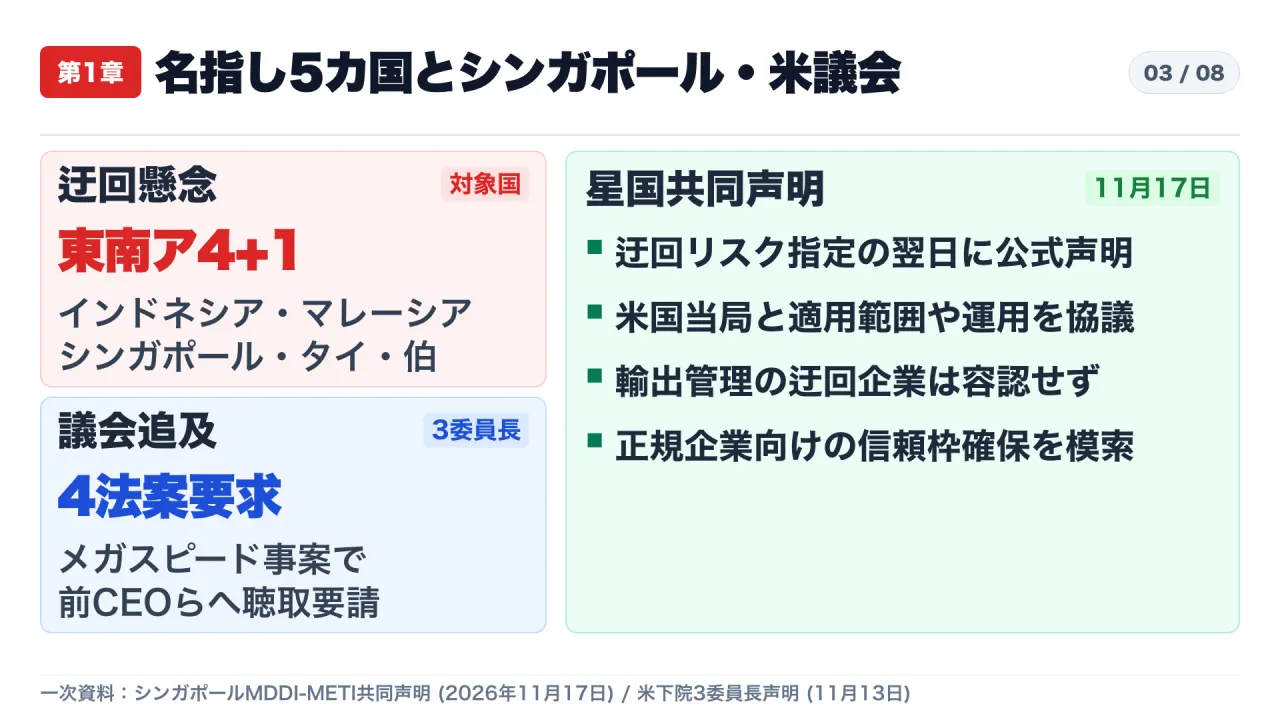
In the Federal Register text, BIS states that while these five jurisdictions are not subject to a U.S. arms embargo, they present a “higher-than-normal risk” of unauthorized diversion to third countries, warranting targeted license controls.
Days before the rule’s release, on November 13, 2026, the Chairmen of three U.S. House committees—Foreign Affairs (Brian Mast), Select Committee on the CCP (John Moolenaar), and Permanent Select Committee on Intelligence (Rick Crawford)—issued a joint request seeking briefings from former NVIDIA CEO Jensen Huang, General Counsel Tim Teter, and Under Secretary of Commerce Jeffrey Kessler regarding national security concerns tied to Megaspeed. The lawmakers simultaneously urged passage of four bills, including the Remote Access Security Act and Chip Security Act, through the National Defense Authorization Act (NDAA).
On November 17, 2026, Singapore’s Ministry of Digital Development and Information (MDDI) and Ministry of Trade and Industry (MTI) issued a joint media statement responding directly to the rule. While engaging U.S. authorities on scope and operational implementation, Singapore emphasized that it does not tolerate companies using connections in Singapore to circumvent or violate export controls, signaling a push to preserve trusted procurement channels for compliant enterprises.
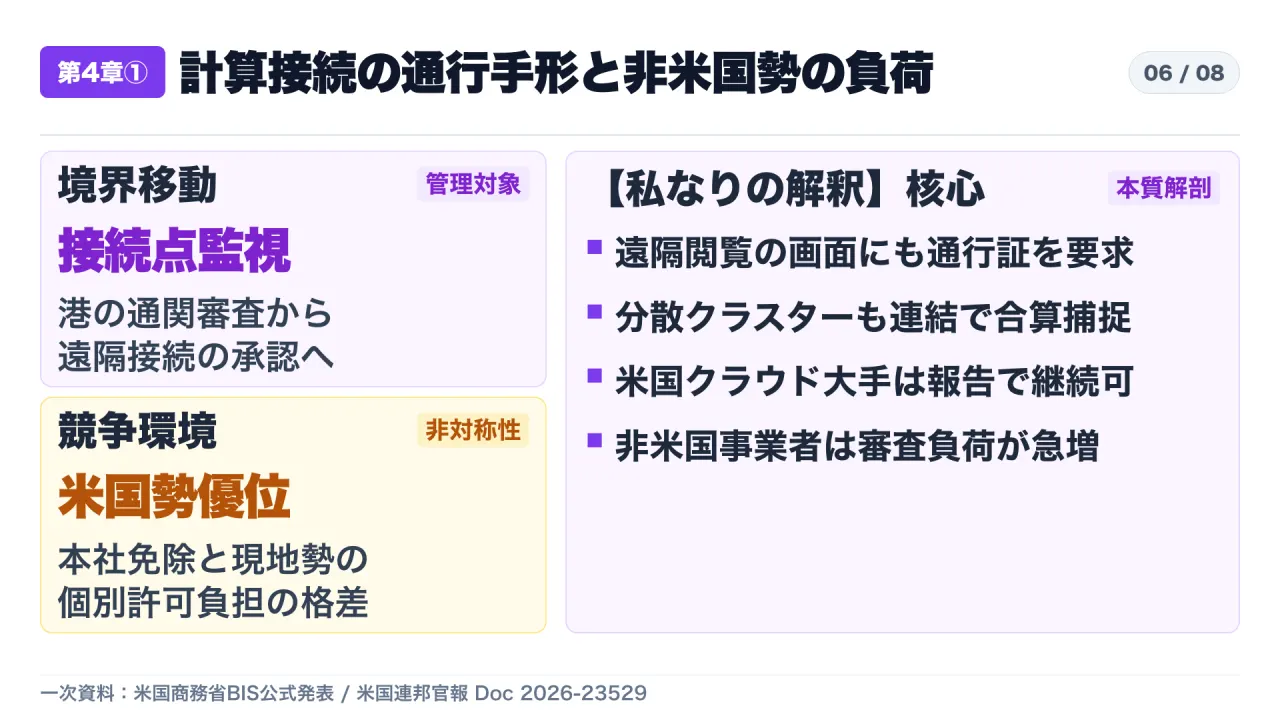
Conceptually, this regulatory shift mirrors restricting the export of precision machine tools, only to find operators installing those tools in a neighboring town’s rental workshop and running production jobs remotely over a network so that finished outputs flow back across the border without a single machine ever leaving the warehouse. Because the physical asset remained stationary while its computational output crossed jurisdictions, BIS moved to regulate the remote operator’s compute gate directly.
3. Exact Numerical Boundaries Inside the 117-Page Federal Register Text
Public summaries often gloss over the technical thresholds that determine whether a cluster requires authorization. Federal Register Doc 2026-23529 codifies precise definitions:
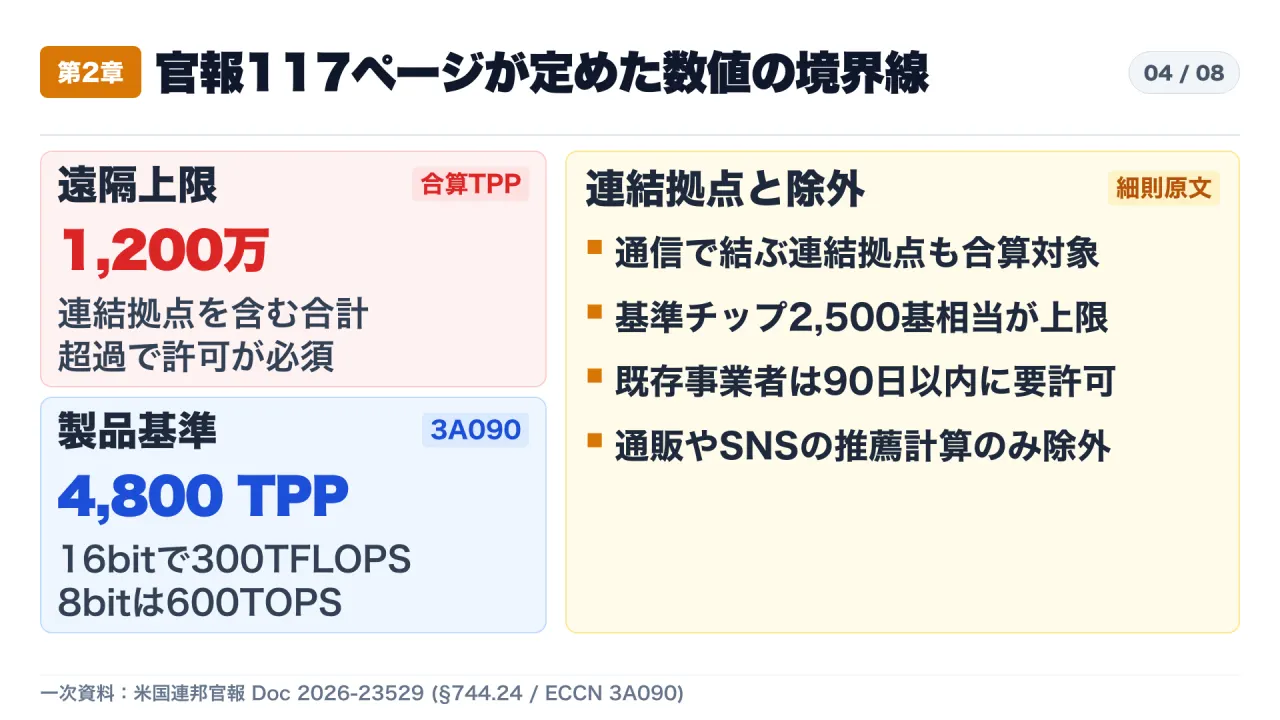
- Controlled Hardware Baseline (ECCN
3A090): Chips with a Total Processing Performance (TPP) of4,800or higher (equivalent to 300 TFLOPS at 16-bit floating point or 600 TOPS at 8-bit integer precision), or chips meeting1,600TPP with a Performance Density of5.92or greater, fall within the licensing scope. - Global Remote Compute Ceiling (
12,000,000Aggregate TPP): Under newly added§ 744.24, any data center worldwide providing more than12,000,000aggregate TPP to an entity headquartered or ultimately parented in Country Group D:5 or Macau triggers a licensing requirement. Normalized against the4,800 TPPbaseline chip,12,000,000aggregate TPP equates to 2,500 baseline chips. - Capturing “Linked Data Centers” Across Networks: The rule explicitly aggregates capacity not only across servers wired inside a single physical building, but also across multiple geographically distributed facilities connected via digital networks. Splitting workloads across smaller regional nodes linked over high-speed networks does not bypass the threshold—just as renting five separate small warehouses under different leases and linking them with fiber lines to operate as a single factory cannot evade a per-site equipment cap.
- 90-Day Transition and the Commercial Recommender Carve-Out: Operators already delivering remote compute before the rule’s release must obtain BIS authorization within 90 days of the effective date. The sole functional carve-out applies to dedicated Commercial Recommender Systems used in online retail and social platforms, reflecting BIS’s effort to separate general-purpose frontier model training and inference clusters from consumer-facing ranking workloads.
4. The U.S.-Headquartered Exemption (§ 743.10) and Foundry Presumptions
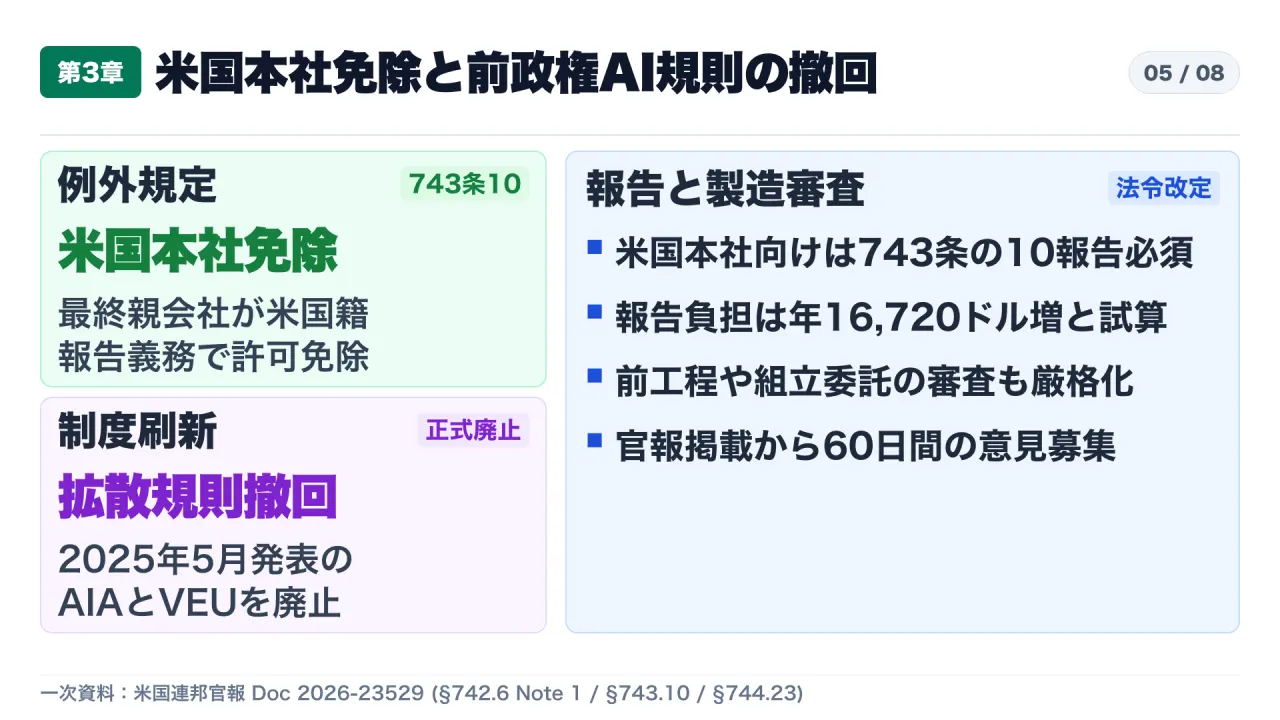
Note 1 to § 742.6(a)(6)(iii)(A)(1) establishes a decisive operational distinction inside the five-nation licensing regime: shipments to Indonesia, Malaysia, Singapore, Thailand, or Brazil are exempt from individual licensing if the ultimate recipient or ultimate parent company is headquartered in the United States.
This exemption is not unconditional. Exporters must satisfy recurring reporting obligations under newly created § 743.10, disclosing shipment items, quantities, and installation locations. Accounting for the repeal of prior AI diffusion reporting requirements alongside the new § 743.10 mandate, BIS estimates a net annual industry reporting cost increase of $16,720.
In parallel, § 744.23(a)(3)(i)(C) tightens presumption rules for front-end logic foundries and outsourced semiconductor assembly and test (OSAT) providers, expanding scrutiny over third-country fabrication serving chip designers in controlled jurisdictions. At the same time, formally rescinding the May 2025 AI Diffusion Rule eliminates License Exception AIA (§ 740.27), the Data Center Validated End-User framework (§ 748.15), and the AI Model Weights Foreign Direct Product rule (§ 734.9), replacing those broad mechanisms with targeted five-nation hardware controls and the global 12,000,000 TPP remote-compute ceiling.
5. Structural Asymmetry and Three Immediate Compliance Checks
The central strategic shift of this rule is that export enforcement now inspects computational capacity and remote network gates rather than shipping manifests alone. In security terms, BIS has moved from merely prohibiting employees from carrying confidential blueprints out of a physical vault to requiring strict identity verification and authorization on every remote screen-sharing connection that peers inside that vault. U.S.-headquartered hyperscalers can continue expanding capacity across the five designated nations via § 743.10 reporting, whereas non-U.S. cloud and colocation operators face individualized license reviews and heavier Know-Your-Customer (KYC) overhead.
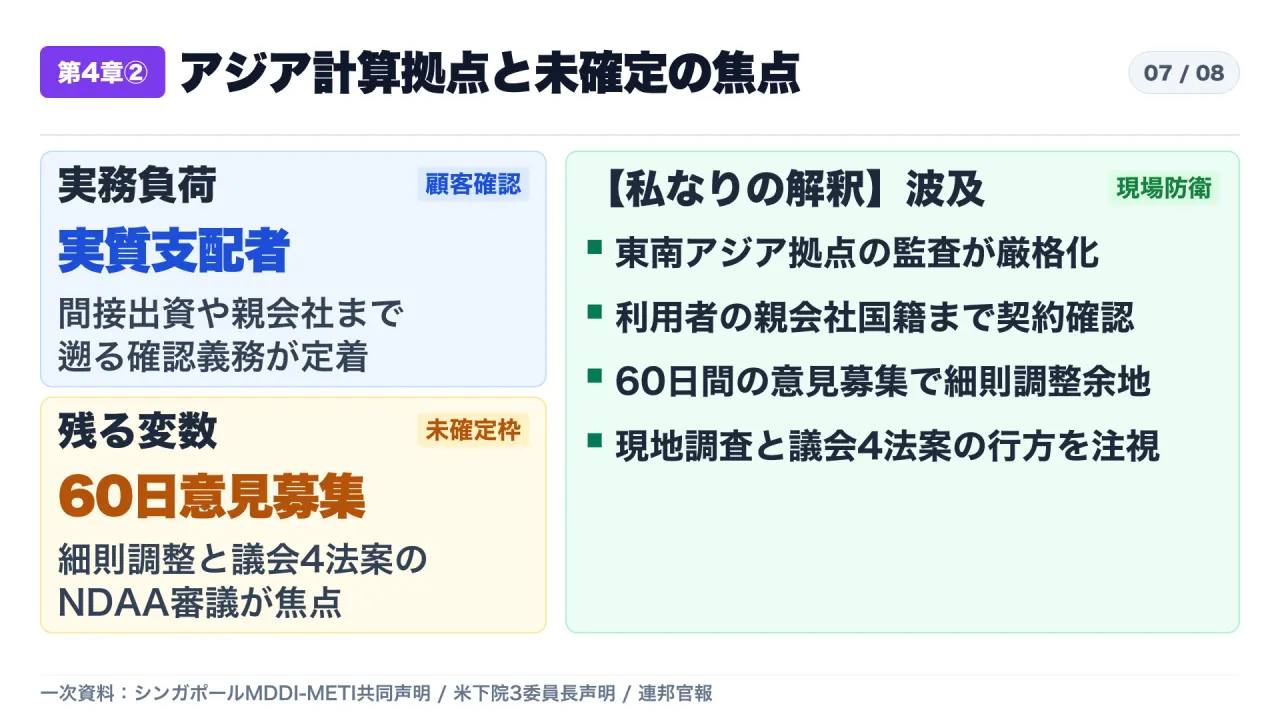
For Japanese and multinational enterprises contracting GPU infrastructure in Southeast Asia, operational continuity now depends directly on whether their upstream provider satisfies U.S. parent-nationality exemptions or secures BIS licenses within the 90-day window. Procurement teams reviewing cloud agreements in Singapore, Malaysia, Thailand, or Indonesia will increasingly face contractual representations requiring disclosure of upstream hardware licensing status and beneficial ownership chains. At the same time, two variables remain open: the 60-day public comment period starting November 19, 2026 may adjust operational details, and the fate of the four NDAA-linked bills in the U.S. Congress—including the Remote Access Security Act and the Chip Security Act—remains to be determined.
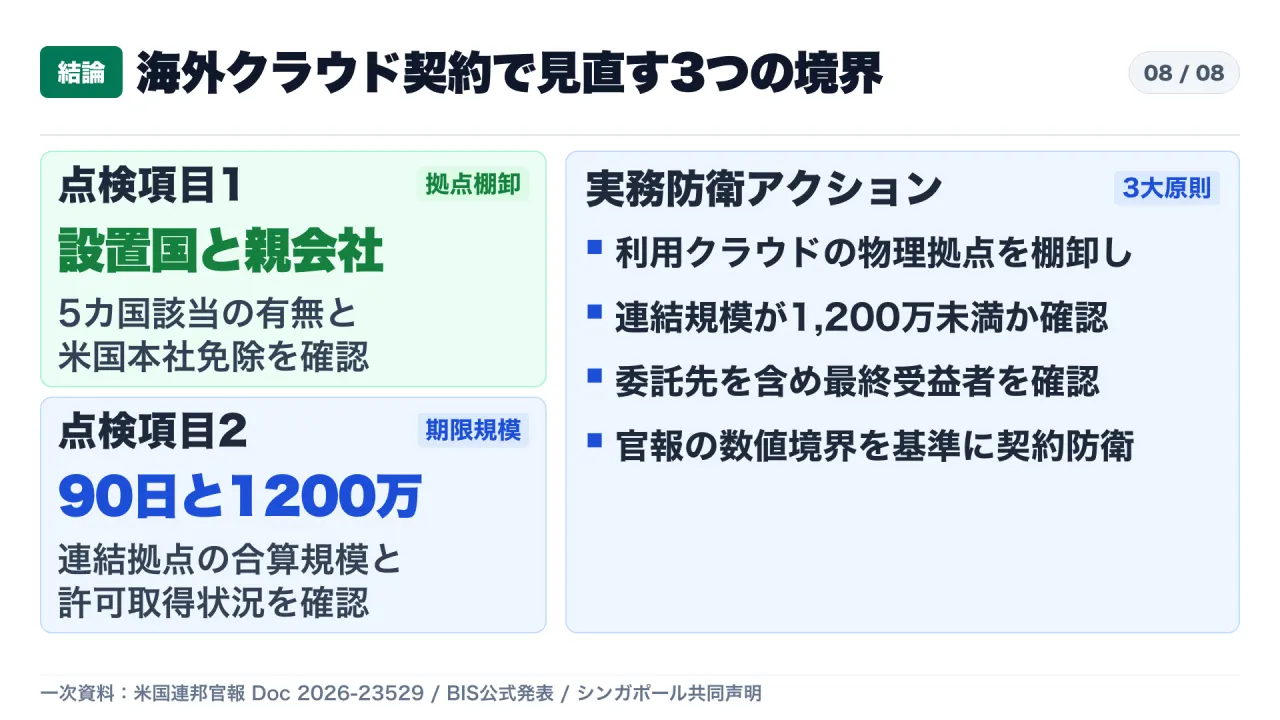
Legal, procurement, and infrastructure teams should execute three verification steps immediately:
- Inventory Cloud Regions and Ultimate Parent Nationality: Confirm whether workloads hosted in Indonesia, Malaysia, Singapore, Thailand, or Brazil run on infrastructure operated by a U.S.-headquartered parent (
§ 743.10exemption eligible) or require an operator-specific BIS license. - Audit Linked-Cluster Capacity Against the 90-Day Clock and
12,000,000TPP Limit: Verify aggregate capacity across network-linked data centers and confirm provider licensing progress ahead of the 90-day deadline. - Enforce Beneficial-Ownership KYC: Where organizations resell or sub-allocate compute capacity, implement ownership screening to ensure neither direct customers nor indirect ultimate parents belong to Country Group D:5 or Macau entities.
Primary Sources
- U.S. Bureau of Industry and Security (BIS) Official Press Release (November 16, 2026)
- U.S. Federal Register Public Inspection Interim Final Rule Full Text (Doc 2026-23529 / Docket No. 261116-0005 / RIN 0694-AK50)
- Singapore MDDI–MTI Joint Media Statement (November 17, 2026)
- U.S. House Three-Committee Chairmen Joint Press Release (November 13, 2026)
- Bloomberg Markets Report: U.S. Moves to Curb China’s Chip Access