Microsoft's Half-Price AI Trap: 2x Pricing in May 2027 and 30% Higher List Costs
Unpacking the May 2027 price cliff, MSBench internal benchmarks, hidden voice reasoning billing, and where Microsoft’s MAI Image 2.7 and Transcribe 2 truly lead.
Japanese Edition: Read the original Japanese article on Substack
Video Episode (Japanese Audio): Watch on YouTube
At Microsoft Ignite 2026, which opened on November 17, 2026, Microsoft AI unveiled seven first-party foundation and domain-specific models alongside its second-generation custom AI accelerator, Maia 200, and a new enterprise customization offering called MAI Licensed Weights. The lineup spans coding agents (MAI Code 2 and MAI Code 2 Flash), cybersecurity analysis (MAI Cyber 2 Flash), real-time voice interaction (MAI Realtime 1), image generation and editing (MAI Image 2.7 and Flash), multilingual transcription (MAI Transcribe 2), and prompt routing (Decision 1.1).
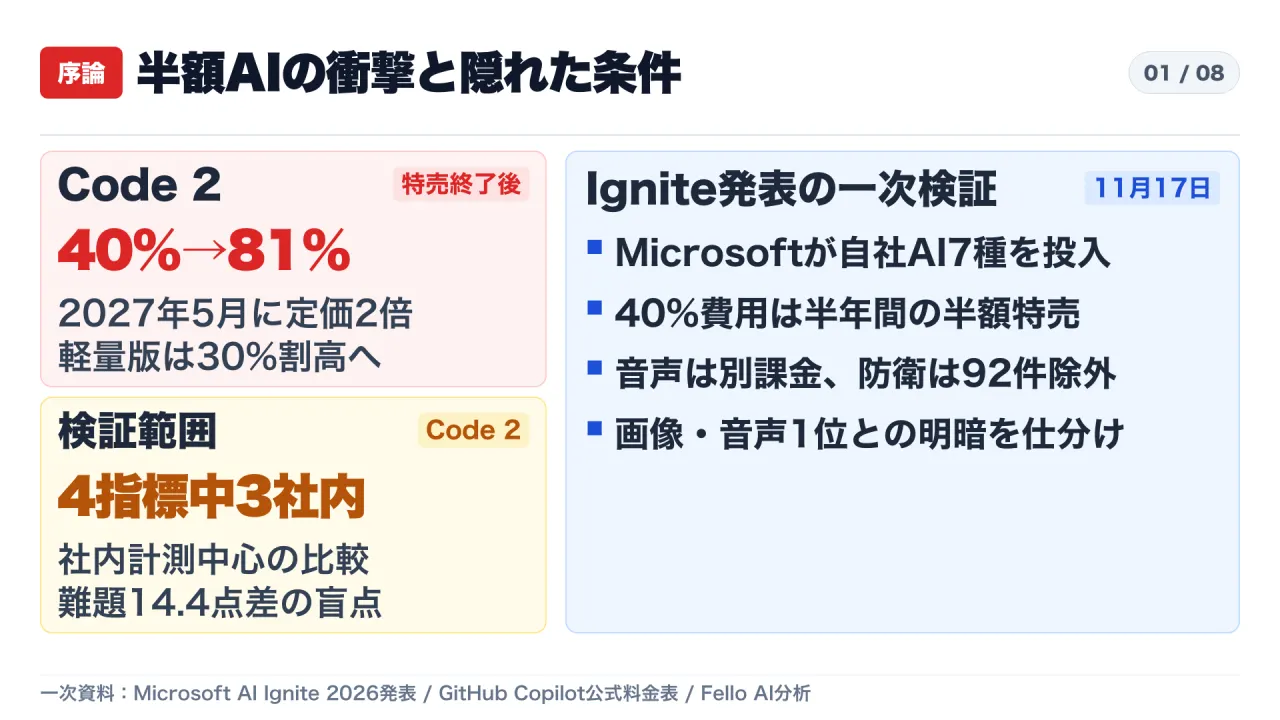
The headline marketing claims were striking: “98% of GPT-6.1 Sol’s coding performance at roughly 40% of the price” and “real-time voice starting at $0.01 per minute.” On paper, Microsoft appeared to be undercutting frontier model rivals by more than half while embedding those models directly into GitHub Copilot, Microsoft 365, and Azure.
However, cross-referencing Microsoft AI’s own footnotes, GitHub Copilot’s official billing tables, Fello AI’s task-level list-price calculations, and Microsoft’s Command Line engineering blog reveals a far more complex picture. The headline 40% price ratio depends on a temporary 50% promotional discount that expires on May 17, 2027. Once standard list pricing takes effect, MAI Code 2’s cost advantage narrows sharply, and the lightweight MAI Code 2 Flash becomes 30% more expensive per task than OpenAI’s GPT-6 Luna. Meanwhile, three of the four flagship coding benchmarks were measured solely inside Microsoft’s internal MSBench environment, voice pricing excludes separate reasoning token charges, and cybersecurity evaluations dropped 92 overlapping tasks while omitting OpenAI’s specialized security model.
At the same time, dismissing the entire announcement as marketing hype would be an analytical mistake. In image editing and medical speech transcription, independent leaderboards and multi-million-transaction production deployments validate Microsoft’s claims. Separating genuine operational strengths from promotional arithmetic is essential for engineering leaders, enterprise architects, and finance teams planning 2027 AI budgets.
1. Strategic Shift: From Frontier Intelligence Races to Daily Workflow Lock-In
To understand Microsoft AI’s November 2026 release, it helps to look at what Microsoft chose not to claim. Rather than chasing the top spot in open-ended frontier reasoning or multi-hour autonomous research agents, Microsoft explicitly stated in its MAI Code 2 documentation that the model is “not yet tuned for foundational scientific research or very long-horizon autonomous agentic tasks.”
Instead, Microsoft is targeting high-frequency, routine enterprise workflows: day-to-day repository edits inside GitHub Copilot, document summarization and drafting inside Microsoft Word, real-time customer support voice pipelines, and bulk medical transcription. By pricing entry-level access aggressively through May 2027 and offering custom fine-tuned weights exclusively inside Azure via MAI Licensed Weights, Microsoft aims to establish developer and enterprise usage habits inside its own cloud ecosystem before competitors can match the distribution footprint.
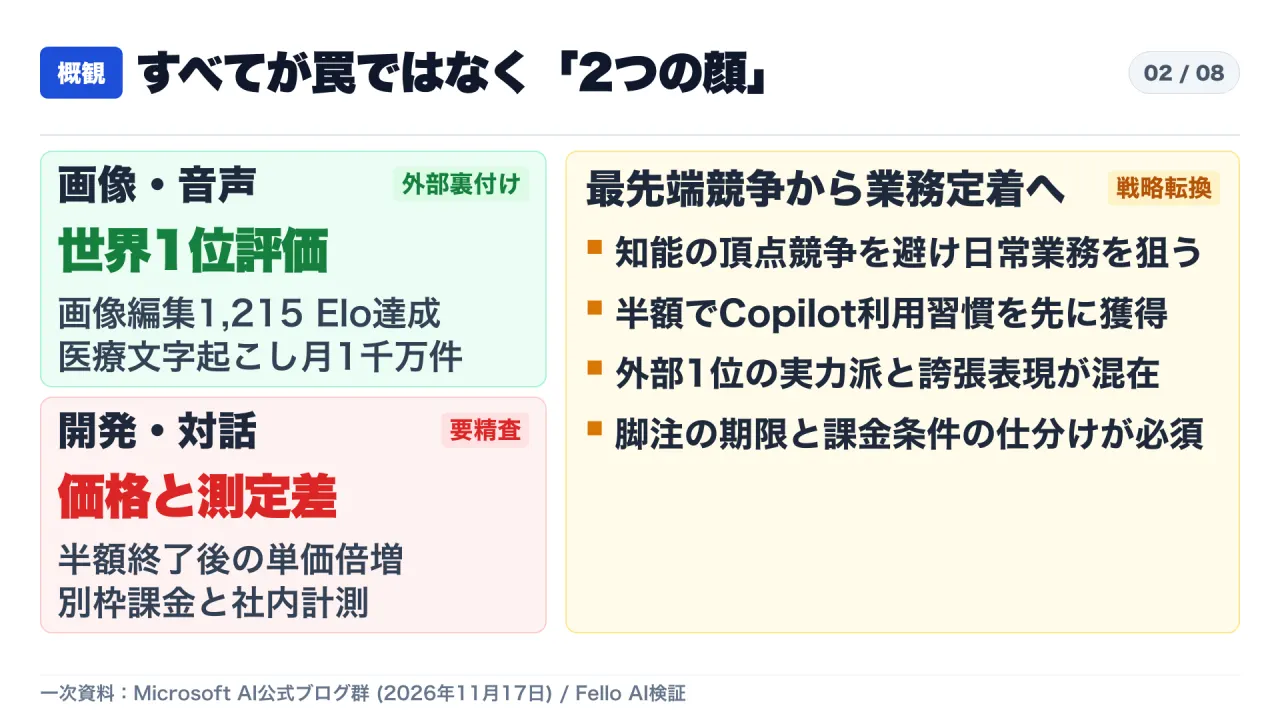
When every model in the announcement is audited against primary footnotes and third-party benchmarks, the seven releases split cleanly into two distinct tiers of evidentiary reliability:
| Model Name | Headline Microsoft Claim | Primary Footnotes & External Verification | Practical Enterprise Caution |
|---|---|---|---|
| MAI Code 2 | 98% of GPT-6.1 Sol performance at ~40% price | Only 1 of 4 benchmarks (FrontierCode v1.1 at 52.0%) is externally verified; 3 are internal MSBench | The 40% price ratio relies on a 50% promo ending May 17, 2027; list pricing rises to 81% of GPT-6.1 Sol |
| MAI Code 2 Flash | Matches GPT-6 Luna at 65% of the price | 3-benchmark average of 61.0% vs. Luna’s 55.1%, but lacks independent external reproduction | At list price after May 17, 2027, task cost reaches $0.104 vs. Luna’s $0.080 (30% higher) |
| MAI Realtime 1 | Voice starting at $0.01/min; beats GPT-Realtime 2.1 | Benchmark scores are internal evaluations without third-party replication | Adaptive reasoning tokens are billed separately ($1.00 input / $5.00 output per 1M tokens) |
| MAI Cyber 2 Flash | 92.3% on CyberGym-E2E at <2% of GPT-6 Astra cost | Internal offline evaluation; 92 of 905 tasks removed for training-data overlap | OpenAI’s dedicated security model (GPT-6 Cyber) was excluded due to limited availability |
| MAI Image 2.7 / Flash | #1 on Artificial Analysis image editing at ~1/5 rival price | Confirmed #1 on AA-Image-Editing v2.1 (1,215 Elo across 5,478 votes) | Strong third-party validation at $34.82 per 1,000 images ($10.24 for Flash) |
| MAI Transcribe 2 | 60 languages at $0.10 per audio hour | Powers Dragon Copilot Transcribe with 10 million clinical records per month | Introductory $0.10/hr pricing carries promotional terms; verify 2027 renewal rates |
| Decision 1.1 | Leads across 102 metrics at $0.042/1M input tokens | Built on Gemma 4 26B A4B; AA Decision Index score of 68; 4,000 enterprise trials | Verify baseline comparisons and independent task evaluations for domain routing |
2. Deconstructing the “40% Cost” Headline and the May 17, 2027 Price Cliff
The central financial catch in the MAI Code 2 rollout is documented directly in GitHub Docs (“Models and pricing for GitHub Copilot”) and Microsoft AI’s announcement footnotes. Both MAI Code 2 and MAI Code 2 Flash are launched under a 50% promotional discount valid through May 17, 2027. Because Microsoft’s headline cost comparisons pit promotional MAI prices against standard list prices of competing models, any organization projecting multi-year budgets from the launch infographic risks a 2x unit-cost jump six months into deployment.
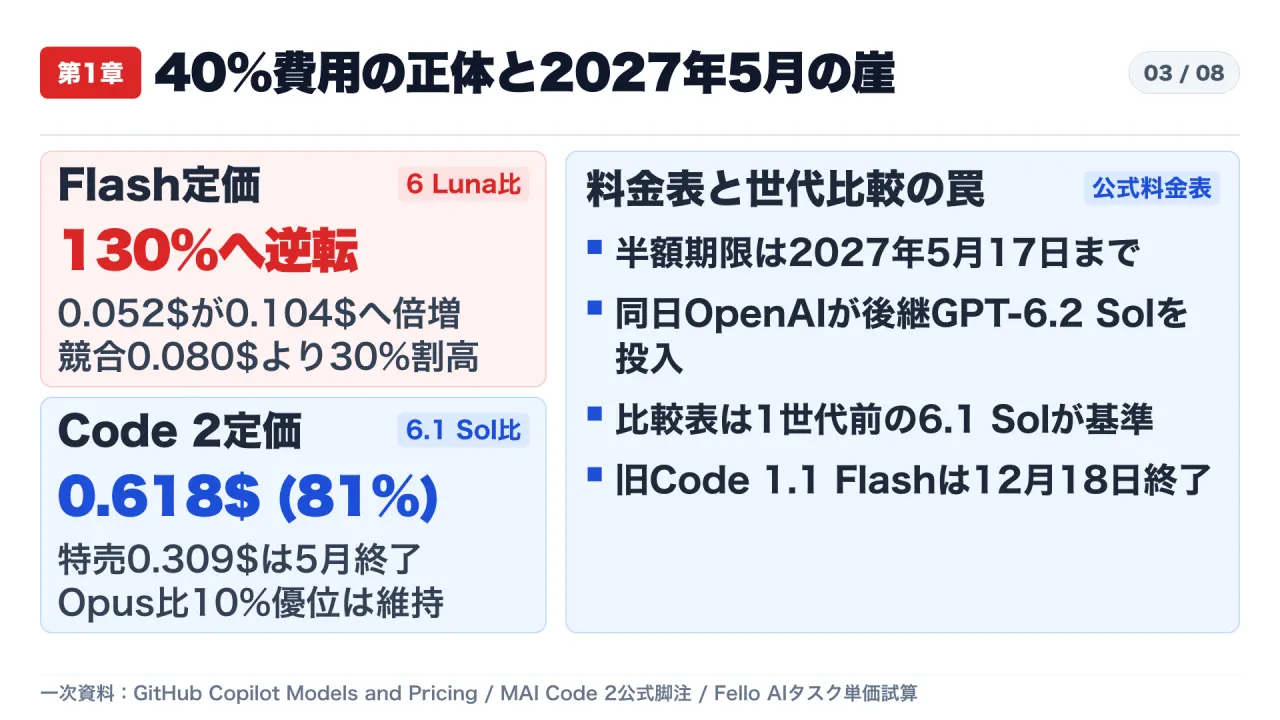
Using GitHub’s published per-million-token rates and Fello AI’s standardized coding-task cost model, the shift from promotional pricing to standard list pricing looks like this:
| Model | Promo Token Rate (In / Out per 1M) | List Token Rate (In / Out per 1M) | Promo Task Cost | List Task Cost | Cost Ratio Shift vs. Rival Baseline |
|---|---|---|---|---|---|
| MAI Code 2 | $0.50 / $2.50 | $1.00 / $5.00 | $0.309 | $0.618 | vs. GPT-6.1 Sol ($0.761): 41% -> 81% |
| Claude Opus 5.5 | — | $4.00 / $20.00 | $6.306 | $6.306 | Code 2 remains ~10% (one-tenth) at list price |
| MAI Code 2 Flash | $0.05 / $0.25 | $0.10 / $0.50 | $0.052 | $0.104 | vs. GPT-6 Luna ($0.080): 65% -> 130% (+30% premium) |
| Claude Haiku 5.5 | — | Undisclosed (task model) | $0.319 | $0.319 | Flash remains ~33% of Haiku 5.5 at list price |
Three operational consequences follow immediately from these figures.
First, MAI Code 2 Flash loses its price advantage over OpenAI’s lightweight tier the moment the promotion ends. At $0.052 per standardized task during the promotional window, Flash sits at 65% of GPT-6 Luna’s $0.080 task cost. Once the 50% discount expires on May 17, 2027, Flash doubles to $0.104 per task—making it 30% more expensive than GPT-6 Luna. Teams that embed Flash into high-volume CI/CD linting, PR summaries, or IDE autocomplete pipelines based on launch-day cost ratios will face an abrupt cost reversal unless they re-route traffic before May 2027.
Second, the comparison baseline aged out on announcement day. On November 17, 2026—the exact same day Microsoft Ignite opened—OpenAI released GPT-6.2 Sol as a direct successor to GPT-6.1 Sol at the identical $2.00 input / $10.00 output per million token price point. Microsoft’s launch charts benchmarked MAI Code 2 against GPT-6.1 Sol, meaning enterprise buyers evaluating options after November 17, 2026 are comparing Microsoft’s discounted model against a previous-generation competitor.
Third, legacy Copilot users face a near-term deprecation deadline. GitHub’s billing notice specifies that the older MAI-Code-1.1-Flash model will be retired across GitHub Copilot on December 18, 2026—just 31 days after the Ignite announcement. Platform administrators therefore have a narrow one-month window to migrate existing Copilot automations, audit token consumption, and test whether MAI Code 2 Flash or competing lightweight models deliver acceptable cost-performance once promotional pricing sunsets.
3. What the 63.2% Coding Average Hides: Internal MSBench Runs and a 14.4-Point SWE-Atlas Gap
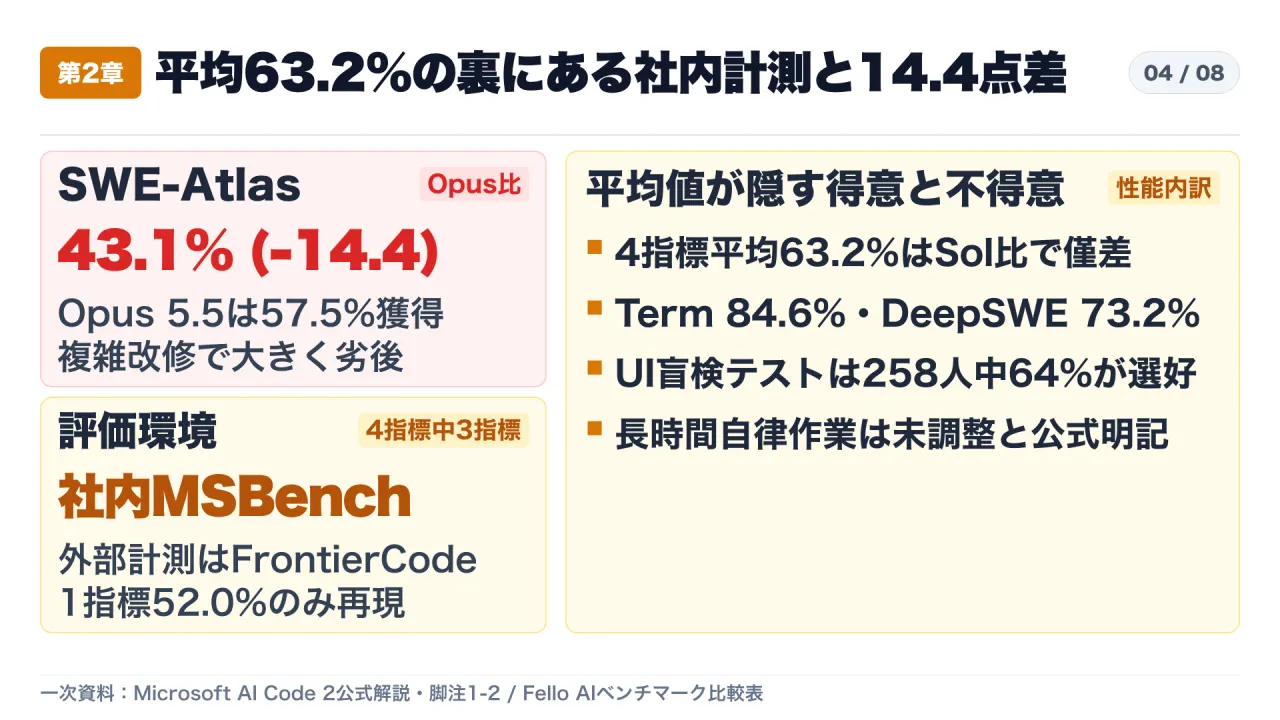
Across four major coding evaluations run at maximum reasoning effort, MAI Code 2 posts a composite average of 63.2%, finishing within 0.9 percentage points of GPT-6.1 Sol (64.1%) and 2.1 percentage points of Claude Opus 5.5 (65.3%). Furthermore, in a blinded human preference study of 258 participants evaluating frontend UI generation, 64% preferred MAI Code 2 over GPT-6 Sol.
However, disaggregating the composite score reveals both sharp task-level divergence and a heavy reliance on internal testing infrastructure:
| Benchmark | Evaluation Environment | Claude Opus 5.5 | GPT-6.1 Sol | MAI Code 2 |
|---|---|---|---|---|
| DeepSWE 1.1 | Internal (MSBench / Copilot CLI) | 69.0% | 74.6% | 73.2% |
| Terminal-Bench 2.1 | Internal (MSBench / Copilot CLI) | 78.7% | 85.0% | 84.6% |
| SWE-Atlas | Internal (MSBench / Copilot CLI) | 57.5% | 47.4% | 43.1% |
| FrontierCode v1.1 | External (Artificial Analysis) | 56.0% | 49.4% | 52.0% |
| 4-Benchmark Average | Maximum reasoning setting | 65.3% | 64.1% | 63.2% |
Two technical details stand out. First, on SWE-Atlas—which tests complex, cross-repository software engineering changes—MAI Code 2 scores 43.1%, trailing Claude Opus 5.5 (57.5%) by 14.4 percentage points. While MAI Code 2 excels at self-contained terminal tasks (84.6% on Terminal-Bench 2.1) and standard single-repo patches (73.2% on DeepSWE 1.1), its accuracy degrades significantly when architectural context spans multiple modules or repositories. Even at roughly one-tenth of Opus 5.5’s list price ($0.618 vs. $6.306 per task), failed multi-repo refactors consume engineering review hours and retry tokens that quickly erode nominal API savings.
Second, three of the four benchmarks were executed internally inside Microsoft’s MSBench harness using Copilot CLI without subagent scaffolding, as disclosed in Footnotes 1 and 2 of the MAI Code 2 technical post. Only FrontierCode v1.1 (52.0%) reflects an independent external leaderboard run by Artificial Analysis. Until third-party evaluators reproduce the DeepSWE, Terminal-Bench, and SWE-Atlas numbers outside Microsoft’s harness, engineering teams should treat the 63.2% composite as provisional rather than independently audited parity.
4. Three Hidden Footnotes: Voice Reasoning Surcharges, 92 Overlap Exclusions, and Missing External Checks
Beyond coding models, the fine print across Microsoft’s voice, cybersecurity, and routing announcements highlights recurring gaps between marketing headlines and production billing or evaluation conditions.
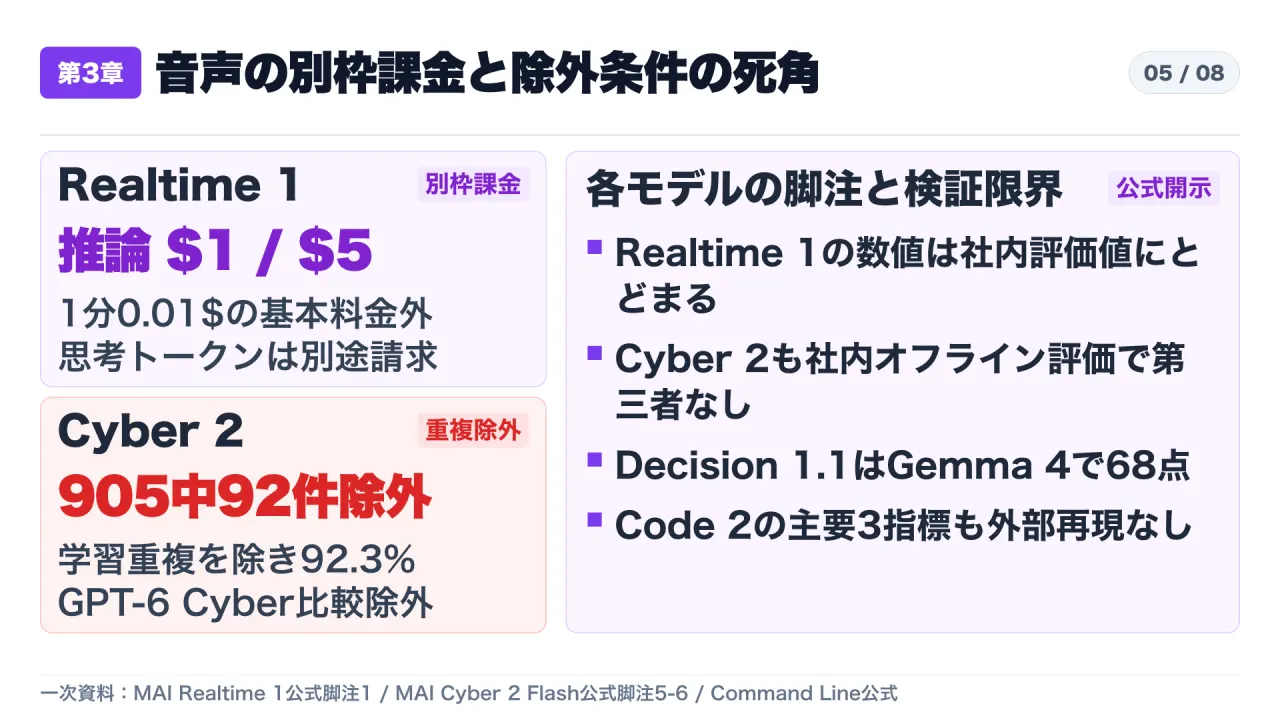
MAI Realtime 1: Separate Token Billing for Adaptive Reasoning
The MAI Realtime 1 product page highlights “audio starting at $0.01 per minute.” Footnote 1 clarifies, however, that the model’s adaptive reasoning engine is metered separately from the base per-minute audio fee, at $1.00 per 1M input tokens and $5.00 per 1M output tokens. For simple scripted voice menus, the surcharge may remain modest. For live customer service or technical troubleshooting agents that invoke tool calls, retrieve policy documents, and perform multi-turn reasoning, total session cost rises well above the $0.01/minute anchor. Moreover, the benchmark gains claimed over GPT-Realtime 2.1 are internal Microsoft evaluations with no published external audit.
MAI Cyber 2 Flash: 92 Overlapping Tasks Removed and Key Rival Omitted
Microsoft reports that MAI Cyber 2 Flash achieves 92.3% on CyberGym-E2E—edgeing out GPT-6 Astra (91.5%) at less than 2% of the cost. Footnotes 5 and 6 reveal two material caveats. First, Microsoft excluded 92 out of 905 total tasks due to detected overlap with training data, reporting scores only across the remaining 813 tasks. Excluding contaminated samples is good scientific hygiene, yet it means the headline 92.3% score does not cover the full canonical 905-task suite and remains an internal offline measurement. Second, OpenAI’s dedicated security-hardened model, GPT-6 Cyber, was omitted from the comparison entirely because it was in limited release while safety guardrails were being finalized.
Decision 1.1: Strong Economics, Incomplete External Context
Decision 1.1—a prompt-routing and classification model built on Google’s Gemma 4 26B A4B architecture—is aggressively priced at $0.042 per 1M input tokens with free output tokens, scoring 68 on the Artificial Analysis Decision Index and already trialed by 4,000 enterprises. While the AA Decision Index provides a useful third-party reference point, Microsoft’s claim of leading across 102 internal metrics still warrants validation on an organization’s own production traffic before replacing deterministic or custom lightweight classifiers.
5. Where Microsoft Truly Leads: Verified Image Editing, Clinical Transcription, and Azure Lock-In
A balanced assessment must also recognize where Microsoft AI’s November 2026 releases clear independent bars by wide margins.
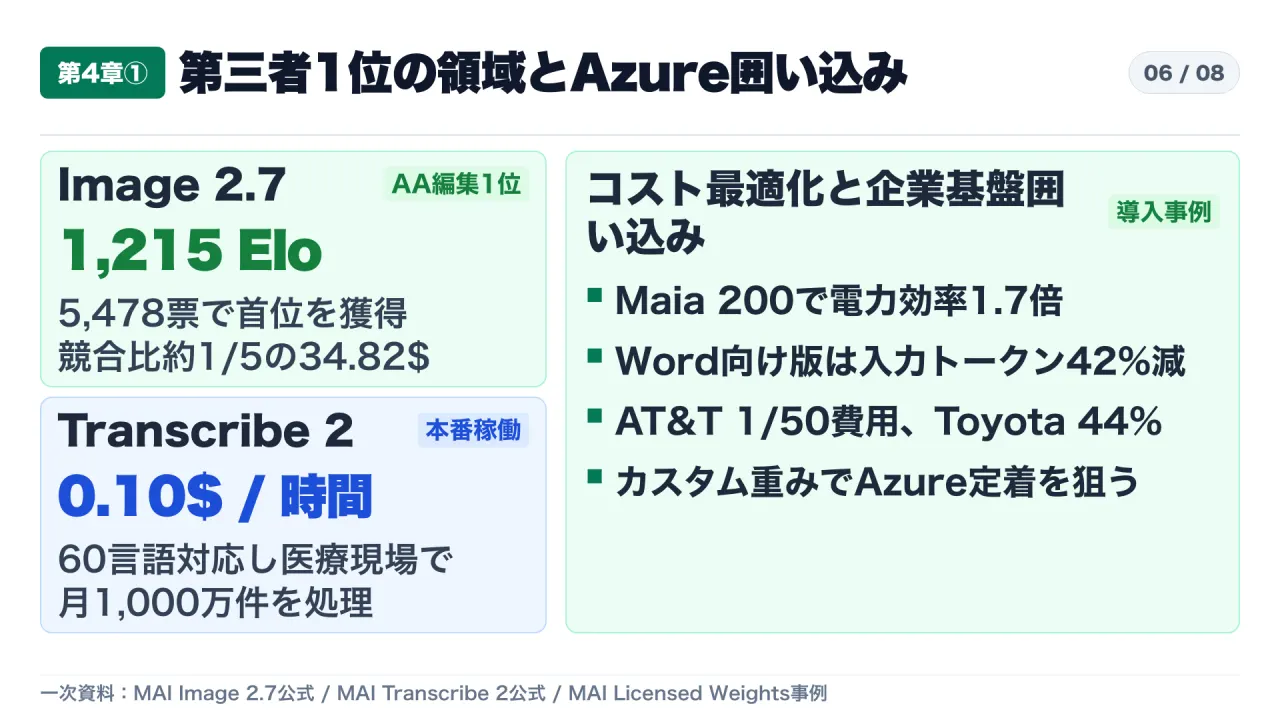
- MAI Image 2.7 (Verified #1 at One-Fifth the Cost): On Artificial Analysis’s independent AA-Image-Editing v2.1 blind human-preference arena, MAI Image 2.7 captured the #1 global ranking with 1,215 Elo across 5,478 community votes, edging out OpenAI’s GPT Image 2.6 Sunburst (max) by 4 Elo points. Crucially, MAI Image 2.7 delivers this quality at $34.82 per 1,000 images (and $10.24 per 1,000 images for Image 2.7 Flash)—roughly one-fifth the price of comparable flagship image editors. Unlike the internal coding benchmarks, both the Elo ranking and the unit economics here are externally corroborated.
- MAI Transcribe 2 (10 Million Clinical Records per Month): Supporting 60 languages at $0.10 per audio hour, MAI Transcribe 2 is not an untested lab prototype; it already powers Dragon Copilot Transcribe, processing 10 million clinical records every month in live healthcare workflows. Organizations building multilingual meeting, call-center, or clinical documentation pipelines gain proven throughput, though procurement teams should verify post-promotional pricing clauses for 2027 renewals.
- Maia 200 Silicon and MAI Licensed Weights: On the infrastructure layer, Microsoft’s second-generation Maia 200 accelerator improves tokens per watt by 1.7x, while the Word-specialized MAI Work Flash reduces input token consumption by 42%. To convert these hardware and model efficiencies into long-term cloud retention, Microsoft introduced MAI Licensed Weights, enabling enterprises to fine-tune and host customized weights directly within Azure. Early disclosed deployments show dramatic task-level ROI: AT&T reported a 50x cost reduction (1/50 of previous baseline) on standard internal workflows; Woven by Toyota achieved a 44% first-pass auto-merge rate on code fixes at less than one-tenth the cost; and Alaska Airlines improved internal classification accuracy from 81% to 91%. The strategic trade-off is clear: deep Azure integration delivers compelling unit economics, while raising switching costs if an organization later attempts to migrate workloads across clouds.
6. Two Verification Traps and Three Guardrails for 2027 AI Architecture
Auditing Microsoft’s primary materials exposes two recurring analytical traps that frequently distort enterprise AI business cases.
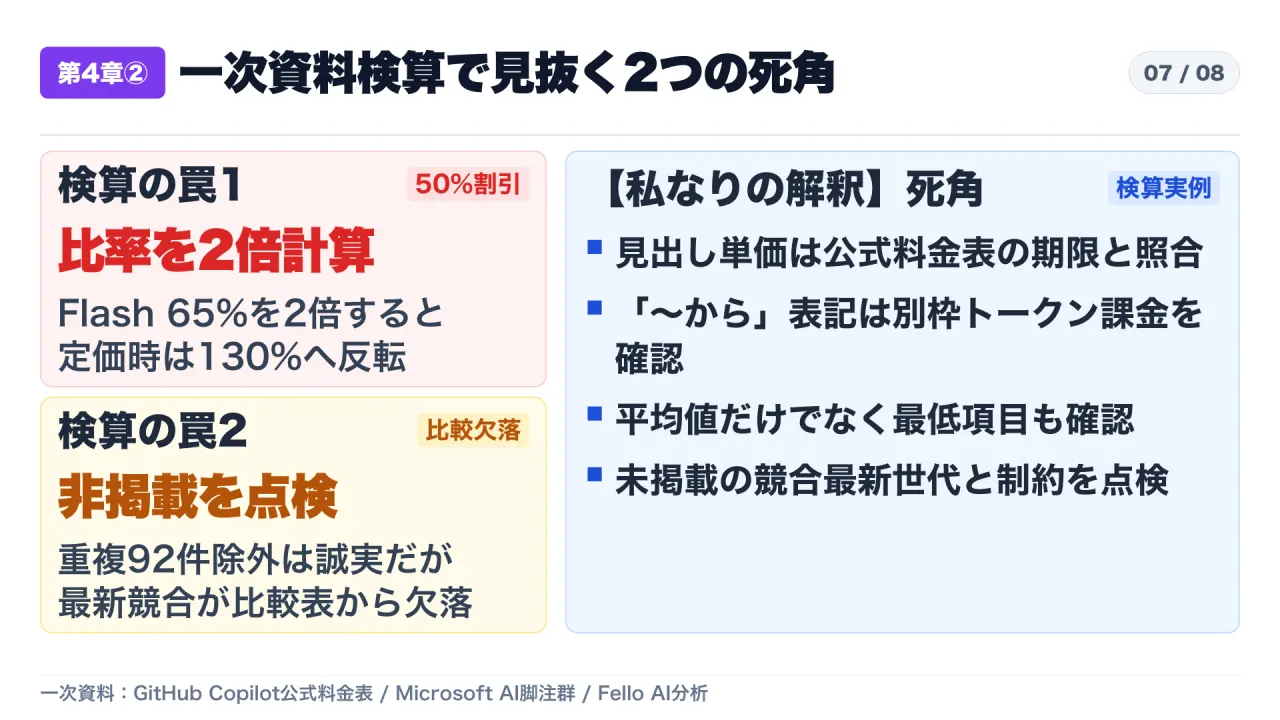
- Extrapolating Promotional Cost Ratios into Multi-Year Budgets: Taking a 65% promotional ratio (MAI Code 2 Flash vs. GPT-6 Luna) and assuming it holds over a 24-month contract ignores the May 17, 2027 step-up that doubles the ratio to 130%. Similarly, anchoring voice budgets on “$0.01/minute” without modeling adaptive reasoning tokens ($1/$5 per 1M) underestimates agentic voice spend.
- Reading Composite Benchmarks Without Checking Baseline Vintage and Exclusions: A 63.2% average masks a 14.4-point collapse on cross-repo SWE-Atlas tasks, just as launch-day charts comparing against GPT-6.1 Sol omit GPT-6.2 Sol released the same morning.
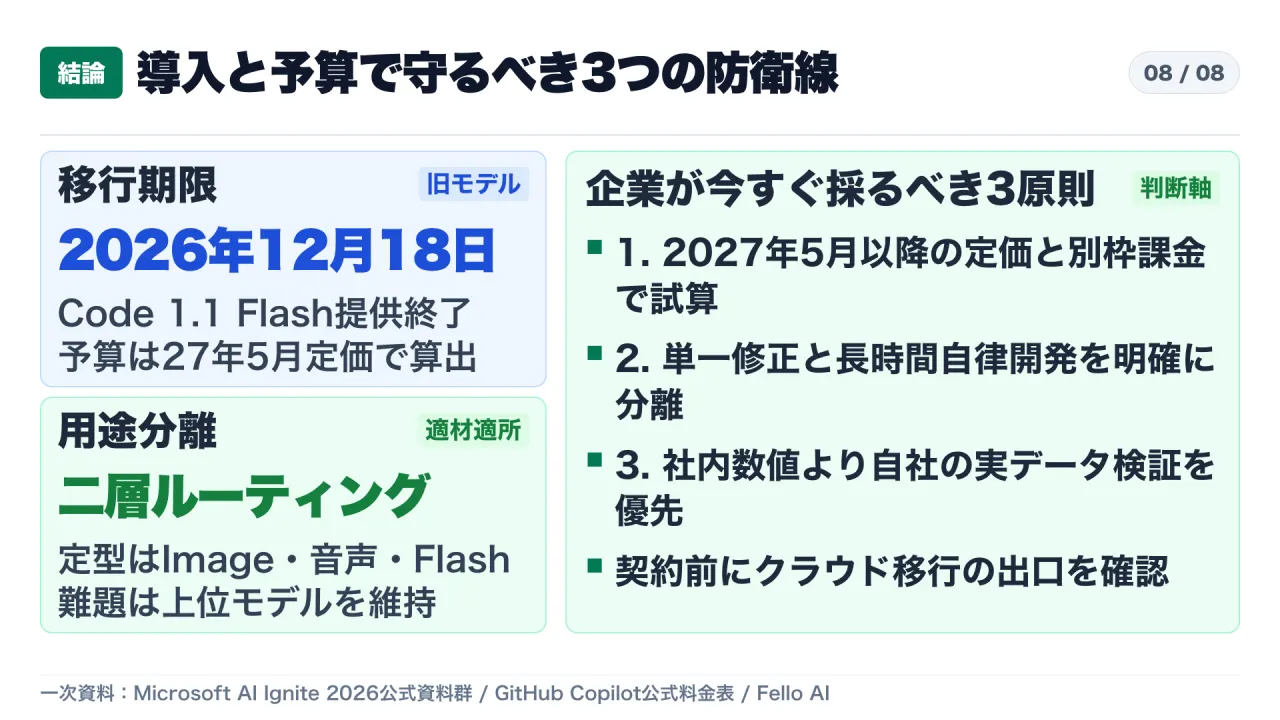
To capture Microsoft’s genuine price-performance advantages without walking into the 2027 cost cliff, engineering and procurement leaders should enforce three operational guardrails:
- Model 2027 Budgets Strictly at Post-Promo List Prices and Full Token Metering: Treat the May 17, 2027 promotional expiration as a hard baseline in financial models. Include separate reasoning-token budgets for MAI Realtime 1 and allocate migration engineering hours ahead of the December 18, 2026 retirement of MAI-Code-1.1-Flash.
- Adopt a Two-Tier Model Routing Architecture by Task Complexity: Route high-volume, bounded workloads—such as image editing (MAI Image 2.7), multilingual transcription (MAI Transcribe 2), and single-file boilerplate edits during the promotional window—to Microsoft’s cost-optimized models. Keep frontier competitors (such as Claude Opus 5.5 or GPT-6.2 Sol) assigned to multi-repository refactoring, architectural debugging, and long-horizon autonomous workflows where a 14.4-point reliability gap directly impacts developer velocity.
- Separate Internal Benchmarks from External Validation and Audit Exit Paths: Weight independent evaluations (Artificial Analysis Elo and FrontierCode v1.1) above internal MSBench runs, run shadow evaluations on proprietary internal repositories before signing multi-year commitments, and map cloud exit costs before adopting Azure-bound MAI Licensed Weights.
Primary Sources
- Microsoft AI Ignite 2026 Official Announcement
- Microsoft AI: Introducing MAI Code 2 and MAI Code 2 Flash
- GitHub Docs: Models and pricing for GitHub Copilot
- Fello AI: MAI Code 2 Price, Benchmarks and Copilot Plans
- Microsoft AI: Introducing MAI Realtime 1
- Microsoft AI: Introducing MAI Cyber 2 Flash
- Microsoft AI: Introducing MAI Image 2.7
- Microsoft AI: MAI Transcribe 2
- Microsoft Command Line: Decision 1.1 GA
- Microsoft AI: Introducing MAI Licensed Weights