How Japan's Fugaku Supercomputer Breach Exposed 4,597 Accounts and SSH Key Risks
Primary disclosures from RIKEN, R-CCS security policies, and Japanese media reveal how a public status page led to an emergency shutdown of 158,976 nodes and why stolen SSH keys outlast offline systems.
Japanese Edition: Read the original Japanese article on Substack
Video Episode (Japanese Audio): Watch on YouTube
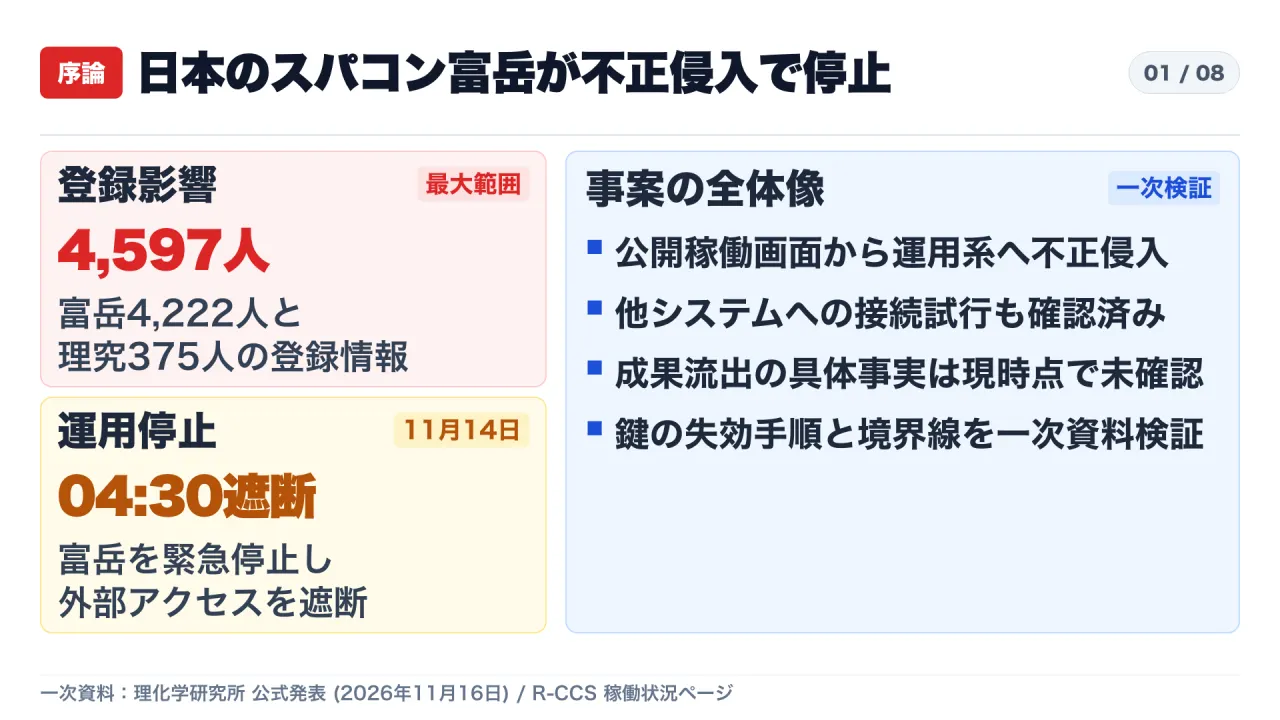
On November 16, 2026, RIKEN—Japan’s flagship national research institute—disclosed an unauthorized intrusion into the operational management network of the Fugaku supercomputer, operated by the RIKEN Center for Computational Science (R-CCS). According to the formal advisory, attackers gained a foothold through an internet-facing operational status dashboard between November 10 and November 13, 2026, manipulated multiple internal servers, and planted unauthorized programs on part of the environment. As a result, account registration records for up to 4,597 users across Fugaku and RIKEN’s AI for Science supercomputer Rikyu, along with research files and third-party authentication credentials stored inside user home directories, were exfiltrated or exposed to potential exfiltration.
Fugaku was shut down and severed from external network access at 04:30 JST on November 14, 2026, and its public operational status page was likewise taken offline to ensure containment. For infrastructure architects, high-performance computing (HPC) administrators, and enterprise security leaders worldwide, the incident highlights two recurring architectural blind spots that standard perimeter defenses often overlook. First, a read-only or informational public status dashboard can become a pivot point into internal operational networks when monitoring surfaces and administrative planes are insufficiently isolated. Second, taking a compromised host offline does not neutralize stolen outbound credentials: SSH private keys and access tokens saved inside shared home directories remain valid at downstream clusters, cloud accounts, and code repositories until revoked individually at every destination.
- Core Thesis: Attackers leveraged a public operational status web page to breach Fugaku’s internal operations network, exposing up to 4,597 registered accounts and home-directory SSH private keys that were subsequently used in attempted connections to external systems, forcing a full shutdown of Japan’s 158,976-node flagship supercomputer.
- Primary Sources Verified: RIKEN official press release (November 16, 2026), R-CCS Fugaku Operational Status notice, R-CCS Supercomputer Fugaku Security White Paper (July 2021), R-CCS Fugaku System Overview, NHK News (November 16, 2026), and Yomiuri Shimbun reports (November 16 and November 17, 2026).
- Actionable Strategic Takeaways: Immediately revoke and rotate any SSH keys, API tokens, or access keys stored on shared HPC environments across all external destination services, separate public status dashboards strictly from internal management networks, and replace static home-directory keys or unrestricted
ForwardAgentconfigurations withProxyJumpand short-lived credentials.
1. Public Dashboard Entry Point and the Scope Separating Fugaku from Rikyu
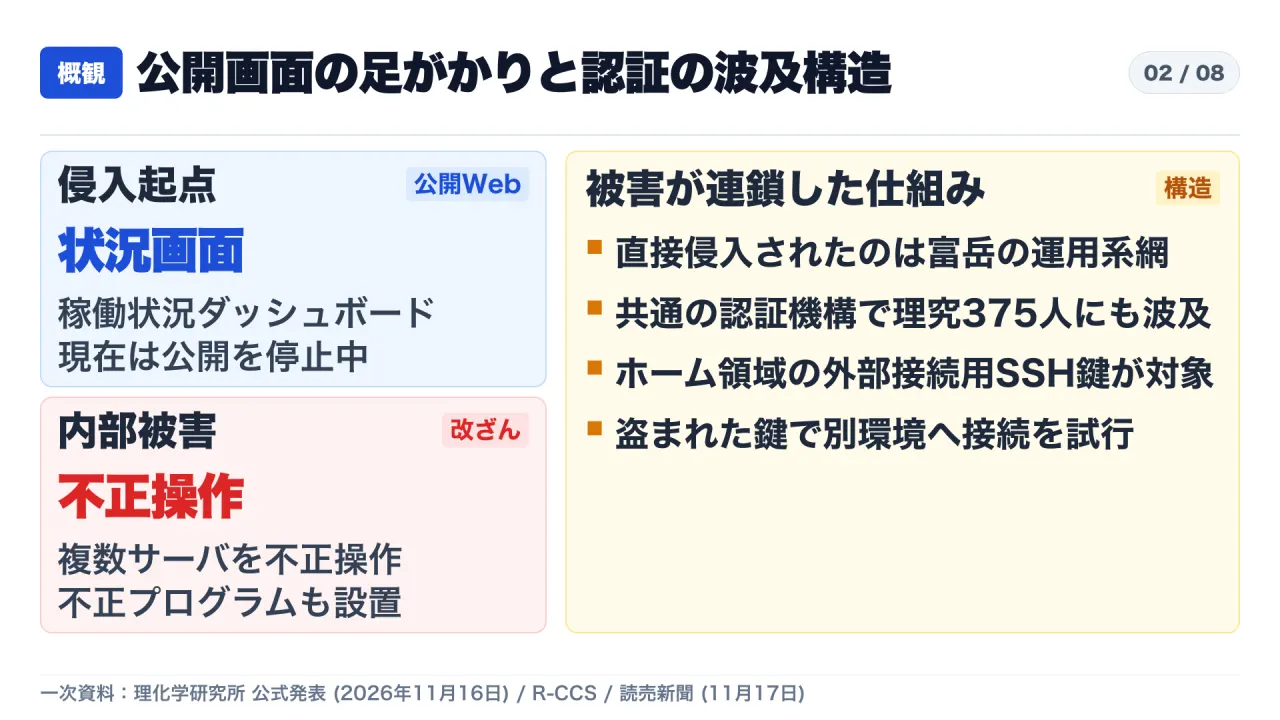
RIKEN’s November 16, 2026 disclosure specifies that the unauthorized access occurred inside the operational system (internal network) of the supercomputer Fugaku. Between November 10 and November 13, 2026, an external actor used the publicly accessible web page displaying Fugaku’s operational status—essentially a public-facing status dashboard—as an entry foothold into the internal operational network. Once inside, the intruder unlawfully operated multiple internal servers and altered system configurations, including installing unauthorized programs on a subset of machines.
Two structural distinctions in RIKEN’s announcement are critical for accurate risk assessment and should not be conflated:
- Separating Fugaku from Rikyu: RIKEN’s formal statement identifies Fugaku’s operational system as the environment that suffered unauthorized access, system tampering, emergency shutdown, and structural remediation. The AI for Science supercomputer Rikyu appears in the incident scope specifically because both systems share user authentication registration records—putting up to 375 Rikyu users’ names and email addresses at risk of exposure. RIKEN has not reported a direct intrusion into Rikyu’s compute environment or an operational shutdown of Rikyu itself.
- Confirmed External Connection Attempts: Files residing in Fugaku user home directories included credentials for connecting to supercomputers and external services outside RIKEN—specifically SSH private keys and access keys. RIKEN confirmed that the intruder actively used a portion of these stolen credentials to attempt connections to other systems.
In enterprise and academic environments alike, shared identity directories and cross-environment status portals often create hidden blast-radius bridges. Even when compute nodes or sibling clusters remain isolated from direct code execution, shared authentication databases mean a breach on one operational management plane immediately elevates phishing and credential-stuffing exposure across adjacent user populations.
2. Minute-by-Minute Official Timeline from Intrusion to Containment
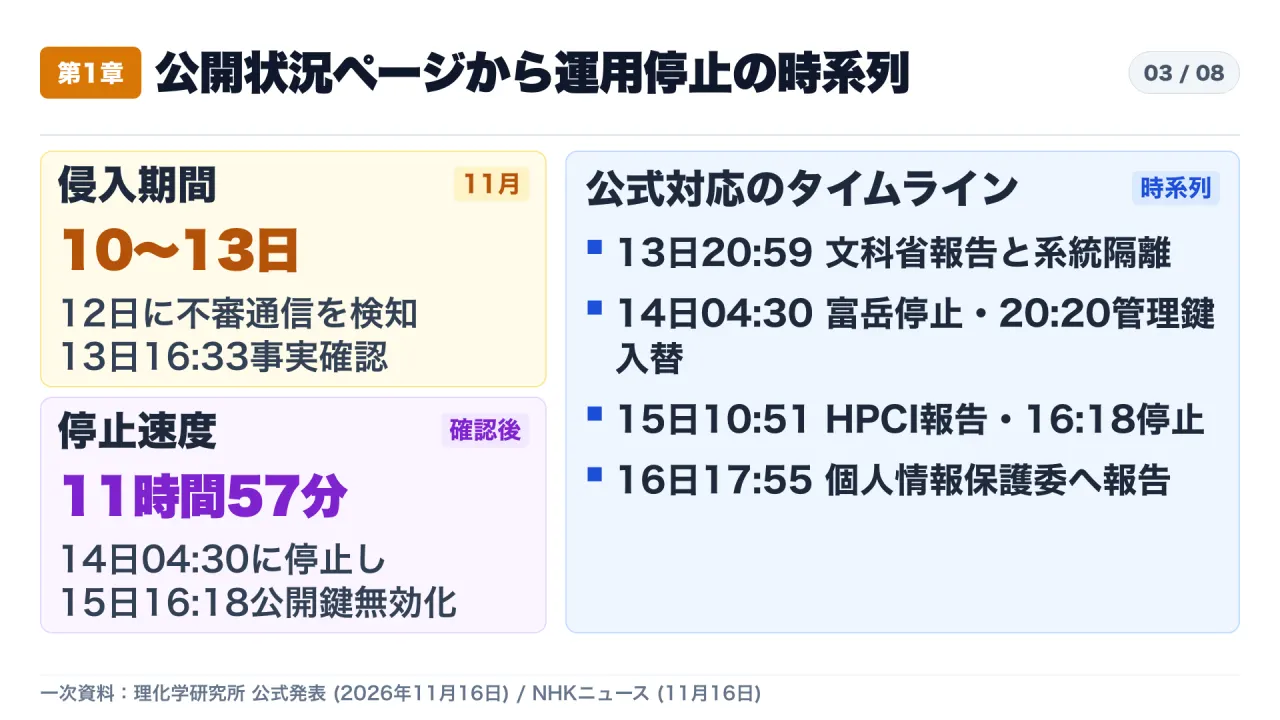
Cross-referencing RIKEN’s official press release establishes the verified sequence of events in Japan Standard Time (JST) during November 2026:
| Timestamp (JST, November 2026) | Verified Event and RIKEN Response |
|---|---|
| November 10–13 | An external third party exploited the internet-facing Fugaku operational status web page as a foothold to intrude into Fugaku’s internal operational network, manipulating multiple servers and tampering with systems. |
| November 12 (Exact hour undisclosed) | Suspicious network communications were detected in coordination with an external maintenance contractor, and an investigation began. |
| November 13, 16:33 | Forensic investigation confirmed the fact of unauthorized access. |
| November 13, 20:59 | RIKEN reported the situation to Japan’s Ministry of Education, Culture, Sports, Science and Technology (MEXT). |
| November 13, 22:07 | RIKEN isolated the system components used in the intrusion. |
| November 14, 04:30 | RIKEN halted Fugaku operations and severed external network access—exactly 11 hours and 57 minutes after confirming unauthorized access. |
| November 14, 20:20 | RIKEN rotated administrative management keys. |
| November 15, 10:51 | RIKEN notified partner institutions participating in the High Performance Computing Infrastructure (HPCI) consortium. |
| November 15, 16:18 | All running and queued compute jobs were terminated; login public keys for all users were invalidated; RIKEN emailed users advising them to revoke any stored external credentials at destination services. |
| November 16, 17:55 | RIKEN filed a formal report with Japan’s Personal Information Protection Commission (PPC) and published the public incident advisory on the same date. |
One timing boundary deserves disciplined interpretation. Because the exact elapsed time between the confirmed breach determination at 16:33 on November 13 and the full system shutdown at 04:30 on November 14 is 11 hours and 57 minutes (under 12 hours), the response after confirmation occurred within a single overnight window. However, because RIKEN did not disclose the exact hour and minute when suspicious traffic was first detected on November 12, external observers cannot calculate the total dwell time from initial detection to shutdown without speculation.
Similarly, the gap between halting external network access at 04:30 on November 14 and canceling all queued jobs and invalidating all user login public keys at 16:18 on November 15 reflects the operational complexity of gracefully stopping and securing a national-scale supercomputer shared by thousands of external researchers across Japan’s HPCI network.
3. Confirmed Exposure Scope vs. Unverified Boundaries
RIKEN’s disclosure clearly separates what has been confirmed as exposed or potentially exfiltrated from categories that remain under active investigation or withheld for security reasons. Maintaining this boundary prevents both under-reaction and unwarranted speculation.
Confirmed Categories of Exposed or Potentially Exposed Assets
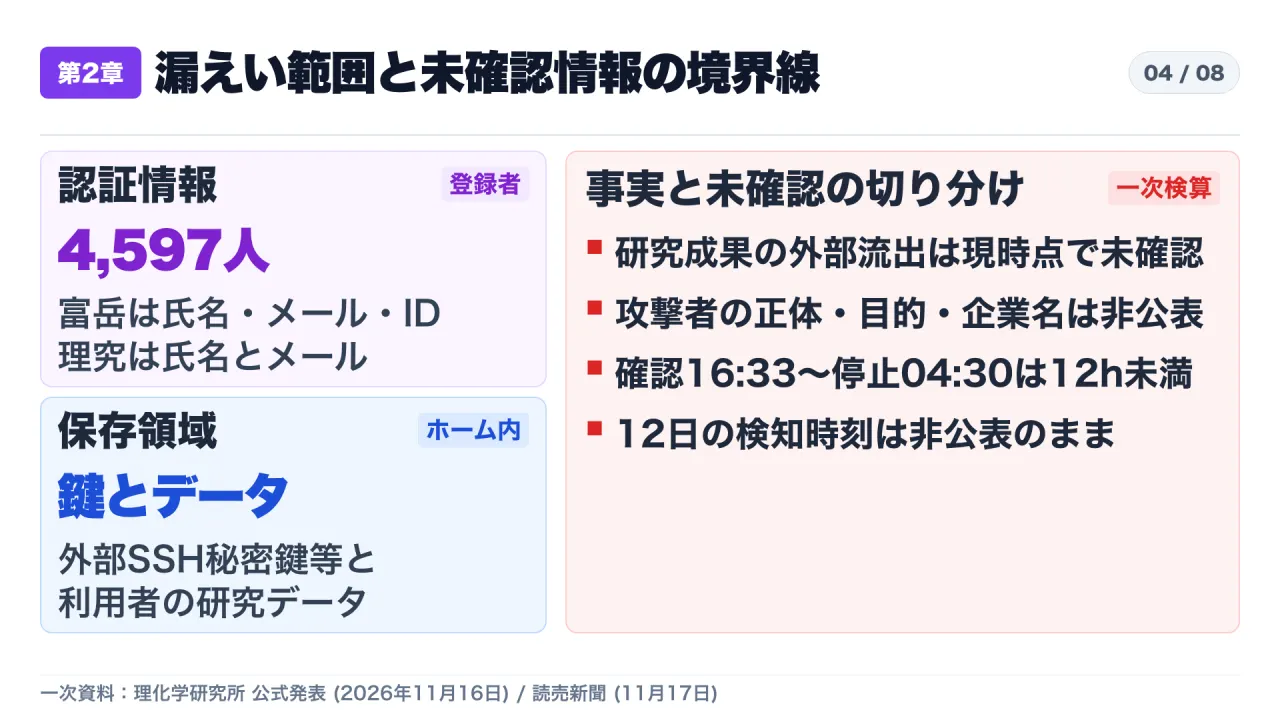
- User Authentication System Registration Data (Maximum 4,597 Individuals Combined)
- Fugaku registered users (up to 4,222 individuals): Full name, email address, and user ID.
- Rikyu registered users (up to 375 individuals): Full name and email address.
- Files Stored in User Home Directories
- Authentication credentials used to connect to supercomputers and external services outside RIKEN (including SSH private keys and access keys).
- User-stored files, including research data residing in affected areas.
Unverified, Ongoing, and Non-Disclosed Boundaries
- Exfiltration of Research Results: As of November 16, 2026, RIKEN explicitly stated that no concrete facts confirming the external leakage of research outcomes had been verified.
- Third-Party Personal Data Inside User Files: Investigators are still checking whether any files stored by users inside home directories contained personal data belonging to third parties.
- Confirmed Downstream Secondary Damage: While RIKEN confirmed that stolen credentials were used to attempt connections to external systems, whether any actual secondary compromise succeeded elsewhere remains under joint investigation with partner institutions.
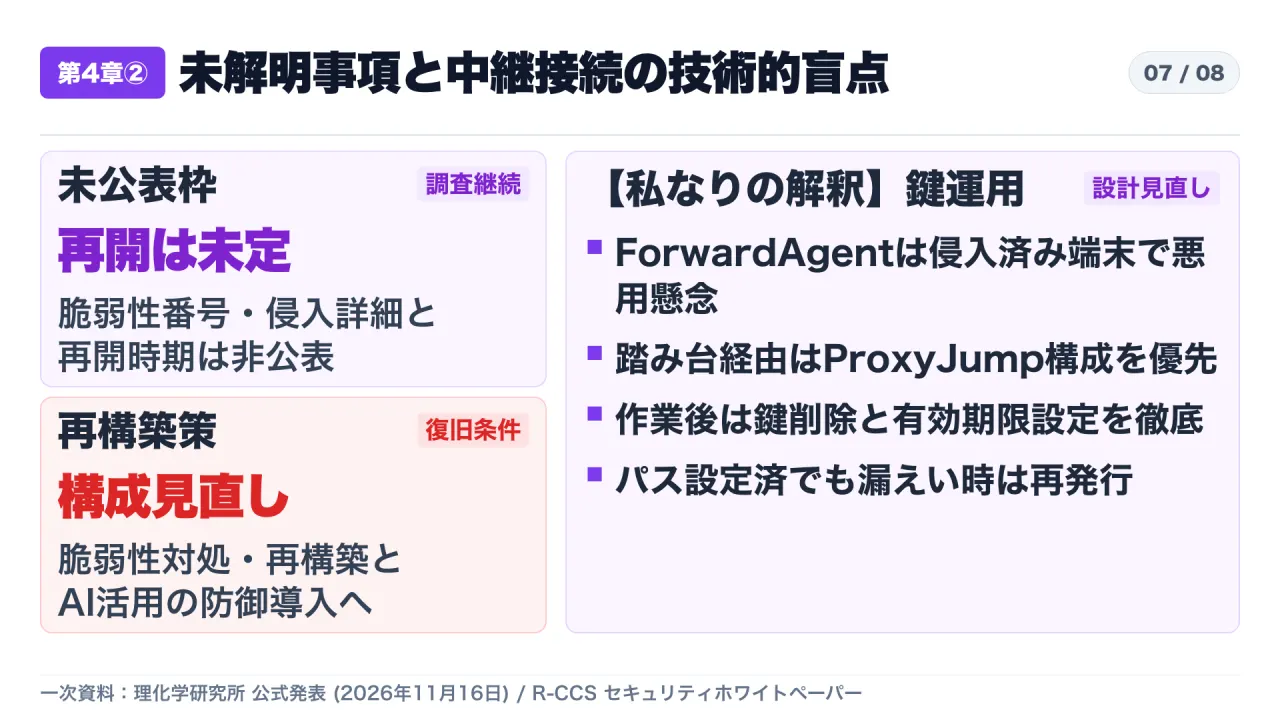
- Technical Exploit Specifics and Attribution: The exact software component or CVE identifier exploited on the public status page, the identity and motive of the threat actor, the name of any private-sector victim companies, and a target date for resuming Fugaku operations have not been disclosed.
Distinguishing between credential exfiltration risk and confirmed research IP theft is essential for legal, compliance, and customer-notification decisions. An organization whose researchers used Fugaku does not yet have evidence that proprietary simulation data left RIKEN’s network—but it does have confirmed reason to assume that any SSH key or API token sitting inside a Fugaku home directory may already be in an attacker’s hands.
4. Why Home-Directory SSH Private Keys Turn a Local Breach into Outbound Lateral Risk
Why did an intrusion into Fugaku’s operational environment immediately create cross-institution lateral movement risk—even after RIKEN cut Fugaku off from the internet? Two architectural premises documented in R-CCS’s July 2021 Supercomputer Fugaku Security White Paper explain the mechanism.
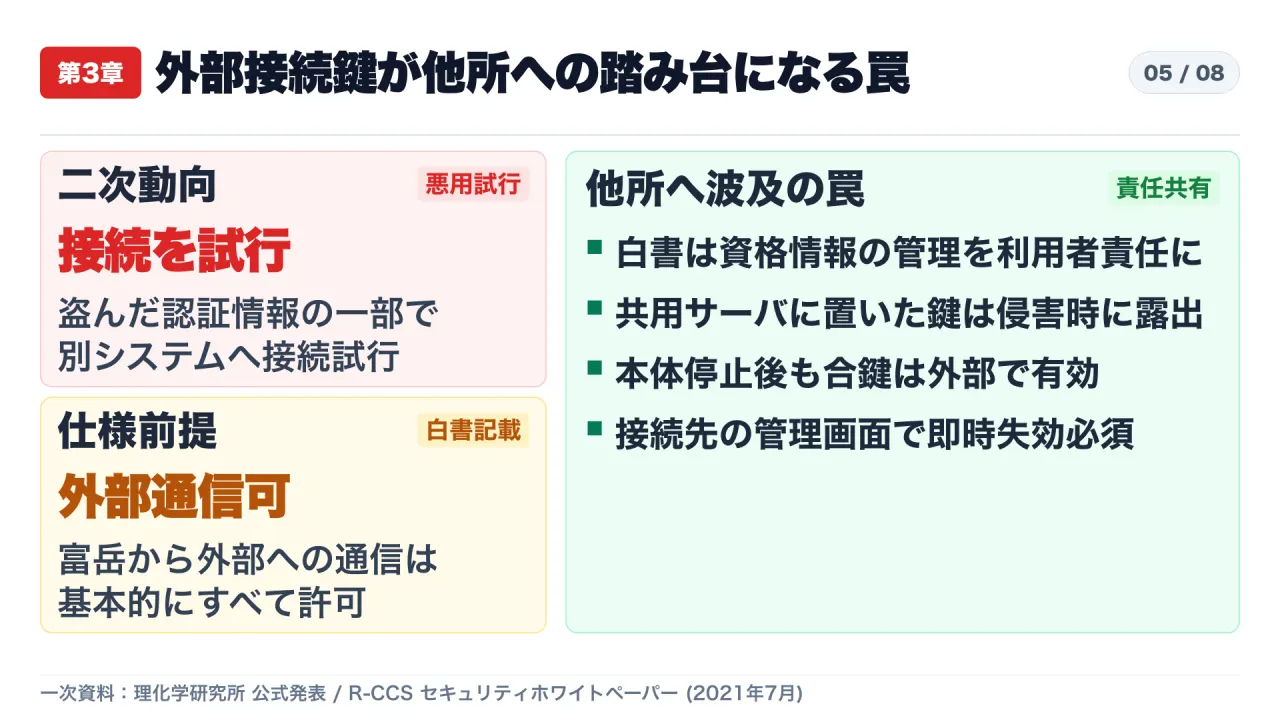
First, R-CCS explicitly operates under a shared security responsibility model. While the center is responsible for protecting the compute hardware, storage infrastructure, system software, and internal network, users remain responsible for managing their own information, research data, user accounts, and authentication credentials.
Second, Section 4.2 (Network Security) of the same white paper documents a permissive outbound policy: outbound communications from Fugaku to external networks are, in principle, permitted so researchers can transfer datasets, pull dependencies, or interact with collaborating HPC centers.
When researchers store long-lived SSH private keys, cloud access keys, or Git repository tokens directly inside their shared HPC home directory for day-to-day convenience, two consequences follow during an operational-system compromise:
- Credential Harvesting Beyond Compute Isolation: Even if an organization’s own corporate firewall blocks direct inbound access from unknown IPs, stolen keys harvested from a compromised multi-tenant host can be replayed from attacker-controlled infrastructure anywhere on the internet if destination accounts lack strict IP allowlisting or hardware-bound MFA.
- Persistence After Host Shutdown: Taking Fugaku offline at 04:30 JST on November 14 stopped traffic originating from RIKEN’s network, yet it did nothing to invalidate stolen private keys at external supercomputers, university clusters, or commercial cloud platforms. Those credentials remain valid until each external service administrator or user revokes them on the destination side.
This dynamic mirrors broader enterprise SaaS and CI/CD incidents: once an attacker extracts static outbound credentials from a shared platform, containment at the breached vendor cannot substitute for destination-side key revocation and destination-side access log auditing.
5. Research Disruption, Outsourcing Governance, and Technical Blind Spots in SSH Relaying
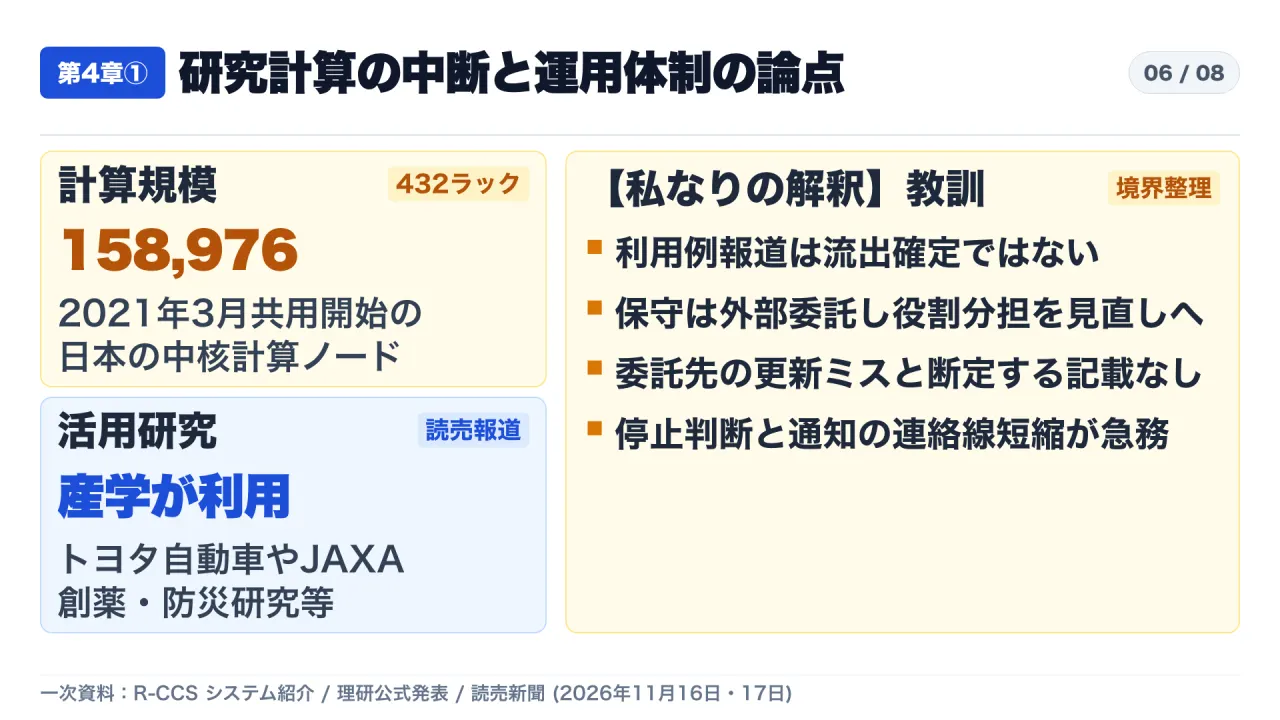
According to R-CCS’s official system specifications, Fugaku began shared public operation in March 2021 with 432 racks and 158,976 compute nodes, forming the core of Japan’s national high-performance computing infrastructure. Reporting by Yomiuri Shimbun on November 16 and November 17, 2026 noted that Fugaku supports major industrial and scientific workloads—including aerodynamic drag simulations for Toyota Motor Corporation, rocket development for the Japan Aerospace Exploration Agency (JAXA), pharmaceutical drug discovery, and disaster-prevention modeling. At a press conference on November 17, 2026, Chief Cabinet Secretary Minoru Kihara emphasized the importance of RIKEN taking appropriate measures to minimize disruption to research activities. It is important to note that media citations of Toyota and JAXA illustrate prominent users of the national facility rather than confirmed leaks of those organizations’ proprietary data.
On the governance front, RIKEN stated that maintenance and management of the affected operational system had been outsourced to an external contractor, and pledged to urgently review the division of roles in its operational maintenance framework so emergency responses can occur faster. At the same time, RIKEN’s public statement does not assert that a contractor’s missed patch directly caused the breach; attribution of root cause remains subject to forensic completion. For any enterprise operating critical infrastructure with external managed service providers (MSPs), the lesson is structural: emergency shutdown authority, escalation contacts, and network-isolation playbooks must be executable without multi-hop organizational friction.
Before bringing Fugaku back online, RIKEN outlined four technical remediation pillars: patching the exploited software vulnerability, rebuilding compromised servers, redesigning the network architecture, and introducing advanced AI-assisted security monitoring.
From a hands-on SSH architecture perspective, security teams should also examine how engineers avoid storing private keys on intermediate or shared servers:
- The Risk of
ForwardAgent: Many engineers enable SSH agent forwarding (ForwardAgent yes) to avoid copying private keys onto jump hosts or shared servers. However, if the intermediate or destination server itself is compromised by an attacker with root privileges, that attacker can hijack the forwarded UNIX domain socket (SSH_AUTH_SOCK) for the duration of the active session and authenticate outward as the user. - Preferring
ProxyJump(ssh -J): When traversing bastion hosts or jump servers,ProxyJumpestablishes an end-to-end encrypted tunnel directly from the client workstation to the final target without exposing the local SSH agent socket to the intermediate node. - Enforcing Short Lifetimes and Cleanup: Where agent forwarding is strictly unavoidable in legacy workflows, administrators should restrict it to explicitly trusted hosts, require key confirmation (
ssh-add -c), enforce short expiration lifetimes (ssh-add -t), and clear loaded keys immediately after completing tasks (ssh-add -D), alongside passphrases and hardware-backed keys (FIDO2/resident keys).
6. Immediate Defensive Checklist for Users and Infrastructure Administrators
Whether an organization runs workloads on national supercomputers like Fugaku or manages multi-tenant cloud and Kubernetes platforms, two distinct groups should act on concrete boundaries immediately.
For Researchers, Developers, and Partner Organizations
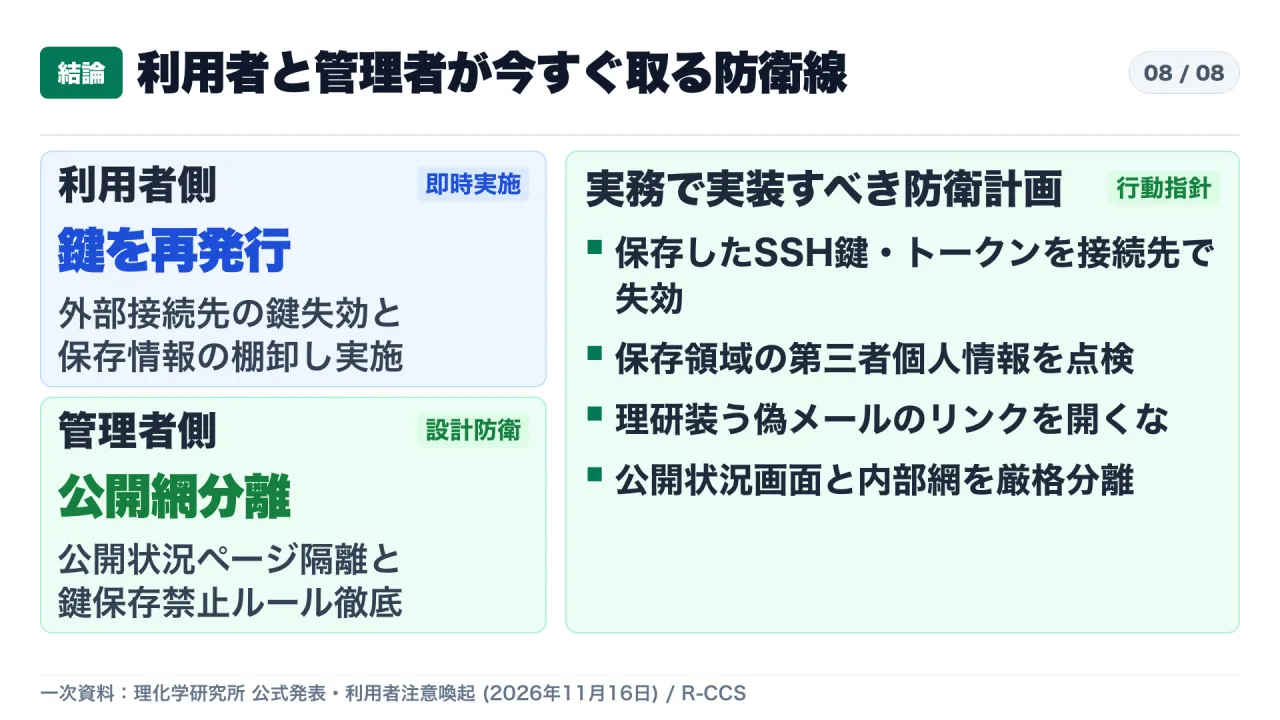
- Revoke and Rotate All Stored External Credentials: Identify every SSH private key, API token, cloud access key, or personal access token ever placed in a Fugaku home directory or shared cluster environment. Revoke them immediately inside the destination services (partner HPC centers, AWS/GCP/Azure, GitHub/GitLab), issue fresh credentials, and audit destination authentication and billing logs for anomalous access starting from November 10, 2026.
- Audit Stored Research Files for Third-Party Personal Data: Inventory files and job outputs stored in affected home directories to verify whether third-party personal information, NDA-covered partner datasets, or regulated records were present, and coordinate promptly with institutional security officers.
- Guard Against Targeted Phishing Using Exposed Registration Data: Because names, email addresses, and user IDs for up to 4,597 Fugaku and Rikyu users may have leaked, treat unsolicited “Fugaku recovery” or “RIKEN account verification” emails with extreme caution. RIKEN explicitly warns users never to click links asking for passwords—RIKEN does not request passwords via email.
For Infrastructure Architects and Security Operations Teams
- Air-Gap Public Status Pages from Internal Management Planes: Operational status dashboards and public telemetry pages must consume sanitized, one-way replicated metrics rather than residing on—or sharing reachable paths with—internal management networks.
- Constrain Outbound Egress and Define Emergency Isolation Authority: Audit whether compute and management nodes truly need unrestricted outbound internet connectivity, implement egress filtering where feasible, and codify direct emergency shutdown authority across internal teams and external maintenance contractors.
- Prohibit Static Long-Lived Credentials on Shared Hosts: Ban storing static external SSH private keys and long-lived tokens in shared home directories; standardize on
ProxyJump, short-lived OIDC/ephemeral certificates, and hardware-backed authentication.
Primary Sources and References
- RIKEN Official Press Release (November 16, 2026)
- RIKEN Center for Computational Science (R-CCS): Fugaku Operational Status
- RIKEN R-CCS: Supercomputer Fugaku Security White Paper (July 2021, PDF)
- RIKEN R-CCS: Fugaku System Overview
- NHK News (November 16, 2026)
- Yomiuri Shimbun (November 17, 2026)
- Yomiuri Shimbun (November 16, 2026)