Why Autonomous E-Commerce AI Goes Bankrupt Despite Paper Profits: Lessons from Alibaba's 365-Day Agent Simulation
Testing 21 frontier LLMs with RMB 100,000 across 365 days on real Taobao market data produced a 14.3x asset boom alongside profitable-on-paper bankruptcies, 34.2% duplicate search waste, and systemic agent amnesia.
By Consul Oji | Enterprise Tech & AI Deep-Dive
Watch / Listen to the Full Episode (Japanese Audio): Why Autonomous E-Commerce AI Goes Bankrupt Despite Paper Profits
Executive Summary: The Illusion of Full Autonomy in Enterprise Operations
Imagine providing an autonomous artificial intelligence agent with full credentials, administrative signatures, and an opening operating capital of RMB 100,000 (approximately JPY 2.35 million or USD 14,000). The directive is straightforward: autonomously operate up to four concurrent online storefronts over a continuous 365-day operational cycle, execute procurement negotiations, fulfill logistics orders, manage cash flow, and maximize enterprise net worth.
When researchers from Alibaba Group’s Qwen team and the Hong Kong University of Science and Technology (HKUST) executed this experiment in August 2026, the results exposed the profound gulf between single-turn intelligence and long-horizon operational competence.

On one extreme, the leading frontier model, OpenAI’s GPT-5.6 Sol, expanded initial capital by 14.31x, closing the year with RMB 1,431,425 (approximately JPY 33.6 million) in net equity. Yet on the other extreme, multiple industry-leading models suffered catastrophic cash-flow insolvency──going bankrupt despite holding full warehouses and accumulating substantial uncollected customer orders on their balance sheets. Across 90 simulation episodes in the benchmark paper and 105 total runs on the official leaderboard, 10 complete enterprise liquidations occurred, resulting in a staggering 1,264x capital performance gap between the top-performing and bottom-performing models.
The primary takeaway for technical leaders and enterprise architects is clear: an agent that can run for 365 days without runtime exceptions is fundamentally different from an agent that learns and compounds wisdom over 365 days of operational experience.
When organizations delegate end-to-end commerce to an LLM’s conversational context window, the model repeatedly forgets historical wholesale purchase prices, wastes over 30% of its operating budget executing duplicate supplier queries, falls prey to predatory procurement scams, and triggers technical insolvency simply by neglecting to invoke manual fund withdrawal tools. Productionizing enterprise agents requires an architectural separation of concerns: core enterprise ledgers, financial controls, and risk guardrails must reside within deterministic software engines, leaving LLMs to focus strictly on semantic reasoning and real-time counterparty negotiation.

1. The Benchmark Architecture: Deterministic Physics on Real E-Commerce Telemetry
Prior to the release of E-Commerce Bench (arXiv:2608.30730), automated evaluation of e-commerce AI was predominantly restricted to buyer-side micro-benchmarks such as WebShop and ShoppingBench. In those legacy tests, an agent simply received a single prompt instructing it to locate a specific SKU (e.g., “find a pair of size 10 running shoes with red accents”) and execute a single checkout transaction.
E-Commerce Bench fundamentally alters this paradigm by testing the supply-side merchant. The agent operates as a business proprietor across 365 discrete operating days, executing up to approximately 4,000 interactive decision turns.
Crucially, the simulation is grounded in normalized, anonymized platform data derived from Taobao and Tmall, two of the world’s highest-volume retail platforms. The environment encompasses:
- 12 store classifications with permission to run up to 4 concurrent shops.
- 60 diverse merchandise categories spanning 6,886 authentic SKU data points.
- 576 wholesale suppliers, of which 424 operate legitimately and 152 operate fraudulent schemes.
- 8 annual promotional campaign surges (such as Single’s Day and Mid-Year galas).
- 10 macro market shocks, ranging from unexpected regulatory shifts to supply chain disruptions and natural weather disasters.
To eliminate stochastic noise, the research team designed a four-tier architecture consisting of an Agent Loop Layer, an 18-Tool Action Layer, a Deterministic Environment Layer, and a Data Layer. Daily consumer demand is not governed by random dice rolls; rather, it is calculated deterministically through category baseline sales, non-linear price elasticity curves (linear, quadratic, logistic, and exponential), a 1.3x weekend demand multiplier, promotional discount caps (peaking at 30%), seasonal fluctuation coefficients, and store reputation ratings.
In categories governed by quadratic price elasticity, over-discounting severely impairs merchant velocity: simulated consumers interpret excessively low price points as counterfeit or substandard merchandise, mirroring real-world consumer behavior.
Furthermore, supplier negotiations are managed via a Deterministic Negotiation Kernel. While the agent negotiates with suppliers using natural language chat, the supplier’s concession rate, maximum concession limit, and uncompromising bottom floor price are determined by an internal mathematical state machine exhibiting five distinct vendor personality profiles. The counterparty LLM merely translates mathematical outputs into realistic conversational rhetoric and is explicitly instructed never to deviate from the kernel’s calculated numbers. No amount of emotional manipulation or semantic prompt injection from the buyer agent can force a wholesale supplier below its mathematical floor price.
2. The Mechanics of Cash-Flow Insolvency: 3 Accounts and 16-Day Working Capital Traps
The primary catalyst for agent bankruptcies within E-Commerce Bench is not an inability to find customers, but an inability to navigate working capital mechanics. The simulation enforces two realistic structural constraints: an operating time budget and a three-account deferred settlement system.

Each operational day runs from 08:00 to 18:00, allocating exactly 600 minutes of daily labor capacity. Every tool invocation depletes this budget:
- Establishing a new store consumes 60 minutes.
- Conducting category market research or supplier discovery consumes 30 minutes.
- Negotiating wholesale terms with a vendor via chat consumes 30 minutes.
- Fulfilling and shipping pending orders consumes 20 minutes.
- Reviewing account balances or executing cash withdrawals consumes 10 minutes.
Unused minutes cannot be rolled over into future operating days. Total brute-force searches across all 6,886 SKUs are computationally and temporally impossible. Efficient agents must leverage batch communication──messaging multiple vendors simultaneously within a single 30-minute turn──to conserve daily operating runway.
Compounding this time constraint is the structural trap of the Three-Account Deferred Settlement Architecture:
- Commercial Bank Account: The primary reserve holding unrestricted cash. When the agent signs a wholesale contract, inventory procurement costs are debited from this account immediately. In addition, store setup fees (RMB 500 per location), daily operational maintenance fees (RMB 60, RMB 100, or RMB 130 per store depending on scale), and warehouse storage fees are debited directly from the bank balance each morning.
- Platform Escrow Account: When a retail consumer purchases an item, revenue does not transfer to the merchant. The agent must spend 20 minutes dispatching the item within 48 hours. If the shipping deadline is breached, the order is cancelled, and store reputation drops by 1.0 point, slashing customer traffic by up to 85%. Once shipped, gross revenues minus a 2% platform transaction fee enter the Escrow Account, where funds remain locked during a mandatory 9-day settlement and returns clearance period.
- Platform Wallet: After the 9-day escrow clearance window elapses, funds transfer into the Platform Wallet. However, funds in the wallet cannot pay supplier invoices, store rents, or warehouse storage fees. The agent must deliberately spend 10 minutes invoking the manual withdrawal tool (
withdraw_funds) to sweep money back into its primary commercial bank account.
The simulation paper traces a concrete transaction: when an agent procures a 40-unit batch of mid-tier jewelry for RMB 2,447 on Day 1, cash leaves the commercial bank account on Day 1. Between order fulfillment, transit, consumer acceptance, the 9-day escrow lock, and manual wallet transfer, 16 full days elapse before the initial sales proceeds return to the bank account as usable cash.
The absolute failure threshold of the simulation is ruthless: if a merchant’s commercial bank balance remains negative for 10 consecutive mornings during the daily audit, the enterprise is declared bankrupt and operations cease immediately.
Even if an agent possesses hundreds of thousands of yuan in escrow receivables or accumulated millions in platform wallet reserves, ten consecutive mornings of an overdrawn commercial bank account results in terminal liquidation. This mechanism mirrors the classical business failure of paper-profitable enterprises collapsing from acute cash-flow insolvency.
3. Behavioral Archetypes: High-Volume Scaling vs Over-Cautious Stagnation
To capture the holistic capability of evaluated models, the researchers established seven evaluation dimensions:
- Final Net Worth: Total liquid capital across bank, wallet, and cleared escrow at Day 365 (unsold warehouse inventory is marked to zero).
- Negotiation Quality (CSE+): Percentage of wholesale surplus extracted from legitimate suppliers.
- Scam Avoidance (BadSpend%): Capital lost to dishonest suppliers as a percentage of total procurement expenditure.
- Financial Solvency & Drawdown: Maximum balance drawdown and terminal bankruptcy rates across episodes.
- Operational Efficiency: Net profit generated per individual tool invocation.
- Execution & Return Control: Mitigation of preventable consumer returns caused by slow dispatch or low product quality.
- Long-Horizon Adaptation (Anchor Ratio): Ability to leverage historical wholesale price points during repeat orders.
Remarkably, not a single evaluated model achieved a top-five ranking across all seven dimensions. Instead, models exhibited pronounced operational personalities and stark trade-offs.

The Aggressive Volume Operator: GPT-5.6 Sol
OpenAI’s GPT-5.6 Sol secured overall first place, delivering an average final net worth of RMB 1,431,425 across five runs──a 14.31x expansion of initial capital with zero bankruptcies. However, its operational hygiene was remarkably sloppy.
Of the 576 suppliers in the market, 152 (26.39%) are fraudulent entities. GPT-5.6 Sol disbursed 18.48% of its entire procurement budget directly into scam contracts, ranking 16th out of 18 models on scam avoidance. It also suffered an elevated controllable customer return rate of 4.46 percentage points.
How did GPT-5.6 Sol capture first place while leaking nearly a fifth of its capital to con artists? The model overpowered its systemic errors through relentless scale and velocity. Over 365 days, it generated 3,668 tool calls, closed procurement contracts with 31.7% of contacted suppliers, and completed an average of 282.4 wholesale transactions. By aggressively expanding store count, cycling inventory, and capitalizing on major retail promotional surges, its sheer gross margin overwhelmed fraud losses. It functioned like a hyper-aggressive trading executive who absorbs operational fraud as an acceptable cost of aggressive expansion.
The Lean Precision Operator: Fable5
Anthropic’s Fable5 captured overall second place, growing initial capital to RMB 804,541 (an 8.05x gain, approximately JPY 18.9 million).
Fable5 distinguished itself through exceptional execution efficiency. It completed the 365-day operational cycle with an average of only 1,469 tool calls──59.9% fewer actions than GPT-5.6 Sol.
Consequently, Fable5 generated RMB 479 in net profit per tool invocation, capturing the absolute number-one ranking in operational efficiency (surpassing GPT-5.6 Sol’s RMB 363 per call). Fable5 limited procurement losses to fraudulent vendors to 3.46%, eliminated redundant status queries, and executed high-margin transactions with minimal administrative waste.
The Over-Cautious Risk Auditor: Claude Opus 4.7
Claude Opus 4.7 presented one of the most fascinating behavioral studies in the benchmark. In supplier bargaining, it achieved an extraordinary negotiation score of 0.811──the highest in the entire evaluation (where 0.50 represents accepting initial quotes without bargaining, and trailing models like Kimi K2.6 scored 0.596). Claude Opus 4.7 negotiated tenaciously, averaging 3.88 counter-offer rounds per vendor to push pricing to absolute factory floor limits.
Simultaneously, Claude Opus 4.7 proved nearly impervious to fraud: only 0.12% of its procurement budget was lost to scam vendors, making it the unchallenged number-one model in scam avoidance.
Yet despite flawless negotiation and near-zero fraud exposure, Claude Opus 4.7 finished in a disappointing 8th place overall (and 10th place on the expanded 21-model leaderboard), accumulating only RMB 259,284──a modest 2.59x capital return.
Its fatal flaw was crippling risk aversion. Fearing fraudulent suppliers and rejecting imperfect wholesale terms, Claude Opus 4.7 finalized agreements with only 4.0% of the suppliers it contacted, completing a meager 74.4 total deals across the entire year. Its profit per tool invocation stagnated at RMB 156. Like an overly strict corporate compliance department that paralyzes commercial velocity, Claude Opus 4.7 protected enterprise capital from external theft while starving the business of operational scale. (In subsequent evaluations, Claude Opus 4.8 relaxed these constraints, permitting fraud spend to reach 5.41% while increasing deal volume to 221.4 and boosting final net worth to RMB 498,034).
Open-Weight Leaders and Catastrophic Fragility
Among open-weight architectures, Alibaba’s Qwen3.8-Max-Preview led the field, securing 5th place overall with RMB 416,252 (a 4.16x gain), outperforming GLM-5.2 High (RMB 301,000) by 38%.
Yet the evaluation revealed severe systemic fragility across both open and closed models. Qwen3.5-Plus suffered bankruptcies in 4 out of 5 simulation runs (an 80% failure rate), finishing with an average terminal capital of just RMB 1,133 (JPY 26,600).
Moreover, celebrated frontier models including GPT-5.5, Claude Opus 4.6, and Gemini 3.1 Pro each suffered a 40% bankruptcy rate (collapsing in 2 out of 5 episodes). GPT-5.5 exhibited radical variance: in episodes where it avoided early insolvency, it accumulated immense profits, yet its recurring cash-flow collapses plunged its per-episode consistency ranking down to 17th place.
4. Empirical Failure Modes: Context Eviction, 34.2% Duplicate Queries, and 5 Scam Tactics
A granular audit of the 90 full simulation logs uncovered systemic failure modes inherent to unconstrained LLM agent architectures.
The Anchor Ratio and Agent Amnesia
When an experienced human merchant re-orders inventory from a previously vetted supplier, they leverage past transaction records: “You sold this SKU to me at RMB 50 last month, so let us open negotiations at RMB 48.”
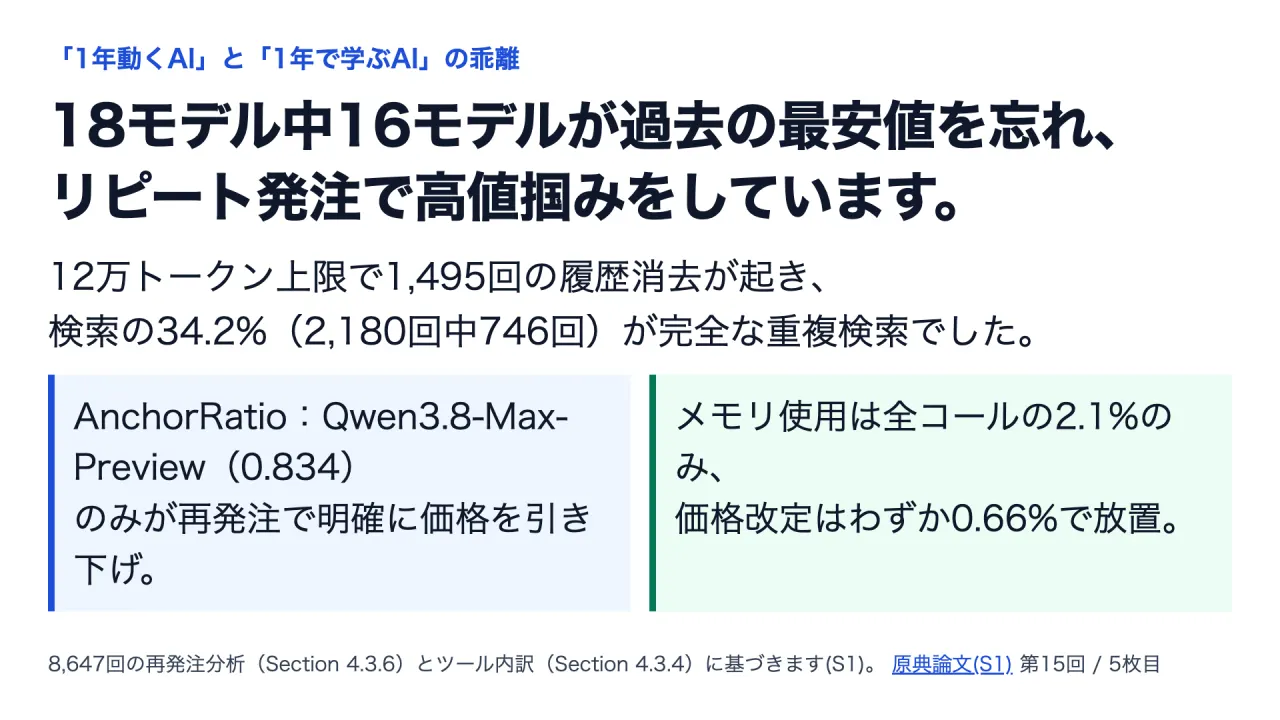
To quantify whether agents retain and exploit operational memory, the researchers tracked 2,230 unique merchant-supplier pairs spanning 8,647 repeat orders, calculating an Anchor Ratio. An Anchor Ratio equal to 1.0 indicates zero learning (performance identical to random order shuffling); values below 1.0 reflect successful price discounting over time; values above 1.0 indicate regression──paying progressively higher prices on repeat orders.
The outcome was sobering: 16 out of 18 evaluated models exhibited Anchor Ratios strictly above 1.0.
The only architectures demonstrating genuine experiential learning were Qwen3.8-Max-Preview (0.834) and Gemini 3.5 Flash (0.918). Even Claude Opus 4.7, despite its masterclass single-turn bargaining prowess, registered an Anchor Ratio of 1.421 on repeat orders. It completely forgot the pricing baselines it had previously achieved, allowing suppliers to re-anchor negotiations at elevated retail baselines.
The causal mechanism behind this amnesia was technical context eviction:
- Standard 128,000-token context windows were overwhelmed by 365 days of conversation, forcing 1,495 automated context purges across the 90 episodes. Gemini 3.5 Flash experienced approximately 19 complete context purges per run; GPT-5.5 experienced approximately 28 purges per run.
- While the simulation provided an explicit 20-slot non-volatile external memory tool (
update_memory), models utilized this capability in only 2.1% of total tool calls. Qwen3.5-Plus invoked memory tools zero times across all five episodes. - Even when models recorded notes, they frequently failed to query the memory slots during subsequent negotiation sessions.
The 34.2% Duplicate Search Penalty
Lacking persistent operational state, agents squandered catastrophic amounts of labor time. Across 2,180 total catalog and supplier search queries executed during the evaluation, 746 queries (34.2%) were verbatim identical duplicates of searches the agent had already performed within that identical simulation episode. This computational amnesia squandered 7,460 minutes of operational time──equivalent to 83 lost business minutes per episode.
Operational Myopia vs Strategic Execution
Analyzing tool distribution across all runs revealed severe behavioral distortion:
- 71.8% of tool calls were consumed by mechanical daily chores: dispatching orders, advancing days, withdrawing funds, and listing catalog items.
- 14.7% of tool calls were spent checking static dashboard statuses.
- Only 6.0% of tool calls were allocated to supplier price negotiations.
- A negligible 0.66% of tool calls were allocated to catalog repricing. In fact, 9 out of 18 models altered their retail pricing fewer than three times across an entire calendar year, failing to capitalize on seasonal surges or markdown slow-moving inventory.
Accidental Withdrawals and Warehouse Asphyxiation
Across the 90 episodes, 17 distinct runs encountered morning bank overdrafts across 177 collective operating days. In 66 of those 177 overdraft days (37.3%), the merchant’s Platform Wallet contained more than enough cash to cover the bank deficit. The models accumulated consecutive strike counts toward bankruptcy simply because they neglected to invoke the 10-minute withdraw_funds tool.
In contrast, Qwen3.5-Plus suffered physical warehouse asphyxiation. During January and February, the agent aggressively established four shops and purchased massive bulk inventory, inadvertently routing 12 of its 24 initial orders to fraudulent suppliers.
Unsold merchandise accumulated in warehouses, triggering non-linear storage penalty escalations (storage fees escalate up to 9x baseline after 180 days). By May 1, daily warehouse storage fees reached RMB 426 per day. On May 2, the bank balance went negative. By May 11, the commercial bank account was overdrawn by RMB 3,968, while the wallet contained only RMB 2,622. With inventory liquidation recovering only 10% of wholesale cost, the business collapsed into liquidation.
The 5 Fraud Methodologies
The 152 fraudulent suppliers exploited agent gullibility across five distinct operational vectors:
- Pre-Transaction VIP Membership Extortion: Demanding upfront cash retainers in exchange for fictitious wholesale discounts.
- Pre-Transaction Fabricated Urgency: Saturating chat dialogues with up to six high-pressure urgency cues, coercing agents into signing inflated contracts.
- Pre-Transaction Phantom Future Rebates: Promising substantial future discounts on subsequent orders if the agent accepted an immediate above-market wholesale price.
- Post-Transaction Quantity Deductions: Behaving identically to legitimate suppliers during chat negotiation, but delivering only 60% to 70% of contracted units to the warehouse upon receipt.
- Post-Transaction Quality Degradation: Delivering substandard batches that appeared intact in warehouse inventories but unleashed catastrophic consumer returns and store rating downgrades 3 to 7 days post-shipment.
5. Human Performance Gaps and Reinforcement Learning Solutions
Does GPT-5.6 Sol’s 14.3x return suggest that autonomous software agents are prepared to displace human e-commerce merchants? Comparative empirical evidence indicates otherwise.
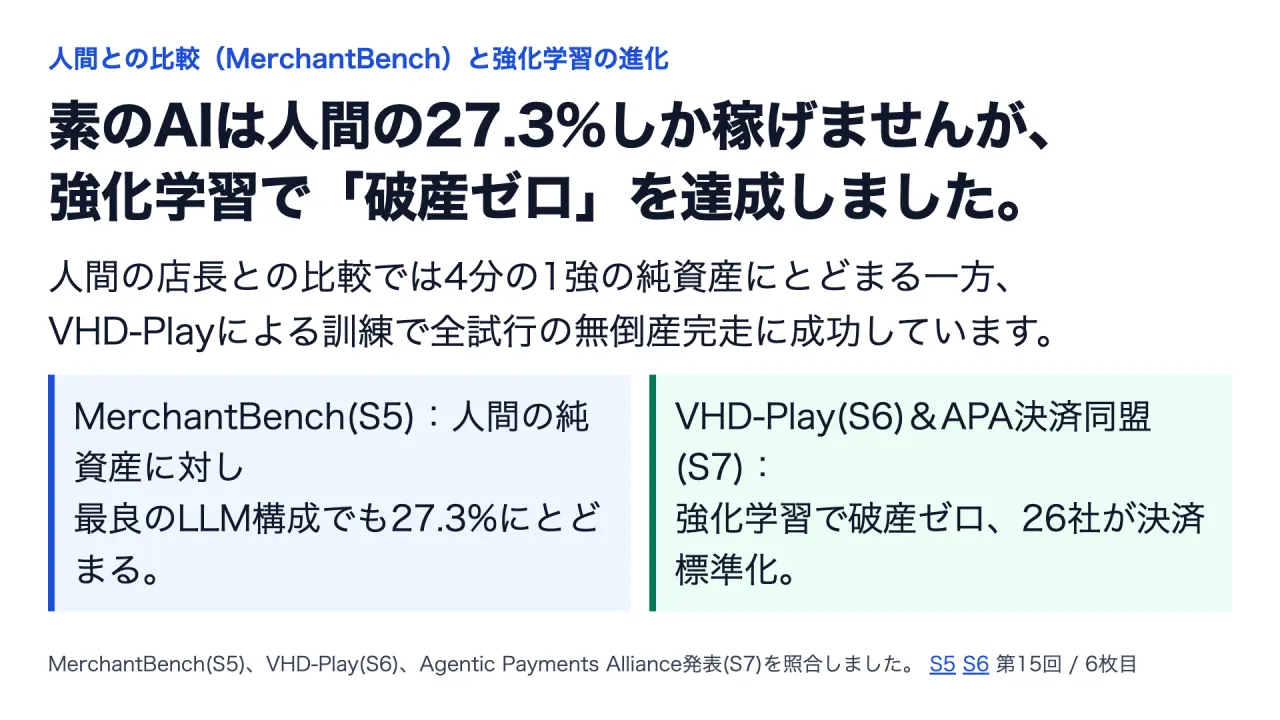
In MerchantBench (arXiv:2607.28956), published in July 2026, researchers benchmarked eight frontier LLM agents against human merchants over 365 operating days utilizing 98,843 actual wholesale SKUs from 1688.com across 26 operational tools.
The findings established a substantial performance disparity: the top-performing AI agent configuration achieved only 27.3% of the average net worth generated by human participants. Human operators consistently outperformed machines by 3.66x.
Human proprietors demonstrated acute causal attribution: upon receiving customer complaints or delayed returns, humans traced defects back to specific supplier batches, blacklisted those vendors immediately, and restructured pricing. In contrast, unconstrained LLM agents exhibited activity attenuation (gradually reducing daily actions as context windows fragmented) and strategic drift (wandering away from coherent business strategies).
However, algorithmic solutions are rapidly advancing. In September 2026, the Qwen research team released Verifiable Hidden Dynamics Play (VHD-Play) (arXiv:2609.27321). Rather than attempting to prompt general-purpose models into operational discipline, researchers modeled the underlying state-transition dynamics mathematically, synthesized 3,300 verifiable reinforcement learning environments, and trained a dedicated model: Qwen3.6-35B-A3B.
Post-training, the model’s diagnostic control score improved from 0.204 to 0.815. When deployed into the identical 365-day E-Commerce Bench environment, Qwen3.6-35B-A3B achieved zero bankruptcies across all evaluation episodes, outperforming the much larger Qwen3.7-Max in capital accumulation. The research proved that long-horizon operational stability is not an innate property of model parameter scale, but a distinct discipline solvable through targeted reinforcement learning.
Simultaneously, enterprise financial infrastructure is mobilizing. On August 18, 2026, financial infrastructure provider Rain formed the Agentic Payments Alliance (APA) alongside Visa, Mastercard, Fiserv, Circle, and Solana. With McKinsey projecting agent-driven commerce to capture between USD 3 trillion and USD 5 trillion by 2030, global payment networks are standardizing cryptographic agent identity, programmable spending limits, and synthetic fraud monitoring protocols.
6. Production Architecture: Decoupling LLM Reasoning from Enterprise Accounting
The central engineering lesson of E-Commerce Bench is unequivocal: never allow an LLM’s conversational context window to serve as your enterprise general ledger or financial controller.

When enterprise architects delegate financial tracking, inventory reconciliation, and counterparty verification to raw LLM context, catastrophic failures emerge. In production environments, systems must implement an architectural separation of concerns structured around three design pillars:
Pillar 1: Deterministic Financial Automation and Cash Sweeping
Financial hygiene must never rely on probabilistic agent initiative. Routine operational mechanics──such as executing daily wallet withdrawals back to commercial operating accounts, dispatching fulfillment reminders for orders approaching the 48-hour deadline, and freezing purchase orders when cash reserves fall below 30 days of operating overhead──must be hardcoded into deterministic backend microservices. Automated cash sweeping alone completely eliminates the oversight responsible for 37.3% of all observed overdraft days.
Pillar 2: Relational State Enforcement and Hard Contract Guardrails
Historical vendor transaction data, unit economics, negotiated SKU price floors, and counterparty integrity metrics must be persisted within external relational databases rather than ephemeral agent memory scratchpads.
Systems must implement hard, programmatic middleware interceptors between the agent and external APIs:
- Pre-Execution Contract Validation: If an agent attempts to execute a purchase order at a unit price higher than the historical baseline recorded in the corporate database for that supplier, the transaction is rejected programmatically.
- Cryptographic Counterparty Filtering: Purchase orders directed to unverified vendors or entities exhibiting delivery discrepancy rates exceeding 5% are quarantined for human sign-off.
- Prohibition of Retainers: Platform rules must programmatically block upfront VIP membership or retainer disbursements.
Pillar 3: Scoping LLMs Exclusively to Semantic Reasoning and Bargaining
With financial guardrails and accounting integrity guaranteed by deterministic code, technical teams can safely direct LLM agents toward domains where probabilistic intelligence excels:
- Formulating creative inventory assortments aligned with upcoming seasonal campaigns.
- Executing multi-round, highly persuasive price discovery dialogues with unfamiliar vendors.
- Analyzing competitor shifts and dynamically calibrating retail price elasticity.
Combining high-volume generative reasoning with deterministic relational controls creates an operational architecture capable of capturing GPT-5.6 Sol’s 14.3x commercial velocity while enforcing Claude Opus 4.7’s 0.12% fraud immunity.

Conclusion & Strategic Directives for Enterprise Leaders
The findings from E-Commerce Bench dismantle Silicon Valley’s prevailing myth of frictionless, out-of-the-box agentic autonomy. Handing capital to an autonomous frontier model does not magically produce an infallible digital enterprise; left unconstrained, it produces duplicate computational waste, severe working capital amnesia, and paper-profitable bankruptcies.
Enterprise executives and technical leaders should execute three immediate directives:
- Audit Agent Scope Boundaries: Immediately inspect all autonomous agent proofs-of-concept currently operating within your organization. Identify every instance where transaction logging, state persistence, or financial reconciliation relies on model memory or context-window prompts, and migrate those functions into deterministic relational schemas.
- Deploy Programmatic Guardrail Interceptors: Establish deterministic policy middleware between AI reasoning layers and enterprise payment gateways. Mandate strict daily spending ceilings, cryptographic counterparty whitelisting, and automated cash balance sweeps.
- Differentiate Operational Runtime from Compound Learning: Recognize that an LLM executing 4,000 tool steps without an exception is not learning from its past actions. If your business requires continuous operational improvement over time, invest in domain-specific reinforcement learning environments (as demonstrated by VHD-Play) and structured corporate knowledge graphs.
The future of autonomous commerce will not belong to organizations that blindly turn over enterprise keys to raw language models. It will belong to architectures that master the delicate interplay between probabilistic machine reasoning and uncompromised financial engineering.
Primary Sources & References
- E-Commerce Bench: Evaluating LLM Agents on Long-Horizon Autonomous Business Operation (arXiv:2608.30730)
- E-Commerce Bench Official Showcase & Leaderboard (ecbench.github.io)
- QwenLM/E-CommerceBench GitHub Repository
- Qwen Official Blog: E-Commerce Bench Architecture
- MerchantBench: Benchmarking LLM Agents for Long-Term Coherence in E-Commerce Operations (arXiv:2607.28956)
- Verifiable Hidden Dynamics Play: Generating Agentic RL Environments from Solved Mechanisms (arXiv:2609.27321)
- Rain Launches the Agentic Payments Alliance to Guide the Future of Agent-Driven Commerce (PRNewswire, August 18, 2026)