Why PHP's 10-Year Dormant Flaw Was Weaponized in 7 Days: Inside PHP2Shell (CVSS 9.2) and the CTO/CISO Rebuild-and-Retire Mandate
Affecting 70% of the web across PHP 5.4 through 8.5.11, CVE-2026-109618 and CVE-2026-109619 demonstrate that frontier AI has compressed multi-month C exploit development into one week—demanding an immediate shift from reactive patching to proactive service shutdown and legacy decommissioning.
By Consul Oji | Enterprise Tech & AI Deep-Dive
Watch / Listen to the Full Episode (Japanese Audio): Inside PHP2Shell (CVSS 9.2) and CTO/CISO Defense Governance
Executive Summary: The AI-Driven Inflection Point in Offensive Cyber Operations
On the night of October 21, 2026, at 10:40 PM JST (13:40 UTC), incident response pagers sounded across engineering departments and security operations centers worldwide. The upstream PHP development team released coordinated emergency advisories disclosing two catastrophic vulnerabilities, collectively designated PHP2Shell: CVE-2026-109618 and CVE-2026-109619. Both vulnerabilities received a maximum Common Vulnerability Scoring System (CVSS) v4.0 score of 9.2 (Critical).
The blast radius of PHP2Shell is staggering. PHP continues to power approximately 70% of all server-side web infrastructure across the public internet, serving as the foundational execution runtime for content management platforms including WordPress, Drupal, and Joomla, alongside hundreds of thousands of bespoke enterprise web applications. The underlying flaws were not bugs introduced in an experimental feature or third-party extension; they resided deep inside the core C codebase (php-src), quietly persisting undetected across more than a decade of releases from PHP 5.4 through PHP 8.5.11.
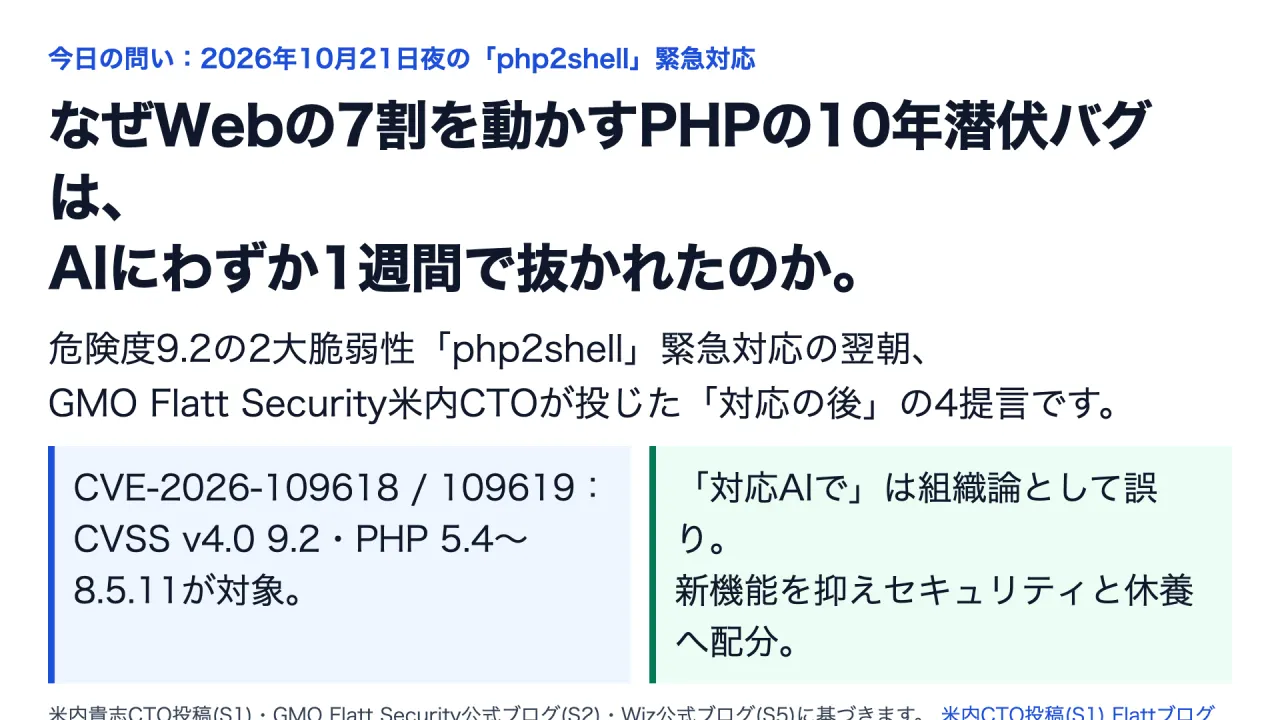
Yet the most alarming revelation of PHP2Shell does not lie in its presence. It lies in the velocity and mechanism of its weaponization.
Historically, identifying deep memory corruption flaws in complex C runtime engines required weeks of specialized manual auditing or compute-heavy fuzzing harnesses. Even after a defect was pinpointed, transforming a subtle heap desynchronization or uninitialized pointer into a deterministic, weaponized remote code execution (RCE) payload across diverse operating systems and compiler configurations typically required two to four months of painstaking work by elite offensive researchers.
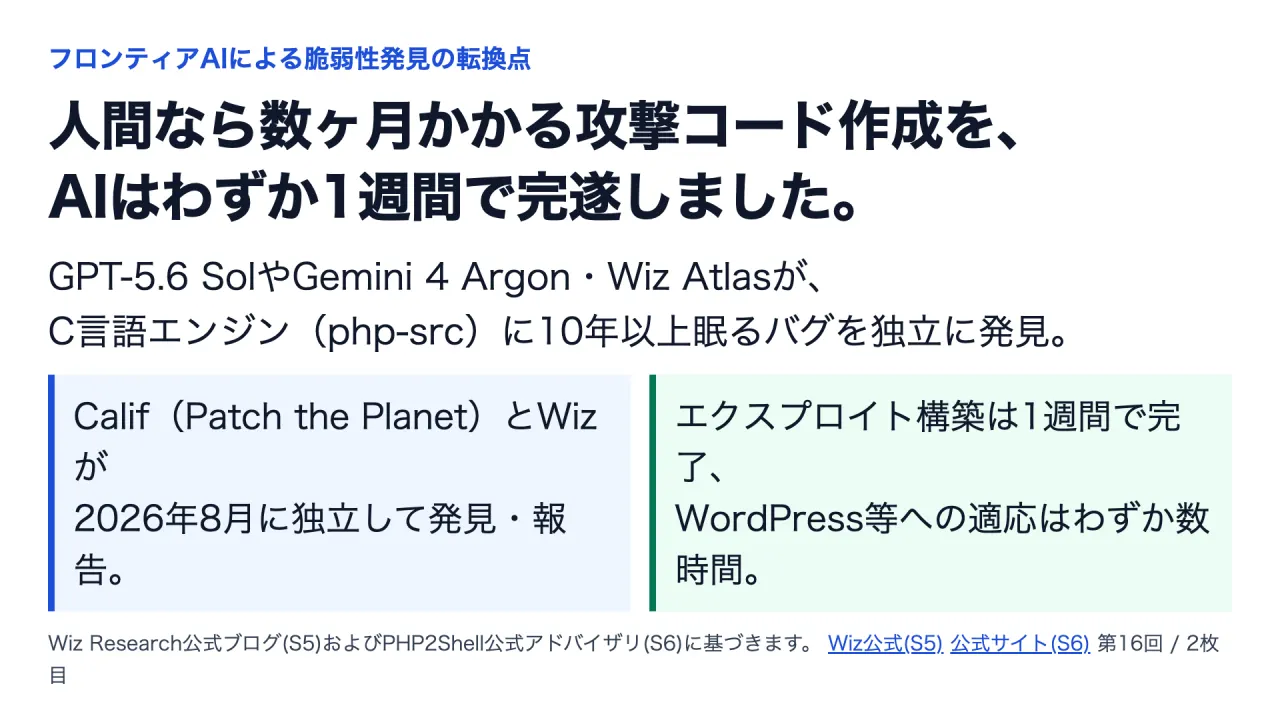
With PHP2Shell, that historical timeline was permanently shattered. Frontier reasoning models—specifically GPT-5.6 Sol and Gemini 4 Argon—autonomously identified the dormant flaws and constructed functional, reliable RCE exploit chains in exactly one week. Once the universal exploit primitive was formulated, tailoring the payload to execute arbitrary commands against standard installations of WordPress, Drupal, and Joomla required merely several hours.
Following an arduous night of patching and triage, Takashi Yoneuchi, Director and Chief Technology Officer of Japanese cybersecurity firm GMO Flatt Security, published a widely discussed leadership manifesto on October 22, 2026, titled Toward the Aftermath of the PHP Vulnerability Response. Yoneuchi warned technology executives that treating AI as a magical silver bullet to handle inbound security alerts is an organizational trap. When frontier AI accelerates the discovery and weaponization of legacy bugs, engineering organizations face structural exhaustion unless executives implement decisive architectural reforms: throttling feature development, establishing contractual agreements to proactively shut down services during critical incidents, and aggressively executing peacetime Rebuild-and-Retire programs.
1. The Discovery and Weaponization Timeline: Dual AI Convergence
To understand why PHP2Shell represents an irreversible turning point in cybersecurity, one must examine how the vulnerabilities were uncovered and weaponized between August 2026 and October 2026.
Between August 14, 2026, and August 26, 2026, two independent research groups operating without mutual awareness converged upon the exact same ten-year-old memory flaws in php-src:
- Ryan Austin (Calif): Operating under OpenAI’s “Patch the Planet” defensive research grant, Austin leveraged GPT-5.6 Sol to perform automated semantic code auditing across foundational open-source repositories. The model flagged anomalous pointer handling during Zend engine shutdown sequences, allowing Austin to formally report the flaw to upstream maintainers.
- Wiz Research Team: Simultaneously, Sagi Tzadik and a team of four security researchers at cloud security firm Wiz conducted large-scale vulnerability research using Wiz Atlas—their specialized AI agent framework—interfaced with Gemini 4 Argon and GPT-5.6 Sol. The autonomous agents independently traced memory boundary anomalies inside PHP’s multipart request processing.
- OpenAI Codex Security Team: Concurrently, researcher Amy Burnett identified and reported adjacent pointer lifecycle irregularities inside the Zend engine’s global state structures.
In their technical retrospective published on October 21, 2026, Wiz Research highlighted the qualitative leap observed in AI-assisted offensive engineering. In prior eras, memory corruption exploitation in enterprise runtimes was bottlenecked by human cognitive bandwidth. An engineer had to manually calculate glibc heap bucket layouts, determine memory alignment offsets, bypass Address Space Layout Randomization (ASLR), and craft fake data structures that survived garbage collection routines without triggering premature segmentation faults.
During the PHP2Shell investigation, autonomous AI agents assumed the burden of combinatorial state exploration. Human researchers supplied strategic guidance and environmental telemetry; the models systematically mapped out memory corruption states, adjusted payload byte sequences to bypass input sanitizers, and generated stable proof-of-concept exploits. The entire progression—from raw bug identification to weaponized remote code execution—concluded in seven days. Adapting the exploit chain to defeat security boundaries in WordPress and Drupal required an afternoon of automated prompt-driven adjustments.
Recognizing the acute danger to global web infrastructure, upstream maintainers orchestrated a coordinated emergency release on October 21, 2026, deploying patched runtime binaries:
- PHP 8.5.12
- PHP 8.4.27
- PHP 8.3.36
- PHP 8.2.35
Crucially, PHP 8.1 and all preceding versions had already crossed their End-of-Life (EOL) milestone. Organizations maintaining legacy workloads on PHP 7.x or early PHP 8.x received no upstream patches whatsoever, leaving millions of servers exposed to automated exploitation.
2. Technical Anatomy: The Two Doors Pried Open by Frontier AI
PHP2Shell consists of two interlocking vulnerabilities that exploit structural assumptions within the Zend Virtual Machine. To comprehend their severity, one must examine how PHP manages memory allocation, request termination, and process persistence.
CVE-2026-109618: Uninitialized Shutdown and the OOM Longjmp Trap
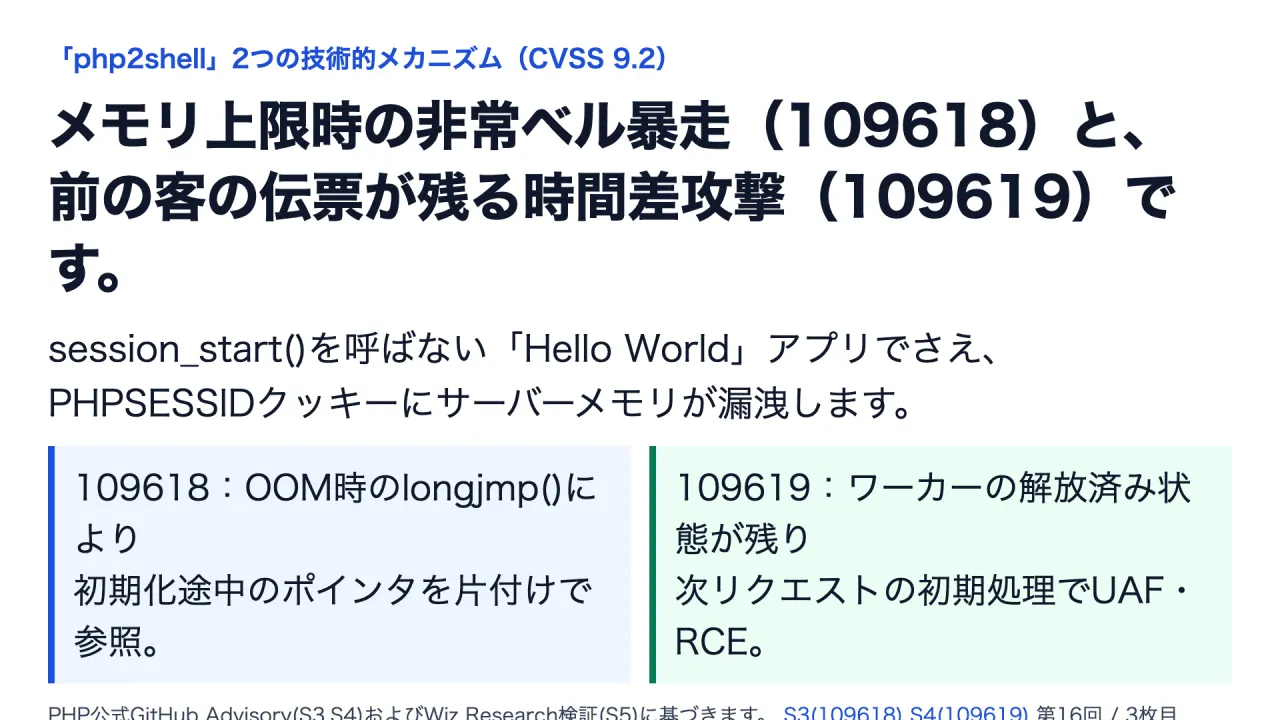
The first vulnerability, CVE-2026-109618, is designated as Remote Code Execution via Out-of-Memory (OOM) Heap Corruption.
Within PHP’s runtime architecture, each incoming HTTP request is bounded by a strict memory allocation ceiling, governed by the memory_limit directive (typically set to 128MB or 256MB). When an operation exhausts this ceiling, the Zend engine must immediately abort execution to prevent system-wide memory exhaustion. Historically, the engine accomplished this using the C standard library’s longjmp mechanism.
The operational hazard of longjmp is that it acts as an unconditional non-local jump: it instantly unwinds the call stack, bypassing normal cleanup sequences, and transfers control directly into php_request_shutdown().
To illustrate this failure mode, consider a restaurant kitchen. The operational rulebook dictates: “If the fire alarm sounds during dinner service, immediately drop all cooking utensils, exit the station, and execute the closing checklist located inside the manager’s binder on the front desk.” Under ordinary conditions, this protocol ensures safety. However, consider what occurs if an intruder deliberately triggers the fire alarm at 5:00 AM—before the kitchen staff has even unlocked the manager’s desk or placed the closing checklist upon it. The staff rushes to the empty desk, grabs whatever scrap of paper happens to be lying on the counter, and blindly executes whatever instructions are scrawled upon it.
This is precisely what occurs inside php-src. During early request parsing, before core internal structures—such as the input filter registry and file upload trackers—are fully initialized, an attacker forces an out-of-memory error. Because the shutdown routines assume that initialization has already concluded, php_request_shutdown() begins iterating over uninitialized pointers located in unmanaged memory.
The catalyst that made this exploitable was a ten-year-old flaw in PHP’s multipart form handling. Upstream developers had implemented max_file_uploads (defaulting to 20) to prevent denial-of-service attacks. However, if an incoming multipart request transmitted MIME parts with an empty filename attribute, PHP allocated internal tracking metadata without incrementing the max_file_uploads counter. By transmitting thousands of empty-filename parts, an attacker could artificially inflate memory consumption, trip memory_limit at the exact microsecond before request initialization finalized, and force the Zend engine into executing attacker-controlled heap addresses.
In the October 21, 2026 security release, upstream maintainers completely eliminated the legacy longjmp unwinding routine. The engine now utilizes a two-tier termination model: a soft cooperative exit that halts at safe virtual machine boundaries, paired with an immediate hard process termination if catastrophic heap corruption prevents deterministic cleanup.
CVE-2026-109619: Stale Global State and Cross-Request Worker Poisoning
The second vulnerability, CVE-2026-109619, is designated as Remote Code Execution via Stale Global State. This defect represents an even more dangerous vector because it compromises the worker pooling model that powers high-performance web architectures.
Modern PHP deployments do not spawn a fresh operating system process for each HTTP request; doing so would introduce prohibitive fork overhead. Instead, process managers—such as PHP-FPM, Apache mod_php, and modern runtimes like FrankenPHP—maintain persistent worker pools. A single worker thread or process sequentially processes hundreds or thousands of successive HTTP requests before being recycled.
Between requests, PHP executes cleanup routines intended to reset global execution context, flush output buffers, and zero out memory heaps. However, when an initial request (the Producer) encountered a fatal error during specific multipart parsing routines, the cleanup routines failed to clear dangling pointers stored in process-wide global structures.
When a subsequent request (the Consumer) arrived at the same persistent worker process, early initialization routines executed before the request-level sandbox was established. Among these early routines was session.upload_progress.enabled—a default PHP setting enabled across virtually all production distributions to track file upload percentages. When the consumer request arrived, the upload progress initialization routine blindly dereferenced the dangling global pointer left behind by the producer request.
This resulted in a classic Use-After-Free (UAF) condition. The worker process attempted to read and write data to a memory region that had already been deallocated and reallocated for other runtime data.
The Zero-Authentication “Heartbleed” Attack
The practical consequence of CVE-2026-109619 was demonstrated by Wiz Research in what the industry termed “Heartbleed for the PHP Ecosystem.”
Consider a minimal web deployment consisting of an isolated, static script containing zero application logic:
<?php echo "Hello World"; ?>
This application possesses no user authentication, no database connections, and no calls to session_start(). In traditional threat modeling, such a script is considered invulnerable to remote exploitation.
Under PHP2Shell, an attacker transmits two consecutive HTTP requests:
- The Seed Request (Producer): A malformed multipart request engineered to terminate abnormally, seeding the worker’s global memory with a dangling pointer pointing to active server heap buffers.
- The Harvest Request (Consumer): A secondary HTTP request containing file upload progress headers. Because
session.upload_progress.enabledis active by default, the PHP engine automatically initiates an internal session without application consent.
As the engine initializes the session data structures against the corrupted heap pointer, it serializes surrounding memory contents—including raw database credentials, environment variables, cloud API tokens, and private cryptographic keys—and injects them directly into the response’s PHPSESSID cookie.
By reading the returned session cookie, the attacker extracts memory state, calculates the base address of the glibc library and PHP binary, and submits a third request that achieves arbitrary remote code execution on the underlying host.
3. The Illusion of Configuration Workarounds and Flatt Security’s Findings
In the immediate aftermath of the midnight disclosure on October 21, 2026, engineering forums and social media channels were inundated with proposed configuration workarounds. The most prevalent recommendation suggested modifying php.ini to disable upload progress tracking:
session.upload_progress.enabled = 0
Superficially, this mitigation appeared appealing to exhausted operations teams. Modifying a configuration flag and reloading configuration files avoided the risks and downtime associated with recompiling binaries or deploying major runtime updates across massive server fleets.
However, both the upstream PHP development team and GMO Flatt Security’s technical audit definitively dismantled this assumption. As Flatt Security documented in their technical bulletin:
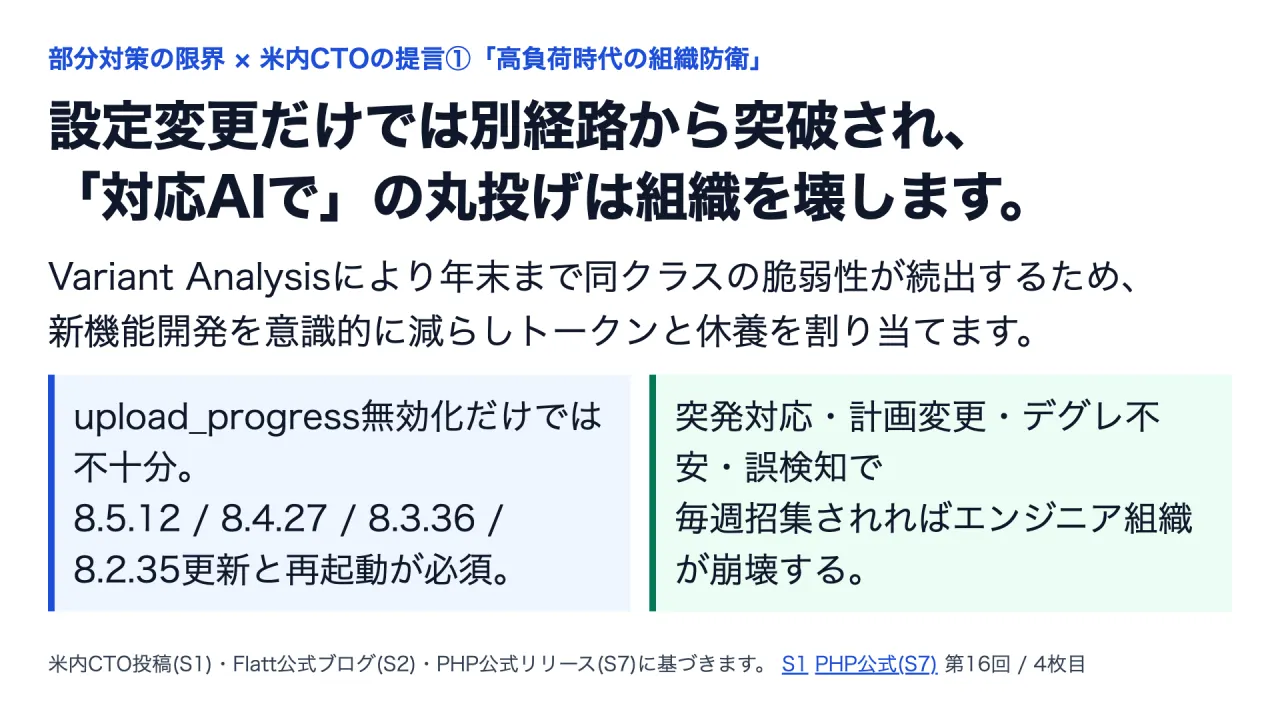
- CVE-2026-109618 operates completely independently of session management: Disabling upload progress tracking has zero protective effect against the out-of-memory longjmp corruption. Any endpoint accepting multipart data remains fully exploitable.
- Upload progress is merely one consumer trigger among many: Within CVE-2026-109619,
session.upload_progress.enabledrepresents the easiest trigger path for proof-of-concept exploits, but it is not the sole mechanism. Dangling global pointers can be dereferenced by internal warning handlers, backtrace generators, and Zend Opcache initialization sequences. Disabling one trigger simply leaves the door open for alternative exploit chains. - Web Application Firewall (WAF) filtering is merely temporary shielding: While commercial WAF rules blocking abnormal multipart structures or oversized header fields can impede rudimentary automated scanners, advanced attackers and AI agents rapidly permute payload encodings to bypass pattern-matching rules.
The only valid remediation is a two-step operational mandate:
- Full Runtime Binary Upgrade: Upgrading packages directly to PHP 8.5.12, 8.4.27, 8.3.36, or 8.2.35.
- Unconditional Worker Process Recycling: Simply updating on-disk
.soshared libraries or binary packages does not purge corrupted memory from persistent worker pools. Runtimes such asphp-fpm, Apache, and FrankenPHP must undergo a full process restart (systemctl restart php-fpm) to eliminate active workers carrying stale global state.
4. CTO Takashi Yoneuchi’s 4 Strategic Directives for Technical Leadership
On the morning of October 22, 2026, at 9:57 AM JST, following an all-night incident response mobilization, GMO Flatt Security CTO Takashi Yoneuchi published an essay addressing technical executives across the technology sector. Yoneuchi looked beyond the immediate tactical remediation of PHP2Shell, formulating four governance principles for the AI-augmented threat landscape.
Directive 1: “Handling It With AI” Is Technically Valid but Organizationally Destructive
In contemporary executive briefings, leadership often adopts a superficial heuristic: “If threat actors are using AI to discover vulnerabilities, we will simply deploy autonomous AI agents to patch our systems.”
Yoneuchi characterized this stance as technically plausible yet organizationally disastrous. Security incident response is fundamentally asymmetrical. Organizations cannot schedule emergency patching at convenient business hours; alerts arrive at midnight, on weekends, and during production deployment freezes.
Even with AI-assisted code analysis, human engineers must bear the ultimate accountability of verifying that an emergency runtime patch does not introduce catastrophic regressions into legacy business logic. Furthermore, the sheer volume of security advisories generated by automated scanners introduces severe alert fatigue, as teams waste hundreds of hours investigating false positives.
When executive leadership demands that engineering teams maintain normal product feature velocity while simultaneously managing constant nocturnal security mobilizations, organizational culture disintegrates. High-performing senior engineers resign, and morale collapses.
Yoneuchi argued that CTOs must make an explicit executive decision: actively reduce feature development velocity. Leadership must deliberately reclaim developer bandwidth, allocating dedicated time, corporate budget, and LLM inference token quotas toward system stabilization and mandatory post-incident recuperation.
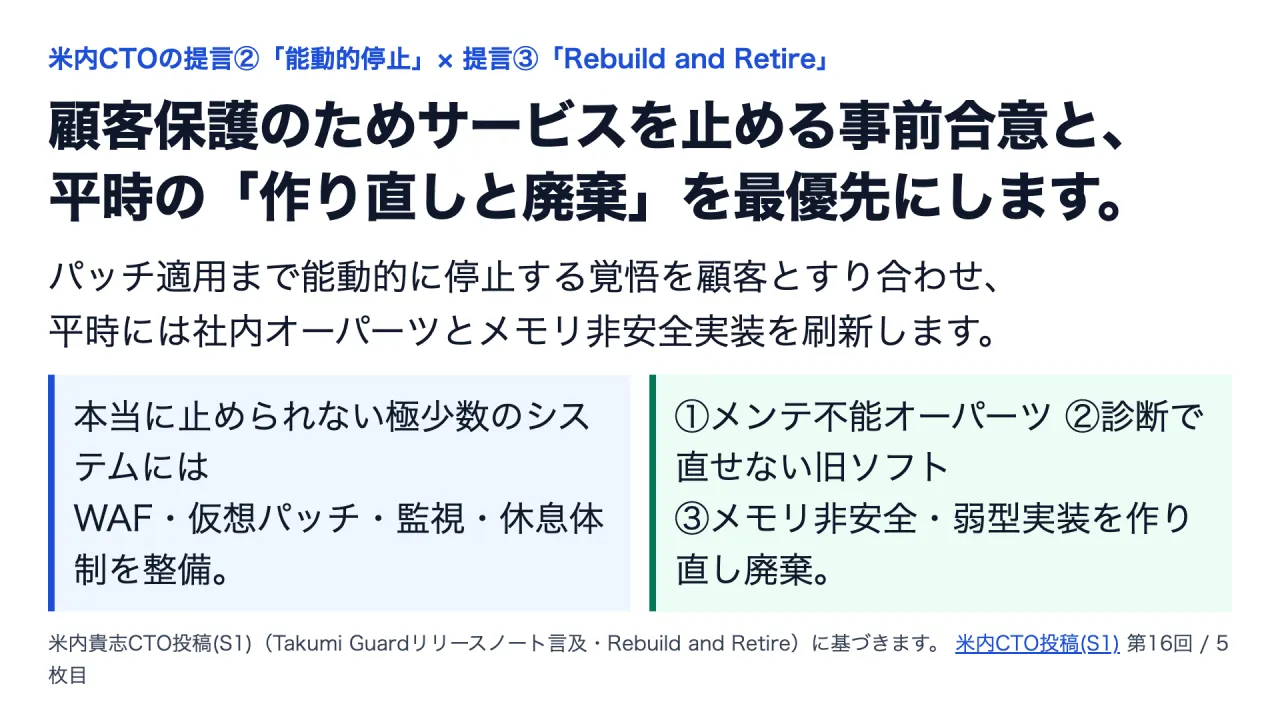
Directive 2: The Courage to Proactively Halt Services to Protect Customers
A pervasive dogma in enterprise software engineering is the absolute sanctity of “24/7/365 zero-downtime availability.” Operations teams often treat taking an application offline as an admission of failure.
Yoneuchi challenged this assumption directly: when confronted with a CVSS 9.2 remote code execution flaw in an active runtime, keeping a service online while testing patches exposes customer data to catastrophic compromise. True customer stewardship often requires taking systems offline proactively to apply remediation safely.
To validate this principle through operational practice, GMO Flatt Security explicitly established in the public release notes for their enterprise security product, Takumi Guard, that the company reserves the right to proactively halt services during extreme upstream emergencies to protect client assets from supply-chain contamination.
For mission-critical infrastructure where downtime is legally or physically impossible (e.g., healthcare life-support telemetry, core interbank settlement networks), leadership cannot rely on ad-hoc crisis heroics. Organizations operating zero-downtime systems must invest in peacetime redundant infrastructure: multi-layered WAF defense, kernel-level eBPF isolation, round-the-clock security operations rotations, and automated blue-green deployment pipelines that swap underlying host runtimes without interrupting transaction flows.
Directive 3: Elevating Peacetime “Rebuild-and-Retire”
When the acute panic of an emergency disclosure subsides, corporate inertia typically pulls engineering organizations straight back into shipping visual feature updates. Yoneuchi warned that unless companies utilize peacetime to systematically eliminate fragile infrastructure, the next vulnerability wave will inflict terminal damage.
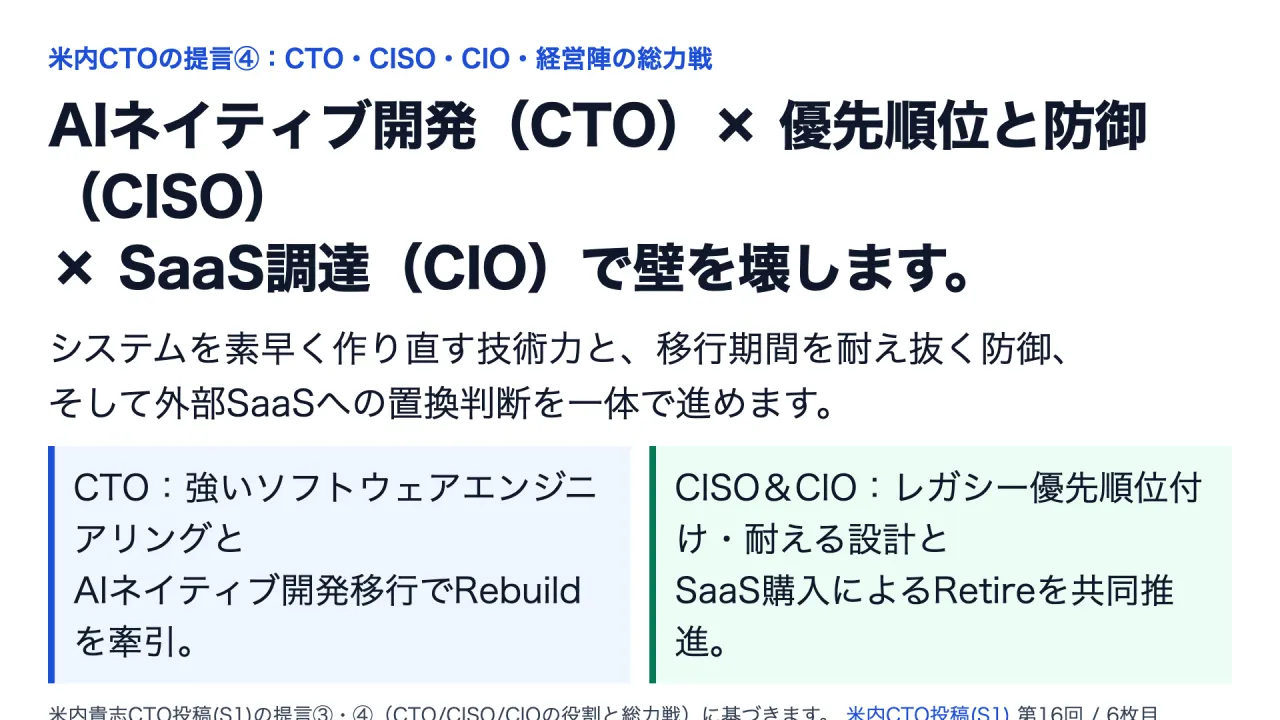
Yoneuchi outlined three explicit targets that must be modernized through Rebuild-and-Retire initiatives:
- Unmaintainable Internal OOPArts: Core business services whose original authors departed the company years ago, which lack automated tests and architectural documentation, and which operations teams fear even restarting.
- Pre-DevOps Legacy Architectures: Software built before modern continuous delivery, immutable containerization, and automated scanning existed—systems that yield hundreds of critical findings during penetration testing, where patching individual vulnerabilities is economically irrational compared to complete reimplementation.
- Memory-Unsafe and Weakly Typed Foundations: Codebases constructed in C, C++, or dynamically typed languages lacking compile-time memory boundaries. As Yoneuchi acknowledged, while developers possess immense sentimental affection for historical runtimes like
php-src, human cognitive limits cannot reliably verify memory safety across millions of lines of C.
Frontier AI has proven that any memory-unsafe C codebase exposed to the public internet will eventually be dismantled. AI-assisted engineering tools should not be deployed to churn out ephemeral marketing widgets; they must be directed toward rapidly porting fragile legacy systems into type-safe, memory-safe languages such as Rust, Go, or modern strictly typed frameworks.
Directive 4: Total Warfare Across the Executive Suite
Rebuilding or decommissioning legacy systems cannot be accomplished by an isolated engineering lead. It requires a unified front across three key executive roles:
- The Chief Technology Officer (CTO): Drives the modernization agenda, establishing AI-native software engineering practices to rebuild critical business systems at 5x to 10x historical velocity.
- The Chief Information Security Officer (CISO): Assesses enterprise threat exposure, prioritizes which legacy applications present the highest risk, and designs interim defensive perimeters while rebuilds are underway.
- The Chief Information Officer (CIO): Evaluates whether legacy bespoke software should even be rebuilt in-house, making aggressive procurement decisions to retire custom code in favor of enterprise SaaS solutions.
When these executives operate in functional silos—CTOs pursuing product velocity, CISOs enforcing compliance friction, and CIOs managing cost accounting—enterprise defense fails. The AI era requires continuous strategic alignment across the executive suite.
5. The Enterprise Defense & Modernization Playbook: 3 Actionable Systems
Synthesizing the primary technical evidence from PHP2Shell with the governance principles articulated by Flatt Security, organizations must implement three operational playbooks to protect their infrastructure.
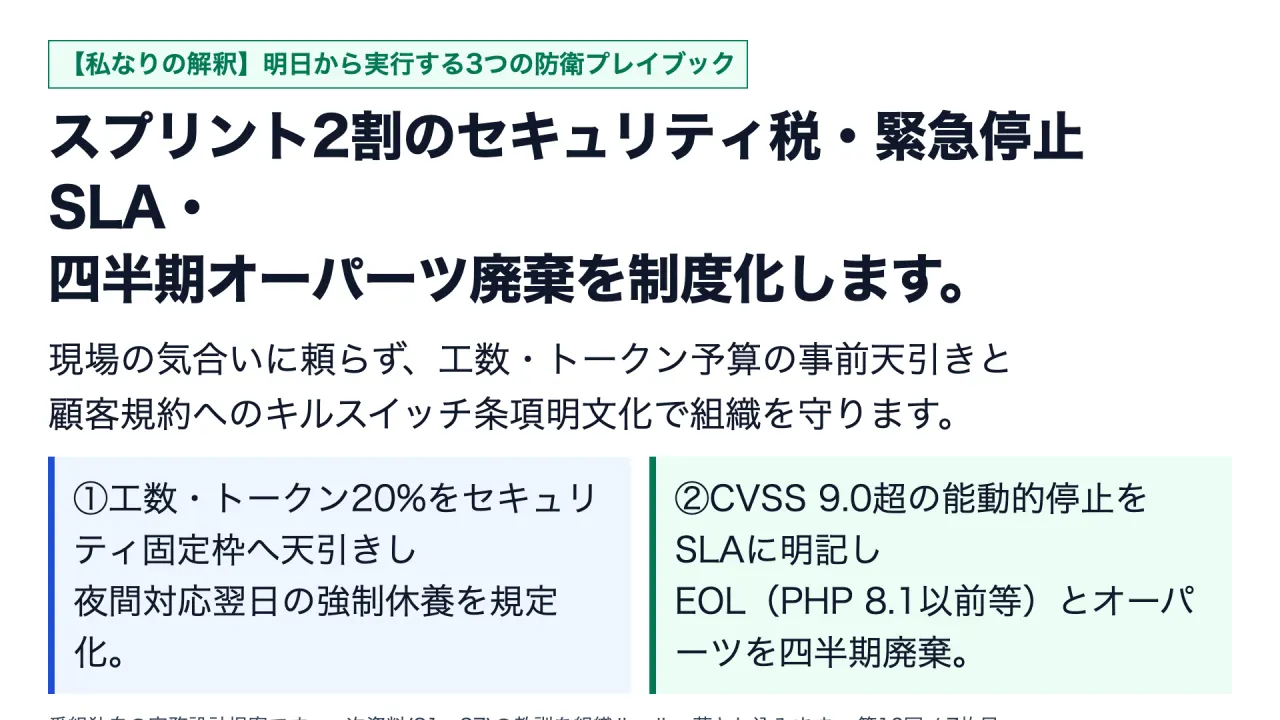
Playbook 1: The 20% Security Token Tax and Mandatory Recovery Protocols
Most enterprise engineering departments plan quarterly roadmaps under the assumption of 100% feature capacity. Consequently, any unscheduled vulnerability response instantly triggers overtime, weekend shifts, and developer burnout.
Technical leadership must institute a permanent 20% Security and Resilience Reserve across all engineering sprints:
- Capacity Allocation: 20% of engineering story points and 20% of corporate LLM token budgets are pre-allocated exclusively to dependency updates, compiler warnings, static analysis remediation, and automated regression testing.
- Mandatory Stand-Down Policy: Formalize human resources rules stating that any engineer participating in emergency off-hours triage is legally barred from participating in normal product sprints the following business day. Resting engineers after critical incidents protects both team health and production stability by preventing sleep-deprived operational errors.
Playbook 2: Contractual Emergency Protection SLAs and Automated Worker Recycling
Operational bottlenecks during critical disclosures frequently stem from business ambiguity: “Are we legally permitted to take down the customer portal for 45 minutes to patch the runtime?”
Organizations must resolve this ambiguity during peacetime:
- Contractual Kill-Switch Terms: Corporate counsel and sales leadership must update enterprise Service Level Agreements (SLAs) and Terms of Service. Contracts should explicitly state: “In the event of an upstream zero-day or platform runtime vulnerability assessed at CVSS 9.0 or higher, the provider reserves the authority to initiate immediate protective maintenance not exceeding four hours to preserve data confidentiality.”
- Automated Rolling Worker Recycling: Operations pipelines must be engineered to prevent stale memory persistence. CI/CD scripts must ensure that container deployments automatically cycle process pools. A simple script verification check ensures that whenever PHP packages update, underlying workers terminate cleanly:
# Production verification check for zero-downtime worker cycling
systemctl reload-or-restart php-fpm || systemctl restart php8.3-fpm
Playbook 3: The Quarterly OOPArts Decommissioning Registry
Organizations must eliminate obsolete runtimes before attackers exploit them.
Establish an executive-sponsored Quarterly OOPArts Decommissioning Registry:
- Runtime Inventory Audit: Catalog every deployed programming runtime across the organization. Flag every instance operating on unsupported or End-of-Life versions (such as PHP 5.x, PHP 7.x, and PHP 8.0/8.1, which received zero patches for PHP2Shell).
- Decommission-or-Rebuild Gating: For any system identified as an unmaintained OOPArt or EOL environment, management establishes a fixed six-month sunset deadline. The system must either be replaced by commercial SaaS or rapidly rewritten using AI coding workflows into memory-safe architectures.
Conclusion: The Strategic Imperative in the Era of AI-Accelerated Exploits
The PHP2Shell vulnerability series marks the end of an era in software security. For decades, the software industry relied on security through obscurity, banking on the assumption that complex memory bugs buried within millions of lines of legacy C code were too labor-intensive for attackers to weaponize at scale.
Frontier AI has permanently dismantled that defense. When automated reasoning agents can parse decades-old codebases, locate uninitialized shutdown routines, and weaponize zero-click RCE exploits within seven days, legacy C infrastructure exposed to the public internet becomes an untenable liability.
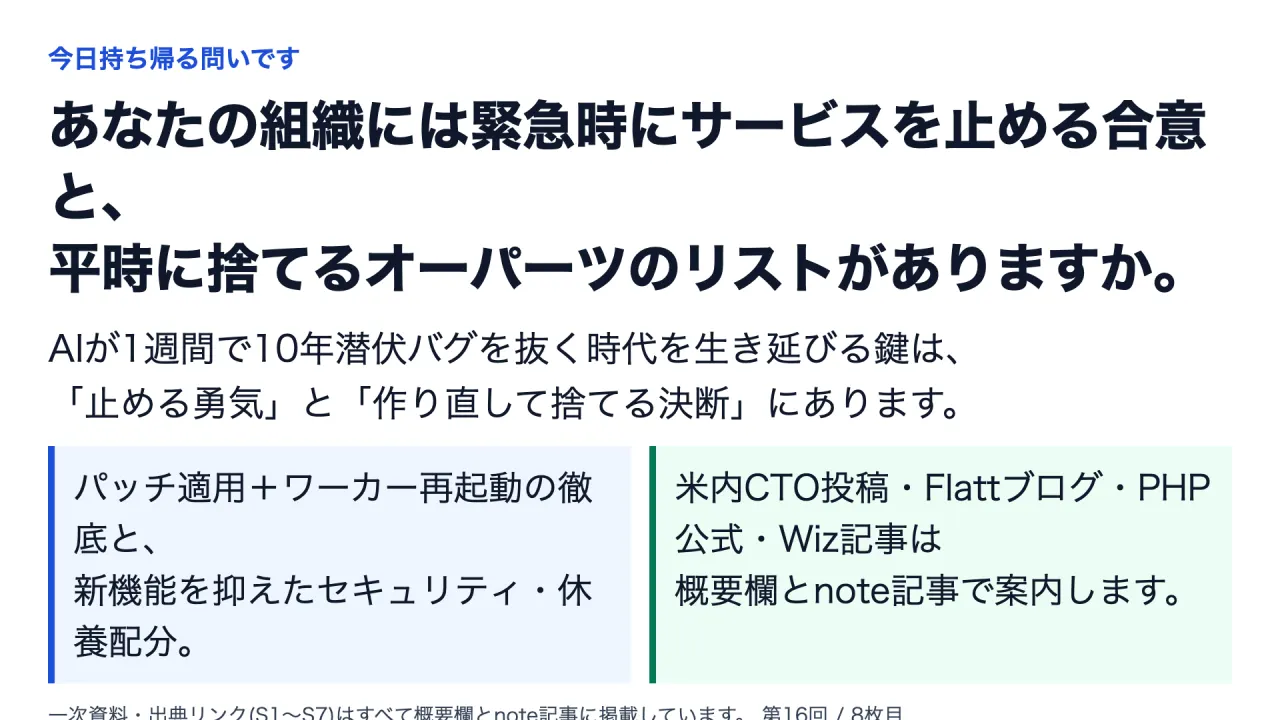
As technical leaders navigate this new reality, they must pose two fundamental questions to their executive boards:
- Does our organization possess the contractual clarity and operational courage to proactively take our services offline for two hours to protect our customers’ data when a critical platform vulnerability strikes?
- Where are our company’s unmaintained internal OOPArts currently running—and do we have an active, executive-backed plan to rebuild and retire them before frontier AI turns them against us?
The answers to those questions will determine which organizations survive the ongoing wave of AI-driven vulnerability weaponization, and which become footnotes in the history of enterprise cybersecurity.
Primary Sources & References
- Takashi Yoneuchi (Director & CTO, GMO Flatt Security / @lmt_swallow) on X: “Toward the Aftermath of the PHP Vulnerability Response” (October 22, 2026)
- GMO Flatt Security Technical Blog: Overview and Response Guidelines for Critical PHP Vulnerabilities “PHP2Shell” (CVE-2026-109618, CVE-2026-109619) (October 21, 2026)
- PHP Official GitHub Security Advisory: RCE via OOM Corruption (CVE-2026-109618 / GHSA-w8hw-w9fx-j79w)
- PHP Official GitHub Security Advisory: RCE via Stale Global State (CVE-2026-109619 / GHSA-6wmf-4rv5-p3rp)
- Wiz Research Technical Blog: PHP2Shell: AI Uncovers Critical RCE Vulnerabilities Affecting 70% of the Internet (October 21, 2026)
- PHP2Shell Official Advisory Portal (calif.io/php2shell/)
- PHP Official News Archive: PHP 8.5.12, 8.4.27, 8.3.36, 8.2.35 Released! (October 21, 2026)